PART 2
“Young man,” my mother said, in her Sunday school teacher voice. “I believe you’re standing on my porch.”
The families in the yard stopped talking.
Irwin tried to smile.
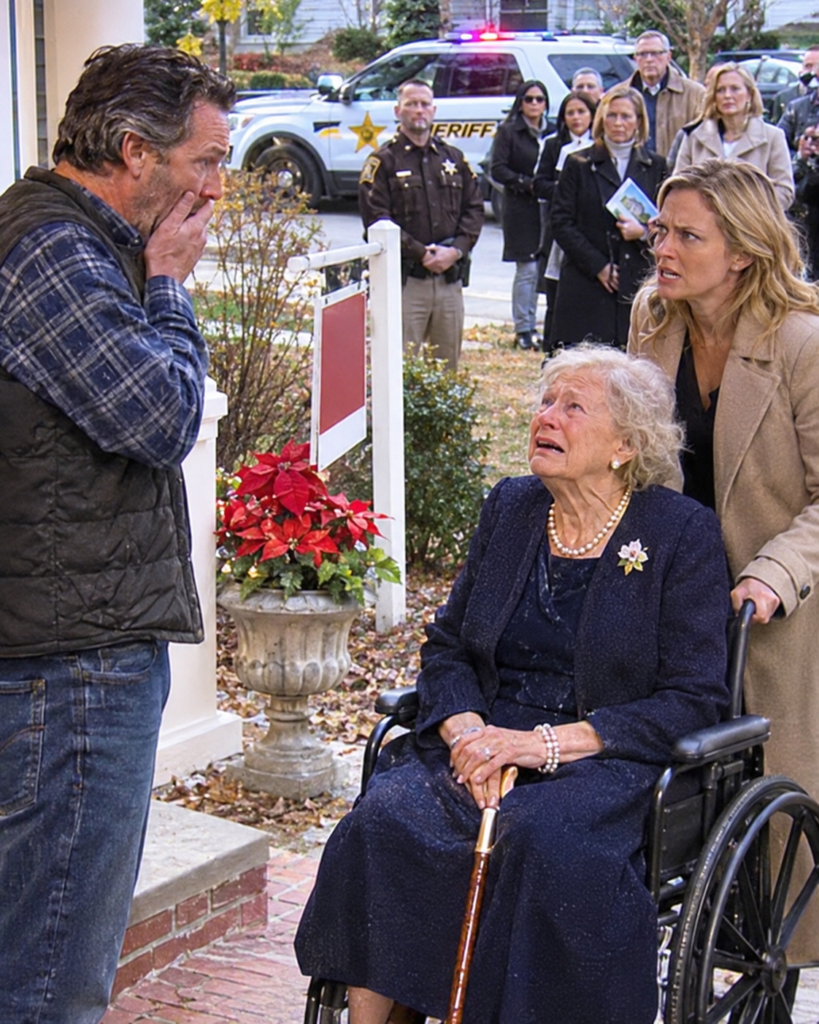
“Mrs.—ma’am, there’s been a misunderstanding. This is my property now. I have a deed.”
“I know,” my mother said. “I’ve seen it. It has my signature on it. Isn’t that funny? I don’t remember signing it. I was in a hospital bed with a new hip and a lot of morphine that day.”
A young couple holding a brochure looked at each other and backed away down the steps.
The deputy walked up behind us. A tall woman with a calm voice.
“Sir, are you Irwin?”
“Yes, but—”
“I’m Deputy Inez with the county sheriff’s office. We’ve received a fraud complaint about this property. I’d like to speak with you.”
The real estate agent came out of the house, holding a clipboard. She looked at my mother in her wheelchair. She looked at the deputy.
“Ma’am,” she said to my mother, “are you Goldie? The previous owner?”
“I’m the current owner,” my mother said. “I never sold it.”
The agent turned pale.
“I’m ending this open house,” she said to the crowd. “Right now. Everyone please leave.”
People walked back to their cars very quickly.
Irwin tried one more time.
“Deputy, she’s eighty-four. She’s confused. Look at her. She doesn’t know what she signed.”
My mother laughed. A real laugh.
“I know exactly what I signed, young man. My name is Goldie Mae, and I’ve signed it the same way for seventy years. With a little curl on the G.”
She took a pen out of her purse. She signed her name on the back of the open house brochure and handed it to the deputy.
“Compare that with his deed,” she said.
The deputy compared them.
On the forged deed, there was no curl.
The investigation moved fast. The notary who had stamped the fake deed was Irwin’s cousin. She admitted she had never met my mother. She’d notarized it at Irwin’s kitchen table.
Irwin was charged with forgery and real estate fraud. So was his cousin.
It took a judge eight weeks to cancel the forged deed and return the house to my mother’s name. My lawyer said that was fast. He said the fraud alert email, with its date and time, made the case easy.
“Most families don’t find out until the house is already sold,” he told me. “You saved her home.”
My mother moved back into her house in February. She walked up her own front steps with a cane. Slowly. Very proud.
The neighbors on her street threw her a welcome home party. Someone made a cake shaped like a house.
Irwin’s house went up for sale in March. Nobody on the street was sorry to see him go.
My mother still sits on my father’s porch every afternoon.
Last week, a young man in a nice car pulled up and asked if she’d ever thought about selling.
She smiled sweetly and pointed at a little sign she’d hung by the door.
“THIS HOUSE IS NOT FOR SALE. THE OLD LADY CAME BACK.”
He drove away.
THE END.
──────────────
Lesson: Elderly homeowners are targets for deed fraud. Sign up for your county’s property fraud alert. It’s usually free, and it might save someone’s home.
Would you have let your mother confront him herself? Tell us in the replies.