The document landed on the scoring table with a sharp slap that cut through the mechanical hum of the wind machines.
Rear Admiral James Crawford stopped smiling.
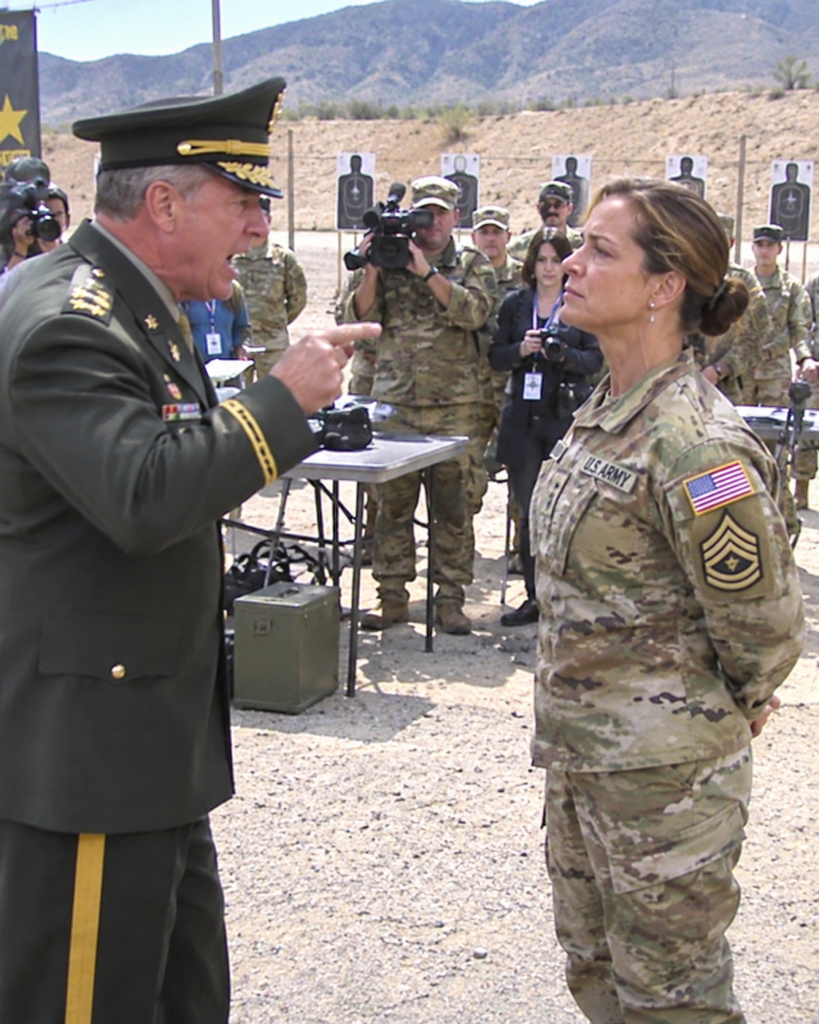
I noticed it immediately.
Not because I was watching him particularly closely, but because men like Crawford rarely allowed their expressions to betray them. His jaw tightened. His right hand moved toward the paper, then hesitated when he saw the red stripe running across its upper edge.
The young lieutenant who had delivered it stood perfectly still.
“Sir,” he said quietly, “this came directly from championship command.”
Crawford snatched the document.
I was standing twenty yards away, beside my battered rifle case, when I saw the color drain from his face.
He read the first line.
Then the second.
His eyes lifted toward Lane Twelve.
Toward me.
For the first time that morning, he looked uncertain.
“Who authorized this?” he demanded.
The lieutenant swallowed.
“General Marcus Whitfield, sir.”
The name moved through the nearby officers like an unexpected gust of wind.
General Marcus Whitfield was not scheduled to attend the Coronado Inter-Service Long Range Championship until the final awards ceremony. He was a four-star Army general, a decorated combat commander, and one of the few men in the military who could make an entire room of senior officers stand straighter simply by walking through the door.
I knew him differently.
I remembered him bleeding into the sand outside a village that no longer appeared on most maps.
I remembered his voice breaking over a radio.
And I remembered the last thing he had said to me before the helicopter carried him away.
You saved more than my life, Angel.
That had been eleven years ago.
I had hoped never to hear that name again.
Crawford folded the document so sharply that the paper nearly tore.
“This is an administrative matter,” he announced into the microphone. “All competitors remain in position. We will proceed with the second round.”
But the lieutenant did not move.
“Sir, the general requested an immediate acknowledgment.”
Crawford lowered the microphone.
“I said we will proceed.”
The lieutenant’s eyes flickered toward the paper.
“With respect, Admiral, the directive requires the competition board to preserve all scoring records and rule modifications made after 0800.”
Silence spread beneath the shade tent.
Marine Staff Sergeant Daniel Calloway, standing beside me, slowly turned his head.
“Well,” he murmured, “that’s interesting.”
I closed the latches on my rifle case.
“Not our business.”
He looked at me.
“Tara, the admiral has been trying to throw you out since breakfast.”
“Then he’s wasting his time.”
Calloway studied my face for a moment.
“You really don’t care what he thinks, do you?”
I glanced toward the scoreboard.
My name remained at the top.
WELLS, TARA — 50/50.
“I care about the next five shots.”
That was the truth.
Or most of it.
Because beneath the calmness I had learned to wear during twenty years in uniform, something ugly was moving through my stomach.
I had received a voicemail from Mama’s oncologist forty minutes earlier.
I had not listened to it.
The phone was still in my pocket.
And I was afraid.
Not of eight hundred yards.
Not of the wind.
Not of an admiral who thought a woman carrying an old rifle was beneath his attention.
I was afraid of hearing a doctor tell me that I had run out of time.
“Competitors!” Crawford shouted.
The microphone squealed.
“Prepare for Round Two.”
I bent down, opened my case again, and removed the rifle.
It was an old Remington-based precision rifle, rebuilt so many times that almost nothing remained untouched except the receiver and the memories attached to it.
The stock had a shallow scratch near the grip.
I knew exactly where it came from.
Afghanistan.
A concrete wall.
A seventeen-hour night when the temperature had dropped so quickly that I could barely feel my fingers.
My old spotter, Sergeant Luis Mendoza, had carved a tiny cross into the underside of the stock after that mission.
Not because he was particularly religious.
Because he said every rifle needed something worth praying over.
Luis had been dead for nine years.
I ran my thumb across the scratch.
Then I lowered myself onto the shooting mat.
Across the range, the wind machines began turning.
The competition officials had positioned them to create irregular crosswinds along the eight-hundred-yard course. The flags snapped in different directions, making the distance look like a corridor of conflicting weather.
Several competitors protested.
One Navy shooter raised his hand.
“Sir, the published rules don’t permit artificial wind changes after registration.”
Crawford ignored him.
Another competitor called out.
“Are the conditions identical for every lane?”
A scoring official checked his tablet without answering.
I watched a strip of red fabric flutter near the seven-hundred-yard marker.
The wind shifted.
Then shifted again.
Calloway lowered himself onto the mat in Lane Eleven.
He glanced sideways.
“You seeing this?”
“Yes.”
“That’s not a normal competition setup.”
“No.”
He gave a humorless laugh.
“You ever going to complain?”
I settled my cheek against the stock.
“When complaining makes the bullet fly straighter.”
The range officer raised his arm.
“Five rounds. Eight hundred yards. Ninety seconds.”
Crawford stepped toward the microphone.
“Let’s see how our miracle shooter handles a real challenge.”
His words drifted across the spectators.
A few people laughed nervously.
Most did not.
I could feel the television cameras turning toward me.
Somewhere behind them, a child asked his father why the admiral kept picking on the woman in Lane Twelve.
The father did not answer.
I breathed in.
Held.
Released.
The flag dropped.
The first shot cracked across the range.
Steel rang.
The second followed.
Another strike.
The third shot came as the crosswind shifted, and I waited just long enough for the movement to settle.
Steel.
The fourth hit the outer scoring ring.
Still a clean strike.
Then something happened.
The wind machine closest to Lane Twelve surged.
Its engine rose in pitch.
A blast of air swept dust across my shooting mat.
I felt grit touch my cheek.
Someone behind the safety barrier shouted.
The range officer turned.
For one brief moment, the entire lane disappeared inside a pale brown cloud.
I kept my finger outside the trigger guard.
Waited.
The dust moved past.
The target returned.
I fired.
The final steel plate rang.
“Cease fire!”
I engaged the safety and remained still.
The scoreboard refreshed.
WELLS, TARA — 100/100.
For three seconds, nobody spoke.
Then the spectators erupted.
Calloway rolled onto his side, stared at the display, and let out a long whistle.
“Lady,” he said, “what exactly did you do in the Army?”
I sat up slowly.
“Mostly paperwork.”
He laughed so hard he had to cover his face.
But Crawford was not laughing.
He was speaking urgently to two officers near the scoring station.
One of them shook his head.
The other pointed toward the wind machine.
Then the large screen above the range flickered.
A replay appeared.
Lane Twelve.
My final shot.
The sudden blast of dust.
The image slowed.
And something became visible that none of us had noticed in real time.
A technician standing beside the wind machine had reached toward its control panel immediately before the surge.
He had not been looking at the target.
He had been looking toward the admiral.
The crowd grew quiet.
The replay ran again.
Then a third time.
Crawford marched toward the production booth.
“Turn that off!”
The screen went black.
But it was too late.
Hundreds of people had seen it.
And so had the cameras broadcasting the championship.
Calloway stood.
“That’s deliberate interference.”
I began packing my rifle.
He caught my arm.
“Tara.”
I looked at his hand.
He released me immediately.
“Sorry,” he said. “But you can’t just ignore that.”
I closed the case.
“I didn’t miss.”
“That isn’t the point.”
I looked toward the black screen.
“Then somebody else can make the point.”
He stared at me.
“Why are you so determined not to fight back?”
I wanted to tell him.
I wanted to explain that once you had watched a man bleed to death while you held pressure against a wound, insults lost their power.
That once you had carried your best friend’s belongings home in a cardboard box, public humiliation became a small thing.
That once you had spent six weeks watching your mother pretend she wasn’t frightened of dying, almost everything else seemed unimportant.
Instead, I said, “Because I have somewhere more important to be.”
My phone vibrated.
I pulled it from my pocket.
MAMA.
For a moment, the range disappeared.
I answered.
“Hey, Mama.”
Her voice came softly through the speaker.
“Baby, are you busy?”
I turned away from the spectators.
“Never too busy for you.”
There was a pause.
I heard the familiar ticking of the kitchen clock behind her.
Then the scrape of a chair.
“Dr. Reynolds called.”
My fingers tightened around the phone.
“What did he say?”
“He wants us to come in Monday.”
“Okay.”
“He said we need to discuss the treatment schedule.”
I closed my eyes.
Mama tried to laugh.
“You know how doctors are. Always wanting to discuss something.”
But I heard what she was hiding.
Her breathing was uneven.
She had been crying.
“Mama.”
“Yes, sweetheart?”
“Did he say anything else?”
Another pause.
“He said we shouldn’t wait too long.”
The words landed harder than anything Crawford had said all morning.
I leaned against the side of the shade tent.
“Listen to me. We’re going to figure this out.”
“Tara, honey, I don’t want you spending everything you have on me.”
I looked at the scoreboard.
One hundred points.
First place.
Two more rounds.
Three hundred thousand dollars.
“Mama, you spent twenty years making sure I had everything I needed.”
“That was different.”
“No, ma’am.”
“Tara—”
“You taught me to drive in a truck with no power steering. You worked double shifts when Daddy got sick. You sat through every graduation and every deployment ceremony even when you were scared to death.”
Her breathing caught.
“You don’t get to tell me you’re not worth fighting for.”
For several seconds, neither of us spoke.
Then she whispered, “I just want more time with you.”
I pressed my fist against my mouth.
Behind me, an announcement echoed across the range.
“Competitors, report to the central staging area.”
I swallowed.
“You’re going to have it, Mama.”
I wanted those words to be a promise.
I needed them to be.
After we hung up, I stood beneath the tent for a long moment, staring at the phone.
Then I wiped my cheeks with the heel of my hand.
When I turned around, Calloway was standing several feet away.
He had heard enough to understand.
He did not ask questions.
He simply held out a bottle of water.
I took it.
“Thank you.”
He nodded toward the staging area.
“Come on. Looks like the admiral has another surprise.”
We walked together across the hot concrete.
The morning marine layer had burned away, leaving the California sky painfully blue. Heat shimmered above the distant targets. Television crews clustered near the main platform.
Crawford stood behind the microphone.
Beside him were three competition officials.
And two military police officers.
My stomach tightened.
The admiral waited until I approached.
Then he smiled.
It was not a pleasant smile.
“Master Sergeant Wells.”
I stopped.
“Admiral.”
“Your equipment has been selected for an unscheduled inspection.”
Calloway immediately stepped forward.
“Sir, under what rule?”
Crawford did not look at him.
“Return to your lane, Staff Sergeant.”
“With respect, sir, every competitor’s equipment was inspected before Round One.”
“Are you questioning my authority?”
Calloway’s jaw tightened.
“No, sir. I’m questioning the procedure.”
A murmur moved through the spectators.
Crawford leaned toward the microphone.
“Ladies and gentlemen, competitive integrity is our highest priority. We have received information suggesting that one participant may be using unauthorized modifications.”
He turned toward me.
“Master Sergeant Wells, surrender your rifle.”
I looked at the two military police officers.
Neither appeared comfortable.
“Is this a voluntary inspection?” I asked.
Crawford’s eyes narrowed.
“You will comply with championship regulations.”
“I have complied with every published regulation.”
“Then you have nothing to hide.”
The old phrase.
I had heard it in interrogation rooms.
At checkpoints.
During investigations where someone had already decided what the truth should be.
I placed the rifle case on the table.
“Document the transfer,” I said.
The younger military police officer blinked.
“Ma’am?”
“Write down the serial number, the time, the names of everyone taking custody, and the condition of the case.”
Crawford gave an impatient wave.
“Just take the rifle.”
I did not move.
“Document the transfer.”
The older officer looked at Crawford.
“Sir, she’s correct. We should establish a chain of custody.”
For the second time that morning, the admiral’s expression changed.
He leaned close enough that only I could hear him.
“You are making a serious mistake, sweetheart.”
I looked directly into his eyes.
“No, Admiral.”
My voice remained quiet.
“I’m making a record.”
The older officer lowered his gaze to hide the smallest movement at the corner of his mouth.
He began writing.
Crawford stepped away.
“Inspect everything.”
I watched them open the case.
The old rifle lay inside, its worn stock resting against the faded foam.
One of the inspectors lifted it carefully.
He examined the chamber, optic, barrel, and stock.
Another checked the competition registration.
Minutes passed.
The crowd grew restless.
Then the younger inspector stopped.
“Sir.”
Crawford turned.
“What?”
The inspector held up a small metal tag attached beneath the case lining.
“There’s an identification marking here.”
My blood went cold.
I had forgotten about that tag.
Not because it was unimportant.
Because I had spent years trying to forget everything connected to it.
The inspector read the engraved numbers.
Then his eyebrows drew together.
“Sir, this isn’t a civilian inventory marking.”
Crawford approached.
“Read it.”
The inspector hesitated.
“It’s an Army property designation. Historical.”
“Read the whole thing.”
The young man looked at me.
I gave him nothing.
He swallowed.
“Project Night Lantern.”
The words seemed to suck the air out of the staging area.
I heard Calloway whisper, “What?”
Crawford stared at the tag.
Then he laughed.
“Somebody has been watching too many war movies.”
He took the tag from the inspector.
“Project Night Lantern? What is this supposed to be, Master Sergeant? A souvenir?”
I kept my hands at my sides.
“It’s not part of the competition equipment.”
“Then explain it.”
“I can’t.”
His smile widened.
“Can’t? Or won’t?”
I looked at the older military police officer.
“I need to speak with the designated security officer.”
Crawford slammed the tag onto the table.
“You will answer me.”
“Not about that.”
He stepped toward the microphone.
“Ladies and gentlemen, it appears our mysterious competitor has been carrying equipment bearing questionable military identification. Until we establish its legitimacy, I am suspending Master Sergeant Wells from further participation.”
The crowd erupted.
Not with applause.
With protests.
Calloway shouted, “You can’t disqualify her over a case tag!”
Several competitors moved toward the table.
A camera operator pushed closer.
Crawford raised his voice.
“Security, escort her off the range.”
The two military police officers hesitated.
I looked down at the old case.
Then at the scoreboard.
First place.
One hundred points.
Two rounds remaining.
My mother’s voice echoed in my head.
I just want more time with you.
For the first time all day, my hands began to tremble.
Not visibly.
Just enough that I pressed them against my thighs.
I could walk away.
I could accept the humiliation.
I could let Crawford take the victory he wanted.
But walking away meant surrendering the one chance I had found to pay for Mama’s treatment.
I lifted my head.
“Admiral, I am requesting a formal appeal.”
He laughed into the microphone.
“On what grounds?”
“Improper disqualification. Unauthorized rule modifications. And interference with a competitor’s firing lane.”
The spectators fell silent.
Crawford’s smile vanished.
“You are accusing a flag officer of misconduct?”
I met his gaze.
“I am requesting that the evidence be preserved.”
His face reddened.
“You have no idea who you’re dealing with.”
I took one step closer.
“Neither do you.”
The words were barely above a whisper.
But the microphone caught them.
And the entire range heard.
Crawford opened his mouth.
Before he could speak, a voice came from behind the spectators.
“That’s enough, James.”
It was not shouted.
It did not need to be.
The crowd began turning.
A black government vehicle had stopped beside the command building.
Its rear door stood open.
Four soldiers in dress uniforms formed a line near the entrance.
And walking between them was a tall man with silver hair, a four-star insignia on his shoulder, and a slight stiffness in his left leg.
General Marcus Whitfield.
I felt my throat close.
Eleven years had passed since I had seen him.
He looked older.
The deep lines beside his mouth had sharpened.
His hair had turned almost completely white.
But I recognized the way he walked.
That left leg.
The one I had helped keep him from losing.
Crawford immediately straightened.
“General Whitfield. We weren’t expecting you until—”
“I know when you were expecting me.”
Whitfield continued walking.
The crowd parted.
He stopped beside the inspection table and looked at the old rifle case.
For several seconds, he said nothing.
Then he touched the faded corner where the duct tape had begun peeling away.
His expression changed.
I remembered him lying beneath a broken wall, blood soaking through the bandages while Luis called for extraction.
I remembered promising him that he would see his daughters again.
I remembered the terrible weight of that promise.
Whitfield slowly lifted his eyes.
They found mine.
“Tara?”
I could not speak.
He took a step toward me.
Then another.
His lips parted.
“My God.”
I swallowed.
“Good afternoon, sir.”
His face tightened.
He looked at the rifle.
At my worn boots.
At the faded shooting mat.
Then at the name displayed on the scoreboard.
WELLS, TARA.
He breathed out.
“I’ve been looking for you.”
Crawford cleared his throat.
“General, this competitor has been disqualified pending an investigation into—”
Whitfield raised one hand.
The admiral stopped.
The general’s eyes never left mine.
“Why didn’t you call me?”
I looked down.
“Didn’t think I had a reason, sir.”
He studied me.
Something passed across his face that I could not bear to look at.
“You always did think you had to carry everything alone.”
I stared at the concrete.
Behind him, the television cameras kept rolling.
Whitfield turned toward Crawford.
“James, why is this woman being removed from the competition?”
The admiral recovered enough to speak.
“Sir, there have been concerns regarding her equipment, her qualifications, and her conduct.”
Whitfield’s expression hardened.
“Her qualifications?”
“Yes, sir. She has no documented competitive history, and—”
“Stop.”
One word.
The admiral fell silent.
Whitfield looked toward the rifle case.
“Do you know who that belongs to?”
Crawford glanced at me.
“A retired master sergeant, sir.”
Whitfield nodded slowly.
“Yes.”
He stepped closer to the microphone.
“A retired master sergeant.”
Then he turned toward the spectators.
“Eleven years ago, I was part of an operation in eastern Afghanistan that nearly ended with the deaths of thirty-seven American service members and twenty-two civilians.”
The range became perfectly still.
I felt the blood draining from my face.
“General,” I said quietly.
He looked at me.
I shook my head.
“Please.”
For a moment, he hesitated.
Then his expression softened.
“I won’t disclose what remains protected, Tara.”
He turned back toward the crowd.
“But I can tell you this. During that operation, communications failed, our extraction route collapsed, and the enemy had us surrounded.”
A breeze moved across the flags.
Whitfield’s voice lowered.
“There was one soldier positioned above the valley who refused to leave us.”
My hands were shaking openly now.
I could see Luis beside me again.
His face streaked with dust.
His voice in my ear.
They’re moving toward the school, Angel.
Whitfield continued.
“That soldier kept a corridor open long enough for every surviving member of my team to reach extraction. She remained at her position after being ordered to withdraw.”
Crawford stood motionless.
The general looked directly at him.
“And when she finally came down from that ridge, she carried a wounded soldier on her back.”
My vision blurred.
Luis.
He had still been alive then.
Still breathing.
Still telling terrible jokes through clenched teeth.
Whitfield paused.
Then he said the words I had spent eleven years avoiding.
“Her call sign was Angel.”
A sound moved through the crowd.
Not quite a gasp.
Not quite a whisper.
Something deeper.
Calloway turned toward me.
His mouth opened.
Then closed.
Crawford stared at Whitfield.
“Angel?”
The general nodded.
“Yes, Admiral.”
He looked at me again.
“And if you had bothered to ask who she was before humiliating her, you might have discovered that the woman you’ve been mocking spent twenty years doing things most of us will never fully understand.”
I could not look at him.
I could not look at anyone.
I stared at the worn toes of my boots.
Whitfield approached slowly.
“Tara.”
I shook my head.
“Sir, I didn’t come here for this.”
“I know.”
“I just wanted to compete.”
“I know.”
My voice broke.
“I need the money.”
The words escaped before I could stop them.
The general’s expression changed.
He stepped closer.
“What money?”
I tried to answer.
Nothing came.
I thought of Mama sitting at the kitchen table.
Of the hospital bills arranged in neat piles.
Of the little yellow sticky notes she placed on the ones she thought I hadn’t seen.
I pressed my lips together.
Whitfield waited.
Finally, I whispered, “My mother’s sick.”
He closed his eyes briefly.
“How sick?”
“Pancreatic cancer.”
The words sounded strange in the open air.
Too private.
Too small for a place filled with uniforms and television cameras.
“The treatment costs more than we have,” I continued. “I saw the prize money. Thought maybe I could still shoot straight enough.”
The general looked toward the scoreboard.
One hundred points.
First place.
Then he looked back at me.
“You crossed the country for a shooting competition because you needed to save your mother?”
I nodded.
He drew a slow breath.
For several seconds, the only sound was the distant hum of a generator.
Then Crawford spoke.
“General, with respect, personal circumstances cannot override competition regulations.”
Whitfield turned.
His expression became cold.
“No, Admiral. They cannot.”
Crawford seemed relieved.
Until the general continued.
“And neither can your personal prejudices.”
The silence sharpened.
Whitfield motioned toward the lieutenant who had delivered the document.
“Bring me the rule amendments.”
The lieutenant stepped forward.
He handed over a folder.
Whitfield opened it.
I watched his eyes move down the page.
Then stop.
He turned another page.
And another.
“James.”
“Yes, sir?”
“Who authorized the distance change for Round Two?”
Crawford straightened.
“I did.”
“Under what authority?”
“As championship director.”
Whitfield looked at the folder.
“The championship director may approve safety modifications. Not competitive alterations designed to disadvantage a specific participant.”
Crawford’s jaw tightened.
“Sir, there was no such intention.”
Whitfield turned to the lieutenant.
“Show him the communications log.”
The young officer produced a tablet.
Crawford looked at the screen.
His face went pale.
I could not see what was written there.
But I saw the moment he understood.
The lieutenant spoke carefully.
“Sir, the range-control system recorded a manual override on the wind equipment serving Lane Twelve. The command originated from an administrative console assigned to the championship director’s office.”
A wave of whispers spread across the range.
Crawford shook his head.
“That proves nothing.”
Whitfield nodded.
“Correct. It establishes a fact requiring investigation.”
He looked toward the two military police officers.
“Preserve the equipment logs, camera footage, and access records. Nobody touches those systems without authorization from the investigating authority.”
Then he turned toward the scoring officials.
“Master Sergeant Wells’s disqualification is suspended pending an independent review. Her score remains recorded. The championship will pause until the competition board can certify fair conditions.”
Crawford stepped forward.
“General, this is my event.”
Whitfield looked at him.
“No, James.”
His voice was quiet.
“This event belongs to the competitors who earned the right to stand here.”
For the first time that morning, Crawford had no answer.
The general turned toward me.
“You deserve a fair chance to finish.”
I stared at him.
Then at the old rifle case.
Then at the scoreboard.
The crowd waited.
Calloway stood beside me, his face serious now.
Whitfield asked, “Tara, do you want to continue?”
I thought of Mama.
Of her trembling voice.
Of the kitchen clock ticking behind her.
Of the bills.
Of the hospital.
Of the little house outside Vidalia where she had taught me that quitting and resting were not the same thing.
I wiped my palms against my trousers.
“Yes, sir.”
My voice was steadier than I expected.
“I do.”
Whitfield nodded.
“Then we’ll make sure you get the chance.”
The general stepped away to speak with the competition officials.
Calloway approached me slowly.
For once, he had no joke ready.
He looked at the rifle case.
Then at me.
“Angel,” he said softly.
I shook my head.
“Tara is fine.”
He nodded.
“Okay.”
A pause.
Then he extended his hand.
“It’s an honor to shoot beside you, Tara.”
I looked at his hand.
And for the first time since arriving at Coronado, I smiled.
I shook it.
“The honor’s mine, Staff Sergeant.”
He grinned.
“Daniel.”
“Daniel.”
Above us, the scoreboard remained frozen.
The cameras were still recording.
The crowd had begun speaking in low, excited voices.
And Crawford stood alone beside the command platform, watching officers remove the tablet from his control station.
I should have felt victorious.
Instead, I felt exhausted.
Because I knew something the crowd did not.
I had not won the championship.
I had not earned a dollar.
My mother was still waiting in Georgia.
And the two hardest rounds were still ahead.
I bent down to lift my rifle case.
That was when General Whitfield returned.
He was carrying a thin gray folder.
His expression had changed.
The warmth was gone.
In its place was something I remembered from Afghanistan.
The look he wore when an operation had taken a turn none of us expected.
“Tara,” he said.
I straightened.
“Yes, sir?”
He glanced toward Crawford, then lowered his voice.
“There’s something you need to know.”
My stomach tightened.
“About the competition?”
He hesitated.
“About your retirement.”
I stared at him.
Three years earlier, I had left the Army believing that the sealed investigation into Project Night Lantern had been permanently closed.
I had signed documents.
Returned equipment.
Accepted a retirement ceremony I barely remembered.
And walked away from the only life I had known since I was twenty-one.
Whitfield opened the folder.
Inside was a single page bearing my name.
TARA E. WELLS.
Below it was a date.
Six weeks earlier.
The same week Mama had dropped the plate.
I looked at the general.
“What is this?”
He did not answer immediately.
Instead, he glanced toward the old rifle case.
Then toward the command building where Crawford was arguing with two officers.
“Someone accessed your sealed personnel record,” Whitfield said.
My mouth went dry.
“Who?”
He looked directly into my eyes.
“That’s what we’re investigating.”
I stared at the page.
The date.
The authorization stamp.
The unfamiliar signature.
Then I noticed something that made my breath stop.
Attached to the record-access request was a medical information inquiry.
Not mine.
My mother’s.
I looked up sharply.
“Why is Mama’s name in an Army file?”
Whitfield’s expression darkened.
“Tara, I need you to listen carefully.”
The wind moved through the shade tent.
Somewhere beyond the range, a helicopter passed overhead.
The general closed the folder.
“Your mother’s illness may not be the reason you were targeted today.”
I felt the ground shift beneath me.
He continued.
“It may be the reason someone knew you would come.”
And across the range, Rear Admiral James Crawford suddenly stopped arguing.
He was staring straight at us.
For the first time all day, he did not look arrogant.
He looked terrified.