My mother’s hand hit my cheek so hard the string quartet missed a note.
That’s the detail I keep coming back to. Not the pain. The pause. The cellist’s bow stuttering mid-phrase, one single wrong note hanging in the warm June air like a question nobody wanted to answer.
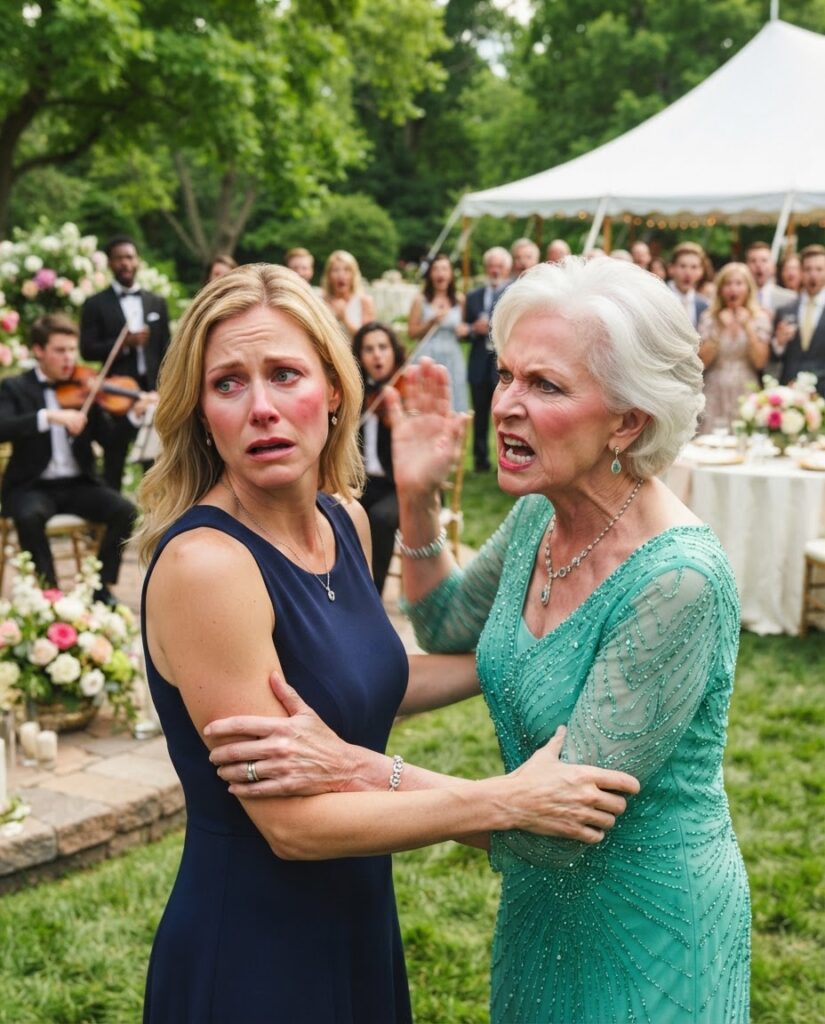
Then silence. The kind that has weight.
Sixty people stood across that manicured lawn. Champagne flutes frozen midair. Conversation dead.
Even the fountain, the marble one she’d had installed the year after my father died, the one that had to keep running because a dry fountain tells people everything, even that seemed to hold its breath.
My palm went to my cheek on instinct. I felt the heat before I felt anything else.
My mother stood three feet away in a $4,600 sea-glass designer dress. A dress I had paid for without her knowing, routed through a personal shopper she thought my father’s estate had retained.
She was shaking. Not with remorse. With fury.
Because 60 people were staring at her.
Because something had gone wrong at her perfect party.
Because I had, by existing in the wrong moment near the wrong person, made her look bad in front of the only audience she’d ever truly cared about.
“Get out,” she said.
Her voice dropped low, the way it always did when she meant it.
Then louder, sharp and clear across the lawn, so every single person with a champagne flute could hear.
“Get out of my house.”
I looked at her for exactly three seconds. I counted.
Then I put my hand down, straightened my shoulders, and walked past the fountain, past the lemon trees she had planted when I was nine, past the bartender who stared very hard at the glass he was polishing.
Past 60 people who looked away one by one as I reached them, like I was the embarrassing thing and not the woman in sea-glass silk who had just struck her adult daughter in front of a string quartet.
I did not run. I did not cry.
I got in my car, sat in the driver’s seat for 90 seconds with the engine off, and then I drove home.
And I started making phone calls.
Let me back up.
Because for this to land the way it needs to, you have to understand what seven years looks like when you’ve spent them holding someone else’s life together with your bare hands.
My father, Gerald Whitmore, died on a Thursday morning in October.
He went quietly. Cardiac event. No warning. Gone before the paramedics arrived.
I was 31 years old and in the middle of a conference call when my mother rang my cell.
I excused myself from the call, walked into a bathroom stall, and let my father be dead for about four minutes.
Then I dried my face, walked back into the conference room, and finished the meeting.
Because that is who I am.
That is who I have always been.
My father had been careful with money his whole life.
He was an engineer, a methodical, patient man who believed that security was something you built slowly and quietly.
He left a modest estate, a paid-off life insurance policy, retirement savings, a house with 11 years still on the mortgage.
What he did not leave was enough to sustain the life my mother believed she was entitled to.
Evelyn Whitmore had grown up with money, married money, and operated on the unspoken assumption that money was simply the natural atmosphere of her existence.
Like oxygen. Like gravity.
Something that was simply there.
She had never balanced a checkbook. Never opened a bank statement.
My father had managed everything.
And when he died, she looked at me the way a person looks at a life raft.
I was her only child.
I was a senior financial analyst at Langford Capital, a firm most people in our city recognized by the building.
I earned well. I had savings. I had no debt.
And I made a decision in those first horrible weeks after my father’s funeral that I have spent seven years quietly regretting and stubbornly refusing to undo.
I decided she would not lose anything.
Not the house. Not the club memberships. Not the marble fountain. Not the car. Not the staff.
Not the dinners and the dresses and the social architecture she had spent her whole adult life constructing.
She would not lose the life, because it would have broken her.
And she was my mother.
And my father would have wanted…
Well, it doesn’t matter what my father would have wanted.
What matters is what I did.
I opened three accounts.
I set up automatic transfers.
I called her mortgage company and set up direct debit from an account they would never connect to her name.
I handled the country club dues quarterly. Car lease monthly. Two credit cards I monitored but kept current.
A household account for staff. The housekeeper. The gardener. The marble fountain service and maintenance contract.
I told no one.
My mother never asked.
I think she genuinely believed, at some level, that the estate was handling things.
That Gerald had been more careful than anyone knew.
That his love for her had been structured into accounts she didn’t need to understand.
She was not stupid.
Evelyn Whitmore is one of the sharpest social strategists I have ever observed.
But she had never, not once in her 64 years, been required to understand money.
So she didn’t.
She spent it.
She thanked no one.
She kept the fountain running.
By the time of the garden party, seven years, three months, and 11 days after my father died, I had paid $812,000 of my own money to keep Evelyn Whitmore’s world exactly as she had always known it.
She had never said thank you because she did not know.
The garden party was for the Harrington Foundation Gala Planning Committee.
Thirty members plus spouses. A catered affair. Passed appetizers. An open bar. A string quartet.
And my mother had organized it because she had organized it every year for the last decade, and because being the woman who organized it was, in her mind, a professional credential more important than any degree.
I had been invited.
I came.
I wore something acceptable, and I stood near the fountain, and I smiled at the right people.
I don’t know what set her off.
I have tried to reconstruct the sequence, and I cannot.
I know I was speaking with Ava Mareno, the catering manager, a warm, efficient woman in her forties who ran a company called Mareno Events and who was, as far as I could tell, doing an impeccable job.
I know my mother appeared at my elbow.
I know she said, in the brittle voice she reserved for moments of social surveillance, “Having a conversation with the help?”
I turned to look at her.
I said something.
I don’t remember exactly what. Something reasonable. Something that would have landed differently on a different day with a different person.
Maybe I said that Ava was not help. She was the reason the party was running smoothly.
Maybe I said it slightly too evenly.
Maybe it was just that I said it in front of people.
And her hand moved.
Sixty people. The string quartet. The champagne. The fountain. The note they missed.
That Monday morning, I arrived at my office at 7:45 a.m.
I made coffee.
I opened my laptop.
I reviewed three reports.
At 9:03 a.m., I called Jonathan Hail, my private banker at Caldwell Trust.
Jonathan had managed my personal accounts for 11 years.
He is 47, methodical, deeply unflappable, and the only person outside of a forensic accountant who knew the full scope of what I had been doing.
“Jonathan,” I said, “I need to cancel everything.”
A pause.
“Everything meaning every account connected to Evelyn Whitmore. Mortgage, direct debit, country club, car lease, both credit cards, the household account.”
Another pause. Longer.
“Claire.”
He used my name carefully, the way he did when he was about to say something he’d already thought through.
“You want to process all of this today?”
“Today.”
“The mortgage payment cycles Friday. If we pull the direct debit now, they’ll miss this month’s payment.”
“Yes.”
I took a sip of coffee. It had gone slightly cold.
“That’s correct.”
He was quiet for three more seconds.
Then, “All of it?”
“Every account connected to Evelyn Whitmore.”
He processed the instructions while I was on the phone.
It took 11 minutes.
When it was done, he sent me a confirmation email at 9:22 a.m. with a summary of the 12 accounts that had been closed, modified, or flagged for termination.
Twelve.
I had not counted them before that moment.
Twelve separate financial lifelines running invisibly for seven years, and she had walked through them every single day without looking down.
By Friday, the car was gone.
She left me a voicemail.
Her voice was doing something I had only heard it do twice before. A controlled shake, like she was holding something very heavy at arm’s length.
“They came and took it, Claire. They just… they came. They took it from the driveway.”
A breath.
“The neighbors saw.”
I listened to it once.
Then I got dressed and went to work.
Her lawyer showed up on a Tuesday, 10 in the morning, unannounced, which told me everything about how rattled she actually was.
Because Evelyn Whitmore would have preferred to die than appear unplanned.
His name was Arnold Price.
Sixty-two. Silver-haired. Navy suit with a pocket square that matched nothing accidentally.
He’d been practicing estate law in this city for 30 years, and he carried himself like someone who had won enough quiet battles to stop announcing them.
He had a leather folder.
He set it on my conference table without opening it.
“Your mother,” he said, “believes there may have been irregularities in the management of your late father’s estate.”
I looked at him.
“She believes,” he continued, with the very deliberate pacing of a man choosing words the way a surgeon chooses instruments, “that funds which should have been administered through the estate were redirected.”
“Redirected,” I repeated.
“Withheld from her as surviving spouse.”
“Mr. Price,” I said.
I said his name quietly.
“My father’s estate was settled in full 14 months after his death. My mother received everything she was legally entitled to under the terms of his will and the applicable state statutes. I have copies of every document signed and filed, if you’d like to review them.”
His expression didn’t change.
“There is a question of ongoing funds.”
“Yes.”
I reached under the conference table and lifted a binder onto the surface.
Black cover. Two-inch spine. Tabbed sections, each labeled with a year.
“There is.”
I slid it across the table.
He opened it.
The first section was 2017.
Monthly statements. Line-itemized transfers. Mortgage payment. Country club dues. Car lease debit. Credit card settlements. Service contracts.
He turned a page.
He turned another.
I watched his eyes move across the columns.
He had been doing this for 30 years, and men like him don’t perform surprise.
They are trained out of it the way surgeons are trained out of flinching.
But something shifted in the architecture of his posture.
Subtle. A quarter inch of adjustment in the shoulders.
He went back two pages, then forward again, then back.
“These payments,” he said.
And his voice was slower now. The way speech goes when the brain is working hard behind it.
“All from your personal accounts?”
“Yes.”
“She had no legal claim to these funds?”
“None.”
“Was there any written agreement between you and your mother? Any promissory note, loan arrangement, gift documentation?”
“No.”
He looked at the binder.
He closed it halfway.
He opened it again.
The gesture of a man hoping the numbers might rearrange themselves into something more useful for his client.
They did not rearrange.
He closed it fully, set his hands flat on the cover.
“I see,” he said.
The room was quiet, except for the ventilation system and the faint sound of someone’s assistant typing in the hallway.
“Mr. Price,” I said, “my mother screamed at me to leave her house in front of 60 witnesses on Saturday afternoon. The house whose mortgage I have been paying for seven years.”
“I would like you to take that binder back to her and explain to her carefully what the word ‘beneficiary’ means versus the phrase ‘my daughter was paying for this.’”
He picked up the binder.
He slid it into his leather folder.
He snapped it shut.
He slid his card across the table, cream stock, engraved, and stood.
“I’ll be in touch,” he said.
“I know,” I said.
Quick pause.
If you want more stories like this in better quality, my Spotify is linked in the description.
I was still sitting at that conference table, eating a sandwich I’d ordered and hadn’t touched for an hour, when my cell rang.
Unknown number.
I almost let it go to voicemail.
Something made me answer.
“Is this Claire Whitmore?”
A woman’s voice. Warm, slightly cautious.
“Yes, this is.”
“Ava Mareno from Saturday. I wanted… First, I wanted to say I’m sorry for what happened. No one should be treated that way.”
She paused, and I could hear her measuring what came next.
“And I also thought you should know your mother has refused to pay our invoice.”
My sandwich sat on the table untouched.
“She says our staff caused a disturbance,” Ava continued. “That the incident was, her word, provoked by our team’s placement near the family during the event.”
I set down the pen I’d been holding.
“Ms. Whitmore,” Ava said carefully, “we had a setup camera positioned near the fountain. It’s part of our standard walkthrough. We use it to document layout for post-event review. It wasn’t intended to capture anything personal.”
I already knew what was coming.
I felt it settle in my chest like a stone dropping through cold water.
“It captured everything,” she said.
I looked up.
Arnold Price had not yet left the building.
I could see him through the glass wall of the conference room, speaking with my assistant, collecting his coat.
“Miss Mareno,” I said, “can you send that footage to me?”
“I… Yes. I wanted to ask first.”
“Send it to me.”
I was already on my feet, moving toward the door.
“And I need you to send a copy to a second address. His name is Arnold Price. He’s an attorney.”
I pushed the door open.
“Mr. Price.”
He turned.
His coat was half on.
His expression was the professional neutral of a man who has seen many strange things and classifies them all.
“I need your email address,” I said. “You’re about to receive something you should see before you advise your client any further.”
He looked at me for a long moment.
Then he reached back into the leather folder and produced a second card.
This one with a handwritten email on the back.
He held it out.
I took it.
I read the address aloud to Ava, still on the line.
“Are you sure?” she said.
“Send it,” I said. “To both of us tonight.”
The file arrived at 6:47 p.m.
Video. MP4. High angle.
The timestamp from Mareno Events setup documentation in the bottom right corner.
I sat at my kitchen table with my laptop and a glass of water I didn’t drink.
And I pressed play.
No audio for the first few seconds.
Just the lawn, the fountain, the pristine white tents, the guests in summer dresses and linen blazers arranging themselves across the green.
The fountain caught the afternoon light and broke it into small pieces.
My mother moved through the frame in her sea-glass dress, working the crowd the way she always worked a crowd.
Gracious. Deliberate. Controlled.
Then the audio synced.
Her voice was clearer than I expected. Sharper.
The camera was positioned closer to the fountain than I’d realized, and she had been standing directly in its sightline.
“Having a conversation with the help?”
I watched myself turn.
I watched my own face. Expression open. Not angry. Genuinely just surprised.
I watched myself say something on camera.
It was brief. Three or four seconds.
Then her hand moved.
The slap sounded different on video.
Smaller, somehow sharper.
The way something sounds when the surrounding space removes all the softness.
No ambient noise to absorb it.
Just the crack of her palm against my cheek, and then, briefly, the cellist’s bow stuttering.
I watched 60 people stop moving.
I watched myself press my palm to my face.
I watched my mother’s expression.
And this is the thing I had not seen in the moment because I was standing too close.
I watched her face in the half second after.
There was no horror.
No immediate contraction of the features that signals a person who has surprised themselves.
There was something else.
A tightening.
The face of someone recalibrating because a result had not landed the way they expected.
She had hit me because she expected me to crumple, and I hadn’t.
And that made it worse.
Then I watched myself walk past the fountain, past the trees, past the bartender, past 60 people who looked away as I reached them.
I had thought, in those first days after Saturday, that I had looked weak in that footage.
Diminished.
A woman who had been struck and simply left.
But watching it back in my kitchen, alone with my water glass and my untouched laptop and seven years of financial records in a binder I had built page by page, I saw something different.
I didn’t look weak.
I looked done.
There is a difference.
Most people have never been done enough to know what it looks like.
It looks quiet.
It looks straight-backed.
It looks exactly like someone who has already made every decision that needs to be made and is now simply implementing them.
I watched myself walk out of frame.
Then I closed the laptop.
Arnold Price sent his email the following morning at 8:14 a.m.
No letterhead.
No formal salutation.
Just his personal email account and two paragraphs.
“Ms. Whitmore, having reviewed the documentation provided at our meeting in conjunction with the video documentation received last evening, I must advise you that there is no legal basis for continued claims against your accounts, assets, or estate decisions. I have communicated this to my client.”
“I have also advised Mrs. Whitmore to resolve all outstanding vendor invoices at her earliest opportunity.”
Beneath that, in a different font, scanned, not typed, a single handwritten line.
“I am sorry for your time.”
I read it twice.
Then I forwarded it.
The mortgage company. The country club membership office. The car dealership.
Every institution that had called me over the years, not often, but occasionally, when a payment had been close to the wire.
Every number I had called at least once in seven years on her behalf.
They deserved to see it.
They deserved to know who had actually been in the room.
Three weeks later, I received a call from a journalist named David Cho at the city’s local business paper.
He was writing a piece on a pattern of billing disputes at high-end catering companies.
Vendors being stiffed by event hosts who blamed staff for disruptions to avoid paying invoices.
Ava Mareno had spoken to him.
He had the video.
He asked me if I wanted to comment.
I thought about it for a while.
“Yes,” I said. “One thing.”
“What’s that?”
“The house where the party was held. Print the address.”
He paused.
“Why?”
“Because she bought it from my father’s estate, and I paid the mortgage for seven years, and the city’s property records are public.”
I let that sit.
“People in that neighborhood know that house. They know her. I think they’d find the context interesting.”
David Cho published the piece 11 days later.
It ran with one photograph, a still from Ava’s setup footage cropped to show only the aftermath.
Sixty guests motionless.
Champagne flute suspended.
And my mother’s face in that half second after the slap, wearing an expression the caption described as apparent anger.
The country club received 17 complaints about her membership.
In the following week, she was asked, in the careful diplomatic language these institutions reserve for requests they cannot legally demand, to take a leave of absence from the Gala Planning Committee voluntarily, to allow the situation to settle.
She did not call me.
I did not call her.
The fountain at the house on Alderton Lane stopped running two months after the party.
The service contract had been in my name.
When I canceled it, maintenance stopped.
I don’t know how long it sat dry before she noticed.
I don’t know who she called.
I don’t know if she stood in front of it and understood, in some part of herself she’d never had to access before, exactly what a dry fountain tells people.
I didn’t ask.
I want to be careful here because I know how this kind of story is supposed to end.
The villain loses everything.
The protagonist rises.
Some piece of poetic symmetry closes the loop, and you go to bed satisfied.
Here is what actually happened.
My mother is 64 years old.
She is selling the house on Alderton Lane.
It was listed six weeks ago, and I have not seen the listing because I have not looked for it.
But two people who know us both have mentioned it to me in the careful way that people mention things they think you might not know.
She has, according to the same careful mentions, moved into a smaller property closer to her sister.
She has not been at the last three events where we might have encountered each other.
I do not know if this is deliberate.
I have had six sessions with a therapist named Dr. Patricia Luvel, who has a practice on the fourth floor of a building I pass on my commute.
She is 60, direct, and does not use the word “closure.”
She uses words like “reorientation” and “grief that skipped a step.”
She suggested in our fourth session that I may have been paying my mother’s bills not only out of love or loyalty, or even a desire to honor my father’s memory, but out of a learned belief that if I kept everything standing, if I held up every wall, if nothing ever fell, then I would be safe.
I did not argue with her.
I’m not sure she’s wrong.
What I know is this.
I paid $812,000 over seven years to maintain a life that was not mine.
For a woman who hit me in front of 60 people and told me to leave.
I did not do it for gratitude.
I did not do it for acknowledgment.
I did not do it consciously for leverage.
But when she swung her hand, and that cellist missed a note, when 60 people froze and the champagne stopped and the fountain kept running because the only reason it ever kept running was me, something shifted that I could not have shifted on purpose.
Something went done.
I called Jonathan Hail that Monday and canceled 12 accounts.
And it felt like setting down something very heavy that I had been so accustomed to carrying I’d stopped noticing the weight.
I notice it now.
My shoulders are different.
That probably sounds absurd, but it’s the most accurate thing I can tell you.
I carry myself differently than I did seven years ago, or even eight months ago.
I walk into rooms, and I do not immediately calculate what I might be required to hold up.
The fountain is dry.
A dry fountain tells people everything.
It told them this:
That nothing is permanent that was only ever sustained by one person’s silence.
That the performance of a life is not the same thing as a life.
That the woman in the sea-glass dress never had what she thought she had, because what she had was a daughter who had quietly decided to give it to her.
And that daughter, one warm June afternoon, quietly decided to stop.
I did not need to destroy her.
I just needed to put the binder on the table.
The truth did the rest.