PART 1 — THE WOMAN THEY UNDERESTIMATED
“Pack your bags.”
“You’re leaving today.”
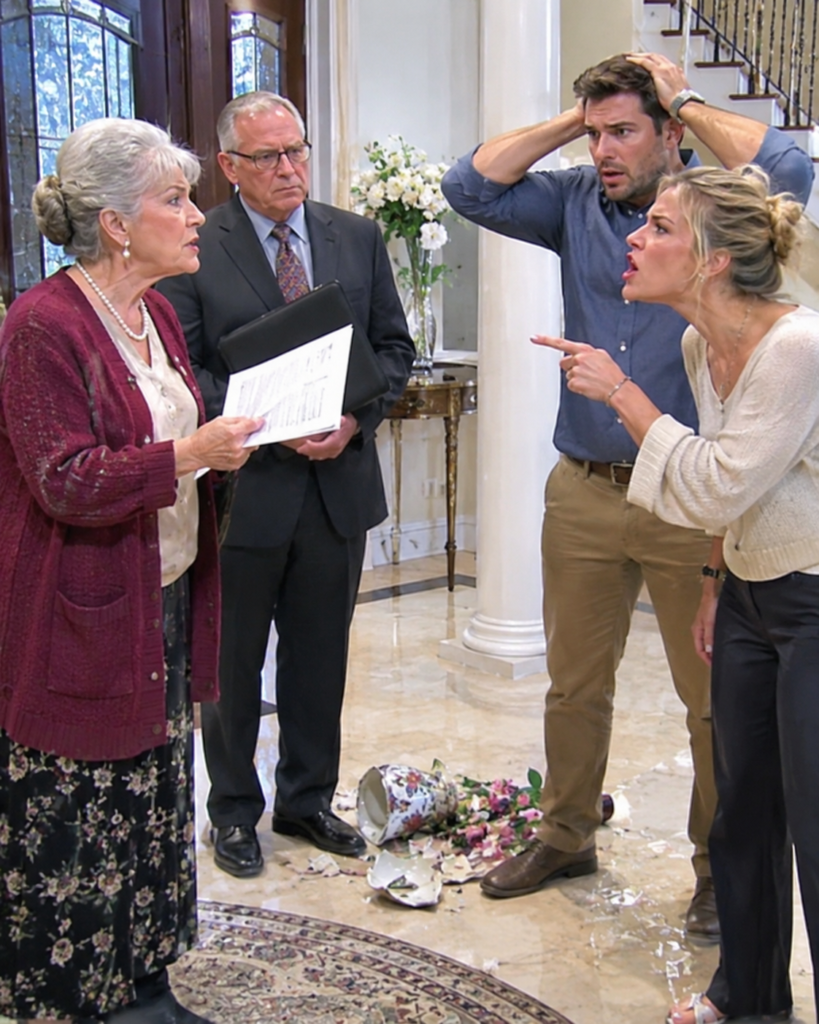
Those were the first words I spoke when I walked through my front door that Friday morning.
My son, David, stood frozen beside the kitchen doorway.
His wife, Sarah, held a paint roller in her trembling hand.
A thick drop of dark gray paint fell onto my polished hardwood floor.
Neither of them moved.
Neither of them smiled.
And neither of them seemed particularly happy to see me.
Which was interesting.
Because just five days earlier, David had hugged me outside Oak Hollow Assisted Living and promised he would visit.
He had told me it was for my own good.
He had told me I needed rest.
He had told me that living alone in such a large house was becoming dangerous.
Now, standing in the home my late husband and I had spent thirty-two years building, I watched my son’s expression change from surprise to something much uglier.
Fear.
Not fear for my health.
Not fear that something terrible had happened to me.
Fear that his carefully arranged future was falling apart.
Sarah recovered first.
“Julia?”
Her voice came out thin and sharp.
“What are you doing here?”
I looked around the living room.
My cream-colored walls were half-covered in charcoal paint.
The antique grandfather clock my husband had restored was missing.
My favorite armchair was gone.
And above the fireplace, where our wedding photograph had hung for decades, someone had installed a television large enough to belong in a sports bar.
I turned back toward her.
“I live here.”
Sarah blinked.
Then she looked at David.
That single glance told me everything.
They had discussed this possibility.
They had simply decided it would never happen.
Behind me stood Arthur Bennett, my oldest friend and a retired estate-planning attorney.
He wore a charcoal suit and carried a leather briefcase.
He had agreed to accompany me because I wanted witnesses.
I wanted documents.
And most importantly, I wanted my son to understand that the days of treating me like a confused old woman were over.
David finally found his voice.
“Mom, you weren’t supposed to come home until Sunday.”
I smiled.
“That’s funny.”
“Because I wasn’t supposed to lose my bedroom either.”
His eyes shifted toward the hallway.
Sarah set the paint roller down.
“Julia, I think you’re misunderstanding the situation.”
“No.”
I opened my leather folder.
“I understand it perfectly.”
I removed the original deed to the house and placed it on the entryway table.
“My name is Julia Margaret Gardner.”
“I am sixty-five years old.”
“I am mentally competent, physically healthy, and the sole legal owner of this property.”
I looked directly at Sarah.
“And I have never given either of you permission to take possession of my home.”
David swallowed.
“Mom, we can talk about this.”
“We are talking.”
Arthur stepped forward.
“David, Sarah, before this conversation continues, I suggest you listen carefully.”
Sarah folded her arms.
“Are you threatening us?”
Arthur remained calm.
“No.”
“I’m advising you that your assumptions about Mrs. Gardner’s property rights are incorrect.”
I almost smiled at the expression on her face.
Sarah had always been comfortable giving orders.
She was considerably less comfortable receiving information she couldn’t control.
I turned toward David.
“You asked to stay here for six months.”
“You said you needed time to recover financially.”
“You promised to respect my home.”
“And within two weeks, you began planning how to remove me from it.”
David opened his mouth.
I raised one hand.
“Don’t interrupt.”
For the first time in years, he obeyed.
“You convinced me to try a nursing home.”
“You moved into my bedroom before the trial was finished.”
“You threw out my furniture.”
“And you started redecorating a house that doesn’t belong to you.”
I paused.
“Now I’m giving you a choice.”
“You can cooperate with a lawful move-out arrangement.”
“Or you can make this much more expensive and humiliating for yourselves.”
Sarah laughed.
It was a short, disbelieving sound.
“You can’t just throw us out.”
I nodded.
“That’s exactly why Arthur is here.”
Her smile disappeared.
Arthur opened his briefcase.
“We’ve prepared a written voluntary surrender agreement,” he explained.
“It provides a documented move-out date, arrangements for collecting personal belongings, and confirmation that Mrs. Gardner is not surrendering any ownership rights.”
Sarah stared at the papers.
“And if we don’t sign?”
“Then Julia will pursue the formal legal remedies available to her.”
He closed the folder.
“Which may include a court proceeding.”
David rubbed his forehead.
“Mom, why are you doing this?”
That question hurt more than I expected.
Because he genuinely seemed to believe that I was the one who had betrayed him.
I looked at the boy I had raised.
The boy whose scraped knees I had cleaned.
The boy whose college tuition I had helped pay.
The boy whose wedding I had financed after his father died.
And I said something I should have said years earlier.
“Because being your mother does not mean I have to let you destroy me.”
For a moment, the room went completely silent.
Then Sarah said something that changed everything.
“You should be careful, Julia.”
Her voice was low.
“David knows things about your finances that you might not want other people finding out.”
Arthur turned his head.
David went pale.
And I realized that the fight over my house was only the beginning.
PART 2 — THE SECRET BEHIND THE SMILE
I had expected anger.
I had expected excuses.
I had even expected tears.
But I had not expected a threat involving my finances.
I studied Sarah’s face.
She was trying to look confident.
Unfortunately for her, I had spent thirty years working as a financial controller before retiring.
I knew the difference between confidence and desperation.
Sarah was desperate.
“What exactly does David know?” I asked.
She looked toward my son.
David shook his head almost imperceptibly.
It was a tiny movement.
But I saw it.
And so did Arthur.
“Sarah,” David muttered.
“Don’t.”
She ignored him.
“Maybe we should talk about the money you’ve been hiding.”
I felt my stomach tighten.
Not because I was hiding anything illegal.
But because I suddenly understood that they had been searching through my private documents.
Arthur spoke before I could respond.
“Any allegation should be made clearly and supported by evidence.”
Sarah hesitated.
Then she smiled again.
“Oh, there’s evidence.”
I looked at David.
“Have you been going through my study?”
He stared at the floor.
“Mom, I was just trying to help.”
“Help with what?”
“Your paperwork.”
I waited.
He said nothing.
Then I asked the question that mattered.
“Did you open my safe?”
His silence answered me.
My husband, Thomas, had installed that safe beneath the floorboards of our study fifteen years earlier.
Only three people had ever known its location.
Thomas.
Me.
And David.
I had shown David where it was after Thomas’s funeral because I believed my son would protect me if anything happened.
I had never imagined he would use that knowledge against me.
“What did you take?” I asked.
David looked up.
“Nothing.”
Sarah turned sharply toward him.
“David!”
He snapped.
“Just stop talking!”
That was the first time I had ever heard him raise his voice at his wife.
Arthur stepped between us slightly.
“Julia, I suggest we document the condition of the property before discussing anything else.”
I nodded.
Then I took out my phone.
I photographed the walls.
The furniture.
The empty spaces where my belongings had stood.
I photographed the paint stains on the floor.
I photographed the boxes stacked beside the staircase.
And when I reached the master bedroom, I stopped breathing for a moment.
My bedroom no longer existed.
At least, not the bedroom I remembered.
My pale blue curtains were gone.
The quilt Thomas had bought me for our twentieth anniversary had disappeared.
Our solid oak bed frame had been replaced with a low white platform bed.
Sarah’s perfume bottles covered my dresser.
Her clothes filled my closet.
And on the nightstand where Thomas’s photograph used to stand, there was a framed picture of David and Sarah smiling on a beach.
I stared at it.
Thirty-two years of marriage.
Thirty-two years of memories.
Erased in five days.
Behind me, David whispered.
“Mom, it’s just furniture.”
I turned around.
“No, David.”
“It was never just furniture.”
He looked confused.
I pointed toward the empty corner.
“Your father sat there every evening when he was undergoing chemotherapy.”
“He read the newspaper in that chair even when he was too weak to walk to the kitchen.”
I pointed toward the window.
“He planted that maple tree because he wanted me to have shade in the summer.”
My voice trembled.
“And you let your wife throw away the things that reminded me of him.”
David lowered his eyes.
For one brief second, I thought I saw genuine shame.
Then Sarah appeared in the doorway.
“Are we really going to turn this into some emotional performance?”
Something inside me went cold.
I looked at her.
“Where is my furniture?”
She shrugged.
“Some of it went to storage.”
“Which storage facility?”
“I don’t remember.”
“Then remember.”
Her jaw tightened.
“We donated some things.”
My heart began pounding.
“Which things?”
She hesitated.
And in that hesitation, I knew.
The grandfather clock.
Thomas’s reading chair.
Our bed.
Perhaps even the quilt.
I stepped toward her.
“Tell me exactly what you did with my husband’s belongings.”
Sarah looked away.
David whispered.
“Sarah, tell her.”
She threw up her hands.
“Fine!”
“We sold some of it.”
The room seemed to tilt.
I gripped the doorframe.
Arthur immediately moved closer.
“Julia?”
I held up my hand.
I was not going to collapse.
I was not going to give Sarah the satisfaction of seeing me break.
I took one slow breath.
Then another.
And I asked a simple question.
“How much?”
Sarah stared at me.
“How much did you get for my furniture?”
David answered.
“About eight thousand dollars.”
Eight thousand dollars.
For furniture Thomas and I had collected over decades.
For memories that could never be replaced.
I looked at my son.
“And where is that money?”
He said nothing.
Sarah looked at the floor.
Then Arthur asked quietly.
“David, was that money deposited into an account controlled by either of you?”
David’s face changed.
And I knew there was something much worse waiting for me.
PART 3 — THE ACCOUNT I NEVER KNEW EXISTED
We returned to the living room.
I sat in the only chair that still belonged to me.
A small wooden dining chair Sarah had apparently considered too ugly to replace.
Arthur stood beside the fireplace.
David sat across from me.
Sarah remained standing.
She looked furious.
But I noticed something else.
She kept checking her phone.
Every few minutes.
As though she were waiting for someone.
I opened my laptop.
During my week at Oak Hollow, I had secured my bank accounts and changed passwords.
But I had not yet completed a full review of every transaction connected to my finances.
Now I understood why that had been necessary.
I logged into my secondary checking account.
The account David had once been authorized to use for emergencies.
The balance was zero because I had transferred the remaining funds into an account under my sole control.
But the transaction history remained.
I scrolled backward.
Three months.
Six months.
Nine months.
Then I stopped.
There were transfers I did not recognize.
Small ones at first.
Four hundred dollars.
Six hundred.
Nine hundred.
Then larger amounts.
Two thousand.
Five thousand.
Seven thousand five hundred.
The recipient appeared under a business name.
Gardner Family Consulting LLC.
I stared at the screen.
I had never heard of that company.
“David.”
He looked up.
“What is Gardner Family Consulting?”
His face turned gray.
Sarah stopped checking her phone.
Arthur leaned toward the screen.
I clicked on another transaction.
Then another.
Over fourteen months, more than sixty thousand dollars had moved through the account.
Some transactions might have been legitimate household expenses.
Others were clearly not.
I began making a list.
David finally spoke.
“Mom, I was going to tell you.”
“When?”
He swallowed.
“When things got better.”
I looked at him.
“What things?”
He rubbed his hands together.
“My business.”
I frowned.
David had told me he was working as a regional operations manager.
He had complained about reduced bonuses.
He had mentioned rising expenses.
But he had never said he owned a business.
“What business?”
Sarah answered.
“He started a consulting company.”
I turned toward her.
“With whose money?”
Silence.
Then David whispered.
“Yours.”
I felt something settle heavily in my chest.
It was not shock anymore.
Shock had already passed.
This was grief.
A quieter kind.
The kind that arrives when you realize someone you love has been lying to you for so long that you no longer know which memories were real.
“How much?” I asked.
David hesitated.
Arthur said, “We can obtain a complete accounting.”
But I kept my eyes on my son.
“How much, David?”
He whispered.
“Seventy-eight thousand.”
Sarah immediately interrupted.
“That includes money we were planning to pay back.”
I turned toward her.
“Money you were planning to pay back is still money you took.”
She opened her mouth.
I continued.
“And money taken without permission is not a family loan.”
David buried his face in his hands.
I watched him for several seconds.
Then I asked the question I had been avoiding.
“Did you forge my signature?”
He froze.
Arthur straightened.
Sarah looked toward the front window.
And David began to cry.
Not loudly.
Not dramatically.
Just a broken, frightened sound.
I had heard him cry like that once before.
When he was nine years old and had accidentally broken his father’s watch.
Back then, I had held him and told him that mistakes could be repaired.
But this was not a broken watch.
This was calculated betrayal.
“David,” I said.
“Answer me.”
He nodded.
Once.
Barely.
But enough.
Arthur closed his briefcase.
“Julia, we need to stop discussing the financial allegations informally.”
I looked at him.
He continued.
“Preserve the records. Don’t alter anything. We should involve an attorney who handles financial fraud.”
Sarah laughed bitterly.
“Oh, wonderful.”
“Now she’s going to have her own son arrested.”
I looked at her.
“No.”
“Your husband made choices.”
“And now he may have to answer for them.”
Sarah stepped closer.
“You have no idea what we’ve been dealing with.”
“Then tell me.”
She glanced at David.
He shook his head.
She ignored him.
“We owe people money.”
I waited.
“Serious people.”
Arthur’s expression changed.
“What kind of people?”
Sarah said nothing.
Then her phone vibrated again.
She looked at the screen.
And for the first time that morning, I saw genuine terror in her eyes.
She turned the phone facedown.
But not before I saw the message.
YOU HAVE UNTIL MIDNIGHT.
And beneath it, another line.
WE KNOW WHERE YOUR MOTHER LIVES.
PART 4 — THE MAN IN THE BLACK CAR
I had spent most of my life believing that family problems should remain inside the family.
My mother believed that.
My grandmother believed that.
And for years, I had repeated the same mistake.
Keep the peace.
Protect the children.
Avoid embarrassment.
But standing in my living room, staring at a threatening message directed toward my home, I understood something important.
Secrecy had not protected my family.
It had protected the people exploiting it.
I asked Sarah to show Arthur the message.
She refused.
David begged her.
“Just show him.”
Finally, she handed over the phone.
Arthur read the screen carefully.
“Who sent this?”
Sarah shook her head.
“I don’t know his real name.”
I stared at her.
“You borrowed money from someone whose name you don’t know?”
She looked away.
David spoke.
“His name is Marcus Vale.”
Arthur’s face became serious.
“Tell us everything.”
The story emerged slowly.
David’s consulting business had failed within six months.
He had invested in a commercial property venture with a man named Marcus.
The project was supposed to involve renovating small warehouses outside the city.
Marcus promised enormous returns.
David borrowed money to participate.
When the deal collapsed, Marcus claimed David owed him additional penalties.
Then came the threats.
At first, they were financial.
Then personal.
Photographs of Sarah leaving work.
Pictures of their children at school.
And finally, photographs of my house.
I felt my pulse quicken.
“You brought this man into my life?”
David nodded miserably.
“I didn’t think it would get this bad.”
Arthur asked whether Marcus had made explicit threats of violence.
David nodded again.
“Then this is no longer simply a property dispute,” Arthur said.
“We need to preserve the messages and contact the appropriate authorities.”
Sarah shook her head violently.
“No police.”
“He said if we went to the police, he would ruin us.”
I looked at her.
“Sarah, he’s already ruining you.”
For once, she had no answer.
Then my phone rang.
It was Mrs. Gable.
My neighbor of twenty-seven years.
“Julia?”
Her voice sounded strained.
“Are you home?”
“Yes.”
“There’s a black car parked across from your driveway.”
I walked toward the window.
A dark sedan sat beneath the maple tree across the street.
Its windows were tinted.
I couldn’t see the driver.
Mrs. Gable continued.
“It’s been there for almost an hour.”
My stomach tightened.
“Stay inside, Margaret.”
I ended the call.
Arthur came beside me.
He looked at the car.
Then at David.
“Does Marcus know your mother’s address?”
David whispered.
“Yes.”
I stepped away from the window.
I was angry.
More angry than I had been when I discovered the missing furniture.
Because my son had not merely stolen from me.
He had exposed me to danger.
And he had done it while telling everyone I was too fragile to live alone.
I looked at him.
“You told me this house was unsafe because I might fall down the stairs.”
My voice was steady.
“But the real danger was the people you invited into my life.”
David began crying again.
This time, I did not comfort him.
Arthur contacted the police and explained the threatening messages and suspicious vehicle.
We were instructed to remain inside and avoid confronting anyone.
Minutes later, the black sedan drove away.
But not before I noticed something.
A white envelope had been pushed through my mail slot.
Arthur photographed it before touching it.
Inside was a single sheet of paper.
A photograph.
It showed me standing outside Oak Hollow on Sunday morning.
My suitcase beside me.
David hugging me goodbye.
On the back, someone had written:
SHE WAS SUPPOSED TO STAY THERE.
I read the sentence twice.
Then I looked at David.
He stared at the photograph.
His mouth fell open.
And he whispered something that made my blood run cold.
“Mom.”
“I never told Marcus you were going to Oak Hollow.”
PART 5 — THE WOMAN BEHIND THE PLAN
For several seconds, nobody spoke.
Then Arthur asked the obvious question.
“Who else knew about Julia’s stay?”
David looked at Sarah.
Sarah looked at the floor.
I felt the truth approaching before anyone said it.
It was there in the way she held her shoulders.
The way her fingers tightened around her phone.
The way she suddenly seemed unable to meet my eyes.
“Sarah,” I said quietly.
“Did you tell Marcus?”
She shook her head.
Too quickly.
“Of course not.”
“Then how did he know?”
“I don’t know.”
Arthur studied her.
“Have you communicated with him independently of David?”
She hesitated.
David looked up.
“What?”
Sarah said nothing.
He stood.
“Sarah, answer him.”
She finally snapped.
“Yes!”
“I talked to him!”
David stared.
“When?”
She crossed her arms.
“After you stopped answering his calls.”
“Why?”
“Because somebody had to fix your mess!”
The room erupted.
David accused her of hiding information.
Sarah accused him of being weak.
Both began shouting about debts, deadlines, and promises.
I listened for a few seconds.
Then I struck the wooden table with my palm.
The sound cracked through the room.
“Enough.”
They stopped.
I looked at Sarah.
“What did you promise him?”
Her expression changed.
She suddenly looked older.
Exhausted.
Defeated.
And frightened.
“He said there was a way to settle the debt.”
I waited.
“He knew your house was paid off.”
My throat tightened.
“How?”
She looked toward David.
He shook his head.
“I only mentioned it once.”
Sarah continued.
“Marcus said if David could persuade you to sell the house, the proceeds would cover everything.”
I stared at her.
“And when I refused?”
She swallowed.
“He suggested assisted living.”
There it was.
The missing piece.
The brochure.
The exaggerated concern.
The sudden conversations about my health.
The insistence that my bedroom was inconvenient.
It had not been merely Sarah’s selfish ambition.
Someone outside our family had been encouraging the entire scheme.
I felt sick.
But I kept listening.
“He said people your age sometimes become overwhelmed,” Sarah whispered.
“He said if you moved somewhere safe, David could manage the property.”
Arthur’s expression hardened.
“Did he suggest falsifying any documents?”
Sarah began crying.
“I didn’t know how far he wanted us to go.”
“That isn’t what I asked,” Arthur said.
She covered her face.
“Yes.”
David staggered backward.
“What documents?”
Sarah shook her head.
“David, please.”
“What documents?”
Finally, she whispered.
“A power of attorney.”
The words hung in the air.
I looked at Arthur.
He was already reaching for his phone.
“Julia, have you signed any power of attorney recently?”
“No.”
“Have you signed anything granting David authority over the house?”
“No.”
Sarah began sobbing harder.
Arthur asked another question.
“Where is the document?”
Sarah pointed toward the kitchen.
“In the drawer beside the refrigerator.”
David rushed toward it.
Arthur stopped him.
“Don’t touch anything.”
We photographed the drawer and the envelope inside it.
The document bore my name.
My address.
And a signature that looked remarkably like mine.
But it wasn’t mine.
The date was three weeks earlier.
The supposed witness was someone I had never met.
And the document purported to give David broad authority over my property and finances.
I stared at the signature.
It was almost perfect.
Almost.
But whoever had copied it had made one mistake.
My middle initial.
I had stopped using it in signatures after Thomas died.
The forged signature included it.
I looked at Sarah.
“Who signed this?”
She shook her head.
“I didn’t.”
“Who did?”
“Marcus brought it.”
David whispered.
“You told me Mom signed it.”
Sarah looked at him.
“I thought she would eventually.”
He stared at her in disbelief.
And I realized something extraordinary.
My son had been willing to believe a document granting him control over my life was genuine because believing it suited him.
He had never asked me.
He had never verified it.
He had simply accepted the possibility of owning everything.
I sat down.
Not because I was weak.
Because I needed one moment to understand the full extent of what had happened.
Then I looked at Arthur.
“I want every document preserved.”
He nodded.
“And I want to know whether anyone has tried to use that paper.”
Arthur’s expression was grave.
“That’s exactly what we need to find out.”
At that moment, David’s phone rang.
He glanced at the screen.
Marcus Vale.
He let it ring.
Then a text arrived.
TELL YOUR MOTHER THE OFFER EXPIRES TONIGHT.
A second message followed.
OR THE BANK GETS THE PAPERS TOMORROW.
PART 6 — THE DEADLINE
By early afternoon, the police had taken statements about the threats.
Arthur had contacted a practicing attorney experienced in property and financial fraud.
My bank had been notified of the suspicious transactions and the potentially forged authorization.
And I had learned something deeply disturbing.
Someone had already attempted to use the false power of attorney.
Three days earlier, an inquiry had been made to a lending institution about obtaining a loan secured by my house.
The application had not been completed.
But it existed.
And the amount requested was staggering.
Four hundred and fifty thousand dollars.
I stared at the figure.
My home was worth considerably more than that.
But I had spent years paying off the mortgage.
Thomas and I had promised each other that neither of us would enter retirement burdened by debt.
Now strangers were trying to borrow against the walls he had helped build.
I looked at David.
“Did you know about this?”
He shook his head.
“Mom, I swear.”
I wanted to believe him.
But belief had become expensive.
Arthur advised me to treat every claim as something requiring independent verification.
For once, I agreed completely.
The attorney arranged urgent steps to alert the relevant institutions and preserve evidence.
We also began examining the property records for unauthorized filings.
Meanwhile, David and Sarah remained in my house.
Not because I wanted them there.
But because Arthur had made something clear.
Even when a person owns a home outright, removing occupants can require formal legal procedures.
I was not going to damage my own case by changing locks while they still had legal occupancy rights.
Instead, I offered them a written agreement.
They could leave voluntarily by the following evening.
I would arrange a supervised collection of belongings.
They would acknowledge that they had no ownership interest in the house.
And we would separately address the missing furniture and money.
David agreed immediately.
Sarah refused.
“This is ridiculous.”
I looked at her.
“What’s ridiculous?”
“You’re acting like we’re criminals.”
I said nothing.
Arthur placed the forged document on the table.
Sarah looked away.
Then I spoke.
“You entered my home asking for shelter.”
“You tried to turn my generosity into ownership.”
“You sold my belongings.”
“You helped create a story that I was incapable of caring for myself.”
“And now you’re offended because I’m protecting what belongs to me?”
Her eyes filled with tears.
But I was finished allowing tears to end difficult conversations.
Sarah finally sat down.
“I thought we could fix everything.”
“With my money?”
She said nothing.
“With my house?”
Still nothing.
“With the years I have left?”
She began crying again.
David whispered.
“Sign it, Sarah.”
She looked at him.
He repeated himself.
“Sign the agreement.”
For the first time since they had moved in, I saw him make a decision without waiting for her approval.
Sarah picked up the pen.
Her hand shook.
Then she signed.
David signed beside her.
Arthur witnessed the signatures.
And for one brief moment, I believed the worst was over.
I was wrong.
At 7:43 that evening, Mrs. Gable called again.
“Julia.”
Her voice was barely a whisper.
“There’s a man at your back gate.”
I turned toward the kitchen window.
A tall figure stood beyond the fence.
He wore a dark jacket.
His face was hidden beneath a baseball cap.
Then my phone vibrated.
An unknown number.
I answered without speaking.
A man’s voice said:
“Mrs. Gardner.”
“You’ve made this unnecessarily complicated.”
I felt my skin turn cold.
“Who is this?”
He laughed softly.
“You know who I am.”
I looked toward the window.
The figure raised one hand.
And waved.
PART 7 — THE NIGHT EVERYTHING BROKE
I did not go outside.
I did not threaten the man.
And I did not try to prove that I was brave.
I ended the call and contacted the police.
Arthur remained with me.
David stood near the kitchen doorway, shaking.
Sarah sat at the dining table with her head in her hands.
The figure outside disappeared before officers arrived.
But the incident changed the situation.
The threats were no longer distant messages.
Someone had come to my property.
Someone had watched my movements.
And someone clearly believed intimidation would persuade me to surrender.
That night, I stayed at Mrs. Gable’s house while the authorities investigated.
Arthur arranged for a professional security assessment.
My son and daughter-in-law were told not to interfere with any evidence.
I barely slept.
At three in the morning, I sat at Margaret Gable’s kitchen table drinking tea.
She had been my neighbor since David was a teenager.
She knew my husband.
She had attended his funeral.
And she had watched me rebuild my life afterward.
She sat across from me.
“Julia,” she said gently.
“Why didn’t you tell me things had gotten this bad?”
I stared into my cup.
“Because I was embarrassed.”
She frowned.
“Embarrassed about what?”
I struggled to answer.
Then the truth came out.
“That I raised a son who could do this to me.”
Margaret reached across the table.
She took my hand.
“David is responsible for his decisions.”
I looked away.
For the first time since leaving Oak Hollow, I cried.
Not loudly.
Not dramatically.
Just tears sliding down my face while the house around me remained quiet.
I cried for Thomas.
For the years when David had been kind.
For the little boy who used to bring me dandelions and tell me they were roses.
For the man who had become a stranger.
And for the terrible realization that loving someone did not give me the power to make them decent.
Margaret sat with me until the tears stopped.
Then she said something I would never forget.
“You can love your son, Julia.”
“But you cannot live his consequences for him.”
I carried those words with me the next morning.
At nine o’clock, Arthur called.
There had been a development.
Investigators had identified the man in the threatening messages as someone connected to a network of fraudulent investment schemes.
Marcus Vale was not merely an aggressive private lender.
He had reportedly used several business names.
He had approached financially distressed people with promises of easy capital.
Then, when they fell behind, he pressured them into signing increasingly dangerous agreements.
David was not the first.
Sarah was not the first.
And my house was not the first property he had targeted.
Arthur explained that the authorities were examining whether the forged documents and threats formed part of a larger scheme.
I listened carefully.
Then I asked one question.
“Can he still take my house?”
Arthur answered cautiously.
“A forged document doesn’t give him lawful ownership.”
“But we still need to make sure no unauthorized transaction has been recorded or processed.”
I nodded.
“Then that’s what we’ll do.”
By noon, my attorney had confirmed that no completed transfer of my property had been recorded.
The lender had been alerted to the disputed authorization.
Additional protective steps were underway.
And Marcus’s messages had been preserved.
But the biggest surprise came that afternoon.
David called me.
He was crying.
“Mom.”
“I need to tell you something.”
I closed my eyes.
“What now?”
He took a shaky breath.
“Sarah didn’t come up with the nursing home idea.”
I sat very still.
“Who did?”
He whispered.
“I did.”
PART 8 — THE CONFESSION
For a moment, I thought I had misunderstood.
“Say that again.”
David began crying harder.
“It was my idea.”
I stared through Margaret’s kitchen window.
Outside, the autumn leaves were beginning to turn.
A small bird landed on the fence.
The world looked painfully ordinary.
And my son was destroying the last illusion I had about him.
“I was the one who found Oak Hollow,” he continued.
“I brought the brochure home.”
“I told Sarah we could convince you.”
I closed my eyes.
“Why?”
He did not answer immediately.
Then he whispered.
“Because I thought you would say no if I asked you for money again.”
There it was.
Not Marcus.
Not Sarah.
Not bad luck.
My son.
He had decided that my independence was an obstacle.
And instead of respecting my answer, he had tried to remove my ability to give one.
I asked him about the forged signature.
He admitted he had provided samples of my handwriting.
He claimed he had not personally signed the document.
He claimed Marcus had assured him it was only a preliminary form.
I listened without interrupting.
Then I asked about the furniture.
David’s voice broke.
“I sold it.”
“Sarah helped arrange the buyers, but I approved it.”
I felt another wave of grief.
“Where is your father’s chair?”
He hesitated.
“A collector bought it.”
“Name?”
He gave me the name.
“Address?”
He gave me that too.
I wrote everything down.
Then I asked about the grandfather clock.
He told me where it had gone.
The bed.
The dresser.
The quilt.
Piece by piece, the missing objects acquired names and locations.
Not all could be recovered.
But some could.
And for the first time, David was giving me information without trying to control what I did with it.
When he finished, he whispered.
“Mom, are you going to forgive me?”
I stared at the wall.
There had been a time when that question would have been enough.
When the sound of his tears would have made me forget everything else.
When I would have rushed to comfort him because seeing my child suffer felt unbearable.
But I was not the same woman who had entered Oak Hollow five days earlier.
I had learned what misplaced forgiveness could cost.
“I don’t know,” I answered.
He began sobbing again.
“Please, Mom.”
I kept my voice calm.
“Forgiveness is not something you can demand because you’re frightened.”
He said nothing.
“You stole from me.”
“You lied to me.”
“You tried to take control of my home.”
“And you placed me in danger.”
I paused.
“If you want to change, you need to start telling the truth to people who can hold you accountable.”
He whispered.
“I will.”
“Then cooperate with the investigation.”
“I will.”
“And stop asking me to rescue you from consequences you created.”
Silence.
Then he said something I had never heard from him before.
“You’re right.”
I ended the call.
And sat quietly for a long time.
The next several weeks were difficult.
There were interviews.
Documents.
Bank statements.
Legal consultations.
And conversations I never imagined having about my own child.
David and Sarah moved out under the written agreement.
They left their keys with Arthur.
A locksmith changed the locks after they surrendered possession.
I returned home with Margaret beside me.
The house looked strange.
The gray paint still covered half the living room.
The master bedroom was nearly empty.
And the grandfather clock no longer stood beside the staircase.
But when I opened the front door, something had changed.
The house was quiet.
Not the tense quiet of people waiting for another argument.
Not the frightened quiet of someone trying to avoid making a mistake.
Real quiet.
Peaceful quiet.
The kind I had not experienced in months.
I walked into the kitchen.
Opened the cabinet.
And placed my favorite blue coffee mug on the lowest shelf.
Exactly where it belonged.
Then I made myself a cup of coffee.
And sat by the window.
For the first time in a long time, I felt like I was home.
PART 9 — THE PRICE OF BETRAYAL
Three months passed.
The investigation into Marcus Vale expanded.
Several other families came forward with similar allegations.
Some had lost savings.
Others had been pressured into dangerous financial agreements.
One elderly couple had nearly lost their home after a relative became involved in a fraudulent investment scheme.
Their story was so similar to mine that reading it made my hands shake.
Eventually, Marcus was arrested on charges connected to the alleged fraud operation.
His guilt would be determined through the legal process.
But his arrest brought a measure of relief.
David also faced consequences.
His cooperation did not erase the unauthorized transfers or the false documents.
He retained an attorney.
He provided records.
And he began working toward restitution.
Sarah moved into an apartment near her sister.
She and David separated.
I did not celebrate.
Their marriage was their responsibility.
And despite everything, I knew that two children were caught in the middle.
My grandchildren, Emily and Noah, had done nothing wrong.
They were twelve and nine.
They had spent weeks listening to adults argue about money, property, and blame.
I made it clear that they were welcome in my life.
But visits would be arranged separately from the conflict with their parents.
One Saturday afternoon, Emily came over with Margaret.
She stood in the living room and stared at the newly painted walls.
I had chosen a soft cream color.
The same shade Thomas loved.
“Grandma?”
“Yes, sweetheart?”
“Are you mad at Dad forever?”
The question nearly broke my heart.
I knelt beside her.
“No, Emily.”
“I’m hurt by what he did.”
“There’s a difference.”
She looked confused.
“Can you still love somebody when you’re hurt?”
I brushed a strand of hair away from her face.
“Yes.”
“Sometimes loving somebody means refusing to pretend their choices were okay.”
She thought about that.
Then she hugged me.
I held her tightly.
And silently promised that whatever happened between the adults, I would never make her responsible for repairing it.
A week later, I received a call from the antique dealer who had purchased Thomas’s grandfather clock.
He had heard about the investigation.
After reviewing the circumstances, he agreed to return it as part of a negotiated repayment arrangement.
When the delivery truck arrived, I stood in the hallway watching two men carefully carry the clock inside.
They placed it in its old position.
Beside the staircase.
I ran my hand over the polished wood.
Thomas had spent six months restoring that clock.
He had replaced the damaged gears himself.
He used to say that old things deserved patience.
That being worn did not mean being worthless.
I wound the clock.
Set the pendulum swinging.
And listened.
Tick.
Tock.
Tick.
Tock.
For the first time since the nightmare began, I smiled without forcing myself.
Later that afternoon, Arthur stopped by.
He carried a folder containing updated estate-planning documents.
We had reviewed my will.
My financial authorizations.
My emergency contacts.
And the people who could make decisions for me if I ever genuinely became unable to do so.
David no longer held financial access.
That was not punishment.
It was protection.
Arthur sat across from me.
“Have you decided what you want to do with the house eventually?”
I looked around the living room.
The sunlight fell across the restored cream walls.
My coffee mug sat beside the sofa.
The grandfather clock ticked steadily.
“I have.”
He waited.
“I want to live here.”
Arthur smiled.
“That sounds reasonable.”
I continued.
“And when I’m gone, I want the house handled according to a plan I choose freely.”
We discussed options.
Including provisions for my grandchildren.
Including safeguards against undue influence.
Including clear instructions so no one could later claim I had been confused.
When we finished, Arthur closed his folder.
“You know, Julia, there’s something I’ve wanted to ask you.”
“What?”
“Why did you agree to go to Oak Hollow in the first place?”
I looked toward the window.
“Because I wanted to know how far they would go.”
He raised an eyebrow.
“And?”
I sighed.
“Farther than I ever imagined.”
Arthur nodded.
Then he asked another question.
“Would you do it again?”
I thought for a moment.
“No.”
He looked surprised.
I smiled faintly.
“Next time, I’d call you before packing my suitcase.”
We both laughed.
It was the first time I had laughed about any of it.
And the sound felt wonderful.
PART 10 — THE END OF THE HOUSE WAR
Six months after I returned from Oak Hollow, David asked to see me.
Not at my house.
Not at his apartment.
At a small café downtown.
I agreed.
Arthur knew where I was going.
Margaret offered to accompany me, but I declined.
This was a conversation I needed to have myself.
When I arrived, David was already sitting at a table near the window.
He looked different.
Thinner.
Older.
His hair had begun to gray at the temples.
He stood when he saw me.
“Hi, Mom.”
“Hello, David.”
We sat.
For a moment, neither of us spoke.
Then he slid an envelope across the table.
Inside was a cashier’s check.
The first substantial payment toward the money he owed me.
I looked at it.
Then at him.
“Where did this come from?”
“I sold my truck.”
He swallowed.
“And some investments.”
I nodded.
“Thank you for making a payment.”
He looked down.
“I know it doesn’t fix anything.”
“No.”
“It doesn’t.”
He took a shaky breath.
“I’ve been seeing a counselor.”
I listened.
“I’ve been trying to understand why I thought I was entitled to things that weren’t mine.”
He rubbed his hands together.
“I kept telling myself I was doing it for my family.”
“But really, I was ashamed.”
“Ashamed that I failed.”
“Ashamed that I couldn’t give Sarah the life I promised her.”
“Ashamed that you had more financial security than I did.”
I watched him carefully.
He continued.
“And instead of admitting I needed help, I convinced myself you owed me.”
I felt tears gathering.
But I let him finish.
“I thought because I was your son, everything you had would eventually be mine anyway.”
He looked at me.
“And I treated you like you were already gone.”
Those words struck deeper than anything else he had said.
Because they were true.
He had looked at my life and seen an inheritance waiting to happen.
He had looked at my home and seen an asset.
He had looked at my independence and seen an inconvenience.
But now, for the first time, he seemed to understand what he had done.
“I don’t expect you to forgive me,” he whispered.
“I just wanted to tell you that I know I was wrong.”
I sat quietly.
Then I reached into my handbag.
I removed a small photograph.
It showed David at seven years old.
He was standing beside Thomas in our backyard.
Both were covered in dirt.
They had spent the afternoon planting the maple tree.
I placed the photograph on the table.
“Do you remember this?”
David smiled through his tears.
“Dad made me dig the hole twice.”
I nodded.
“Because the first one wasn’t deep enough.”
He laughed softly.
Then he began crying.
I looked at the photograph.
“Your father loved you more than anything.”
David wiped his face.
“I know.”
“He wanted you to become a good man.”
“I know.”
I looked into my son’s eyes.
“And being a good man isn’t about never failing.”
“It’s about what you do after you’ve failed.”
David nodded.
I pushed the photograph toward him.
“Keep this.”
He picked it up carefully.
Then he whispered.
“Can we start over?”
I thought about that question.
A year earlier, I would have said yes immediately.
I would have invited him home.
Cooked his favorite dinner.
Pretended everything was fine.
But I had learned that rebuilding trust was not the same as erasing the past.
“We can start from where we are,” I said.
“Slowly.”
“With honesty.”
“With boundaries.”
“And with the understanding that my home and my finances are not yours to control.”
He nodded.
“I understand.”
I studied him.
“I hope you do.”
We finished our coffee.
When we stood to leave, he hesitated.
Then he asked.
“Can I hug you?”
I looked at him for a long moment.
Then I opened my arms.
He held me tightly.
And for a few seconds, I remembered the little boy who used to fall asleep on my shoulder.
But when we stepped apart, I did not invite him back to live with me.
I did not offer him another loan.
I did not promise to make his problems disappear.
I simply said goodbye.
And walked to my car.
Because love did not require me to surrender myself.
And forgiveness, if it came, would have to grow alongside accountability.
Not replace it.
That evening, I returned home just before sunset.
The maple tree stood in the front yard.
Its leaves were golden.
The windows glowed warmly.
And the house looked exactly as it should.
I parked in the driveway.
Walked up the path.
And unlocked my front door.
Inside, the grandfather clock was ticking.
My favorite armchair had finally been recovered from storage.
The quilt Thomas had given me lay folded across the back of the sofa.
Not everything had been returned.
Some belongings were lost forever.
Some money might never be recovered.
And some relationships would never look the same.
But I had stopped measuring my life by what other people were willing to give me.
I had reclaimed the right to decide for myself.
I walked into the kitchen.
Made a cup of tea.
And carried it into the living room.
On the mantel stood a photograph of Thomas.
I picked it up.
For a moment, I imagined what he would have said.
He had always been the calmer one.
The man who believed almost any disagreement could be solved over coffee.
But he had also been fiercely protective of our home.
I smiled at his photograph.
“You would have been proud of me,” I whispered.
The clock ticked.
The house settled quietly around me.
Outside, the last sunlight disappeared behind the trees.
And I realized that the greatest victory had not been removing David and Sarah from my house.
It had not been exposing the forged documents.
It had not been recovering my money.
Or even watching the man who threatened me face an investigation.
The greatest victory was something much simpler.
I no longer felt guilty for protecting myself.
For years, I had confused kindness with surrender.
I had believed that a good mother should always sacrifice.
Always forgive.
Always make room.
Always give one more chance.
But I had finally learned that generosity without boundaries could become an invitation to exploitation.
My son had mistaken my patience for weakness.
Sarah had mistaken my silence for ignorance.
Marcus had mistaken my age for vulnerability.
They were all wrong.
I was sixty-five years old.
I had survived the death of my husband.
I had built a career.
Raised a family.
Paid off a mortgage.
And learned how to stand on my own when life took away the person I loved most.
I had not done all of that to spend my remaining years asking permission to live in my own home.
I placed Thomas’s photograph back on the mantel.
Then I sat in my armchair.
The same mahogany armchair Sarah had dragged into the garage.
The leather was worn.
The wooden arms had tiny scratches.
And one cushion sagged slightly on the left side.
It was not fashionable.
It was not modern.
It would never appear in one of Sarah’s decorating magazines.
But it was mine.
And that was enough.
I closed my eyes.
For the first time in months, I did not worry about who might walk into my bedroom.
I did not listen for whispered conversations in the hallway.
I did not wonder whether someone was searching through my papers.
I did not feel like a guest in the house I owned.
I was home.
And I was free.
A few minutes later, my phone buzzed.
It was a message from Emily.
Grandma, can we bake cookies together next Saturday?
I smiled.
Then typed:
Of course, sweetheart. I’ll have everything ready.
She replied with three red hearts.
I placed the phone beside my tea.
And laughed softly.
Because that was what a home was supposed to be.
Not a prize to be stolen.
Not a financial asset waiting for its owner to disappear.
Not a battlefield where the strongest person claimed the largest room.
A home was supposed to be a place where love could exist without fear.
Where memories were respected.
Where doors could be opened willingly.
And where nobody had to surrender their dignity to belong.
I looked around my living room one last time.
At the restored clock.
The cream walls.
The family photographs.
The worn armchair.
The familiar shadows.
Everything seemed ordinary.
And after everything I had endured, ordinary felt magnificent.
Then I whispered the words that had changed my life.
Only this time, I wasn’t speaking to David.
Or Sarah.
Or Marcus.
I was speaking to the woman I had been before all of this happened.
The woman who had been afraid to disappoint her son.
The woman who had swallowed her anger to keep the peace.
The woman who had almost allowed herself to disappear inside someone else’s plans.
“Pack your bags.”
“You’re leaving today.”
And in my imagination, I watched that frightened version of myself stand up.
Walk toward the door.
And leave behind every ounce of guilt that had kept her trapped.
I took one final sip of tea.
Outside, the wind moved gently through the maple leaves.
Inside, the grandfather clock struck eight.
And for the first time in a very long time, the only person deciding what happened next in my life…
Was me.
THE END.