PART 2
I took a deep breath and went under.
The water was green and dark. I couldn’t see anything past my own hands.
I came back up, gasping, and screamed her name again.
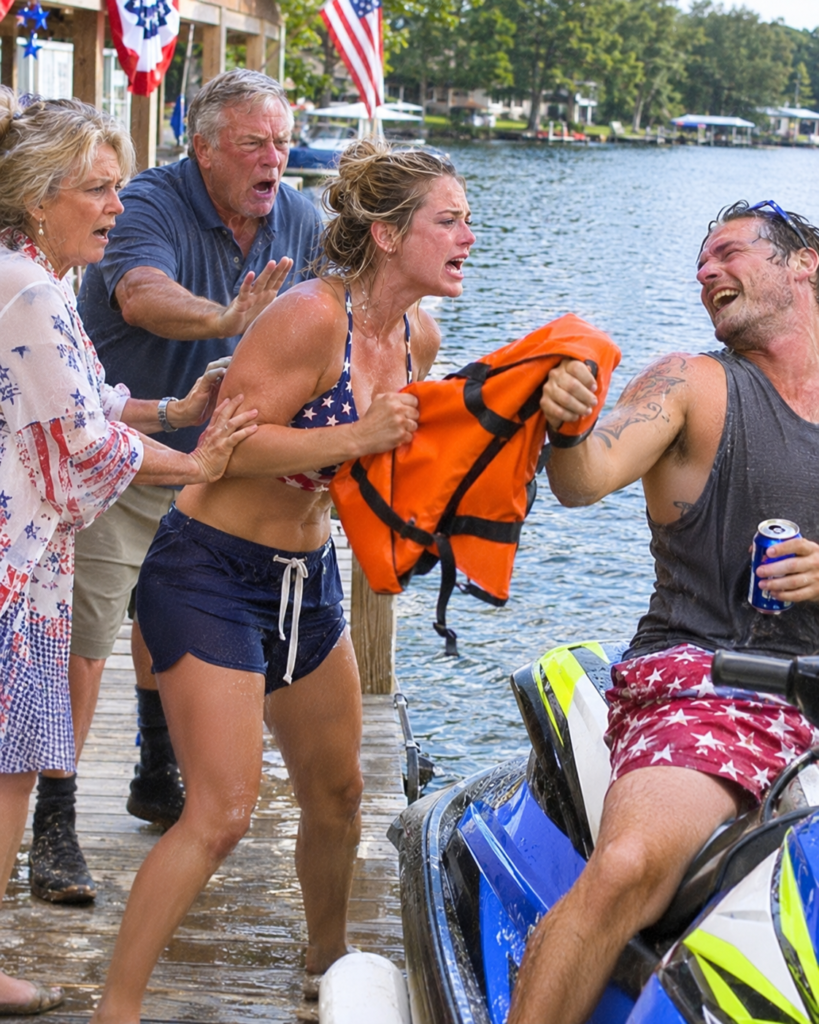
That’s when I heard a whistle.
A long, shrill blast. Then another.
About fifty yards away, near the edge of the boat channel, a teenage boy on a paddleboard was waving his arms and blowing a whistle on a lanyard.
Next to him was one of the big orange channel marker buoys.
And wrapped around it, arms locked, face barely above the water, was my daughter.
I swam faster than I have ever swum in my life.
When I reached her, she was shaking so hard her teeth clacked. Her lips were blue. She’d swallowed a lot of water.
But she was holding on.
“Mommy,” she sobbed. “I found something that floats. I held on. You came.”
I pulled the orange vest over her head and buckled it with shaking fingers. Then I held her and the buoy at the same time, and I cried into her wet hair.
The boy on the paddleboard was fifteen. His name was Dax. He’d been paddling near the channel and seen her go under once, then come up and grab the buoy. He’d been blowing his whistle for help ever since.
“She just kept saying, ‘My mom is coming,’” he told me.
A sheriff’s patrol boat reached us four minutes later. They pulled us both on board.
Cassie spent the night in the hospital. She had water in her lungs. The doctor kept her on oxygen until morning.
“If she hadn’t held on to that buoy,” the doctor said, “she wouldn’t have lasted long in open water.”
The water patrol deputies met Trey on the dock.
My nephew had told the 911 dispatcher exactly what I said. A child in the water. No life jacket. A jet ski. A drunk driver.
My father tried to tell the deputies that Cassie had “slipped off the dock.”
Three neighbors on the next dock had seen the whole thing. One of them had filmed it.
Trey blew a 0.19. More than double the legal limit.
He was charged with boating while intoxicated, child endangerment, and leaving the scene of an accident. Because of his record, it was a felony.
My father called me that night at the hospital.
“I hope you’re proud of yourself,” he said. “You just sent your brother to prison.”
“No, Dad,” I said. “Trey did that. You and Mom just spent twelve years helping him.”
I hung up. I haven’t been back to the lake house since.
Trey pleaded guilty in the fall. Three years.
My nephew, the one who called 911, moved in with his other grandparents. He said he didn’t want to spend another summer at that lake.
In September, Cassie and I went to visit Dax and his family. Cassie gave him a card she’d drawn herself. A girl holding an orange buoy and a boy with a whistle.
Underneath, in purple crayon, she’d written:
“Thank you for not leaving me.”
Dax’s mother taped it to their refrigerator.
Cassie is taking swim lessons now. Twice a week. She’s getting really good.
She still wears her orange vest on the lake.
She says it’s not for babies.
It’s for people who want to come home.
THE END.
──────────────
Protecting your family doesn’t mean protecting the person who hurt them. Sometimes it means making the call nobody else will make.
What would you have said to your father on that dock? Tell us in the replies.