Victoria’s phone rang before the ambulance doors fully closed.
From the stretcher, Clare watched through the narrowing gap as her mother-in-law answered with the same composed expression she had worn while destroying a marriage in front of forty guests.
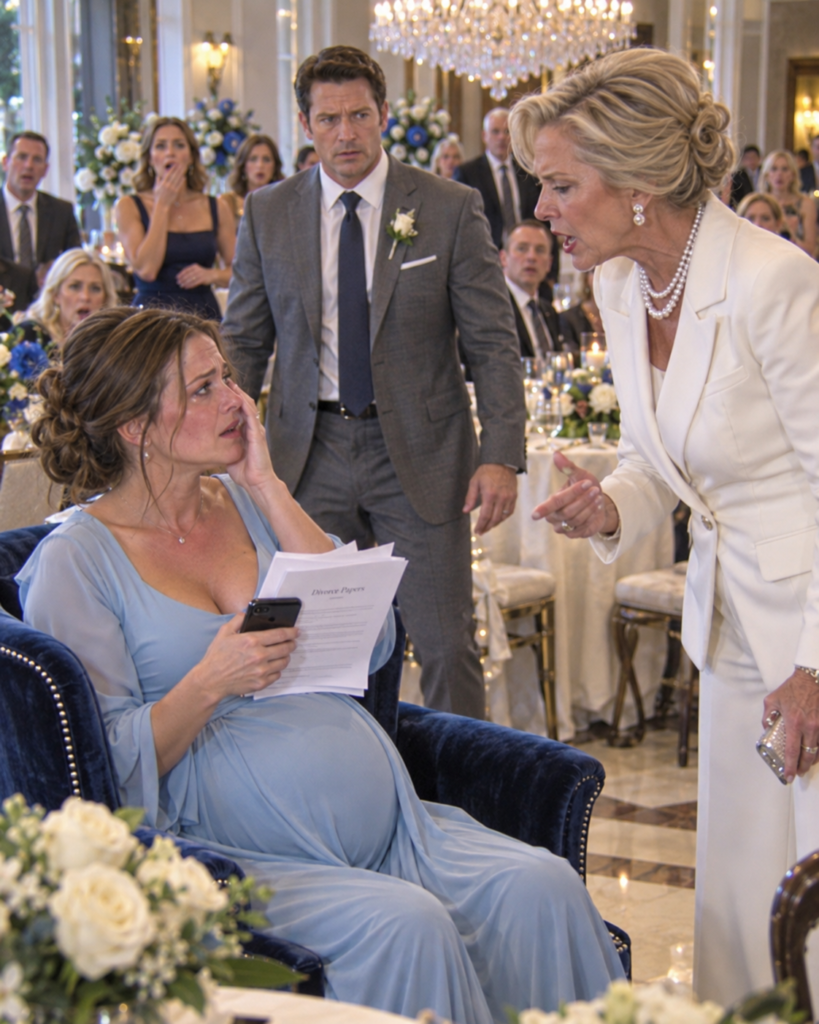
Then the expression broke.
Victoria’s eyes widened.
Her shoulders stiffened.
Across the ballroom, Bradley stepped out from behind the marble column and moved toward her.
The doors slammed shut.
Inside the ambulance, a paramedic fastened a blood-pressure cuff around Clare’s arm while another attached monitors to her stomach.
Tessa sat near her feet, clutching the cream envelope and the scattered divorce papers she had gathered from the floor.
“Stay with me,” the paramedic said.
“How far apart are the contractions?”
“I don’t know.”
Clare pressed one hand over the hard curve of her belly.
The pain was easing, but fear still moved beneath her skin.
Her phone remained connected to Naomi Pierce, the attorney who had represented Clare’s grandmother’s trust for nearly twenty years.
“Clare,” Naomi said, her voice controlled and precise, “I need verbal authorization.
Do you want me to seek an emergency injunction preventing Bradley and Victoria Ashford from transferring, selling, encumbering, or removing assets connected to the Ellison Trust properties?”
Clare looked at the divorce papers in Tessa’s hands.
She remembered Bradley’s lowered eyes.
Victoria’s whisper.
The zero balance in the joint account.
“Yes,” she said.
“File everything.”
Tessa stared at her.
“What properties?”
Another contraction tightened across Clare’s stomach.
She breathed through it while the monitor clicked rapidly beside her.
When the pain passed, she opened the photograph Naomi had sent three days earlier.
It showed the first page of a recorded deed for Ashford Manor, the country club grounds, and forty-two acres surrounding both properties.
The ownership line did not name Bradley, Victoria, or any Ashford family company.
It named the Ellison Heritage Trust.
Clare Ellison Ashford, sole trustee.
Tessa read the line twice.
“You own their house?”
“I control the trust that owns it.”
“Since when?”
“Since my grandmother died.
I only learned the property was included last week.”
The truth had been buried beneath decades of Ashford mythology.
Victoria told everyone that her late husband had built the family fortune and preserved the estate through discipline and breeding.
In reality, the Ashfords had nearly lost everything thirty-two years earlier after a reckless expansion of their hotel business.
Clare’s grandmother, Evelyn Ellison, had quietly purchased the mortgage debt through a private trust.
When the Ashfords defaulted, the trust acquired the estate.
Evelyn allowed the family to remain under a renewable occupancy agreement because Victoria’s husband had once saved Evelyn’s brother from a fatal boating accident.
The arrangement was generous, private, and conditional.
The Ashfords could live on the estate.
They could host events and maintain the appearance of ownership.
They could not sell the land, borrow against it, remove trust assets, or claim legal title.
Victoria had signed the original agreement herself.
For years, nobody questioned the story she told society.
Not even Bradley.
Clare had found the truth while reviewing her grandmother’s estate documents ahead of her daughter’s birth.
A sealed file contained the deed, the occupancy agreement, tax records, and a letter addressed to Clare.
Never confuse possession with ownership, Evelyn had written.
People who live inside a beautiful thing often begin to believe it belongs to them.
Clare had not confronted Bradley immediately.
She wanted Naomi to verify every document first.
Three days earlier, Naomi had confirmed that the deed remained valid and the trust remained the sole legal owner.
Clare had planned to tell Bradley after the baby shower.
Now the knowledge felt less like an inheritance and more like a shield.
Naomi’s voice returned through the phone.
“I have another problem.
Bradley initiated a transfer from the country club operating account twenty minutes ago.
He is moving funds into Ashford Capital Holdings.”
“Can he do that?” Clare asked.
“He has signing authority over the club’s operating company, but the company leases the land and building from your trust.
The transfer may violate the lease and the marital asset preservation rules that apply once he filed for divorce.”
“Block it.”
“I’ll notify the bank and seek a temporary restraining order.
I am also sending formal notice that the occupancy agreement is under review.”
Tessa gave a stunned laugh without humor.
“Victoria threatened to throw you out of your own house while her son stole money from a company operating on your land.”
“She thought I didn’t know.”
Clare’s phone beeped with an incoming call from Bradley.
She let it ring.
It stopped, then immediately began again.
Naomi said, “Do not speak to him without recording the call or having me present.”
“You’re present.”
Clare merged the call.
Bradley did not greet her.
“What have you done?”
His voice shook with anger, not concern.
Clare looked at the fetal monitor.
“I’m in an ambulance, Bradley.
You watched me collapse.”
“My mother just received a notice claiming you control the estate.”
“I do.”
“That is impossible.”
Naomi spoke before Clare could answer.
“Mr.
Ashford, this is Naomi Pierce, counsel for the Ellison Heritage Trust.
The deed was recorded thirty-two years ago.
Your mother signed the occupancy agreement as a witness and adult resident.
A certified copy has been delivered electronically to your attorney.”
There was a pause.
Then Victoria’s voice cut through the speaker.
“That document was never intended to be used against us.”
Clare closed her eyes.
It was the first admission.
Naomi heard it too.
“Mrs.
Ashford,” she said, “you should end this call and contact independent counsel.”
“Clare,” Victoria snapped, ignoring her, “whatever story that lawyer has told you, you do not understand the consequences.
The estate is the Ashford family’s identity.”
“You just served me divorce papers inside it.”
“Because you forced Bradley’s hand.”
“How?”
“You never adapted.
You embarrassed him.
You questioned family decisions.
You behaved as though marriage gave you authority.”
Tessa leaned toward the phone.
“She is the legal owner.
Marriage did not give her authority.
The deed did.”
Bradley swore under his breath.
Victoria continued as if Tessa had not spoken.
“Withdraw the notice.
We will restore a reasonable amount of money to your account and arrange an apartment until the child is born.”
The child.
Not Clare’s daughter.
Not their granddaughter.
An asset to be arranged.
Clare’s voice became very calm.
“Did you instruct the staff to remove my belongings?”
“The staff was following household orders.”
“Did you tell guests they would testify that I was unstable?”
Silence.
“Did you threaten to take my baby while I was having contractions?”
“You were emotional.”
“Forty people heard you.”
Victoria’s tone hardened.
“Forty people depend on this family for invitations, donations, contracts, and access.
Do not imagine they will choose you.”
Naomi said, “Thank you, Mrs.
Ashford.
That statement was recorded.”
The line went dead.
At the hospital, doctors determined that Clare had suffered severe stress-induced contractions but was not yet in active labor.
Her daughter’s heartbeat remained strong.
Clare was admitted for observation, hydration, and monitoring.
Tessa stayed beside her while Naomi worked from a small consultation room down the hall.
By evening, the first court order arrived.
Bradley was prohibited from transferring additional marital funds.
The bank froze the money he had moved from the joint account and flagged the country club transfer for review.
Victoria and Bradley were ordered not to remove Clare’s possessions from Ashford Manor or interfere with trust property.
The order did not evict them.
Not yet.
It merely stopped them from completing the plan they had expected to finish before Clare left the hospital.
At seven that night, a nurse entered with a sealed envelope delivered by a process server.
Bradley had filed an emergency petition claiming Clare posed a financial and emotional risk to herself and the unborn child.
Attached were three witness statements.
One came from Victoria.
The other two came from women who had attended the baby shower.
They described Clare as volatile, confused, and obsessed with controlling Ashford family assets.
One claimed Clare had deliberately shattered a champagne glass.
Another claimed Clare had threatened to ruin the family before collapsing.
Tessa read the pages in disbelief.
“They watched you have a medical emergency.”
“Victoria invited them for this.”
Naomi entered the room carrying a slim black folder.
“She did more than invite them,” she said.
“Both women received payments from an Ashford charitable foundation this month.
One received forty thousand dollars for a consulting project with no written scope.
The other received a private school tuition grant for her grandson.”
“Can we prove the statements were bought?” Clare asked.
“We can prove the timing.
We can also prove the ballroom security system recorded the entire event.”
Tessa sat up.
“There were cameras?”
“Four interior cameras with audio.
The club manager tried to disable access after the ambulance left, but the footage automatically backed up to the property owner’s server.”
Clare looked at the folder.
Her trust’s server.
Naomi placed a tablet on the bed and pressed play.
The ballroom appeared from above.
Victoria stood beneath the chandelier, handing Clare the envelope.
Every sentence was clear.
You were useful for producing an heir.
Our child, if necessary.
Several people here have witnessed your instability.
By the time you wake up, you’ll have nothing.
The video also showed Bradley behind the column.
He watched Clare collapse, took one step forward, then stopped when Victoria glanced at him.
He had not been frozen by shock.
He had been waiting for permission.
Clare watched the clip once.
Then she turned the tablet facedown.
“Submit it.”
The emergency custody hearing took place the next morning in a private hospital conference room through a secure video connection.
Clare wore a plain blue robe.
Her hair was tied back.
A monitor remained attached beneath the blanket.
Victoria appeared from an attorney’s office in a cream jacket.
Bradley sat beside her, looking as though he had not slept.
Their lawyer argued that Clare’s newly discovered control of the trust had triggered paranoid and retaliatory behavior.
He described the baby shower as a regrettable marital discussion that had become medically complicated.
The judge listened without expression.
Then Naomi played the recording.
Victoria’s face changed as her own voice filled the room.
The judge heard the threat to empty Clare’s finances.
The custody threat.
The reference to purchased witnesses.
Bradley’s silence.
When the video ended, Naomi submitted the banking records showing that Bradley had drained the joint account less than ten minutes before the papers were served.
She submitted the attempted country club transfer.
She submitted the payments to the two witnesses.
Finally, she opened the black folder.
“Your Honor, the opposing petition suggests my client is delusional for claiming authority over Ashford Manor.
I am providing the certified deed, the active trust instrument, thirty-two years of tax payments, and the occupancy agreement signed by Mrs.
Victoria Ashford.”
The judge examined the documents.
Bradley turned toward his mother.
“You knew?”
Victoria did not answer.
“You told me Grandfather paid off the property.”
“This is not the time.”
“You knew Clare owned it?”
“She does not own it personally.
A trust does.”
Naomi said, “Clare is the sole trustee and beneficiary.”
The judge looked over his glasses.
“Mrs.
Ashford, were you aware that the Ellison Trust held title when you instructed staff to remove the trustee’s possessions?”
Victoria’s lawyer touched her arm, but she pulled away.
“That agreement was a private accommodation.
Evelyn Ellison never intended for her granddaughter to weaponize it.”
“That is not an answer.”
Victoria lifted her chin.
“Yes.
I knew the trust held the deed.”
Bradley stared at her.
The judge denied the emergency petition.
He ordered that no custody presumption be drawn from Clare’s medical episode and referred the witness payments and financial transfers for further review.
Bradley was ordered to restore the joint funds immediately and communicate with Clare only through counsel regarding finances or the divorce.
The hearing ended, but the family’s collapse had only begun.
Within forty-eight hours, two country club board members resigned after learning that Bradley had attempted to move operating funds during the divorce filing.
The bank opened an internal fraud investigation.
The charitable foundation suspended Victoria’s authority pending an audit of the payments to witnesses.
Naomi also delivered a formal notice of material breach under the occupancy agreement.
Victoria had used trust property to facilitate an unlawful removal of the trustee, directed staff to pack protected possessions, and attempted to treat trust-owned assets as marital family property.
She was given thirty days to cure the violations or leave the estate.
Bradley came to the hospital on the third day.
He arrived alone, carrying flowers Clare did not allow into the room.
A security officer remained outside the door, and Naomi joined by phone.
Bradley looked smaller without his tailored jacket and his mother beside him.
“I did not know about the deed,” he said.
“You knew about the divorce papers.”
He rubbed both hands over his face.
“My mother said it had to happen quickly.
She said you were preparing to take control of the family through the baby and the trust documents.”
“You signed.”
“I was scared.”
“So was I.
I was on the ballroom floor while you hid behind a column.”
His eyes filled, but Clare felt no relief in seeing it.
“There is someone else,” she said.
It was not a question.
Bradley looked down.
Her name was Celeste Rowan, the daughter of a hotel investor Victoria wanted tied to the Ashford business.
The relationship had begun months earlier during trips Bradley called restructuring meetings.
Celeste had been promised that Bradley’s divorce would be private and that Clare would accept a settlement before the baby was born.
When news of the frozen transfers reached her father, the proposed investment disappeared.
Celeste ended the relationship through her attorney and provided messages showing that Victoria had planned the baby shower confrontation as a way to create public evidence of Clare’s instability.
Bradley had known Clare might become distressed.
He had not expected her to collapse.
The distinction meant nothing to her.
“I can fix this,” he said.
“You cannot fix what you were willing to do.”
“I am her father.”
“Then become the kind of father who does not use his daughter as leverage.”
Clare did not seek to erase Bradley from the child’s life.
She asked the family court for a structured parenting plan, supervised visits at first, and mandatory counseling.
Her restraint surprised the Ashfords more than revenge would have.
She did not need to destroy Bradley.
She only needed to stop him from destroying her.
Four weeks later, Victoria refused to cure the occupancy violations.
She continued telling friends that the deed was a technicality and ordered estate staff not to cooperate with the trust’s property manager.
Naomi filed for possession.
At the hearing, Victoria argued that decades of residence entitled her to remain.
The court disagreed.
The agreement was clear, the trust had paid the taxes, and Victoria had acknowledged its ownership under oath.
She was given fourteen days to vacate the private residential wing.
The ballroom and country club remained open under new professional management.
Employees kept their jobs.
Events continued.
Clare refused to punish workers for the family’s conduct.
The two paid witnesses withdrew their statements and cooperated with investigators.
One admitted Victoria had dictated nearly every sentence.
The charitable foundation recovered part of the money and removed Victoria from its board.
Bradley resigned from the country club company after the audit found unauthorized transfers and personal expenses.
He avoided criminal charges by returning the funds and entering a civil settlement, but his reputation within the business community collapsed.
The divorce concluded months later.
Clare retained control of the trust, her separate inheritance, and the estate.
Bradley received no interest in the property because he had never owned any.
The restored joint funds were divided under court supervision, and additional sanctions were imposed for the attempted dissipation of assets.
Victoria moved into a smaller home owned in her own name.
For the first time in decades, the address on her invitations no longer carried the word Ashford Manor.
Clare’s daughter, Evelyn Grace, was born healthy two weeks after the final property hearing.
Tessa stood beside Clare in the hospital room when the nurse placed the baby against her chest.
Clare looked down at the tiny face, the dark lashes, the hand curling around her finger.
The fear she had carried since the ballroom finally loosened.
Bradley met his daughter later that day under the terms of the temporary parenting order.
He cried quietly and held her with both hands.
Clare watched from across the room, neither forgiving nor interfering.
Some consequences were legal.
Others were the knowledge of what a person had chosen when kindness required courage.
Months later, Clare returned to the ballroom for the first time.
The roses were gone.
The chandelier still cast warm circles across the polished floor.
A faint mark remained near the dessert table where the champagne glass had shattered.
She carried Evelyn against her shoulder while workers prepared the room for a community maternal-health fundraiser.
The event would support emergency housing and legal assistance for pregnant women facing financial coercion.
Naomi joined her near the center of the room.
“You could have sold all of it,” the attorney said.
“I thought about it.”
“Why didn’t you?”
Clare looked around the ballroom where Victoria had expected to erase her.
“Because the building did not betray me.
People did.”
She had learned the difference between reclaiming power and reproducing cruelty.
Ownership was not the right to humiliate someone weaker.
It was the responsibility to decide what a place would become after harm had passed through it.
Near the entrance, the old brass plaque bearing the Ashford family crest had been removed.
In its place was a simple engraved plate.
ELLISON HOUSE.
No slogan.
No dynasty.
No warning.
Just the name of the woman who had protected the property in silence, and the granddaughter who finally understood why.
Clare adjusted the blanket around her sleeping daughter.
On the day of the baby shower, Victoria had believed she was proving that Clare belonged nowhere.
Instead, she had forced open a sealed history, exposed her own deception, and handed Clare every reason to stop asking permission to stand inside what was already hers.
The chandelier brightened above them.
This time, Clare did not look away.