The little girl nodded.
“My mom.”
The courtroom seemed to become smaller around us.
Judge Carter looked toward the bailiff.
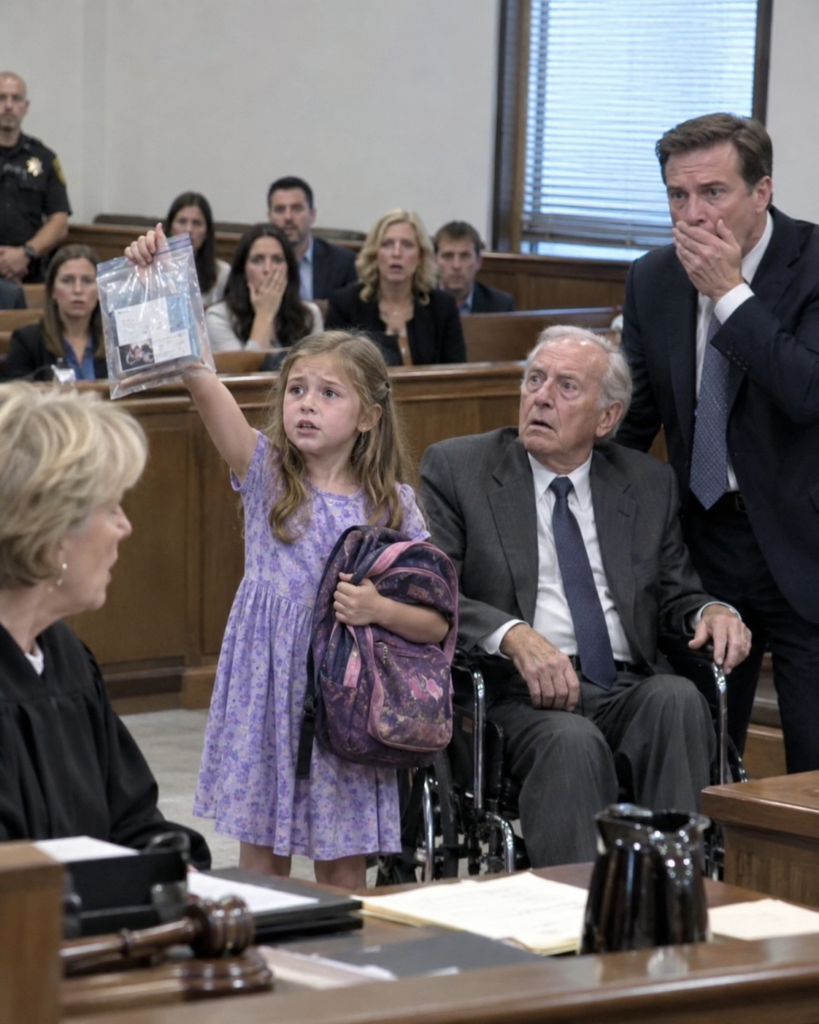
“Is this child here with an adult?”
A woman stood from the last row.
“I’m her aunt, Your Honor. Maria Reyes.”
She looked nervous but composed.
“Sophie wanted to give the envelope herself. Her mother was very specific about that.”
Daniel stepped closer to his attorney.
“This is highly irregular.”
Judge Carter gave him a level look.
“So is an unexpected witness carrying evidence connected to a guardianship proceeding.”
Daniel stopped speaking.
The judge turned to Maria.
“Did you review the contents?”
“No, Your Honor. Elena sealed it herself.”
“When?”
“About six weeks before she passed away.”
My chest tightened.
I had not known.
Vanessa turned sharply toward me.
Even Gregory finally looked startled.
“Elena died?” I asked.
Maria’s expression softened.
“In May, Mr. Whitmore.”
I closed my eyes.
For a few seconds, the courtroom disappeared.
I remembered Elena placing coffee beside my desk every morning even though I had told her a hundred times she did not need to do it.
I remembered her laughing when I accused her of organizing my office so efficiently that I had become unnecessary.
I remembered promising to visit her after she left.
I never had.
When I opened my eyes again, Sophie was still standing beside me.
“She said you’d be busy,” Sophie said quietly. “She said you were always busy.”
There was no accusation in her voice.
Somehow, that made it harder.
Judge Carter asked the clerk to receive the envelope.
Daniel objected.
His attorney rose beside him.
“Your Honor, without authentication—”
“I am not admitting anything into evidence yet,” Judge Carter said. “I am determining whether this court should continue with a decision today.”
That silenced the room.
The clerk carried the envelope forward.
Judge Carter examined it.
My name was written across the front.
ARTHUR WHITMORE — PERSONAL. TO BE OPENED ONLY IF A GUARDIANSHIP PETITION IS FILED.
A second line had been written beneath it.
If Arthur cannot open it himself, give it to the presiding judge.
The judge looked at me.
“Mr. Whitmore, do you consent to my opening this?”
“Yes.”
My answer came faster than anything I had said all morning.
The seal broke with a soft tear.
Judge Carter unfolded three pages.
She read silently.
A minute passed.
Then another.
Daniel’s attorney leaned toward him and whispered something.
Vanessa watched the judge.
Gregory stared at the floor.
Finally Judge Carter lifted her head.
“This hearing is suspended until I can review this material properly.”
A murmur rolled through the courtroom.
Daniel stood again.
“Your Honor—”
“Sit down, Mr. Whitmore.”
He did.
The judge looked toward me.
“Mr. Whitmore, the letter raises questions concerning the completeness of the medical records presented to this court.”
My mouth went dry.
“What questions?”
Judge Carter glanced at Daniel’s legal team.
“That will be addressed after the documents are verified.”
Then she did something I had not expected.
She looked directly at Gregory.
“Mr. Hale, I would also like a complete disclosure of any prior representation involving Daniel Whitmore, Whitmore Family Holdings, or entities controlled jointly by the brothers.”
Gregory’s face changed.
Not dramatically.
Just enough.
I saw it.
So did Vanessa.
Daniel turned toward him.
“What does that have to do with anything?”
Judge Carter’s voice remained calm.
“Potential conflicts of interest have everything to do with representation.”
Gregory swallowed.
“Understood.”
It was the first time all morning I felt the ground beneath Daniel’s case shift.
Not collapse.
Shift.
And after weeks of feeling as if every door had been quietly locked around me, even that small movement felt enormous.
Judge Carter scheduled an emergency review for three days later.
She appointed temporary independent counsel for me until Gregory’s potential conflict could be examined.
She also ordered an independent neurological and psychiatric capacity evaluation.
Most importantly, she postponed any guardianship ruling.
No victory.
No defeat.
Just time.
As the courtroom emptied, reporters crowded outside the doors, but the bailiffs guided Sophie and Maria through a private corridor.
Before leaving, Sophie looked back at me.
I raised my hand as far as I could.
“Thank you.”
She smiled.
“My mom said you’d know what to do.”
I wished I had as much confidence in myself as Elena apparently had.
An hour later, I was sitting in a conference room with my new temporary attorney.
Her name was Rachel Kim.
She was forty-something, direct without being cold, and the first thing she did after closing the door was pull a chair beside me rather than across from me.
“What do you want?” she asked.
The question surprised me.
“To stop Daniel.”
“That is what you don’t want.”
She opened a notebook.
“What do you want?”
I stared at the rain sliding down the window.
No one had asked me that in months.
Doctors asked about symptoms.
Daniel asked whether I remembered meetings.
Vanessa asked whether I had eaten.
Mark asked what needed signing.
Gregory asked whether I understood the risks.
But no one asked what I wanted.
“I want my decisions to remain mine,” I said.
Rachel nodded.
“Even bad ones?”
I looked at her.
“Especially bad ones.”
A faint smile appeared.
“That is generally part of being an adult.”
She turned to Elena’s letter.
The court had allowed us a copy.
Elena had written carefully.
She explained that during her final months at my office, she had been helping organize private medical files because I had begun transferring some responsibilities away from the corporate office.
She found two versions of a neurological consultation.
The copy included in Daniel’s petition contained a summary stating that I showed “progressive cognitive decline affecting independent judgment.”
But the complete consultation contained another paragraph.
The doctor had written that my performance could not be reliably interpreted until a possible interaction among several medications was reviewed.
That paragraph was absent from the version submitted to the court.
Rachel tapped the page.
“That does not automatically mean someone intentionally removed it.”
“I know.”
“Do you?”
I looked at her.
She waited.
I leaned back.
“No.”
That was the truth.
A week earlier, I would have assumed Daniel had done it deliberately.
Now I was less certain.
Anger had become too easy.
Elena’s letter contained more.
She had noticed appointment dates in Daniel’s petition that did not match the dates recorded in my private calendar.
She had also found references to an evaluation she could not locate in the original files.
Before she became too ill to continue working, she copied everything and placed the originals somewhere secure.
At the bottom of the third page, Elena wrote:
Arthur, you once told me documents do not tell the truth by themselves. People have to put them in the right order.
Then came one final sentence.
Ask Mark why March 17 disappeared.
I read it three times.
Rachel looked at me.
“What happened March seventeenth?”
“I don’t know.”
“Think.”
I tried.
March had been difficult.
I had experienced severe fatigue, confusion, and several episodes when words seemed to vanish halfway between my mind and my mouth.
Daniel had begun attending more meetings.
Vanessa had returned to New York after years living mostly in Connecticut.
Mark had rearranged my schedule.
Gregory had started discussing “protective structures.”
March seventeenth.
Then something surfaced.
“A meeting,” I said.
“With whom?”
“I don’t remember.”
Rachel made a note.
“Then Mark might.”
Mark Ellis arrived that evening.
He looked ten years older than he had in court.
We met in my apartment library, where I had once hosted governors, surgeons, CEOs, and foreign investors.
Now the room mostly held unopened mail and medicines arranged in labeled boxes.
Mark remained standing near the door.
“You should have told me,” I said.
His shoulders lowered.
“I know.”
“Which part?”
He looked toward Rachel.
She nodded.
“Everything.”
Mark sat.
He had worked for me seventeen years.
I had hired him when he was twenty-eight, ambitious and painfully serious. Over time, he became the person who knew which meetings I would hate, which people I secretly liked, and when to remove me from a charity dinner before exhaustion made me unreasonable.
“March seventeenth was the day Dr. Leland came to the apartment,” he said.
I remembered the name.
Neurologist.
Not my regular specialist.
Daniel had recommended him.
“He evaluated me?”
“For almost three hours.”
“I don’t remember that.”
“You were having a bad week.”
That statement hurt, but I knew it was true.
Mark continued.
“Dr. Leland said he was concerned about your concentration, but he also thought the medication changes could be affecting you. He recommended waiting six weeks before drawing conclusions.”
Rachel leaned forward.
“Was there a written report?”
“Yes.”
“Where is it?”
Mark hesitated.
“That is the problem.”
I felt my stomach tighten.
“Mark.”
“I scanned it into the private records system.”
“And?”
“Two weeks later, when Daniel asked me for everything connected to your condition, the March seventeenth report was gone.”
“Deleted?”
“I don’t know.”
“Who had access?”
Mark looked miserable.
“You. Me. Elena. Daniel, after you authorized him during your hospitalization. And Gregory’s office had document access for estate planning.”
Gregory.
Again.
I turned toward the window.
“Why were you sitting with Daniel today?”
“Because he asked me to testify.”
“Against me.”
“No.”
His answer was immediate.
“I was supposed to testify that your memory had become inconsistent.”
“It has.”
“Yes.”
The simple agreement irritated me more than denial would have.
Mark noticed.
“Arthur, I’m not going to lie for you.”
I said nothing.
“But I wasn’t going to say you were incapable, either.”
“Then why didn’t you tell me any of this?”
“Because I didn’t know who to trust.”
That stopped me.
Mark looked down at his hands.
“Daniel said Gregory believed guardianship was necessary. Gregory said Daniel had medical support. Vanessa told me not to give anyone original documents. Elena suddenly left. You were forgetting conversations. Everyone seemed to know something different.”
“And you decided silence was safer.”
“Yes.”
Rachel closed her notebook.
“Silence is rarely neutral.”
Mark nodded.
“I know that now.”
He reached into his briefcase.
“I brought something.”
It was a printed calendar.
March seventeenth was circled.
Beneath Dr. Leland’s appointment appeared another entry scheduled at 6:30 that evening.
VANESSA — PRIVATE.
I frowned.
“Vanessa was here?”
Mark nodded.
“For nearly two hours.”
“I don’t remember.”
“She asked me not to put details in the system.”
Rachel looked at him sharply.
“Why?”
“I never knew.”
The following morning Vanessa came to see me.
I expected evasions.
Instead, she walked into the library, removed her coat, and placed a small metal key on the table between us.
“I hoped I would never need to give you this,” she said.
I stared at it.
“What does it open?”
“A safe-deposit box.”
“Yours?”
“No.”
Her eyes met mine.
“Elena’s.”
I looked at Rachel.
Vanessa continued.
“March seventeenth was the night Elena called me.”
“Why you?”
“Because she was frightened that records were being moved around without anyone keeping track of which versions were original.”
I frowned.
“Frightened of Daniel?”
“No.”
Vanessa’s answer surprised me.
“She did not know who was responsible. Neither did I.”
That distinction mattered.
Vanessa sat across from me.
“She wanted someone outside the companies to keep copies. She trusted me because I had no financial authority anymore.”
“You were supporting Daniel in court.”
“I was sitting beside him.”
“You never corrected him.”
“I was waiting.”
“For what?”
“For the hearing to reach the point where the documents had to be entered formally.”
My anger stirred.
“You could have told me.”
Vanessa’s expression tightened.
“I tried.”
“When?”
“March seventeenth.”
I searched my memory.
Nothing.
“You told me?”
“You told me I was imagining conspiracies because I still resented Daniel.”
I looked away.
That sounded like something I might have said.
Especially during those months after our divorce, when every concern Vanessa raised felt like criticism.
She touched the key.
“Elena wanted the originals preserved until an independent attorney could retrieve them.”
Rachel examined the number stamped into the metal.
“There is more?”
Vanessa nodded.
“Medical records. Correspondence. A copy of Dr. Leland’s complete report.”
My pulse quickened.
“And?”
Vanessa hesitated.
“One envelope Elena told me never to open.”
“Addressed to whom?”
Vanessa met my eyes.
“To me.”
That evening, with court authorization, Rachel accompanied Vanessa and Maria Reyes to the bank.
I stayed home.
For three hours, I watched the clock.
At 8:14, Rachel returned.
She placed a thick folder on my desk.
“The report exists.”
I exhaled slowly.
“And what does it say?”
“That on March seventeenth, Dr. Leland considered you temporarily impaired by fatigue and possible medication effects. He specifically recommended against making permanent legal conclusions until you were reevaluated.”
My hands trembled.
Not from illness this time.
“Then Daniel’s case—”
“Is more complicated than he represented.”
More complicated.
Not destroyed.
But changed.
Rachel removed another item.
A sealed cream-colored envelope.
Vanessa’s name was written across the front.
On the back, Elena had added six words.
Arthur should be present when opened.
Vanessa arrived twenty minutes later.
She sat beside me.
Neither of us spoke for a while.
Then she broke the seal.
Inside was a single page.
As Vanessa read, the color slowly left her face.
“What?” I asked.
She handed the letter to Rachel.
Rachel read it once.
Then again.
“What is it?” I demanded.
Rachel looked toward me.
“Elena believed the missing medical report was only part of the problem.”
My heart began pounding.
“What else?”
Rachel placed the page before me.
At the bottom, Elena had written the date.
March 21.
Four days after Dr. Leland’s evaluation.
Above it was a sentence that changed everything I thought I understood about the hearing.
Daniel did not begin this process.
Gregory Hale did.
-END OF PART 2, –PRESS NEX PART IN BOTTOM OF PAGE TO READ NEXT PART
PART 3: For most of my life, I had believed betrayal announced itself.
A secret account.
A forged signature.
A whispered conversation behind a closed door.
But sitting in my library with Elena’s letter before me, I began to understand that the most damaging mistakes could begin with something far quieter.
An assumption.
Gregory Hale had been my lawyer for twenty-three years.
He helped negotiate the sale of my first hospital network.
He sat beside me when my father’s estate was divided.
He drafted agreements during my divorce from Vanessa.
He knew the architecture of my life almost as well as I did.
According to Elena, Gregory had contacted Daniel on March twenty-first.
Not the other way around.
Rachel read Elena’s letter aloud.
“Elena states that Mr. Hale requested records concerning Arthur’s medical condition and asked Daniel whether the family had discussed protective oversight.”
Vanessa folded her arms.
“That sounds like Gregory.”
I looked at her.
“What does that mean?”
“He always believed disorder was more dangerous than almost anything else.”
Rachel nodded thoughtfully.
“Elena also says Gregory told her Arthur’s estate plan would become difficult to administer if questions arose about capacity.”
I almost laughed.
“Difficult for whom?”
No one answered.
The next morning, Gregory requested a private meeting.
Rachel insisted on attending.
We met in a conference room at his firm.
The walls displayed photographs of Gregory shaking hands with men whose names appeared on buildings.
He entered carrying no briefcase.
For once, he looked less like an attorney than a tired man nearing seventy.
“Arthur.”
I did not offer my hand.
“Did you start the guardianship discussion?”
He sat slowly.
“Yes.”
No elaborate denial.
No argument.
Just yes.
I had prepared myself for deception.
The admission unsettled me more.
“Why?”
Gregory looked at Rachel.
She said nothing.
Then he looked back at me.
“Because I thought you were deteriorating quickly.”
“You are my lawyer.”
“I know.”
“Then why didn’t you speak to me?”
“I did.”
“When?”
“Several times.”
I searched my memory.
There were fragments.
Gregory in my apartment.
Gregory closing files.
Gregory asking whether I understood a revised partnership agreement.
Me telling him to stop treating me like an old man.
I hated those fragments because they did not fit neatly into the story I wanted.
I wanted Gregory to have betrayed me.
That would have been simpler.
“I should have handled it differently,” he said. “But you were refusing evaluations. You were cancelling appointments. You signed two documents and later said you didn’t remember signing them.”
Rachel interrupted.
“Were either of those documents financially damaging?”
“No.”
“Were they invalid?”
“No.”
“Then why did you conclude guardianship was appropriate?”
Gregory exhaled.
“I did not initially conclude that. I suggested Daniel speak with a geriatric care attorney about possible future options.”
“But you later represented Arthur during the proceeding.”
“Yes.”
“After previously advising Daniel?”
Gregory’s face tightened.
“That was an error.”
It was the first apology he had offered.
Not enough.
But real.
“Why didn’t you challenge Daniel’s evidence?” I asked.
Gregory looked at me.
“Because I believed parts of it.”
The room went still.
My pride flared.
“So you decided I was incompetent.”
“No.”
“You behaved as though I was.”
“I believed you needed structured assistance.”
“Those are not the same thing.”
“I know that now.”
I turned my wheelchair toward the window.
For years, I had paid people to solve problems before they reached me.
Now one of those people had tried to solve me.
Rachel asked the question that mattered.
“Did you remove Dr. Leland’s report?”
“No.”
“Did you know the submitted summary was incomplete?”
Gregory hesitated.
“No. But I should have.”
That hesitation told me he had already spent many hours asking himself the same question.
“Who prepared Daniel’s medical exhibits?”
“An outside elder-care consulting firm.”
Rachel wrote down the name.
“Who hired them?”
“I suggested them.”
Daniel signed the engagement.
The mystery had become less dramatic and more troubling.
There was no mastermind sitting in a dark room.
There were people.
Busy people.
Concerned people.
People who trusted summaries.
People who assumed someone else had checked.
People who acted on partial information because the consequences of waiting frightened them.
Sometimes, I realized, lives were changed not by one terrible decision but by six reasonable decisions made by people who never compared notes.
The independent evaluation took place the following day.
Dr. Priya Shah spent nearly four hours with me.
She asked about my companies.
My childhood.
The current year.
Recent news.
Medication schedules.
Why I had chosen certain investments.
What I would do if someone offered me a clearly unfavorable contract.
At one point she asked me to remember five words.
I remembered four.
Twenty minutes later, three.
I hated every second of it.
“You’re frustrated,” she observed.
“I built a company with thirty-eight thousand employees and now I’m failing a grocery-list exercise.”
She smiled gently.
“This is not an exam you pass by being impressive.”
I almost smiled.
“That may be the first test in my life where that is true.”
Later, she asked about Daniel.
I gave her the angry version first.
Then she waited.
Eventually, I gave her the honest one.
Daniel had always been the careful brother.
I was the one who took risks.
When we were boys, I jumped from the roof of our garage because I believed an umbrella would slow my fall.
Daniel ran inside to find our mother before I landed.
Nothing had really changed.
I built.
Daniel protected.
I expanded.
Daniel preserved.
For decades, those differences complemented each other.
Until illness turned them into opposing philosophies.
“What do you think your brother is afraid of?” Dr. Shah asked.
I stared at the floor.
“That I’ll destroy what we built.”
“And what are you afraid of?”
“That he’ll keep it safe by taking it away from me.”
When I said it aloud, the conflict suddenly seemed painfully clear.
Two brothers.
Both afraid.
Both mistaking control for protection.
Daniel came to my apartment that evening.
For the first time in months, he came alone.
No attorney.
No Vanessa.
No Mark.
He stood in the doorway until I motioned him inside.
“You talked to Gregory,” he said.
“Yes.”
He nodded.
“I expected you would.”
“Did you know Dr. Leland recommended waiting?”
Daniel sat.
“I knew he wanted another evaluation.”
“That is not what I asked.”
He looked down.
“Yes.”
The word landed heavily.
Anger rose inside me.
“You knew.”
“I knew he thought medication might be affecting your concentration.”
“And you filed anyway.”
“Yes.”
“Why?”
Daniel rubbed his forehead.
“Because you stopped taking calls from me. You cancelled the follow-up. You fired one home nurse after she reminded you about medication. You tried to approve a major property sale and then forgot the meeting the next morning.”
“The sale never happened.”
“That isn’t the point.”
“It is part of the point.”
He looked exhausted.
“So what was I supposed to do?”
“Talk to me.”
“I tried.”
“Try harder.”
“I did!”
His voice rose, then immediately softened.
He looked toward the door as though embarrassed by the sound.
“I did,” he repeated.
“I came here eleven times in March.”
I had remembered perhaps four.
That frightened me.
Daniel continued.
“You accused me of wanting your money. You told me I had spent my entire life waiting for you to fail.”
I looked away.
“I remember saying that.”
“Do you remember apologizing?”
No.
He gave a small, sad laugh.
“You did.”
That was worse somehow.
Daniel leaned forward.
“I should have waited for the second evaluation. I know that. I thought if I waited and something happened, I would never forgive myself.”
“Something like what?”
“You signing away half the company. Falling alone. Making a decision you couldn’t reverse.”
“So you wanted the power to reverse everything for me.”
“I wanted time.”
“That is not what full guardianship gives you.”
“I know that now.”
I studied him.
For weeks, I had imagined Daniel celebrating behind closed doors.
Instead, he looked as trapped by the process as I felt.
“Why Vanessa?” I asked.
“She approached me.”
That surprised me.
“She told me you needed support but said she would never agree to full financial guardianship.”
“Yet she sat beside you.”
“She wanted to hear exactly what I said under oath.”
That sounded like Vanessa too.
Daniel hesitated.
“I thought she was supporting me.”
“She let you think that?”
“She let me assume it.”
Despite myself, I smiled faintly.
Daniel noticed.
“So she’s still good at that.”
“The best.”
For a moment, we were brothers again.
Then the moment passed.
“Did you know the report submitted to court was missing a paragraph?” I asked.
“No.”
I believed him.
Not because I wanted to.
Because after sixty-two years, I knew how Daniel lied.
He overexplained.
This answer had contained nothing.
Rachel called the next morning.
The elder-care consulting firm had found the source of the missing paragraph.
It was not deliberate.
A case manager had created a two-page summary from a seven-page neurological report. When documents were later assembled for court, someone mistakenly labeled the summary “complete physician report.”
Daniel’s legal team relied on it.
Gregory failed to verify it.
The mistake was serious.
But it was a mistake.
Part of me was almost disappointed.
A villain would have been easier to forgive than a system made careless by urgency.
The independent evaluation arrived the day before our return to court.
Rachel read it to me.
Arthur Whitmore shows mild cognitive impairment complicated by fatigue, medication effects, and chronic illness.
I stopped her.
“Mild cognitive impairment.”
“Yes.”
My mouth felt dry.
“Keep reading.”
He demonstrates consistent understanding of his financial circumstances, personal preferences, relationships, and consequences of major decisions. He retains decision-making capacity but would benefit from structured support, medication review, and delegated administrative assistance.
I closed my eyes.
Not perfect.
Not unchanged.
But still me.
Rachel continued.
There was no basis, in Dr. Shah’s opinion, for full guardianship.
A limited support arrangement would be sufficient.
I expected relief.
Instead, I felt grief.
Because some part of Daniel’s concern had been justified.
My memory was changing.
My independence needed adaptation.
I could win the hearing and still lose something.
That evening Vanessa found me sitting beside the living-room window.
“You look disappointed for a man who just received good news.”
“I wanted the doctor to say nothing was wrong.”
“She didn’t.”
“No.”
Vanessa sat on the sofa nearby.
“Arthur, nothing being wrong has never been a requirement for having a life.”
I looked at her.
“You rehearsed that.”
“No.”
“You did.”
“Maybe in the elevator.”
I laughed.
It was the first real laugh I had managed all week.
The next morning, Maria Reyes arrived with another folder.
“Sophie found this in the backpack lining.”
Rachel frowned.
“Lining?”
Maria smiled.
“Elena sewed pockets into everything.”
Inside was a small black notebook.
Elena’s handwriting filled the pages.
Dates.
Document locations.
People contacted.
Notes about meetings.
Nothing dramatic.
Just meticulous records.
Then, near the back, Rachel stopped reading.
“What?”
She turned the notebook around.
A page was marked with my initials.
AW — revised personal directive completed February 11. Signed with independent witnesses. Original placed in Bexley Trust vault. Copy to VC after reconciliation meeting.
I stared.
“Personal directive?”
Vanessa leaned closer.
“I never received a copy.”
“Do you remember signing one?” Rachel asked.
Slowly, I did.
February eleventh.
Before the worst of the confusion.
I had met with an independent estate lawyer because Gregory’s firm represented several family entities.
I had wanted clear instructions in case my health declined.
“Bexley Trust,” I said.
Rachel was already reaching for her phone.
Three hours later, we learned the document existed.
And it contained something none of us expected.
I had specifically rejected naming either Daniel or Vanessa as sole guardian or sole financial decision-maker.
Instead, if I lost capacity, I had chosen a professional fiduciary for financial matters and Vanessa for medical decisions, with Daniel serving only as family adviser.
But that was not the most important part.
Near the end was a paragraph I had written myself.
My handwriting.
My words.
If my capacity is ever questioned, I request every reasonable effort be made to preserve my independent choices through supported decision-making before guardianship is considered.
I had anticipated this.
Before my worst months began.
Before Daniel’s petition.
Before Gregory’s concern.
I had already decided what I wanted.
Rachel smiled.
“That is significant.”
Vanessa looked almost relieved.
Daniel, when told, said nothing for nearly a minute.
Then he asked for a copy.
But the notebook held one final surprise.
Elena had written another entry beneath the note about my directive.
March 24 — D.W. asked whether Arthur had ever created a less restrictive plan. Told him yes. Told him where Gregory should request it.
D.W.
Daniel Whitmore.
My brother had known my directive existed.
When I confronted him that evening, he did not deny it.
He simply looked at me with an expression I could not read.
“Yes,” he said. “Elena told me.”
“Then why didn’t you find it?”
Daniel looked down.
“I did.”
The room seemed to tilt.
“You found it?”
“Yes.”
“Before you filed the petition?”
“No.”
He lifted his eyes.
“I found it the day after.”
I stared at him.
“And you continued anyway?”
Daniel’s face tightened.
“For forty-eight hours.”
“Why?”
His next words left the room silent.
“Because Gregory told me your directive might not matter if the court decided you had already lost capacity when you signed it.”
Rachel immediately spoke.
“But February eleventh was before the period of documented impairment.”
“I know that now.”
Daniel turned toward me.
“Arthur, that is why I stopped asking for permanent control.”
I frowned.
“What are you talking about?”
He reached into his coat and placed a document on the table.
A court filing.
Dated two days earlier.
I read the heading.
AMENDED PETITION.
Daniel had quietly changed his request.
He was no longer seeking full guardianship.
He was asking the court to approve the least restrictive support plan consistent with my February directive.
I looked up.
“Why didn’t you tell me?”
His expression softened.
“Because I thought you wouldn’t believe me.”
And for the first time since this began, I realized the final question before us was no longer whether Daniel could be trusted with my life.
It was whether either of us still knew how to trust the other.
-END OF PART 3–PRESS NEX PART IN BOTTOM OF PAGE TO READ NEXT PART
PART 4 – ENDING: The courtroom looked different when I returned three days later.
Maybe the room had not changed.
Maybe I had.
The reporters were still there.
The polished wood still reflected the ceiling lights.
Judge Carter still sat above us with the same unreadable expression.
But Daniel was no longer seated at the opposite table.
At his request, his attorney had moved beside him farther down the aisle, leaving a clear space between us.
Vanessa sat behind me.
Mark sat beside Maria Reyes.
Sophie was not in court.
Maria had wisely decided that her niece had already done enough.
She was spending the afternoon at school, where the greatest question she faced was apparently whether she would be allowed to bring cupcakes for a classmate’s birthday.
I was glad.
Some battles belonged to adults.
Children should not have to carry them longer than necessary.
Judge Carter began by reviewing the new evidence.
Dr. Shah’s evaluation.
Dr. Leland’s complete report.
My February directive.
The consulting firm’s explanation concerning the incomplete medical summary.
Elena’s records.
Gregory’s conflict disclosure.
No single revelation transformed the case.
Together, they changed everything.
When Judge Carter finally looked toward Daniel, she asked a simple question.
“Mr. Whitmore, what relief are you requesting today?”
Daniel stood.
He looked toward me first.
Then toward the judge.
“None, Your Honor.”
A quiet murmur moved through the courtroom.
His attorney whispered something, but Daniel continued.
“I withdraw the guardianship petition.”
Judge Carter studied him.
“Completely?”
“Yes.”
“What about your amended request for supported decision-making?”
“That should be Mr. Whitmore’s request, not mine.”
For several seconds, I could not speak.
The brother I had believed wanted control was surrendering the last piece of control he still possessed.
Judge Carter looked toward Rachel.
“Mr. Whitmore?”
Rachel turned to me.
This time, no one answered for me.
I moved closer to the microphone.
“I would like to request a voluntary supported decision-making agreement.”
Judge Carter nodded.
“With whom?”
I had thought about that question all night.
“Professional support for financial administration. Vanessa Cole as my designated medical advocate, consistent with my directive.”
Vanessa lowered her eyes.
“And Daniel Whitmore?” the judge asked.
I looked at my brother.
“As my brother.”
A few people smiled.
Daniel did not.
His eyes filled instead.
I continued.
“If he still wants the job.”
Daniel cleared his throat.
“I do.”
Judge Carter allowed herself the smallest smile.
The court approved a temporary voluntary arrangement pending final documentation.
No guardian.
No transfer of control.
No declaration that I was incapable of running my life.
But neither did the court pretend nothing had changed.
I would have regular independent medical reviews.
Large financial transactions would receive a second professional review.
My medications would be supervised more carefully.
Mark would no longer control medical records and corporate records at the same time.
And Gregory’s firm would step away from my personal representation.
I agreed to every condition.
A month earlier, I would have considered them humiliating.
Now I understood something my younger self would have hated.
Accepting help was not the same as surrendering authority.
Sometimes it was how authority survived.
When court adjourned, the reporters surged toward the hallway.
Rachel prepared me for questions.
I shook my head.
“No press conference.”
Daniel looked surprised.
“You’ve never refused a microphone in your life.”
“I’m growing.”
“Apparently.”
Vanessa laughed.
We escaped through a side exit.
Outside, Manhattan moved on without caring that my life had nearly changed inside a stone building.
Taxis honked.
A delivery cyclist argued with a driver.
A man sold coffee from a cart.
The sky was bright after several days of rain.
Daniel walked beside my wheelchair.
For half a block, neither of us spoke.
Then he stopped.
“I owe you an apology.”
I looked up.
“One?”
He almost smiled.
“Several.”
“Start with the expensive ones.”
He laughed.
Then his expression became serious again.
“I should never have asked for full guardianship before exhausting every other option.”
“No.”
“I should have shown you the February directive as soon as I found it.”
“Yes.”
“I should have questioned the medical summary instead of assuming the professionals had checked it.”
“Yes.”
He looked at me.
“You could make this slightly easier.”
“I could.”
“But you won’t.”
“No.”
For a moment, silence returned.
Then I said, “I owe you apologies too.”
Daniel blinked.
“I spent years treating your caution as weakness.”
He looked away.
“I mocked you for worrying.”
“You did.”
“I ignored you when you tried to talk to me about my health.”
“You definitely did.”
“Now who is making this difficult?”
“I learned from you.”
I smiled.
“I also accused you of waiting for me to fail.”
Daniel’s expression changed.
“That one hurt.”
“I know.”
It took effort to say what came next.
“I’m sorry.”
He nodded.
Not dramatically.
Not with some perfect speech.
Just once.
That was enough.
Vanessa had gone ahead with Rachel, giving us space.
Daniel began walking again.
After a few steps he said, “For what it’s worth, I never wanted the companies.”
“You spent forty years complaining about how I ran them.”
“That is different.”
“How?”
“I wanted you to run them correctly.”
I laughed so hard I had to stop the wheelchair.
Daniel laughed too.
It felt familiar.
Painfully familiar.
Like finding an old photograph and realizing the people in it had not disappeared after all.
The weeks that followed were less dramatic than the hearing.
They were also more important.
My doctors adjusted two medications.
The mental fog did not vanish completely, but it improved.
Some mornings I was sharp.
Others required more patience.
I learned to use a digital schedule with reminders.
I allowed Mark to create written summaries after important meetings.
I began recording major decisions so I could review my own reasoning later.
At first, every accommodation felt like evidence against me.
Eventually, it began to feel like equipment.
A wheelchair did not mean I had stopped moving.
A reminder did not mean I had stopped thinking.
Help did not erase me.
Mark asked to resign.
I refused.
Then I changed my mind.
Not because I blamed him.
Because both of us needed different boundaries.
He accepted a new role overseeing one of our charitable programs.
Before leaving my private office, he stood in the doorway the way he had the night we discussed March seventeenth.
“I should have spoken sooner,” he said.
“Yes.”
“I thought staying neutral meant staying out of it.”
“So did a lot of people.”
He nodded.
“I won’t make that mistake again.”
“I hope you make entirely new mistakes.”
That surprised him.
Then he smiled.
“I probably will.”
Gregory wrote me a letter.
Not an email.
A letter.
Three pages handwritten.
He admitted he had blurred the line between protecting a client and directing a client.
He acknowledged that his prior advice to Daniel created a conflict he should have disclosed immediately.
He apologized without excuses.
I did not respond for two weeks.
Then I invited him for coffee.
We did not repair twenty-three years of friendship in an afternoon.
We did not try.
Forgiveness, I discovered, was not a door that opened once.
It was more like a hallway.
You walked through it gradually.
Sometimes you stopped.
Sometimes you turned around.
Sometimes you needed to sit down before continuing.
But if both people kept moving, distance changed.
Vanessa proved more complicated.
After the hearing, she remained my medical advocate.
That meant she attended appointments.
Which meant she resumed doing something she had perfected during our marriage.
Correcting me.
“You told Dr. Shah you slept seven hours.”
“I did.”
“You slept five.”
“I was approximating.”
“You were lying.”
“I was rounding.”
“You cannot round five to seven.”
“I built a technology company. Numbers are flexible.”
She stared at me.
I surrendered.
“Five.”
“Thank you.”
One afternoon after an appointment, we stopped at a small café near Central Park.
For years, Vanessa and I had spoken mainly through attorneys, family invitations, and carefully controlled holiday dinners.
Now we sat across from one another eating soup.
Ordinary soup.
It felt stranger than court.
“Why did we become so bad at this?” I asked.
“At soup?”
“At talking.”
Vanessa stirred her tea.
“You wanted every problem solved.”
“That is usually considered a useful quality.”
“Not when the problem is another person.”
I smiled faintly.
“That sounds rehearsed too.”
“It might be.”
She looked out the window.
“When you got sick, you became terrified people would see you differently.”
I said nothing.
“So every time I offered help, you heard pity.”
“That is not entirely wrong.”
“No.”
“And you?”
“I became afraid that if I stopped helping, something would happen and I would blame myself.”
I thought about Daniel.
“You two have more in common than either of you would enjoy admitting.”
“Do not tell him.”
“I absolutely will.”
She smiled.
We did not discuss reconciliation.
Not then.
Some relationships did not need to return to what they were to become valuable again.
We began with coffee.
Then occasional dinners.
Then Sunday walks through the park when weather allowed.
No promises.
No dramatic reunion.
Just two people learning how to speak without defending old versions of themselves.
The greatest surprise came from Sophie.
Two months after the hearing, Maria brought her to the Whitmore Community Medical Center for a small memorial gathering honoring Elena.
I had asked Maria’s permission before arranging it.
A plaque was placed in the records department.
Not because Elena had uncovered some grand conspiracy.
Because she had done something more important.
She had cared about accuracy when everyone else was rushing.
The plaque read:
ELENA REYES
SHE BELIEVED EVERY PERSON DESERVED TO HAVE THEIR STORY KEPT WHOLE.
Sophie read it carefully.
Then she looked at me.
“My mom would say the letters are too big.”
Maria laughed.
“She absolutely would.”
I smiled.
“What size would she prefer?”
“Smaller.”
“Much cheaper.”
Sophie considered this seriously.
“Then you should change it.”
I promised to think about it.
The foundation also created an annual Elena Reyes Fellowship for medical-records advocacy and patient decision support.
Maria initially resisted the idea.
“I don’t want Sophie thinking her mother helped you because she expected something.”
“She didn’t.”
“I know.”
“This isn’t payment.”
“What is it?”
“Memory.”
Maria looked at the plaque.
Then she nodded.
Sophie wandered toward a display showing the history of the hospital.
Daniel arrived late.
He had brought flowers.
“Bribery?” I asked.
“For Maria.”
“Good. I don’t like those.”
“You never did.”
We watched Sophie explain something to Vanessa with enormous seriousness.
Daniel put his hands in his pockets.
“I sold the house in Westchester.”
I looked at him.
“The one Dad left you?”
“Yes.”
“Why?”
“Too big.”
I waited.
He smiled.
“And before you ask, no, I am not hiding financial problems.”
“I wasn’t going to ask.”
“You absolutely were.”
He was right.
“What will you do?”
“Buy something smaller.”
“Where?”
“Maybe Connecticut.”
I looked toward Vanessa.
Daniel followed my gaze.
“Not that close.”
We laughed.
Then he grew quiet.
“I spent a lot of years protecting things because Dad protected things.”
“Our father protected money.”
“And reputation.”
“And grudges.”
Daniel nodded.
“I don’t want to inherit all of that.”
Neither did I.
For the first time, we began discussing the future of the family companies without arguing about control.
Over the next six months, I reduced my operational responsibilities.
Not because a judge ordered me to.
Because I chose to.
I remained chairman.
Daniel remained on the family board.
But day-to-day leadership passed to younger executives we both trusted.
One afternoon, after signing the final transition papers, I sat alone in my office.
For forty years, that room had defined me.
Awards covered one wall.
Photographs covered another.
Groundbreaking ceremonies.
Hospital openings.
Magazine covers.
Handshakes.
Success had always appeared in photographs as something solid.
But sitting there, I realized my proudest decisions had become the ones no camera recorded.
Calling my brother.
Listening to my doctor.
Letting Vanessa help.
Admitting I was afraid.
Changing my mind.
A soft knock came at the door.
Daniel entered carrying two cups of coffee.
“You done?”
I looked around.
“Yes.”
“How does it feel?”
I considered lying.
“Terrifying.”
He handed me a cup.
“Good.”
“Good?”
“It means you know it matters.”
We sat in silence.
Then I asked, “Do you remember the garage roof?”
Daniel groaned.
“You are sixty-two years old and still proud of that?”
“I almost flew.”
“You broke your wrist.”
“Details.”
“You used an umbrella.”
“It was a large umbrella.”
He shook his head.
“You know what I remember?”
“What?”
“Mom yelling at me afterward.”
I frowned.
“Why you?”
“She said I should have stopped you.”
I stared at him.
Daniel smiled sadly.
“I was six.”
Something inside me shifted.
For fifty-six years, he had been trying to stop me from falling.
Perhaps neither of us had ever understood where that instinct began.
“You know,” I said, “you weren’t responsible.”
“I know.”
“You don’t sound convinced.”
“I’m working on it.”
“So am I.”
That became our agreement.
Not to fix each other.
To work on things.
A year after the hearing, I returned to the courthouse.
Not for myself.
The hospital network was launching a legal-medical partnership designed to help older adults and people with chronic illness understand advance directives, supported decision-making, and guardianship alternatives.
Judge Carter had agreed to speak at the opening.
When she saw me, she looked at my wheelchair.
Then at Daniel standing beside me.
“No purple backpack today?”
I smiled.
“Thankfully.”
She shook my hand.
“How are you, Mr. Whitmore?”
A year earlier, I would have answered automatically.
Fine.
Strong.
Improving.
Now I gave her the truth.
“Some days are easier than others.”
She nodded.
“That sounds familiar.”
Across the lobby, Vanessa was speaking with Rachel.
Mark had arrived with several members of the foundation.
Maria stood near the entrance.
And beside her was Sophie.
She spotted me and waved.
I waved back.
The purple backpack had been replaced by a bright green one.
She hurried over, holding a book against her chest.
“Mr. Whitmore!”
“Ms. Reyes.”
She grinned.
“I’m eight now.”
“My mistake.”
She opened the book.
Inside was a photograph of Elena.
Sophie had written something beneath it.
I looked closely.
My mom said papers matter because people forget.
I swallowed.
“She said that?”
“All the time.”
I glanced toward Maria.
She nodded.
Sophie continued.
“So I wrote it down.”
“That was smart.”
She closed the book.
“Are you still forgetting things?”
Children had a way of asking questions adults spent paragraphs avoiding.
“Yes.”
“Important things?”
“Sometimes.”
She thought about that.
“Then write them down.”
I laughed.
“That is excellent advice.”
Daniel came over.
Sophie looked between us.
“Is he still your brother?”
Daniel raised an eyebrow.
“I hope so.”
I pretended to consider.
“For now.”
Sophie rolled her eyes and returned to Maria.
Daniel watched her go.
“She likes you.”
“Obviously.”
“She tolerates you.”
“Jealousy is unattractive.”
The event began a few minutes later.
Before entering the auditorium, I paused.
A year earlier, I had entered that courthouse convinced everything meaningful was about to be taken from me.
Instead, I had left with something I had spent most of my life avoiding.
Limits.
At first, they felt like loss.
Later, they became clarity.
I could not control whether my body weakened.
I could not force my memory to remain exactly as it had been.
I could not undo the mistakes Daniel made.
Or Gregory.
Or Mark.
Or Vanessa.
Or me.
But I could still choose what came next.
I could choose who stood beside me.
I could choose which responsibilities to keep.
Which ones to release.
Which apologies to accept.
Which relationships deserved another attempt.
And which version of strength I wanted to carry into the years I still had.
Daniel placed a hand on my shoulder.
“You ready?”
I looked through the auditorium doors.
Vanessa had saved two seats in the front row.
Maria and Sophie sat nearby.
Rachel was arguing cheerfully with Mark about the event schedule.
People who had once stood on different sides of a courtroom were now gathered in the same room for something better.
I nodded.
“Yes.”
Daniel began pushing my wheelchair forward.
Then I stopped him.
“What?”
“I can manage.”
He released the handles immediately.
No argument.
No wounded expression.
Just trust.
I moved the chair forward myself.
Slowly.
Not perfectly.
But under my own direction.
And Daniel walked beside me.
Not behind.
Not ahead.
Beside.
That, I finally understood, was what I had been fighting for all along.
Not the right to need no one.
The right to decide how I would be helped.
– END OF PART 4 – LET SAY YES AND LIKE, SHARE THIS POST IN FACEBOOK SO THAT WE HAVE THE MOTIVATION TO SHARE MORE STORIES