Sophie looked at Mrs. Dawson.
Then at me.
It was the first time she had ever looked at me as if I might be an answer instead of a stranger.
“I’ll go,” I said.
Mrs. Dawson agreed to bring the twins after arranging a ride with her daughter.
I rode with Sophie in my SUV behind the ambulance.
For the entire drive, she stared at its flashing red lights.
She didn’t ask whether Hannah was going to die.
That question had already been asked.
Instead she whispered, “What happens to kids when their mom has to stay in the hospital?”
I gripped the steering wheel.
“They stay somewhere safe until she can come home.”
“Where?”
“I don’t know yet.”
Her head turned sharply.
I had learned enough about Sophie in four days to understand that she didn’t like adults saying they knew things when they didn’t.
So I didn’t pretend.
“But we’ll figure it out.”
She watched me another moment.
“You said I wouldn’t face this alone.”
“I remember.”
“Promises count even if you’re scared when you make them.”
I glanced at her.
“Is that one of your mom’s rules?”
“No.”
Sophie looked back at the ambulance.
“That’s one of mine.”
At the hospital, everything became forms, questions, fluorescent lights, and waiting.
Hannah had pneumonia, severe dehydration, and anemia that the doctor believed had been developing for months. None of it was untreatable, but her body had been running on almost nothing.
She needed to stay.
Possibly several days.
That was when a hospital social worker named Elena Brooks appeared.
Elena was in her early forties, with a calm voice and the remarkable ability to ask uncomfortable questions without making them sound like accusations.
She sat across from me in the waiting room.
“You’re a relative?”
“No.”
“Family friend?”
I hesitated.
“I met them four days ago.”
Her pen stopped.
Sophie, sitting beside me, immediately said, “He bought us formula.”
Elena looked between us.
“Four days ago?”
“Yes.”
“And today you were contacted because Hannah collapsed?”
“Mrs. Dawson called me.”
Sophie crossed her arms.
“He came because he promised.”
Elena gave her a gentle smile.
“I’m glad someone came.”
Then she turned back to me.
“I need you to understand something, Mr. Whitaker. My questions aren’t about whether you’re a good person. They’re about making sure three children are safe while their mother receives treatment.”
“I understand.”
I did.
Or at least I was beginning to.
Before that week, problems in my world usually came with contracts, invoices, schedules, and solutions.
This problem had laws.
History.
Fear.
And three children who could not simply be placed wherever everyone’s emotions told them they belonged.
Mrs. Dawson arrived with the twins shortly afterward.
The hospital and county family-services office worked out a temporary plan. Mrs. Dawson had known Hannah for almost three years and was willing to have Sophie stay with her. Her daughter would help with the twins while the necessary emergency checks were completed.
I offered to pay for a professional caregiver.
Elena shook her head.
“You can assist. But you cannot privately arrange custody of children you’ve known for four days.”
The sentence stung more than it should have.
Probably because it was true.
Sophie overheard.
“He isn’t taking custody.”
“I know,” Elena said.
“He’s helping.”
“I know that too.”
That evening, while Hannah slept upstairs, Sophie sat with me in the hospital cafeteria.
She picked raisins out of a small box one at a time.
“Are they going to take us away?”
“No one has said that.”
“That isn’t what I asked.”
I looked at her.
She had a talent for forcing adults into honesty.
“They’re trying to make sure you’re somewhere safe until your mother comes home.”
“What if they think Mom isn’t good enough?”
“Being sick doesn’t make someone a bad parent.”
“What about missing school?”
I didn’t answer immediately.
Her eyes dropped.
“I knew it.”
“Sophie.”
“I knew I shouldn’t have told you.”
“You told me because it was true.”
“I could’ve lied.”
“Yes.”
Her chin trembled.
“But then you would’ve had to carry that lie too.”
She blinked rapidly.
“I can carry things.”
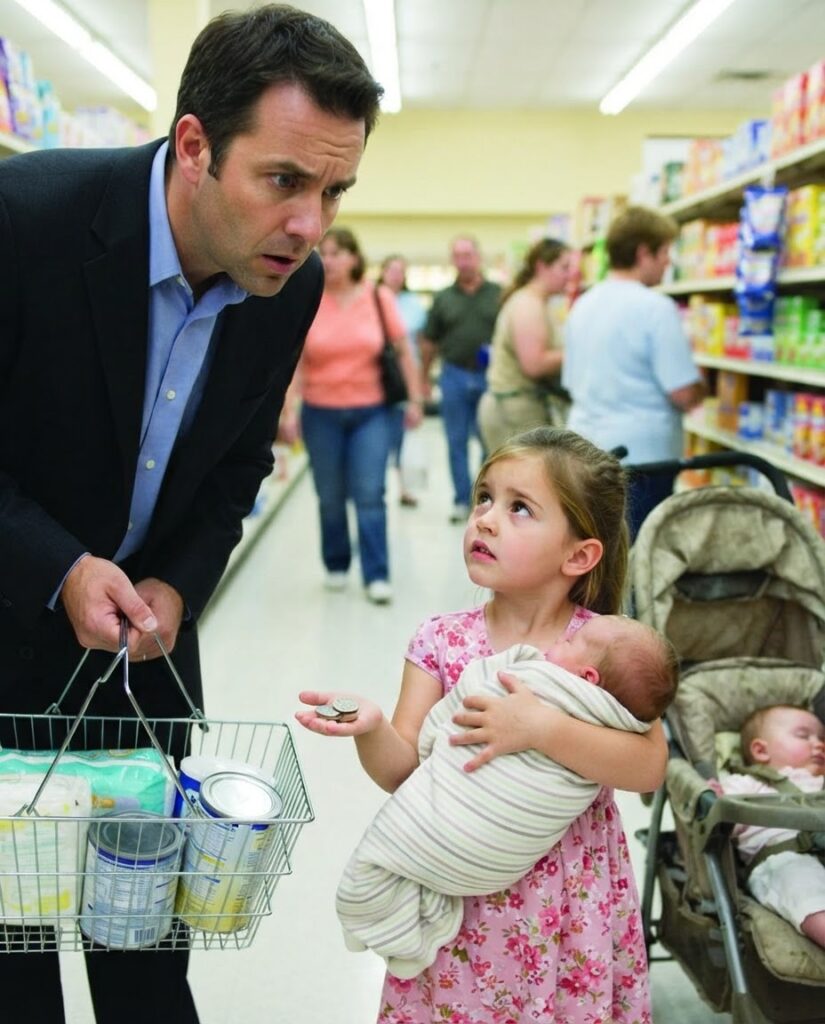
I thought about the afternoon I had first seen her.
A baby against her shoulder.
Coins in her palm.
A stroller with one wheel that pulled slightly to the left.
“You already carry too much.”
That was when Sophie finally cried.
Not loudly.
She climbed onto the chair beside mine, leaned against my arm, and cried so quietly that the people walking past us probably never noticed.
I sat completely still.
I had negotiated acquisitions worth tens of millions of dollars without feeling half as helpless as I did while a six-year-old cried against my coat.
Hannah came home six days later.
She had lost weight.
The first thing she did was apologize.
Not to me.
To Sophie.
“I should’ve realized how sick I was.”
Sophie pressed herself into Hannah’s arms.
“You knew.”
“I knew I wasn’t well. I didn’t know how bad it had gotten.”
“You still should’ve told somebody.”
Hannah closed her eyes.
“I know.”
Mrs. Dawson quietly carried the twins into the kitchen, giving them privacy.
I followed.
A minute later Hannah called my name.
I returned to the living room.
She was still holding Sophie.
“You didn’t have to stay involved,” she said.
“I know.”
“You could’ve called someone and walked away.”
“I know that too.”
Her expression shifted.
I expected gratitude.
Instead, I saw embarrassment.
Perhaps even anger.
“I hate this.”
“I know.”
“No, you don’t.”
That was fair.
She looked around the small living room.
The groceries I had bought were still stacked in places because there was nowhere to put them. New packages of diapers sat beside the sofa. Medication bottles lined the table.
“I had a job,” she said. “I had savings. Not much, but enough. Then the twins came early. Then the medical bills. Then I missed shifts because Sophie got sick, and then I got sick, and suddenly every month became something I had to survive.”
She wiped her cheek impatiently.
“And now every person who looks at me sees a woman who couldn’t feed her children.”
“I don’t.”
Her eyes moved to mine.
“What do you see?”
I thought before answering.
“A mother who waited too long to ask for help.”
“That isn’t much better.”
“No.”
To my surprise, she laughed.
Barely.
But she laughed.
It was the beginning of something.
Not romance.
Not yet, and perhaps not ever.
Something simpler and more difficult.
Trust.
Over the next several weeks, we established rules.
Most of them were Hannah’s.
I could bring groceries, but I was not allowed to quietly pay her rent.
I could help repair the broken back steps because, as she put it, “That’s actually what your company does.”
I could arrange an interview for a bookkeeping position with a nonprofit that bought supplies from one of my businesses, but Hannah had to apply herself.
“If they hire me because of you, I’m quitting,” she warned.
“They won’t.”
“How do you know?”
“Because their finance director dislikes me.”
She stared at me.
“Seriously?”
“She says I talk too much in meetings.”
Hannah smiled.
“I already like her.”
She got the job.
Three mornings a week at first, then four.
A county program helped cover childcare for the twins.
Sophie returned to school full time.
The first Monday I picked her up afterward, she climbed into the passenger seat carrying a construction-paper drawing.
“Mrs. Ramirez told us to draw our family.”
I looked at the page.
There was Hannah.
Sophie.
Two remarkably round babies.
Mrs. Dawson.
And, standing at the far edge, a tall figure with arms nearly as long as his legs.
“Is that me?”
“No.”
I studied it.
“Who is it?”
“You.”
“That feels unnecessarily confusing.”
She giggled.
I pointed at the enormous square in the figure’s hand.
“What am I holding?”
“Your phone.”
“Why is it bigger than my head?”
“Because you’re always looking at it.”
That evening I began leaving my phone in the car when I visited.
By March, Thursday dinner had become a tradition.
Not because anyone decided it should.
It simply happened.
Mrs. Dawson came sometimes. Other evenings it was just Hannah, Sophie, the twins, and me crowded around a table designed for three people.
I learned that Mason liked mashed carrots and Noah considered vegetables a personal betrayal.
I learned Sophie hated mushrooms but would eat them if they were chopped small enough that she couldn’t identify them.
I learned Hannah hummed when she cooked.
And they learned things about me.
Things I had not expected to tell anyone.
My wife, Claire, had died eight years earlier.
Cancer.
We had been married for nineteen years.
We had wanted children.
It never happened.
There had been doctors and treatments early in our marriage, then years of saying perhaps someday we would adopt.
Someday became next year.
Next year became after the business expansion.
Then Claire became ill.
After she died, I stopped thinking about the life we had planned and concentrated on the one I had left.
Work.
That was easier.
Sophie listened to this story one evening while constructing a tower from wooden blocks on the living-room rug.
“So you wanted kids?”
“Yes.”
“But you didn’t get any.”
“No.”
She considered that.
Then pointed at the twins.
“You can borrow those two whenever they’re screaming.”
Hannah laughed so hard she nearly dropped a plate.
I laughed too.
But later, driving home alone through the Milwaukee snow, I realized Sophie’s joke had unsettled something inside me.
My house had been quiet for eight years.
I had called that quiet peace.
Now I was beginning to suspect it had simply been absence.
By April, the snow had melted.
Sophie’s attendance was nearly perfect.
Hannah had regained the weight she had lost and no longer looked as if a strong wind might knock her over.
The twins were sitting with support.
Life had not become easy.
It had become manageable.
There is a difference.
And perhaps that was why none of us noticed the small signs that something else was approaching.
The first was a letter.
I arrived one Thursday carrying a bag of apples and found Hannah standing beside the kitchen counter with an opened envelope in her hand.
When she saw me, she folded it immediately.
“Bad news?”
“No.”
The answer came too quickly.
I set down the groceries.
“You don’t have to tell me.”
“I know.”
She placed the envelope inside a drawer.
Then she smiled.
It was almost convincing.
The second sign came two weeks later.
A dark blue sedan was parked across the street when I arrived.
Its driver remained inside.
I noticed because the engine was running.
When I left two hours later, the car was gone.
“Someone visiting Mrs. Dawson?” I asked Hannah the following week.
“What car?”
I described it.
Her hands stopped moving over the dish towel.
Only for a second.
Then she shrugged.
“Probably.”
I should have asked more.
But Hannah had spent months learning that I could be present without demanding access to every locked room in her life.
I did not want to undo that.
The third sign came from Sophie.
We were sitting on the front steps while Hannah fed the twins inside.
“Mr. Whitaker?”
“Yes?”
“Do grown-ups sometimes come back after they leave?”
I looked at her.
“Sometimes.”
“Even if nobody asks them?”
“Yes.”
She pulled at a loose thread on her sleeve.
“Do they get to change everything?”
Something in her voice made me sit straighter.
“Who came back?”
“Nobody.”
“Sophie.”
She stood.
“Mom says dinner’s ready.”
“Hannah hasn’t called us.”
But she was already through the door.
Three days later, at 8:12 on a Monday morning, Elena Brooks called me.
I remembered the exact time because I was walking into my weekly operations meeting.
“Mr. Whitaker, I need to speak with you regarding the Carter family.”
I stopped in the hallway.
“Is everyone all right?”
“The children are safe.”
Those words did not calm me.
“What happened?”
“There has been a report made to child protective services.”
I stepped into an empty conference room and closed the door.
“What kind of report?”
“I can discuss that better in person.”
“Am I named in it?”
Silence.
That gave me the answer.
“Yes,” Elena said.
I drove to the county office twenty minutes later.
Hannah was already there.
She sat in a chair beneath a window, both hands wrapped around a paper cup she had not touched.
She looked at me.
“I didn’t call you.”
“I know.”
“Elena did.”
“I know.”
“Andrew, I swear—”
“I know.”
Her eyes filled anyway.
Elena entered and closed the office door.
The report was anonymous.
The caller claimed Hannah was becoming dependent on an unrelated wealthy man who had gradually taken control of her household.
Some of the accusations were vague.
Others were specific.
The caller claimed I routinely kept Sophie overnight at my home.
False.
That I had paid Hannah large amounts of cash.
False.
That I had discussed taking legal guardianship of the children.
False.
That Hannah had become unable to make independent decisions because she feared losing my financial support.
Also false.
But there were true details mixed among the lies.
The date I met Sophie.
The grocery store.
Hannah’s hospitalization.
The childcare arrangement.
My Thursday visits.
Even the repair to the back steps.
“That information isn’t exactly secret,” I said.
“No,” Elena agreed. “But taken together, it suggests the reporter has some familiarity with the family.”
Hannah’s face was pale.
“What happens now?”
“We investigate.”
“And the kids?”
“They remain with you unless we identify an immediate safety concern.”
Hannah closed her eyes.
I asked, “And me?”
“For the moment, we’d prefer your contact with the children occur when Hannah or another approved adult is present.”
The words landed harder than I expected.
Sophie and I sometimes went for ice cream.
I occasionally picked her up after school.
I had taken her to the public library twice when Hannah worked late.
Nothing extraordinary.
Nothing secret.
But those ordinary things had become part of our lives.
Now they were evidence to be examined.
“I’ll cooperate,” I said.
Hannah looked at me.
“You don’t have to.”
“Yes, I do.”
That evening, Sophie heard enough of a conversation to understand more than we intended.
She stood halfway down the stairs.
“Are they saying Mr. Whitaker can’t come anymore?”
Hannah looked up.
“Sophie—”
“Because of us?”
“No.”
“Because of him?”
“No.”
“Then why?”
Adults are very good at creating complicated explanations when the truth is frightening.
I decided not to.
“Someone told the county they were worried about the way I’ve been helping your family.”
“Who?”
“We don’t know.”
“So tell them they’re wrong.”
“We will.”
“Then it’s fixed.”
I looked at her.
“It might take some time.”
Her face changed.
“You’re leaving.”
“No.”
“People always say things take time when they’re leaving.”
“I’m not leaving.”
“You can’t promise that.”
I remembered the hospital cafeteria.
Promises count even if you’re scared when you make them.
“I can promise what I control,” I said. “I can’t control what the county decides. I can’t control who made the report. But I can control whether I disappear because things became difficult.”
She stared at me.
“And?”
“And I’m not disappearing.”
She came down the remaining stairs.
Then, because Sophie was still Sophie, she said, “Good.”
As if we had just settled a business agreement.
The investigation lasted eleven days.
They interviewed Hannah.
They interviewed me.
They spoke with Mrs. Dawson, Sophie’s teacher, the childcare provider, and Hannah’s employer.
A worker visited my home.
He seemed surprised by its emptiness.
There were no children’s rooms.
No hidden nursery.
No evidence I had been planning to take anyone.
Just four bedrooms I rarely entered and a kitchen built for a family that never existed.
At one point he noticed a small framed drawing on my refrigerator.
The picture Sophie had made at school.
“You keep that here?”
“Yes.”
“Why?”
I looked at the crooked figure holding the oversized phone.
“Because someone drew me as part of her family.”
The worker studied me.
“That matters to you.”
“Yes.”
“Does Hannah know that?”
I thought about it.
“I don’t know.”
That evening, I told her.
We were sitting on her porch after the twins had fallen asleep.
Sophie was inside doing spelling homework.
Hannah held a mug of tea between her palms.
“The social worker asked whether you matter to me,” I said.
Her eyebrows rose.
“And what did you say?”
“That wasn’t his question.”
“What was?”
“Whether you knew how much all of you matter to me.”
The porch went very quiet.
A car passed at the end of the street.
Hannah stared into her tea.
“Do we?”
“Yes.”
“All of us?”
“Yes.”
She nodded slowly.
“That’s what scares me.”
I had expected almost any answer except that.
“Why?”
“Because Sophie notices everything. She notices when you come. When you leave. When you’re late. She notices the kind of cereal you buy. The songs you skip in the car.”
“That one country song is terrible.”
“That is not the point.”
“I know.”
“She trusts you.”
“I trust her too.”
“That isn’t the same thing.”
“No.”
Hannah looked toward the front window, where Sophie’s shadow moved behind the curtain.
“She has lost people before.”
There was something in the way she said it.
Not generally.
Specifically.
“Hannah.”
She closed her eyes.
“I should have told you.”
My stomach tightened.
“Told me what?”
Before she could answer, the front door opened.
Sophie stood there holding her spelling worksheet.
“Mom, is ‘necessary’ one C or two?”
“One C, two S’s.”
“Who invented that?”
“I don’t know.”
“I don’t like them.”
The moment disappeared.
But not completely.
I remembered it.
Two mornings later, Elena called.
The investigation had found no evidence that the children were being neglected or that I had acted improperly.
I sat back in my office chair.
“So it’s finished?”
“Almost.”
That word again.
Almost.
“There’s another issue,” she said.
“What issue?”
“The report included information we couldn’t initially verify.”
I waited.
“It concerns Sophie.”
I stood without realizing it.
“What about her?”
“I need Hannah present for this conversation.”
We met that afternoon.
Hannah knew before Elena said a word.
I could see it.
Elena placed a thin folder on the table.
“The anonymous caller stated that Hannah Carter is not Sophie’s biological mother.”
I turned toward Hannah.
She was staring at the folder.
“Hannah?”
Her voice came quietly.
“That’s true.”
For several seconds I thought I had misunderstood.
“Sophie is my daughter,” she said quickly. “Legally. Completely. I adopted her.”
I sat down again.
“Why didn’t you tell me?”
“Because it isn’t something strangers need to know.”
“I’m not a stranger.”
“No.”
She looked at me.
“And that’s exactly why it became harder to tell you.”
Elena waited.
Hannah folded her hands.
“My older sister was Sophie’s biological mother.”
The room seemed suddenly smaller.
“Her name was Rachel.”
I remembered Sophie asking whether grown-ups came back after they left.
“What happened to her?”
Hannah stared at the tabletop.
“She disappeared when Sophie was eight months old.”
“Disappeared?”
“She left.”
There was pain in the correction.
“She was twenty-two. She was overwhelmed. Sophie’s father wasn’t involved. Rachel asked me to watch Sophie for two days.”
Hannah swallowed.
“She never came back.”
I said nothing.
“After six months, I filed for guardianship. Later, I adopted Sophie. Rachel never appeared in court. Never answered letters. Never called.”
“And Sophie knows?”
“She knows I adopted her. She knows Rachel was her first mother.”
“Does she remember her?”
“No.”
“Then why is this in the report?”
Elena opened the folder.
“That is what concerns us.”
Inside was a copy of an old court document.
Hannah stared at it.
Her face drained of color.
“That’s from the adoption.”
“Yes.”
“How did the reporter get it?”
“Some adoption records can be accessed under limited circumstances, but this particular copy contains handwritten notes.”
Hannah leaned closer.
Her fingers began trembling.
I saw a faded blue sentence along one margin.
Rachel may return when ready.
“What is that?” I asked.
Hannah didn’t answer.
Elena did.
“According to Hannah, that note was written by her family attorney on Hannah’s personal copy.”
I looked at Hannah.
“Where was your copy?”
“In a box.”
“Where?”
Her eyes met mine.
“My bedroom closet.”
No one spoke.
Then I remembered the envelope.
The blue sedan.
Sophie asking whether people got to change everything when they returned.
“Hannah,” I said carefully, “has someone been inside your house?”
She pressed both hands against the edge of the table.
“I don’t know.”
“Has Sophie seen someone?”
“I don’t know.”
Elena turned another page.
“There’s something else.”
It was a photocopy of a letter.
Unlike the court document, it was recent.
Dated three weeks earlier.
Hannah made a small sound when she saw the handwriting.
I had never heard that sound from her before.
Not even in the hospital.
“You recognize it,” Elena said.
Hannah nodded.
“Whose handwriting?”
For several seconds, she could not answer.
Then she whispered one name.
“Rachel.”
My attention moved from Hannah to the letter.
“What does it say?”
Elena did not hand it to me.
She looked at Hannah instead.
“I think you should tell him.”
Hannah’s eyes were wet now.
“I started getting letters two months ago.”
I thought of the envelope in the kitchen.
“You said it wasn’t bad news.”
“I didn’t know what it was.”
“Why didn’t you tell me?”
“Because I thought somebody was playing some awful joke. Rachel has been gone almost six years.”
“What did the letters say?”
“At first? Nothing important. Things about Sophie when she was a baby. A yellow blanket she liked. A scar on her knee from when she was learning to crawl.”
“Things only Rachel would know.”
“Yes.”
“Then why didn’t you respond?”
“There was no return address.”
Elena glanced down at the page.
“This letter was different.”
Hannah’s voice broke.
“It said she was coming back.”
A long silence filled the room.
I finally understood Sophie’s strange question on the steps.
“She knows.”
Hannah nodded.
“She found one of the letters.”
“What did you tell her?”
“That I didn’t know whether it was really Rachel.”
Elena closed the folder.
“The report appears to have been filed shortly after that letter was delivered.”
“Do you think Rachel filed it?” I asked.
“We don’t know.”
“But whoever filed it had Hannah’s private adoption document.”
“Yes.”
“And knew details about my involvement.”
“Yes.”
Hannah looked suddenly terrified.
“Can Rachel take Sophie?”
“Not simply because she returned,” Elena said. “Hannah is Sophie’s legal parent. An adoption isn’t erased because a biological parent changes her mind years later.”
Hannah’s shoulders loosened slightly.
“But,” Elena continued, “if Rachel is back, we need to understand what she wants and whether she has been attempting direct contact.”
“Why?”
“Because Sophie deserves to know who is approaching her and why.”
The meeting ended with more questions than answers.
Outside, rain had begun falling.
Hannah and I stood beneath the county building’s awning.
“I should’ve told you,” she said.
“Yes.”
“I kept thinking if I ignored the letters, they would stop.”
“They didn’t.”
“No.”
“Did you really believe they were fake?”
“At first.”
“And later?”
She looked toward the rain.
“No.”
That answer hurt more than I expected.
Not because she had lied.
Because I understood why.
Trust is strange.
We think it means telling someone everything.
Sometimes it means believing they will still be there after hearing the thing you were most afraid to tell them.
“I’m still here,” I said.
Hannah looked at me.
“I know.”
It was the first time she said it as if she truly did.
When we returned home, Sophie was at Mrs. Dawson’s.
The twins were asleep.
I helped Hannah check the windows and back door.
Nothing was disturbed.
At the bottom of the bedroom closet sat a cardboard box.
Hannah pulled it forward.
The lid had been replaced crookedly.
Inside were old photographs, hospital bracelets, adoption papers, and a tiny yellow blanket.
She lifted the papers.
Her personal copy of the adoption order was gone.
The copy submitted with the anonymous report had not come from some distant court archive.
Someone had taken it from this house.
Hannah sat back on her heels.
“That doesn’t make sense.”
“Who has a key?”
“Mrs. Dawson.”
“Anyone else?”
“No.”
I thought of the repaired back steps.
The Thursday dinners.
The days Hannah worked.
The afternoon Sophie said people sometimes returned without being invited.
Then the front door opened downstairs.
Hannah froze.
A second later we heard Sophie’s voice.
“Mom?”
We hurried down.
Mrs. Dawson stood in the doorway holding Noah’s diaper bag.
Sophie was beside her.
Something was wrong.
Sophie’s face was pale.
Hannah knelt.
“What happened?”
Sophie reached into the pocket of her coat.
“I didn’t want Mrs. Dawson to call anybody because I thought maybe I was wrong.”
She pulled out a folded piece of paper.
“But then the lady came again today.”
Hannah stopped breathing for a second.
“What lady?”
“The one who knows my old name.”
No one moved.
Hannah took the paper.
There were only six words written inside.
You still draw stars backward, Sophie.
Hannah covered her mouth.
Sophie looked from her to me.
“I used to do that when I was little,” she whispered.
Hannah’s hands shook.
“Where did you get this?”
“She was outside school.”
Mrs. Dawson stepped forward.
“I called the school as soon as Sophie told me. They’re checking the cameras.”
Hannah’s voice barely worked.
“What did the woman look like?”
Sophie stared at her mother for a long moment.
Then she walked to the shelf beside the television.
There was a framed photograph there I had seen dozens of times.
Two young women standing beside Lake Michigan.
Hannah at nineteen.
And beside her, an older girl with the same dark eyes.
Sophie picked up the frame.
She pointed to Rachel.
“Her.”
Hannah sat down hard on the edge of the sofa.
For almost six years, Rachel had been a story about someone who had left.
Now she was a woman standing outside Sophie’s school.
A woman who knew where Hannah lived.
Who knew where Sophie went each morning.
And perhaps a woman who had been close enough to watch the four of us slowly become something none of us had expected.
My phone rang.
Elena.
I answered immediately.
“Andrew,” she said, “I just received additional information about the anonymous report.”
I looked at Hannah.
“What information?”
“The caller contacted the office again.”
My eyes moved to the photograph in Sophie’s hands.
“Was it Rachel?”
There was a pause.
“That’s the strange part.”
Hannah stood.
Elena continued.
“The caller says Rachel Carter did not file the report.”
I frowned.
“Then who did?”
“We still don’t know. But the caller gave us something we didn’t have before.”
“What?”
“A name.”
Hannah gripped the back of the sofa.
Elena said it.
I watched every trace of color leave Hannah’s face.
“No,” she whispered.
I covered the phone.
“You know that name?”
She looked at Sophie.
Then at Mason and Noah sleeping peacefully in their carriers.
Finally, she looked at me.
“Yes.”
“Who is it?”
Hannah’s answer was barely audible.
“The one person Rachel was running from when she left.”
And suddenly the anonymous report no longer felt like an attempt to separate us.
It felt like a warning.
END OF PART 2 – LIKE, SHARE AND COMMENT “THE ENTIRE STORY” IF YOU WANT TO READ THE FULL STORY.