Not yet.
So I stayed where I was.
“The first letter is the one Aunt Joanna always knew about,” he said.
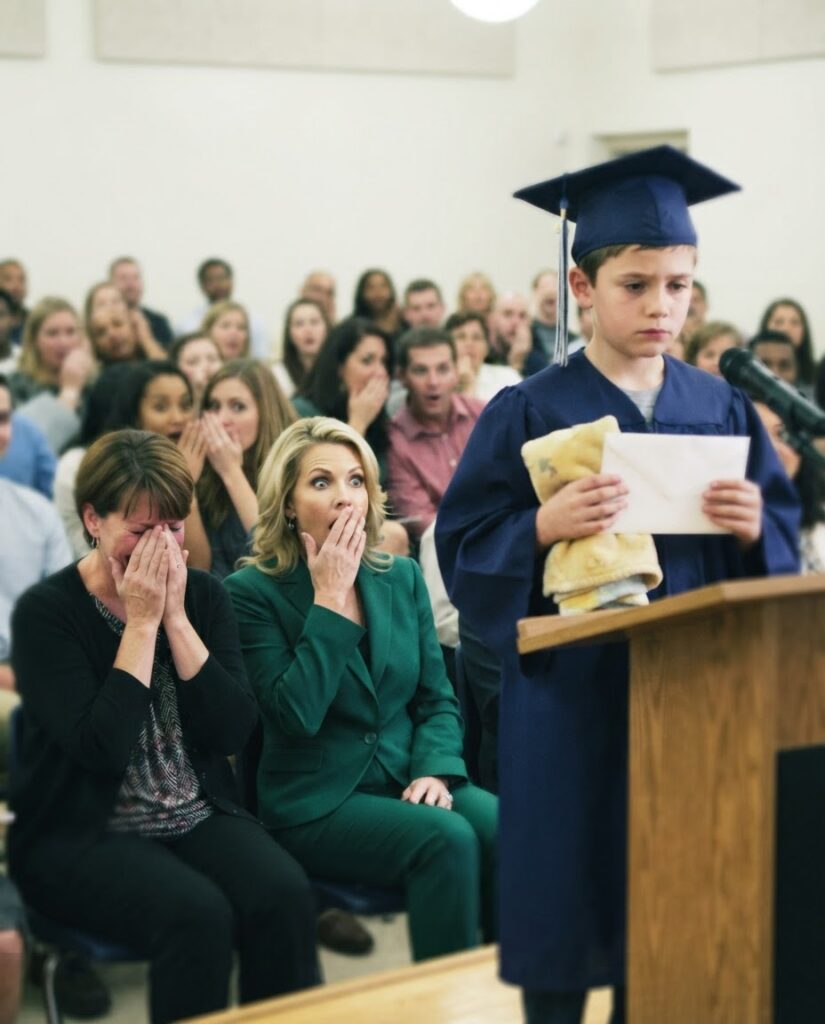
A murmur passed through the room when he called me Aunt Joanna.
Ethan noticed.
He noticed everything.
He gave a small, almost apologetic smile.
“I call her Joanna when I’m explaining biology,” he said. “I call her Mom when I’m talking about my life.”
That was when my eyes filled.
Not because of Denise.
Not because of the cake.
Because of him.
Because even in a moment he had spent years thinking about, he was trying to make the truth precise.
Ethan unfolded the first sheet.
He did not read all of it.
I was grateful.
Some things belonged to families even when those families had failed at keeping them safely.
He read only three sentences.
“Jo, I don’t know how to do this. You do. I know that isn’t fair. I know I’m asking you for something I have no right to ask, but when he is with you, I can see that he feels safe.”
Denise lowered her phone.
Ethan continued.
“If I cannot become the mother he needs, please be the person who stays.”
My hand went over my mouth.
I remembered the letter.
I had read it so many times the first year that the folds had nearly split apart.
But I had forgotten that sentence.
Or perhaps I had trained myself not to remember it.
At twenty-two, I had been angry at Denise for writing it.
At thirty-two, hearing Ethan read it, I heard something else.
Fear.
Shame.
And, buried under both, trust.
Ethan folded the page again.
“That is why I don’t think the first letter proves my biological mother didn’t love me,” he said. “I think it proves she knew she couldn’t take care of me then.”
Denise’s face changed.
Her shoulders dropped slightly.
I watched her stare at our son as if she were hearing her own words spoken back to her from a distance of ten years.
Then Ethan lifted the second envelope.
“This one is different.”
Dad shifted beside Mom.
I noticed immediately.
“Where did you get that?” he whispered.
Ethan heard him.
Of course he did.
“In Grandpa’s desk.”
Dad closed his eyes.
Not with anger.
With recognition.
I turned toward him.
“What letter?”
He did not answer.
Ethan did.
“I found it when I was six.”
A few people in the audience gave nervous little laughs, apparently imagining six-year-old Ethan snooping through drawers.
They did not know him.
At six, Ethan had not snooped.
He had researched.
He had been looking for an old ruler because he wanted to measure the height of the kitchen table after deciding the manufacturer’s dimensions on the website were inaccurate.
He had opened every drawer in Dad’s study with the seriousness of an archivist.
Apparently he had found more than a ruler.
“I knew the yellow blanket letter,” Ethan continued. “Mom showed it to me because I asked why Denise left me.”
He looked at me.
“She didn’t tell me everything at once. She explained more as I got older.”
I nodded, though I doubted he needed my confirmation.
“But this letter was addressed to Grandma and Grandpa.”
Mom gripped the strap of her handbag.
Denise stepped forward half a pace.
“Ethan,” she said softly.
He looked at her.
There was no hatred in his expression.
That almost made it harder to watch.
“I’m not trying to embarrass you,” he said.
Denise swallowed.
“I know.”
“I need you to know that.”
“I do.”
He studied her face for another second, then opened the envelope.
The paper inside was older than the one in the blanket. Creased. Slightly yellow at the edges.
“I’m not going to read most of it,” Ethan said. “Because most of it isn’t anybody else’s business.”
Relief crossed Mom’s face.
Then he read.
“Mom and Dad, please stop calling this temporary when you talk to Joanna. It isn’t temporary unless Joanna wants it to be. I cannot keep asking her to build her life around the possibility that I might suddenly become someone different.”
I looked at Denise.
Her eyes were wet.
Ethan went on.
“I signed the guardianship papers. Joanna should have them. If she wants to raise Ethan, she should never have to wonder whether I can walk in one day and simply take him away.”
The auditorium disappeared around me.
I heard only one phrase.
I signed the guardianship papers.
I turned slowly toward my parents.
Mom stared down at her hands.
Dad looked older than he had that morning.
“What papers?” I whispered.
Neither answered.
Onstage, Ethan lowered the letter.
“I spent four years trying to understand why Mom never knew that letter existed.”
His voice wavered for the first time.
He took a breath.
Then another.
His adviser, Dr. Feldman, rose from the chair behind him and quietly approached.
“You all right?” she asked.
Ethan nodded.
She rested a hand lightly against his shoulder.
That tiny gesture did something the entire ceremony had failed to do.
It reminded everyone in the room that he was ten.
Dr. Feldman leaned toward the microphone.
“I think our valedictorian has earned the right to finish in his own time.”
A few people clapped.
Then more.
The applause grew, not explosive or celebratory, but warm.
Protective.
Ethan looked embarrassed.
That was reassuringly normal.
He waited for the room to settle.
“I’m not telling this story because I think letters decide who a parent is,” he said. “They don’t.”
His eyes found me.
“Days do.”
My breath trembled.
“Ordinary days. School days. Sick days. Bad days. Days when nothing important happens except somebody comes home.”
I stopped trying not to cry.
Beside me, Mom began crying too.
Ethan looked toward Denise.
“And I don’t think biology is meaningless either. I wanted to know where I came from. I still do. But knowing where you come from isn’t the same as knowing where home is.”
Denise nodded once.
Very slowly.
Ethan looked down at the speech he had abandoned.
“I was supposed to say that intelligence is mostly curiosity plus persistence.”
A faint laugh moved through the audience.
“I still think that’s true.”
He smiled.
“But sometimes curiosity finds answers you weren’t actually looking for.”
Then he looked directly at my parents.
“And sometimes adults need to answer questions they hoped would disappear.”
He stepped back from the microphone.
For a terrible second, nobody moved.
Then Dr. Feldman began clapping.
The audience rose.
I remained seated because my legs would not work.
Ethan gathered the blanket and letters, descended the stage steps, and walked straight past Denise.
Straight toward me.
This time, he did not give me a look asking me to wait.
He climbed over the empty chair beside mine and wrapped both arms around my neck.
I held him.
“Was that too much?” he whispered.
It nearly broke me.
“No.”
“Are you sure?”
“Yes.”
“I changed the speech.”
“I noticed.”
“I thought you might.”
I laughed into his hair.
Then I felt another hand on his back.
Denise.
For one instant, all three of us were connected by the same child.
Ethan pulled away first.
Denise did not try to hug him.
That mattered.
Instead, she crouched slightly so they were closer to eye level.
“I owe you a conversation,” she said.
“You owe Mom one first.”
Denise looked at me.
“I know.”
Mom spoke behind us.
“We all do.”
I turned.
My mother looked as though the ten years between Ethan’s birth and this afternoon had settled onto her face in a single hour.
Dad stood beside her holding the ridiculous white cake.
Its red frosting letters suddenly looked painfully childish.
CONGRATULATIONS FROM YOUR REAL MOM.
Dad looked down at it.
Then at me.
“I didn’t order this,” he said.
Mom grimaced.
“I did.”
Denise stared at her.
“You told me you were getting a graduation cake.”
“I thought it would be nice.”
“You wrote that?”
Mom’s eyes moved toward the floor.
“I didn’t think—”
“No,” Denise said quietly. “You didn’t.”
There was no shouting.
No scene.
Somehow that made the truth sharper.
Jonathan, who had remained several steps behind Denise through everything, finally approached.
He carried himself like a man accustomed to entering rooms where decisions were already halfway made, but when he reached Ethan he did not extend a hand or begin talking.
He waited.
Ethan looked at him curiously.
Jonathan nodded toward the abandoned cake.
“For what it’s worth,” he said, “I vote for removing the word real before anyone eats it.”
Ethan considered this.
“Technically, frosting removal has a low success rate.”
Jonathan smiled.
“I was afraid you’d say that.”
Dr. Feldman appeared beside us.
“There’s a conference room behind the faculty lounge,” she said to me. “It has a door that closes.”
I had never loved another adult so quickly.
“Thank you.”
She turned to Ethan.
“And you, Mr. Valedictorian, are supposed to attend a reception.”
“I’d rather not.”
“You are the reason half the donors came.”
“That sounds like their problem.”
Dr. Feldman hid a smile.
“Twenty minutes.”
“Ten.”
“Fifteen.”
Ethan sighed.
“Fine.”
She pointed down the hallway.
“There are miniature cheesecakes.”
He brightened.
“Why didn’t you mention that first?”
And just like that, for a moment, he was ten again.
The adults laughed.
Even Denise.
Especially Denise.
I realized it was the first time I had heard her laugh naturally that day.
The conference room contained a long table, ten padded chairs, a whiteboard, and a bowl of individually wrapped peppermints nobody touched.
Ethan sat beside me.
Denise sat across from us.
My parents took the far end.
Jonathan remained near the door.
“You don’t have to stay,” Denise told him.
“I know.”
She nodded.
He stayed.
I placed both hands on the table.
“Start with the guardianship papers.”
Mom looked at Dad.
Dad looked at Denise.
Denise answered.
“I signed them six weeks after I left.”
“You signed away custody?”
“Not exactly. They were consent papers for you to become Ethan’s legal guardian. A lawyer helped me prepare them.”
“What lawyer?”
“A legal aid office in Columbus.”
“And where are they?”
Dad rubbed his forehead.
“They were in my desk.”
Ethan raised one finger.
“The folder marked E.M.”
Dad glanced at him.
“Yes.”
“You still have them?”
“I believe so.”
I stared at my father.
“You believe so?”
“Joanna—”
“Ten years.”
“I know.”
“No, Dad. I don’t think you do.”
My voice did not rise.
It didn’t need to.
“For ten years, every school authorization, every medical form, every trip, every program application, every time somebody asked what my legal relationship to Ethan was, I had to explain. You had papers that could have helped us?”
Dad exhaled.
“They weren’t complete.”
“What does that mean?”
“The lawyer prepared Denise’s consent. You still had to file your own petition. There would have been a hearing.”
“Why didn’t you tell me?”
Mom answered.
“Because we thought Denise might come back.”
Denise stared at her.
“I told you I wasn’t ready.”
“You were twenty-four.”
“I was twenty-three.”
“You were overwhelmed.”
“Yes.”
“We thought once things settled—”
“They didn’t settle for ten years, Mom.”
My mother flinched.
Denise’s voice softened.
“I’m not saying I made good choices. I didn’t. But I told you not to make Joanna wait.”
Mom looked at me.
“I thought we were protecting everybody from making something permanent too quickly.”
“You protected the possibility of Denise changing her mind,” I said.
Mom nodded helplessly.
“Yes.”
“And what about the possibility of me building a life around the reality I was already living?”
No one answered.
Ethan’s foot touched mine under the table.
A small deliberate press.
I looked at him.
He was watching me closely.
I realized he had spent years trying to solve an adult problem because none of us had been brave enough to put the pieces on the same table.
I took a slow breath.
“Okay,” I said.
Five faces lifted toward me.
“We’re not solving ten years this afternoon.”
Ethan nodded immediately.
“That seems statistically unlikely.”
I almost smiled.
“We’re going to solve today.”
Denise folded her hands.
“All right.”
“First, nobody is taking Ethan anywhere.”
“I know.”
“You said you came to take him home.”
Denise closed her eyes briefly.
“I know what I said.”
“Did you mean it?”
She took a long time answering.
“I meant something,” she finally said. “But not what it sounded like.”
“That is a very Denise answer.”
A trace of the sister I remembered appeared in her expression.
“I deserve that.”
“What did you mean?”
She glanced at Jonathan.
He gave no sign of rescuing her.
Good.
Denise had always been talented at attracting people who finished her sentences.
This man, apparently, would not.
“I came because I thought it was time to be part of Ethan’s life in a real way.”
Ethan’s eyebrows rose.
Denise corrected herself quickly.
“In a consistent way.”
“Better,” he said.
She nodded.
“I have been talking about it for months. I didn’t know how to start.”
“So you chose graduation?”
“It seemed important.”
“That is why it was a bad day to choose,” Ethan said.
Denise accepted that too.
“I see that now.”
I watched her carefully.
“Why now?”
There it was.
The question she had been avoiding.
Denise touched the edge of the envelope.
“Because Jonathan and I are getting married.”
I glanced at him.
He looked mildly uncomfortable at becoming part of the sentence.
Denise continued.
“He has a daughter. Lily. She’s thirteen. We’ve been talking about what family will look like.”
Ethan leaned back.
“So you decided you needed your son.”
Denise winced.
“I realized I had a son I had spent years keeping at a safe distance.”
“Safe for who?”
“For me.”
Her answer came quickly.
It surprised all of us.
Maybe even Denise.
She looked at Ethan.
“You were easier to love from far away.”
Silence.
She shook her head.
“That came out terribly.”
“No,” Ethan said. “It came out accurately.”
Denise’s eyes filled.
“I could send presents. I could tell people about you. I could be proud of you without confronting the fact that I hadn’t earned a place beside you.”
I had never heard my sister speak about herself that way.
Not once.
She continued.
“And then Jonathan asked me what kind of relationship we had.”
Jonathan spoke for the first time.
“She told me Joanna was raising you.”
I looked at Denise.
“From the beginning?”
He nodded.
“She never told me otherwise.”
That surprised me more than I wanted it to.
Denise had posted photographs online that made strangers assume she was far more involved than she was.
But with the man she intended to marry, apparently she had told the truth.
“Then why the performance today?” I asked.
Denise looked embarrassed.
“Because I panicked.”
“The cake wasn’t yours.”
“No.”
“The ‘take you home’ speech?”
“That was mine.”
Ethan’s mouth tightened.
Denise looked at him.
“I had imagined you would be happy.”
“I was happy before you arrived.”
“I know.”
“I mean I’m not unhappy you came.”
She waited.
“I’m unhappy you came with a plan for me that I didn’t help make.”
Something in Denise’s face softened.
“That is fair.”
Jonathan nodded once, almost imperceptibly.
Ethan noticed.
“You agree with me.”
“I do.”
“Did you know she planned to say that?”
“No.”
Denise looked at him.
“You knew I wanted Ethan to spend part of the summer with us.”
“Yes. I didn’t know you intended to announce it as a decision.”
Her face reddened.
“I thought if I sounded certain, it would be easier.”
Jonathan gave a small sigh.
“For whom?”
Denise looked at him.
Then at Ethan.
Then at me.
“For me.”
That answer changed the room.
Not completely.
Not magically.
But enough.
Sometimes the difference between an excuse and an explanation is whether the person offering it still expects to get what they want.
Denise no longer seemed to.
Ethan picked at the corner of the yellow blanket.
“I would visit.”
Denise stared at him.
“What?”
“I said I would visit.”
Hope lit her face so quickly that Ethan immediately held up a hand.
“A visit is not moving.”
“I understand.”
“And Mom comes the first time.”
“Of course.”
“And I’m not calling Jonathan Dad.”
Jonathan nearly choked on a laugh.
“I would be deeply concerned if you did.”
That finally made Ethan smile.
“And I want to meet Lily before anyone decides we are siblings in an emotional sense.”
“Very reasonable,” Jonathan said.
Denise looked between us.
“You’d really come?”
Ethan shrugged with exaggerated casualness.
“I have questions.”
Denise laughed through tears.
“I assumed you might.”
“I made a list.”
“How long?”
“Thirty-seven.”
Jonathan murmured, “I like him.”
Ethan heard.
“I have twelve for you.”
Jonathan sat up straighter.
“Of course you do.”
For a few minutes, the room felt almost possible.
Not healed.
Possible.
There is a difference.
Then I remembered the envelope.
“Why did you keep the second letter?” I asked Ethan.
He looked down.
“I thought you knew about it.”
“At six?”
“Yes.”
“Why?”
“Because you always told me Denise knew you were raising me.”
I nodded.
“So when I read the letter, it matched what you had told me. I thought the adults had already discussed it.”
“And later?”
“When I was eight, I figured out you hadn’t seen it.”
“How?”
“You said something.”
“What did I say?”
“You were filling out the application for the summer institute. They asked for guardianship documents. You said, ‘If Denise ever decides she wants him back, I don’t know what happens.’”
I remembered.
The application had been fourteen pages long.
Ethan had been eating apple slices at the kitchen counter while I muttered at the paperwork.
I had not realized he was listening.
Of course he was listening.
“You were scared,” he said.
“Yes.”
“That was when I knew.”
“Why didn’t you tell me?”
His answer came quietly.
“Because Grandpa told me he would.”
I turned toward Dad.
My father looked stricken.
“Dad?”
He stared at the table.
“I intended to.”
“When?”
“I don’t know.”
“That’s not an answer.”
“No.”
He rubbed his hands together.
“I found Ethan with the letter. I realized what he had read. I told him it was adult paperwork and that I would explain everything to you.”
“And then?”
“I put it off.”
“For four years?”
His eyes met mine.
“I was ashamed.”
The anger that had been building in me shifted shape.
Not gone.
But changed.
Dad had never been a cruel man.
He was a man who hated disappointing people so much that he could delay difficult truths until the delay itself became the greater disappointment.
I had inherited some of that.
Maybe we all had.
“You should have told me.”
“Yes.”
“You should have told Ethan you hadn’t.”
“Yes.”
“You let him carry this.”
Dad looked at Ethan.
“I did.”
Ethan studied him.
“Are you angry that I used the letter?”
“No.”
“Even in front of everyone?”
Dad thought for a moment.
“I wish we had spared you the need.”
That was the first thing anyone had said all afternoon that made Ethan look uncertain.
He blinked.
Then nodded.
“Me too.”
Mom reached for Dad’s hand.
I did not reach for anyone.
Not yet.
There were still too many questions inside me.
The fifteen minutes Dr. Feldman had negotiated became forty.
Eventually she opened the door and informed us that the miniature cheesecakes were disappearing at a statistically alarming rate.
Ethan stood immediately.
“Why did nobody tell me?”
“You were discussing family law,” she replied. “I made a judgment call.”
He hurried out.
Jonathan followed, promising to save him two.
Mom and Dad left more slowly.
Denise remained.
I knew she would.
When the door closed, the two of us sat across from each other.
Sisters.
For years, I had thought of us mostly as opposite sides of Ethan’s story.
I had forgotten there had been a time before him.
Denise had taught me how to braid my hair.
I had covered for her when she missed curfew.
She had sat in the front row at my high school graduation and screamed louder than anyone when my name was called.
Then Ethan happened.
And we became roles instead of sisters.
“You should have told me about the guardianship forms yourself,” I said.
“I know.”
“Why didn’t you?”
“I thought Mom and Dad had.”
“You never checked?”
Denise looked away.
“No.”
“Why?”
“Because checking meant talking to you.”
“That was the point.”
“I know.”
I waited.
She looked back at me.
“You knew exactly what I had done, Joanna. Everybody else could believe whatever version made them comfortable. You couldn’t.”
I said nothing.
“When I talked to you, I felt twenty-three again. Tired. Scared. Certain I had ruined everything.”
“You didn’t ruin everything.”
“I left you with a newborn.”
“Yes.”
“You lost your scholarship.”
The words hit harder than I expected.
“I made a choice.”
“You made a choice after I left you almost no good options.”
“That is also true.”
Denise looked down at her hands.
“I used to tell myself you wanted Ethan.”
“I did.”
“I know. But there’s a difference between wanting him and wanting what happened.”
That distinction settled between us.
I had never said it aloud.
I loved Ethan more than anything in my life.
I would choose him again.
But I had also lost things.
Both statements were true.
And admitting one did not diminish the other.
Denise reached into her handbag.
“I brought something.”
I stiffened instinctively.
She noticed.
“It isn’t another letter from me.”
“Good.”
She almost smiled.
Then she pulled out a manila folder.
“Jonathan found these when he helped me clear out the storage unit last month.”
She pushed it across the table.
My name was written on the tab.
JOANNA — SCHOOL.
I recognized Denise’s handwriting.
“What is this?”
“Things from that year.”
I opened the folder.
There were photocopies of Ethan’s birth certificate.
An old hospital bracelet.
A receipt from the legal aid office.
Then a letter bearing the crest of the college where I had planned to study social work.
My chest tightened.
I unfolded it.
Dear Ms. Hart,
We understand that unexpected family circumstances may affect your ability to enroll for the fall semester…
I stopped.
Looked at Denise.
“What is this?”
Her face had gone pale.
“Keep reading.”
I did.
The scholarship committee had reviewed a request for deferment.
My scholarship, the letter explained, could be held for one academic year.
Tuition support would remain intact.
Housing assistance could be reconsidered upon enrollment.
I read the paragraph twice.
Then a third time.
“I never requested a deferment.”
“I did.”
I stared at her.
“You what?”
“I called the admissions office after I left Ethan with you. They said they couldn’t discuss your file with me, but they told me how you could request a deferment. I wrote a letter explaining there was a family emergency and asked them to contact you.”
“You signed my name?”
“No. Never. I signed mine and explained I was your sister. They sent this because they still needed confirmation from you.”
I looked at the date.
September 18.
Three weeks after I had placed my acceptance letter in the drawer.
My hands began to shake.
“Where did this go?”
“I thought you got it.”
“I didn’t.”
“It was mailed to Mom and Dad’s house.”
I stared at the address.
She was right.
The address was ours.
The house where I had been living.
The house where I had spent mornings warming bottles and afternoons washing tiny socks and nights trying to persuade myself that school could wait.
“I never saw this.”
“I know that now.”
“How?”
“It was in the storage unit.”
“Why?”
Denise shook her head.
“I don’t know.”
“How did a letter addressed to me end up in your storage?”
“I don’t know.”
For once, I believed her immediately.
She looked frightened by the question herself.
“There were two boxes from Mom and Dad’s basement in the unit,” she said. “Dad gave them to me when they renovated six years ago. He said they were my old things. I never opened them.”
I looked back at the folder.
Under the college letter was another page.
A handwritten note.
Not Denise’s handwriting.
Mom’s.
Denise leaned forward.
“I didn’t see that until yesterday.”
I unfolded it.
Joanna—
This came for you. We should talk before you answer. You have enough on your shoulders right now, and I don’t want you making a decision because you feel guilty about school.
Mom.
Nothing else.
No explanation of why the note had never reached me.
No proof that she had deliberately kept it.
Just evidence that she had held the letter in her hands.
I sat completely still.
Denise whispered, “Jo?”
I looked at the date again.
Ten years ago.
One year.
I could have deferred for one year.
Maybe after that year I still would have stayed home.
Maybe I would have attended part-time.
Maybe Ethan’s needs would have made school impossible.
Maybe nothing would have changed.
But the choice had existed.
And I had never known.
“Did Mom put this in the box?” I asked.
“I don’t know.”
“Did Dad?”
“I don’t know.”
“Did you ever ask them?”
“Not yet.”
“Why?”
“Because I thought you should see it first.”
That, more than anything else she had done that day, made me look at her differently.
She had waited.
Not because waiting was easier for her.
Because this truth belonged to me.
I closed my eyes.
For ten years, I had told myself a story.
Denise left.
I stayed.
Therefore I lost school.
Simple.
Clean.
Painful, but clean.
Now the story had another page.
Someone had tried to preserve my scholarship.
Someone else had received the answer.
And somehow, in a house full of people who claimed they were doing what was best for the family, nobody had placed the decision back into my hands.
A soft knock sounded.
Jonathan opened the door.
“Sorry. Ethan says there are exactly three cheesecakes remaining and this information may be time-sensitive.”
Neither Denise nor I moved.
He looked at our faces.
“What happened?”
Denise looked at me, leaving the answer to me.
I folded the college letter carefully along its old crease.
“There’s another thing my family forgot to tell me.”
Jonathan’s eyes settled on the folder.
He did not ask.
From the hallway, Ethan called, “Mom?”
My son.
My home.
The life I had chosen after choices had already been made around me.
“I’m coming,” I answered.
I stood, carrying the letter with me.
At the door, Denise touched my arm.
“Joanna.”
I turned.
“If you had known,” she said, “would you have gone?”
I looked through the doorway.
Ethan stood at the end of the hall holding two miniature cheesecakes, one in each hand.
He had frosting on the sleeve of his graduation gown.
He looked happy.
Safe.
Mine in every way that mattered and never mine in the way possession mattered.
Behind me was the letter from the life I had once imagined.
Ahead of me was the child who had become the center of the life I actually lived.
And for the first time in ten years, I realized the question was not whether I regretted choosing Ethan.
I didn’t.
The question was whether I had ever truly been allowed to choose everything else.
I looked at Denise.
“I don’t know.”
And that answer frightened me more than certainty would have.
Because folded inside my hand was proof that ten years earlier, another door had opened.
Someone had simply forgotten to tell me it was there.
-END OF PART 2 –PRESS NEX PART IN BOTTOM OF PAGE TO READ NEXT PART
Not perfect.
Better.
I decided families might work the same way.
Denise came to stand beside me.
“You’re not going to ask her?”
“I am.”
“When?”
“When Ethan isn’t five feet away holding cheesecake.”
“He has excellent hearing.”
“Exactly.”
Across the room, Ethan turned.
“I heard that.”
Denise laughed.
I did too.
Then Ethan resumed his conversation.
Jonathan was nearby talking with Dr. Feldman. From the little I could hear, she was explaining the academic program to him.
He asked sensible questions.
Not what will Ethan achieve?
Not how famous could he become?
He asked how many hours Ethan studied.
Whether he had friends his own age.
Whether accelerated students received counseling support.
Whether there were limits on how quickly they could advance.
I liked him for those questions.
Perhaps that was unfair.
Perhaps I had spent so long around adults who saw Ethan’s intelligence before they saw Ethan that basic awareness felt extraordinary.
But I liked him anyway.
“You picked a good one,” I told Denise.
She followed my gaze.
“Jonathan?”
“No. The cake.”
She stared at me.
Then realized I was joking.
“Very funny.”
“I thought so.”
A smile came slowly.
“You like him.”
“I’ve known him for forty-seven minutes.”
“You’ve disliked people faster.”
“That is true.”
Denise nodded.
“He’s patient.”
“With you?”
“Unreasonably.”
“That seems necessary.”
She bumped my shoulder lightly with hers.
For half a second, we were teenagers again.
Then Mom approached carrying two paper plates.
“Cake?”
“No, thanks,” I said.
Denise accepted hers.
Mom looked at me.
She knew.
I saw it immediately.
Her gaze dropped to the manila folder beneath my arm.
The color left her face.
“Oh,” she said.
Just that.
Oh.
Not What is that?
Not Where did you get it?
She knew.
I looked toward Ethan.
He was now trying to convince Jonathan that one could determine the structural integrity of a paper plate using only utensils available on the dessert table.
“Not here,” I told Mom.
She nodded.
“Tonight?”
“Yes.”
Dad joined us.
He saw the folder too.
Unlike Mom, he looked confused.
“What’s that?”
Mom answered before I could.
“The college letter.”
Dad frowned.
“What college letter?”
Mom closed her eyes.
And suddenly I understood something important.
Whatever had happened ten years earlier, my parents did not share the same memory of it.
That made me less angry.
It also made the mystery harder.
We left the auditorium a little after four.
Ethan insisted on carrying his certificate himself.
He also insisted the yellow blanket go into my purse because, according to him, “public display has served its function.”
Denise and Jonathan were staying at a hotel near the university.
My parents planned to drive home.
I expected Ethan to come with me.
Instead, he stood in the parking lot and looked between our cars.
“I want ice cream.”
I blinked.
“You ate three cheesecakes.”
“Two and a half. Jonathan took part of one.”
Jonathan raised a hand.
“Guilty.”
“You want more dessert?”
“This is graduation.”
He said it as though graduation suspended all ordinary dietary rules.
Denise smiled.
“There’s an ice cream place around the corner.”
Ethan looked at me.
“Can we all go?”
All.
That word had rarely included Denise.
“Sure.”
The ice cream shop had six tables, a black-and-white tiled floor, and a teenage employee who looked increasingly confused as Ethan requested samples of four flavors and evaluated them as though defending a thesis.
He finally chose vanilla.
Denise stared at him.
“After all that?”
“Vanilla provides a neutral baseline.”
She looked at me.
“Has he always been like this?”
“Yes.”
“At three?”
“Worse.”
“I heard that,” Ethan said.
“You were supposed to.”
We pushed two tables together.
My parents had already left for home, giving me a quiet promise that we would speak that evening.
That left me, Ethan, Denise, and Jonathan.
A family shape nobody would have predicted that morning.
Ethan took three bites before beginning the interview he had promised.
“Question one.”
Denise put down her spoon.
“We’re doing this now?”
“Yes.”
Jonathan leaned back.
“This should be good.”
Ethan looked at Denise.
“Why didn’t you call on my birthdays?”
She stopped smiling.
“I did sometimes.”
“Three times.”
She nodded.
“You sent packages seven times.”
“Yes.”
“You posted every year.”
Denise lowered her eyes.
“Yes.”
“So why was posting easier than calling?”
There was nothing childish about the question.
But the way Ethan scraped melting ice cream from the edge of his bowl reminded me not to mistake intelligence for adulthood.
Denise seemed to understand the same thing.
She did not drown him in explanation.
“I was embarrassed,” she said.
“Of me?”
“No. Of myself.”
“Why?”
“Because every year I waited, talking to you felt harder.”
“So waiting caused more waiting.”
“Yes.”
“That’s irrational.”
“Very.”
He considered.
“I do irrational things too.”
Denise smiled faintly.
“Like what?”
“I reorganized Mom’s kitchen alphabetically once.”
“You put flour beside forks,” I said.
“It was conceptually consistent.”
“It was chaos.”
Jonathan laughed.
Ethan moved to question two.
“What do you actually know about me?”
Denise looked startled.
“I know you’re brilliant.”
“That’s what strangers know.”
Her face fell.
Ethan continued before the silence grew painful.
“What food do I hate?”
“Broccoli?”
“I like broccoli.”
“Most children hate broccoli.”
“I’m not most children.”
“I’m beginning to understand that.”
He waited.
Denise tried again.
“Mushrooms?”
“No.”
“Olives?”
“No.”
“Tomatoes?”
“Yes.”
His eyes brightened.
Denise brightened too.
“Really?”
“Cooked tomatoes. Raw are acceptable.”
“That seems like an important distinction.”
“It is.”
She pointed her spoon at him.
“I’ll remember.”
“Question three. What am I afraid of?”
Denise stopped.
This one she did not guess.
“I don’t know.”
Ethan looked at me.
I knew.
Silence.
Not quiet.
Silence.
There was a difference.
When Ethan was four, a storm knocked out the electricity overnight. He woke in darkness so complete he could not hear the refrigerator hum or the fan beside his bed.
He had screamed for me.
For years afterward, we kept a small white-noise machine running near his door.
By eight, he no longer needed it.
Mostly.
I waited to see whether he would tell Denise.
“Rooms that are too quiet,” he said.
Denise did not ask why.
That was the right choice.
“Thank you for telling me.”
Ethan nodded.
Question four was about favorite books.
Question five was about school.
Question six was whether Denise wanted other children.
She said she and Jonathan had not decided.
Question seven was about Lily.
Jonathan answered that one.
“She likes soccer, mystery novels, and drawing faces on fruit.”
Ethan frowned.
“Why?”
“I’ve learned not to ask.”
“Is she nice?”
“Usually.”
“Does she know about me?”
“Yes.”
“What did you tell her?”
Jonathan’s expression became serious.
“That Denise has a son who was raised by his aunt, and that you’re important to her even though the relationship is complicated.”
Ethan nodded approvingly.
“That is sufficiently accurate.”
“What was question eight?” Denise asked.
Ethan took another bite of ice cream.
“I decided not to ask it yet.”
Denise looked disappointed.
Then she caught herself.
“Okay.”
That was the moment, more than her explanations in the conference room, when I first believed she might actually be capable of building something with him.
She let the unanswered question remain unanswered.
For Denise, that was growth.
When we finished, Ethan asked Jonathan if Lily liked chess.
“She knows how to move the pieces,” Jonathan said.
“That wasn’t the question.”
“No. She does not like chess.”
Ethan sighed.
“Unfortunate.”
“She may survive without it.”
“Statistically, yes.”
Outside the shop, Denise hesitated before getting into Jonathan’s car.
“Tomorrow?” she asked Ethan.
He looked at me.
I let him answer.
“Lunch.”
Denise smiled.
“Lunch.”
“No surprises.”
“Agreed.”
“No cake with declarations.”
“I promise.”
“Jonathan can come.”
Jonathan placed a hand over his heart.
“An honor.”
Ethan looked at Denise.
“And Mom.”
“Obviously.”
I smiled at the word.
Obviously.
Ten years of motherhood distilled into an assumption so secure it no longer required explanation.
That evening, after Ethan went upstairs to change out of his graduation clothes, my parents sat at my kitchen table.
The manila folder lay between us.
Dad read the college letter twice.
Then he read Mom’s note.
“I never saw this,” he said.
Mom nodded.
“I know.”
“You wrote this?”
“Yes.”
I sat across from her.
“Tell me what happened.”
She held the note carefully by the edges.
“I remember the letter arriving.”
“Why didn’t you give it to me?”
“I meant to.”
The answer irritated me immediately.
“Mom.”
“I know how that sounds.”
“Then explain it better.”
She looked toward the stairs.
“Ethan had been sick that week.”
I remembered.
A fever.
Nothing serious, but at the time every cough from that tiny baby had terrified me.
“You hadn’t slept,” Mom continued. “You were already talking about giving up the scholarship.”
“I had given it up.”
“You said you had.”
“What does that mean?”
“You hadn’t withdrawn yet.”
I stared at her.
“I thought you had.”
“No. Your father kept telling you to wait until you were sure.”
Dad nodded slowly.
“That sounds familiar.”
Mom continued.
“The letter came, and I read the first paragraph because I thought it was financial paperwork.”
“You opened my mail?”
Her eyes dropped.
“Yes.”
Dad looked at her.
“Margaret.”
“I know.”
My mother rarely looked small.
That evening she did.
“I saw that the scholarship could be deferred. And I thought I should talk to you before you answered.”
“Why?”
“Because I was afraid you would go.”
There it was.
No elaborate secret.
No conspiracy.
A simple human fear.
I sat back.
Mom’s hands began to tremble.
“I was exhausted too,” she said. “Your father was working. Denise had left. You were barely sleeping. I had this baby in the house and two daughters whose lives suddenly seemed to be falling apart in different directions.”
“So you kept the letter.”
“For a few days.”
“How many?”
“I don’t remember.”
“Try.”
“A week. Maybe two.”
Dad stared at her.
“You never told me.”
“I intended to.”
“That sentence seems popular in this family,” I said.
Dad accepted the criticism.
Mom did too.
“I put the letter with some of Denise’s paperwork because I didn’t want it lost,” Mom said.
“And then?”
“Your grandmother fell.”
I remembered that too.
Grandma Ruth had broken her wrist that autumn.
Mom spent nearly two weeks driving back and forth to Cincinnati.
“When I came home,” she said, “everything was chaos. You told me you had formally withdrawn from school.”
“I had.”
“So you left the letter where it was.”
I stared at her.
“You knew I could have deferred.”
“Yes.”
“And you said nothing.”
Tears filled her eyes.
“Yes.”
“Why?”
“By then I thought telling you would only make you feel worse.”
I stood and walked to the window.
Outside, Ethan’s bicycle rested against the garage.
The handlebars were slightly crooked because he had tried to adjust them himself.
A normal problem.
I focused on it.
Behind me, Mom said, “I was wrong.”
I kept looking outside.
“I wish I had some explanation that made it smaller,” she continued. “I don’t.”
Dad spoke quietly.
“You should have told us.”
“I know.”
“You should have told Joanna.”
“I know.”
“What happened to the box?” I asked.
Mom wiped her eyes.
“Years later, when we cleared the basement, I thought it was Denise’s. Her name was on most of the papers. Your father took it to her storage unit.”
Dad rubbed his forehead.
“I remember the box.”
That was it.
No grand design.
No scheme.
A letter misplaced first by fear, then by life, then by time.
A lost choice.
Those can hurt as much as deliberate ones.
Sometimes more, because there is nobody cleanly to blame.
I turned back.
“Do you know what I keep thinking?”
Mom shook her head.
“If you had given it to me, I might not have gone.”
She blinked.
“I might have looked at Ethan and decided I couldn’t leave.”
“I know.”
“I might have deferred and then withdrawn a year later.”
“Yes.”
“I might have done exactly what I ended up doing.”
“Yes.”
“But I would have known it was my decision.”
Mom began crying.
Quietly.
I sat again.
“I’m angry.”
“You should be.”
“I don’t know how long.”
“I understand.”
“I don’t want you disappearing because you feel guilty.”
She looked surprised.
“You’re Ethan’s grandmother. You’re my mother. We still have birthdays and dinners and ordinary Tuesdays.”
“I’d like that.”
“But I’m not going to make you feel better before I actually feel better.”
Mom nodded.
“That’s fair.”
Dad reached across the table and covered her hand.
For years, I had confused forgiveness with erasing consequences.
I no longer believed they were the same.
I could love my mother and still need time.
I could understand why she had acted from fear and still wish she had trusted me with my own future.
Both were true.
From the stairs came Ethan’s voice.
“Are you done discussing things I’m not supposed to hear?”
All three of us looked up.
He stood halfway down wearing pajama pants and a T-shirt printed with the periodic table.
“How long have you been there?” I asked.
“Eleven seconds.”
Dad smiled despite everything.
“Precisely?”
“Approximately.”
He came downstairs.
Mom held out her arms, then stopped herself.
“May I?”
Ethan walked into her hug.
She held him gently.
Nothing dramatic.
No speeches.
When she released him, Ethan looked at the folder.
“Another letter?”
“The college one.”
He frowned.
“What college one?”
For once, he had not already discovered the secret.
I almost laughed.
“There was a chance for me to defer my scholarship when you were a baby.”
His eyes widened.
“You could have gone to school?”
“Maybe.”
“And you didn’t know?”
“No.”
He looked at Grandma.
Then Grandpa.
Then me.
His mind was already racing.
I knew the look.
“Stop,” I said.
“I haven’t said anything.”
“You’re calculating alternate timelines.”
He closed his mouth.
Because that was exactly what he was doing.
“There is something important I need you to understand,” I said.
He sat beside me.
“I did not miss school because of you.”
“But—”
“No.”
He waited.
“I missed one path. That is different.”
He looked unconvinced.
“You were a baby. You didn’t decide anything. Adults made choices around you. I made choices too.”
“Would you have gone if you knew?”
The same question Denise had asked.
This time, the answer came more easily.
“I might have.”
He looked down.
“Then your life would be different.”
“Yes.”
“I might be different.”
“Yes.”
He stared at his hands.
I reached across and took them.
“Different is not automatically better.”
He looked up.
“You don’t know what would have happened.”
“Neither do you.”
That stopped him.
“You like unknown variables,” I said. “Try respecting this one.”
A reluctant smile appeared.
“That’s unfair.”
“Why?”
“You used my own reasoning against me.”
“I raised you. I know your weaknesses.”
He leaned against my shoulder.
After a moment, he whispered, “Would you go now?”
I looked at him.
“What?”
“To school.”
I laughed softly.
“I have a job.”
“That wasn’t my question.”
Of course it wasn’t.
I looked at the old college letter.
The paper represented a door that had closed.
But doors were not the same as destinations.
“I don’t know.”
Ethan sat upright.
“You always say ‘I don’t know’ means we need more information.”
“I regret teaching you things.”
“No, you don’t.”
“No.”
“So get more information.”
Mom looked at me.
Dad did too.
I felt suddenly outnumbered.
“What exactly are you proposing?”
Ethan shrugged.
“Ask.”
“Ask whom?”
“The university. Or another university. You wanted social work.”
“Ten years ago.”
“Do you not want it now?”
I opened my mouth.
Nothing came out.
That was answer enough.
The next morning, I woke before Ethan.
I made coffee.
Then I took my old scholarship acceptance letter from the drawer where it had remained all these years.
I had moved apartments twice.
Bought new furniture.
Changed jobs.
Replaced nearly everything I owned.
But somehow that letter had followed me.
I placed it beside my laptop.
At 7:14 a.m., I searched for the university’s adult degree programs.
At 7:36, Ethan wandered into the kitchen.
He saw the screen.
He did not celebrate.
He simply opened the refrigerator.
“Eggs?”
I looked at him.
“That’s all you have to say?”
“You’re gathering information.”
“Yes.”
“That is not yet a decision.”
“No.”
He nodded.
“Then eggs.”
Sometimes raising a genius was profoundly annoying.
Three weeks later, Denise returned to Ohio.
Not for a ceremony.
Not with a cake.
Not with Jonathan.
She came alone.
She asked whether she could take Ethan to lunch.
I said yes.
He said yes.
I did not go.
That was harder than I expected.
For ten years, I had been the person beside him for everything.
Doctors.
Teachers.
Competitions.
Airports.
Bad nights.
Good mornings.
Letting him walk out the door with Denise felt like loosening a knot I had tied around my own heart.
But trust could not grow if I supervised every minute.
They returned three hours later.
Ethan carried a bag from a bookstore.
Denise carried nothing.
“How was it?” I asked.
“Acceptable,” Ethan said.
Denise rolled her eyes.
“He asked me question eight.”
I looked at him.
“What was it?”
He took off his shoes.
“I’ll tell you later.”
Denise did not answer for him.
Another point in her favor.
When she left, Ethan sat at the kitchen table.
“Well?”
I asked.
He turned the bookstore bag around and around.
“Question eight was whether she wished she had kept me.”
I said nothing.
“What did she say?”
“She said wishing is complicated.”
“That sounds like Denise.”
“She said she wishes she had been capable of staying.”
I nodded.
“But she said she doesn’t wish she had taken me away from you.”
I swallowed.
Ethan looked toward the door Denise had just closed.
“I think that was the correct answer.”
“Do you?”
“Yes.”
He went upstairs to read.
I remained at the table for a long time.
By autumn, Denise had visited four times.
Then five.
Sometimes Jonathan came.
Once Lily came too.
She was tall, quiet, and immediately unimpressed by Ethan’s attempt to teach her chess.
“You explain too much,” she told him.
“You ask too few questions.”
“I didn’t ask any.”
“Exactly.”
Twenty minutes later, they were drawing faces on oranges.
I found one in the refrigerator with glasses and an angry expression.
Beneath it, Lily had written DR. ORANGE.
Ethan insisted it was scientifically unserious.
He kept it until the orange went soft.
My parents changed too.
Not dramatically.
Dad brought me the old guardianship folder himself.
We met with a family-law attorney.
Because Denise’s decade-old consent had never been filed, it did not magically resolve everything, but it gave us a starting point.
More importantly, Denise came to the meeting.
She signed new documents.
This time, nothing went into a drawer.
Nothing waited for someone to become ready.
By December, I became Ethan’s legal guardian with Denise’s full consent.
We explained every step to him.
He complained that the forms used unnecessarily repetitive language.
The judge smiled.
“So do most adults.”
Ethan liked her immediately.
Outside the courthouse, Denise handed me a small envelope.
I stiffened.
She laughed.
“It’s not a secret.”
Inside was a card.
No long apology.
No attempt to summarize ten years in perfect language.
Just six lines.
You stayed when I could not.
You raised him without teaching him to hate me.
You gave him a home without pretending his history did not exist.
Thank you is too small.
But it is still true.
Thank you.
I read it twice.
Then I hugged my sister.
Not because everything was repaired.
Because something had begun.
There is a difference.
The following January, I enrolled in two evening courses at a state university thirty minutes from home.
Not the college from the old letter.
Not the exact future I had imagined at twenty-two.
A new one.
Ethan helped me choose classes until I banned him from the process after he suggested I add statistics “for balance.”
“I am thirty-two years old,” I told him.
“That is unrelated to statistical literacy.”
“You are banned.”
“Authoritarian.”
“Go do your homework.”
“I finished it.”
“Then go invent homework.”
He did.
My first night of class, I stood in front of the mirror for fifteen minutes.
I changed shirts twice.
Then three times.
Ethan leaned against the bathroom doorway.
“You’re nervous.”
“I am not.”
“You’ve checked your bag four times.”
“I like preparedness.”
“You forgot a pen.”
I stared at him.
He held one out.
“You’re terrible.”
“You’re welcome.”
At the front door, I stopped.
For years, I had been the person who stayed.
Leaving, even for three hours, felt strange.
Ethan saw it.
“I’ll be fine.”
“I know.”
“Grandpa is coming over.”
“I know.”
“We have dinner.”
“I know.”
“There is no reason for you to remain here.”
“I know.”
He smiled.
“You’re repeating yourself.”
I laughed.
Then I walked outside.
The winter air was cold enough to sting my cheeks.
I sat in the car.
Put both hands on the steering wheel.
And cried.
Not from sadness.
Not exactly from happiness either.
Some emotions do not fit inside one word.
I cried for the twenty-two-year-old woman who had placed an acceptance letter in a drawer.
I cried for the baby who had needed her.
I cried for all the years I had believed one choice had permanently canceled another.
Then I wiped my face and drove to class.
Two years passed.
Ethan turned twelve.
He grew four inches and complained constantly about having to replace trousers.
He remained academically extraordinary.
But he also became obsessed with baking bread for six months, played terrible guitar for three, and developed a friendship with a boy named Marcus who could not solve advanced equations but could beat Ethan at every video game they owned.
I was delighted.
Denise became familiar rather than occasional.
That was what mattered most.
Not dramatic apologies.
Repetition.
Calling when she said she would.
Remembering that Ethan hated cooked tomatoes.
Knowing when his school breaks began.
Sending books he actually wanted.
Listening when he corrected her.
Occasionally telling him he was being rude when he corrected her too sharply.
The first time she did that, Ethan stared at her.
Then at me.
I raised my eyebrows.
“She’s right.”
He looked betrayed.
Denise tried not to smile.
Eventually he said, “Fine.”
It was the most normal exchange the three of us had ever shared.
Jonathan and Denise married in a small ceremony the following spring.
Ethan attended.
So did I.
He did not walk Denise down the aisle.
He did not stand beside Jonathan.
Nobody tried to turn the wedding into a symbolic repair of the past.
He sat with me.
At the reception, Lily dragged him onto the dance floor.
He protested for almost seven full minutes.
Then danced terribly.
I filmed it.
He threatened to revoke my phone privileges.
I reminded him I paid the bill.
Denise saw us laughing and came over.
“What happened?”
“Mom is violating my dignity.”
“I have video.”
Denise held out her hand.
“Send it.”
“You people are impossible.”
He walked away.
Denise watched him go.
Then she looked at me.
“Do you ever stop being amazed?”
“No.”
“Me neither.”
There was no competition in the words anymore.
That mattered.
Three years after his graduation ceremony, Ethan came home one afternoon carrying the yellow blanket.
I had not seen it in months.
“Where did you find that?”
“My closet.”
“You mean the archaeological site?”
“It is organized.”
“It is layered.”
He ignored me and placed the blanket on the table.
The fabric had faded.
One corner was frayed.
“I don’t think I need this anymore.”
I touched the edge.
“You want to get rid of it?”
“No.”
He looked offended.
“I want you to keep it.”
“Why?”
He thought about the answer.
“Because I used to think it was evidence.”
“Of what?”
“That Denise left.”
He sat across from me.
“Then I thought it was evidence that she chose you.”
“And now?”
“It’s a blanket.”
I smiled.
“That sounds healthy.”
“I thought so.”
I folded it carefully.
Not around letters.
Not around secrets.
Just itself.
Ethan watched.
“Mom?”
“Yes?”
“Do you still wish you had gotten the college letter?”
The question surprised me.
“Yes.”
He nodded.
“Even now?”
“Especially now.”
He frowned.
I explained.
“Knowing about it would have given me a choice.”
“But you’re almost finished with your degree now.”
“That doesn’t erase what happened.”
He considered that.
“Are you still angry at Grandma?”
“Sometimes.”
“You still have dinner with her every Sunday.”
“Yes.”
“So you forgave her.”
“I did.”
“But you’re angry.”
“Sometimes.”
He leaned back.
“That seems contradictory.”
“People are contradictory.”
“I dislike that.”
“You’ll survive.”
He smiled.
I reached across the table.
“Forgiveness doesn’t mean pretending something never hurt. It means I decided the hurt doesn’t get to make every future decision for me.”
Ethan became still.
I knew that expression.
He was filing the sentence somewhere.
Maybe for later.
Maybe forever.
The following May, I graduated.
Not at twenty-six as I had once planned.
At thirty-five.
Ethan sat in the audience wearing a tie he hated.
My parents sat beside him.
Denise and Jonathan sat on the other side.
Lily had come home from a school trip early to attend.
When my name was called, I walked across the stage.
I expected to look at Ethan.
Instead, for one moment, I looked at all of them.
My mother crying.
My father clapping.
Denise standing.
Jonathan beside her.
Lily holding up her phone.
And Ethan.
My son was not filming.
He simply watched me.
The same way I had watched him three years earlier.
With certainty.
After the ceremony, he found me in the crowd.
“I have something for you.”
He handed me a white bakery box.
I laughed.
“Should I be concerned?”
“Open it.”
Inside was a small cake.
White frosting.
Blue letters.
No declarations of ownership.
No claims about who was real.
Just four words.
CONGRATULATIONS, MOM. YOUR TURN.
I stared at it.
Ethan shifted awkwardly.
“Lily helped with the frosting.”
“I can tell.”
“Why?”
“One word is sliding.”
“She said that gives it character.”
“She’s right.”
He smiled.
Denise approached.
She looked at the cake.
Then at me.
For a second, memory passed between us.
Another graduation.
Another cake.
Another version of our family.
“I like this one better,” she said.
“So do I.”
Mom joined us.
Her eyes were red.
“I’m proud of you.”
I hugged her.
“I know.”
Dad kissed my forehead.
Jonathan took photographs.
Lily stole frosting.
Ethan objected.
The afternoon became noisy and ordinary.
Exactly what I wanted.
Later, when everyone had gone and the house was quiet, Ethan and I sat on the back steps.
He was fifteen now.
Too tall to fit beneath my chin.
Too independent to need me every minute.
Still mine in the way love meant responsibility, history, and choice.
Not ownership.
Never ownership.
He looked across the yard.
“Do you know what I was going to say in the original graduation speech?”
“The science one?”
“Yes.”
“No.”
He smiled.
“I was going to say that every complicated system depends on initial conditions.”
“That sounds like you.”
“I thought everything could be explained that way. Denise left. You stayed. Everything else followed.”
“And now?”
“Now I think people can introduce new conditions.”
I looked at him.
“That is a terrible metaphor.”
“It is mathematically sound.”
“It is emotionally terrible.”
“You understand it.”
“I do.”
He leaned against my shoulder.
For a while neither of us spoke.
Years ago, silence had frightened him.
Now he could sit inside it peacefully.
That was one of the quietest measures of how much he had grown.
After a minute, he said, “I’m glad you stayed.”
I closed my eyes.
“So am I.”
“But I’m also glad you learned to leave sometimes.”
I laughed softly.
“For class?”
“For yourself.”
That one got me.
I reached over and squeezed his hand.
The yellow blanket was upstairs in my dresser.
The first letter remained inside a box.
The second letter was there too.
So was the old scholarship notice.
I kept all three.
Not because our lives were defined by them.
Because they reminded me how easily families can mistake silence for protection, postponement for kindness, and love for knowing what is best for someone else.
We had all done some version of that.
Denise had assumed distance was easier for Ethan.
Mom had assumed withholding a choice would spare me pain.
Dad had assumed difficult conversations could wait.
I had sometimes assumed protecting Ethan meant making every decision before he could make one himself.
We had not become a better family because one dramatic truth appeared at a graduation.
We became better slowly.
By answering calls.
Showing up.
Giving choices back.
Saying what was difficult while there was still time to say it.
Letting apologies remain imperfect.
Letting forgiveness remain unfinished.
Letting love become something practiced rather than claimed.
Ethan stood.
“I’m hungry.”
“You ate half a graduation cake.”
“That was several hours ago.”
“It was ninety minutes.”
“Time is relative.”
“Not that relative.”
He opened the back door.
“Denise texted.”
I looked up.
“What does she want?”
“She wants to know if we’re coming Sunday.”
“For dinner?”
“Yes.”
“You want to?”
He shrugged.
“Lily will be there.”
I smiled.
“So yes.”
“Yes.”
“Then tell her yes.”
He typed.
A second later his phone buzzed.
“What did she say?”
He showed me.
Great. And tell Joanna I’m making lasagna. No cooked tomatoes for you. I remembered.
Ethan stared at the message.
Then smiled.
A small smile.
But I saw what it meant.
Denise remembered.
Years earlier, in an ice cream shop, she had promised she would.
I put my arm around him.
“Ready?”
“For dinner?”
“For whatever comes next.”
He considered the question with the seriousness he gave everything important.
Then he nodded.
“Yeah.”
We went inside together.
And I thought about that graduation auditorium one final time.
Denise entering in green.
The cake.
The letters.
My anger.
Ethan standing behind a microphone, trying to turn ten years of unanswered questions into something precise enough to understand.
At the time, I thought he had uncovered the truth about our family.
He hadn’t.
Not completely.
The truth turned out to be larger and quieter than any letter.
Denise was his biological mother.
I was the woman who raised him.
My parents had loved us and still made mistakes that cost us years.
Denise had failed him and still found a way to begin again.
I had sacrificed opportunities and still had the right to build new ones.
Ethan could love more than one person without reducing what he shared with me.
None of us needed to win.
None of us needed to disappear.
And home, I finally understood, was not decided by who arrived first, who carried the right title, or who could claim the strongest connection.
Home was built by the people who learned how to stay without trapping one another.
How to return without demanding the past be erased.
How to tell the truth without using it as a weapon.
How to open the door and allow someone else to choose whether to walk through it.
Ten years after Denise placed Ethan in my arms, she returned believing she could announce where he belonged.
She was wrong.
So were the rest of us, in different ways.
Because Ethan had never been a prize to keep or a problem to solve.
He was a person.
And once we finally treated his future—and one another’s—as a matter of choice rather than possession, the question of who was his “real” family stopped needing an answer.
We already knew.
We were.
All of us.
Not in the same way.
Not without scars, mistakes, boundaries, or unfinished conversations.
But truthfully.
And this time, truth was enough.
-END OF PART 3-LET SAY YES AND LIKE, SHARE THIS POST IN FACEBOOK SO THAT WE HAVE THE MOTIVATION TO SHARE MORE STORIES