The Wallet, the Pink Notice, and the Family Secret That Had Waited Twelve Years
For several seconds after Nathaniel Graves ordered the doors locked, nobody in the lobby moved.
Ruby stood in the middle of the polished marble floor with Nathaniel’s wallet pressed against her chest.
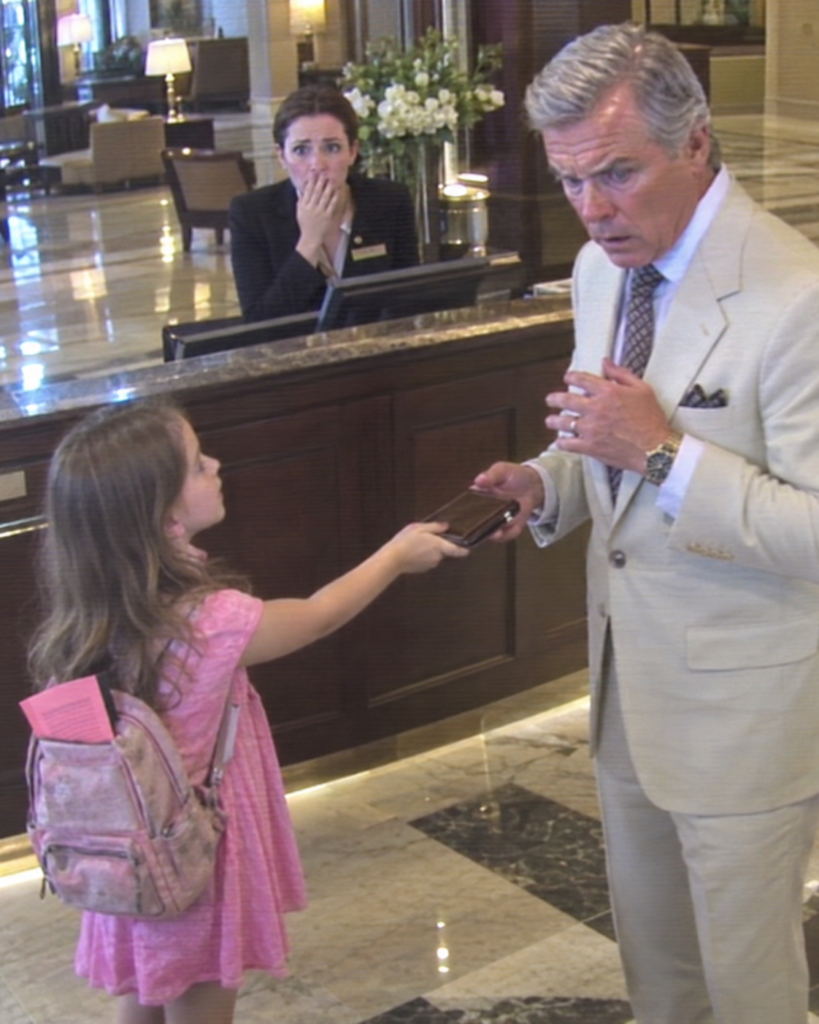
She had expected him to be grateful.
She had imagined handing over the wallet, hearing a quick thank-you, and perhaps making it home before her mother realized she had spent nearly all of her lunch money on bus fare.
Instead, the enormous lobby had gone strangely quiet.
Nathaniel seemed to realize what his words had sounded like.
His expression softened immediately.
“No,” he said, more calmly. “I’m sorry. Nobody is in trouble.”
The security guards stopped.
Nathaniel glanced around the lobby.
“I only meant that I need a few minutes before anyone leaves who may have seen that document. Please unlock the doors.”
One of the guards nodded and touched his radio.
Ruby’s shoulders relaxed a little.
Nathaniel turned toward her.
Up close, he did not look quite like the photographs Ruby had seen in newspapers.
Those photographs always showed him standing at podiums or beside enormous buildings, his silver hair perfect and his expression serious.
Now he looked tired.
And frightened.
Not frightened of Ruby.
Frightened by something he had seen.
He pointed gently toward her backpack.
“May I ask what that pink paper is?”
Ruby looked behind herself as if she had forgotten it was there.
“Oh.”
She pushed the eviction notice deeper into her bag.
“It’s nothing.”
Nathaniel’s eyes remained fixed on it.
“It isn’t nothing.”
Ruby’s cheeks burned.
She hated when people found out about the rent.
At school, she had once overheard two girls whispering about a boy whose family had been evicted. They had spoken as though being poor were something contagious.
“My mom’s handling it,” Ruby said quickly.
Nathaniel was silent.
Then he crouched slightly so he was no longer towering over her.
“I believe you,” he said. “But there is something printed on that notice that I recognize.”
Ruby frowned.
“You read it from way over there?”
“Not all of it. Only the property company.”
Ruby slowly pulled out the pink page.
Across the top, beneath the words FINAL NOTICE, was a company name.
Aldridge Residential Holdings.
Nathaniel stared at it.
His jaw tightened.
“Where do you live?”
Ruby hesitated.
Her mother’s rules immediately came to mind.
Never tell strangers where you live.
Even if the stranger wore an expensive suit.
Even if everyone in the building knew his name.
Nathaniel appeared to understand.
“You don’t have to give me the address,” he said quickly. “Your mother taught you correctly.”
Ruby liked him a little better for saying that.
She handed him the wallet instead.
“You should probably check this first.”
Nathaniel looked down.
“The wallet.”
“There was nine hundred dollars inside.”
His eyebrows rose.
“You counted it?”
“Twice.”
A faint smile appeared on his face.
“And all nine hundred dollars are still there?”
Ruby nodded.
Nathaniel opened the wallet and checked the contents.
Then he closed it.
“What’s your name?”
“Ruby Bennett.”
The smile disappeared.
Not slowly.
Instantly.
Ruby noticed.
She noticed because grown-ups often seemed to forget that children noticed things.
“You know my name?” she asked.
Nathaniel did not answer immediately.
Behind him, his assistant, a woman carrying a tablet, had emerged from the elevator.
“Nathaniel?”
He looked toward her.
“Margaret, cancel my eleven o’clock.”
Margaret blinked.
“It’s the pension committee.”
“Move it.”
“And your lunch with—”
“Move that too.”
Margaret studied Ruby.
Nathaniel handed her the eviction notice.
The moment she read the address printed near the bottom, her expression changed.
“Good heavens,” she whispered.
Ruby’s stomach tightened again.
“What?”
Nathaniel rubbed one hand over his face.
Then he looked at Ruby.
“Ruby, would you allow us to call your mother?”
That sounded reasonable.
It also sounded serious.
“Why?”
“Because there is something about your apartment building that I believe she deserves to know.”
“Are we still getting kicked out?”
Nathaniel’s expression became pained.
“I don’t know yet.”
It was not the answer Ruby wanted.
But it was the first answer he had given that sounded completely truthful.
Ruby gave Margaret her mother’s phone number.
Margaret stepped away.
Nathaniel led Ruby toward a quiet seating area near a wall of enormous windows.
A tray of sandwiches had apparently been prepared for some meeting.
Ruby tried not to stare at them.
Nathaniel noticed anyway.
“Have you eaten lunch?”
Ruby shook her head.
“Why not?”
“I spent my lunch money getting here.”
His eyebrows lifted.
“You spent your lunch money returning my wallet?”
“The bus isn’t free.”
For the first time since seeing the notice, Nathaniel laughed.
It was a soft, surprised laugh.
“No,” he said. “I suppose it isn’t.”
He called over one of the staff members.
“Would you bring Miss Bennett some lunch, please?”
Ruby glanced at the sandwiches.
“Could I just have one of those?”
“You can have anything you want.”
“Just one is fine.”
A turkey sandwich, apple slices, and a glass of milk appeared a minute later.
Ruby ate carefully.
Nathaniel sat opposite her.
He did not touch anything.
Finally Ruby asked the question that had been bothering her.
“Why did my name scare you?”
Nathaniel looked toward the windows.
Far below, cars moved along the streets like tiny metal toys.
“It didn’t scare me.”
“It did.”
Nathaniel looked back at her.
Ruby took another bite of sandwich.
“My mom says grown-ups sometimes answer a different question when they don’t want to answer the real one.”
That almost earned another smile.
“Your mother sounds perceptive.”
“She is.”
Nathaniel folded his hands.
“Then I should try not to insult either of you.”
He leaned back.
“Twelve years ago, my company owned a group of apartment buildings on Aldridge Street.”
“The building where we live?”
“Yes.”
Ruby stopped chewing.
Nathaniel continued.
“Graves Energy is an energy company, but years ago we had a real-estate division. We bought properties near several of our facilities. I was younger then, and I was expanding too quickly.”
“Expanding what?”
“The company.”
“Why?”
Nathaniel paused.
“That’s a very good question.”
Ruby waited.
“At the time,” he said, “I would have told you bigger was always better.”
“And now?”
“Now I would tell you bigger means more things you can fail to notice.”
Ruby was not sure she completely understood that, but she liked the way he said it.
He continued.
“The Aldridge properties were managed by another company. Later, they were sold.”
“To Aldridge Residential Holdings?”
“No.”
That seemed important.
Nathaniel glanced at the notice again.
“That company wasn’t supposed to exist.”
Before Ruby could ask what that meant, Margaret returned.
“Her mother is on her way.”
Ruby sat straighter.
“Is she mad?”
Margaret’s expression softened.
“Mostly worried.”
“That’s worse.”
Margaret almost laughed.
“Probably.”
Nathaniel stood.
“Margaret, get Daniel Cho from legal. And find everything we still have concerning the Aldridge Street properties from twelve to thirteen years ago.”
Margaret hesitated.
“Everything?”
“Especially the Bennett file.”
Ruby’s head snapped toward him.
“There is a file with our name on it?”
Nathaniel went very still.
“Yes.”
“Why?”
He looked down at her.
“I think that is something your mother should explain with us.”
Ruby suddenly lost interest in the rest of her sandwich.
Twenty-six minutes later, the glass entrance doors opened and Claire Bennett hurried into Graves Tower.
Ruby had rarely seen her mother downtown.
Claire worked at a small medical-supply warehouse on the east side and spent most of her days in jeans, comfortable shoes, and a blue company shirt.
Today she still wore that shirt.
One sleeve had a small streak of packing dust across it.
Her brown hair had been pulled into a hurried ponytail.
The moment she saw Ruby, relief flooded her face.
“Ruby.”
Ruby jumped up.
Her mother crossed the lobby and hugged her.
“I called the school.”
“I know.”
“You left after dismissal?”
“Yes.”
“Without telling me?”
Ruby lowered her head.
“I found his wallet.”
Claire closed her eyes.
“Ruby.”
“It had nine hundred dollars in it.”
That made Claire open her eyes.
“And you brought it all the way here?”
“I remembered what you said.”
For a moment, Claire seemed torn between being upset and being proud.
Eventually she kissed the top of Ruby’s head.
“We are having a very long conversation about taking buses alone.”
“Okay.”
“Very long.”
“Okay.”
Only then did Claire seem to notice the man standing several feet away.
Nathaniel had not interrupted them.
Claire’s entire body became still.
Nathaniel spoke first.
“Hello, Claire.”
Ruby looked between them.
Her mother’s face had lost its color.
“You know him too?”
Claire’s eyes remained on Nathaniel.
“Yes.”
The answer was barely audible.
Nathaniel swallowed.
“It’s been a long time.”
“Twelve years,” Claire said.
Ruby looked from one adult to the other.
Exactly twelve years.
The same amount of time Nathaniel had mentioned.
Suddenly the enormous lobby did not seem quite so enormous.
The mystery had narrowed into a small circle containing Ruby, her mother, and Nathaniel Graves.
Claire reached for Ruby’s hand.
“We should go.”
“Claire, please.”
“No.”
“There are things you need to see.”
“I’ve seen enough.”
Ruby tugged gently on her mother’s fingers.
“Mom?”
Claire looked down.
“He has a file with our name.”
Claire’s expression changed.
Nathaniel noticed.
“So you didn’t know?”
“Know what?”
Nathaniel glanced toward Margaret.
Margaret handed him a thin folder that Daniel Cho had just brought downstairs.
Nathaniel did not open it.
Instead, he held it out to Claire.
“The company archives had this.”
Claire stared at the faded file.
Across its front was written:
BENNETT, ELEANOR / CLAIRE
Claire made no move to take it.
Ruby had never heard the name Eleanor Bennett.
“Who’s Eleanor?”
Her mother shut her eyes briefly.
“My mother.”
“My grandmother?”
“Yes.”
“You said Grandma Eleanor died before I was born.”
“She did.”
Nathaniel lowered the file.
He spoke carefully.
“I think we should talk somewhere private.”
Claire looked at Ruby.
Ruby could tell she wanted to leave.
But leaving would not make the folder disappear.
Finally Claire nodded.
“Five minutes.”
Nathaniel’s office was on the forty-second floor, though it was less grand than Ruby expected.
There were bookshelves.
Family photographs.
A battered wooden desk tucked beside a much larger modern one.
A small framed picture showed a much younger Nathaniel standing beside an older woman wearing gardening gloves.
Ruby wandered toward it while the adults sat down.
“That’s my mother,” Nathaniel explained.
“Is she alive?”
“She is. She’s eighty-two and still believes every house needs too many tomato plants.”
Ruby smiled.
Claire did not.
Nathaniel placed the Bennett folder on the coffee table.
“I owe you an apology.”
Claire folded her arms.
“For which part?”
“Possibly several.”
“That’s not an encouraging beginning.”
“No.”
Nathaniel opened the folder.
Inside were property records, letters, photographs, and photocopies of checks.
One letter was handwritten.
Nathaniel slid it toward Claire.
She recognized the writing before touching it.
“Mom.”
Ruby leaned closer.
“Grandma wrote that?”
Claire nodded.
Nathaniel waited.
Eventually Claire picked it up.
The letter was dated twelve years earlier.
Claire read silently.
Her face changed as she moved down the page.
“What does it say?” Ruby asked.
Claire hesitated.
Then she read the important part aloud.
“‘Mr. Graves, I am writing because the tenants at 114 Aldridge were promised an opportunity to purchase the building collectively before any outside sale. We raised the required deposit, and your office confirmed the arrangement. We have now been told those records cannot be found.’”
Claire stopped.
Nathaniel continued quietly.
“Your mother organized the tenants.”
Claire looked at him.
“I knew that.”
“What you may not know is that I agreed to the sale.”
Claire frowned.
“To whom?”
“To the tenants.”
Silence filled the office.
Nathaniel removed another document.
It was a memorandum bearing his signature.
Twelve years earlier, Nathaniel Graves had approved the sale of 114 Aldridge Street to a cooperative created by the residents.
The price was far below market value.
Ruby studied the page without understanding every word.
“So Grandma bought our building?”
“Not exactly,” Nathaniel said. “She and twenty-three other families were supposed to buy it together.”
Claire stared at the memorandum.
“But they didn’t.”
“No.”
“My mother spent the last two years of her life trying to prove there had been an agreement.”
Nathaniel nodded.
“I know.”
Claire looked up sharply.
“You knew?”
“Not then.”
The anger in Claire’s face did not erupt.
It settled.
That somehow made the room quieter.
“When did you know?”
“Three years after she died.”
Claire looked away.
Nathaniel continued.
“The real-estate division was shut down after an internal audit. We discovered that several property transactions had been rerouted through intermediary companies. By the time we traced Aldridge, the original management company had dissolved.”
“Who rerouted it?”
“My former chief financial officer, Malcolm Voss, and two outside partners.”
Ruby listened closely.
She expected the name to mean something.
It did not.
Claire’s expression suggested it did.
“Voss.”
“You remember him?”
“He came to the building.”
Nathaniel nodded.
“He told the residents the cooperative agreement had never been formally approved.”
“He told us my mother had misunderstood.”
“She hadn’t.”
Claire looked down at her mother’s letter.
For years, she had apparently carried one version of the past.
Now another version lay on Nathaniel’s coffee table.
Ruby moved closer to her.
Claire put an arm around her automatically.
“What happened to Voss?” Claire asked.
“He resigned during the audit. There wasn’t enough evidence at the time to prove criminal misconduct concerning Aldridge. Some records were missing. Others appeared legitimate.”
“And you let it go.”
Nathaniel accepted the accusation without arguing.
“Yes.”
Claire looked surprised by the answer.
“I spent years telling myself we’d investigated as far as we could,” he continued. “Legally, perhaps we did. Personally, I stopped asking questions because every answer exposed another mistake made while my name was on the company.”
“That sounds convenient.”
“It was.”
Claire looked at him for a long moment.
Ruby watched both adults.
Neither raised a voice.
But there seemed to be an entire conversation underneath the one she could hear.
Nathaniel reached for the pink eviction notice.
“Then today your daughter walked into my lobby carrying this.”
He tapped the company name.
“Aldridge Residential Holdings.”
Claire frowned.
“You said that company shouldn’t exist.”
“It didn’t twelve years ago.”
Daniel Cho, the attorney, spoke for the first time.
“We checked its corporate registration while you were coming here. Aldridge Residential Holdings was incorporated eighteen months ago.”
Claire stared at him.
“By whom?”
Daniel placed a printed page on the table.
“The listed manager is a company called Voss Property Administration.”
No one spoke.
Even Ruby understood that name.
“Is that the same Voss?” she asked.
Daniel nodded.
“Malcolm Voss’s son, Evan, runs it now.”
Nathaniel leaned forward.
“The ownership is layered through several companies, so we haven’t confirmed who ultimately controls your building.”
Claire looked down at the eviction notice.
“Our landlord changed last year.”
“Did the tenants receive notice of a sale?”
“We received a letter saying management had changed.”
“That isn’t necessarily the same thing.”
Claire’s brow furrowed.
“What are you saying?”
“I’m saying I don’t yet know who legally owns 114 Aldridge Street.”
Ruby raised her hand.
Everyone looked at her.
She lowered it.
“Sorry. School habit.”
Nathaniel smiled faintly.
“Go ahead.”
“If nobody knows who owns our building, can they still kick us out?”
Daniel answered carefully.
“Your mother should keep following the instructions on the notice for now. But before anything happens, we can help her understand whether the notice is valid and whether the company sending it has the authority it claims.”
Claire immediately stiffened.
“I can’t afford Graves Energy lawyers.”
“You won’t be billed,” Nathaniel said.
“I don’t want charity.”
“It’s not charity.”
“Then what is it?”
Nathaniel glanced at Eleanor’s letter.
“Responsibility.”
Claire refused to sign anything.
That surprised Nathaniel less than Ruby expected.
Instead, he gave Claire copies of every document and the contact information for an independent housing attorney named Sofia Ramirez.
“She doesn’t work for me,” Nathaniel explained. “I contacted her office because I wanted you to have someone whose responsibility is only to you.”
Claire studied the card.
“You’re paying her?”
“I offered to cover the initial consultation through a legal-aid fund.”
Claire hesitated.
“I can accept a consultation.”
Nathaniel nodded.
“That’s all I’m asking.”
Ruby sat beside her mother swinging her feet.
Her sandwich had finally been finished.
She still had questions.
A lot of them.
“Why was Mom’s name on the file?”
Claire looked down.
Nathaniel looked at Claire.
Claire sighed.
“Because I lived in the building with Grandma Eleanor.”
“But you don’t live there now?”
Claire smiled sadly.
“We do.”
Ruby blinked.
“Our apartment?”
“The same one.”
Ruby looked astonished.
“Room 3B?”
Claire nodded.
“You grew up in my bedroom?”
“That was my bedroom first.”
Ruby considered this remarkable betrayal of information.
“You never told me.”
“You never asked.”
“I didn’t know I was supposed to ask.”
That finally made Claire laugh.
The tension in the room loosened.
Nathaniel glanced toward the old photograph of his mother.
“Sometimes families forget which stories children don’t know yet.”
Ruby accepted this explanation only partially.
She pointed at the folder.
“So Grandma Eleanor tried to buy the building.”
“With the other tenants,” Claire said.
“And somebody stopped them.”
“Yes.”
“And now the somebody’s son owns it?”
“We don’t know that,” Nathaniel said. “Not yet.”
Ruby thought for a moment.
“Then that’s what we need to find out.”
Three adults looked at her.
“What?”
Nathaniel smiled.
“Nothing.”
“You all made the same face.”
Claire squeezed her shoulder.
“It’s because sometimes you sound exactly like your grandmother.”
Ruby liked the idea.
She had no memories of Eleanor Bennett.
Only one photograph at home showing a round-faced woman with bright eyes holding a flowerpot.
Now, suddenly, Grandma Eleanor had a handwriting style, a building, an argument, and an unfinished plan.
She had become real.
That evening, Claire and Ruby returned to Aldridge Street.
The building looked different to Ruby.
It was still four stories of worn brown brick.
The front step still had a crack running through the middle.
Mrs. Alvarez still had three flowerpots crowded on her third-floor windowsill.
Mr. Harris still sat outside working crossword puzzles in a folding chair whenever the weather was good.
But now Ruby knew something had almost happened here.
Something involving her grandmother.
Something people had forgotten.
Mr. Harris looked up when they approached.
“Ruby! Heard you went downtown.”
Ruby stared.
“How?”
“Mrs. Alvarez.”
Mrs. Alvarez leaned from her window.
“I heard it from your mother when she called asking if you’d come home.”
Claire shook her head.
“News travels faster in this building than electricity.”
“Especially when the electricity works,” Mr. Harris called.
Claire smiled despite herself.
Then Ruby noticed something.
Mr. Harris had lived in 114 Aldridge longer than anyone she knew.
“Mr. Harris?”
“Yes?”
“Did you know my grandma?”
His pencil stopped.
He looked at Claire.
Claire nodded slightly.
Mr. Harris folded his newspaper.
“Eleanor Bennett?”
Ruby sat on the step beside him.
“She tried to buy this building.”
Mr. Harris’s eyes widened.
“Well.”
He removed his glasses.
“Where did you hear that?”
Claire took the copied memorandum from her bag.
“Apparently she came much closer than any of us knew.”
Mr. Harris read the document.
For nearly a minute, he said nothing.
Then he whispered, “I knew she wasn’t imagining it.”
Claire’s eyes filled with questions.
“What do you remember?”
Mr. Harris looked up at the building.
“Your mother collected money from twenty-four families. Five hundred dollars each.”
Claire nodded.
“The cooperative deposit.”
“Twelve thousand dollars.”
Ruby did the math slowly in her head.
“That’s a lot.”
“It was everything some families had,” Mr. Harris said.
“What happened to it?” Claire asked.
“We got it back.”
Claire frowned.
“I remember Mom being furious because the deal fell apart, but I was nineteen. I was working nights. I didn’t understand any of it.”
“The money was returned about six weeks later.”
“By Graves Energy?”
Mr. Harris shook his head.
“No.”
“Then who?”
He closed his eyes, trying to remember.
“A cashier’s check came with a letter. Your mother kept the letter.”
Claire went still.
“Where?”
“No idea.”
Ruby looked at her mother.
Claire looked toward the third-floor windows.
Their apartment.
Her mother’s apartment.
Eleanor’s apartment.
“We still have Grandma’s boxes,” Claire said.
There were six of them.
They had been stacked behind winter coats in the hallway closet for as long as Ruby could remember.
Claire rarely opened them.
Ruby had always assumed they contained boring grown-up things.
Tax records.
Old dishes.
Christmas decorations nobody liked.
That night, the apartment became an excavation site.
Claire ordered pizza because cooking suddenly seemed impossible.
Mr. Harris joined them.
Mrs. Alvarez arrived ten minutes later carrying lemonade and announcing that Eleanor Bennett would personally haunt all of them if they searched her belongings without proper refreshments.
Ruby was allowed to stay up an hour later than usual.
The search turned up photographs first.
Claire at six years old wearing enormous yellow rain boots.
Claire at twelve with braces.
Eleanor standing outside 114 Aldridge beside a row of neighbors.
Nathaniel Graves appeared in one photograph.
Young.
Dark-haired.
Sleeves rolled up.
Ruby held it closer.
“You knew him.”
Claire took the picture.
“I’d forgotten this.”
Mr. Harris leaned over.
“He visited when Graves bought the property.”
Mrs. Alvarez nodded.
“He ate two plates of Eleanor’s rice.”
“That was arroz con pollo,” Mr. Harris said.
“I know what I cooked, Thomas.”
“You said Eleanor’s.”
“She helped.”
Claire laughed softly.
Ruby studied the photograph.
Nathaniel was standing beside Eleanor.
Between them was Claire.
Her mother could not have been much older than Ruby was now.
Something inside Ruby shifted.
People she knew as adults had existed long before her.
They had made promises.
Misunderstood one another.
Changed.
Forgotten things.
Kept other things.
At last Claire found a brown accordion folder marked ALDRIDGE CO-OP.
Inside were copies of tenant signatures, deposit receipts, meeting notes, and correspondence.
Near the bottom was a cream-colored envelope.
Claire pulled out the letter.
Mr. Harris recognized it immediately.
“That’s the one.”
Claire unfolded it.
The letter stated that the cooperative purchase had been canceled because financing requirements could not be met.
Enclosed had been a refund.
But in the bottom right corner was something strange.
Claire pointed.
“This isn’t Graves letterhead.”
Mr. Harris shrugged.
“I didn’t notice back then.”
It came from a company called Northbridge Asset Services.
Ruby watched her mother scan the page again.
Then Claire found another sheet inside the envelope.
A photocopy of the cashier’s check.
At the bottom was a bank routing notation and a handwritten reference number.
Claire took out her phone.
“I’m sending this to Sofia.”
It was almost nine.
Sofia Ramirez called eight minutes later.
Claire put her on speaker.
“Claire, where did you find this?”
“My mother’s records.”
“This changes something.”
Ruby sat straighter.
“What?”
“The refund wasn’t issued by Graves Energy.”
“We noticed.”
“Northbridge Asset Services was the company that acquired the mortgage note on the building six days before the tenant sale was canceled.”
Claire frowned.
“But Nathaniel said Graves still owned the property.”
“According to the documents he gave us, they did.”
“So how could someone else acquire the mortgage?”
“They could acquire debt secured by the building without owning the building.”
Mr. Harris leaned closer.
“English, please.”
Sofia laughed.
“Someone may have placed new debt against 114 Aldridge shortly before the cooperative purchase was supposed to close.”
Claire went quiet.
“Would that have prevented the sale?”
“Potentially.”
“Who owned Northbridge?”
“I don’t know yet.”
Ruby knew the answer before anyone said it.
“Voss?”
Sofia paused.
“I wouldn’t assume that without records.”
Ruby sank back.
“Grown-ups really don’t like guessing.”
“We like guessing,” Sofia said. “Lawyers just prefer proving.”
Ruby decided she liked Sofia.
Claire continued sorting papers while they talked.
Then her hand stopped.
There was something else in the folder.
A sealed envelope.
Unlike the others, this one was not addressed to Eleanor.
Across the front, in faded blue ink, were three words.
For Nathaniel Graves.
Everyone stared at it.
Claire touched the envelope.
“It was never mailed.”
Ruby whispered, “Is it from Grandma?”
Claire recognized the handwriting.
“Yes.”
The envelope remained sealed.
Mr. Harris stood.
“That belongs to Mr. Graves.”
Claire looked at him.
“After twelve years?”
“Especially after twelve years.”
The next morning, Claire called Nathaniel.
This time they did not meet at Graves Tower.
Claire chose Sofia’s office.
Neutral ground.
Nathaniel arrived alone.
He looked genuinely surprised when Claire handed him the letter.
“My mother wrote this.”
“I can see that.”
“She never sent it.”
Nathaniel turned the envelope over.
The seal remained intact.
“Would you like to open it?” Claire asked.
He looked toward Ruby.
Ruby had brought a coloring book but had mostly been listening.
“I think all of us should hear it.”
Nathaniel carefully opened the envelope.
Eleanor’s letter was three pages long.
He began reading silently.
Halfway down the first page, he stopped.
Then he returned to the beginning.
“What?” Claire asked.
Nathaniel raised his eyes.
“Your mother believed someone inside my company was trying to keep me from seeing her correspondence.”
Claire folded her hands.
“Was she right?”
“I don’t know.”
He read further.
Near the end, Eleanor had written about a meeting.
Nathaniel read the paragraph aloud.
“‘You told us at the community hall that you wanted families to have the first chance to own the place they had spent years making into a home. I believed you. I still believe you meant it. That is why I cannot understand why Mr. Voss now says you never approved the cooperative sale.’”
Nathaniel stopped.
His face had become very still.
Claire asked, “Did you say that?”
“Yes.”
“You remember?”
“Clearly.”
Nathaniel lowered the letter.
“I had grown up in rentals. My mother moved us seven times before I finished high school. When Graves Energy started acquiring employee housing, I promised myself we wouldn’t treat people like entries on a spreadsheet.”
He looked around Sofia’s modest conference room.
“And then I became busy enough to do exactly that.”
Nobody replied.
Nathaniel continued reading.
On the final page, Eleanor mentioned something none of them expected.
A meeting scheduled for the following Monday.
She had written:
I have finally found the original purchase authorization bearing your signature, together with the internal routing sheet showing who removed the cooperative file from your office. I will bring both.
Nathaniel slowly lowered the page.
Claire stared at him.
“The original authorization is in the file you already showed us.”
“Yes.”
“But what’s the routing sheet?”
Nathaniel looked toward Sofia.
“In our old system, important documents traveled between departments with a paper log. Whoever received a file signed for it.”
Sofia leaned forward.
“If Eleanor had that sheet—”
“We could know exactly who intercepted the cooperative agreement.”
Ruby looked between them.
“But Grandma said she was bringing both.”
Claire’s expression had changed.
“She never went to the meeting.”
Nathaniel frowned.
“Why not?”
Claire stared at the letter.
“Because she went into the hospital that weekend.”
The room became quiet.
“She died six weeks later,” Claire said. “By then the building deal had been canceled. I was nineteen and trying to keep everything together. Whatever she intended to give you…”
Her voice faded.
Ruby leaned against her arm.
Claire kissed her hair.
Sofia broke the silence gently.
“If the routing sheet existed, Eleanor may have kept it with the original authorization.”
Nathaniel nodded.
“Where?”
Claire shook her head.
“We searched everything.”
Ruby thought about the six boxes.
The accordion folder.
The photographs.
The old apartment.
Then she remembered something.
“Not everything.”
Claire looked down.
“What do you mean?”
“Grandma’s desk.”
Claire stared at her.
“We don’t have Grandma’s desk.”
“Yes, we do.”
“No, sweetheart. The little table in your room came from a thrift shop.”
“Not my desk.”
Ruby pointed toward home as though the building were visible through Sofia’s wall.
“The desk downstairs.”
Mr. Harris had once told Ruby that the old wooden writing desk in the building’s tiny laundry room had belonged to someone who used to handle rent receipts for neighbors.
Claire’s expression slowly changed.
“Mom’s secretary desk.”
Nathaniel looked confused.
Claire stood.
“When management renovated our apartment after she died, I couldn’t keep all her furniture. Mr. Harris asked if the building could use her writing desk downstairs.”
“Has it been there ever since?” Sofia asked.
Claire nodded.
“For twelve years.”
An hour later they stood in the basement laundry room of 114 Aldridge.
The desk was wedged between a vending machine and a shelf of abandoned detergent bottles.
It was scarred, faded, and covered with old community notices.
Mr. Harris met them downstairs.
When Claire explained what they were looking for, he shook his head.
“I’ve opened every drawer in that thing.”
Ruby crouched beside it.
“So did Grandma have secret drawers?”
Mr. Harris smiled.
“Your grandmother believed secrets were simply facts waiting for the correct audience.”
Nathaniel ran his fingers along the wood.
“My mother had a desk like this.”
He pushed one small drawer inward, then lifted it slightly.
Nothing happened.
Mr. Harris pointed toward a decorative wooden strip beneath the writing surface.
“Eleanor once hid Christmas money somewhere in there.”
Claire looked at him.
“You never mentioned that?”
“I forgot.”
Mrs. Alvarez, who had appeared because nobody in 114 Aldridge conducted interesting business without her eventually learning about it, rolled her eyes.
“You remember baseball scores from 1974 but not useful information.”
Nathaniel pressed the wooden strip.
A narrow compartment released with a soft click.
Everyone stopped.
Inside lay a single folded document.
Claire took it out.
The paper had yellowed at the edges.
At the top were the words:
DOCUMENT CONTROL — EXECUTIVE OFFICE
Below that was a chain of names, dates, and signatures.
Nathaniel scanned it.
His finger stopped at one line.
Claire leaned closer.
The file had left Nathaniel’s office twelve years earlier after receiving his signature.
It had gone to corporate finance.
The recipient had signed his name.
Malcolm Voss.
But there was another entry below it.
Three days later, Voss had transferred the file somewhere else.
Not to legal.
Not to real estate.
To a small subsidiary called Northbridge Asset Services.
Sofia exhaled.
“There’s your connection.”
Nathaniel nodded slowly.
Then Ruby pointed toward the bottom.
“What’s that?”
A final handwritten notation appeared beneath the official routing table.
It had been added by Eleanor.
Original copied. Evidence secured with C.B. in case anything happens to me.
Claire’s face went pale.
“C.B.?”
Ruby looked up.
“Is that you?”
“No. My middle name is Marie.”
Nathaniel frowned.
“Do you know anyone with those initials?”
Mr. Harris shook his head.
Mrs. Alvarez did the same.
Claire stared at her mother’s handwriting.
Twelve years earlier, Eleanor Bennett had discovered where the cooperative agreement had been diverted.
She had hidden the routing sheet.
But apparently she had trusted something even more important to someone identified only by two initials.
C.B.
Ruby stood beside her mother’s old family desk, surrounded by adults who had spent twelve years believing the most important evidence had disappeared.
Then she noticed one more thing.
At the bottom of the page, almost hidden beneath Eleanor’s notation, was a date.
The day after the document had been transferred to Northbridge.
And beside it, another handwritten sentence:
Claire knows him. She just doesn’t know what he did for us.
Ruby looked up at her mother.
“Mom?”
Claire stared at the words.
“I don’t know any C.B.”
But the uncertainty in her voice said something else.
Somewhere in the past was a person Claire had forgotten.
Someone Eleanor had trusted.
Someone who might still know why a building meant for twenty-four working families had ended up in somebody else’s hands.
And for the first time, Nathaniel Graves was no longer looking at Ruby’s eviction notice.
He was looking at Claire.
“Think,” he said gently. “Who was C.B.?”
Claire lowered herself into Eleanor’s old chair.
For a long moment she said nothing.
Then, slowly, a memory returned.
A young man who used to carry groceries upstairs for Eleanor.
Someone who had worked nights while Claire worked days.
Someone Eleanor trusted enough to keep a spare key.
Claire whispered his name.
“Caleb Brooks.”
Mr. Harris’s eyes widened.
Nathaniel frowned.
“Who is Caleb Brooks?”
Claire looked at the hidden compartment in her mother’s desk.
“He was my best friend.”
She swallowed.
“And twelve years ago, the week after my mother went into the hospital…”
Claire raised her eyes.
“…Caleb disappeared from Aldridge Street without ever telling me why.”
PART 3
For most of her life, Claire Bennett had told herself that Caleb Brooks had simply left.
People did that.
Especially when they were young.
Especially when they had no money, no property, and no promises strong enough to hold them in one place.
At nineteen, Claire had been angry about it.
At twenty-five, she had stopped being angry.
By thirty, she rarely thought of him at all.
Now she sat at her mother’s old desk in the basement of 114 Aldridge Street staring at the initials C.B.
Ruby stood beside her.
“Was he really your best friend?”
Claire nodded slowly.
“We grew up in this building together.”
“Where did he live?”
“Fourth floor. Apartment 4A.”
Mr. Harris smiled faintly.
“Caleb and Claire were inseparable.”
Mrs. Alvarez folded her arms.
“Until they became teenagers and started pretending they weren’t.”
Claire gave her a look.
“Please don’t make this more interesting than it was.”
“I make no promises.”
Ruby looked delighted.
Nathaniel, however, remained focused on the document.
“What happened to him?”
Claire shook her head.
“I don’t know. He left.”
“When?”
“About twelve years ago.”
“Before or after your mother died?”
Claire thought.
“Before.”
“Before the cooperative collapsed?”
“Just after.”
Sofia Ramirez had joined them downstairs and was photographing the routing sheet for her records.
“Did Eleanor trust him?” she asked.
“Completely.”
“Would she have given him documents?”
Claire hesitated.
“Yes.”
Ruby sat on the edge of an unused folding table.
“Then we find Caleb.”
Claire gave her daughter a tired smile.
“People are slightly harder to find than lost wallets.”
Ruby considered this.
“Did you try the internet?”
Every adult in the room smiled.
Finding Caleb Brooks turned out to be both harder and easier than Ruby expected.
There were hundreds of Caleb Brookses online.
There were teachers.
Contractors.
Dentists.
Musicians.
A man in Nebraska who raised miniature goats.
None seemed connected to Aldridge Street.
Then Mr. Harris remembered that Caleb’s mother had been named Denise.
Mrs. Alvarez remembered Denise had a sister in North Carolina.
Claire remembered Caleb had wanted to become an electrician.
Sofia’s investigator pieced the clues together.
By the following afternoon, she had a likely match.
Caleb Brooks.
Forty years old.
Licensed electrician.
Owner of Brooks Electrical Services.
Living in Richmond, Virginia.
Claire stared at the information on Sofia’s laptop.
Ruby sat beside her.
“That’s him?”
“The age is right.”
“Picture?”
Sofia clicked.
A company website appeared.
The man on the screen had a closely trimmed beard and a broad smile.
Claire covered her mouth.
“That’s him.”
Ruby leaned closer.
“He looks nice.”
“He was.”
Claire corrected herself.
“He is. Probably.”
Nathaniel sat across the conference table.
“Would you like Sofia to contact him?”
Claire hesitated.
Twelve years was a long time.
People built entire lives inside twelve years.
Ruby had been born, learned to walk, learned to read, lost six baby teeth, and developed strong opinions about peas in less time than that.
Claire suddenly wondered whether digging into the past was fair.
Then she looked at the eviction notice.
This was no longer only about memory.
Twenty-four families had once put their savings toward owning 114 Aldridge.
Some had moved.
Some had died.
Others still lived there.
Whatever Eleanor had discovered belonged to more people than Claire.
“Call him,” she said.
Caleb did not answer.
Sofia left a brief message.
She did not mention the documents.
She said only that she was helping Claire Bennett with an old property matter involving Aldridge Street.
Sixteen minutes later, Sofia’s phone rang.
Claire visibly startled.
Sofia answered.
“Mr. Brooks?”
A man’s voice came through the speaker.
“Yes. You said Claire Bennett?”
Claire closed her eyes.
Sofia looked toward her.
“She’s here.”
A pause.
Then:
“Claire?”
She opened her eyes.
“Hello, Caleb.”
For several seconds, neither spoke.
Ruby watched her mother’s face.
There was no anger there.
Mostly surprise.
And perhaps sadness for all the years between one hello and the next.
Caleb finally laughed softly.
“I’ve imagined this conversation about a thousand times.”
Claire’s eyebrows rose.
“You could’ve made it happen.”
“I know.”
The answer was so immediate that Claire’s prepared defensiveness seemed to lose its target.
Caleb continued.
“I should have called years ago.”
“Why didn’t you?”
“I was ashamed.”
“Of what?”
Another pause.
“Of leaving.”
Claire looked down.
Nathaniel remained silent.
Sofia gave them space.
Caleb said, “I didn’t leave because of you.”
“I assumed that eventually.”
“I left because of your mother.”
Claire stiffened.
Ruby looked at her.
Caleb quickly added, “Not because she did anything wrong.”
“Then explain.”
“Eleanor gave me something.”
Claire looked at the routing sheet.
“Documents.”
“Yes.”
“What?”
Caleb took a long breath.
“She found records proving the cooperative purchase had been approved. She also found copies of loan documents connected to Northbridge.”
Nathaniel leaned forward.
“Do you still have them?”
“Who’s that?”
“Nathaniel Graves.”
Silence.
Then Caleb gave a small, disbelieving laugh.
“Well. I guess Ruby really did return your wallet.”
Ruby’s eyes widened.
“How do you know about that?”
Caleb laughed again.
“Sofia told me enough to explain why she was calling.”
Ruby accepted this.
Nathaniel repeated the question.
“Do you still have the records?”
“No.”
Claire’s shoulders fell.
Caleb continued.
“But I know where they are.”
Everyone became still.
“Eleanor didn’t trust keeping everything in one apartment. She asked me to take copies to a lawyer.”
“Which lawyer?” Sofia asked.
“A woman named Miriam Bell.”
Sofia typed the name.
“Did she represent the tenants?”
“Not officially. She was a friend of Eleanor’s from church.”
Claire frowned.
“I remember Miriam.”
“She helped Eleanor create a statement about what had happened.”
“What statement?”
“Everything. The cooperative agreement. The canceled sale. The loan. Voss.”
Nathaniel’s voice was quiet.
“Did Miriam ever contact Graves Energy?”
“She tried.”
Nathaniel looked away.
Caleb continued.
“Then Eleanor got sick.”
Claire squeezed Ruby’s hand.
“Why did you leave?”
This time Caleb took longer to answer.
“My father got a job in Virginia. He wanted me to go with him. I planned to stay in Aldridge.”
Claire remembered that.
Caleb had talked about starting an electrical apprenticeship.
Then, suddenly, his apartment had been empty.
“I visited Eleanor in the hospital,” Caleb said. “She told me the building fight might take years. She told me not to build my entire life around finishing something she had started.”
Claire’s expression softened.
“That sounds like her.”
“She also made me promise I’d tell you where the documents were.”
Claire stared at the phone.
“You didn’t.”
“No.”
“Why?”
“I came to your apartment the night before we moved. You were asleep at the hospital.”
“I spent almost every night there.”
“I left a note.”
Claire frowned.
“There was no note.”
“I put it through your mail slot.”
Mr. Harris suddenly shifted.
“What color envelope?”
Everyone looked at him.
He rubbed his forehead.
“Blue.”
Caleb went quiet.
“Yes.”
Mr. Harris looked horrified.
“Oh, Lord.”
“What?” Claire asked.
“The mailboxes.”
Claire stared.
“What about them?”
“Management replaced them that week.”
Mrs. Alvarez groaned.
“The old boxes were removed before anyone emptied half the slots.”
Mr. Harris nodded.
“There was a whole argument about it.”
Caleb said quietly, “You never got it.”
Claire leaned back.
“No.”
Something that had felt like abandonment for twelve years suddenly became something much smaller and more ordinary.
A note.
A replaced mailbox.
Two young people assuming the worst because neither knew what the other knew.
Claire laughed once.
Not because it was funny.
Because sometimes life changed direction for embarrassingly simple reasons.
“You could have called later.”
“I know.”
“You’ve said that twice.”
“I can say it a third time.”
Claire smiled despite herself.
“Don’t.”
There was warmth in the silence that followed.
Not romance.
Not yet, and perhaps not ever.
Just recognition.
A piece of an old friendship being carefully returned.
Like a wallet found beneath a bus bench.
Miriam Bell had retired eight years earlier.
She was seventy-six and lived forty minutes outside the city.
When Sofia reached her, Miriam remembered Eleanor immediately.
“Of course I remember her,” she said. “Eleanor Bennett never entered a room quietly, even when she didn’t say a word.”
Two days later, they visited her.
Ruby came because Miriam insisted.
“I want to meet Eleanor’s granddaughter.”
Miriam lived in a small white house surrounded by hydrangeas.
She opened the door before they knocked.
Her silver hair was braided over one shoulder.
She took one look at Claire and smiled.
“You have your mother’s eyes.”
Then she looked at Ruby.
“And you have her curiosity.”
Ruby liked her instantly.
They sat around Miriam’s kitchen table drinking lemonade.
Nathaniel did not come.
He had deliberately stayed away.
“This belongs to the Bennetts first,” he had told Sofia. “If they want me involved afterward, I’ll come.”
Claire noticed the gesture.
So did Sofia.
Miriam brought out an old document box.
“I wondered whether anyone would ever ask about this.”
Claire touched the lid.
“You kept it all these years?”
“I was a lawyer. Keeping paper is one of our less charming instincts.”
Inside were copies of everything Eleanor had collected.
The cooperative agreement.
Nathaniel’s signed authorization.
The routing sheet.
Loan documents involving Northbridge.
Letters.
Meeting notes.
And one final affidavit signed by Eleanor.
Sofia spent nearly an hour reviewing the contents.
Ruby colored flowers on scrap paper while listening.
Eventually Sofia sat back.
“This is significant.”
Claire looked at her.
“Does it prove Voss stole the building?”
“No.”
Claire seemed disappointed.
Sofia continued.
“It proves something more useful than a dramatic accusation.”
“What?”
“It proves the tenant cooperative had an enforceable agreement that was improperly interfered with.”
Miriam nodded.
“That was my conclusion twelve years ago.”
Claire frowned.
“Then why didn’t you file a lawsuit?”
Miriam looked at her gently.
“Your mother became very ill.”
“That didn’t erase the agreement.”
“No. But Eleanor asked me not to file.”
Claire stared.
“Why?”
Miriam removed another letter.
This one was addressed to her.
“Eleanor learned that a lawsuit could take years. The tenants would need money. Some families wanted to continue. Others were already frightened about losing their apartments.”
“She gave up?”
Miriam shook her head.
“Eleanor rarely gave up. She changed strategy.”
“What strategy?”
“She wanted to negotiate directly with Nathaniel Graves.”
Claire looked at the papers.
“But she never got the chance.”
“No.”
Miriam folded her hands.
“After she died, I contacted the temporary tenant committee. By then several families had moved, the refunded deposits had been spent, and nobody wanted to begin an expensive legal fight.”
Claire lowered her head.
“I didn’t even know.”
“You were nineteen. You were grieving. Your mother specifically told me not to burden you with the case unless the building became threatened again.”
Claire looked up sharply.
“Threatened again.”
Miriam nodded toward the eviction notice on the table.
“Which, apparently, it has.”
The documents did not produce a miracle.
They produced work.
A great deal of it.
Sofia spent days comparing title records.
Nathaniel opened Graves Energy’s archives to an independent review.
Caleb emailed copies of old correspondence he had kept.
Mr. Harris and Mrs. Alvarez began contacting former tenants.
Ruby created a notebook titled THE ALDRIDGE MYSTERY, though Claire made her promise that homework came first.
Gradually, the history became clear.
Twelve years earlier, Graves Energy had agreed to sell 114 Aldridge Street to the tenants.
Before closing, Malcolm Voss had arranged for Northbridge Asset Services—an entity in which he held a hidden financial interest—to acquire debt secured by the property.
The new debt complicated the cooperative purchase.
Voss then represented internally that the tenants had withdrawn because they could not obtain financing.
To the tenants, he represented that Nathaniel Graves had withdrawn his approval.
Both claims were misleading.
But another discovery surprised everyone.
Malcolm Voss had not personally owned 114 Aldridge for the following twelve years.
Northbridge had sold its interest after only fourteen months.
The building had changed hands three times since.
The present ownership structure was complicated but lawful.
Evan Voss’s management company had recently been hired by the newest investment group.
Claire sat across from Sofia when she explained it.
“So Evan didn’t inherit some secret stolen building?”
“No.”
“And the eviction notice?”
“Your rent is genuinely overdue.”
Claire looked embarrassed.
“I know.”
“But there is an issue.”
“What?”
“The notice includes fees that appear inconsistent with your lease, and the management company failed to apply a payment you made last month.”
Claire blinked.
“I told them that.”
“I know.”
Ruby, drawing beside her, looked up triumphantly.
“So Mom was right.”
“About that payment, yes.”
Claire smiled.
“Take the victories where you can get them.”
Sofia continued.
“Correcting the account won’t solve everything. You’ll still owe back rent.”
Claire’s smile faded.
“How much?”
Sofia gave her the corrected number.
It was less than Claire feared.
Still more than she had.
Nathaniel had offered to pay it.
Claire refused.
Ruby heard them discussing it later.
“You returned nine hundred dollars to me,” Nathaniel told her.
“That was your money.”
“And paying the rent would be my money.”
“Exactly.”
Nathaniel laughed.
“I see where Ruby gets it.”
Claire remained serious.
“I need to be able to support my daughter.”
“Accepting help once doesn’t mean you can’t.”
“No. But the kind of help matters.”
Nathaniel considered this.
“What kind would you accept?”
Claire had an answer.
“Help the building.”
Nathaniel did.
Not by buying it.
Not secretly.
Not by making a grand announcement.
Instead, he commissioned an independent valuation of the damages arising from Graves Energy’s failed cooperative sale twelve years earlier.
His board resisted at first.
The company had changed.
Shareholders had changed.
Employees who had never heard of Aldridge Street wondered why Graves Energy should address a property dispute that had been dormant for more than a decade.
Nathaniel did not force them.
He gave them the complete record.
He acknowledged his own failure to supervise the division properly.
He asked for a vote.
After several meetings, Graves Energy established a restitution fund equal to the amount the original cooperative had lost in appreciation and opportunity, subject to independent review.
Former tenant families could receive individual payments.
Or they could collectively assign their share toward a new purchase effort.
The choice belonged to them.
That mattered to Claire.
“You didn’t decide for us,” she told Nathaniel.
“I’ve had enough experience deciding things for other people.”
Some former tenants wanted their money.
They had built lives elsewhere.
They were entitled to it.
Others wanted to help 114 Aldridge become resident-owned at last.
Mr. Harris pledged his entire share.
Mrs. Alvarez did the same.
Claire chose half.
“You need the other half,” Mr. Harris told her.
“So does the building.”
Ruby was confused.
“If we use all of it, wouldn’t that help more?”
Claire sat with her at the kitchen table.
“Maybe. But Grandma Eleanor wasn’t trying to prove that good people should sacrifice everything.”
“What was she trying to prove?”
“That families deserve a fair chance.”
Ruby thought about this.
“A fair chance isn’t the same as getting everything you want.”
“No.”
“That’s annoying.”
“Extremely.”
The pink eviction notice remained on their refrigerator for three more weeks.
Not because Claire enjoyed looking at it.
Because Ruby had written beneath it:
REMEMBER WHAT STARTED EVERYTHING.
Then, on a rainy Thursday afternoon, Claire came home carrying a white envelope.
Ruby was doing multiplication homework.
Claire put the envelope on the table.
“What’s that?”
“My payment plan.”
Ruby stared.
“Are we staying?”
“We’re staying.”
Ruby jumped from her chair.
Claire barely had time to put down her bag before Ruby hugged her.
The corrected rent account, a temporary assistance grant from the city’s housing stabilization program, and Claire’s new payment arrangement had resolved the immediate eviction problem.
Nathaniel had not paid the rent.
Claire had accepted guidance, legal assistance, and time.
The distinction mattered to her.
Ruby did not understand every detail.
She understood the important part.
Her room remained her room.
The crack in the front step remained their crack.
Mrs. Alvarez’s flowerpots would still be visible from Ruby’s window.
That evening, they removed the pink notice from the refrigerator.
Claire started to throw it away.
Ruby stopped her.
“Can I keep it?”
“Why?”
“For the mystery notebook.”
Claire smiled.
“You inherited entirely too much from your grandmother.”
Caleb returned to Aldridge Street in October.
He drove up on a Saturday morning in a white work van.
Ruby spotted him first.
“Mom!”
Claire came to the window.
For a second, nineteen-year-old Claire seemed to appear inside the woman Ruby knew.
Then she smiled.
They met Caleb on the front steps.
He looked older than the photograph from Sofia’s computer, but his smile was the same.
Claire folded her arms.
“You took twelve years.”
“I hit traffic.”
She laughed.
Then they hugged.
It was not dramatic.
No music played.
Nobody standing nearby burst into applause.
It was simply two old friends discovering that twelve years had changed them without erasing everything.
Caleb crouched beside Ruby.
“So you’re the famous wallet finder.”
Ruby frowned.
“I’m not famous.”
“Your mother has mentioned the wallet about six times.”
Claire objected.
“Twice.”
“At least five.”
Ruby whispered to Caleb, “She exaggerates less than Mrs. Alvarez.”
“Everyone exaggerates less than Mrs. Alvarez.”
From the third-floor window came a shout.
“I HEARD THAT.”
Caleb laughed so hard he had to sit on the steps.
Something about the sound seemed to complete a circle nobody had known was unfinished.
In November, the current owner of 114 Aldridge agreed to consider a purchase proposal from a newly formed resident cooperative.
There was no guarantee.
The building’s value had risen dramatically.
The residents did not have enough money to buy it outright.
But they had the restitution fund.
They had access to community-development financing.
They had legal representation.
Most importantly, they had time to make a real offer.
At the first cooperative meeting, twenty-eight residents crowded into the basement.
Nathaniel sat in the back.
He had been invited by Claire.
Ruby sat beside him drawing houses.
“Did Grandma Eleanor sit here?” she whispered.
“Probably.”
“Did you?”
Nathaniel looked around.
“I sat near that washing machine.”
Ruby pointed.
“That one?”
“I doubt it’s the same washing machine.”
“You never know.”
Nathaniel smiled.
At the front, Claire spoke.
She had never considered herself a public speaker.
But she had spent years handling warehouse schedules, school conferences, rent shortages, broken appliances, and every other ordinary emergency life offered.
Standing in front of neighbors no longer seemed impossible.
“My mother wanted this building to belong to the people who lived in it,” she said. “That was her dream. But we aren’t obligated to repeat her dream exactly.”
Mr. Harris frowned.
Claire continued.
“We need to decide what works for us now. Some people want ownership. Some want stable rent. Some may want to move. Nobody should be pressured because of something that happened twelve years ago.”
Nathaniel watched her carefully.
Ruby watched Nathaniel.
“You agree with her,” Ruby whispered.
“Completely.”
“How can you tell?”
“Because she’s saying something it took me forty years to learn.”
“What?”
Nathaniel leaned closer.
“Helping people make choices is different from making choices for them.”
Ruby wrote this in the margin of her drawing.
She was collecting good sentences.
By spring, the cooperative had enough commitments to submit an offer.
The owners countered.
The residents countered again.
Banks asked questions.
Inspectors found plumbing repairs that nobody had budgeted for.
Three families changed their minds.
Two new families joined.
For weeks it seemed possible.
Then impossible.
Then possible again.
Ruby learned that most important things happened that way.
Not through one enormous moment.
Through dozens of ordinary moments when somebody decided not to quit.
On May 14, the offer was accepted.
Claire read the email three times.
Then she called Mr. Harris.
Mr. Harris called Mrs. Alvarez.
Mrs. Alvarez called half the building before Claire reached the second floor.
By dinner, everyone knew.
The closing would not occur for another sixty days.
Sofia repeatedly warned them that financing still had conditions.
Ruby wrote in her notebook:
DO NOT CELEBRATE TOO EARLY.
Then beneath it:
BUT MAYBE CELEBRATE A LITTLE.
They celebrated a little.
Nathaniel visited Eleanor Bennett’s grave for the first time that summer.
He asked Claire before going.
She came with Ruby.
His mother, Beatrice, came too.
At eighty-two, Beatrice Graves was small, sharp-eyed, and exactly as interested in gardening as Nathaniel had claimed.
She brought flowers from her own yard.
Ruby liked her immediately.
“So you’re the little girl who returned the wallet,” Beatrice said.
“Everybody keeps calling me that.”
“What would you prefer?”
Ruby thought.
“Ruby.”
Beatrice nodded approvingly.
“Ruby it is.”
They stood beside Eleanor’s grave.
Nathaniel placed no grand speech into the quiet afternoon.
He simply said, “I should have paid better attention.”
Claire looked at him.
“You can’t change that.”
“No.”
“But you paid attention when Ruby walked into your lobby.”
Nathaniel smiled toward her.
“She made it difficult not to.”
Ruby was crouched nearby examining a ladybug.
Beatrice watched her son.
“You’ve spent your whole life believing responsibility means controlling the outcome.”
Nathaniel sighed.
“Mother.”
“I’m eighty-two. I’ve earned the right to be inconvenient.”
Claire laughed.
Beatrice continued.
“Sometimes responsibility is staying long enough to hear what happened.”
Nathaniel looked at Eleanor’s name carved into the stone.
“She tried to tell me.”
“Then hear her now.”
The cooperative purchase of 114 Aldridge closed on July 18.
The residents did not become rich.
The building did not magically repair itself.
They inherited a roof that would need replacing within four years, ancient pipes, a temperamental boiler, and enough paperwork to make Mr. Harris threaten retirement from a job nobody had officially given him.
But they owned it together.
Ruby received no apartment building.
No giant inheritance.
No secret fortune.
What she received was something stranger.
A percentage.
A tiny membership share held in trust through Claire’s cooperative interest.
“You mean I own part of the laundry room?” Ruby asked.
Claire laughed.
“Technically, all members collectively own the common areas.”
“I’m saying I own part of the laundry room.”
“Fine.”
“And part of the stairs?”
“Sure.”
Ruby became delighted.
“Do I own the crack outside?”
Claire considered.
“Collectively.”
Ruby wrote MY CRACK in her notebook.
Several weeks later, Nathaniel invited Ruby and Claire back to Graves Tower.
This time the receptionist greeted Ruby by name.
She was not the same receptionist who had threatened to call security.
That woman, Caroline Pierce, was still employed there.
Ruby saw her near the elevators.
Caroline hesitated before approaching.
“Ruby?”
“Hi.”
Caroline looked uncomfortable.
“I owe you an apology.”
Ruby waited.
“I judged you when you walked into the lobby.”
Ruby glanced at her patched backpack.
She still used it.
One strap had been repaired again.
Caroline continued.
“I thought you didn’t belong here.”
“Nobody really belongs in a lobby,” Ruby said.
Caroline blinked.
Claire covered a smile.
Ruby explained, “It’s where people wait before going somewhere else.”
Caroline laughed.
“That’s a fair point.”
Ruby nodded.
“Apology accepted.”
Then she walked toward the elevator.
Claire followed.
Nathaniel was waiting upstairs.
On his desk sat the same black wallet.
Ruby recognized the scratch near one corner.
“You still have it.”
“I do.”
“You should be more careful.”
“I’ve become considerably more careful.”
Nathaniel reached into a drawer.
He handed Ruby an envelope.
She immediately looked suspicious.
“What’s this?”
“A receipt.”
“For what?”
“Open it.”
Inside was a small laminated card.
At the top were the words:
GRAVES COMMUNITY SCHOLARSHIP FUND
Ruby looked confused.
Nathaniel explained.
“After everything happened, several people suggested I give you a reward.”
“I don’t want a reward for returning something.”
“I know.”
“So what is this?”
“A scholarship fund for students from neighborhoods with resident-owned housing cooperatives.”
Ruby stared at him.
“Just for me?”
“No.”
“How many kids?”
“We hope hundreds eventually.”
She considered this.
“Okay.”
Nathaniel smiled.
“Okay?”
“That’s better than giving me money.”
Claire’s eyes softened.
Nathaniel handed Ruby a second item.
Nine crisp one-dollar bills.
Ruby frowned.
“What’s this?”
“Your bus fare and lunch money, with interest.”
“You gave me nine dollars.”
“I rounded up.”
“That’s too much.”
“Ruby.”
She counted the bills.
Then placed four back on his desk.
“This is enough.”
Nathaniel stared at the four dollars.
Claire laughed.
“Don’t argue. You won’t win.”
Nathaniel picked up the money.
“I’ve negotiated billion-dollar contracts.”
“And?”
“I’ve had easier negotiations.”
Ruby put the remaining five dollars in her backpack.
Then she noticed something sitting on Nathaniel’s shelf.
A framed copy of Eleanor’s original letter.
Not the private one.
The first letter asking Graves Energy to honor its promise to the tenants.
Below it was a small metal plaque:
Doing the right thing matters most when nobody’s watching.
Ruby stared.
“That’s what my mom says.”
Nathaniel looked at Claire.
“She told me Eleanor used to say it.”
Claire nodded.
“My mother said it to me. I said it to Ruby.”
Ruby looked from the plaque to her mother.
“So Grandma started it?”
“Apparently.”
Ruby considered the twelve years separating Eleanor’s words from the wallet beneath the bus-stop bench.
“That’s weird.”
Nathaniel smiled.
“Life often is.”
“No. I mean…”
Ruby searched for the right words.
“If Grandma hadn’t said it to Mom, and Mom hadn’t said it to me, I might have kept your wallet.”
Claire raised an eyebrow.
Ruby quickly added, “I wouldn’t have.”
“You admitted you thought about it.”
“For one second.”
“Two.”
“Maybe.”
Nathaniel laughed.
Ruby pointed at the plaque.
“But if I didn’t return it, you wouldn’t have seen the notice.”
“No.”
“And nobody would’ve found Grandma’s papers.”
“Possibly not.”
“And Mom might not have found Caleb.”
Claire smiled.
“And the building?”
Nathaniel answered.
“Someone else might eventually have uncovered the old records.”
Ruby shook her head.
“But they didn’t.”
She stood very still, considering something larger than herself.
She had always imagined important choices felt important when you made them.
Apparently they did not.
Sometimes an important choice looked like nine hundred dollars beneath a rusty bench.
Sometimes it looked like spending lunch money on bus fare.
Sometimes it looked like an old woman saving a document in a wooden desk.
Sometimes it looked like accepting help without surrendering independence.
Or apologizing twelve years late.
Or answering a telephone call.
Or admitting you had failed to pay attention.
Ruby closed her backpack.
“Can we go home now?”
Claire smiled.
“We can.”
Nathaniel walked them to the elevator.
Before the doors closed, Ruby suddenly looked at him.
“Mr. Graves?”
“Yes?”
“Did you ever figure out how you lost your wallet?”
Nathaniel blinked.
Claire laughed.
After everything they had discovered, nobody had asked.
Nathaniel shook his head.
“I believe it fell from my coat when I got out of a car near Aldridge Street.”
Ruby grinned.
“So there wasn’t a mystery?”
“Apparently not.”
The elevator doors began closing.
Ruby waved.
“Sometimes things just fall out of pockets.”
The doors shut.
Nathaniel stood alone for a moment.
Then he looked toward his office, toward Eleanor’s framed letter, and smiled.
Sometimes they did.
And sometimes what fell out was not the thing that mattered.
That evening, Ruby sat on the front steps of 114 Aldridge Street.
The rusty bus stop was visible at the end of the block.
Mr. Harris worked a crossword beside her.
Mrs. Alvarez watered flowers above them.
Caleb was in the basement with Claire, helping repair a light fixture that had flickered for approximately eleven years.
They had become friends again.
Nothing had been rushed.
Nothing needed to be.
Claire had learned that forgiveness did not require pretending the missing years had never happened.
Caleb had learned that regret was useful only when it eventually became action.
Nathaniel had learned that responsibility could not rewrite yesterday, but it could influence what happened tomorrow.
And Ruby had learned that adults were far less certain about everything than they pretended.
She opened her mystery notebook.
On the first page she had written:
THE CASE OF THE BILLIONAIRE’S WALLET
Below it she now added:
Solved. Mostly.
Then she turned to a blank page.
Mr. Harris glanced over.
“What are you writing?”
Ruby thought for a moment.
“The important part.”
“And what’s that?”
She wrote slowly.
Grandma Eleanor never got to see what happened to the building. But that didn’t mean what she did was wasted.
Mr. Harris read it.
“That’s pretty good.”
Ruby added another sentence.
Sometimes a good choice waits years before somebody finds it.
Mr. Harris lowered his crossword.
“That’s even better.”
Ruby closed the notebook.
Across Aldridge Street, evening sunlight turned the windows gold.
Children rode bicycles along the sidewalk.
Someone upstairs was cooking onions.
A radio played softly through an open window.
Nothing about the building looked extraordinary.
It was still old.
Still imperfect.
Still full of people arguing about laundry schedules, hallway noise, parking spaces, maintenance bills, and whose turn it was to sweep the front steps.
But it belonged to them.
Not because one billionaire had rescued them.
Not because Ruby had discovered a hidden fortune.
Not because Eleanor Bennett had secretly arranged everything twelve years earlier.
It belonged to them because enough people, across enough years, had made enough difficult choices to create another chance.
Claire came outside.
“Ruby, dinner.”
“What are we having?”
“Spaghetti.”
“With mushrooms?”
“Yes.”
Ruby groaned.
Caleb appeared behind Claire.
“I voted against mushrooms.”
“You don’t get a vote,” Claire said.
“I was told this was a democracy.”
“The building is. My spaghetti isn’t.”
Mr. Harris laughed.
Ruby stood and slipped the notebook into her backpack.
Before entering the building, she looked once toward the bus stop.
The bench had recently been painted.
The city had replaced the rusted trash can beside it.
Nothing lay underneath.
No wallet.
No money.
No secret waiting to be discovered.
Ruby smiled anyway.
She no longer expected meaningful things to announce themselves.
Sometimes they arrived looking ordinary.
A lost wallet.
A pink notice.
A forgotten letter.
An old friend calling after twelve years.
A mother willing to accept help without surrendering her dignity.
A powerful man willing to admit that power had once kept him from seeing what mattered.
A grandmother leaving behind a promise she would never know had finally been honored.
Ruby climbed the steps.
Claire held the door.
“Hurry up.”
“I’m coming.”
“And wash your hands.”
“I know.”
Ruby stepped inside.
The door closed behind them.
On the wall beside the mailboxes hung a new brass plaque approved by the cooperative.
It did not carry Nathaniel Graves’s name.
It did not carry Claire’s.
It did not even carry Ruby’s.
It read:
114 ALDRIDGE STREET RESIDENT COOPERATIVE
Established from a promise first made twelve years before it was finally kept.
Beneath those words was one smaller line.
In memory of Eleanor Bennett, who believed home should mean having a voice in what happens to it.
And every morning after that, Ruby passed those words on her way to school.
Most days she did not stop.
She had multiplication tests, library books, missing socks, lunches to remember, and buses to catch.
Life continued being ordinary.
But every once in a while, she touched the edge of the plaque.
Then she remembered the day she had stood beneath a rusty bus-stop bench holding nine hundred dollars that could have solved one immediate problem.
She had wanted desperately to keep it.
Instead, she had returned what wasn’t hers.
And somehow, by returning one man’s property, she had helped an entire building reclaim a promise that had belonged to them all along.