PART 2
Boston received us beneath a gray November sky.
Rain streaked the windows of the sedan as we crossed into the city, turning the lights along the Charles River into blurred ribbons of gold. I watched pedestrians hurry beneath umbrellas, couples sharing coats, students balancing coffee cups and backpacks.
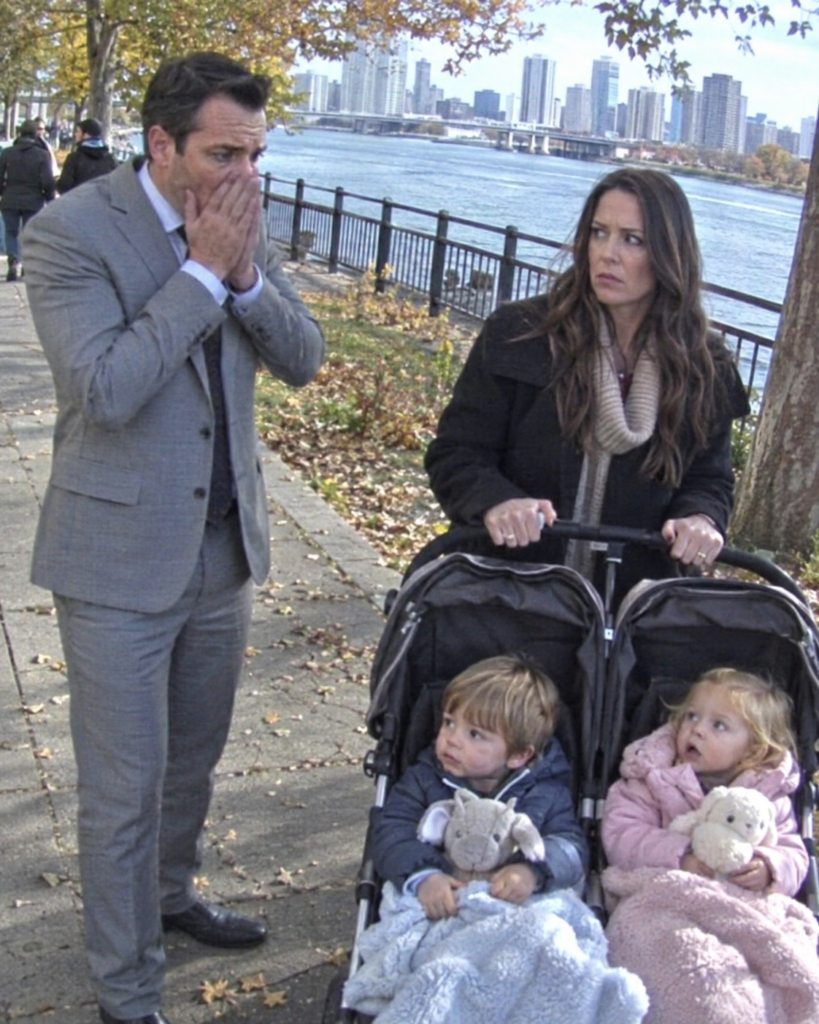
Somewhere among them was Evelyn.
Somewhere, my children were growing up without knowing I existed.
Marcus sat across from me, his phone in one hand and the photograph in the other. He had barely spoken since we left Chicago. That worried me more than any warning could have.
“What did you find?” I asked.
He looked at me through the dim light inside the car.
“Her address is in Cambridge. A small brownstone on Fairmont Street. She works three days a week at a family resource center near the river.”
“And the man?”
“Julian Hart. Thirty-eight. Pediatrician at St. Vincent’s Children’s Clinic.”
I stared at the rain.
“Her husband.”
“That’s what the records say.”
The words landed more heavily than they should have. I had no right to be surprised. Three years had passed. I had walked away from Evelyn with my pride intact and my priorities unchanged. If she had rebuilt her life, I had no one to blame but myself.
Still, imagining another man standing in my kitchen, touching the same coffee mug, hearing the children cry in the middle of the night—
I closed my eyes.
“Do they have his name?”
“The children?”
“Yes.”
“Lily and Samuel Hart.”
Hart.
Not Moretti.
Not mine.
I looked down at the photograph again. Lily was wearing a yellow coat and a knitted hat with two pom-poms. Samuel sat beside her, holding a toy truck. Evelyn’s hand rested on the stroller handle.
She looked peaceful.
That hurt most of all.
Peace was something I had never been able to give her.
Marcus shifted in his seat. “Boss, there’s more.”
“There always is.”
“I accessed the public records and spoke with someone at the resource center. Evelyn doesn’t hide. She’s known in the neighborhood. People trust her.”
I almost smiled, though there was nothing funny about it.
“She always wanted to help people.”
“I know.”
“Does Julian work at the same clinic?”
“No. But he volunteers at the resource center on weekends. He helps with medical referrals and children’s health screenings.”
I turned toward the window.
The image formed too easily: Evelyn laughing with him while he carried the children inside. Julian kneeling to zip Lily’s coat. Julian answering the phone and calling Evelyn his wife.
A life that had continued without me.
Perhaps that was what I deserved.
The car stopped outside the Fairmont Street address just after four. The rain had thinned to a mist, and the brownstone stood between two narrow buildings with bright window boxes and bicycles chained to the railings.
Warm light glowed behind the curtains on the second floor.
I remained in the car.
Marcus opened his door.
“Are you coming?”
“I don’t know.”
He studied me. “You crossed three states.”
“That doesn’t mean I know what to say.”
“You don’t have to say everything tonight.”
“What do I say when she opens the door?”
“The truth.”
I gave him a tired look. “You make it sound simple.”
“It isn’t. But lying would make it worse.”
I stepped out into the cold.
The front gate creaked beneath my hand. I walked up the stone steps slowly, each one making my chest tighter. At the door, I stared at a brass plaque engraved with three names.
Evelyn Hart.
Julian Hart.
Lily and Samuel Hart.
Four names.
There was no room for Adrian Moretti.
I raised my hand and knocked.
For several seconds, nothing happened.
Then footsteps approached.
The door opened, and I saw Julian Hart.
He was taller than I expected, with dark blond hair and a calm, open face. He wore a navy sweater over a white shirt, the sleeves rolled to his elbows. A faint streak of flour marked one cheek.
His eyes moved from me to Marcus, then back again.
Recognition came slowly.
“You’re Adrian,” he said.
Not a question.
I nodded.
Julian stepped outside and closed the door behind him.
The gesture was polite, but careful.
“Evelyn knows you’re here?”
“No.”
“Then you shouldn’t have come.”
“I know.”
That answer seemed to surprise him.
He folded his arms. “What do you want?”
“To speak with her.”
“She doesn’t want contact with you.”
The words struck harder than I expected.
“Did she say that?”
“She said she wanted to be left alone.”
“Three years ago?”
“Repeatedly.”
I looked beyond him toward the warm light under the door.
“Are the children inside?”
Julian’s expression softened. “Yes.”
“Can I see them?”
“No.”
I swallowed.
“I’m their father.”
“You don’t know that.”
“I have reason to believe—”
“You have a photograph.”
His voice remained calm, but there was firmness beneath it.
“Two and a half years ago, Evelyn arrived in Boston with two infants and a suitcase. She had no money, no family here, and no interest in being found. I met her at the resource center. I helped her find housing, a job, and medical care. Over time, we became friends.”
He paused.
“She never told me who the children’s father was.”
I looked at him sharply.
“You knew they weren’t yours?”
“Not biologically. But I became their parent in every way that mattered.”
“And then you married her.”
“Yes.”
“Why?”
Julian’s eyes lowered for a moment.
“Because we loved each other. Because we built something good. Because the children deserved stability. Because Evelyn had spent years believing that if she trusted the wrong person, everything she loved could be taken from her.”
His gaze returned to mine.
“She was afraid of you.”
I had heard those words before, but never from a stranger standing on her doorstep.
“Of me personally?”
“Of your world. Your family. The power surrounding your name.”
“I would never hurt her.”
“I believe you mean that now.”
The door opened behind him.
“Julian?”
Evelyn’s voice.
Every muscle in my body tightened.
Julian turned.
She appeared in the doorway wearing a soft gray cardigan, her brown hair tied loosely at the nape of her neck. She looked older than the woman I remembered, but not diminished. There was a steadiness in her face that had not existed when we were married.
Then she saw me.
The color drained from her cheeks.
“Adrian.”
My name sounded like a memory she had locked away.
I wanted to apologize. I wanted to explain why I had come. I wanted to ask if Lily had my eyes because she was my daughter.
Instead, the only words I could manage were, “Hello, Evelyn.”
Her hand tightened around the edge of the door.
Julian glanced at her. “Do you want me to call someone?”
“No.”
The answer came quietly.
She looked at me again.
“Why are you here?”
“I found out about the children.”
Her face changed—not surprise, exactly. More like exhaustion.
“I wondered when you would.”
The sentence made my heart stumble.
“You knew I might find out?”
“I knew Marcus Reed was very good at his job.”
I looked toward the car, where Marcus stood beneath an umbrella.
“How long have you known?”
“That he was looking for me? Since yesterday.”
“Then why didn’t you call?”
A faint, bitter smile touched her lips.
“You never called me for three years.”
There was no accusation in her voice. That made it worse.
“I didn’t know about Lily and Samuel.”
“You should have.”
“I know.”
She looked away.
Inside the house, a child laughed. Another voice called, “Mommy!”
Evelyn closed her eyes briefly.
That single word seemed to pull her back from the past.
“Would you like to come inside?” she asked.
Julian turned toward her. “Evelyn—”
“I’m not inviting him to stay,” she said. “I only want to hear what he has to say.”
Julian studied her, then stepped aside.
I entered the house.
The first thing I noticed was how ordinary it was.
A small entryway. Children’s boots lined beside the radiator. A bowl filled with colorful hair clips. Drawings taped to the wall. There was a wooden train set beneath the staircase and a framed photograph of Evelyn holding two newborn babies.
She was crying in the picture.
Not from sadness, I realized. From joy.
My eyes stayed on the photograph too long.
“They were born at Massachusetts General,” she said behind me. “A boy and a girl. Samuel arrived first. Lily came seven minutes later.”
My throat tightened.
“Are they mine?”
Evelyn’s expression became guarded.
“That’s what you came here to ask?”
“It’s the most important question I’ve ever asked.”
“No, Adrian. The most important question would have been asked two years and six months ago.”
“I didn’t know.”
“You didn’t want to know.”
The truth of it left me defenseless.
Julian moved toward the living room. “I’ll take the children upstairs.”
“No,” Evelyn said. “They don’t need to be involved.”
“They’re not involved,” he replied gently. “They’re watching a stranger stand in their hallway.”
The word stranger burned.
He went upstairs, and within moments we heard small footsteps and his warm voice explaining that Mommy had a visitor.
Evelyn walked into the kitchen.
I followed, stopping near the doorway.
The room smelled of cinnamon and bread. A pot simmered on the stove. There were two small cups on the counter, one pink and one blue, and a calendar covered in appointments, school events, and drawings.
This was her life.
Not a temporary hiding place.
Not a desperate chapter waiting for me to return.
A home.
She leaned against the counter.
“Who told you?”
“Marcus.”
“Of course.”
“He found a photograph.”
“That photograph was taken by a neighbor. She sent it to a friend in Chicago, who recognized my name.”
“Why didn’t you tell me?”
Evelyn’s gaze dropped to the floor.
“I tried.”
My breath caught.
“What do you mean?”
“Several times.”
“When?”
“Before the divorce was final. After the children were born. Once through your office.”
“I never received anything.”
“I know.”
Her answer was too certain.
“How?”
“Because I kept copies.”
She crossed to a drawer and pulled out a thin folder. Its edges were worn, the paper inside carefully arranged.
She placed it on the table.
The first page was a letter addressed to me.
Adrian,
I don’t know if you’ll read this. I don’t know if you’ll care. But the children were born last week. They are healthy. A boy and a girl. I named them Samuel and Lily.
My hands began to shake.
I turned the page.
Another letter.
Adrian,
I’m not asking you to come back to me. I’m asking you to decide whether you want to know your children. If you do, write to me at the address below.
The date was six weeks after the birth.
There were more.
A letter written three months later. Another after their first birthday. A final one dated nine months ago.
You once said I made everything difficult. Maybe this is the only way I know how to make something simple. If you want a place in their lives, you need to come honestly—not as a Moretti, not with lawyers, guards, or money. Just as yourself.
I looked up.
“Why didn’t I get these?”
“I sent them.”
“Where?”
“To your office.”
“Which address?”
“The one I had.”
I shook my head. “My office receives everything.”
“Apparently not.”
I studied the letters. Each envelope had been opened and resealed. There were no postmarks visible on the copies, only handwritten dates.
“Who handled your mail?”
“My assistant at the time.”
“What was her name?”
“Clara.”
Marcus had mentioned her once. Clara Voss, my mother’s longtime administrative aide. She had worked for the family business for nearly twenty years before retiring shortly after my divorce.
I felt cold despite the warmth of the kitchen.
“Did you send anything else?”
Evelyn hesitated.
“A medical report.”
“What medical report?”
“The children’s birth records. I thought you might need proof before you believed me.”
I stared at her.
“You never told me their names.”
“I was afraid you would use them against me.”
“I would never—”
“You say that now.”
She opened the folder again and removed a smaller envelope.
“This was returned to me.”
I took it.
The paper was creased and yellowed at the edges. My name was written across the front in Evelyn’s handwriting.
Adrian Moretti
Moretti Holdings
Chicago, Illinois
Across the lower corner, someone had written in red ink:
Addressee unavailable.
But I had been available.
I had been in my office every day.
I turned the envelope over. The seal had been broken, then pressed closed again. Inside was a single sheet and a photograph from the hospital.
Evelyn beside two transparent bassinets.
Samuel asleep beneath a blue blanket.
Lily awake, her tiny hand lifted toward the camera.
I could barely breathe.
“I didn’t know,” I said.
“I believe you.”
That was somehow worse than anger.
“You believe me?”
“I believe you didn’t receive the letters. I don’t know why.”
Neither did I.
A floorboard creaked upstairs.
Evelyn quickly gathered the papers.
“You need to leave.”
“I understand.”
“Do you?”
She placed the folder against her chest.
“You have a life in Chicago that cannot simply be placed beside ours because you discovered us. Lily and Samuel are not evidence. They’re not an inheritance. They’re children.”
“I know.”
“Do you?” Her voice trembled for the first time. “Because I have spent two and a half years protecting them from instability. I won’t let you arrive with promises and disappear when the novelty fades.”
“I won’t disappear.”
“You disappeared before they were born.”
“I disappeared from you,” I said. “Not from them. I didn’t know they existed.”
“But you knew I was pregnant.”
The words stopped me.
I stared at her.
“I suspected,” I admitted. “You were trying to tell me something. I was too busy to listen.”
“And after I left?”
“I thought you wanted the divorce.”
“I did want the divorce.”
The honesty startled me.
“But not because I stopped loving you,” she continued. “I wanted a divorce because I realized I was married to a man who had no room in his life for me. I had begged you to come to one appointment. One. You sent someone else.”
“I was wrong.”
“Yes.”
The word hung between us.
Upstairs, Samuel laughed again. A moment later, Lily’s voice joined his.
Evelyn looked toward the ceiling.
“They know Julian as their father.”
I nodded, though the motion felt unnatural.
“He’s been there for every fever, every nightmare, every first day of preschool. He taught Samuel how to tie his shoes. He sat beside Lily when she was afraid of thunder.”
“I’m not asking him to step aside.”
“You may not have the right to ask for anything yet.”
“I know.”
She studied me carefully.
“You keep saying that.”
“Because I’m beginning to.”
For the first time, something in her expression softened—not forgiveness, but recognition.
A car door slammed outside.
Marcus appeared in the kitchen doorway.
“Boss.”
Evelyn’s face tightened at the title.
Marcus noticed and immediately corrected himself. “Adrian. I’m sorry.”
“What is it?”
He held out his phone.
“I called Clara Voss.”
My pulse changed.
“And?”
“She still lives in Chicago. She refused to discuss your mail over the phone. But I found something in the old office.”
“What?”
“A locked cabinet in the records room. It was listed under your mother’s private correspondence.”
Evelyn went still.
Marcus continued, “The cabinet was never transferred when Clara retired. The building manager let me access it.”
“What was inside?”
“Letters.”
My eyes moved to the folder in Evelyn’s hands.
“How many?”
“Seven from Evelyn. Two from a hospital. One from a family court attorney.”
Evelyn’s lips parted.
Marcus looked at her. “There’s also an envelope addressed to Adrian. It was never opened.”
“Who signed it?” I asked.
He turned his phone toward me.
The photograph showed a cream-colored envelope, dust along its edges, my name written in a familiar hand.
Beneath it, in smaller letters, was a sentence that made the room seem to lose all its warmth.
Victoria Moretti — Do not forward.
Evelyn gripped the back of a chair.
“My mother,” I whispered.
Marcus nodded grimly.
“And Adrian,” Evelyn said, staring at the photograph, “that envelope was sent before the twins were born.”
I looked at her.
“What was inside?”
She shook her head slowly.
“I don’t know.”
Marcus’s phone buzzed again.
He read the new message, and his expression changed.
“What now?” I asked.
He looked from me to Evelyn.
“The envelope was opened tonight.”
“By whom?”
Marcus’s voice lowered.
“Your mother.”
-END OF PART 2, –PRESS NEX PART IN BOTTOM OF PAGE TO READ NEXT PART
PART 3
The words settled over the kitchen like a sudden drop in temperature.
“Your mother,” Evelyn repeated.
Marcus lowered the phone. “I don’t know why she opened it. I only know the building manager saw her enter the records room about twenty minutes ago. Clara Voss was with her.”
“Where are they now?”
“Clara left. Your mother is still inside the building.”
I looked at Evelyn. Her face had gone pale, but she wasn’t frightened. She looked tired—tired in the way a person looks when an old suspicion has finally been given a name.
“Did she take the envelope?” she asked.
Marcus nodded. “She left with it.”
Julian appeared in the doorway behind us. He had changed into a soft green sweater, and his expression became guarded when he saw Marcus’s face.
“What happened?”
Evelyn didn’t answer immediately.
“My mother opened the letters,” I said.
Julian’s gaze moved to the folder on the table, then to Evelyn.
“Victoria?”
“Yes.”
His jaw tightened. “That explains a lot.”
I turned toward him. “What does?”
“Nothing I can prove.”
“Tell me anyway.”
Julian glanced at Evelyn. She gave a small nod.
“When Evelyn first came to Boston, she had a letter from your mother.”
My chest tightened. “What letter?”
“I don’t know exactly. Evelyn never showed it to me. But she said your mother had contacted her before she left Chicago. She told Evelyn that you had made your decision and that involving children would only create more pain.”
Evelyn closed her eyes.
“I didn’t say that,” she murmured.
“You didn’t have to,” Julian replied gently. “You believed it.”
I stared at her. “My mother told you I didn’t want the children?”
“She didn’t speak to me directly,” Evelyn said. “She sent the letter to my apartment after I left.”
“Do you still have it?”
“No.”
“Why not?”
“Because I burned it.”
Her voice was quiet, almost embarrassed.
“I was pregnant, alone, and barely sleeping. I had already spent months trying to reach you. When that letter came, I thought it confirmed everything I was afraid of.”
“What did it say?”
“That you wanted no connection to me. That your family would deny the children were yours. That if I tried to contact you, lawyers would become involved.”
I felt something inside me harden—not toward Evelyn, but toward the shape of the past.
“I never said any of that.”
“I know that now.”
“Why didn’t you ask me?”
She gave me a sad look. “I had been asking you for months.”
There was no answer I could offer that would make the words less true.
Marcus stepped farther into the kitchen. “There’s more.”
I looked at him.
“The envelope your mother opened wasn’t the only thing in the cabinet. Clara told me she kept copies of everything because Victoria instructed her to record all correspondence from Evelyn.”
Evelyn’s eyes widened. “Copies?”
“Letters, hospital documents, and a note from an attorney. The cabinet contained a separate file labeled with Evelyn’s maiden name.”
“What did the note say?” I asked.
“Clara didn’t read it. She said your mother took the entire file.”
“Then call her.”
Marcus glanced at Evelyn.
I understood what he wasn’t saying. This was no longer only a family matter between my mother and me. Evelyn had a right to hear whatever came next.
I took out my phone and called Victoria.
She answered before the second ring.
“Adrian.”
Her voice was steady. Too steady.
“Where are you?”
“At the office.”
“With my letters.”
There was a pause.
“I assumed Marcus would tell you.”
“You opened them.”
“I did.”
“Why?”
“Because you were about to make a decision that could change several lives, and I wanted to know what information you had been denied.”
I almost laughed, but there was nothing amusing in the sentence.
“You mean what information you denied me.”
Her silence was answer enough.
Evelyn turned away, one hand pressed against the counter.
“Did you intercept Evelyn’s letters?” I asked.
“I did not intercept all of them.”
“Which ones?”
“The first letter came to my office before the divorce was final. You were in a meeting with the D’Alessandro group. I read it because it was marked personal and urgent.”
“You opened my mail.”
“I was trying to protect you.”
“You opened my mail.”
“Adrian, you had enemies watching every weakness in our family. Evelyn was pregnant, emotional, and frightened. She had already threatened to leave. I believed the letter was an attempt to force you into a marriage you no longer wanted.”
I closed my eyes.
“You decided that without speaking to me?”
“I knew you.”
“No,” I said. “You knew the version of me you had raised.”
There was another silence.
Then she said, “The twins were born into a world that could have harmed them.”
“Because of me?”
“Because of the Moretti name.”
I looked at Evelyn. She was standing beneath the little calendar covered in children’s drawings, listening without interrupting.
“Did you send Evelyn that letter?” I asked.
“I sent one.”
“What did it say?”
“That you had no intention of returning to the marriage. That you would not be pressured into acknowledging children you had not chosen to have.”
My hand tightened around the phone.
“You had no right.”
“No,” Victoria said. “I didn’t.”
The admission took me by surprise.
She continued, “But I was afraid. Your father had just been hospitalized. Two of our businesses were under investigation. People were asking questions about you, about Evelyn, about every person close to the family. I thought distance would keep her safe.”
“You sent her away with no support.”
“I arranged support.”
Evelyn turned sharply.
“What does that mean?”
Victoria’s voice changed when she heard her. It became softer, but not warmer.
“I paid the first year of your apartment in Cambridge. I arranged for a private physician to monitor you during the pregnancy. I gave money to the family resource center where you later found work.”
Evelyn stared at the phone as though Victoria were standing in the room.
“No.”
“Yes.”
“I never received money from you.”
“You received it anonymously.”
“Why anonymously?”
“Because I knew you would refuse it if you knew where it came from.”
“You had no right to decide what I accepted.”
“I know that now.”
The words sounded familiar, but coming from Victoria they seemed almost impossible.
“Why didn’t you tell me?” I asked.
“Because I thought I was preserving your future.”
“My future was three years of not knowing my children existed.”
“I believed you would eventually be grateful.”
The sentence was so painfully like my mother that I almost recognized the woman she had been trying to become beneath it.
“Did you tell Evelyn I wanted nothing to do with the children?”
“I told her you had not asked about them.”
“That wasn’t the question.”
Victoria exhaled slowly.
“I told her you had not made a decision.”
“That still wasn’t the question.”
“I told her that if she returned to Chicago, the children would be pulled into a life neither of you could control.”
Evelyn spoke at last. “You told me Adrian would take them from me.”
Victoria went quiet.
The room seemed to contract around us.
“Did you?” I asked.
“I said the family would pursue its interests.”
“That is not an answer.”
“I didn’t know what you would do,” Victoria said. “I knew what the attorneys would advise. I knew the family would argue that children connected to you should not be raised outside our protection. I thought if Evelyn stayed away, everyone would be safer.”
Everyone.
The word carried its own indictment.
“Where is the file?” I asked.
“In my office.”
“Read the attorney’s letter to me.”
“I can send you a photograph.”
“No. Read it.”
There was a pause, followed by the faint rustle of paper.
“Dear Mr. Moretti,” she began. “I am writing on behalf of Evelyn Carter regarding the birth of her children and your potential parental rights. Ms. Carter does not wish to initiate legal proceedings at this time. However, she has requested confirmation that any future communication from her will be delivered directly to you and not to members of your family or business.”
Evelyn covered her mouth.
Victoria continued.
“She further requests that her medical records and the children’s birth records remain confidential. Should you wish to establish paternity, please contact my office within thirty days.”
The kitchen was utterly silent.
“Date?” I asked.
“May twenty-second.”
The twins had been born in May.
I looked at Evelyn. “You sent that to me?”
“Yes.”
“And the hospital records?”
“I sent them with it.”
Victoria turned a page.
“There is a note from the attorney saying the documents were returned unopened two weeks later.”
“Why?”
“Because you instructed Clara not to bring personal correspondence to you while the divorce proceedings were ongoing,” Victoria said.
I felt the truth strike in layers.
I had given a simple order. Clara had followed it. My mother had expanded it into a wall. Evelyn had sent letters into that wall, believing I had chosen not to see them.
And I had never once asked whether anything had arrived.
“What did the envelope you opened tonight contain?” I asked.
Victoria didn’t answer.
“Mother.”
“It was a letter from Evelyn.”
“I know that.”
“She wrote that she was leaving Chicago and would not contact you again unless you reached out first.”
“That’s all?”
“No.”
Her voice faltered.
“What else?”
“She wrote that if you ever learned about the children, you should understand that she had not hidden them to punish you. She had hidden them because she believed your family would turn them into possessions.”
Evelyn lowered her head.
I looked at the two small cups on the counter. Pink and blue. Ordinary objects, carrying the weight of a life I had never seen.
“She was right,” I said.
My mother responded quietly, “I never wanted to own them.”
“But you wanted to control where they lived, who knew about them, and whether I had the chance to meet them.”
“I wanted to prevent a custody fight.”
“You created the secrecy that made one possible.”
“I know.”
The repetition disturbed me more than an argument would have.
“Why open the envelope tonight?”
“Because Clara called me after Marcus came to the office. She told me you had found Evelyn. I realized you might hear an incomplete version of what happened and blame the wrong person.”
“You mean you were afraid I would blame you.”
“I am not afraid of your blame, Adrian.”
“Then what are you afraid of?”
For the first time, my mother’s voice lost its certainty.
“That I was wrong.”
No one spoke.
Victoria continued, “I spent years believing that control was the same as protection. Your father taught me that. I taught it to you. I thought if I managed every risk, nobody could take anything from us.”
Her voice thinned.
“But Evelyn and those children were never ours to manage.”
Evelyn turned toward the window. Outside, the rain had stopped, leaving the glass dark and reflective.
“Where is Clara now?” I asked.
“She went home.”
“Tell her to come to Boston tomorrow.”
“Adrian—”
“Not to defend you. Not to explain. She needs to give Evelyn every letter and document herself.”
Victoria was quiet for a moment.
“She will come.”
“And you?”
“I will send the originals.”
“That isn’t enough.”
“I know.”
The admission left the room strangely empty.
I ended the call.
For several seconds, none of us moved.
Then Julian crossed to the stove and turned off the burner beneath the simmering pot.
“The food will be cold,” he said. “But I can make something else.”
The simple kindness of the sentence nearly undid me.
“I should leave,” I said.
Evelyn looked at me. “Yes.”
I nodded.
At the doorway, I stopped. Upstairs, I could hear Julian speaking softly to the children. A toy rolled across the floor. Lily giggled, and Samuel shushed her with great seriousness.
I wanted to climb the stairs.
I wanted to see their faces without a photograph between us.
But wanting was not the same as having the right.
“I’m going to ask for a paternity test,” I said carefully. “Not because I doubt you. Because the children deserve certainty, and because I need to take responsibility in a way that doesn’t disrupt their lives.”
Evelyn held my gaze.
“I’m not agreeing tonight.”
“I understand.”
“If it happens, it will be through doctors and attorneys you choose. No one from my family.”
“Agreed.”
“No security outside the house. No appearing at their school. No gifts delivered without asking.”
“Agreed.”
“And you don’t get to call yourself their father until we know what place you can honestly hold in their lives.”
The words hurt, but they were fair.
“I’ll earn the right to be called anything.”
Julian walked me to the door.
Before I stepped outside, he said, “Adrian.”
I turned.
“I don’t think you’re the same man Evelyn married.”
I waited.
“But she doesn’t know that yet.”
“I know.”
“And neither do the children.”
“I know.”
He nodded once. “Then start with patience.”
I stepped onto the front stoop.
Marcus waited by the car, holding an umbrella though the rain had ended.
As we descended the steps, Evelyn called my name.
I turned.
She stood just inside the doorway, one hand resting against the frame.
“Adrian.”
“Yes?”
“The letter from the attorney wasn’t the only thing in that file.”
My pulse quickened.
“What else was there?”
She looked toward the stairs, where Julian and the children remained out of sight.
“Victoria said she was protecting us. But the attorney’s letter was written before I left Chicago.”
I waited.
Evelyn’s face had gone pale again.
“I didn’t leave because of Victoria,” she said. “I left because someone else came to the hospital after the twins were born.”
“Who?”
She tightened her fingers around the door.
“I don’t know his name. But he knew about you. He knew about the children. And he told me that if I stayed in Chicago, your enemies would find us before you ever did.”
Behind me, Marcus went still.
Evelyn looked directly at me.
“That man gave me the address of the apartment in Cambridge.”
A cold unease moved through me.
“Did Victoria send him?”
“I thought she had.”
“And now?”
Evelyn shook her head.
“Now I’m not sure.”
She reached into the folder and withdrew a photograph, older and more faded than the others.
It showed the hospital corridor outside the maternity ward.
A man stood near the elevators, his face turned partly away from the camera.
But the signet ring on his right hand was visible.
Marcus stepped closer.
He stared at the image for several seconds, then whispered, “Boss.”
“What?”
“That ring belonged to your father’s private attorney.”
I looked back at Evelyn.
She held the photograph out to me.
On the reverse, written in blue ink, was a message neither of us had seen before.
If Adrian ever finds you, ask him what happened to his father’s missing ledger.
-END OF PART 3–PRESS NEX PART IN BOTTOM OF PAGE TO READ NEXT PART
PART 4 (THE END)
I looked back at the photograph.
The man stood beneath the hospital’s fluorescent lights, one shoulder turned toward the camera. His face was indistinct, but the ring was not.
A black onyx stone surrounded by a narrow silver band.
I had seen it on my father’s hand countless times.
Not my father’s attorney.
My father’s private accountant, Daniel Vale.
“He died,” I said.
Marcus’s expression remained fixed on the photograph. “The records say he died three years ago.”
“Three years ago,” Evelyn repeated. “When I left Chicago.”
The timing settled between us.
I studied the image again. “Are you certain it’s his ring?”
Marcus nodded. “Your father had it made after your grandfather died. Daniel wore it whenever he represented the family.”
Evelyn’s fingers tightened around the doorframe.
“What was the missing ledger?” she asked.
I looked at her. “I don’t know.”
That was the truth, though it sounded impossible coming from me. I had grown up surrounded by Moretti business records, family stories, and whispered conversations that stopped whenever I entered a room. But after my father’s death, I had taken control of the organization in pieces, relying on people who had worked beside him longer than I had.
Daniel Vale had been one of those people.
“He handled the old accounts,” I continued. “Mostly legal transfers, property holdings, charitable trusts. My father trusted him.”
“Did you?”
“I trusted the fact that my father did.”
Marcus pulled out his phone. “I’ll look into Vale.”
“No,” I said. “Not through the usual channels.”
His eyes lifted.
“If my mother was telling the truth, this ledger has already been used to frighten Evelyn. I don’t want anyone connected to the organization asking questions in Boston.”
Marcus understood immediately. “I’ll use an outside investigator.”
“And keep it quiet.”
“I will.”
Evelyn looked between us. “What does the ledger contain?”
“I don’t know yet.”
“But someone thought it mattered enough to send me away.”
“Perhaps.”
She gave me a tired smile. “That’s not reassuring.”
“No,” I admitted. “It isn’t.”
Julian appeared behind her. “Evelyn, Lily wants to know if the visitor is leaving.”
The words were simple, but they brought me back to the boundary I had nearly forgotten.
“I’m leaving,” I said. “I’m sorry for arriving without warning.”
Evelyn studied me for a moment. “You can come tomorrow.”
The permission was so unexpected that I almost misunderstood her.
“For the documents,” she added. “Clara is bringing them.”
“I’ll be here.”
“You may meet the children,” she said. “If they’re comfortable.”
My heart moved painfully against my ribs.
“I’ll follow your lead.”
“That matters.”
I nodded.
Then I stepped away from the house.
Marcus waited until we were inside the car before speaking.
“What are you thinking?”
“That my father kept secrets from me. My mother intercepted letters. Clara followed orders she shouldn’t have followed. And Daniel Vale may have known about my children before I did.”
“Those are facts.”
“I’m thinking about the part that isn’t.”
He glanced at me.
“Why would Vale warn Evelyn instead of using the information against me?”
Marcus looked back through the window at the brownstone.
“Maybe he wasn’t warning her.”
The possibility followed us through the wet streets of Boston.
I barely slept that night.
At six in the morning, Marcus called from the adjoining room of the hotel.
“We found Daniel Vale.”
I sat up. “He’s alive?”
“Yes.”
The word erased the last remnants of sleep.
“Where?”
“Vermont. He’s been living under his mother’s maiden name in a small town outside Burlington. He teaches accounting at a community college.”
“Why did everyone believe he was dead?”
“Your mother told the family he died of a heart attack in Switzerland. There’s no death certificate.”
I rose and walked to the window. Dawn had spread a pale gray light over Boston.
“Can you contact him?”
“I already did. He agreed to speak with you.”
“Where?”
“He’s driving here.”
I looked at the clock.
“How long?”
“Three hours.”
I dressed quietly and met Marcus in the hotel lobby. We did not discuss the situation during the drive to Fairmont Street. There were too many possibilities and not enough facts.
When Evelyn opened the door, her expression was wary but calmer than the night before.
“You came early.”
“I wanted to tell you something before Clara arrived.”
She stepped aside.
Julian was in the kitchen preparing breakfast while Lily and Samuel sat at the table, each surrounded by sliced fruit and pieces of toast. They looked smaller than they had in the photograph. More real.
Samuel had dark hair and a serious expression as he concentrated on spreading jam. Lily’s brown curls escaped from two uneven ribbons, and she was whispering to a stuffed rabbit propped beside her plate.
They both looked up.
Evelyn rested a hand lightly against my arm.
“This is Adrian,” she said. “He’s an old friend of mine.”
The words were careful, and I was grateful for them.
Lily looked at me. “Are you a doctor like Daddy?”
“No.”
“Do you work?”
“I do.”
“What do you do?”
I glanced at Evelyn.
She intervened gently. “Adrian works in Chicago.”
Samuel considered this. “Do you know how to fix trains?”
I looked down at the wooden locomotive in his hand. One wheel had come loose.
“I can try.”
Julian brought me the small train and a screwdriver from a nearby drawer. I sat on the floor beside Samuel, careful not to move too close. He watched everything I did with solemn attention.
The wheel required a small metal pin. My fingers were more accustomed to signing documents than repairing toys, but after several attempts, I managed to secure it.
Samuel pushed the train across the table.
“It works.”
“It does.”
Lily leaned toward me. “Can you make it go fast?”
“I can try.”
She smiled.
Across the room, Evelyn watched silently. There was no sudden transformation, no easy forgiveness. Only a small opening, fragile and undeserved.
I understood that it was enough.
Clara arrived at ten.
She was a slight woman in her late sixties, with silver hair cut neatly at her jaw and a leather case held against her chest. When she entered the house, her eyes went immediately to Evelyn.
“I’m sorry,” she said.
Evelyn stood near the fireplace. “You opened my letters.”
“I did.”
“Why?”
Clara’s hands trembled around the case.
“Your divorce was already difficult. Mrs. Moretti told me Adrian had instructed the office not to bring him personal correspondence. She said she would handle anything related to you.”
“And you believed her?”
“I believed I was following his wishes.”
“You never asked him.”
“No.”
The answer was honest and painful.
Clara set the case on the table and opened it. Inside were envelopes tied with a faded blue ribbon, medical records, and copies of legal documents.
“I kept everything,” she said. “I knew it should have been delivered, but once I understood what Mrs. Moretti was doing, I was afraid to confront her. Then months passed. And years.”
Evelyn touched the top envelope but didn’t pick it up.
“You could have called me.”
“Yes.”
“You could have told Adrian.”
“Yes.”
“Why didn’t you?”
Clara’s eyes filled, though her voice remained steady.
“Because I was ashamed. I had worked for the Moretti family for twenty years. I told myself Mrs. Moretti was protecting everyone. Eventually, I had to admit that I was protecting my position instead.”
Evelyn looked at her for a long moment.
“I don’t know if I can forgive you.”
“You don’t have to.”
The words settled more gently than an apology would have.
Clara turned toward me. “There’s something else.”
She removed a narrow envelope from the case.
“This was in Daniel Vale’s handwriting. Mrs. Moretti never saw it.”
I opened it.
Inside was a single page.
Adrian,
Your father kept a private ledger apart from the company accounts. I found it after his death and gave it to Victoria for safekeeping. It contains the names of men who used the family’s charitable foundations to move money without your father’s knowledge. Some of those men remain connected to Moretti Holdings.
I intended to bring it to you, but Victoria told me you were preparing for a federal investigation and could not be trusted with information that might destabilize the organization. I disagreed.
The ledger disappeared three years ago.
If anything happens to me, ask Victoria where she placed it.
Daniel Vale.
I read the page twice.
Evelyn’s face tightened. “So he sent me away because of the ledger?”
“Maybe he believed you were in danger,” I said. “Maybe he wanted to keep the ledger from people who were looking for it.”
Clara shook her head. “There was a note attached to the original file. It said Daniel had arranged temporary housing for Evelyn because he believed someone was monitoring the Moretti offices.”
“Did he know about the children?”
“I don’t know.”
A knock sounded at the door.
Marcus opened it.
An older man stood on the stoop, wearing a charcoal coat and carrying no luggage. His hair was white at the temples, and his face held the quiet exhaustion of someone who had spent years avoiding a conversation he knew would eventually come.
Daniel Vale looked at me.
“You resemble your father more than he would have liked.”
I stepped aside. “Come in.”
He entered and removed his coat.
Evelyn remained near the fireplace. Julian stood beside her—not blocking her, simply present.
Daniel noticed the children first and lowered his voice. “They’re safe?”
“Yes,” Evelyn said.
“Good.”
I handed him the letter. “You wrote this?”
“I did.”
“You’re alive.”
“I never told Victoria I was dying.”
“Why did she say you were?”
“Because I left after refusing to give her the ledger.”
“Where is it?”
Daniel looked toward the children, then back to me. “In Chicago.”
My pulse quickened.
“Where?”
“Your father’s old lake house.”
I stared at him. “That property was sold.”
“On paper.”
Marcus stepped forward. “Who owns it now?”
“An educational trust. The money was routed through three accounts and eventually returned to a foundation in your mother’s name. The house was never transferred.”
I understood then why the ledger had remained hidden. My father had built layers around every important thing—legal layers, financial layers, emotional ones. By the time I inherited his world, I had mistaken secrecy for strength.
“Why didn’t you come to me?” I asked.
“Because I watched you become your father.”
The words hurt because they contained enough truth to matter.
“You were twenty-nine,” Daniel continued. “You believed fear was leadership. You trusted people who praised your decisiveness and ignored anyone who asked you to slow down. I thought you would destroy the ledger or use it to punish everyone named inside.”
“And now?”
“Now I’ve heard you drove to Boston to meet children you weren’t even sure had your blood.”
Evelyn looked at me.
Daniel continued, “That tells me you may finally understand that responsibility is not the same as control.”
No one spoke for several seconds.
“Take me to the lake house,” I said.
Daniel shook his head. “Not yet.”
“Why?”
“Because the ledger is not the only thing there.”
My mother’s name rose in my mind.
“What else?”
“A letter from your father.”
The house seemed to grow quieter.
“Why would he leave me a letter?”
“Because he knew his health was failing. He wrote it before his final surgery. He asked me to deliver it when you were ready to hear the truth about the family.”
“And you decided I wasn’t ready.”
“I decided you were still measuring your worth by how many people obeyed you.”
I had no defense.
Daniel looked at Evelyn. “The ledger identifies the people who diverted money from the family foundations. Some were using those funds to influence local officials and business competitors. Your father discovered it late. He was afraid that exposing them would put the family at greater risk.”
“And the man at the hospital?” I asked.
“Was a courier. He worked for your father. He believed Evelyn was being watched because one of the people named in the ledger knew about the pregnancy.”
“Who?”
Daniel hesitated.
“Your uncle Matteo.”
The name was familiar. My father’s younger brother had left Chicago years ago after a disagreement over the charitable foundations. I had been told he was living in Arizona.
“Is he still alive?”
“Yes. He is a private investor in New York.”
“Does my mother know?”
“She knew his name was in the ledger. She did not know whether he had acted alone.”
I looked at Victoria’s actions differently—not absolving them, but understanding the fear beneath them. She had chosen secrecy because she believed disclosure would bring danger. Daniel had done the same. Clara had done the same.
Each person had protected a fragment of the truth until the truth became a prison.
“What do you want from me?” I asked.
Daniel’s expression softened.
“Nothing. I want you to decide what kind of man will inherit what remains.”
I looked at the children again.
Samuel had abandoned his toast and was moving the repaired train along the table. Lily was holding her rabbit close, watching the adults with the solemn patience of a child who knew something important was happening but trusted the people around her to keep her safe.
I turned to Evelyn.
“I need to go back to Chicago,” I said. “But I won’t disappear.”
She nodded slowly.
“You can call,” she said. “Once a week. No unexpected visits.”
“Agreed.”
“If the paternity test confirms you’re their father, we’ll work with a family counselor. You, me, and Julian.”
“Yes.”
“And your mother stays away until I say otherwise.”
“I’ll make that clear.”
“Not just to her. To everyone.”
“I will.”
Julian came to stand beside us.
“You should know,” he said, “that being present may be more difficult than arriving dramatically.”
“I understand.”
“No,” he said, with a faint smile. “But you will.”
For the first time since entering the house, I allowed myself to smile back.
I knelt beside Lily and Samuel.
“I have to go home for a little while,” I told them.
Samuel held up the train. “Take it?”
“Would you let me?”
He thought carefully, then shook his head. “It belongs here.”
“You’re right.”
Lily reached for a piece of paper and a blue crayon. She drew quickly, then held it out to me.
It was a crooked house with four figures standing beneath a yellow sun.
“Who are they?” I asked.
“Mommy. Daddy. Samuel. Me.”
She pointed to a small figure outside the house.
“And you.”
My throat tightened.
“Where am I?”
She tapped the page.
“Coming back.”
I looked at Evelyn.
She had turned away, but not before I saw the tears in her eyes.
I accepted the drawing carefully.
“I will,” I said.
The following week changed the shape of my life.
Daniel led me to the lake house, where we found the ledger in a false compartment beneath the library floor. My father’s letter was beside it, sealed and addressed in his unmistakable handwriting.
He had not written an apology. My father had never been skilled at those.
Instead, he wrote that power without accountability became another form of weakness. He admitted he had taught me to protect the family by hiding its failures, and that he had mistaken silence for loyalty.
At the end, he wrote:
If you ever have children, give them the truth before they inherit your fear.
I read the sentence until the words blurred.
With Daniel’s help, I brought the ledger to an independent attorney and began separating the legitimate family businesses from the operations built on secrecy. I dismissed no one publicly and threatened no one privately. People were offered hearings, contracts were reviewed, and the foundations were placed under outside oversight.
It was slower than control.
It was also cleaner.
Victoria came to Boston two months later, alone.
She did not enter the house until Evelyn invited her.
I waited in the hallway while they spoke in the kitchen. I heard no raised voices. When my mother emerged, her face was wet with tears.
“Evelyn doesn’t forgive me,” she said.
“Did she say that?”
“She said forgiveness isn’t something she can promise. But she may allow me to write to her.”
“That’s more than you deserve.”
“Yes,” Victoria said. “It is.”
She handed me a packet of envelopes.
“For the children,” she said. “Only if Evelyn decides they should have them.”
Inside were letters she had written to Lily and Samuel—not claiming them, not asking them to love her, simply telling them the truth about where they came from and why she had failed to protect their mother’s choices.
Evelyn read them first.
She allowed Victoria to send one.
Then, slowly, another.
The paternity test was completed in the spring.
The results confirmed what my heart had already begun to understand.
Lily and Samuel were my children.
But biology did not grant me a place in their lives. It gave me a responsibility to earn one.
I visited Boston every other weekend at first. I stayed in a small hotel. I learned which books Lily liked, which foods Samuel refused, and how long both children needed to settle after a busy day.
Julian remained their father.
I never asked him to surrender that name.
Instead, over time, the children began calling me Dad Adrian—not because anyone instructed them to, but because Lily decided one afternoon that my name was too long and Samuel agreed.
Evelyn and I did not remarry.
We did not pretend the years between us had vanished.
We attended counseling. We apologized without demanding immediate forgiveness. We learned to speak before resentment became silence.
Some wounds became scars. Others remained tender.
But the truth no longer lived behind locked doors.
A year after I first stood on Evelyn’s doorstep, the four of us walked beside the Charles River beneath a clear autumn sky. Julian pushed the stroller, though the children were too old to need it except when they grew tired. Lily held my hand on one side. Samuel held Evelyn’s on the other.
Marcus walked several steps behind us, carrying snacks and a backpack far too large for him.
I looked at the water, at the city, at the family I had nearly lost before I knew it existed.
Evelyn glanced at me. “What are you thinking?”
“That I should have come here years ago.”
“You weren’t ready.”
“No,” I said. “But I was loved.”
She looked ahead.
“Yes,” she said softly. “You were.”
Lily tugged my hand. “Dad Adrian, look.”
She pointed to the river, where sunlight flashed across the surface like scattered glass.
I knelt beside her.
“It’s beautiful,” I said.
She leaned against my shoulder.
For a moment, I thought about the man I had been—the man who believed providing was the same as loving, that silence was protection, that a family could be secured through control.
Then I looked at Samuel laughing beside Julian and Evelyn walking beside us, no longer waiting for me to become someone worthy of her.
I understood that a second chance was not a door someone opened for you.
It was a path you walked every day, with patience, humility, and the willingness to keep showing up.
So I took Lily’s hand, reached for Samuel’s, and walked home with them.
– END OF PART 4 - LET SAY YES AND LIKE, SHARE THIS POST IN FACEBOOK SO THAT WE HAVE THE MOTIVATION TO SHARE MORE STORIES