Part 3 recap: From the podium, I watched the father who had called me a bad investment decide whether he could finally raise his camera for me.
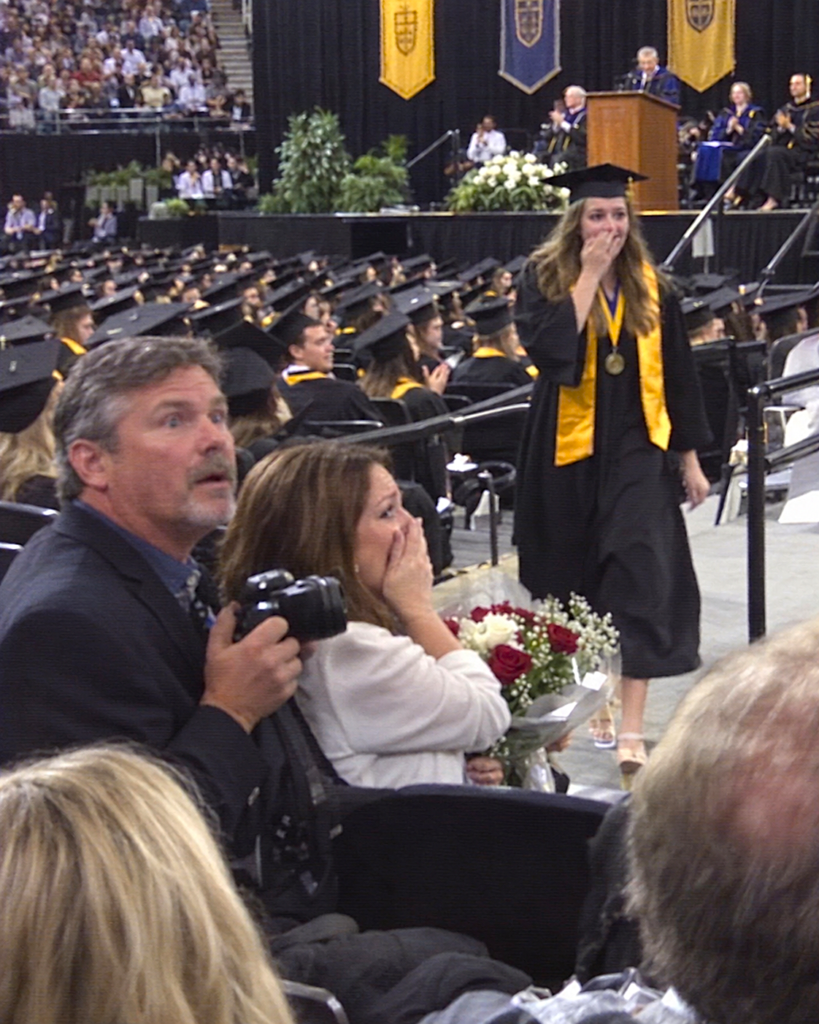
The first few steps toward the podium felt strangely ordinary. My shoes touched the same stadium floor as every other graduate’s, but I could feel my family watching me now for reasons none of them had expected.
I kept moving.
Image
Harold’s camera was no longer raised. He held it against his chest, staring at the gold sash and the bronze medallion as if he were trying to make the pieces fit together.
My mother still had Victoria’s roses in her arms. Victoria remained seated among the graduates, her expression fixed on me as I passed.
Four years earlier, the three of them had sat in our living room and decided I was the bad investment.
Now the university had introduced me to nearly 3,000 people as its valedictorian and Whitfield Scholar.
I reached the podium and placed my hands against its edges. The bronze medallion tapped softly against the front of my gown.
From there, I could see Harold clearly.
For years, I had imagined what it might feel like if he finally understood that he had been wrong about me. I thought I would feel triumphant. Maybe angry. Maybe relieved.
Instead, I felt something quieter.
I no longer needed him to understand.
Dr. Smith had helped me be seen. I had done the work after that—the shifts, the applications, the sleepless nights, the six straight semesters with a 4.0, and the decision to walk into Whitmore without telling my family what I had become there.
Harold had come prepared to photograph the daughter he believed was worth the investment.
Now he had to decide whether he could lift that camera for me.
And from the podium, I watched his hand begin to move.
His fingers tightened around the camera body first.
Then he lifted it.
Not quickly. Not with the automatic enthusiasm he had shown while waiting for Victoria’s name. He raised it slowly, almost carefully, until the lens was pointed toward the podium.
Toward me.
For a second, the sight of it pulled me backward through four years of memories I had thought I had already made peace with.
The family meeting.
My mother staring at the carpet.
Victoria looking at her phone.
My father leaning back in his chair as if he were discussing a stock purchase instead of his daughter’s future.
“You’re smart, but you’re not special. There’s no return on investment with you.”
I remembered carrying those words into the tiny room near Eastbrook State where summer heat collected against the ceiling because there was no air conditioning.
I remembered setting an alarm for 4:20 a.m. so I could make the café by five.
I remembered counting bus fare twice because being wrong by a few dollars could mean skipping lunch later in the week.
I remembered opening my cracked laptop on nights when I was too tired to think clearly and forcing myself to finish one more scholarship essay anyway.
Back then, I had imagined success as an argument I could eventually win.
If I earned enough grades, enough scholarships, enough honors, maybe I could place the evidence in front of my family and finally force them to admit they had misjudged me.
But standing at that podium, I understood how much my definition of winning had changed.
The university had already made its decision about my work.
Dr. Smith had made hers years earlier when she wrote See me after class beneath an A+ paper and then helped me find an opportunity I had almost convinced myself was too big for me.
And I had made mine every morning I got out of bed and kept going without knowing whether anyone at home would ever care.
The camera rose another inch.
Harold’s eye settled behind the viewfinder.
I could not tell whether he was proud, embarrassed, confused, or simply trying to recover from the shock of realizing that the ceremony he thought belonged to Victoria had placed me at its center.
For once, I did not try to read his face for permission.
I looked down at the speech in front of me.
My hands were steady.
Then I began.
I spoke about being underestimated without naming the people who had underestimated me.
I spoke about how easy it is to confuse opportunity with ability when some people begin with more support than others.
I spoke about the professors who notice a student staying late, the coworkers who quietly cover a shift during finals week, and the strangers who make room for someone who is still learning how to believe there might be room for them at all.
I did not turn the speech into an accusation.
I had spent too many years building something of my own to make the most important public moment of my education about the people who had refused to help build it.
So I thanked the people who had.
When I mentioned Dr. Smith, I found her several rows away among the faculty.
She gave me the smallest nod.
It was the same kind of nod she used after reading a draft she knew I could improve—quiet, practical, without making the moment about herself.
That nearly broke me more than any applause could have.
Because four years earlier, when my own family reduced my future to a financial calculation, one professor had looked at my work and treated my potential like something worth protecting.
“Let me help you be seen.”
Those six words had done more for me than Harold’s judgment ever had.
I continued speaking.
Somewhere in the crowd, the camera shutter clicked.
I heard it once.
Then again.
I did not look toward it.
I kept my eyes on the graduates in front of me.
That mattered.
The old Francis would have searched for Harold immediately. She would have needed to know whether he was finally taking pictures, whether he looked proud, whether the expression on his face proved she had been worth something after all.
But that girl had spent years waiting outside doors that never opened.
The woman standing at the podium had learned to build another entrance.
When I finished, the applause rose around the stadium.
I stepped back from the microphone, took one slow breath, and returned to my seat.
The ceremony moved on because ceremonies always do.
More names were called.
More graduates crossed the stage.
Families cheered from the stands.
Victoria eventually stood when her turn came, and I watched her walk forward in her cap and gown.
Whatever had happened between us, she had still completed four years of school.
I clapped for her.
It surprised me how easy that was.
Her accomplishments did not erase mine.
Mine did not need to erase hers.
That was another thing our father had gotten wrong when he decided that supporting one daughter required measuring her against the other.
He had turned us into competing investments before either of us was old enough to understand how deeply that would shape the way we looked at each other.
For years, I had blamed Victoria for accepting everything he gave her.
Some of that resentment was deserved. She had seen enough to know I was being treated differently, and she had rarely challenged it.
But sitting among the graduates, I also understood that Harold had built the scoreboard.
He had taught both of us that attention was something one daughter received when the other lost.
I did not want to carry that system into the rest of my life.
After the final degrees were awarded, graduates began spilling into the aisles.
Families stood, gathered bags, checked phones, and tried to find one another in the movement.
I touched the Whitfield medallion once as I walked.
The bronze had warmed against my gown.
That detail stayed with me because I remembered how cold it had felt before the ceremony began.
I had spent so long thinking of the scholarship as proof.
Proof that my father was wrong.
Proof that my mother was wrong.
Proof that I had been worth investing in.
But the medallion had never been created for Harold.
It represented the work I had done and the people who had recognized it.
It did not need to become a weapon just because my family had once used money like one.
When I reached the area where families were gathering, I saw my mother first.
She was still holding the roses.
The bouquet suddenly looked almost absurdly large.
She glanced at Victoria, then at me, as though realizing for the first time that she had brought something for one daughter and nothing for the other.
I did not rescue her from the discomfort.
I also did not punish her with it.
I simply stood there.
Harold came up beside her with the camera hanging from its strap.
For several seconds, he looked at the medallion again.
Then his eyes moved to the gold sash.
I could almost see the questions forming.
How had I transferred to Whitmore without telling them?
How had I earned the scholarship?
How long had I known I would be valedictorian?
How had his daughter built an entire final year at Victoria’s university without giving him a single opportunity to take credit for it?
The answer to the last question was the simplest.
I had learned not to tell him things I loved while they were still fragile.
He had taught me that.
Not intentionally, perhaps.
But thoroughly.
My mother finally spoke first.
“Francis,” she said.
Just my name.
Nothing else seemed ready to come out.
Harold opened his mouth, closed it, then looked toward the camera in his hand.
“I took some pictures,” he said.
It was such a small sentence that I almost laughed.
Four years ago, he had delivered a complete financial judgment on my future without hesitation.
Now he could barely tell me he had photographed me.
I nodded.
“Okay.”
He seemed to be waiting for more.
I had nothing more to give him in that moment.
Not because I hated him.
Not because I wanted revenge.
Because his camera was no longer the evidence I needed.
My mother shifted the roses from one arm to the other.
“We didn’t know,” she said.
“I know.”
“Why didn’t you tell us?”
That question landed differently than Harold’s silence.
There were dozens of possible answers.
Because you agreed with him.
Because you called me poor Francis to Aunt Carol and then said he was right.
Because nobody called me when I worked Thanksgiving week.
Because I saw a table set for three and finally understood I had been waiting for an invitation that was not coming.
But I did not need to unload four years in the middle of a graduation crowd.
So I gave her the answer that covered all of it.
“Because I wanted one thing in my life that nobody in this family got to decide the value of before I did.”
My mother looked down at the roses.
Harold did not argue.
That mattered more than an apology would have in that second.
He had always been ready with an explanation.
Practicality.
Potential.
Money.
Return on investment.
For once, there was no spreadsheet hidden inside his words.
Victoria reached us a moment later.
She was still wearing her cap, slightly crooked now, and holding the folder she had received after crossing the stage.
She looked from me to our parents.
Then she looked at the medallion.
“You really didn’t tell anybody?” she asked.
“No.”
“Not even Mom?”
“No.”
Her expression tightened briefly.
I could not tell whether she felt betrayed, impressed, angry, or embarrassed.
Maybe all of it.
For years, Victoria had occupied the position our father created for her—the daughter whose achievements justified his choices.
My standing beside her with a gold sash did not only challenge what he thought about me.
It challenged the role she had been given too.
She looked at Harold.
Then she looked back at me.
“You were the speaker,” she said quietly.
“Yes.”
There was nothing to soften.
Nothing to exaggerate.
Just the fact.
She gave a small nod.
“Your speech was good.”
It was not an apology.
I did not pretend it was.
But it was the first compliment I could remember receiving from her that did not contain a comparison.
“Thank you,” I said.
My mother looked as if she wanted the afternoon to become normal again.
I recognized the instinct because I used to share it.
In our family, discomfort was usually treated like a mess someone needed to clean before company noticed.
But some things should remain visible long enough for people to understand what caused them.
The empty space where my bouquet should have been was one of those things.
The camera hanging from Harold’s hand was another.
So was the fact that I was standing there in a university gown they had never expected to see me wear.
Nobody could repair four years in the time it took graduates to find their families after commencement.
I did not want them to try.
Harold eventually asked, “How long have you been at Whitmore?”
“My final year.”
His eyebrows lifted.
“And the scholarship?”
“I earned it before I transferred.”
He nodded once, absorbing the timeline.
The facts were simple.
What they meant was harder.
I had not secretly become capable.
I had been capable when he decided I was not worth the money.
What changed was not my value.
What changed was that I stopped allowing his opinion to be the only measurement in the room.
That distinction had taken me years to understand.
Dr. Smith spotted me before the conversation could stretch any further.
She approached with the same composed expression she carried into class, and I felt my shoulders loosen before she even reached us.
I introduced her simply as the professor who had first told me about Whitfield.
She did not give my family a speech about what they had missed.
She did not need to.
Her presence said enough.
Here was someone who had seen my work before there was a medallion around my neck.
Someone who had invested time instead of money and expected no ownership in return.
My father shook her hand.
My mother thanked her.
I watched that exchange without needing to interpret it.
After a few minutes, Dr. Smith moved on to greet other students.
My family remained together in the middle of the crowd, but the arrangement felt different now.
Not healed.
Different.
That was enough for one afternoon.
Before we separated, Harold touched the camera hanging at his chest.
“I’ll send you the pictures,” he said.
For the first time, I smiled.
Not because I had finally earned a place in his camera roll.
Because I knew I would be fine whether he sent them or not.
“Sure,” I said.
Then I turned toward the people who had come looking for me after the ceremony.
There were classmates waving from a few yards away, graduates I had studied beside, people who knew me from late nights and deadlines rather than from childhood rankings.
I walked toward them wearing the same gold sash that had stunned my family less than an hour earlier.
The medallion rested warm against my gown now.
Behind me, Victoria still had her roses.
I did not resent them the way I thought I would.
They were hers.
My achievement did not require taking anything from her.
And my father’s camera, once the object that seemed to measure which daughter mattered enough to be remembered, had changed too.
He had finally pointed it at me.
But the important part was that I had already stopped living for the moment when he would.