There’s soup in the freezer.
The guilt disappeared.
Not completely.
But enough.
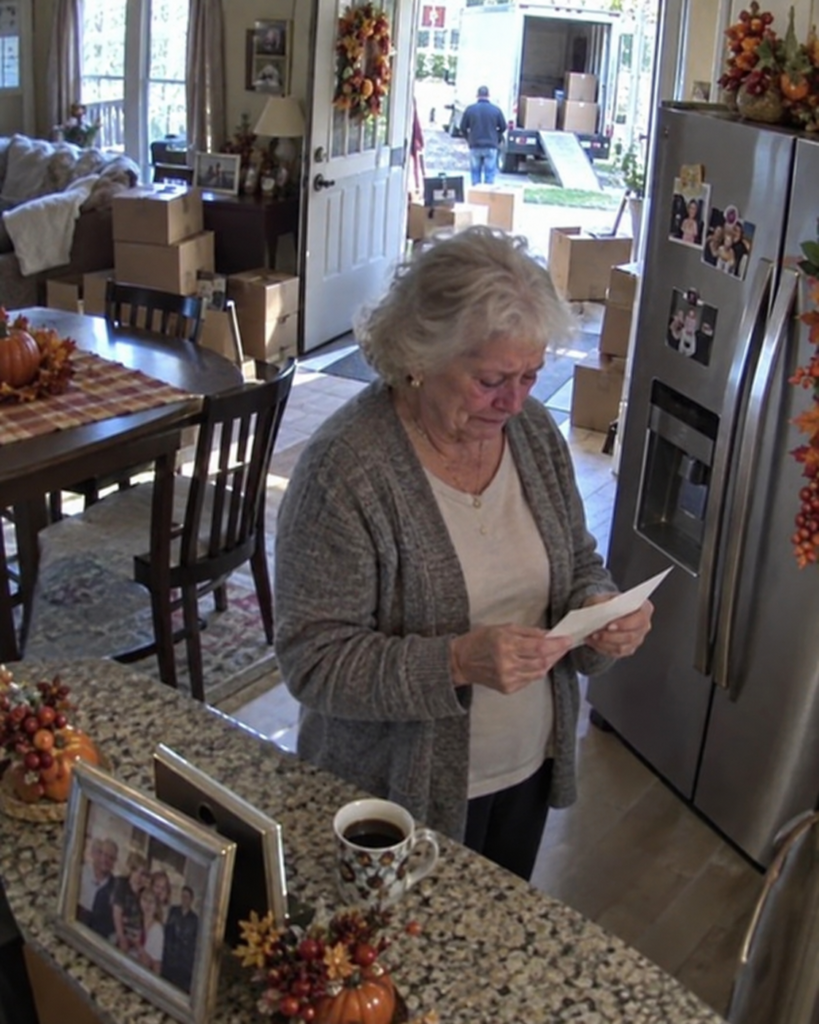
A man climbed out of the moving truck and walked toward me carrying a clipboard.
“Margaret Sullivan?”
“That’s me.”
“I’m Luis.”
He glanced at the large two-story house behind me.
“Where are we going?”
I handed him a sheet of paper.
It listed the address of a furnished short-term apartment in Old Town Scottsdale.
I had rented it the previous afternoon for one month.
One month.
That was all the future I had been prepared to decide.
Luis studied the list of furniture I had written.
“You’ve marked specific items?”
“I have receipts for all of them.”
He smiled politely.
“Then you’re more organized than most people we move.”
“My husband used to say organization was my favorite form of entertainment.”
Luis laughed.
For the first time in twenty-four hours, the sound of another person laughing near me felt strangely comforting.
I walked him through the house.
“The blue sofa. Both armchairs. The television in the family room. The dining table and six chairs.”
Luis glanced toward the kitchen.
“The refrigerator?”
I hesitated.
It was mine.
I had paid nearly four thousand dollars for it because Rebecca had wanted the model with two freezer drawers and an interior water dispenser.
But there were groceries inside.
Food for the children when they came home.
“Leave it.”
Luis looked at my list.
“You have it marked.”
“I changed my mind.”
The washer and dryer stayed too.
So did the guest beds.
I realized, as we walked from room to room, that ownership and belonging were not always the same thing.
I had paid for the beds.
But Emily had slept in the guest room during thunderstorms.
Jack sometimes sprawled across one on Sunday afternoons reading comic books.
Taking everything simply because I could would not make me freer.
It would only make the house emptier.
In the end, I took the furniture from my bedroom, the antique sideboard that had belonged to Arthur’s mother, two lamps, my desk, one sofa, one armchair, a small television, several boxes of kitchenware I had brought from Illinois, my grandmother’s dishes, and the Italian coffee maker.
I stood in front of that machine longer than I should have.
Then I put a red sticker on it.
Luis raised an eyebrow.
“That one matters?”
“More than it should.”
By ten thirty, the truck was full.
The house looked different, but not stripped.
There were empty spaces.
That was all.
Spaces.
I walked through each room once more.
Daniel’s framed family photograph remained on the mantel.
The children’s school pictures stayed on the staircase wall.
Rebecca’s cookbooks sat neatly beside the stove.
Nothing had been damaged.
Nothing had been hidden.
Nothing had been done in anger.
I placed my house key on the dining counter beside Rebecca’s note.
Underneath it, I left another page.
Daniel,
I am safe.
I have moved into a temporary apartment and will contact you after you return.
I have taken only property that belongs to me and have receipts for everything removed.
I love you and the children.
But I will no longer live in a home where decisions about my life are made without me.
We will talk when you are home.
Mom
I read it three times.
Then I added one sentence.
Please do not tell the children I left because of them. I did not.
That mattered more than anything else.
I locked the front door from the inside, walked out through the garage, pressed the button, and stepped beneath the lowering door.
Four years of my life disappeared behind beige metal panels.
I followed the moving truck in a rental car.
Halfway to the apartment, my phone rang.
For one wild moment, I thought Daniel had somehow discovered what I had done.
But the screen showed another name.
Linda Herrera.
I nearly laughed.
Linda had been my closest friend since I moved to Arizona. We met at a community art class where neither of us had shown any talent whatsoever.
I answered.
“Happy day after Thanksgiving.”
“That depends,” Linda said. “Did you survive yesterday with Rebecca’s sweet potatoes?”
“There were no sweet potatoes.”
“What happened?”
I drove silently for several seconds.
Then I told her.
Not everything.
Just enough.
When I finished, Linda said nothing.
That was one of the reasons I loved her.
She knew silence could be more respectful than instant advice.
Finally she asked, “Where are you now?”
“Following a moving truck.”
“A moving truck?”
“I moved out.”
Another pause.
“Maggie.”
“Yes?”
“Where are you sleeping tonight?”
“An apartment in Old Town.”
“Do you want company?”
I looked ahead at the truck carrying pieces of my old life toward a place I had never seen in person.
“Yes,” I said.
“I think I do.”
The apartment was smaller than it had looked online.
Of course it was.
Real estate photographs have the same relationship to reality that family Christmas letters do.
Everything appears brighter, wider, happier.
Still, the place had large windows, a small balcony, and a view of palm trees across the courtyard.
Luis and his crew carried in my furniture while I directed traffic.
The blue armchair went near the window.
Arthur’s mother’s sideboard fit against the dining wall.
My desk went into the second bedroom.
The coffee maker occupied the most important position in the kitchen.
Linda arrived at noon carrying sandwiches, two iced teas, and an orchid.
“What is that for?” I asked.
“People bring plants when someone starts a new chapter.”
“I’m renting for thirty days.”
“Then it’s a short chapter.”
She walked into the living room and surveyed the boxes.
“So.”
“So.”
“Are you terrified?”
“Yes.”
“Regret it?”
I considered the question.
“No.”
Linda nodded.
“Good. Then eat your sandwich.”
That afternoon we unpacked dishes while I told her the full story.
I told her about Hawaii.
I told her about the note.
And finally, I told her what I had heard Rebecca say six months earlier.
It’s not really her we need. It’s her money.
Linda stopped unwrapping a glass.
“You never told me that.”
“I was embarrassed.”
“Why?”
“Because I had spent three years telling everyone how wonderful it was living with family.”
“It can have been wonderful and still become something else.”
I sat down.
That sentence settled somewhere deep inside me.
For months I had been rewriting my own memories.
If Rebecca was ungrateful now, perhaps she had always been ungrateful.
If Daniel ignored me now, perhaps he had never loved me properly.
But that wasn’t true.
When Arthur died, Daniel had flown to Chicago the same night.
He slept in a chair beside my bed because I had been afraid of waking alone.
He handled funeral arrangements when I could barely remember my own telephone number.
Rebecca had packed my kitchen when I moved.
The grandchildren had taped a sign above my new Arizona bedroom.
WELCOME HOME GRANDMA.
Those things had happened too.
Maybe the most painful truth was that love could be genuine and still become careless.
That night, after Linda left, I sat alone on the balcony.
The city below glowed in warm pools of light.
Music drifted faintly from a restaurant.
Someone laughed in the courtyard.
I expected loneliness.
Instead, I felt tired.
Wonderfully, peacefully tired.
No lunches to pack.
No laundry waiting.
No one asking what was for dinner.
At ten fifteen, I made tea and opened my laptop.
There was an email from Daniel.
The subject line read:
YOU’RE NOT ANSWERING.
My heart jumped.
I opened it.
Mom,
We’ve called several times. I wanted to make sure you were okay. I know you’re probably angry, but please don’t turn this into something bigger than it is.
The kids are having a great time.
We’ll talk when we get back.
Love,
Daniel
I stared at the second paragraph.
Please don’t turn this into something bigger than it is.
For years, I had used almost the same sentence on myself.
Don’t make trouble.
Don’t take it personally.
They’re busy.
Families make compromises.
I closed the laptop.
I did not reply.
The next morning, I woke at six out of habit.
My body waited for footsteps overhead.
There were none.
I waited for the sound of a bedroom door opening.
Nothing.
Then I remembered.
I was alone.
And for the first time in decades, I could choose what happened next.
I walked to a café three blocks away.
I ate eggs outside beneath a striped umbrella.
After breakfast, I wandered through an art market and bought a ridiculous turquoise scarf.
At eleven, Linda called.
“Are you busy?”
“I’m buying things I don’t need.”
“Excellent. You’re recovering beautifully.”
We had lunch.
Afterward, she drove me to a neighborhood in north Scottsdale I had passed hundreds of times but never entered.
A low stone sign read:
SAGUARO RIDGE — ACTIVE ADULT COMMUNITY.
I frowned.
“What are we doing here?”
“Looking.”
“At what?”
“Options.”
“I don’t need to be put somewhere.”
Linda stopped the car.
“No one is putting you anywhere.”
Her voice was gentle.
“That is the point.”
We toured a two-bedroom townhouse with white walls, a shaded patio, and a small den.
The agent talked about walking clubs, book groups, yoga, woodworking, day trips, a community garden.
I barely listened.
I was looking at the kitchen.
Not because it was impressive.
Because it was mine to imagine.
My coffee cup by that window.
Arthur’s photograph on that shelf.
Dinner for one if I wanted it.
Dinner for twelve if I invited people.
No one needing permission from anyone else.
“What do you think?” the agent asked.
“I think I’m not ready.”
“Of course.”
She handed me a brochure.
“Keep it anyway.”
I tucked it into my handbag.
Two days later, Daniel called again.
This time, I answered.
“Mom.”
His relief was immediate.
“Where have you been? We were worried.”
“I’m fine.”
“Did you get my email?”
“I did.”
A pause.
“Are you angry?”
“I’m thinking.”
“About Thanksgiving?”
“About the last four years.”
Silence came through the phone.
In the distance, I heard children laughing and waves breaking.
“Mom, Hawaii was Rebecca’s idea. We found a last-minute package and—”
“You don’t need to blame your wife.”
“I’m not.”
“Yes, you are.”
Another pause.
Then Daniel lowered his voice.
“We honestly thought the flight would be hard on you.”
“Did you ask me?”
“No.”
“Did you think about asking me?”
He didn’t answer.
I looked around the apartment.
My boxes were still stacked against the wall.
“Daniel, the problem isn’t Hawaii.”
“Then what is?”
“You stopped seeing me as a person who makes choices.”
“That’s not fair.”
“It may not feel fair.”
“You live with us because we care about you.”
“I moved in because you asked me to.”
“We all agreed it made sense.”
“It did make sense. Then.”
His voice became more strained.
“Why are you talking like you’re leaving?”
I took a breath.
“Because I already did.”
For several seconds, I heard nothing.
Then: “What?”
“I moved out Friday.”
“Moved where?”
“A temporary apartment.”
“You moved out while we were away?”
“Yes.”
“Mom, you can’t just—”
He stopped himself.
I waited.
When he spoke again, his voice was quieter.
“What did you take?”
“Things that belong to me.”
“What does that mean?”
“The blue sofa. My bedroom furniture. The sideboard. My dishes. Some other things.”
“The coffee maker?”
Despite myself, I smiled.
“Yes.”
“Oh, for God’s sake.”
“It was mine.”
“You gave it to Rebecca.”
“I bought it for the household.”
“That’s basically the same thing.”
“No, Daniel. That sentence explains more than you realize.”
He exhaled.
“Can we talk when we get home?”
“Yes.”
“Will you come back to the house?”
“To talk. Yes.”
“To live.”
“I don’t know.”
That frightened him.
I could hear it.
And I understood why.
My leaving did not simply create an emotional problem.
It created practical ones.
Who would pick up Jack on Tuesdays?
Who would stay with Emily when school closed?
Who would cook three nights a week?
Who would buy groceries when Rebecca forgot?
Who would sit with the children so Daniel and Rebecca could go to dinner?
I wondered whether he was thinking about losing his mother or losing the life his mother had made easier.
Perhaps both.
That was the hardest possibility of all.
People were rarely only one thing.
“Mom?”
“Yes?”
“There’s something we need to talk about when I get home.”
“What?”
“The house.”
My fingers tightened around the phone.
“What about it?”
“Just… the money you gave us when we bought it.”
“What about the money?”
He hesitated.
“Rebecca and I don’t remember it the same way you do.”
My stomach turned cold.
“How do you think I remember it?”
“As a loan.”
“It was a loan.”
Daniel was quiet.
“Rebecca thought it was a gift.”
I closed my eyes.
Eighty-five thousand dollars.
The amount I had transferred after selling my Oak Park apartment.
Daniel had said they would repay me when their finances improved.
At least, that was what I remembered.
“Daniel, you told me—”
“I know what I said.”
“Then what are we discussing?”
“There was paperwork.”
“What paperwork?”
“I don’t want to do this on the phone.”
The apartment suddenly felt too quiet.
“Daniel.”
“We’ll talk Sunday.”
“Were there documents I signed?”
“Yes.”
I stood.
“What documents?”
“I need to look at them.”
He sounded genuinely uncertain now.
That frightened me more than defensiveness would have.
After we hung up, I sat at my desk and opened the blue folder.
Receipts.
Bank statements.
Furniture invoices.
Moving documents.
But nothing concerning the eighty-five thousand dollars.
I remembered the bank transfer.
I remembered Daniel sitting across from me at the old apartment.
I remembered Arthur’s accountant, a man named Peter Cohen, telling me not to mix family and money without putting things in writing.
Had I listened?
At seventy-three, there is a particular kind of panic that comes when you cannot immediately find a document you remember existing.
You question the paper.
Then you question the drawer.
Then, eventually, you question yourself.
I spent three hours searching.
Nothing.
Finally, I called Peter.
He had retired two years earlier, but I still had his number.
“Maggie Sullivan,” he said when he answered. “Well, there’s a voice I haven’t heard lately.”
“Peter, do you remember when I moved to Arizona?”
“Of course.”
“Do you remember the money I gave Daniel for the house?”
Silence.
Then his tone changed.
“Yes.”
“Was it a gift?”
“No.”
Relief went through me so quickly I nearly laughed.
“You’re certain?”
“I’m an accountant, Maggie. Certainty is the only interesting thing about me.”
I sat down.
“Do you have anything in writing?”
“I might.”
“Might?”
“I closed the office. Most records were digitized.”
My pulse began pounding.
“Peter, Daniel says there was paperwork.”
“There was.”
“What kind?”
“I don’t want to answer from memory.”
I stared out the window at palm trees moving softly in the evening wind.
“When can you check?”
“Now.”
I heard a chair scrape.
Then footsteps.
A door opening.
Keys.
Peter had always been like that.
If something could be answered, he saw no reason to leave it unanswered.
He returned several minutes later.
“I have the file.”
My mouth went dry.
“And?”
“Interesting.”
I almost laughed from nerves.
“Peter, at my age, interesting is not a reassuring word.”
“Your eighty-five thousand dollars was documented as a family loan.”
I closed my eyes.
“Thank God.”
“But there’s more.”
I opened them again.
“What?”
“You didn’t loan it only to Daniel.”
“What do you mean?”
“The agreement lists Daniel and Rebecca jointly.”
“That makes sense.”
“Yes. But there’s an addendum.”
I frowned.
“What addendum?”
“You signed it three months later.”
“I don’t remember that.”
“I can send it to you.”
“What does it say?”
Peter took a breath.
“It changes when repayment is due.”
My hand tightened around the phone.
“To when?”
“When the property is sold, refinanced…”
He paused.
“Or when you cease using the residence as your primary home.”
For several seconds, the words made no sense.
Then they did.
“When I move out.”
“Yes.”
I stared at the boxes around my little apartment.
The turquoise scarf lay across the back of my chair.
My moving receipt sat on the desk.
I had thought I was simply reclaiming my independence.
But without remembering it, four years earlier, I had signed a piece of paper that made my decision mean something else too.
“When I moved out Friday,” I whispered, “the loan became due.”
Peter was quiet.
“Yes, Maggie.”
My chest tightened.
Not with triumph.
With dread.
Daniel and Rebecca had a mortgage.
School expenses.
Cars.
A life built around the assumption that I would remain inside that house.
“Send me everything,” I said.
“I will.”
“And Peter?”
“Yes?”
“Don’t contact Daniel.”
“I wouldn’t without your permission.”
After we hung up, I remained at the desk.
Five minutes later, the documents arrived.
I opened the agreement.
There was my signature.
There was Daniel’s.
There was Rebecca’s.
And beneath the addendum was something I had completely forgotten.
A handwritten sentence beside Rebecca’s initials:
Loan repayment will protect Maggie’s future housing needs if she ever chooses to live independently again.
I read it twice.
Rebecca had initialed it.
Daniel had initialed it.
So had I.
They had known.
At least once, they had known.
The question was not whether the loan existed.
The question was how all three of us had managed to live for four years as though my independence never would.
I closed the document and stared into the darkening room.
Daniel had said we needed to talk about the house.
Now I knew why.
But one question remained.
If Rebecca had once signed a promise meant to protect my independence, when had she started believing my independence no longer mattered?
-END OF PART 2, –PRESS NEX PART IN BOTTOM OF PAGE TO READ NEXT PART
Daniel’s family returned Sunday afternoon.
I knew because Emily called me from the airport.
“Grandma!”
Her voice filled the apartment before I had time to prepare myself.
“Hello, sweetheart.”
“We brought you something.”
“That was kind.”
“It’s not food because Daddy said airport food costs too much and Mommy said not everything in Hawaii counts as airport food.”
In the background, Rebecca said, “Emily.”
“What?”
I smiled despite myself.
“What did you bring me?”
“It’s a surprise.”
“Then you shouldn’t tell me.”
“I didn’t.”
“You called me to tell me you had a surprise.”
“That doesn’t count.”
I could hear Jack laughing.
Something inside me softened.
The children knew nothing.
To them, Hawaii had been beaches, hotel breakfasts, sunscreen, and a week without homework.
Good.
That was exactly how it should remain.
“Will you be home when we get there?” Emily asked.
The question caught me.
“No, sweetheart.”
“Where are you?”
“I have an apartment for a little while.”
Silence.
“Why?”
I chose my words carefully.
“Because sometimes grown-ups realize they need to change something in their lives.”
“Did we do something?”
“No.”
I answered so quickly that there could be no doubt.
“You and Jack did absolutely nothing. I love you both exactly the same as I did before your trip.”
“Are you still coming to my winter concert?”
“Front row if they let me.”
“They won’t. Parents sit in rows.”
“Then the best row available.”
That satisfied her.
After we hung up, I sat on my sofa and cried for the first time.
Not because Daniel had left me home.
Not because of the money.
Because an eight-year-old child had immediately wondered whether an adult’s departure was her fault.
I had promised myself I would never let that happen.
At four thirty, Daniel texted.
We’re home. Can you come at six?
I replied.
Yes.
Then, after thinking, I added:
I would prefer that we talk after the children are settled.
Agreed.
At six, I drove back to the house.
My former house.
Their house.
I wasn’t sure what to call it anymore.
Jack opened the door before I rang the bell.
“Grandma!”
He was eleven and had recently begun believing himself too old for enthusiastic affection, but he forgot that rule and hugged me.
Emily appeared behind him holding a paper bag.
“This is yours.”
Inside was a small wooden sea turtle painted blue and green.
“I picked it,” she said.
“It’s beautiful.”
“You can put it in your apartment.”
Rebecca stood several feet away.
She looked tired from the flight.
“Hi, Maggie.”
“Hello, Rebecca.”
No anger.
No embrace.
Just two women standing inside a home they had once built together in different ways.
Daniel came down the hallway.
“Kids, unpack. Grandma and I are going to talk later.”
“I can show her my shell first,” Emily said.
“You can show me another day.”
Emily frowned.
I crouched slightly to meet her eyes.
“Put all your treasures together and I’ll come see them Wednesday.”
“All of them?”
“All of them.”
That created a task important enough to send her upstairs.
Jack followed.
When they were gone, the three of us stood silently.
The absence of my furniture was noticeable but not dramatic.
The blue sofa was gone, leaving a rectangle of lighter carpet.
My sideboard had left an empty wall.
The coffee maker was gone.
Rebecca looked toward its former place.
“I bought a new one this morning.”
Her tone was not sarcastic.
Just factual.
“I’m glad.”
Daniel gestured toward the dining table.
“Can we sit?”
We did.
For years, I had served meals at that table.
Birthdays.
Thanksgiving.
Tuesday spaghetti.
Sunday pancakes.
Now a folder sat between us.
Daniel had brought his copy.
I had brought mine.
He looked at the pages.
“So Peter had them.”
“Yes.”
“You called him.”
“Yes.”
Daniel nodded.
“I found our copy after we got back.”
Rebecca folded her hands.
“I had forgotten the addendum.”
“So had I,” I said.
Her eyes lifted.
That seemed to surprise her.
“You did?”
“I remembered the loan. I didn’t remember it became due when I moved out.”
Daniel leaned back.
“This creates a problem.”
“I understand.”
“Eighty-five thousand dollars is not something we can produce next week.”
“I’m not asking you to.”
Rebecca looked at me carefully.
“But legally you could.”
“Peter says the agreement allows ninety days.”
Daniel gave a humorless laugh.
“That doesn’t make it much easier.”
“No.”
He rubbed his forehead.
“Why didn’t you tell us before you moved?”
“Because I didn’t remember.”
“And if you had?”
I considered it.
“I still would have moved.”
His face tightened.
“But you might have warned us.”
“Yes.”
That was true.
He looked surprised by my answer.
I had no interest in pretending I had behaved perfectly simply because I had been hurt first.
“I should have told you I was leaving before I hired movers,” I said. “I made that decision while I was angry.”
“You didn’t seem angry on the phone.”
“I was.”
Rebecca looked at the folder.
“You were hurt.”
“Yes.”
She nodded slowly.
For the first time since I arrived, something in her expression changed.
The defensiveness faded.
“I’m sorry about Hawaii.”
Daniel glanced toward her.
Rebecca continued.
“Not because you moved out. Not because of the loan. I’m sorry because we should have asked you.”
I had imagined an apology many times over the previous days.
In all of them, I felt immediate relief.
Reality was different.
“I appreciate that.”
She looked disappointed.
Perhaps she had expected forgiveness to arrive faster.
Perhaps I had too.
Daniel said, “I’m sorry too.”
“I know.”
“No, Mom. I mean it.”
“I believe you.”
“Then why does it feel like you’re still angry?”
“Because an apology does not erase four years in ten seconds.”
He looked down.
The room became quiet.
Finally Rebecca spoke.
“You heard me.”
I looked at her.
“On the patio.”
For one moment, none of us moved.
Daniel turned toward his wife.
“What?”
Rebecca’s face had gone pale.
“She heard me talking to Claire.”
My heart beat faster.
Daniel looked between us.
“What did you say?”
Rebecca closed her eyes briefly.
Then she looked at me.
“That we couldn’t ask you to leave because you watched the kids, bought groceries, paid for things.”
Daniel stared at her.
“And?”
Her voice became very soft.
“And that it wasn’t really her we needed. It was her money.”
Daniel stood.
“Rebecca.”
“Sit down.”
I surprised all three of us.
He looked at me.
“I don’t need you defending me.”
“I’m not defending you.”
“I know. Sit anyway.”
Slowly, he did.
Rebecca pressed her hands together.
“I said it.”
“Yes.”
“It was terrible.”
“Yes.”
She swallowed.
“But there was more.”
I felt my body go still.
“What more?”
“I said, ‘That’s what it’s starting to feel like.’”
I frowned.
She continued.
“I wasn’t telling Claire that I wanted your money.”
Her voice shook slightly, but she remained composed.
“I was telling her I was worried that was what our family had become.”
I stared at her.
“No.”
“Yes.”
“I heard you.”
“You heard part of it.”
I searched my memory.
The patio door had been open slightly.
Rebecca’s voice.
We can’t ask her to leave. She watches the kids, buys groceries, and pays for things. It’s not really her we need. It’s her money.
I had walked away.
I had not stayed to hear another word.
“What did you say next?” I asked.
Rebecca answered immediately.
“I told Claire I hated that we depended on you so much.”
Daniel’s brow tightened.
“You never told me that.”
“I tried.”
“When?”
“Last spring. Twice.”
She looked at me again.
“I told Claire I thought we were taking advantage of you.”
My thoughts moved slowly.
“That isn’t what it sounded like.”
“I know.”
“Why didn’t you say something to me?”
“Because I was ashamed.”
The same answer I had given Linda.
That realization unsettled me.
Rebecca continued.
“You paid for groceries even when I told you not to. Then I stopped telling you not to. You picked up the kids because it was easier. Then we stopped asking if you were available. You cooked because you were better at it. Then somehow dinner became your responsibility.”
Daniel stared at the table.
Rebecca’s eyes filled, though no tears fell.
“One day Emily asked me what Grandma’s job was. And Jack said, ‘She takes care of us.’”
My chest tightened.
“I love taking care of them.”
“I know.”
“That wasn’t a burden.”
“Not at first.”
The words were gentle.
Not accusing.
And because of that, they landed harder.
Rebecca looked at Daniel.
“I told him we had to change things.”
Daniel nodded reluctantly.
“She did.”
I looked at him.
“And?”
“I said you liked helping.”
I almost laughed.
“Of course I liked helping.”
“I know.”
“No, Daniel. That is the problem. You thought because I loved doing something, I must want to do it forever.”
He looked down again.
I thought of Arthur.
For forty-eight years, he had taken out the trash every Tuesday and Friday.
He never minded.
Until arthritis settled into his knees.
One morning I found him standing beside the garbage cans in the snow, unable to drag them down the driveway.
He was furious when I hired someone.
Not because he loved garbage.
Because he hated needing help.
People change.
Capabilities change.
Wants change.
Love is supposed to notice.
“I believe you,” I told Rebecca.
Her expression broke slightly.
“About the conversation?”
“Yes.”
Relief crossed her face, followed quickly by something else.
“But it doesn’t fix everything,” I added.
“I know.”
I reached into my handbag and removed the Saguaro Ridge brochure.
“I’m thinking about buying a place.”
Daniel stared at it.
“You’re serious.”
“Yes.”
“You don’t have to.”
“That isn’t the point.”
He picked up the brochure.
“An active-adult community?”
“Don’t say it like I’m checking into a hospital.”
“I didn’t.”
“You used your hospital voice.”
Rebecca almost smiled.
So did I.
The small moment disappeared quickly, but not completely.
Daniel opened the brochure.
“Two bedrooms?”
“For guests.”
“Mom, you could buy somewhere closer.”
“It’s fourteen minutes away.”
“Without traffic.”
“In Arizona there is always traffic.”
Rebecca took the brochure from him.
“This patio is nice.”
“It is.”
“Have you seen it?”
“With Linda.”
Daniel looked wounded.
“You took Linda?”
“She took me.”
He leaned back.
“You planned all this in a week.”
“No. I started considering it in a week.”
“What’s the difference?”
“The difference is I haven’t made a decision.”
He nodded slowly.
I looked at the loan documents.
“There is another issue.”
“The money,” he said.
“Yes.”
Daniel folded his arms.
“We can refinance.”
“Should you?”
“What do you mean?”
“What would it do to your payments?”
He hesitated.
“They’d go up.”
“How much?”
“We don’t know yet.”
Rebecca said quietly, “Probably more than we can comfortably manage.”
Daniel looked at her.
“We could make it work.”
“That phrase worries me,” I said.
He frowned.
“Why?”
“Because you have two children, college savings, your own retirement, and a house.”
“So what do you want us to do?”
“I don’t know yet.”
His frustration returned.
“The loan is due, Mom.”
“I understand.”
“You want your independence. That requires money.”
“I also don’t want you making a foolish financial decision because I moved out.”
Rebecca studied me.
“Would you consider extending the loan?”
“Yes.”
Daniel looked up.
I held up my hand.
“Under different terms.”
“What terms?”
“I don’t know yet.”
His face tightened again.
“Then what are we doing?”
“Talking.”
He looked at me as though this were the least satisfying answer imaginable.
Perhaps because for most of his life, I had solved things.
Dinner.
School forms.
Doctor appointments.
Money.
After Arthur died, I solved myself by moving to Arizona.
Now I was asking him to remain inside uncertainty.
It was uncomfortable.
It was also necessary.
I stood.
“I’m going home.”
Daniel looked toward the stairs.
“The kids wanted dessert with you.”
“Then I’ll stay for dessert.”
Rebecca stood too.
“I made pie.”
“You?”
“Yes.”
“From scratch?”
She frowned.
“I am capable of using an oven.”
“I have four years of evidence to the contrary.”
For one second she stared at me.
Then she laughed.
It was small and surprised.
So was mine.
Daniel looked between us as if he had missed a meeting.
Dessert was awkward and lovely.
Emily showed me thirty-seven photographs.
Twenty-two were of the ocean.
Eight were of hotel breakfasts.
Four contained only her own fingers.
Jack showed me a shell he had found and explained that he had returned it to the beach because a sign said visitors should leave natural objects where they found them.
“I took a picture instead.”
“That was smart.”
“Dad wanted to bring it.”
Daniel protested.
“It was a very good shell.”
We laughed.
Nothing was repaired.
But for forty minutes, nothing needed to be.
When I left, Emily ran after me.
“Grandma.”
She handed me another folded paper.
I opened it after reaching the apartment.
It was a drawing.
The four of them stood beside a palm tree.
I stood several inches away in front of a square building.
A dotted line connected us.
Above the line, Emily had written:
GRANDMA STILL LIVES HERE TOO.
I taped it to my refrigerator.
The next week changed something.
Not dramatically.
In small ways.
Daniel texted instead of calling five times.
Rebecca asked if I wanted to pick Emily up after school rather than assuming I would.
When I said no because I had lunch plans, she replied:
Have fun.
No guilt.
No follow-up question.
Jack came to the apartment Saturday and helped me assemble a bookshelf.
He read the instructions aloud with great authority while I corrected him whenever he skipped a page.
When Daniel picked him up, he stood in my doorway.
“This place is nice.”
“It is.”
“Small.”
“It’s temporary.”
He nodded.
“Jack said you’re taking a pottery class.”
“I am.”
“You hate pottery.”
“I hated pottery twenty years ago.”
“Since when do people stop hating pottery?”
“Since they become seventy-three and realize they’re allowed to change their minds.”
He smiled.
“Mom?”
“Yes?”
“I miss you.”
The words were so quiet I nearly pretended not to hear them.
Instead, I said, “I miss you too.”
He looked toward the parking lot.
“Not the help.”
I waited.
“You,” he added.
That mattered.
More than I wanted him to know.
Two days later, Peter called.
“I’ve been reviewing the original loan file.”
“Why?”
“Because I’m retired and apparently have no hobbies.”
“What did you find?”
“There’s an email I think you should see.”
“From whom?”
“Rebecca.”
I sat straighter.
“What about?”
“The loan.”
He forwarded it.
The message had been sent four years earlier, two days before the documents were signed.
Peter,
Thank you for insisting this be a loan rather than a gift.
Daniel thinks his mother will never ask for the money back, but I don’t want Maggie’s generosity to cost her choices later.
Please make sure there is language protecting her if she decides she wants her own home again.
Rebecca
I read it three times.
Then a fourth.
Rebecca.
Not Daniel.
Rebecca had requested the protection clause.
The woman whose sentence on the patio I had carried like a stone for six months had once insisted, privately and without telling me, that I should never become financially trapped inside their home.
The discovery did not erase what had happened.
But it complicated the story I had been telling myself.
That evening, I called Rebecca.
“Can you come over?”
“Is everything okay?”
“Yes.”
Twenty minutes later, she arrived carrying two coffees.
“I didn’t know what you drink here.”
“The same thing I drank there.”
“I know. That sounded stupid.”
She sat on my sofa.
I handed her the printed email.
She looked at it.
“Oh.”
“You wrote this.”
“Yes.”
“Why?”
She considered the question.
“When my grandmother moved in with my parents, she sold her house and gave most of the money to my father.”
I had never heard this story.
“What happened?”
“Nothing terrible.”
Her expression turned thoughtful.
“That was the problem. Everyone was nice. Everyone loved each other. But after a few years, my grandmother wanted her own apartment again.”
“And?”
“She couldn’t afford one.”
I understood.
“My father had used the money to pay off their mortgage.”
“Yes.”
“Did she stay?”
“Until she died.”
Rebecca stared at the paper.
“She never complained. But every time my parents argued, she went to her bedroom and shut the door because she said it wasn’t her house.”
Her voice softened.
“I was fourteen when she moved in. I remember thinking that being grateful looked an awful lot like being quiet.”
I looked around my apartment.
The blue armchair.
The turquoise scarf.
My ridiculous pottery-class schedule attached to the wall.
“Why didn’t you tell me this four years ago?”
“I thought making sure the paperwork was right was enough.”
“And then?”
“Then life happened.”
She smiled sadly.
“We became exactly the kind of family I thought I was protecting you from.”
I shook my head.
“Not exactly.”
“Close enough.”
“No.”
I looked at her.
“There is a difference between becoming careless and becoming cruel.”
She absorbed that.
Then she nodded.
“I’ll take careless.”
“It isn’t a compliment.”
“I know.”
We sat quietly.
Finally she said, “Daniel thinks you’re going to demand the money and buy the townhouse.”
“I haven’t decided.”
“I think you should.”
Her answer surprised me.
“You do?”
“Yes.”
“Why?”
“Because you lit up when you talked about the patio.”
I smiled.
“You noticed that?”
“Maggie, I lived with you for four years. I notice more than you think.”
“That is debatable.”
“Fair.”
We both laughed.
Then she looked at the email again.
“There is one thing Daniel hasn’t told you.”
My smile disappeared.
“About the money?”
“Not exactly.”
“What?”
She hesitated.
“He met with a lender yesterday.”
“To refinance?”
“Yes.”
“He told me.”
“He didn’t tell you what they said.”
My stomach tightened.
“What did they say?”
“They can refinance.”
“That sounds like good news.”
“It would pay you back.”
“But?”
Rebecca looked at me.
“But Daniel would have to empty most of the children’s education savings to qualify comfortably after closing costs and pay down another debt first.”
I stared at her.
“What other debt?”
Her eyes met mine.
“A business loan.”
“What business?”
“Daniel’s.”
I shook my head.
“He doesn’t own a business.”
Rebecca’s expression told me I was wrong.
“He does now.”
Since when?
Why had he hidden it?
And most importantly, if Daniel had been carrying a financial burden large enough to threaten the children’s savings, why had no one thought I should know?
-END OF PART 3–PRESS NEX PART IN BOTTOM OF PAGE TO READ NEXT PART
For most of Daniel’s life, I had known when he was hiding something.
At seven, he hid a broken lamp behind the sofa.
At thirteen, he hid a report card beneath his mattress.
At seventeen, he tried hiding the fact that he had backed Arthur’s car into our mailbox.
He always became unusually helpful.
That week, he sent me three messages asking whether I needed groceries.
The third one arrived Tuesday morning.
Need anything from Costco?
I stared at it.
Then typed:
No. But I would like to know about your business loan.
The little dots appeared.
Disappeared.
Appeared again.
Finally:
Rebecca told you.
Yes.
Can we talk tonight?
Yes.
He arrived at seven carrying nothing.
No flowers.
No groceries.
No attempt to soften the conversation.
That gave me hope.
We sat on the balcony.
The Arizona evening was cool, and below us people moved between restaurants and shops.
Daniel rubbed his hands together.
“I should have told you.”
“Yes.”
“I was going to.”
“When?”
He looked at me.
“I don’t know.”
“Then you weren’t going to.”
He sighed.
“Probably not.”
I appreciated the answer.
“What business?”
He leaned back.
“Consulting.”
“You already consult.”
“For someone else.”
He explained.
For nearly fifteen years, Daniel had worked for a healthcare technology firm. He earned well, traveled occasionally, complained about management, and stayed because stability seemed sensible with two children and a mortgage.
Two years earlier, a colleague named Marcus had approached him about starting a small consulting company specializing in software transitions for medical offices.
Daniel invested savings.
Then more savings.
Then he personally guaranteed a modest business line of credit.
The company was not failing.
But it was not yet successful enough to repay everything.
“How much?”
He told me.
Sixty-two thousand dollars remained on the business loan.
I sat quietly.
“And Rebecca knows?”
“Yes.”
“The children’s education money?”
“We haven’t touched it.”
“But you were considering it.”
“To refinance the house.”
“To repay me.”
He nodded.
“Absolutely not.”
His expression tightened.
“Mom—”
“No.”
“The loan is due.”
“Then we change the agreement.”
“You need the money.”
“I need enough money for my life. I do not need your children’s college savings.”
“They’re my children.”
“And my grandchildren.”
He looked frustrated.
“You can’t keep rescuing us.”
The words stopped me.
Because he was right.
I had spent years helping until help became expectation.
Now I was about to solve another problem simply because I could.
I folded my hands.
“What do you suggest?”
He blinked.
“What?”
“You said I shouldn’t rescue you. Fine. What do you suggest?”
Daniel stared out over the balcony.
“I could sell my share of the business.”
“Do you want to?”
“No.”
“Then that seems foolish.”
“We could sell the house.”
I had expected that.
“How would the children feel?”
“They’d adjust.”
“That wasn’t my question.”
He looked down.
“They love the house.”
“Do you?”
“Yes.”
“So does Rebecca?”
“Yes.”
“Then what else?”
He thought.
“We could repay part of your loan now and the rest over time.”
“How much now?”
“Twenty thousand without hurting anything important.”
“And the rest?”
“Monthly payments.”
I nodded.
“That sounds reasonable.”
His head lifted.
“You’d agree to that?”
“Maybe.”
“Maybe?”
“I want terms.”
He almost smiled.
“Peter has infected you.”
“Peter was right.”
“He’ll enjoy hearing that.”
“He already knows.”
Daniel laughed.
It was the first easy sound between us in days.
Then he became serious.
“Mom, there’s something I need you to understand.”
“What?”
“When I asked you to move in after Dad died, I wasn’t thinking about childcare.”
“I know.”
“I wasn’t thinking about money.”
“I know that too.”
“I was scared.”
I looked at him.
He swallowed.
“When Dad died, you sounded empty on the phone.”
I remembered those weeks only in fragments.
Condolence cards.
Casseroles.
Arthur’s coat hanging by the door.
Waking at three in the morning and reaching toward a side of the bed that would never be warm again.
Daniel continued.
“I thought if you stayed in Chicago, something in you would disappear.”
“It nearly did.”
“So when you moved here and started cooking and driving the kids around and making friends…”
He smiled slightly.
“You became Mom again.”
A sharp tenderness rose inside me.
“But somewhere along the way,” he said, “I started treating that version of you like she existed for us.”
I said nothing.
“I thought needing you was the same as loving you.”
“That is an important difference.”
“I know.”
“No. You know now.”
He nodded.
“Now.”
I looked at my son.
The boy who used to climb into our bed during thunderstorms.
The man who held my hand at Arthur’s funeral.
The father who worked too much and worried too quietly.
He had hurt me.
And he loved me.
Both could be true.
“I heard something years ago,” I said.
“What?”
“Your father told a friend that marriage was mostly learning to update your information.”
Daniel laughed.
“That sounds like Dad.”
“He said people get into trouble because they keep loving the person their spouse used to be instead of noticing who they are becoming.”
I looked toward the apartment.
“I think families do that too.”
“You changed.”
“Yes.”
“So did we.”
“Yes.”
He took a breath.
“Will you ever live with us again?”
“No.”
The answer came easily.
His expression fell.
I reached across the table and touched his hand.
“That isn’t a punishment.”
“I know.”
“I need my own home.”
He nodded.
“And I think you need yours.”
We sat there quietly.
Then he smiled.
“Are you buying the townhouse?”
“I’m thinking about it.”
“You’ve been thinking about it for a week.”
“At seventy-three, that counts as impulse buying.”
Three days later, I made an offer.
Not because Daniel wanted me to.
Not because Rebecca encouraged me.
Not because Linda declared the patio “criminally perfect.”
I made the offer because I stood alone in the empty living room, sunlight crossing the floor, and could imagine my life there without needing anyone else to approve it.
The seller accepted.
I used savings for the down payment.
Daniel and Rebecca paid twenty thousand dollars toward the family loan.
Peter drew up a new agreement for the remaining sixty-five thousand.
Reasonable interest.
Monthly payments.
No surprises.
No children’s education money.
No emergency refinancing.
Everyone signed.
This time, we all read every page.
Rebecca tapped the final paragraph.
“Primary residence clause.”
“I noticed.”
“We’re not forgetting that one again.”
“No.”
Peter, who joined by video call, said, “I’m deeply moved that after forty years of professional service, my legacy is convincing one family to read contracts.”
“You dreamed too small,” I told him.
Moving into Saguaro Ridge felt different from moving out of Daniel’s house.
The first move had been about leaving.
The second was about arriving.
Linda helped choose curtains.
I chose pale ones that let the morning sun through.
Jack assembled another bookshelf, this time without pretending he had read the directions.
Emily selected a bright yellow cushion for the patio.
Rebecca brought a housewarming gift.
A coffee maker.
Not Italian.
Not expensive.
A simple black machine with one button.
“I thought you should have one that belongs to this house,” she said.
I looked at her.
“That may be the most thoughtful insult to Italian engineering I’ve ever received.”
She laughed.
Daniel carried boxes from the garage.
At one point, I heard him call from the hallway.
“Mom, where do you want Dad?”
I knew exactly what he meant.
Arthur’s photograph.
“Living room.”
Daniel placed it on the mantel.
He adjusted it twice.
Then stepped back.
“Here?”
“Perfect.”
That evening, all four of them stayed for dinner.
I ordered pizza.
Rebecca stared at the boxes piled in my kitchen.
“You’re not cooking?”
“No.”
“You always cook on moving day.”
“I changed my mind.”
She grinned.
“I’m starting to enjoy that sentence.”
We ate from paper plates on the patio.
Nothing remarkable happened.
And that was remarkable.
No speeches.
No dramatic promises.
Jack talked about science class.
Emily demonstrated a dance she had learned at school.
Daniel complained about an accountant.
Rebecca told Linda a story that made her laugh so loudly the neighbor’s dog barked.
I looked around the table and realized I was not outside my family.
I had simply changed my address within it.
The months that followed were not perfectly smooth.
Real change rarely is.
The first time Rebecca called and said, “Can you pick up Emily?” I automatically said yes.
Then remembered I had pottery class.
I nearly canceled.
Instead I said, “I can’t today.”
There was a pause.
Then Rebecca replied, “Okay. I’ll arrange something.”
No disappointment.
No pressure.
I spent the afternoon creating a bowl so crooked Linda called it “an architectural warning.”
I displayed it proudly.
Daniel struggled too.
He occasionally arrived without calling.
The third time, I made him stand on the patio while I finished a phone conversation.
“You’re serious about this boundaries thing,” he said afterward.
“Very.”
“Dad would have laughed.”
“Your father respected locked doors.”
“He also picked locks.”
“Only once.”
“Twice.”
We both smiled.
The business improved.
Not dramatically.
Gradually.
Marcus and Daniel landed two long-term clients.
Then another.
Daniel stopped asking whether I needed anything from Costco every three days.
He began calling to ask ordinary questions.
Had I watched the baseball game?
Did I remember the name of his fifth-grade teacher?
Would I like to come for dinner Sunday?
Come for dinner.
Not cook dinner.
The distinction pleased me more than it should have.
Rebecca changed in quieter ways.
One afternoon, about four months after I moved, she visited alone.
We sat on the patio drinking iced tea.
She looked tired.
“Can I ask you something?”
“Of course.”
“How did you know when you were doing too much for everyone?”
I smiled.
“I didn’t.”
She frowned.
“I thought you might have wisdom.”
“I have age. People confuse the two.”
She laughed.
Then became thoughtful.
“I signed up for a photography class.”
“That’s wonderful.”
“It’s Thursday nights.”
“So?”
“Thursday was always one of the nights you watched the kids.”
I heard what she was not saying.
Without me living there, she and Daniel had been forced to rebuild the structure of their family.
They had hired a college student two afternoons a week.
Daniel rearranged his work schedule.
Jack was old enough to do more for himself.
Some evenings were more difficult.
But something important had happened.
Their household no longer depended on one person silently absorbing every inconvenience.
“What does Daniel think?” I asked.
“He said we’ll figure it out.”
“Good.”
She smiled.
“You know what’s strange?”
“What?”
“I used to think asking you for help was proof we were close.”
“And now?”
“Now I think being able to hear no without taking it personally is proof we’re close.”
I raised my glass.
“That is actual wisdom.”
“I’m writing down the date.”
By spring, our family had found a new rhythm.
Wednesday afternoons belonged to the grandchildren.
Not because anyone scheduled me.
Because I chose them.
Jack sometimes came over and did homework at my dining table.
Emily brought craft supplies and covered my patio with paper, ribbon, glitter, and objects whose purpose remained mysterious.
When they left, I missed them.
That was the difference.
Missing someone after choosing time with them felt very different from resenting time you never chose.
One Wednesday, Emily asked a question while painting a wooden birdhouse.
“Grandma?”
“Yes?”
“Are you still mad about Hawaii?”
Children rarely approach difficult subjects with warning.
I put down my paintbrush.
“I was hurt about Hawaii.”
“That’s what Mom said.”
“What else did she say?”
“That grown-ups made a bad decision.”
I smiled slightly.
“That sounds accurate.”
“Do you forgive them?”
I looked at my granddaughter.
Forgiveness.
Adults make the word complicated.
We imagine it as a door that is either open or shut.
But mine had been more like sunrise.
Slow.
Uneven.
Light reaching one corner before another.
“Yes,” I said.
“Completely?”
I laughed.
“Where did you learn to ask questions like that?”
“Mom.”
“That also sounds accurate.”
I considered my answer.
“I forgive them. But forgiveness doesn’t mean pretending nothing happened.”
“What does it mean?”
“It means you stop wanting the past to become different.”
Emily frowned.
“The past can’t become different.”
“Exactly.”
Satisfied, she returned to the birdhouse.
I sat there thinking that perhaps eight-year-olds should be assigned to simplify most human problems.
In May, Daniel invited me to lunch.
Just the two of us.
We went to a Mexican restaurant Arthur had loved during visits to Arizona.
Halfway through lunch, Daniel slid an envelope across the table.
“What’s this?”
“Open it.”
Inside was a check.
Ten thousand dollars.
I looked at him.
“This is more than the monthly payment.”
“We had a good quarter.”
“You need reserves.”
“We have reserves.”
“Your business loan?”
“Down to thirty-eight.”
I was impressed.
“That’s excellent.”
He smiled.
“I wanted to pay extra on yours.”
I looked at the check.
Then at him.
“Why?”
“To finish what we owe.”
“No rush.”
“I know.”
That was the answer I wanted.
Not fear.
Not guilt.
Responsibility.
I placed the check in my handbag.
“Thank you.”
He lifted his glass.
“You’re welcome.”
Then he hesitated.
“Mom?”
“Yes?”
“I found something when we cleaned the garage.”
He pulled out his phone.
On the screen was a photograph.
An old cardboard box.
Across the side, in Arthur’s handwriting:
MAGGIE — THINGS SHE WILL INSIST ARE IMPORTANT.
I laughed so suddenly that people turned toward us.
“What was inside?”
“Receipts.”
“Of course.”
“From 1989.”
“Your father had no respect for historical records.”
“There was something else.”
Daniel swiped to another photograph.
It showed a folded piece of notebook paper.
“What is that?”
“I brought the original.”
He reached into his pocket and gave it to me.
The paper was yellowed.
Arthur’s handwriting covered one side.
Maggie,
If you are reading this, you are probably trying to decide whether to throw something away.
Throw it away.
Except this note.
Keep this because I know you.
You spend your whole life making places feel like home for other people.
Remember to keep one place for yourself.
Love,
A.
I stopped breathing for a moment.
Daniel watched me quietly.
My eyes blurred.
This grief was different from the grief after Arthur died.
That grief had felt like falling through a floor.
This was softer.
A door opening unexpectedly onto a room I thought I would never see again.
“He wrote this?”
“Apparently.”
“I never saw it.”
“He probably forgot he wrote it.”
“That also sounds like him.”
Daniel smiled.
I folded the note carefully.
“He would have liked your place.”
“I think so.”
“He would have made fun of the community yoga.”
“He made fun of everything involving flexibility.”
We laughed.
I took Arthur’s note home and placed it beside his photograph.
Not inside the blue folder.
Some things should not be filed.
That summer, I flew to Chicago for the first time since moving west.
Alone.
Daniel offered to come.
I said no.
He did not argue.
I walked through Oak Park and passed the building where Arthur and I had lived.
Someone had planted red flowers near the entrance.
I drank coffee at our old café.
Visited two friends.
Walked farther than Daniel probably would have liked.
Took a nap when I was tired.
And realized that was the whole point.
I could rest because I chose to rest.
Not because someone had decided I was too old to go.
When I returned to Arizona, Jack and Emily met me at the airport with Rebecca.
Emily waved a sign.
WELCOME HOME GRANDMA.
The same words that had hung over my bedroom door four years earlier.
But this time they meant something different.
Home was not their house.
Home was not my townhouse.
Home was not Illinois.
Home was being welcomed without being owned.
That Thanksgiving, one year after Hawaii, we gathered at my place.
It was too small for seven people once Linda joined us.
Perfect.
Daniel brought mashed potatoes.
Rebecca made sweet potatoes.
They were terrible.
We ate them anyway.
Jack set the table.
Emily made place cards.
Mine said:
GRANDMA
OWNER OF THIS HOUSE
I laughed until I nearly cried.
“Who told you to write that?”
“No one.”
Rebecca looked suspiciously innocent.
Daniel carved the turkey.
Before dinner, he raised his glass.
“I’m not making a speech.”
“That sounds like the beginning of a speech,” Jack said.
“It’s not.”
We waited.
Daniel looked at me.
“Last Thanksgiving, we made a decision for someone else because we told ourselves we knew what was best.”
The room became quiet.
He continued.
“We were wrong.”
I watched his face.
There was no performance in it.
No self-punishment.
Only understanding.
“This year,” he said, “I’m thankful Mom taught us that loving somebody means leaving room for their choices.”
Rebecca raised her glass.
“To Maggie.”
Linda raised hers.
“To boundaries.”
Jack looked confused.
“To turkey.”
Emily shouted, “To Hawaii!”
Everyone laughed.
Even me.
Especially me.
After dinner, the children went inside to choose a movie.
Rebecca followed with plates.
Daniel remained on the patio beside me.
“You know,” he said, “we could actually go to Hawaii together someday.”
I looked at him.
“Are you inviting me?”
“Yes.”
“Or telling me?”
He smiled.
“Inviting.”
“Then I’ll think about it.”
He shook his head.
“You enjoy saying that now.”
“I do.”
We stood beside each other as the sun disappeared behind the desert mountains.
My life had not become smaller at seventy-three.
It had become mine again.
I had lost an old arrangement.
I had gained a home.
My son had lost the version of his mother who was always available.
He had discovered the woman underneath.
Rebecca and I had lost the easy assumptions that once existed between us.
What grew in their place was slower, more deliberate, and far more honest.
And the grandchildren?
They still ran through my hallway.
They still raided my kitchen.
They still left shoes where shoes had no business being.
Only now, after they went home, the house became quiet.
Not the terrible silence of that Thanksgiving morning.
A peaceful silence.
The kind that belongs to a life with doors you can open willingly and close without guilt.
Later that night, after everyone left, I found a container in the refrigerator.
Rebecca had labeled it:
SOUP.
Underneath, she had added:
Only if you actually want it.
I stood alone in my kitchen laughing.
Then I took a marker and wrote beneath her message:
I’ll decide tomorrow.
I placed the container back on the shelf.
On the refrigerator door, held beneath a little blue sea-turtle magnet, was Arthur’s note.
Remember to keep one place for yourself.
I had.
And somehow, by finally creating a place that belonged to me, I had not lost my family.
I had found a healthier way back to them.
– END OF PART 4 – LET SAY YES AND LIKE, SHARE THIS POST IN FACEBOOK SO THAT WE HAVE THE MOTIVATION TO SHARE MORE STORIES