THE CLUE IN THE QUIET HALLWAY: A FATHER WHO SEARCHED EVERYWHERE—EXCEPT INSIDE HIS OWN HOME
PART 2
I stood beneath the ventilation grate and breathed in again.
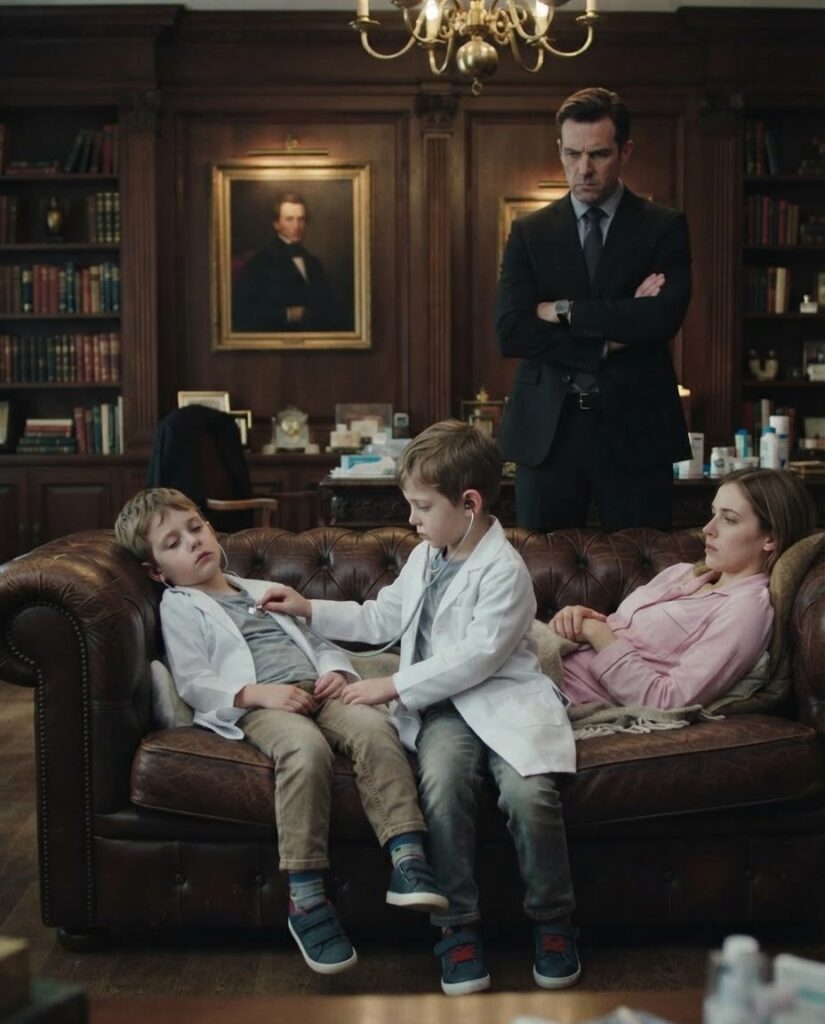
The smell was faint enough that I might have ignored it anywhere else.
Sweet.
Dry.
Chemical.
Something between old cedar, cleaning solution, and the sharp scent that clung to winter clothes stored too long in a closet.
Nathan watched me.
“What is it?”
“I don’t know yet.”
Behind him, Mrs.
Bennett had gone unusually still.
That interested me almost as much as the smell.
I stepped closer to the wall.
The vent sat between Jacob’s room and Jonah’s, high above an antique table decorated with a vase of white flowers.
“Is this ventilation connected to the rest of the house?”
Nathan glanced at Mrs.
Bennett.
She answered.
“The east wing has a separate system.”
“Why?”
“It was renovated two years ago.”
Two years.
The same amount of time the boys had been getting sick.
I turned toward Nathan.
“When exactly did their symptoms begin?”
He frowned.
“Not long after their fourth birthday.”
“And when was the renovation finished?”
Mrs.
Bennett looked at him before answering.
“Three weeks before their fourth birthday.”
Nobody spoke.
It wasn’t proof of anything.
It wasn’t even close.
But for the first time since I had entered that mansion, the facts seemed to be pointing in the same direction.
Nathan’s expression changed.
“You think the house is making them sick?”
“I think there’s something worth checking.”
Mrs.
Bennett folded her hands in front of her.
“This estate is inspected regularly.”
“I’m sure it is.”
“Air filters are changed every month.
The heating system is serviced twice a year.
We have water testing, mold inspection and pest control.”
“That doesn’t mean we should ignore a smell nobody can identify.”
Her mouth tightened slightly.
I understood her reaction.
Mrs.
Bennett had probably spent years ensuring that nothing went wrong inside Nathan Coleman’s home.
My question wasn’t simply about a ventilation system.
To her, it sounded like an accusation.
I softened my voice.
“I’m not saying anyone failed.”
Her eyes met mine.
“Not yet, perhaps.”
Nathan interrupted before the tension could grow.
“Show her the boys.”
Jacob and Jonah were sitting at a small table beside the windows when I entered their room.
Matching faces.
Different expressions.
Jacob looked up immediately.
Jonah continued working on a wooden puzzle.
They were pale, but not frighteningly so.
Thin little wrists emerged from the sleeves of their sweaters.
Nothing about them looked dramatic.
That was somehow worse.
They looked like children who had simply forgotten what it felt like to have energy.
“Are you Emily?”
Jacob asked.
“I am.”
“Are you another doctor?”
“No.”
Jonah finally looked at me.
“Good.”
Nathan gave him a surprised look.
I smiled.
“Not fond of doctors?”
“We have too many.”
Jacob nodded seriously.
“One has cold hands.”
“And one talks like we aren’t in the room,” Jonah added.
Nathan looked down.
Something about that sentence reached him.
I pulled out a chair.
“What are you building?”
“A lighthouse,” Jacob said.
“It’s supposed to be a lighthouse,” Jonah corrected.
“It is a lighthouse.”
“It has three doors.”
“It’s a big lighthouse.”
Their argument was quiet and completely ordinary.
For several minutes I simply sat with them.
I asked about their books.
Their favorite food.
Whether they preferred dogs or cats.
Jacob preferred dogs.
Jonah said cats were smarter.
Jacob insisted that intelligence wasn’t everything.
Jonah reminded him that their father owned no pets, so the argument was “mostly theoretical.”
I laughed before I could stop myself.
Nathan did too.
It was brief.
Almost startled.
As though laughter had become an unfamiliar sound in that part of the house.
Then Jacob rubbed his forehead.
Nathan noticed instantly.
“Headache?”
“A little.”
His father crossed the room.
“We can stop.”
“I’m okay.”
“You don’t have to prove anything.”
“I know.”
There was tenderness between them, but also something heavier.
Nathan watched his sons too carefully.
He measured every yawn.
Every pause.
Every wince.
Every unfinished meal.
He had become a father who loved by monitoring.
Perhaps fear had taught him no other way.
I spent the rest of that afternoon learning the boys’ routine.
Lessons in the morning when they had energy.
Rest after lunch.
Short walks when the weather allowed.
No rough games.
No long outings.
Dr.
Reeves had built their entire schedule around conserving strength.
By five o’clock, I noticed another pattern.
The headache Jacob had mentioned improved when we sat on the terrace.
Jonah became more talkative outside.
When Mrs.
Bennett called us in for dinner, both boys complained almost immediately that they were tired.
It could have meant nothing.
But after years of caring for sick children, I had learned something important.
Patterns rarely announce themselves.
They whisper.
You have to listen long enough to hear them.
That evening, after the boys had gone to sleep, I found Nathan in his study.
The medical files were still spread across his desk.
“You read all of these?”
I asked.
“More than once.”
“May I?”
He hesitated.
Then pushed several folders toward me.
“I assume confidentiality was explained by the agency.”
“Yes.”
I sat down.
I wasn’t looking for a diagnosis.
That would have been foolish.
I was looking for timing.
Nathan had kept meticulous records.
Dates.
Appointments.
Test results.
Travel.
Medication changes.
Hospital visits.
The kind of record a frightened parent makes when he believes the answer might be hidden somewhere between Monday and Tuesday.
One detail appeared again and again.
In July, when the twins had spent nearly three weeks at Nathan’s sister’s house near the coast, both boys had improved.
Not completely.
But noticeably.
Their appetite had increased.
Jacob had stopped complaining about morning headaches.
Jonah had required fewer afternoon naps.
Within ten days of returning home, the fatigue returned.
I looked up.
“Did anyone pay attention to this?”
Nathan came around the desk.
I pointed at the notes.
“That was a good summer.”
“You wrote that they improved.”
“They had fewer symptoms.”
“Where were they staying?”
“My sister Caroline’s place in Rhode Island.”
“Were they on different medicine?”
“No.”
“Different food?”
“Not significantly.”
“Different schedule?”
“A little.”
I tapped the page.
“But they weren’t living here.”
His face tightened.
“You really think this matters.”
“I think it deserves to matter until someone proves it doesn’t.”
Nathan leaned against the desk.
For a long moment, he said nothing.
Then he looked toward the windows.
“I’ve had this house inspected.”
“I know.”
“Twice.”
“Who chose what to inspect?”
He looked back at me.
I continued.
“If someone checks for mold, they can tell you whether there’s mold.
If someone checks the furnace, they can tell you whether the furnace works.
But did anyone ever come here because two children were sick and ask what they might both be exposed to?”
That question landed differently.
“No.”
“Then maybe that’s where we begin.”
The next morning Dr.
Reeves arrived shortly after breakfast.
He looked unhappy to see me sitting with Nathan.
“What now?”
Nathan didn’t waste time.
“I want an environmental evaluation of the east wing.”
Dr.
Reeves removed his glasses.
“On what basis?”
Emily Dawson, household help.
I could almost hear the phrase before he said it.
Instead he looked directly at me.
“This was your suggestion.”
“Yes.”
“Why?”
“The symptoms began around the time that wing was renovated.
Both boys improved during an extended stay away from the house.
There’s also an unusual chemical odor near their ventilation system.”
He gave a patient sigh.
“Fatigue varies.
Children have good weeks and bad weeks.”
“I understand.”
“Correlation is not diagnosis.”
“I understand that too.”
“Then you understand that chasing every coincidental detail can create unnecessary anxiety.”
I looked at Nathan.
“Has unnecessary anxiety been the problem in this house?”
Dr.
Reeves’ jaw tightened.
Nathan raised one hand.
“That’s enough.”
But he wasn’t speaking to me.
“I want the inspection.”
Dr.
Reeves looked at him.
“Nathan—”
“Three million dollars bought me theories.
An air-quality inspection costs considerably less.”
That ended the discussion.
By noon, Nathan had contacted an environmental health consultant recommended by one of the Boston hospitals.
Dr.
Lena Shah arrived the following morning.
She was in her forties, practical, quiet, and completely uninterested in the atmosphere of importance surrounding the estate.
That alone made me like her.
She asked questions nobody else had asked.
What rooms did the twins spend the most time in?
Had furniture been replaced?
Had floors been refinished?
Were pesticides used?
Were antique textiles stored nearby?
Had insulation been added?
Was the ventilation system independent?
Mrs.
Bennett produced maintenance binders.
Dr.
Shah studied them.
Then she walked through the east wing with a small collection of sampling devices.
When she reached the hallway between the twins’ rooms, she stopped exactly where I had stopped.
She inhaled.
“That odor is always here?”
Mrs.
Bennett answered.
“I’ve never noticed it.”
Nathan frowned.
“Neither have I.”
Dr.
Shah glanced at me.
“You did?”
“Yes.”
She climbed onto a small step stool and inspected the vent.
“Has anyone opened the return cavity?”
Mrs.
Bennett said, “Maintenance would have.”
“Recently?”
“I would need to check.”
The grate was removed.
The smell became stronger.
Jacob, watching from his doorway, wrinkled his nose.
“That’s the old-coat smell.”
Every adult in the hallway turned toward him.
“What?”
Nathan asked.
“The old-coat smell.”
Jonah appeared beside his brother.
“It’s stronger when the heat comes on.”
My heart began beating faster.
Not because we had an answer.
Because the boys had just given us another piece of information nobody had thought to ask for.
Dr.
Shah crouched so she was level with them.
“How long have you noticed that?”
Jacob shrugged.
“A long time.”
“Does it bother you?”
“Sometimes it makes my head feel funny.”
Nathan’s face drained of color.
Dr.
Shah immediately raised a hand.
“We still don’t know what it is.”
Her calm mattered.
Nathan needed facts, not fear.
She turned to him.
“Until we identify the source, I’d prefer the children sleep somewhere else.”
Nathan answered instantly.
“There’s a guesthouse.”
“Separate ventilation?”
“Completely separate.”
“Good.”
Within an hour, the twins had turned moving into the guesthouse into an adventure.
They packed books, puzzles, stuffed animals, and enough toys to survive what Jacob described as “a minimum of eleven years.”
That night we ate grilled cheese sandwiches at the guesthouse kitchen table.
There were no chandeliers.
No staff moving silently through halls.
No polished silver.
Just Nathan, his sons, Mrs.
Bennett, and me.
Jonah dipped his sandwich into tomato soup.
“Can we stay here forever?”
Nathan looked surprised.
“You prefer this to your room?”
“It’s smaller.”
Jacob nodded.
“Smaller is good.”
“Why?”
The boys looked at each other.
Then Jacob said, “Because we know where you are.”
Nathan stopped eating.
I looked down at my bowl.
Some moments belonged to families.
Even when you were sitting at the same table.
Nathan cleared his throat.
“I’m usually working.”
“We know,” Jonah said.
There was no accusation in it.
That was what made it painful.
Nathan reached across the table and moved Jacob’s cup away from the edge.
“I could work here sometimes.”
Jacob smiled.
“That would be okay.”
The next two days passed quietly.
Dr.
Shah continued testing.
The boys remained in the guesthouse.
And something happened that no machine needed to measure.
On the second morning, Jonah came downstairs before anyone called him.
On the third, Jacob asked if we could walk to the fountain.
It was not a miracle.
They were still tired.
Still pale.
Still children with an unresolved medical problem.
But Nathan noticed.
So did Dr.
Reeves.
He arrived on the third afternoon with new blood test results.
He found the twins outside with me, tossing fallen leaves into the fountain and assigning each one a name.
“You seem energetic,” he told Jacob.
Jacob considered that.
“Medium energetic.”
Dr.
Reeves almost smiled.
“An improvement.”
Nathan came down the path.
“What do the tests show?”
The doctor’s expression became serious.
“Some of the same abnormalities we’ve seen before.
Mild anemia.
A few markers that suggest the red blood cells are breaking down faster than expected.”
Dr.
Shah, who had just stepped out of the guesthouse, stopped.
“How long has that been happening?”
“Intermittently.”
“Any history of G6PD deficiency?”
Dr.
Reeves looked at her.
“No.”
“Tested?”
“I’d have to review the earlier panels.”
Something in his answer bothered me.
Not because he had done anything wrong.
Because for the first time, he sounded uncertain.
Dr.
Shah turned toward the main house.
“I’d like access to the ventilation chase and the storage areas behind the east wing.”
Mrs.
Bennett, standing near the terrace steps, went pale.
Nathan noticed.
“Margaret?”
It was the first time I had heard him call her by her first name.
“There’s an old storage room behind that corridor,” she said.
Dr.
Shah looked at her.
“What’s stored there?”
Mrs.
Bennett took a moment before answering.
“Mrs.
Coleman’s belongings.”
Nathan became perfectly still.
Nobody spoke.
I finally understood why the subject of the twins’ mother had never come up.
Mrs.
Bennett lowered her voice.
“Her clothes.
Rugs from her sitting room.
Some upholstered furniture.
Boxes.”
Nathan looked toward the mansion.
“That room was sealed.”
“It was.”
“Was?”
“When the ventilation system was changed, maintenance needed access through the rear wall.”
“And after that?”
“I don’t know.”
Dr.
Shah asked gently, “Were any moth repellents or preservation chemicals used on the textiles?”
Mrs.
Bennett’s face changed.
“I used storage blocks.”
“What kind?”
“I don’t remember.”
“When?”
“Years ago.”
“Where are they now?”
“I assumed they had been removed.”
Nathan stared at her.
“You assumed?”
The words were quiet.
That was all.
But Mrs.
Bennett looked devastated.
“I was trying to preserve Eleanor’s things.”
For several seconds, Nathan could not answer.
Then Dr.
Shah stepped forward.
“This may have nothing to do with the boys.
We need evidence.”
Nathan nodded once.
“Open the room.”
Mrs.
Bennett led us through a narrow service corridor behind the east wing.
At the end stood an unremarkable white door.
Nathan stopped in front of it.
His hand rested on the handle, but he did not turn it.
I suddenly realized that whatever was behind that door had remained untouched not because Nathan had forgotten it.
Because he had remembered too much.
“My wife died when the boys were eighteen months old,” he said.
His voice was flat with practiced control.
“Afterward, Bennett packed her personal things.
I told everyone I didn’t want the room disturbed.”
Mrs.
Bennett whispered, “I thought I was helping.”
Nathan closed his eyes briefly.
Then he opened the door.
The scent rolled into the corridor almost immediately.
Sweet.
Chemical.
Familiar.
Dr.
Shah stepped inside.
Old coats hung beneath white cloth covers.
Rugs stood rolled against the wall.
Boxes were stacked neatly along shelves.
And beside the far wall, partially hidden behind a wardrobe, was an air-return duct.
Dr.
Shah walked toward it.
Then she looked down.
Several small white blocks rested inside shallow metal containers near the textiles.
Mrs.
Bennett stared.
“No.”
Dr.
Shah crouched without touching them.
“Do you recognize those?”
Mrs.
Bennett swallowed.
“Yes.”
“The storage treatment?”
“Yes.”
“I bought them years ago.”
“How many?”
“I don’t remember.”
“Were they supposed to remain in an open room?”
“No.”
Nathan looked from the blocks to the ventilation duct.
The pieces were beginning to fit together.
Not perfectly.
Not yet.
But enough to frighten him.
Dr.
Shah stood.
“Nobody touches anything until we know what those contain.”
She called her laboratory.
Samples were collected.
The ventilation system was shut down.
The twins stayed in the guesthouse.
That evening, I found Nathan alone on the guesthouse porch.
The lights from the mansion glowed through the trees.
He was staring at them as though the house belonged to someone else.
“I spent three million dollars,” he said.
I sat in the chair beside him.
“You mentioned that.”
“I took them to every specialist whose name anyone gave me.”
“I know.”
“I flew doctors here.”
“I know.”
“I would have taken them anywhere.”
“I believe you.”
His hands closed together.
“And the entire time, it might have been twenty yards from my office.”
“You don’t know that yet.”
He looked at me.
“But you noticed it.”
“I noticed a smell.”
“I live here.”
“You also live with memory.”
His eyes narrowed slightly.
I nodded toward the mansion.
“That room wasn’t just a storage room to you.”
He looked away.
“No.”
“Then maybe you trained yourself not to notice anything connected to it.”
For once, Nathan Coleman had no answer.
The next morning Dr.
Reeves arrived before breakfast.
He asked to speak with Dr.
Shah privately.
Half an hour later, they called Nathan and me into the sitting room.
Reeves held an old laboratory report.
His arrogance was gone.
“I found something.”
Nathan remained standing.
“What?”
“A test from eleven months ago.”
Dr.
Reeves looked directly at me, then at Dr.
Shah.
“One of the boys had an abnormal metabolite level.
The lab note suggested possible environmental exposure.”
Nathan’s voice became very quiet.
“What exposure?”
“At the time, the result was low enough that I considered contamination possible.
I ordered a repeat test, but the repeat panel didn’t include the same compound.”
“Why not?”
“The second lab used a different screening protocol.”
“And you didn’t pursue it.”
“No.”
Dr.
Reeves did not defend himself.
That surprised me more than anything.
“I should have,” he said.
Nathan stared at the report.
Dr.
Shah placed another folder beside it.
“I received the first air samples this morning.”
Everyone turned toward her.
She spoke carefully.
“The east wing shows elevated levels of compounds associated with moth-repellent products.
The concentration is highest near the storage room and the ventilation return.”
Mrs.
Bennett covered her mouth.
Nathan’s face became unreadable.
“Can that cause what’s happening to the boys?”
“It could contribute to headaches, fatigue and blood abnormalities under certain exposure conditions.
But I’m not going to call it the answer until their physicians and toxicology specialists confirm it.”
“Could leaving the house explain why they improved?”
“Yes.”
Silence filled the room.
Then Jonah appeared in the doorway holding half a piece of toast.
“Dad?”
Nathan turned instantly.
“What is it?”
“Jacob says I cheated.”
“Did you?”
“Yes.”
Nathan stared at him.
“So why are we discussing this?”
“Because he’s being dramatic about it.”
From somewhere behind him Jacob shouted, “You moved the knight when I wasn’t looking!”
Jonah sighed.
“See?”
For one extraordinary second, nobody knew what to do.
Then Dr.
Shah laughed.
I did too.
Even Dr.
Reeves smiled.
Nathan walked toward his son.
“I’ll investigate.”
Jonah nodded solemnly.
“Thank you.”
As they disappeared down the hallway, I looked at Mrs.
Bennett.
She was crying silently.
Not loudly.
Not theatrically.
She simply stood beside the window with tears running down her face.
“I put those things in that room,” she whispered.
“You didn’t connect them to the ventilation renovation,” I said.
“I should have.”
“Maybe.”
She looked at me.
“That doesn’t make me feel better.”
“It isn’t supposed to.”
She seemed surprised.
I continued quietly.
“But guilt and responsibility aren’t always the same thing.”
Before she could answer, Dr.
Shah’s phone rang.
She listened for less than a minute.
Then her expression changed.
“What is it?”
Dr.
Reeves asked.
She ended the call.
“The detailed chemical identification is back.”
Nathan had just returned to the doorway.
Dr.
Shah looked at him.
“The storage blocks contain naphthalene.”
Dr.
Reeves went still.
Then he looked down at the boys’ blood results.
“Mild hemolysis,” he murmured.
Dr.
Shah nodded.
“And if the twins have an underlying enzyme deficiency that makes them more sensitive…”
Dr.
Reeves was already reaching for his phone.
“I’m ordering the test.”
Nathan looked between them.
“What test?”
Dr.
Reeves raised his eyes.
“One we should have ordered a long time ago.”
And suddenly the mystery that had consumed two years, dozens of specialists, and millions of dollars was no longer scattered across a hundred theories.
It had narrowed to one room.
One ventilation system.
One forgotten decision made years earlier.
And one unanswered question hidden inside the twins themselves.
-END OF PART 2, –PRESS NEX PART IN BOTTOM OF PAGE TO READ NEXT PART
WHAT THE HOUSE HAD BEEN HOLDING: THE TRUTH WASN’T ABOUT BLAME—IT WAS ABOUT WHAT NO ONE HAD BEEN READY TO FACE
PART 3
The test took three days.
Those three days changed the Coleman household more than the previous two years had.
The twins stayed in the guesthouse.
Nathan stayed there too.
At first, I assumed it was temporary.
By the second night, his laptop had moved onto the kitchen table.
By the third morning, half his phone calls were being taken on the back porch while Jacob and Jonah searched the lawn for acorns.
Nobody announced the change.
It simply happened.
Perhaps families sometimes begin healing that way.
Not through speeches.
Through relocation.
Through breakfast.
Through being in the same room long enough to become familiar again.
The boys were improving, but slowly.
That was important.
There was no magical morning when they suddenly jumped out of bed restored.
Jacob still needed to rest after lunch.
Jonah still complained occasionally of headaches.
But their appetite grew stronger.
Their concentration improved.
They laughed more.
On the fourth day in the guesthouse, I discovered them building a fortress out of sofa cushions.
Dr.
Reeves arrived while Jacob was defending the western wall with a wooden spoon.
He stopped in the doorway.
“What happened here?”
“We were invaded,” Jonah explained.
“By whom?”
“Jacob.”
“I live here too!”
Jacob protested.
Jonah looked at the doctor.
“He doesn’t understand borders.”
Dr.
Reeves removed his glasses.
For the first time since I had met him, he looked like an ordinary man rather than a physician determined to win every room he entered.
“Apparently neither do many adults,” he said.
Nathan appeared behind him.
“You have the results?”
The lightness vanished.
Dr.
Reeves nodded.
He asked the boys to continue their battle while the adults stepped into the small study.
Dr.
Shah had joined us by video call.
Mrs.
Bennett stood near the door.
Nobody sat.
Dr.
Reeves opened the folder.
“Both boys have G6PD deficiency.”
Nathan frowned.
“What does that mean?”
“It’s an inherited enzyme deficiency.
Many people live with it without serious problems, but certain triggers can cause red blood cells to break down more rapidly.”
Dr.
Shah added, “Naphthalene exposure is a known trigger.”
Nathan looked at her.
“So this is it.”
“We have a strong explanation,” she said.
“Their laboratory patterns, symptoms, environmental results, and improvement away from the exposure all line up.
Their medical team should still follow them carefully, but yes—the evidence is now much more coherent.”
Nathan lowered himself into a chair.
It was the first time I had ever seen him sit as though his legs had stopped supporting him.
“They’re going to recover?”
Dr.
Reeves’ voice softened.
“We expect significant improvement once the exposure is eliminated.
They’ll need monitoring while their blood counts normalize, and you’ll need guidance about other triggers associated with the deficiency.
But nothing we’ve found suggests they can’t return to a much more normal childhood.”
Nathan looked down.
Nobody interrupted him.
After almost two years of fearing something nameless and progressive, relief could apparently be as heavy as fear.
Finally he whispered, “Normal.”
Dr.
Reeves nodded.
“Normal.”
Through the wall came a loud crash.
Then Jonah yelled, “We’re okay!”
Dr.
Shah smiled from the screen.
Nathan covered his eyes for a moment.
When he lowered his hand, he was laughing.
Not because anything was funny.
Because he could.
Mrs.
Bennett left the room quietly.
I followed her.
I found her standing behind the guesthouse beside a stone wall covered in ivy.
“Mrs.
Bennett.”
She didn’t turn around.
“I knew about the storage blocks.”
“You’ve said that.”
“I chose them.”
“You chose them years before the ventilation system was changed.”
“That does not change the fact.”
“No.”
She finally faced me.
Her eyes looked tired.
“You don’t intend to comfort me.”
“Not with something untrue.”
A small, sad smile appeared.
“I suppose that’s why Nathan hired you.”
“He hired me because he was desperate.”
“He’s been desperate for a long time.”
She looked toward the main house.
“I came to work for the Colemans before the boys were born.
Eleanor chose me.”
That was the first time anyone had spoken Nathan’s wife’s name without the room changing around it.
“What was she like?”
Mrs.
Bennett’s expression softened.
“Warm.
Disorganized.
Always losing her keys.
She bought flowers she forgot to put in water and books she never had time to read.”
I smiled.
“Sounds terrible.”
“She was impossible.”
The affection in her voice was unmistakable.
“When she died, Nathan couldn’t decide what to keep.
He couldn’t decide what to give away.
So he decided nothing.”
“The storage room.”
“Yes.”
“I packed everything.”
Mrs.
Bennett looked down at her hands.
“There were expensive wool coats.
Old rugs from her family.
A seamstress told me moths had already damaged one garment.
I ordered preservation supplies.
At the time, the storage room was closed off from the occupied wing.”
“And then the ventilation was renovated.”
“Two years later.”
“You didn’t make that connection.”
“No.”
“Neither did the contractor.”
“No.”
“Neither did the maintenance company.”
“No.”
“Neither did the doctors.”
She looked at me sharply.
“I’m not looking for company in my mistake.”
“I know.”
“Then why say it?”
“Because there’s a difference between taking responsibility and carrying every piece of blame you can find.”
She turned away.
“I almost resigned this morning.”
“Does Nathan know?”
“No.”
“Are you going to?”
“I haven’t decided.”
“Maybe you should wait until he’s allowed to have an opinion about losing someone else he trusts.”
Her shoulders tightened.
“I don’t know if he trusts me.”
“He let you raise half this house.”
“That was before.”
“Before you made a mistake?”
She gave me a look.
“You have an irritating way of reducing dramatic things to simple sentences.”
“It saves time.”
That earned me another reluctant smile.
By afternoon, the estate had changed completely.
Environmental remediation teams sealed the east wing.
The storage contents were removed under professional supervision.
The ventilation system was dismantled and cleaned.
Air samples were taken from the boys’ rooms, the hallway, adjacent spaces and staff quarters.
Nathan insisted that the entire house be tested, even though Dr.
Shah explained that the problem appeared localized.
“I’m not assuming anything again,” he said.
Nobody argued.
Dr.
Reeves began reviewing every medical record from the previous two years.
Not because Nathan demanded it.
Because he did.
For the first time, I watched a proud man examine his own mistakes without trying to explain them away.
Late one evening, I found him in the guesthouse kitchen.
He was sitting with a stack of reports beside an untouched cup of coffee.
“You’re still here.”
“So are you.”
“I work here.”
He looked at me over his glasses.
“Apparently so do I.”
I opened the refrigerator.
“Did you eat dinner?”
“Yes.”
I looked at the untouched plate Mrs.
Bennett had wrapped and labeled for him.
He sighed.
“No.”
I put it in the microwave.
“You don’t have to supervise me.”
“I supervise children.
You’re easier.”
“That may be the first time anyone has said that.”
I placed the plate in front of him.
He stared at it.
Then he said, “I owe you an apology.”
I sat opposite him.
“That sounded painful.”
“It was.”
“I appreciate the effort.”
He almost smiled.
“I treated you dismissively.”
“Yes.”
“I assumed your lack of credentials meant your observations had less value.”
“Yes.”
“You could let me finish.”
“I thought agreeing might help.”
He leaned back.
“I’ve spent forty years learning medicine.”
“And I’ve spent fifteen years learning children.”
“That distinction appears more important than I gave it credit for.”
He looked toward the ceiling.
“I should have pursued the abnormal toxicology result.”
“Why didn’t you?”
He was silent before answering.
“Because by then I had become convinced their condition was metabolic or genetic.”
“G6PD is genetic.”
“Yes, but it wasn’t causing symptoms spontaneously.
I was looking for a rare disease complicated enough to explain why so many doctors had missed it.”
“And the answer was simpler.”
“Not exactly simple.”
“No.”
He folded his hands.
“But ordinary.”
I understood what he meant.
Sometimes expertise created a strange kind of blindness.
When dozens of brilliant people failed to find an answer, the next brilliant person assumed the answer must be even more complicated.
Nobody wanted to believe that an old storage room and a ventilation duct could matter more than advanced imaging and specialist conferences.
Dr.
Reeves looked at me.
“Medicine teaches pattern recognition.”
“So does nannying.”
That time he laughed.
A week passed.
Then another.
The twins’ blood counts improved.
Their headaches became less frequent.
Their color returned gradually.
One morning Jacob ran from the kitchen to the porch.
Nathan called after him.
“Slow down.”
Jacob stopped.
Not because he was tired.
Because his father had told him to.
Then he looked confused.
“Why?”
Nathan opened his mouth.
No answer came.
For two years, “slow down” had meant protection.
Now the words no longer fit.
I stood beside him.
“Maybe let him decide when he’s tired.”
Nathan watched Jacob race Jonah around an oak tree.
“You think I hover.”
“I think you’ve had reasons to.”
“That wasn’t my question.”
“Yes.”
He nodded.
“I hover.”
“Professionally.”
That earned the faintest smile.
Then his expression became serious again.
“I don’t know how to stop waiting for something to go wrong.”
“You probably don’t stop all at once.”
“How, then?”
“Start by letting them reach the tree.”
He watched.
Jacob touched the trunk first.
Jonah accused him of leaving early.
A debate followed.
Nobody collapsed.
Nobody complained of dizziness.
Nobody asked to lie down.
Nathan exhaled.
It sounded almost like surrender.
Not defeat.
Release.
The problem was that removing the chemical exposure did not remove two years of habits.
The boys had learned to think of themselves as fragile.
Nathan had learned to treat every burst of energy as something that needed to be rationed.
Mrs.
Bennett had learned to maintain silence around anything uncomfortable.
And Dr.
Reeves had learned that expertise could become armor.
Recovery, I realized, would mean changing all of those things.
Not just blood results.
One afternoon I found Jonah sitting on the porch steps while Jacob kicked a ball across the lawn.
“You don’t want to play?”
“I do.”
“Then why aren’t you?”
He picked at a loose thread on his sleeve.
“What if I get tired?”
“Then you rest.”
“What if Dad gets worried?”
“Dad worries when the weather changes.”
Jonah smiled.
“He does.”
I sat beside him.
“You don’t have to prove you’re better.”
“I know.”
“You also don’t have to prove you’re sick.”
He looked at me.
That sentence seemed to surprise him.
For two years, adults had asked him how he felt.
How tired?
How dizzy?
How much pain?
How long?
Children learned quickly what grown-ups watched for.
“What if I don’t know how I feel?” he asked.
“Then say that.”
“Doctors don’t like that.”
“Doctors survive disappointment.”
He considered this.
Then shouted, “Jacob!”
His brother stopped.
“What?”
“Kick it here.”
Jacob kicked the ball badly.
It rolled six feet to Jonah’s left.
“You’re terrible,” Jonah called.
“I’m recovering!”
“That’s not why!”
Their voices drifted across the grass.
Nathan was watching from the guesthouse window.
But he didn’t come outside.
Progress.
Three weeks after the discovery, Dr.
Shah declared the guesthouse safe, the main living areas safe, and the east wing still temporarily closed pending additional testing.
Nathan accepted the report.
Then he asked a question.
“What happens to the storage room?”
Dr.
Shah looked puzzled.
“From an environmental standpoint?”
“No.”
He turned toward me.
I understood.
He meant Eleanor.
That night, he unlocked the room again.
Most of the chemical materials and contaminated packaging had already been removed.
The remaining belongings had been professionally cleaned or sealed for evaluation.
The space looked strangely empty.
Nathan stood inside.
I remained near the door.
“You don’t have to stay,” he said.
“I know.”
He walked toward one of the cleaned archival boxes.
Inside was a blue scarf.
He lifted it carefully.
“My wife wore this the first time we met.”
I said nothing.
“She was at a fundraiser.
I hated fundraisers.”
“Did she?”
“She hated them more.”
He smiled at the memory.
“She spilled coffee on me.”
“Romantic.”
“She told me I was standing in an inconvenient place.”
“I think I would have liked her.”
“You would have argued.”
“That doesn’t mean I wouldn’t like her.”
He ran the scarf between his fingers.
“I kept everything.”
“I noticed.”
“I thought throwing anything away meant…”
He stopped.
“You don’t need to finish.”
“Yes, I do.”
He stared at the box.
“I thought it meant deciding she was gone.”
I leaned against the doorframe.
“And if you didn’t decide?”
“Then apparently I could spend five years storing coats.”
There was bitterness in his voice, but also recognition.
I walked farther into the room.
“You don’t have to choose between keeping everything and forgetting her.”
He looked at me.
“No?”
“No.”
“You speak from experience?”
“My father died when I was twenty-four.”
It was the first personal thing I had told him.
Nathan waited.
“My mother kept his shoes beside the back door for almost a year.”
“Why?”
“She said moving them felt rude.”
His expression softened.
“What happened?”
“One day she donated them.”
“And that fixed it?”
“No.”
“Then what did?”
“Nothing fixed it.”
I looked at the blue scarf.
“She just learned that remembering him didn’t require the shoes.”
The next day, Nathan brought the twins into the storage room.
Not to tell them about chemicals.
That part had already been explained in simple, age-appropriate terms by their doctors.
He brought them to tell them about their mother.
He showed them photographs.
A recipe book filled with Eleanor’s handwriting.
A music box.
The blue scarf.
Jonah held it up.
“Did Mom like blue?”
“She loved blue,” Nathan said.
Jacob found an old picture showing Eleanor standing beside a lake.
“Was she funny?”
Nathan looked at the photograph.
“Yes.”
“Funnier than Emily?”
Nathan glanced at me.
“Considerably.”
“Rude,” I said.
The boys laughed.
Nathan did too.
Then he told them stories.
Not tragic stories.
Ordinary ones.
How Eleanor burned pancakes.
How she sang the wrong lyrics to songs.
How she insisted both twins kicked whenever Nathan spoke near her stomach.
How she bought two identical stuffed bears because she was convinced the babies would argue before they were even born.
The twins listened.
For the first time, their mother became more than a portrait in a hallway.
She became a person.
That evening Mrs.
Bennett finally told Nathan she intended to resign.
I wasn’t present when the conversation began.
I only knew because I passed the library and heard Nathan say, “No.”
I stopped.
Not to listen.
At least, that was what I told myself.
Mrs.
Bennett’s voice was quiet.
“I should have remembered those storage treatments.”
“You should have.”
“Yes.”
“The maintenance company should have identified them during renovation.”
“Yes.”
“The ventilation contractor should not have placed a return beside a chemical storage area.”
“No.”
“Reeves should have followed the lab result.”
“Yes.”
“I should have asked why the boys improved away from home.”
She said nothing.
Nathan continued.
“Apparently there is enough regret in this house for everyone.”
“I was responsible for your home.”
“You still are.”
“Sir—”
“My sons love you.”
Her voice broke slightly.
“That doesn’t erase what happened.”
“No.”
“Then why would you ask me to stay?”
“Because leaving is not the only way to accept responsibility.”
I found myself smiling.
Apparently someone had been listening.
Mrs.
Bennett did not resign.
Instead, she reorganized the estate’s entire maintenance system.
Every product entering the property had to be documented.
Environmental records were added to health files.
Service contractors no longer worked from old standing orders without annual review.
And Mrs.
Bennett developed a habit of opening windows that would have horrified her former self.
Four weeks after we moved into the guesthouse, Dr.
Shah cleared most of the mansion for occupancy.
The east wing would remain closed a little longer.
Nathan surprised everyone.
“We’re not moving the boys back there.”
Mrs.
Bennett blinked.
“Where will they sleep?”
Nathan looked toward the smaller bedrooms near the family library.
“The west rooms.”
Those rooms had no elaborate carved ceilings.
No private sitting room.
No custom bathroom.
No distant hallway separating the children from everyone else.
They were simple.
Warm.
Close to Nathan’s bedroom.
Jacob approved immediately.
Jonah inspected both rooms before announcing, “We can hear Dad’s door from here.”
Nathan looked at me.
He remembered the first dinner in the guesthouse.
Because we know where you are.
“Yes,” he told Jonah.
“You can.”
That night, after the boys had chosen their rooms, I was unpacking books when Dr.
Reeves called.
He had completed his final review of the old medical records.
“I found something else,” he said.
I braced myself.
“What?”
“Not another disease.”
“That’s encouraging.”
“A pattern.”
He sent the document to Nathan and me.
Hospital visits.
Vacations.
Symptoms.
Air-quality dates.
The pieces aligned almost perfectly.
But one entry stood out.
Eight months earlier, the twins had spent five days in the main house during a heating-system repair.
Their symptoms had improved briefly.
Then worsened again when they returned to the east wing.
Nathan stared at the page.
“We had the answer eight months ago.”
Dr.
Reeves shook his head.
“No.
We had a clue.”
“There’s a difference?”
“A clue only becomes an answer when someone notices it.”
His eyes moved toward me.
Nathan followed his gaze.
I suddenly felt uncomfortable.
“I noticed a smell.”
Dr.
Reeves nodded.
“And then you asked a question.”
After the call ended, Nathan stood beside the window.
“Emily.”
“Yes?”
“You came here as a nanny.”
“That was the advertisement.”
He turned.
“I don’t think the boys only need a nanny anymore.”
I raised an eyebrow.
“Are you firing me after one month?”
“No.”
“Good, because I haven’t unpacked everything.”
He almost smiled.
“I want you to stay.”
“As what?”
He considered the question.
Then footsteps thundered down the hallway.
Jacob appeared.
“Emily!
Jonah says he gets the room with the bigger window!”
Jonah shouted from behind him, “Because I chose first!”
Nathan closed his eyes.
I smiled.
“Whatever my job title is, apparently negotiations have begun.”
But later that night, when everyone had gone to bed, I passed the former east wing.
The doors were closed.
The ventilation system was silent.
The strange sweet smell was gone.
For the first time, the hallway smelled like nothing.
And somehow that felt extraordinary.
Then I noticed a cardboard box outside the old storage room.
Written across the top in Nathan’s handwriting were three words:
FOR THE BOYS.
Inside were photographs.
Letters.
The music box.
The blue scarf.
And one small envelope I had never seen before.
Nathan picked it up behind me.
His expression changed when he recognized the handwriting.
“Eleanor wrote this.”
“To you?”
He turned the envelope over.
Then he shook his head.
“No.”
On the front, in faded blue ink, were the words:
For Jacob and Jonah, when they’re old enough.
Nathan stared at the letter his wife had written years earlier.
A letter he had never known existed.
And suddenly the room that had held the answer to the boys’ illness was offering the family something else entirely.
A piece of their mother waiting to be heard.
-END OF PART 3–PRESS NEX PART IN BOTTOM OF PAGE TO READ NEXT PART
THE THINGS WE FINALLY LET GO: AFTER YEARS OF SEARCHING FOR AN ANSWER, THE COLEMAN FAMILY DISCOVERED WHAT HOME WAS SUPPOSED TO FEEL LIKE
PART 4
Nathan did not open Eleanor’s letter that night.
I thought he would.
So did Mrs.
Bennett.
Instead, he carried it downstairs and placed it in the locked drawer of his desk.
Then he stood there with his hand resting on the wood.
“They’re six,” he said.
I leaned against the doorway.
“They are.”
“Eleanor wrote ‘when they’re old enough.’”
“Yes.”
“How old is old enough?”
“I don’t think wives leave instruction manuals for widowers.”
He gave me a tired look.
“That would have been helpful.”
“I’m sure you would have ignored it.”
“That is possible.”
He looked at the drawer again.
“I want to read it.”
“Of course you do.”
“But it isn’t mine.”
That answer told me something important about Nathan Coleman.
For all the stories people told about him outside those gates, inside the quiet library he was simply a father standing in front of a letter he desperately wanted to open and choosing not to because it belonged to his sons.
“Then save it,” I said.
“For when?”
“You’ll know.”
He looked skeptical.
“That sounds suspiciously sentimental.”
“I occasionally disappoint people.”
Nathan closed the drawer.
The letter remained unopened.
Life, meanwhile, became unexpectedly noisy.
By early autumn, Jacob and Jonah were strong enough to resume more normal lessons and activities.
The change was gradual enough that I sometimes failed to notice it until something ordinary surprised me.
One morning, I walked into the kitchen and discovered both boys sitting on the floor.
“What happened?”
Jacob looked confused.
“Nothing.”
“Why are you on the floor?”
“We’re making a city.”
Only then did I notice dozens of wooden blocks spread across the tiles.
Three weeks earlier, sitting on the floor for an hour would have exhausted them.
Now Jonah was constructing a bridge while arguing about whether dragons required building permits.
Apparently they did not.
“Breakfast,” Mrs.
Bennett announced.
Nobody moved.
“Gentlemen.”
Jacob placed one final block.
“We’re almost done.”
Mrs.
Bennett looked at me.
I looked at the boys.
Then at her.
A remarkable transformation had occurred in Mrs.
Bennett over the previous weeks.
The woman who once appeared capable of running a military academy with a raised eyebrow now sighed and sat on the floor.
“Explain the city.”
The twins stared at her.
“So breakfast is delayed?”
Jonah asked.
“Three minutes.”
Jacob pointed proudly.
“This is the library.”
“Excellent.”
“This is the hospital.”
“Very practical.”
“This is Dad’s office.”
Mrs.
Bennett examined the tiny block building.
“Why does it have no door?”
Jacob answered without hesitation.
“So he can’t go to work.”
I covered my mouth.
Mrs.
Bennett looked away.
Neither of us succeeded in hiding our laughter.
Nathan entered at exactly that moment.
“What’s funny?”
“No door,” Jonah said.
Nathan looked at the block city.
Then at his office.
Then at us.
“I assume I’m missing context.”
“You frequently are,” Mrs.
Bennett said.
The room became completely silent.
Mrs.
Bennett herself looked horrified.
Nathan stared at her.
Then he laughed.
It began quietly.
Then grew.
Mrs.
Bennett laughed too.
Soon the boys joined in despite having no idea why.
It was the first time I realized that the mansion had changed.
Not physically.
Though the east wing had been remediated, repainted, and inspected until even Dr.
Shah admitted there was little left to test.
The greater change was sound.
Doors stayed open.
Music played in the kitchen.
The twins ran through hallways again.
Mrs.
Bennett sometimes forgot to correct them.
Nathan took fewer calls during dinner.
Some days he even left his phone upstairs.
The first time that happened, Jacob stared at the table.
“Where’s your phone?”
“In my room.”
“Is it broken?”
“No.”
Jonah narrowed his eyes suspiciously.
“Did Emily take it?”
“I did not.”
Nathan buttered a piece of bread.
“I decided I didn’t need it for forty-five minutes.”
Both boys looked impressed.
“Can you do that?”
Jacob asked.
“Apparently.”
The progress in their health continued.
Their blood counts moved steadily toward normal.
Their headaches disappeared.
They gained weight.
Their doctors gradually removed restrictions from their daily activities.
Dr.
Reeves remained involved, but his manner changed.
He spoke to the boys rather than over them.
He explained tests before ordering them.
And once, when Jonah said he did not understand something, Reeves sat beside him and drew a diagram involving castles, guards and “lazy red blood cells,” which was medically imperfect but extremely effective.
Afterward, Jonah told me, “Dr.
Reeves is less annoying now.”
The doctor overheard him.
“I’m delighted by the endorsement.”
“You’re still a little annoying.”
“Progress takes time.”
Dr.
Shah visited for final environmental testing in November.
She walked through the former storage room with Nathan.
It no longer contained tightly packed boxes or covered furniture.
Nathan had kept a few meaningful things.
The rest had been cleaned, donated, given to Eleanor’s relatives, or carefully disposed of.
Sunlight entered through a window that had once been covered.
“What will you do with this room?”
Dr.
Shah asked.
Nathan looked at me.
I shrugged.
“Don’t ask the nanny.
Apparently we cause trouble.”
Dr.
Shah smiled.
Nathan walked toward the window.
“I was thinking about making it a reading room.”
“For the boys?”
“For everyone.”
A week later, shelves were installed.
Not expensive display shelves nobody could touch.
Real shelves.
Low enough for children.
Jacob filled one section with adventure stories.
Jonah created a science shelf.
Mrs.
Bennett added mysteries.
Nathan contributed biographies that nobody else appeared eager to read.
I placed a battered copy of
The Secret Garden
near the window.
Nathan picked it up.
“This looks ancient.”
“It survived my childhood.”
“That explains the damage.”
“You’re becoming funny.”
“I’m concerned about it.”
The storage room that had once preserved a life nobody could bear to sort through became the warmest room in the house.
Maybe that was the point.
Homes should hold memory.
They should not become trapped inside it.
Nathan made another change that winter.
He told me during breakfast.
“I’m restructuring my work.”
I looked up.
“What does that mean?”
“It means fewer nights away.”
“Your sons will approve.”
“It also means I’m separating myself from several operations I should have left years ago.”
He did not explain further.
I didn’t ask.
I knew enough about Nathan’s reputation to understand that his world outside the estate was complicated.
But I also knew that something in him had shifted.
Two years spent believing his children might have an incurable illness had changed what power meant to him.
Once, power had meant controlling everything.
Now he seemed to understand that the most important things in his life could not be controlled.
Only cared for.
“I missed a lot,” he said.
“You were trying to save them.”
“I know.”
“But?”
He looked through the window.
Jacob and Jonah were arguing over a snowman whose head had fallen off.
“But I spent so much time trying to keep them alive that I forgot to live with them.”
There was no self-pity in his voice.
Just understanding.
“You can’t change those years.”
“No.”
“You can change Thursday.”
He looked at me.
“Thursday?”
“Tomorrow.”
“What happens tomorrow?”
“Whatever you choose.”
He thought about that.
The next morning, Nathan canceled every meeting on his schedule.
He took the twins sledding.
I went because somebody had to prevent three Coleman men from making unreasonable decisions involving hills.
That somebody failed.
Nathan chose the steepest slope.
“You’re supposed to be the responsible adult,” I told him.
He looked at the sled.
“I own the hill.”
“That is not how gravity works.”
Jacob laughed so hard he fell backward into the snow.
Jonah pointed downhill.
“Dad goes first.”
Nathan sat on the sled.
“This seems poorly planned.”
“You own the hill,” I reminded him.
He looked at me.
“Enjoying this?”
“Immensely.”
He pushed off.
Ten seconds later, one of the most feared men in Connecticut disappeared into a snowbank.
The twins screamed with laughter.
Nathan emerged covered in snow.
For one second, I wondered whether he was angry.
Then he threw a snowball at me.
It missed by several feet.
“Terrible aim,” I said.
He threw another.
That one did not miss.
By lunch, all four of us were soaked, freezing and exhausted.
Jacob ate two bowls of soup.
Nathan noticed.
He started to say something.
Then stopped.
No questions about appetite.
No questions about fatigue.
No worried hand against a forehead.
He simply passed Jacob another piece of bread.
That was progress too.
Mrs.
Bennett’s progress looked different.
She had spent years believing perfection was the same thing as care.
After what happened, she began questioning that belief.
She trained two assistants instead of doing everything herself.
She took Sundays off.
On one particularly astonishing afternoon, I found her in the reading room wearing ordinary clothes.
No black dress.
No keys clipped at her waist.
No clipboard.
“Who are you?”
I asked.
“Very amusing.”
“What happened?”
“I’m off duty.”
“Does Nathan know?”
“He insisted.”
I sat beside her.
“What are you reading?”
She showed me a mystery novel.
“Any good?”
“Terrible.”
“Then why continue?”
“I need to know who did it.”
“That is how they get you.”
She closed the book.
“I visited Eleanor’s sister yesterday.”
I waited.
“We spoke about the storage room.”
“How did that go?”
“She cried.”
Mrs.
Bennett looked at the shelves.
“So did I.”
I said nothing.
“She told me Eleanor would have hated the idea of all those clothes sitting in boxes.”
“That sounds consistent with what you’ve told me.”
“She also said something else.”
“What?”
“She said grief makes people protect strange things.”
I thought of my father’s shoes.
Nathan’s boxes.
Mrs.
Bennett’s storage blocks.
“Yes,” I said.
“It does.”
She looked at me.
“I spent weeks believing that forgiving myself meant pretending the mistake didn’t matter.”
“And now?”
“Now I think perhaps it means allowing what happened to change how I live.”
I smiled.
“That sounds inconveniently wise.”
“I dislike it.”
“I imagine so.”
Christmas approached.
The estate transformed.
The boys insisted on decorating the enormous tree in the main hall themselves.
This resulted in the bottom four feet receiving approximately ninety percent of the ornaments.
Mrs.
Bennett stared at the result.
Her eye twitched.
I waited.
Nathan waited.
Jacob waited.
Finally she said, “It’s perfect.”
Jonah narrowed his eyes.
“You don’t mean that.”
Mrs.
Bennett sighed.
“No.”
Everyone laughed.
On Christmas Eve, snow began falling shortly after sunset.
Dinner finished late.
The boys carried blankets into the reading room.
Nathan lit the fireplace.
Mrs.
Bennett brought hot chocolate.
For almost an hour, nobody mentioned medicine.
Nobody mentioned blood tests.
Nobody mentioned ventilation.
Nobody mentioned the years they had lost to uncertainty.
We simply sat there.
Then Jacob noticed the blue scarf displayed inside a small glass-front cabinet.
“That was Mom’s.”
Nathan nodded.
“Yes.”
Jonah studied his father.
“Do you miss her at Christmas?”
The question was gentle.
Nathan did not hide from it.
“Yes.”
“Do you get sad?”
“Sometimes.”
Jacob thought about that.
“Can you be happy too?”
Nathan looked at his son.
“Yes.”
“I think you can do both.”
Nathan smiled.
“I think you’re right.”
The room fell quiet again.
Then Nathan stood.
“Wait here.”
He left.
When he returned, he was holding an envelope.
My breath caught.
Mrs.
Bennett recognized it immediately.
Nathan sat between the boys.
“I found this a few months ago.”
“What is it?”
Jonah asked.
“A letter from your mother.”
Both children became very still.
“She wrote it for you.”
Jacob looked at the envelope.
“Can we read it?”
Nathan swallowed.
“That’s why I brought it.”
He handed the letter to Jonah.
“I don’t know all the words,” Jonah said.
“I can help.”
They opened it together.
Eleanor’s letter was not dramatic.
That was what made it beautiful.
She had written it during a period when she knew her health was uncertain but still hoped she would have many years with her sons.
She told them about the day they were born.
About Jacob refusing to sleep unless someone walked with him.
About Jonah gripping Nathan’s finger.
She told them she hoped they would be curious.
Kind to each other.
Brave enough to change their minds.
She told them not to worry about becoming important.
She hoped instead they would become people they liked being when the room was quiet.
Then, near the end, Nathan stopped reading.
His voice had changed.
I could see the line from where I sat.
And please remind your father that loving you is not the same as protecting you from everything.
Nathan laughed once under his breath.
Mrs.
Bennett looked down.
Jacob leaned against his father.
“Mom knew you worried a lot.”
“Apparently.”
“She was smart.”
“Very.”
Jonah pointed at the page.
“There’s more.”
Nathan continued.
The final paragraph was simple.
Eleanor wrote that families sometimes changed shape.
People left.
People arrived.
Children grew.
Homes changed.
But love, when cared for properly, made room rather than taking it away.
When the letter ended, nobody spoke for a while.
Then Jacob asked the most six-year-old question imaginable.
“Can we have cookies?”
Mrs.
Bennett stood.
“Yes.”
Just like that, life continued.
Months passed.
Spring returned.
The boys’ final follow-up appointment came on a bright morning in April.
Dr.
Reeves examined them.
Reviewed their blood work.
Asked about school.
Asked about sleep.
Asked how often they were tired.
Jacob answered, “When Emily makes us read boring books.”
“They are classics,” I protested.
“They’re old.”
“That’s not the same thing.”
Dr.
Reeves smiled and turned toward Nathan.
“Their numbers look excellent.”
Nathan nodded.
He had become better at receiving good news without immediately asking what could go wrong.
Not perfect.
Better.
“Restrictions?” he asked.
“None beyond the usual precautions associated with G6PD deficiency.
Their pediatrician will continue routine monitoring.”
Nathan exhaled.
Jacob raised his hand.
“Yes?”
Reeves asked.
“Can we play soccer?”
“Yes.”
“Can we swim?”
“Yes.”
“Can we ride bikes?”
“With helmets.”
Jacob looked disappointed.
“That part is non-negotiable.”
Jonah raised his hand.
“Can Dad stop asking if we’re tired every ten minutes?”
Dr.
Reeves looked at Nathan.
“I strongly recommend it.”
“Traitor,” Nathan said.
The boys laughed.
Outside the clinic, Jacob raced Jonah to the car.
Neither boy won because both accused the other of cheating.
Nathan watched them.
A year earlier, he would have called for them to slow down.
He didn’t.
Instead he stood beside me with his hands in his coat pockets.
“You were right.”
“That happens occasionally.”
“I’m serious.”
“So am I.”
He looked toward the boys.
“I kept thinking the answer would come from the most expensive person in the room.”
“I noticed.”
“Instead it came from someone who smelled the hallway.”
“That sounds less impressive when you say it that way.”
He smiled.
“I’ve been thinking about what to do with the money.”
“What money?”
“The amount I had budgeted for continued specialist care.”
“Buy a yacht?”
“I dislike boats.”
“Second mansion?”
“I’m having difficulty managing one.”
That was fair.
He looked toward the clinic.
“Dr.
Shah helped me contact a pediatric environmental health program.”
I turned toward him.
“They want to expand home-exposure evaluations for families with unexplained recurring symptoms.”
“That sounds useful.”
“I’m funding it.”
I stared at him.
“Anonymously.”
“Why anonymously?”
He looked amused.
“You think putting Nathan Coleman’s name on a children’s medical program improves fundraising?”
“Excellent point.”
His expression became serious.
“I don’t want another parent to spend two years looking in the wrong direction because nobody asked what was happening inside the house.”
I nodded.
“That’s a good use of the money.”
“It feels better than another private jet.”
“You have more than one?”
He began walking toward the car.
“That information is outside your job description.”
“I don’t have a job description anymore.”
That stopped him.
He turned.
Six months earlier, he had asked me to stay.
The temporary nanny contract had quietly become permanent.
My official title remained ridiculous.
Family Care Coordinator.
Mrs.
Bennett had suggested it.
Jonah preferred “Person Who Tells Dad No.”
Jacob preferred “Boss of Snacks.”
I preferred Emily.
Nathan looked at me.
“You could leave.”
“I know.”
“The boys are healthy.”
“I noticed.”
“You could take another position.”
“Yes.”
His expression was difficult to read.
“But?”
I looked toward the car, where two identical faces were pressed against the window making terrible expressions at us.
“But I’m not finished.”
“With what?”
One of the boys honked the horn.
Nathan closed his eyes.
“That.”
I smiled.
“Exactly.”
By summer, Jacob and Jonah could run from the mansion to the old fountain without stopping.
They did it every morning.
Sometimes Nathan joined them.
Usually he lost.
He claimed he was allowing them to win.
Nobody believed him.
The east wing remained closed to bedrooms.
Nathan converted part of it into a playroom and the rest into offices for Mrs.
Bennett and household staff.
The old storage room stayed a library.
The blue scarf remained behind glass.
Eleanor’s letter went into a special box the boys could open whenever they wanted.
And the mansion that had once seemed too large for the people inside it slowly became a home.
One evening in late August, I sat on the terrace watching the twins chase fireflies.
Nathan came outside carrying two cups of tea.
He handed me one.
“They’re supposed to be getting ready for bed.”
“They’re conducting research.”
“On fireflies?”
“Important research.”
“You encourage them.”
“Constantly.”
He sat beside me.
For a while, we watched without talking.
The fountain glowed in the garden.
Windows stood open across the first floor.
Somewhere inside, Mrs.
Bennett was listening to music while cleaning up after dinner despite officially being off duty.
Nathan looked toward the east wing.
“Do you ever think about the day you arrived?”
“Yes.”
“What did you think of me?”
“You want the polite answer?”
“No.”
“I thought you were exhausted, controlling, suspicious and accustomed to people doing what you said.”
He nodded.
“Accurate.”
“You also looked terrified.”
His expression changed.
“I was.”
“I know.”
“What do you think now?”
I watched Jonah capture a firefly in his hands, immediately panic about hurting it, and release it again.
“I think you’re still controlling.”
Nathan laughed.
“Thank you.”
“But less interestingly so.”
“I’ll accept that.”
Jacob shouted from the lawn.
“Dad!”
Nathan stood.
“What?”
“Race us!”
He looked at me.
“I’m drinking tea.”
“Excuse.”
“Emily?”
I lifted my cup.
“I have responsibilities.”
“Coward.”
He set his tea down.
Then he walked onto the lawn.
Jonah drew a line in the grass with his shoe.
“From here to the fountain.”
Nathan took his position.
Jacob looked at me.
“You count!”
I stood.
“All right.
Ready?”
Three faces turned toward the garden.
Two small.
One older.
All smiling.
“Three.”
Nathan leaned forward.
“Two.”
Jacob giggled.
“One.”
They ran.
Nathan did not tell them to slow down.
He did not watch their breathing.
He did not ask if they were tired.
He simply ran beside his sons beneath the fading summer light.
Jacob reached the fountain first.
Jonah accused him of starting early.
Nathan claimed second place.
Nobody agreed.
Their laughter drifted across the lawn toward me.
And standing there with my tea growing cold in my hand, I finally understood something.
When I had arrived at the Coleman estate, I thought I had been hired to help two sick children.
I had been wrong.
The boys needed help, certainly.
But so did their father.
So did Mrs.
Bennett.
Even Dr.
Reeves, in his own way.
They had all spent years trying to protect something.
Health.
Memory.
Reputation.
Certainty.
The past.
And in trying so hard to hold everything together, they had stopped questioning whether some things needed to be released.
An old room.
An old assumption.
An old fear.
The belief that love could prevent every bad thing from happening.
Jacob called my name.
“Emily!
Come race!”
“I’m wearing the wrong shoes!”
Jonah put his hands on his hips.
“Excuse!”
Nathan laughed.
I set down my tea.
“All right.”
I walked toward them.
Then I ran.
Not because anyone needed saving.
Not because a mystery needed solving.
Not because something terrible waited behind a closed door.
I ran because two healthy boys were laughing beneath the trees.
Because their father was laughing with them.
Because every window in the house behind us was open.
And because after years of searching for what was wrong, the Coleman family had finally learned how to notice what was right.
– END OF PART 4 – LET SAY YES AND LIKE, SHARE THIS POST IN FACEBOOK SO THAT WE HAVE THE MOTIVATION TO SHARE MORE STORIES .
←
Previous