Julian Blackwood came home from Aspen expecting a warm house, a quiet wife, and a son who still carried his name.
He had spent Christmas in another woman’s bed and called it business.
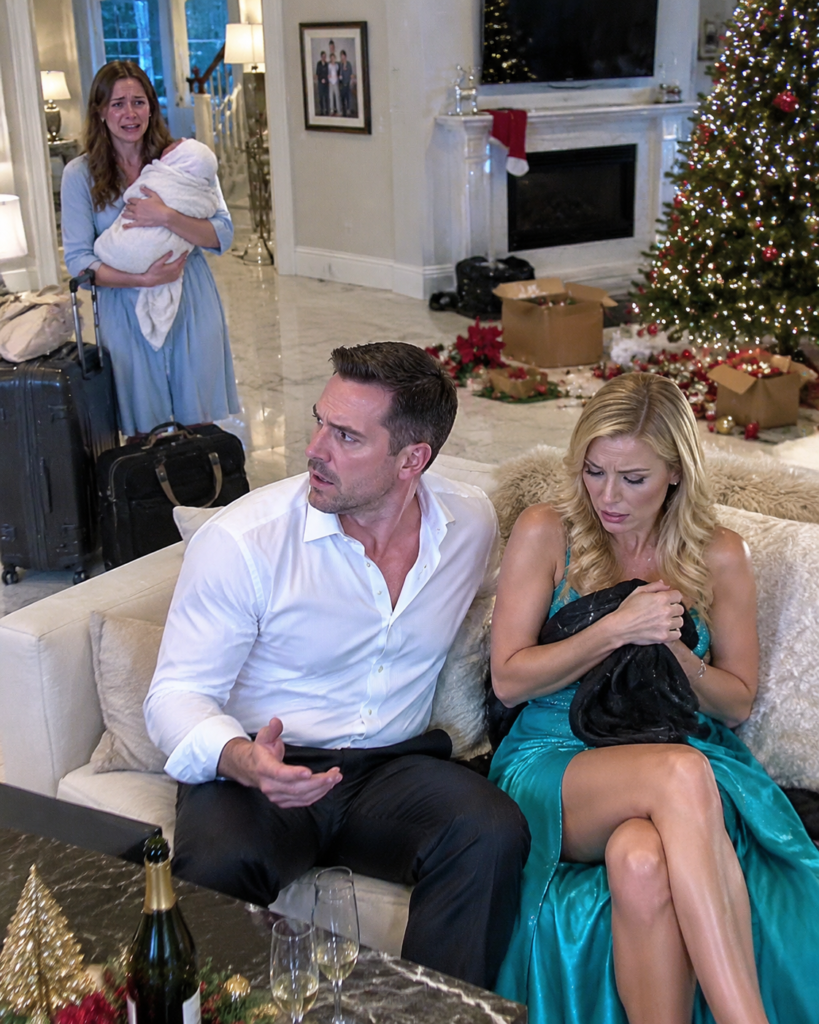
By the time he turned his key in the front door, Elena had already taken the child, emptied the safe, and changed the future in a courthouse he never knew she had entered.
The Mercedes rolled over the frozen gravel just after dawn, its tires making a soft, expensive crunch beneath the pale Connecticut sky. The estate stood at the end of the long driveway like a postcard from another life: white columns, black shutters, a wreath still hanging on the front door, smoke absent from the chimneys. The Christmas lights along the hedges were dark. Frost clung to the boxwoods. Everything looked still.
Julian Blackwood sat behind the wheel for a moment longer than necessary, watching his own reflection in the windshield. He liked what he saw most mornings. Forty-two years old, sharp jaw, tailored cashmere coat, hair still thick enough to look effortless, a man who had learned early that money could soften almost any flaw. He had the rested look of someone who had not actually been working for the last week, although his calendar said he had been trapped in emergency merger negotiations with a Japanese shipping partner.
Tokyo.
That was what he had told Elena.
A crisis in Tokyo, urgent and boring, the kind of corporate disaster that made a faithful wife sigh and say, “Go. We’ll be fine.” He had kissed her forehead in the kitchen while their two-year-old son, Harrison, banged a wooden spoon against the leg of his high chair. He had apologized for missing Christmas morning. He had promised to make it up to them. Then he had walked out with two suitcases, three fake expense folders, and an Aspen chalet confirmation buried inside a private email account his wife was never supposed to see.
Now he stepped out into the cold with the slow confidence of a man returning to property he believed was still his. The air smelled of wet stone, pine, and the faint metallic bite of snow that had not yet fallen. He reached into the back seat for his briefcase, checking once more for the duty-free Japanese whiskey and the printed receipts he had bought online from a service that specialized in giving liars paperwork. He prided himself on details. Details were why Blackwood Logistics had grown under his leadership. Details were why board members obeyed him. Details were why Elena, sweet, composed, devoted Elena, had never found a thread to pull.
He climbed the front steps, rehearsing the face he would wear when she opened the door.
Tired.
Important.
A little guilty, but in the noble way men were guilty when work stole them from their families.
“Elena?” he called before the door even opened, putting fatigue into his voice. “I’m home.”
No footsteps answered.
He frowned, slid his key into the lock, and pushed inside.
The foyer was cold enough to make him inhale sharply. Not cool. Not drafty. Cold. The kind of cold that settled into marble and wood when a house had not been heated for days. His breath fogged faintly in front of him. The chandelier above the staircase was unlit. The smell was wrong too. No cinnamon candle, no coffee, no baby lotion, no trace of the roasted chicken Elena usually made when he came back from trips. Instead there was lemon disinfectant and emptiness.
“Elena?” he called again, louder now.
Silence.
Julian closed the door behind him. The sound echoed too far, as if the house had been hollowed out.
He walked into the living room and stopped.
The Christmas tree still stood in the corner by the windows, twelve feet tall, trimmed from a farm in Vermont, delivered by men in quilted jackets two weeks before Christmas. But it was naked. No lights. No velvet ribbon. No antique glass angels from his grandmother’s collection. No silver train running around the base. No hand-painted Blackwood ornaments that Cornelius Blackwood had guarded like family relics. Only branches. Needles scattered across the floor like green bones.
Julian stared at it, annoyed before he was afraid.
“Elena, what the hell is this?” he muttered.
Then he noticed the stockings were gone from the mantel.
Not moved.
Gone.
His stocking, Elena’s, Harrison’s small red one with the embroidered train on the cuff. The brass holders were gone too. In their place, the mantel had been wiped clean, so clean he could see the pale rectangles where dust had once framed the decorations.
His irritation tightened into something sharper.
He dropped the briefcase in the foyer and took the stairs two at a time.
“Harrison!”
His voice cracked on the second syllable.
He burst into the nursery.
The room was empty with an almost surgical precision. The crib was still there, because it was built-in mahogany and too heavy to move quickly, but the mattress was bare. No fitted sheet with blue moons. No stuffed elephant. No blanket with Harrison’s initials. The rocking chair was gone. The bookshelf was gone. The framed watercolor of sailboats above the changing table was gone. The changing table itself remained, polished and blank, with not so much as a diaper cream stain in the drawer.
Julian stood in the doorway, one hand on the frame.
The mobile over the crib had been removed. He had bought that mobile himself, a ridiculous imported thing with tiny planets spinning around a painted sun. He remembered Elena laughing when he installed it because he had cursed at the instructions for twenty minutes. Harrison used to point at Saturn and squeal.
The ceiling above the crib showed four small holes where the screws had been.
Julian backed away.
“Elena!”
Now there was no performance in his voice. He ran down the hall to the master bedroom and shoved open the door. The bed was made, but not with their gray Italian sheets. Plain white covers had been pulled over the mattress, the kind used in vacation homes after summer ends. The nightstands were empty. Elena’s perfume bottles were gone. The framed photograph from their wedding was gone. On his side, his watch tray sat untouched, his cufflinks neatly arranged, his silk ties hanging in the open closet beyond.
Her side had been erased.
Not emptied carelessly. Erased.
No dresses. No shoes. No velvet hangers. No jewelry boxes. No robe on the hook. No cosmetic bag on the vanity. Even the small ceramic dish where she kept hairpins had vanished.
Julian crossed to the walk-in closet. His half looked exactly as he had left it, a museum of expensive restraint: navy suits, charcoal suits, rows of Italian leather shoes, cashmere sweaters folded by color. Elena’s half was bare white shelving. The carpet had fresh vacuum lines. The safe built into the back wall, the one he had installed for her jewelry and told the contractor was for “peace of mind,” stood open.
Empty.
He touched the door of it with two fingers as if it might be hot.
“What did you do?” he whispered.
His phone was already in his hand. He called her.
Straight to voicemail.
He called again.
Voicemail.
He texted: Where are you?
The message turned blue.
Delivered.
No response.
His pulse started thudding in his ears. He opened their last conversation and saw the message he had sent three hours ago from the hired car after landing.
Landed safely. Can’t wait to see you and Harry.
Her reply sat beneath it, clean and impossible.
Safe travels. We’re waiting.
He read it three times.
We’re waiting.
He looked around the stripped bedroom and felt for the first time that the sentence had not been affectionate. It had been a door closing.
Julian went downstairs too quickly, nearly slipping on the polished landing. He told himself there had to be an explanation. Elena was dramatic when hurt, but she was not reckless. She had a mother in Boston, a father in Newport, friends from college who still sent Christmas cards with watercolor return addresses. She could have left for a day, taken Harrison, staged the house to scare him.
But the safe.
The nursery.
The heat.
This was not a tantrum. This was logistics.
And logistics was his language.
He entered his home office because that was where he thought best. He needed scotch, a phone charger, and five minutes to assemble the situation into a problem he could solve. His office smelled faintly of leather and extinguished fire. The mahogany desk faced the windows. The family crest, an oak tree wrapped in a ribbon, hung over the bookshelves. He had always liked the crest. It suggested endurance. Bloodline. Roots deep enough to survive weather.
In the center of his desk sat an envelope.
Thick.
Cream-colored.
Perfectly aligned with the edge of the leather blotter.
On top of it lay a diamond tennis bracelet.
His mouth went dry.
The bracelet had been his Christmas gift to Elena, although he had not been home to give it to her. He had bought it at Cartier in November, hidden it in the wall safe behind the fox hunt painting in the hall, and told himself it would soften the insult of his absence. A good husband did not need to be faithful if he was generous enough. That had been the private arithmetic of his marriage.
He stepped back into the hallway and stared at the painting.
Then he tore it from the wall.
The safe behind it was open.
Not cracked. Not damaged. Opened with the code.
The emergency cash was gone. Fifty thousand dollars in bundled hundreds, gone. The bearer bonds his father had taught him to keep “outside the ordinary system,” gone. The passports, gone. A velvet pouch containing his mother’s sapphires, gone.
And the hard drive.
The black external drive that contained his real ledger, the one he had kept because he trusted memory less than encryption. Offshore accounts. Cayman transfers. Consulting fees paid to shell companies. Personal expenses disguised as business development. The kind of private records men like Julian kept because they believed the danger was other people’s stupidity, never their own.
The drive was gone.
His knees weakened. He braced one hand against the wall.
For several seconds, the house did not feel empty anymore. It felt occupied by Elena’s intelligence.
He returned to the office like a sleepwalker and lifted the envelope. His fingers were numb. Inside was a stack of documents and photographs, clipped in exact order. Elena had always been organized. Grocery lists, pediatric appointments, thank-you notes, tax folders, luggage labels. He had once found that trait charming because it made his life smoother. Now it felt lethal.
The first page was a printed text exchange.
December 24th, 11:42 p.m.
Julian to Isabel: She’s asleep. God, I miss your skin. Two days until Aspen, baby. Just hold on.
Julian’s stomach lurched.
He remembered sending it from the bathroom with the faucet running. Elena had been in bed, turned away from him, breathing slowly. He had watched her shoulder rise and fall and thought, with lazy contempt, how easy marriage became once a woman stopped asking questions.
She had not been asleep.
The next page was a photograph of him and Isabel at the airport. Grainy but clear. His hand at the small of Isabel’s back. Isabel looking up at him with that bright, hungry admiration that had made him feel young and chosen. Behind them, a departure board glowed with flights to Denver.
The next photo showed the Aspen chalet driveway.
The next, Isabel in a white coat on a balcony, holding a glass of champagne.
The next, Julian kissing her under outdoor heat lamps while snow fell behind them like theater.
He flipped faster, rage and fear battling so violently in his chest that he could not tell which one was winning.
Then the final document slid into view.
It bore the seal of the Superior Court of Connecticut.
Julian stared at it.
His eyes moved slowly, refusing the meaning until the words forced themselves into shape.
In the matter of the minor child formerly known as Harrison James Blackwood.
Petitioner: Elena Marie Sterling.
Order Granting Petition For Change Of Name.
It is hereby ordered that the legal name of the minor child shall be changed to Harrison James Sterling.
The room narrowed.
Sound vanished.
He read it again.
Harrison James Sterling.
Not Blackwood.
Sterling.
Elena had not just left him. She had taken the only name his father had ever cared about and removed it from the only grandson who could carry it.
Julian lowered himself into the desk chair. His hands shook with a strange delicacy, as though they belonged to an old man. He saw Cornelius Blackwood in his mind, standing in the library with a tumbler of scotch, telling him, “Money can be rebuilt. Reputation can be repaired. But a name is either carried forward or it dies.”
Julian had laughed then. He had been twenty-seven, handsome, newly appointed to the company board, certain his father was melodramatic.
Now the sentence returned like a curse.
At the bottom of the stack was a yellow sticky note in Elena’s handwriting, the letters angled and firm.
You wanted a life without consequences, Julian. Now you have one without us.
Beneath that, in smaller writing:
P.S. I would not waste time checking the Cayman accounts.
For the first time since stepping into the house, Julian made no sound at all.
He did not scream. He did not slam the desk. He did not throw the bracelet, though his hand closed around it hard enough for the stones to bite his palm. He went still. Stillness was how Julian survived bad news. Rage was for employees and contractors and wives who cried. Strategy belonged to men like him.
He called Arthur Pendleton.
Arthur answered on the sixth ring, his voice thick with sleep. “Julian? What time is it? I thought you were in Tokyo.”
“I’m home.”
There was a pause. “Home from Tokyo?”
Julian closed his eyes. “She knows.”
Arthur exhaled. In that tiny silence, Julian heard the attorney in him wake up. “Who knows what?”
“Elena. Aspen. Isabel. The accounts. I don’t know how much. She’s gone. Harrison is gone. The safes are empty.”
“Slow down.”
“She changed his name.”
Arthur said nothing.
“Arthur.”
“She changed Harrison’s name?”
“I’m looking at a court order.”
“That’s not possible without your consent.”
Julian looked at the stack of documents. “Apparently it is.”
“No. Not under ordinary procedure. A father with legal rights has notice. Unless there was an emergency petition, abandonment claim, danger allegation, or a signed waiver.”
The word waiver passed through Julian like a blade.
He saw Elena in the kitchen the morning he left. Hair loose, robe tied at the waist, coffee mug in one hand, a neat stack of papers in the other.
“Insurance renewals,” she had said. “House, cars, umbrella policy. You said you wanted them handled before year-end.”
He had been irritated because the car was waiting and Isabel had texted him a photo from the airport lounge. He remembered Elena placing a pen beside his espresso. He remembered signing without reading, flipping pages with one hand while checking his watch.
“She gave me papers,” he said.
Arthur’s voice hardened. “What papers?”
“Insurance. Household things.”
“And you signed them without reading?”
“I was leaving for an international merger negotiation,” Julian snapped, because arrogance came easier than fear. “I didn’t think my wife was setting a legal trap.”
Arthur cursed quietly. “Scan everything you have and send it to me. Right now. And check your accounts. If she went after the name, she went after the money.”
Julian opened his banking app with hands that would not steady.
Access denied.
He tried the joint checking account.
Account closed.
He tried the private investment portfolio, the one linked through three layers of advisers and one offshore feeder fund.
Balance: $0.00.
For a moment, he thought the app had malfunctioned. Digital systems failed. Banks froze. Software glitched. Money did not simply disappear because a wife got angry.
He called the private client line.
“This is Julian Blackwood,” he said when the operator answered. “My accounts are showing inaccurate balances.”
“Please hold, Mr. Blackwood.”
Classical music played for ninety seconds. Julian heard every note as an insult.
When the operator returned, her voice was careful. “Sir, it appears several accounts were restricted on December 27th pursuant to a marital asset preservation order and transfer into secured escrow under Sterling and Vance LLP.”
Julian gripped the edge of the desk. “That is not authorized.”
“The joint holder submitted executed authority, sir, along with supporting documentation and a fraud protection affidavit.”
“Fraud protection?”
“Yes, sir.”
“My wife is not a bank regulator.”
“I understand your frustration, Mr. Blackwood.”
No one who understood frustration spoke that politely.
Julian hung up before he said something recorded.
He stood in the cold office, surrounded by the objects of power that no longer worked. Diplomas. Awards. Framed magazine covers. A photograph of himself shaking hands with the governor at a port expansion ceremony. None of them could warm the house. None of them could unlock the accounts. None of them could put Blackwood back on his son’s birth certificate.
He needed to find Elena.
Not call her.
Not text her.
Find her.
He drove to Newport because pride is often stupid before it becomes desperate. He knew the Sterling estate well enough to imagine her there, wrapped in one of her mother’s cardigans, drinking tea while Robert Sterling congratulated himself on a legal ambush. He drove too fast down I-95, the Mercedes eating the frozen asphalt. He screamed once inside the car, a raw sound that startled even him, then fell silent and began calculating.
The name change was not emotional. That was what frightened him.
Elena could have filed for divorce. She could have demanded custody. She could have leaked the affair to friends, humiliated him at the club, called Isabel’s parents. Instead she had targeted the name.
Why?
Then the answer surfaced from a part of his mind that had been trying not to look at it.
The Blackwood Family Trust.
Cornelius Blackwood had designed the trust like a dead man still gripping the throat of the living. Forty million dollars, not to be distributed outright to Julian, but released under his trusteeship when the first male heir bearing the legal surname Blackwood turned three. Harrison’s third birthday was sixteen days away. Julian had been counting on that payout for two years. Not openly. Not in board meetings. Not in anything that would look desperate. But he had leveraged personal equity, borrowed against projected control, and covered increasingly reckless investments with the quiet confidence that forty million dollars would soon become available under the elegant phrase “for the benefit of the heir.”
For the benefit of Harrison.
For the benefit of Julian.
If Harrison was no longer legally Blackwood before his birthday, the trust dissolved and reverted to the charitable foundation overseen by a board Julian did not control.
Elena had not stolen his son’s inheritance.
She had burned down the bridge Julian planned to use to steal it.
The realization made him physically nauseous.
“You spiteful little saint,” he whispered.
The Sterling estate gates were closed when he arrived. They rose black and tall between stone pillars, wet with winter fog. He pressed the horn, long and hard, until a voice crackled through the intercom.
“Go home, Julian.”
Robert Sterling.
“Elena took my son,” Julian shouted through the open car window. “Open the gate before I call the police.”
“Call them.”
“I will.”
“They already have copies of the temporary custody order.”
Julian swallowed. “Temporary what?”
“Court date is Tuesday morning. Ten o’clock. Family division.”
“She kidnapped him.”
“No,” Robert said. “She protected him. There is a difference, though I understand why it would confuse you.”
“Let me speak to my wife.”
“Former wife, soon enough.”
“You arrogant bastard.”
“Careful,” Robert said, and his voice dropped into something colder. “The sheriff has the doorbell footage from your house, the nursery audio, the travel records, the Aspen chalet footage, and your signed waiver. The IRS has a separate packet. The company board has another. There are many rooms you are no longer the smartest man in, Julian.”
Julian looked up toward the mansion beyond the gates. Warm light glowed in several windows. He imagined Elena behind one of them, holding Harrison, whispering that Daddy was away. The thought made him want to ram the gate with the Mercedes.
“Where is Harrison?”
“Safe.”
“Where is Elena?”
“Beyond your reach for tonight.”
“This isn’t over.”
“No,” Robert said. “It is beginning. Happy New Year.”
The intercom clicked off.
Julian sat in the driveway while frost gathered on the edges of the windshield. His hands rested on the steering wheel. For the first time in his adult life, he had no immediate action that improved his position. Every instinct in him demanded movement, dominance, noise. But Elena had chosen documents. Documents did not flinch when shouted at. Court orders did not care what kind of watch a man wore.
He drove to a hotel on the harbor.
The young woman at the front desk smiled with practiced warmth. “Welcome. Do you have a reservation?”
“One night. Suite if you have it.”
He placed his platinum card on the counter.
She swiped it.
Her smile weakened.
“I’m sorry, sir. It was declined.”
“Try it again.”
She did.
“I’m sorry.”
He gave her another card.
Declined.
A third.
“Sir, this one says reported stolen.”
Julian stared at the card as if it had betrayed him personally. Behind him, a family in ski jackets entered laughing, trailing the smell of cold air and peppermint gum. The father glanced at Julian’s coat, his tense jaw, the pile of rejected cards. Recognition flickered there. Not of the man. Of the fall.
Julian took the cards back slowly.
“I’ll make other arrangements,” he said.
Outside, he sat in the Mercedes with the heat running and the fuel gauge at a quarter tank. His phone buzzed.
Isabel.
Miss you already. Did you tell the wicked witch? Can’t wait to be the next Mrs. Blackwood.
Julian looked at the message until the words blurred.
Then he laughed.
It was not a happy sound. It was the sound of a man discovering that the woman he had destroyed his life to impress had no idea the life was already rubble.
Pack a bag, he typed. Come to the house. We need to talk.
He drove back to Connecticut through a dawn that seemed to get colder with every mile.
Three months earlier, Elena Sterling Blackwood had been sitting on the kitchen floor with a cracked iPhone and a toddler eating blueberries from a plastic bowl.
That was the beginning.
Not a private investigator. Not a lipstick stain. Not perfume on a collar, though those things had existed and she had explained them away with the generous stupidity of a woman trying to preserve a family. The beginning was an old phone Julian tossed onto the counter because he had upgraded and was too careless to finish erasing himself from the device.
“Let Harrison use it for cartoons,” he said, shrugging into his coat. “Just download whatever makes him quiet.”
Harrison was in his high chair, laughing because three blueberries had rolled under his thigh. Elena remembered that detail later with cruel clarity. The domestic absurdity of it. The tiny blue stains on her son’s fingers. The ordinary light through the kitchen window. Her husband at the door, handsome and already elsewhere.
“Client dinner?” she asked.
“Probably late.”
“Will you eat?”
“I’ll grab something there.”
He kissed the air near her cheek and left smelling of cedar cologne.
Elena had not gone looking for ruin. She had wiped the cracked screen with a dish towel, sat on the floor beside Harrison’s high chair, and connected the old phone to the Wi-Fi. It began syncing before she had even opened the app store. Passwords. Notes. Calendar fragments. A weather notification for Aspen. She frowned because nobody in their house had searched Aspen recently.
Then the Notes app refreshed.
At the top was a note titled simply: Aspen.
Elena touched it.
There are moments in a life when the mind refuses drama because drama would waste energy. Elena did not gasp. She did not drop the phone. She did not press a hand to her mouth like women in films. She sat on the kitchen floor in yoga pants and a sweater with dried applesauce on the cuff, reading the itinerary of her husband’s betrayal while her son offered her a wet blueberry.
Chalet at Silver Creek.
Guest: Isabel M.
Cover story: Tokyo merger with Kaito Systems.
Budget: 45K.
Use offshore account if Amex flagged.
Gift: pearl earrings, not diamond, too obvious.
Elena read the note once.
Then again.
Then she looked at Harrison.
He was smiling at her with his entire face, two tiny teeth showing, hair sticking up from his nap. He held out the blueberry with solemn generosity.
“For Mama,” he said.
Her throat closed so sharply she could not answer.
That night, Julian came home at eleven thirty-two, smelling of sake and another woman’s shampoo. He complained about traffic. He asked if Harrison had been difficult. He kissed Elena’s forehead while looking at his phone.
She watched him from a place inside herself she had never visited before. It was not numbness. It was distance. She saw the man, the suit, the wedding ring, the practiced fatigue. She saw how much labor she had done to keep believing he was complicated instead of cruel.
When he went upstairs to shower, she photographed the note with her own phone. Then she sat at the kitchen table until two in the morning, listening to the hum of the refrigerator and the rain against the windows.
She considered confronting him.
The idea lasted less than a minute.
Julian was built for confrontation. He would deny what he could, minimize what he could not, accuse her of invading his privacy, cry if useful, rage if cornered, promise if trapped. By dawn he would have turned his betrayal into her instability. He had done it in smaller ways for years.
You’re tired, Elena.
You’re too sensitive.
That isn’t what I meant.
You know how business is.
You think every woman wants me.
She opened the drawer where they kept household files and took out the Blackwood Family Trust summary. She had read it before, years earlier, while pregnant and bored and trying to understand why Cornelius Blackwood’s lawyers used language like “male issue” as if children were livestock. At the time, Julian had laughed.
“It’s old-fashioned,” he had said. “Dad liked the sound of old blood.”
She had asked, “Why does the surname matter?”
“Because he was insane,” Julian said. “But rich insane, which is the only kind that counts.”
Now she read it again under the dim kitchen pendant lights.
The heir must bear the legal surname Blackwood at the age of distribution.
A sentence can sit quietly for years and become a weapon only when someone finally sees its edge.
The next morning, Elena buckled Harrison into his car seat and drove to Newport without telling her parents she was coming. She did not go to the family house first. She went to Sterling and Vance, the law firm where her uncle Robert occupied a corner office overlooking the harbor.
Robert Sterling was sixty-eight, spare and silver-haired, with the mild manners of a retired professor and the professional reputation of a man who could dismantle a fortune without raising his voice. He had never liked Julian. He had said so only once, before the wedding, when Elena was too in love to hear it.
“He admires himself through you,” Robert had told her. “Be careful with men who treat love like a mirror.”
She had been twenty-nine then and offended on principle.
Now she walked into his office carrying a diaper bag, a folder, and a humiliation so heavy it made her shoulders ache.
Robert listened without interruption. He did not make a shocked face when she showed him the Aspen note. He did not call Julian names. That was one of the things Elena trusted about him. Robert believed anger was useful only after documents were organized.
When she finished, he folded his hands on the desk.
“Do you want a divorce?”
“Yes.”
“Do you want custody?”
“Yes.”
“Do you want revenge?”
Elena looked out the window. A gull stood on the roof of the building across the street, hunched against the wind.
“I want Harrison safe from becoming collateral,” she said.
Robert’s expression changed.
“That is a better answer.”
He asked questions for two hours. Not dramatic questions. Useful ones. Did Julian handle the tax returns? Did he ask her to sign them without explanation? Did he keep cash at home? Did she know about non-business travel billed through the company? Did he discuss company debt? Did he ever use Harrison’s trust as a solution in conversation? Had he said anything about boarding school, custody, inheritance, image?
At that, Elena looked down.
Robert waited.
“There was something last month,” she said. “I thought he was joking.”
“What did he say?”
“He was changing Harrison. He had Isabel on speaker because he thought I was downstairs. Harrison was crying. Julian said he couldn’t wait for the trust to pay out so he could send the kid to boarding school and travel without all the noise.”
Robert’s jaw tightened.
“The nursery camera records audio,” Elena said. “We installed it when Harrison had reflux.”
“Do you still have the footage?”
“Yes.”
Robert stood, walked to a cabinet, and removed a leather-bound file. “Then we begin with preservation. You do not confront him. You do not threaten him. You do not empty accounts without process. You do not disappear in a way that makes you look unstable. You become boring, precise, and legally unbearable.”
For the first time since finding the note, Elena almost laughed.
Robert opened the file to the trust clause and tapped it once.
“Julian has made one mistake larger than the affair,” he said. “He has assumed you do not know what he needs.”
Over the next three months, Elena learned the anatomy of a controlled demolition.
It did not feel glamorous. It felt like exhaustion.
She met with Robert on Wednesdays under the pretense of visiting her mother. She worked with Mara Chen, a forensic accountant Robert trusted more than anyone in New England. Mara was in her forties, blunt, brilliant, and allergic to sentiment. She wore black turtlenecks, carried two laptops, and drank gas station coffee as if taste were a moral weakness.
“Cheating is not my department,” Mara told Elena during their first meeting. “Money is. Men lie with flowers, but they confess in spreadsheets.”
Mara taught Elena what to look for. Duplicate reimbursements. Flights coded as client meetings. Hotel charges split across departments. Consulting fees paid to entities with no web presence. Jewelry purchases categorized as corporate gifts. Rent on an apartment Julian claimed was for a visiting executive but that matched Isabel Martin’s neighborhood and, later, Isabel’s tagged Instagram posts.
Elena printed everything.
Not because she wanted to stare at it.
Because evidence needed paper.
At night, after Harrison fell asleep, she sat at the dining room table surrounded by folders while the house breathed around her. Sometimes Julian was home, drinking scotch in his office, laughing softly at messages she was no longer foolish enough to pretend were from colleagues. Sometimes he was gone. She learned that loneliness inside marriage was not emptiness. It was overcrowding. Too many lies in the room. Too much unsaid pressing against the walls.
She documented the cash.
She photographed the wall safe while Julian was in the shower.
She copied account statements.
She downloaded nursery audio to an external drive.
She built a calendar that matched Julian’s “business trips” to Isabel’s social media posts: a wine glass at a Miami hotel pool; a ski glove on a balcony railing; a bracelet Elena recognized because Julian had once told her it was for a client’s wife.
One night, she found Harrison asleep on the carpet beside her chair, one hand wrapped around a toy truck. She must have forgotten the time. The table was covered with Julian’s sins in neat piles. She bent to lift her son and felt such grief that her knees nearly gave out.
“I am so sorry,” she whispered into his hair.
Not because she was leaving.
Because she had stayed long enough for the house to teach him silence.
The signed waiver was Robert’s idea, but Elena’s execution.
“It must be legal,” she said immediately.
“It will be,” Robert replied. “The ethics of obtaining it are a separate conversation.”
“I will not forge anything.”
“You will not need to.”
The document was dense but valid. A temporary delegation of parental authority in the event of international travel, attached to year-end estate planning and household insurance updates. It included specific language allowing Elena to execute filings concerning dependent status, medical access, school enrollment, and emergency name correction or alteration should legal or financial protection require it during Julian’s absence. Robert did not hide the clause. He buried it in plain sight under language Julian would consider beneath him.
“He may read it,” Elena said.
Robert looked at her over his glasses. “Will he?”
No.
He would not.
On the morning Julian left for Aspen under the name Tokyo, Elena placed the stack beside his espresso. Harrison sat in his high chair wearing pajamas covered in tiny bears. Snow pressed softly against the kitchen windows. The car service waited outside.
“Insurance renewals,” she said. Her voice did not shake. “Also the updated umbrella policy and dependent travel authorizations. Robert said the old forms were outdated.”
Julian barely glanced up. “Where do I sign?”
She pointed.
He signed.
Page after page.
His Mont Blanc moved quickly, impatiently, his eyes flicking toward his phone whenever it buzzed. Once, Harrison said, “Dada, look,” holding up a piece of toast shaped vaguely like a moon.
“In a minute,” Julian said.
He never looked.
Elena watched the pen cross the signature line that would later be enlarged in court exhibits. She felt no triumph. Only a sadness so cold it had no tears.
At the door, Julian kissed her cheek.
“I hate leaving you at Christmas,” he said.
“I know,” she replied.
That was the last lie she gave him for free.
Within two hours of his plane taking off, Elena was in court with Robert. The petition was not theatrical. It was procedural, supported by the signed authorization, evidence of pending financial harm tied to the Blackwood surname, temporary custody concerns, and a sealed affidavit concerning Julian’s statements about using the trust and removing Harrison from daily family care. The judge was not interested in adultery. Judges rarely are. But financial exploitation of a minor child, coupled with documented legal consent and imminent trust distribution, created urgency.
Harrison James Sterling became legal before sunset.
Elena cried only once that day, in the courthouse bathroom, with her hands pressed against the sink and the automatic faucet turning on and off beneath her wrists. She cried for the little boy whose name had become a battlefield because adults had failed him. Then she washed her face, reapplied lip balm, and went home to pack.
She had six hours.
The movers arrived in unmarked trucks. Karen Diaz, Harrison’s nanny, came too, though Elena had tried to give her the week off.
“Mrs. Blackwood,” Karen said, standing in the nursery doorway with her coat still on, “I knew something was wrong for months. Let me help.”
Karen was fifty-four, Dominican, widowed, and had raised three children before raising other people’s. She had watched Julian ignore his son with the quiet disgust of a woman paid too little to comment. She packed Harrison’s books with the care of someone handling sacred objects. She wrapped the planet mobile in towels. She removed every trace of the child from the room because Elena asked her to, and because she understood why the empty crib mattered.
“Don’t leave him a nursery to mourn,” Karen said. “Leave him a mirror.”
By midnight, the house was stripped of Elena and Harrison but not damaged. That distinction mattered to her. She took what belonged to her, what belonged to the child, and what Robert’s orders allowed. She left Julian’s clothes. His awards. His office. His family crest. His cold kingdom.
Before she walked out, she placed the documents on his desk.
She put the bracelet on top.
Then she turned off the heat.
Monday morning, Julian walked into Blackwood Logistics as if the building still recognized him.
The headquarters in downtown Stamford was all glass and limestone, twenty-eight floors of corporate confidence overlooking the harbor. The lobby smelled of polished stone and expensive coffee. Employees moved through the turnstiles with laptop bags and winter coats, speaking in low Monday voices. For twelve years Julian had entered that lobby without slowing, nodding only when nodding benefited him.
That morning, the security guard rose from behind the desk.
“Mr. Blackwood,” Sam said. “Please stop.”
Julian paused with his badge lifted. “Good morning to you too, Sam.”
He tapped the card.
Red light.
He tapped again.
Red.
Sam stepped around the desk. He was a broad man with tired eyes, a veteran who had once told Julian he needed Christmas Eve off for his granddaughter’s recital. Julian had denied the request because “policy was policy” and then flown to Aspen with Isabel.
“It’s not a system issue,” Sam said.
Julian’s smile thinned. “Open the gate.”
“I can’t do that.”
“I am the CEO.”
“I have instructions to collect your badge and escort you upstairs as a visitor.”
People slowed.
Nothing humiliates a powerful man like procedure applied evenly in public.
Julian looked around at employees who suddenly found the floor fascinating. “Who gave that instruction?”
“Chairman Thorne.”
“Call him.”
“He’s expecting you.”
Sam held out a visitor badge.
The sticker read: JULIAN BLACKWOOD – VISITOR.
Julian felt heat rise up his neck. He wanted to tear it in half. Instead he took it, because refusal would make him look powerless and he had not yet accepted that he was.
The elevator ride to the top floor was silent.
When the doors opened, Julian moved toward his office, but Marcus Thorne stood in the boardroom doorway.
“In here,” Marcus said.
Marcus was seventy-one, silver-haired, and built like a man who had never wasted a sentence. He had been Cornelius Blackwood’s closest business friend and Julian’s most persistent irritation. In the early years, Marcus had corrected him gently. In the later years, not gently at all.
Julian stepped into the boardroom and saw the full board seated around the long table.
His chair at the head was empty.
A smaller chair waited at the opposite end.
“No,” Julian said.
Marcus did not blink. “Sit down.”
“I will stand.”
“Suit yourself.”
The room was bright with winter light. On the wall, the Blackwood oak tree logo gleamed in brushed metal. Beneath it sat the people who controlled what Julian had always mistaken for his inheritance: directors, counsel, the interim CFO, two outside advisers, and Mara Chen, whose presence he did not yet understand.
“What is this?” Julian demanded. “My wife is having some kind of episode, and apparently you’ve allowed her family to interfere with company operations. I need access restored, a bridge transfer authorized, and—”
Marcus slid a file across the table.
It stopped in front of Julian.
“We received notice from Sterling and Vance regarding the dissolution trigger of the Blackwood Family Trust,” Marcus said. “We also received notice from First Harbor Bank that your personal loans secured by pledged company equity have been called.”
Julian forced a laugh. “Personal loans are personal.”
“Not when you pledged voting shares as collateral while representing to this board that your liquidity remained strong.”
Julian looked at the file but did not touch it.
Marcus continued. “Not when your solvency affects executive control. Not when you used anticipated trust access to support private leverage. Not when company funds appear to have been used for personal travel, gifts, and housing.”
“That is absurd.”
Mara Chen opened a folder. “I would avoid that word today.”
Julian turned toward her. “Who are you?”
“The person who read your reimbursements.”
A few directors looked down.
Marcus pressed a button on the conference phone. “Play it.”
Julian heard his own voice fill the room.
Yeah, put the papers there, Elena. I don’t care what they say. I trust you. I have a plane to catch.
Then Elena’s voice, quiet.
This includes Harrison’s dependent authorizations.
Fine. Whatever. Where do I sign?
The recording ended.
Marcus looked at him with something worse than anger. Disappointment requires intimacy. This was contempt.
“You signed the documents,” Marcus said. “Your son’s legal name changed. The trust dissolved. The foundation has confirmed receipt pending final transfer. Your expected control of forty million dollars no longer exists.”
Julian’s throat tightened. “Elena manipulated me.”
“You were in a hurry to deceive her.”
“That has nothing to do with my performance as CEO.”
Marcus leaned forward. “Your conduct exposed the company to lender action, tax review, reputational damage, and governance instability. It also triggered the morality and fiduciary clauses of your employment agreement.”
“Nobody enforces morality clauses,” Julian said.
“Against useful men, rarely,” Marcus replied. “Against liabilities, efficiently.”
The room fell silent.
Julian looked around the table. “You cannot remove me. My name is on the building.”
“Your grandfather’s name is on the building,” Marcus said. “Your father expanded it. You inherited stewardship and mistook it for ownership.”
The general counsel, a pale man Julian had once mocked for sweating during presentations, cleared his throat. “The board voted at 7:15 this morning. Termination for cause. Effective immediately. Your company email, building access, vehicle access, and expense authority are revoked.”
Julian gripped the chair back.
“No.”
Marcus’s eyes did not move. “Yes.”
That was when Isabel arrived.
The receptionist appeared in the doorway looking like she would rather be anywhere else on earth. “Mr. Thorne, I’m sorry. There is a young woman in the lobby asking for Mr. Blackwood. She says she was told to come.”
Julian closed his eyes.
A moment later Isabel burst into the boardroom wearing a white faux-fur coat, oversized sunglasses pushed onto her head, and panic sharp enough to cut through her perfume.
“Julian,” she said, then looked around. “What is happening? My card was declined at the hotel. The house is freezing. Some man told me not to go inside. Why is everyone staring?”
The silence became unbearable.
Isabel crossed to Julian and grabbed his arm. “Tell them to fix it.”
Marcus looked at the young woman, then at Julian.
“I believe we are done.”
“Marcus,” Julian said, but his voice came out thin.
“Sam,” Marcus called.
The security guard stepped into the room.
Julian looked at Isabel. She was still beautiful in the way expensive mistakes are beautiful before the invoice arrives. Her mascara was perfect. Her mouth trembled with indignation, not fear. She had no idea she was the visible proof of everything the board had just decided.
“Get off me,” Julian whispered.
“What?”
“I said get off me.”
She recoiled. “Don’t talk to me like that.”
“Mr. Blackwood,” Sam said carefully, “please come with me.”
Julian walked out of the boardroom past the people who had ended him in less than an hour. Isabel followed, asking questions too loudly. In the elevator, she began crying, but the tears looked strategic and delayed. Sam stared ahead.
Outside, the winter wind hit Julian’s face.
He reached for his car keys.
Sam extended a hand. “The Mercedes is company property.”
Julian stared at him.
“The keys, sir.”
Employees watched through the lobby glass.
Julian dropped the keys into Sam’s palm.
He stood on the sidewalk in a cashmere coat with no car, no job, no liquid funds, and a mistress who had stopped crying long enough to say, “How are we getting to the airport?”
He laughed once.
“We’re not.”
“What are we doing?”
“Falling,” he said. “Apparently.”
The first three weeks of January taught Julian the difference between inconvenience and consequence.
Inconvenience was missing a flight. Consequence was learning that every person who used to return your calls had first checked whether knowing you still benefited them.
He rented a furnished studio in Bridgeport under a corporate acquaintance’s name after three luxury hotels refused his cards. The apartment had thin walls, a radiator that clanged at night, and a pullout couch with a permanent sag in the middle. The refrigerator buzzed like an insect. The bathroom light flickered. Isabel moved in for exactly nine days because she believed temporary disgrace could become romantic if photographed correctly.
By day six, she was no longer calling it an adventure.
“This place is making my hair smell like soup,” she said one morning, standing barefoot in the kitchenette while Julian sorted legal notices at the table.
“We don’t have soup.”
“That isn’t comforting.”
He ignored her.
The table was covered with paper: lender demands, credit card actions, notices of seizure, counsel withdrawal letters, and a preliminary divorce filing that did not read like heartbreak. It read like a woman who had evidence and patience.
His phone rang.
Martin Weiss.
Julian answered immediately. “Tell me y