PART 2
“Now tell me, waitress.”
Dante Moretti’s hand remained around my wrist, not tight enough to hurt, only steady enough to stop the men above us from making a terrible mistake.
Rain ran from his dark hair into his eyes.
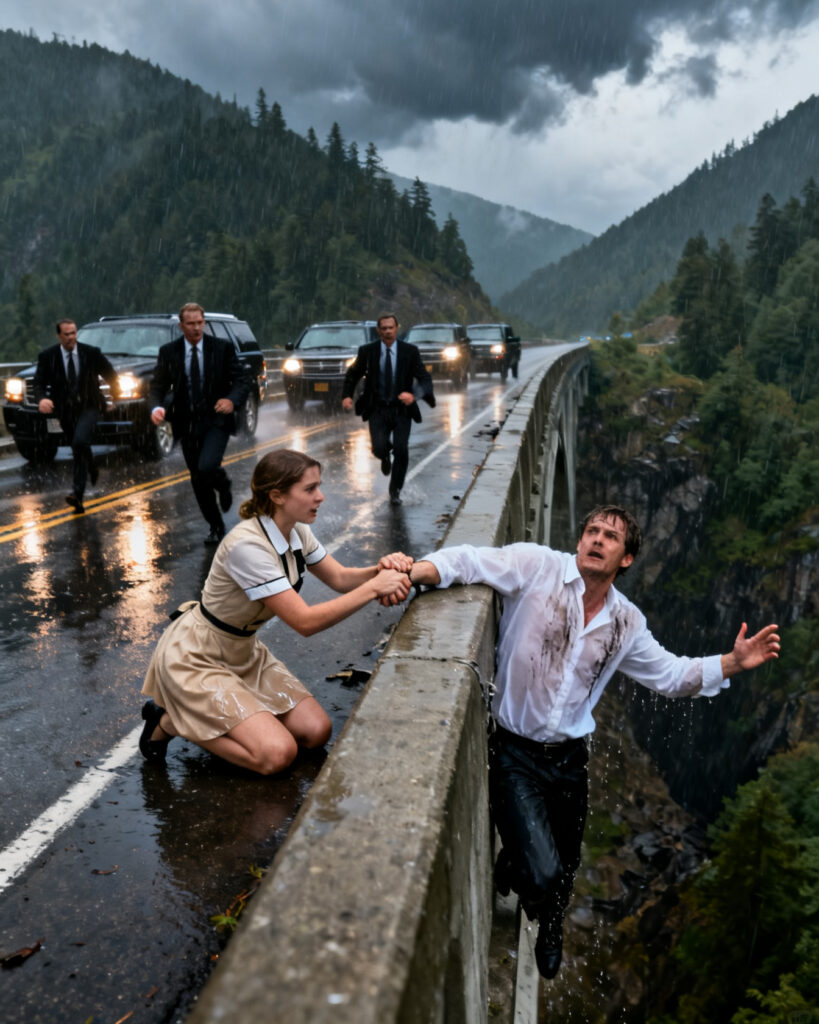
“How did you know my brakes were going to fail?”
I looked from him to the silhouettes gathered along the broken guardrail.
“I heard your wife.”
Something changed in his face.
Not shock.
Not exactly.
It was more like a door closing quietly behind his eyes.
Dante released my wrist.
“What did you hear?”
“She was at Bellini’s with a man. They were in the private booth behind the partition.” My teeth were chattering now, though I barely noticed. “He told her it was done. She asked about the brakes.”
No one spoke.
I forced myself to continue.
“She said they’d fail on the mountain road.”
Dante’s gaze stayed on mine.
“And?”
I wished I could lie.
“She said that by midnight she’d be a grieving widow.”
The rain suddenly seemed louder.
One of the men above us turned his face away.
Dante did not.
For several seconds, his expression remained almost unnaturally composed.
Then a siren sounded in the distance.
His eyes narrowed slightly.
“You called emergency services?”
“Before I followed you.”
For the first time, something almost human flickered through his expression.
“Good.”
A man in a charcoal overcoat climbed carefully down the slope toward us.
He was perhaps forty-five, broad-shouldered, with silver at his temples. Unlike the others, he had put away his weapon.
“Dante.”
“I’m all right, Marco.”
“You’re bleeding.”
“It looks worse than it is.”
Marco glanced at me.
“This is Cara Fields,” Dante said.
The fact that he remembered my name startled me.
I had told him only once, months ago, when I had served a private dinner at Bellini’s.
“Cara called the police,” Dante continued. “She stays until they arrive. No one interferes with her statement.”
Marco’s eyes met mine.
Then he nodded.
“Understood.”
The next hour passed in fragments.
Paramedics.
Police lights reflecting blue and red through rain.
A blanket around my shoulders.
Questions asked once, then again, and then a third time by a detective named Lena Park, whose calm voice somehow made it easier to breathe.
Dante sat in the back of an ambulance while someone cleaned the cuts along his forehead.
He refused to leave until Detective Park had taken my first statement.
He did not try to change anything I said.
He did not suggest what I should leave out.
He did not ask for special treatment.
That surprised me more than I expected.
When the detective finally closed her notebook, she studied me.
“You’re certain of the words?”
“As certain as I can be.”
“That matters.”
“I know.”
“Did Mrs. Moretti see you?”
“I don’t think so.”
“And the man?”
“No.”
“Could you identify him?”
“I never saw his face clearly.”
Her expression remained neutral.
“But you heard him.”
“Yes.”
“Would you recognize his voice?”
I hesitated.
“Maybe.”
That single word seemed to settle heavily between us.
Detective Park handed me a card.
“If anyone contacts you about what happened, call me.”
I looked toward the ambulance.
“Anyone?”
“Anyone.”
I understood what she meant.
So did she.
Yet the first person who contacted me the next morning was not a stranger, a reporter, or one of Dante’s employees.
It was my manager.
“Cara,” Theo said when I answered.
His voice sounded exhausted.
“You’re on the news.”
I sat up in bed.
“What?”
“Not your name. Not yet. They’re saying an unidentified witness reached Mr. Moretti after a vehicle accident on Ridgeway Pass.”
I rubbed my eyes.
I had slept less than two hours.
“What’s happening at the restaurant?”
A pause.
“That’s why I’m calling.”
My stomach tightened.
“What happened?”
“Mr. Bellini wants to close the private dining room for the day.”
“That’s probably wise.”
“He also wants you to stay home.”
“For how long?”
Another pause.
“I don’t know.”
I stared at the peeling paint above my bed.
It should not have surprised me.
Bellini’s survived because wealthy people believed nothing they said there would ever leave the room.
I had violated that unspoken rule.
To save a man’s life, yes.
But powerful customers rarely cared about context when privacy was involved.
“Am I fired?”
“No,” Theo said immediately. “And if anyone tries, they’ll have to explain it to me first.”
Despite everything, I smiled faintly.
Theo Ramirez had been my manager for three years. He complained about late deliveries as if they were personal betrayals, drank terrible vending-machine coffee, and remembered every employee’s birthday.
“Thanks.”
“Just stay home today.”
“I need the shift.”
“I know.”
Rent was due in six days.
Theo knew that too.
“I’ll make sure you get your hours somehow.”
Before I could answer, someone knocked on my apartment door.
My entire body went still.
Theo heard my silence.
“What is it?”
“Someone’s here.”
“Don’t open it.”
I walked quietly toward the door and looked through the peephole.
A woman stood in the hallway.
Mid-fifties.
Dark wool coat.
Gray streaking elegant black hair.
No security detail that I could see.
She carried a bakery box.
I frowned.
“Who is it?” Theo asked.
“I have absolutely no idea.”
The woman knocked again.
“Ms. Fields?” she called.
I did not open the door.
“Who are you?”
“My name is Lucia Moretti.”
I nearly dropped my phone.
Dante’s mother.
I had seen her photographs in newspapers.
She had been married to Vittorio Moretti for thirty-two years before his death. Society pages described her as a philanthropist. Other articles described the Moretti family with far less flattering language.
Theo whispered through my phone.
“Cara, call Detective Park.”
Lucia seemed to hear the silence.
“I understand why you would not want to open the door,” she said. “So I’ll leave this here.”
There was a rustle.
“I only wanted to say thank you.”
I remained where I was.
Her footsteps retreated.
I waited until I heard the elevator doors close before opening mine.
A white bakery box sat on the floor.
On top was a handwritten card.
Dear Cara,
My son is alive because you chose not to look away.
There is no gift large enough for that, so I will not insult you by pretending there is.
These are almond pastries from a bakery my family has visited for forty years. Dante says you always refuse dessert when you work late.
Apparently, he notices more than anyone realizes.
Thank you.
Lucia Moretti
I read the note twice.
Then I called Detective Park.
She listened.
“Keep the card,” she said. “But it doesn’t sound like a threat.”
“I didn’t think it was.”
“Good. And Ms. Fields?”
“Yes?”
“Mr. Moretti has asked through his attorney whether he may speak with you again. I told him only if you agree.”
That surprised me.
“He asked permission?”
“So far.”
I looked at Lucia’s note.
“When?”
“Not today. He’s still being observed at the hospital.”
“Is he okay?”
There was a small pause.
“You can ask him yourself if you choose to meet.”
Two days later, I did.
Not at Dante’s house.
Not at one of his offices.
At Detective Park’s suggestion, we met in a quiet conference room at the district attorney’s building.
Neutral territory.
Dante arrived without the expensive suit I was accustomed to seeing at Bellini’s.
He wore a dark sweater and a jacket.
There was a small bandage near his hairline.
Marco remained outside.
Dante entered alone.
For the first time since I had known who he was, he looked less like a headline and more like a tired thirty-eight-year-old man.
He sat across from me.
“Cara.”
“Mr. Moretti.”
“Dante.”
“I think I’ll stay with Mr. Moretti.”
The corner of his mouth moved.
“Fair.”
Detective Park had left a recorder on the table.
Dante nodded toward it.
“My attorney recommended that anything involving the incident be documented.”
“That seems smart.”
“I have spent the last two days discovering how many things I should have done differently.”
There was no bitterness in his voice.
Only fatigue.
I waited.
He folded his hands.
“Tell me about the man with Vanessa.”
“I barely saw him.”
“Height?”
“A little taller than her.”
“Hair?”
“Dark, I think.”
“Age?”
“Forties, maybe. I’m sorry.”
“You don’t need to apologize.”
His answer came quickly.
I studied him.
There was something strange about sitting across from a man whose life I had held, literally, with both hands.
He must have been thinking something similar because his gaze dropped briefly to the healing scratches across my palms.
“You hurt yourself.”
“I’ve had worse from opening wine crates.”
“That is almost certainly untrue.”
“Probably.”
A brief silence passed between us.
Then he asked, “Why did you follow me?”
I stared at him.
“Because your brakes had been sabotaged.”
“That explains why you wanted to warn me. It doesn’t explain why you drove up a mountain in a storm after a stranger.”
“You weren’t a stranger.”
His eyebrows lifted.
“I’ve served you dinner twelve times.”
“Eleven.”
I blinked.
“You counted?”
“You served my mother’s birthday dinner twice. The charity committee dinner three times. Two meetings with my attorneys. Four dinners with Vanessa.”
“That’s eleven?”
“One dinner was lunch.”
Despite myself, I laughed.
It felt so out of place that I immediately covered my mouth.
Dante smiled.
The expression transformed him.
Only for a second.
Then it disappeared.
“My point,” he said, “is that you didn’t owe me anything.”
“No.”
“Yet you came.”
I looked through the narrow conference-room window at the gray afternoon.
“My father used to say there’s a difference between not being responsible for someone and deciding they don’t matter.”
Dante’s expression changed.
“What happened to him?”
“He died six years ago. Heart condition.”
“I’m sorry.”
“He was stubborn until the end.”
“Good quality?”
“Depends on the day.”
His smile returned faintly.
Then the door opened.
A woman entered.
She had Dante’s gray eyes.
But where his face held everything back, hers revealed every feeling immediately.
Relief.
Anger.
Worry.
And curiosity when she saw me.
“Sorry,” she said. “Detective Park said you were almost finished.”
Dante stood.
“Cara, this is my sister Elena.”
Elena Moretti was thirty-four and, unlike her brother, rarely appeared in society photographs.
I knew only that she was an architect and had lived in Boston for years.
She offered her hand.
“Thank you for saving my brother.”
“You’re welcome.”
“I’ve been trying to think of a more sophisticated way to say that for two days.”
“There probably isn’t one.”
“That’s what my mother said.”
Dante sat back down.
Elena remained standing.
She looked at him.
“You still haven’t told her?”
“Told me what?”
Brother and sister exchanged a glance.
Elena sighed.
“Vanessa is gone.”
My stomach dropped.
“What do you mean, gone?”
“She left the house the night of the crash,” Dante said. “Before the police could speak to her.”
“Do they know where she is?”
“Her lawyer contacted them yesterday,” Elena said. “She’s safe.”
“Then why—”
“She won’t speak without counsel present,” Dante said. “Which is her right.”
The matter-of-fact way he said it surprised me.
“You’re not angry?”
His eyes met mine.
“I am several things.”
That answer stayed with me.
Dante leaned back.
“Anger doesn’t change what happened.”
Elena looked at him as if she had never heard him say anything like that before.
The door opened again.
Detective Park appeared.
“Mr. Moretti, I need a moment.”
Dante stood.
Before leaving, he glanced at me.
“Whatever happens next, Cara, you don’t owe my family anything else.”
I frowned.
“What does that mean?”
“It means you saved my life. I won’t turn that into a debt you have to keep paying.”
Then he was gone.
Elena remained.
She took the seat her brother had vacated.
For a few moments, neither of us spoke.
Finally she said, “He wasn’t always like this.”
“Like what?”
“Controlled.”
I smiled faintly.
“That’s hard to imagine.”
“Our father could fill an entire room without raising his voice. Dante spent most of his twenties trying to do the same.”
“And now?”
“Now he spends most of his time trying not to become him.”
That caught me off guard.
The Moretti name had always seemed like one solid thing from the outside.
Power.
Money.
Old rumors.
Men in expensive coats.
But Elena spoke of it like an inheritance too heavy to carry.
She looked toward the closed door.
“I left because I thought Dante had made his choice.”
“What choice?”
“To keep our father’s world exactly as he found it.”
“And did he?”
Elena’s expression grew complicated.
“I don’t know anymore.”
That was the first time I wondered whether the story everyone knew about Dante Moretti might be incomplete.
The second came the following morning.
Theo called me from Bellini’s.
“Can you come in through the kitchen entrance?”
“I thought I was supposed to stay home.”
“So did I.”
“What happened?”
“Mr. Bellini reviewed the private-room reservations.”
My heart began beating faster.
“And?”
“There’s something you should see.”
I arrived twenty minutes later.
Bellini’s was closed between lunch and dinner.
Theo was waiting in the office behind the kitchen.
Mr. Aldo Bellini sat at his desk.
He was seventy-two years old, always perfectly dressed, with silver hair and a habit of calling everyone under forty kid.
For once, he did not tell me I looked tired.
“Sit down, Cara.”
I sat.
Theo closed the door.
Mr. Bellini pushed a printed reservation record across the desk.
“Private booth seven was not reserved by Vanessa Moretti.”
I read the paper.
The reservation had been made three days earlier.
Name: Matthew Avery.
“Who’s Matthew Avery?”
“That’s what I asked,” Theo said.
Mr. Bellini turned his monitor toward us.
“The deposit was placed using a corporate account.”
The company name meant nothing to me.
Vale Strategic Consulting.
“What is this?” I asked.
Mr. Bellini exhaled.
“I have no idea.”
Theo pointed at the bottom of the page.
“There’s more.”
A note had been added to the reservation.
Guest requests 1998 Barolo. Confirm with J.V.
My stomach tightened.
“J.V.?”
Theo nodded.
“Exactly.”
There were footsteps outside.
Detective Park entered with another officer.
Mr. Bellini had called her before calling me.
Good.
I was beginning to appreciate people who did things in the correct order.
Detective Park looked at the record.
“May I take this?”
Mr. Bellini nodded.
“You may take the entire computer if you need it.”
For almost an hour, we sat while records were copied.
Then Detective Park asked me to step into the empty dining room.
Sunlight came through the tall windows.
Bellini’s looked different without customers.
Smaller.
Less intimidating.
Detective Park held a photograph.
“I’m going to show you someone. Don’t guess. If you don’t recognize him, tell me.”
She placed the picture on a table.
A man stood beside Dante at some charity event.
Mid-forties.
Dark hair.
Navy suit.
His face was turned partly toward the camera.
I felt something cold run through me.
Not certainty.
Recognition.
Something in the line of his jaw.
The way he held his head.
“I think that’s him.”
“You think?”
“I need to hear his voice.”
Detective Park nodded.
“That’s reasonable.”
“Who is he?”
Before she could answer, another voice came from behind me.
“Julian Vale.”
Dante stood in the doorway.
He had arrived with Elena.
His attention was fixed on the photograph.
I looked from the image to him.
“You know him?”
Dante gave a quiet, humorless breath.
“Since I was sixteen.”
Elena moved beside him.
“Julian manages some of the Moretti family trusts.”
“Not anymore,” Dante said.
Detective Park’s attention sharpened.
“Why?”
Dante looked at his sister.
Something passed silently between them.
Then he turned back to the detective.
“Because three weeks ago, I ordered an independent audit.”
“Of what?”
“Everything Julian controlled.”
Elena’s eyes widened.
“You never told me that.”
“I wasn’t certain there was a problem.”
“Why order the audit?”
Dante looked again at the photograph.
“Because money was disappearing.”
No one spoke.
Detective Park asked quietly, “How much?”
“We don’t know yet.”
“And Mrs. Moretti knew about the audit?”
Dante’s jaw tightened.
“She knew I had concerns.”
“Did Mr. Vale know?”
“He would have learned eventually.”
Theo leaned against a chair.
“So this wasn’t only about an affair.”
Dante’s eyes remained on Julian’s photograph.
“No.”
That one word changed everything.
For two days, I had believed I had overheard a wife and her lover plotting to remove an unwanted husband.
Terrible, but simple.
Now it wasn’t simple.
Because Julian Vale was not merely Vanessa Moretti’s lover.
He had access to Dante’s finances.
His family trusts.
His business records.
And possibly whatever Dante had been close to discovering.
Elena looked at her brother.
“What exactly were you auditing?”
He hesitated.
It was the first time I saw real uncertainty in him.
Finally he said, “A redevelopment fund.”
“What redevelopment fund?”
“The Harbor Street project.”
Elena went completely still.
“My project?”
Dante nodded.
Her face lost color.
Harbor Street.
Even I knew that name.
It was the neighborhood where the Moretti family had started more than fifty years ago.
Elena had spent two years designing a community restoration plan there—affordable apartments, small-business spaces, a medical clinic, and a public library.
The project had stalled six months earlier because investors claimed construction costs had become impossible.
Elena stared at her brother.
“You told me the funding collapsed.”
“I told you what the finance reports showed.”
“And Julian controlled the accounts?”
“Yes.”
Her voice dropped.
“Oh, God.”
Dante looked toward the rain-streaked windows.
“We may have been asking the wrong question.”
Detective Park closed her notebook.
“What question should we be asking?”
Dante’s voice was quiet.
“Not why Vanessa wanted me gone.”
He glanced at the photograph of Julian Vale.
“But what Julian believed I was about to find.”
And for the first time since that night on the mountain, I understood something that frightened me more than the secret conversation itself.
I had not simply interrupted a failing marriage.
I had stepped into the middle of a truth that had been quietly unraveling a family for years.
-END OF PART 2, –PRESS NEX PART IN BOTTOM OF PAGE TO READ NEXT PART
PART 3
Three days after Dante’s accident, I went back to work.
Not because everything was normal.
Nothing was normal.
But my rent still existed.
People still wanted coffee.
Wine glasses still needed polishing.
And after several days of detectives, statements, unknown phone numbers, and the uncomfortable realization that strangers were discussing my actions online, carrying a tray felt almost peaceful.
Theo met me beside the kitchen.
“You okay?”
“I’m working on it.”
“Good enough.”
He handed me an apron.
“Table twelve wants sparkling water. Table fourteen thinks risotto can be prepared in four minutes.”
“Then the universe is healing.”
Theo laughed.
That sound helped.
Most customers did not recognize me.
The newspapers had withheld my name because I was a witness.
A few regulars stared longer than usual, but nobody asked.
At seven-thirty, however, the hostess approached me.
“There’s a woman asking for you.”
My stomach tightened.
“Who?”
“Mrs. Moretti.”
“Vanessa?”
The hostess blinked.
“No. The older one.”
Lucia.
She sat alone near the window.
No private room.
No security visible.
Just a woman in a cream coat with a cup of tea cooling in front of her.
When I approached, she smiled.
“Cara.”
“Mrs. Moretti.”
“I promise I am here for dinner, not interrogation.”
“That’s reassuring.”
Her eyes warmed.
“Sit for one minute?”
“I’m working.”
“Then thirty seconds.”
I glanced toward Theo.
He nodded.
I sat.
Lucia folded her hands.
“I heard you received the pastries.”
“I did. Thank you.”
“Were they good?”
“Very.”
“Then at least one thing this week has gone correctly.”
I smiled.
She looked tired.
Not physically.
Something deeper.
“I spent most of my life believing I understood my family,” she said.
I did not know how to answer.
“You probably understand them better than I do.”
“That is becoming less certain by the hour.”
Her gaze drifted toward the restaurant entrance.
“Elena came home.”
“I met her.”
“My daughter has not slept under my roof for more than four nights in eight years.”
There was quiet happiness in Lucia’s voice, mixed with regret.
“I always blamed Dante for that.”
“What happened between them?”
She hesitated.
“Too much silence.”
That answer followed me through the rest of my shift.
Too much silence.
It sounded insignificant.
But maybe silence was how families became strangers.
Not one enormous betrayal.
A hundred conversations never attempted.
After closing, I found a manila folder sitting beside my purse in Theo’s office.
I frowned.
“What’s this?”
“Old private dining invoices.”
“Why are they beside my purse?”
“Because you told Detective Park you remembered Julian Vale coming in before.”
“I said I thought I remembered him.”
Theo nodded.
“So I checked.”
“Theo.”
“What?”
“You’re turning into an amateur detective.”
“I prefer ‘organized restaurant professional.’”
I opened the folder.
“Did Detective Park ask you to do this?”
“No. But Mr. Bellini told us to preserve anything involving Vale Strategic Consulting.”
That made me feel better.
We were not investigating.
We were organizing.
That distinction mattered.
The invoices went back eighteen months.
Vale Strategic Consulting had booked Bellini’s private rooms eleven times.
Sometimes for two guests.
Sometimes four.
One reservation included Vanessa.
Several did not.
“What does this prove?” I asked.
“Nothing.”
Theo pointed toward three invoices.
“But look at the names.”
Each had been signed by someone different.
Matthew Avery.
James Vincent.
Jonathan Voss.
All J.V.
I stared at him.
“That’s not subtle.”
“People doing questionable things often think no one is looking.”
I remembered my father saying something similar.
The important clue was rarely invisible.
People simply expected you to ignore it.
The following morning, Detective Park collected the records.
She told Theo and me not to contact anyone on the list.
Neither of us argued.
Then, before leaving, she turned to me.
“Mrs. Moretti has agreed to be interviewed.”
“Vanessa?”
“Yes.”
My stomach tightened.
“Did she say why?”
“No.”
“Do I need to be there?”
“No.”
Relief came first.
Then something I was embarrassed to recognize as disappointment.
Not because I wanted to face Vanessa.
Because I wanted answers.
Detective Park must have seen it.
“Investigations move more slowly than stories,” she said.
“That is becoming painfully clear.”
“That’s because real people contradict themselves. They remember things late. They misunderstand each other. Sometimes they lie. Sometimes they tell the truth badly.”
I thought about Dante.
And Elena.
And Lucia’s phrase.
Too much silence.
That afternoon, Elena called me.
I nearly ignored the unknown number.
“I got your number from Detective Park,” she said quickly. “With permission.”
That sentence alone told me she and her brother had been discussing boundaries.
“What’s wrong?”
“Nothing. I wanted to ask a strange favor.”
“What?”
“Coffee.”
“That is strange.”
She laughed.
“Dante wants to come too.”
“Less coffee, more ambush.”
“He said you’d say that.”
In the end, I agreed.
We met in a small café where nobody seemed impressed by the Moretti name.
Dante arrived wearing jeans.
I stared.
He noticed.
“What?”
“I thought rich men were legally required to wear suits.”
Elena almost choked on her coffee.
Dante sat across from me.
“That requirement was repealed last year.”
Something had changed between the siblings.
They were still careful with each other.
But careful was different from cold.
Elena slid a folder across the table.
“I found something.”
I did not touch it.
“Should I be seeing this?”
“It isn’t evidence from the investigation. It’s family correspondence.”
“That sounds even less like my business.”
“It became your business the moment you almost broke both hands pulling my brother out of a car.”
Dante sighed.
“Elena.”
“What? It’s true.”
She opened the folder.
Inside was an old letter.
The paper had yellowed slightly.
“My father wrote this to Dante nine years ago,” she said.
I looked at Dante.
“You kept it?”
“I forgot I had it.”
Elena corrected him.
“You hid it in a locked desk.”
“I stored it.”
She looked at me.
“This is how he talks when he’s wrong.”
Dante looked offended.
For the first time, they sounded like siblings.
Elena turned serious.
“I found it while looking for old Harbor Street deeds.”
“Why does the letter matter?”
She looked down at the page.
“Because I spent eight years believing Dante promised our father he would preserve everything exactly as it was.”
Dante stared into his coffee.
“He didn’t.”
Elena shook her head.
“My father asked him to do the opposite.”
I read only the portion she indicated.
Vittorio Moretti’s handwriting was surprisingly elegant.
Whatever this family built through fear will eventually be taken from it by fear. If you inherit my chair, do better with it than I did.
I stopped.
There was more.
Give Elena something she can be proud to come home to.
I looked up.
Elena’s eyes shone, though she refused to cry.
“You never told me.”
Dante’s voice was quiet.
“You were already gone.”
“That is not an answer.”
“No.”
“Why?”
He took his time.
“Because I was ashamed.”
Elena stared.
“Of what?”
“That it took him dying before I admitted you were right.”
The café seemed to disappear around us.
I suddenly felt like an intruder in a conversation that should have happened years earlier.
I pushed the letter gently toward Elena.
“I should probably leave.”
“No,” she said.
Dante looked at me.
“Please stay.”
So I did.
Dante rested his forearms on the table.
“Our father’s businesses were complicated.”
That word carried enormous weight.
“He believed loyalty solved everything,” Dante continued. “It didn’t. After he died, I started closing divisions that depended on relationships I didn’t want.”
Elena frowned.
“You told me you were consolidating.”
“I was.”
“You knew what I thought that meant.”
“Yes.”
“Why didn’t you correct me?”
“I thought if I fixed everything first, you’d come home.”
Elena looked stunned.
“That is the stupidest thing you have ever said.”
Dante nodded.
“Probably.”
“You thought you could repair twenty years of family history and present it to me like a renovated kitchen?”
“I’m aware of the flaw now.”
I covered a smile with my coffee cup.
Elena noticed.
“You can laugh.”
“I absolutely cannot.”
“Yes, you can.”
Even Dante smiled.
The tension eased.
Only slightly.
But sometimes slightly was enough to let people keep talking.
Dante told her about Harbor Street.
The redevelopment project had been more than an investment.
He had created it because it was the neighborhood where Lucia had grown up.
Elena had designed it because she believed communities should not have to lose their history in order to become safer and more prosperous.
Neither sibling had ever told the other why the project mattered so much.
That fact seemed almost absurd now.
“I thought you funded it for publicity,” Elena said.
“I thought you designed it because Mother asked.”
“You could have asked.”
“So could you.”
She stared at him.
Then she laughed.
Not because it was funny.
Because sometimes two people discover they have wasted years being equally stubborn, and laughter is easier than mourning every lost day.
Two hours later, I walked outside with Dante.
Elena had left to meet Lucia.
The afternoon was cool.
For a while, Dante and I walked without speaking.
“You don’t have to escort me,” I said.
“I’m going in the same direction.”
“My bus stop is three blocks away.”
“So is my car.”
“Convenient.”
He glanced at me.
“You don’t trust me.”
The sentence did not sound offended.
Just observant.
“I don’t know you.”
“That is fair.”
“You’re famous for things I don’t understand.”
“Also fair.”
“You have men who arrive in twenty black cars.”
“Four.”
“It looked like twenty.”
“It usually does when Marco is worried.”
I smiled.
Then his expression turned serious.
“You should trust your instincts, Cara.”
“I do.”
“No. You trust them when someone else is in danger.”
That stopped me.
“What does that mean?”
“You followed me up a mountain because you believed something was wrong. But when something affects you, you spend half your time convincing yourself you’re overreacting.”
“That’s a big conclusion from four conversations.”
“Eleven dinners.”
“Twelve.”
“Eleven and lunch.”
I laughed despite myself.
At the bus stop, he stayed several feet away.
No crowding.
No expectation.
“Detective Park told me Vanessa made two calls to my phone before the crash,” he said.
I looked at him.
“What?”
“I didn’t answer.”
“Why not?”
“I was driving.”
“Did she leave messages?”
“No.”
My mind went back to the booth.
Vanessa laughing softly.
By midnight, I’ll be a grieving widow.
“You think she changed her mind?”
“I don’t know.”
“Do you want her to have changed her mind?”
His eyes met mine.
“That is a different question.”
I waited.
Finally he said, “Yes.”
That answer surprised me.
“After what she did?”
“I don’t want my wife to be the worst thing she has ever done.”
There was no forgiveness in his voice yet.
No excuse.
Only sadness.
“That doesn’t mean we stay married,” he added. “It doesn’t mean there are no consequences. It means twelve years of knowing someone don’t disappear because the thirteenth year ended badly.”
My bus appeared at the corner.
Before I boarded, Dante said, “Cara.”
I turned.
“Thank you.”
“For what now?”
“For listening to Elena.”
“I didn’t do anything.”
“You stayed.”
That word followed me home.
Two days later, Detective Park called.
Vanessa had given a statement.
She could not tell me everything.
But she could tell me one thing.
“The two phone calls were genuine attempts to reach Mr. Moretti,” she said.
I sat at my kitchen table.
“Did Vanessa say why?”
“She says she panicked.”
“After planning it?”
“Yes.”
I closed my eyes.
People were impossible.
That was the only conclusion.
“She claims Julian convinced her Mr. Moretti was planning to leave her with nothing.”
“Was he?”
“No.”
“How do you know?”
“His attorney produced draft separation documents. Mrs. Moretti would have received a substantial settlement.”
I stared through the window.
“So Julian lied.”
“It appears he lied about several things.”
“Why did Vanessa believe him?”
“That is a question she is still trying to answer.”
The next development came from Lucia.
She invited Elena, Dante, and me to dinner.
I nearly declined.
Dante called ten minutes later.
“You can say no.”
“I know.”
“My mother thinks feeding people solves problems.”
“My father believed that too.”
“Then you understand what we’re dealing with.”
I went.
Lucia’s home was not what I expected.
Large, yes.
Elegant.
But lived in.
Photographs crowded the piano.
A ceramic bowl Elena had apparently made at fourteen sat on a shelf despite being spectacularly ugly.
Dante’s high-school graduation photograph stood beside one of him at six years old, missing both front teeth.
I stared at it.
“You saw nothing,” he said behind me.
“I saw everything.”
“I can have the photograph removed.”
“Then I’ll know exactly how powerful you really are.”
Dinner was strange.
And warm.
And occasionally sad.
Lucia told stories.
Elena corrected them.
Dante denied half of them.
For ninety minutes, nobody mentioned Vanessa.
Then dessert arrived.
Lucia set down her fork.
“I visited her today.”
Dante froze.
“You what?”
“With her attorney present.”
Elena leaned forward.
“Why?”
“Because she asked.”
Lucia looked at her son.
“I did not go for you.”
“I know.”
“I went because she has been part of this family for twelve years, and I needed to look at her when she told me what happened.”
Dante’s jaw tightened.
“What did she say?”
“That she believed Julian when he told her you planned to divorce her and expose private financial arrangements that would leave her publicly disgraced.”
“I never planned that.”
“She knows.”
Lucia’s expression softened with sadness.
“She knows now.”
Nobody spoke.
“She also told me something else,” Lucia said.
“What?”
“She kept records.”
Dante leaned forward.
“Of Julian?”
“Emails. Financial statements. Notes from meetings.”
“Why?”
“Because after you announced the audit, she began wondering whether he had lied to her.”
Elena whispered, “When?”
“Two weeks before the accident.”
I stared at Lucia.
“Then why didn’t she stop everything sooner?”
Lucia looked at me.
“Because knowing you may have made a terrible mistake is not the same as having the courage to admit it.”
There was no defense in her voice.
Only truth.
Dante stood and walked to the window.
For several moments he said nothing.
Then he asked, “Where are the records?”
“With Detective Park.”
The following morning, the records changed the investigation.
Julian had been moving money through consulting companies for years.
Not enough at once to attract attention.
A fee here.
A subcontract there.
Expenses buried under legitimate projects.
But the Harbor Street fund had been different.
Its budget was large.
Its oversight had been fragmented between several family entities.
And Julian had apparently believed the project could absorb losses that would be blamed on inflation and construction costs.
The missing amount was significant.
But that was not what made Elena sit down when Detective Park explained it.
Some of the money had come from a trust Lucia created after Vittorio’s death.
A trust meant for community projects.
“This is why Harbor Street stalled,” Elena whispered.
Dante nodded.
For years, Elena had believed her brother lost interest in her work.
Dante had believed Elena abandoned the project when costs became impossible.
Neither had understood that someone else had been quietly creating the distance between them.
Later, Elena found me outside Bellini’s.
She hugged me without warning.
“What happened?”
“They found enough money to restart Harbor Street.”
“That’s good.”
“No. You don’t understand.”
She stepped back.
“I thought Dante killed the project.”
“And he thought you walked away.”
“Yes.”
“That family needs a group calendar.”
She laughed through tears.
“That may genuinely solve half our problems.”
Then her expression changed.
“Cara, there’s something else.”
She held out a copy of one of Julian’s financial schedules.
It listed dozens of consulting payments.
I did not understand any of them.
Until I saw one company name.
BELLINI HOSPITALITY SERVICES.
I stared.
“What is that?”
“Elena?”
Dante had approached from behind her.
She handed him the page.
His expression changed immediately.
“Bellini doesn’t have a company by that name,” I said.
“Are you sure?”
“I’ve worked there four years.”
Dante looked at Elena.
“How much?”
She pointed.
Three payments.
Totaling nearly four hundred thousand dollars.
My stomach dropped.
“That’s impossible.”
Dante’s voice remained calm.
“Maybe.”
I shook my head.
“Mr. Bellini would never—”
“I’m not accusing him.”
“But someone used his restaurant’s name.”
Elena nodded.
“Or something close enough to look ordinary in an expense report.”
Suddenly I remembered the old invoices.
The private rooms.
Eleven meetings.
Fake names.
And something else.
Something so ordinary I had ignored it completely.
“Wait.”
Dante looked at me.
“What?”
“Every private function has a service file.”
Elena frowned.
“What’s in it?”
“Menus. Seating requests. Wine lists. Sometimes vendor receipts.”
Dante understood first.
“Receipts for expenses charged to the event.”
“Yes.”
“And how long does Bellini keep them?”
“Seven years.”
We called Detective Park.
Then Theo.
Then Mr. Bellini.
No one touched the files until investigators arrived.
Three hours later, Theo stood beside me in the restaurant office while Detective Park examined a storage box.
One receipt after another.
Florists.
Car services.
Catering consultants.
Most legitimate.
Then she found a series of invoices connected to Julian’s meetings.
Same letterhead.
Same company.
Bellini Hospitality Services.
Mr. Bellini stared at it.
“I have never seen this company in my life.”
Detective Park turned the paper over.
A bank-routing notation had been handwritten on the back.
Theo looked at me.
My pulse quickened.
The restaurant had not merely been the place where I overheard the secret.
For more than a year, without anyone realizing it, Bellini’s had also been the place where Julian’s paper trail crossed itself.
Detective Park carefully placed the invoice into an evidence sleeve.
Then she looked at Dante.
“This may be the connection we were missing.”
“To Julian?”
“To all of it.”
“What do you mean?”
She closed the file.
“The financial records Vanessa preserved suggest Mr. Vale wasn’t only trying to hide missing money.”
Her voice remained measured.
“He was preparing to make someone else appear responsible for it.”
Dante’s expression hardened.
“Who?”
Detective Park looked toward Mr. Bellini.
Then at me.
“Until we finish tracing the accounts, I can’t say.”
But I already knew one thing.
For months, Julian Vale had used Bellini’s as camouflage.
And somewhere inside those quiet invoices and forgotten service files was the answer to a question none of us had thought to ask:
If Dante had discovered the missing money before the accident—
who was Julian planning to blame?
-END OF PART 3–PRESS NEX PART IN BOTTOM OF PAGE TO READ NEXT PART
PART 4
The answer took twelve days.
Real answers, Detective Park had warned me, rarely arrived with dramatic music.
They arrived in spreadsheets.
Bank statements.
Timestamped emails.
Old invoices nobody remembered saving.
They arrived because someone compared one number with another until a pattern finally stopped looking accidental.
And eventually, the pattern pointed to Julian Vale.
Not Mr. Bellini.
Not Dante.
Not Elena.
Julian.
The company called Bellini Hospitality Services existed only on paper.
Its mailing address belonged to a rented office used by three different consulting companies.
Its payments passed through accounts Julian controlled before being moved elsewhere.
The name had been chosen for one reason.
It sounded ordinary.
If an auditor saw expenses connected with dinners at Bellini’s beside payments to Bellini Hospitality Services, there was a good chance no one would look twice.
For years, no one had.
Until Dante did.
“The audit would have found it?” I asked Detective Park.
We were sitting in the same conference room where I had first spoken to Dante after the crash.
“Yes.”
“How soon?”
“A few weeks.”
I stared at the tabletop.
“So Julian knew?”
“He knew questions had started.”
“And Vanessa?”
“She knew only what he told her.”
“That Dante was hiding money from her.”
“Yes.”
I shook my head.
“What happens now?”
“To Mr. Vale?”
“To everyone.”
Detective Park gave a tired smile.
“That’s above my pay grade.”
Julian did not disappear.
He did not flee to another country.
There was no dramatic chase.
His attorney contacted investigators after search warrants were issued.
Two days later, Julian surrendered voluntarily.
I saw the news notification while carrying a plate of sea bass across Bellini’s dining room.
I stopped for half a second.
Then I kept walking.
That was strangely important to me.
The world did not stop because the mystery had finally acquired an official answer.
Table nine still needed dinner.
Theo still complained that someone had stacked glasses incorrectly.
Mr. Bellini still checked every flower arrangement as if world peace depended on symmetry.
Life continued.
Vanessa also cooperated with investigators.
Her attorneys announced that she accepted responsibility for her role in the plan against Dante and for concealing information about Julian’s financial conduct.
The statement did not excuse her.
Neither did Dante.
But he refused every interview request.
When one reporter asked whether he intended to “destroy” the people responsible, Dante gave the only public answer he would ever give.
“No.”
The reporter seemed confused.
Dante continued.
“There are courts for deciding consequences. I have a family to repair and a business to run.”
That quote appeared everywhere for three days.
Then the news cycle moved on.
People always imagine revenge lasts longer than grief.
Usually it is the opposite.
Three weeks after the accident, Dante came to Bellini’s alone.
He requested a table in the main dining room.
Not the private booth.
I was assigned to him.
I walked over with a menu.
“We meet again.”
He looked up.
“Apparently I come here often.”
“Eleven dinners and one lunch.”
“Finally.”
“I checked the records.”
“That feels like cheating.”
“It absolutely was.”
I poured water.
“What can I get you?”
“Coffee.”
“You came to one of the most expensive restaurants in the city for coffee?”
“I’m trying to live dangerously.”
I raised an eyebrow.
“Your recent record suggests you should stop doing that.”
He laughed.
The sound made two nearby diners turn.
Dante did not seem to notice.
I brought the coffee.
When my section slowed, I returned.
He looked different.
The cut on his forehead had healed.
But the real change was harder to name.
He seemed less guarded.
Or perhaps I was finally learning where the doors were.
“How is Elena?” I asked.
“Annoyingly involved in everything.”
“That sounds positive.”
“She moved her architecture office back here.”
I smiled.
“Really?”
“She says temporarily.”
“And you don’t believe her.”
“Not for a second.”
“What about Harbor Street?”
“Restarting.”
“Good.”
“Would you like to see it?”
I hesitated.
“The construction site?”
“The plans.”
“Why?”
“Because you’ve heard us talk about the project for a month.”
“That doesn’t explain why my opinion matters.”
Dante looked into his coffee.
Then back at me.
“No. I suppose it doesn’t.”
I waited.
He had learned enough by then to recognize that I was not going to rescue him from an incomplete sentence.
Finally he said, “Because I like hearing what you think.”
Simple.
No pressure.
No elaborate compliment.
I hated how effective it was.
“I’ll look at the plans.”
“Good.”
“But if there’s one of those glass towers that looks like a giant refrigerator, I’m criticizing it.”
“That will make Elena like you even more.”
The following Sunday, I went to Lucia’s house for lunch.
This time, I knew where the plates were.
That seemed significant.
Lucia made too much food.
Elena brought architectural plans.
Dante’s cousin Sofia arrived with a stack of nonprofit documents and immediately began arguing with Dante about board oversight.
I listened from the kitchen.
“You need independent directors,” Sofia said.
“We have them.”
“You have people who have known you since childhood.”
“They’re independent.”
“They remember you with braces.”
“That should make them more independent.”
Elena entered carrying bread.
“They also remember when he cried because his hamster died.”
“I was eight.”
Sofia looked delighted.
“Really?”
Dante pointed toward Elena.
“You see what happens when we let her come home?”
Lucia smiled into her salad.
She had waited eight years to hear her children argue in the same room again.
That was obvious.
Something about it made my chest ache.
My father would have loved this table.
Not the money.
Not the famous name.
The noise.
He believed quiet dinners meant people were hiding things.
After lunch, Elena spread Harbor Street plans across the dining-room table.
The project included three restored apartment buildings, a public courtyard, shops at street level, and a new community center.
I pointed at a small square.
“What’s this?”
“Restaurant space,” Elena said.
“For what restaurant?”
“Unknown.”
“Then why is the kitchen so small?”
She blinked.
“It is?”
“Tiny.”
Dante leaned over my shoulder.
“She found a flaw in eleven seconds.”
Elena ignored him.
“What would you change?”
I pointed.
“Storage here. Service entrance there. If you put the refrigerators against this wall, deliveries won’t cross the dining area.”
Elena grabbed a pencil.
“Go on.”
For the next twenty minutes, I forgot I was speaking to an architect.
I talked about everything Bellini’s did well.
And everything it didn’t.
Servers walking too far between kitchen and dining room.
Badly placed dish stations.
Guests seeing stacks of linen when restroom doors opened.
Tiny mistakes people designing restaurants rarely noticed because they were not the ones carrying six plates through the space at seven-thirty on a Saturday night.
When I finished, Elena stared at me.
“What?”
“Have you ever studied hospitality design?”
“No.”
“Restaurant management?”
“No.”
“Why?”
The question caught me off guard.
“Because school costs money.”
“You could do it now.”
I laughed.
“With what time?”
“Night classes exist.”
“So does exhaustion.”
Dante said nothing.
I noticed because a month earlier he might have immediately offered to pay.
Now he simply listened.
That mattered.
Elena rolled up one plan.
“You should think about it.”
I did.
For several weeks.
Then something unexpected happened.
Mr. Bellini called me into his office.
I braced myself.
“This is about table seventeen, isn’t it?”
“What happened at table seventeen?”
“Nothing.”
He narrowed his eyes.
“Sit.”
I sat.
Theo was already there.
Mr. Bellini placed a brochure in front of me.
The City Hospitality Institute.
Part-time management certification.
I stared at it.
“What is this?”
“A program.”
“I can see that.”
“You should apply.”
I laughed.
Then realized neither man was joking.
“I can’t afford this.”
Mr. Bellini waved one hand.
“Tuition reimbursement.”
“What?”
“Bellini’s has had the program for nine years.”
I turned slowly toward Theo.
He looked guilty.
“Nine years?”
“I thought you knew.”
“How would I know?”
“It’s in the employee handbook.”
“Nobody reads the employee handbook.”
Mr. Bellini looked offended.
“I wrote the employee handbook.”
“Exactly.”
Theo coughed to hide a laugh.
I looked again at the brochure.
“Why are you showing me now?”
Mr. Bellini leaned back.
“Because I’ve watched you for four years.”
“That sounds ominous.”
“You know people.”
“I carry food to them.”
“No.”
He shook his head.
“You know when a customer wants conversation and when they want silence. You know when a new server is overwhelmed before they admit it. You know which cook needs five quiet minutes after a bad service and which one needs someone to make him laugh.”
I swallowed.
Mr. Bellini’s voice softened.
“You think management is ordering people around. Good management is noticing what people need before the problem reaches the dining room.”
Theo smiled.
“She’s good at that.”
Mr. Bellini nodded.
“You have been ready for more responsibility for a long time, Cara. You simply never asked.”
I thought about my father.
About Dante.
About Elena.
About all the ways silence could convince people that the life they had was the only life available.
“What happens if I finish the program?”
Mr. Bellini shrugged.
“Maybe you take Theo’s job.”
Theo sat up.
“Excuse me?”
“Eventually.”
“Why am I here for this conversation?”
“Motivation.”
I started laughing.
So did Theo.
And for the first time in years, I looked at my job and saw not only the bills it paid.
I saw where it might lead.
I applied.
I was accepted.
The classes began in September.
Dante found out from Lucia.
He sent exactly one text.
Congratulations.
Nothing more.
No offer.
No check.
No suggestion that his money could solve every obstacle.
I stared at the message for a long time before replying.
Thank you.
Then, after thinking about it:
I still think Elena’s kitchen is too small.
His response came immediately.
She moved the wall.
Six months passed.
The investigation became court proceedings.
Julian entered a plea after prosecutors presented the financial records.
Vanessa also reached an agreement with prosecutors that included cooperation, financial restitution, and a sentence determined through the legal process.
Dante never discussed the details with me unless I asked.
I rarely did.
One evening, however, he told me Vanessa had written him a letter.
We were walking through Harbor Street.
Construction had begun again.
New windows reflected the orange evening sky.
“What did she say?” I asked.
“A great deal.”
“Are you going to answer?”
“I already did.”
I looked at him.
“What did you say?”
“That I hope she uses whatever comes next to understand how she arrived where she did.”
“That sounds very mature.”
“I rewrote it seven times.”
“That sounds more believable.”
He smiled.
Then his expression became thoughtful.
“She apologized to Elena.”
“For the money?”
“For helping Julian hide what he was doing after she began suspecting him.”
“Did Elena answer?”
“Yes.”
“What did she say?”
“Apparently that’s private.”
I smiled.
“Good for her.”
Dante glanced toward the renovated buildings.
“I used to think forgiveness meant telling someone what happened didn’t matter.”
“And now?”
“Now I think it means accepting that it mattered and deciding it doesn’t get to decide everything else.”
I considered that.
“Did you forgive her?”
“I don’t know.”
He was quiet for a moment.
“But I’m not waiting to hate her anymore.”
That seemed more honest than certainty.
His divorce became final in early spring.
He told me over coffee at Bellini’s.
By then, we had become something neither of us named.
Friends, probably.
Strange friends.
The kind who might go three weeks without speaking and then spend two hours debating whether old buildings should be preserved if renovation cost more than replacing them.
I knew he hated cinnamon.
He knew I could not stand jazz covers of pop songs.
I knew he called his mother every morning.
He knew I still spoke to my father when I could not make a decision.
I knew he regretted the years he had lost with Elena more than anything Julian had stolen.
He knew I kept my acceptance letter from the hospitality program taped inside my kitchen cabinet because I liked seeing proof that my life was moving.
None of those things felt dramatic.
That was why they mattered.
One year after the accident, Harbor Street reopened its first restored block.
The community center held an open house.
Families walked through bright rooms.
Local shop owners toured storefronts.
Lucia cried when she saw the library.
Elena pretended not to.
Dante stood near the entrance talking to residents rather than reporters.
I was examining the restaurant space when Elena approached.
“Well?”
“The kitchen is acceptable.”
“Acceptable?”
“You moved the wall.”
“I moved two walls.”
“You’re learning.”
She rolled her eyes.
“You’re impossible.”
“So your brother says.”
Her expression became suspiciously pleased.
“What?”
“Nothing.”
“Elena.”
She walked away.
Coward.
That evening, after the crowd left, I stepped into the courtyard.
Small lights had been strung above the tables.
Dante was sitting alone on the edge of a planter.
No suit jacket.
Tie loosened.
For once, nobody needed anything from him.
I sat beside him.
“Big day.”
“Yes.”
“Your father would be proud.”
He looked across the courtyard.
“I hope so.”
“Your sister is.”
“I know.”
“That matters more.”
“Yes.”
For a moment, we simply sat.
Then he said, “I want to ask you something.”
“That sentence is never reassuring.”
“Dinner.”
I turned.
“We have dinner.”
“No. We accidentally occupy the same tables while arguing about zoning regulations.”
“That is dinner.”
“Cara.”
There was something in his voice I had not heard before.
Nervousness.
Dante Moretti, a man who could walk into a room full of bankers, lawyers, politicians, and business owners without hesitation, was nervous.
I enjoyed it far too much.
“You’re asking me on a date.”
“Yes.”
“An actual date.”
“Yes.”
“How long have you been planning this?”
“Long enough that Elena threatened to ask you for me.”
I laughed.
“That I believe.”
His smile faded into something quieter.
“There’s no obligation attached to anything that happened between us.”
“I know.”
“You saved my life.”
“I know.”
“That cannot be the reason you say yes.”
I looked at him.
A year earlier, I had known him as a silhouette behind expensive glassware.
A dangerous name.
A man people watched when he entered a room.
Now I knew the person who called his mother every morning.
The brother who was learning to apologize before a decade passed.
The man who had enough money to solve many problems but was slowly learning that not every problem was his to solve.
And he knew me.
Not as the waitress who had run through the rain.
Not as the woman in newspaper stories.
Cara.
The woman who hated jazz covers.
Who wanted to manage restaurants.
Who always checked the emergency exit when she entered unfamiliar places.
Who had learned that surviving and living were not always the same skill.
“I know,” I said.
“So?”
“So what?”
“Cara.”
I let him suffer another three seconds.
Then I smiled.
“Yes.”
His shoulders relaxed.
I laughed.
“You were actually worried.”
“Of course I was.”
“You own half the buildings on this street.”
“A building has never rejected me.”
“There’s still time.”
He shook his head.
Our first date was not at Bellini’s.
I refused.
Instead we ate at a small family restaurant on Harbor Street whose owner insisted on giving us too much dessert.
The second date was a walk through the botanical gardens.
The third was canceled because I had an exam.
Dante did not complain.
He sent coffee to Bellini’s for the entire evening shift instead.
Theo said that was acceptable behavior.
Mr. Bellini said Dante had ordered the wrong roast.
Life continued.
Slowly.
Normally.
Beautifully.
Another year passed before anyone used the word love.
It was me.
Not him.
This irritated Dante enormously because Elena had apparently bet him I would say it first.
“You bet on our relationship?” I demanded.
Elena looked innocent.
“I bet against my brother.”
“That is not better.”
Lucia laughed so hard she had to sit down.
By then, Harbor Street was fully open.
I had completed my certification.
Bellini promoted me to assistant dining-room manager.
Theo continued insisting I was after his job.
I continued telling him he should be worried.
The restaurant space at Harbor Street opened too.
Not mine.
Not yet.
But Elena had invited me to consult on the layout, and seeing servers move through a room I had helped design gave me a feeling I had never experienced while counting tips at two in the morning.
Possibility.
Years earlier, I had believed ordinary people survived by staying invisible around powerful people.
Sometimes that was true.
But I had learned something else.
Being seen was not always dangerous.
Sometimes it was how life found you.
At Lucia’s birthday dinner three years after the accident, the entire family crowded around the long table.
Elena had become a permanent fixture in the city again.
Sofia chaired the independent oversight committee for the family foundation and delighted in telling Dante no.
Lucia had stopped pretending she did not cry at every family celebration.
Even Marco, who had once pointed a weapon down a rainy hillside because he thought I was a danger, now brought his wife to dinner and complained that Dante scheduled meetings too early.
The Moretti family was still complicated.
Of course it was.
All families were.
The difference was that now they talked.
Sometimes badly.
Sometimes loudly.
Sometimes too late.
But they talked.
After dinner, Lucia brought out almond pastries.
The same kind she had left outside my apartment years earlier.
She placed one in front of me.
“You still remember,” I said.
“Of course.”
Across the table, Dante looked offended.
“I told her.”
Lucia waved him away.
“You told me once.”
“That counts.”
I broke the pastry in half and handed him a piece.
“You hate almonds.”
“I’ve changed.”
“You absolutely have not.”
He ate it anyway.
Later, we stood outside beneath the terrace lights.
The city stretched below us.
Dante slipped his hand into mine.
No urgency.
No fear.
Just familiarity.
“Do you ever think about that night?” he asked.
“The mountain?”
“Yes.”
“Sometimes.”
“So do I.”
I looked at him.
“Do you wish it never happened?”
He took a long time to answer.
“I wish Vanessa had made a different choice.”
“So do I.”
“I wish Julian had.”
“Yes.”
“I wish you had never needed to climb down that hill.”
“Definitely.”
He smiled.
“But do I wish I had continued living the exact life I was living before it?”
His gaze moved toward the dining room window.
Inside, Lucia was laughing.
Elena was arguing with Marco about something.
Theo, invited for the first time that year, was stealing another pastry.
Dante shook his head.
“No.”
Neither did I.
I would never call what happened a gift.
Some experiences did not need to become beautiful in order for something beautiful to grow afterward.
That was the lesson I finally understood.
We did not get to choose every event that changed us.
But we did get to choose what we built after.
Dante built a family that spoke before silence became distance.
Elena built places that invited people home.
Lucia learned that loving her children did not mean protecting them from every painful truth.
Vanessa, from a distance, began the difficult work of accepting the consequences of her choices instead of explaining them away.
And I built a life larger than the one I had once assumed was all I could afford.
Two months later, Bellini called me into his office again.
This time Theo was grinning.
I immediately distrusted both of them.
“What?”
Mr. Bellini pushed a folder across the desk.
“What is this?”
“A partnership proposal.”
I stared at him.
“For what?”
“The new restaurant.”
“What new restaurant?”
Theo could no longer keep quiet.
“He’s opening a second location.”
I looked at Mr. Bellini.
“You said you would never open another restaurant.”
“I say many things.”
“You say them loudly.”
He tapped the folder.
“I need someone to run it.”
My hands went still.
“You mean Theo.”
“I mean you.”
I could not speak.
Mr. Bellini smiled.
“Take the folder home.”
“I don’t know if I can do this.”
“That is why you are ready.”
“What?”
“People who are completely certain they can run restaurants are usually unbearable.”
Theo nodded solemnly.
“True.”
“You’re both terrible.”
“Read the proposal,” Bellini said.
I did.
Three times.
Then I called Dante.
Not to ask what I should do.
Not to ask whether he thought I was capable.
I already knew the answer to that.
I called because he was the person I wanted beside me while I decided.
He came over with coffee.
We sat on my kitchen floor because my table was covered in textbooks and schedules.
“What do you want?” he asked.
“I’m terrified.”
“That wasn’t my question.”
I looked down at the proposal.
Then I smiled.
“I want it.”
He smiled too.
“Then there’s your answer.”
Six months later, I unlocked the doors of Bellini’s second restaurant for the first time as managing partner.
My name was not on the building.
I did not need it to be.
I knew what I had built.
Opening night was chaos.
Wonderful chaos.
Theo complained about my reservation system.
Mr. Bellini criticized the flowers.
Elena inspected the kitchen as if she deserved partial credit.
Lucia cried.
Marco ordered two desserts.
And Dante sat at table twelve.
The same number as the first table I had ever served him at years before.
When I finally reached him, he looked around the dining room.
“Busy night.”
“Very.”
“Do you have time for coffee?”
I stared at him.
“You came to one of the most expensive restaurants in the city for coffee?”
His eyes warmed.
“I’ve been told I do that.”
I poured him a cup.
Then, because nobody was watching closely enough to care, I leaned down and kissed his cheek.
Three years earlier, I had been a waitress who believed people like Dante Moretti lived in a world separated from mine by velvet curtains, private booths, and names whispered carefully.
I had been wrong.
There were no separate worlds.
Only people.
People who made mistakes.
People who kept secrets.
People who lost years because pride felt safer than honesty.
People who sometimes chose badly and had to live with what came next.
And people who, given another chance, chose differently.
I looked around the dining room I now helped lead.
At Theo laughing near the kitchen.
At Mr. Bellini pretending not to look proud.
At Elena explaining something to Lucia with both hands.
At Dante watching me with the quiet patience he had learned over the years.
Once, I had pulled him away from the edge of a cliff.
But that was never the whole story.
In the years afterward, all of us had been pulling one another back from smaller edges.
From silence.
From resentment.
From fear.
From lives that had become too narrow.
And somehow, through choices far quieter than the one I made in the rain, we had found our way toward something none of us could have imagined that night.
Home.
– END OF PART 4 – LET SAY YES AND LIKE, SHARE THIS POST IN FACEBOOK SO THAT WE HAVE THE MOTIVATION TO SHARE MORE STORIES