The applause seemed to go on forever.
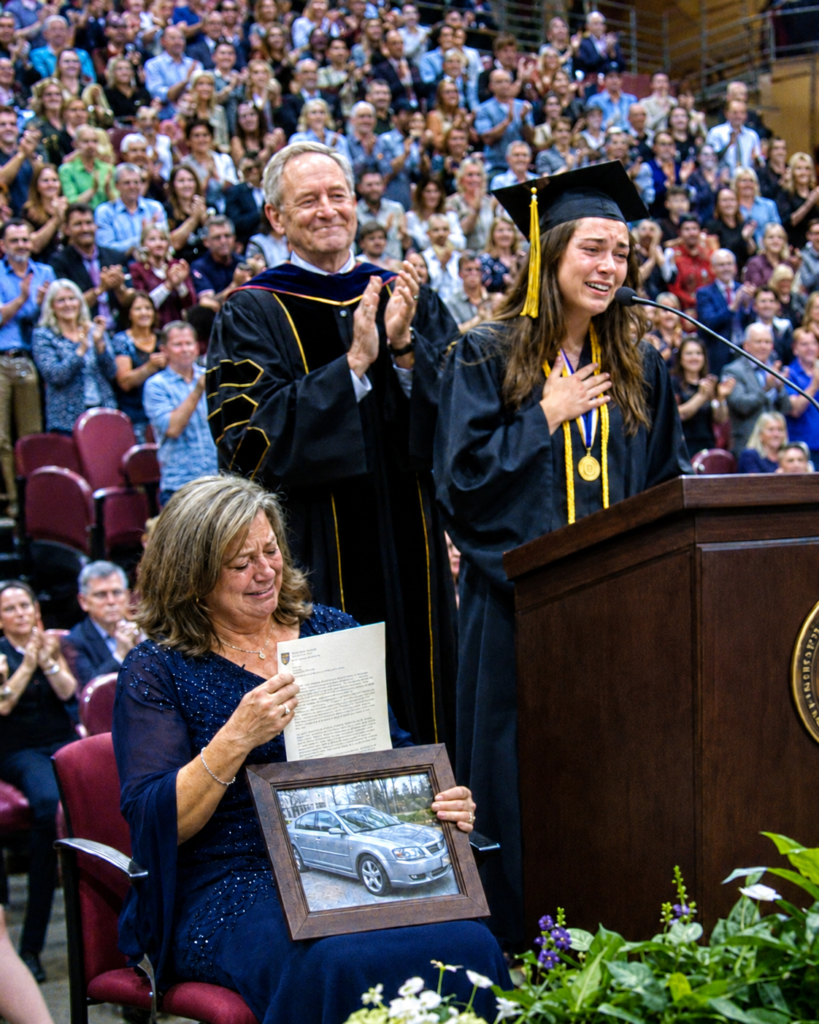
Jane stood beneath the bright stage lights, one hand still resting against the podium, while hundreds of people rose from their seats around me.
Professors.
Students.
Parents.
People I had never met.
They were all clapping for my daughter.
But somehow, when Jane looked down at me, it felt like there were only two people in that enormous auditorium.
Her and me.
For fifteen years, that had been enough.
I pressed a tissue beneath my eyes, laughing softly through my tears as the woman beside me squeezed my shoulder.
“You must be so proud,” she whispered.
I nodded because I couldn’t trust myself to speak.
Proud wasn’t a big enough word.
I was proud of the little girl who used to sit at our kitchen table coloring while I calculated which bill could wait another week.
I was proud of the teenager who never asked why her classmates had vacations and new phones while she had thrift-store jackets and a mother who was always tired.
I was proud of the college student who worked twenty hours a week, carried a full class load, and still somehow found the strength to call me every Sunday night and ask, “Mom, did you eat?”
And now she was standing on a stage as valedictorian.
My Jane.
When the ceremony ended, the graduates spilled into the courtyard behind the auditorium.
Families rushed forward carrying flowers, cameras, balloons, and handmade signs.
For several minutes, I couldn’t find Jane in the crowd.
Then I heard her voice.
“Mom!”
I turned.
She was running toward me in her black graduation gown, the gold honor cords bouncing against her chest.
I barely had time to open my arms before she crashed into me.
We held each other so tightly that neither of us said anything.
There was nothing left to say.
Or at least, that’s what I thought.
When Jane finally stepped back, she was crying again.
“I ruined my makeup,” she said.
“You look beautiful.”
“You’re supposed to say that.”
“I’m your mother. It’s legally required.”
She laughed.
It was the same laugh she’d had when she was five years old.
For one tiny second, I saw that little girl again.
Then Jane reached beneath her graduation gown and pulled out a cream-colored envelope.
My name was written across the front.
“Mom,” she said quietly, “there’s one more thing.”
I stared at it.
“Jane, if this is another surprise, I don’t think my heart can take it.”
“You’ll survive.”
“That’s easy for you to say.”
She smiled but didn’t laugh this time.
“Open it.”
I slid my finger beneath the flap.
Inside was a folded sheet of paper.
At the top was the logo of a local automobile dealership.
For several seconds, the words didn’t make sense.
Then I saw the line printed in bold.
PAID IN FULL.
I looked up at her.
“What is this?”
Jane bit her lower lip.
Behind her, two of her closest friends were already smiling.
“Come with me.”
She took my hand and led me through the courtyard toward the parking area.
I kept asking questions.
She refused to answer any of them.
Then we turned the corner.
And I stopped walking.
Parked beneath a flowering dogwood tree was a silver sedan.
Nothing extravagant.
Nothing flashy.
But clean.
Reliable.
Beautiful.
A large red ribbon stretched across the hood.
I stared at the car.
Then at Jane.
Then back at the car.
“No.”
Jane smiled.
“Yes.”
“No, Jane.”
“Yes, Mom.”
I shook my head rapidly.
“You cannot buy me a car.”
“I already did.”
“With what money?”
That was when the Dean appeared behind us.
He was holding his graduation cap beneath one arm and smiling like a man who had been waiting for this exact moment.
“Technically,” he said, “she had help.”
Jane rolled her eyes.
“I wanted to tell her myself.”
The Dean laughed.
Then he explained.
The Sterling Alumni Foundation had heard Jane’s graduation speech during rehearsal.
Several members of the foundation were present.
One of them owned a chain of automobile dealerships across the state.
After hearing the story about the car I had sold four years earlier, he asked Jane privately whether she thought I would accept a replacement.
Jane apparently said no.
“She said you would insist the money should go to someone who needed it more,” the Dean told me.
“That sounds like you,” Jane added.
“So,” the Dean continued, “they structured it differently. The dealership donated the vehicle through an alumni family support program. Insurance is covered for the first year.”
I stared at them.
“You planned this?”
Jane nodded.
“For weeks.”
I looked at the car again.
For four years, I had stood at bus stops before sunrise.
I had walked home in the rain.
I had carried grocery bags three blocks because taxi fare felt irresponsible.
Once, during winter, I slipped on an icy sidewalk and tore the knee of my work pants.
I remember sitting there for several seconds, exhausted and embarrassed, wondering how much longer I could keep doing it.
I never told Jane about that.
But somehow, standing in that parking lot, it felt as if every mile I had walked had finally led here.
“I don’t know what to say,” I whispered.
Jane stepped closer.
“Say you’ll let me drive it sometimes.”
I laughed so suddenly that I started crying again.
“You don’t even live at home anymore.”
“I’m still your daughter.”
“And apparently still very expensive.”
She hugged me.
That evening, we drove home together.
Jane insisted I take the driver’s seat.
My hands felt strange on the steering wheel.
I hadn’t owned a car in four years.
At the first traffic light, I glanced over at her.
She had removed her graduation cap and was leaning back against the passenger seat, watching the city pass outside the window.
“You know,” I said, “I would’ve done it all again.”
Jane turned toward me.
“The car. The shifts. The sleepless nights. All of it.”
“I know.”
“But I’m glad it’s over.”
She smiled.
“Me too.”
For the next few months, life became something unfamiliar.
Quiet.
I stopped working nights.
The first evening I stayed home, I didn’t know what to do with myself.
At nine o’clock, I kept checking the time.
At ten, I made tea.
At eleven, I sat on the couch and realized something almost embarrassing.
I had forgotten how to rest.
For years, every minute had belonged to someone else.
My employer.
The bills.
The grocery store.
The university.
The bus schedule.
Jane.
I had built my entire life around surviving until tomorrow.
Now tomorrow didn’t frighten me anymore.
Jane began her fellowship that fall.
Her master’s program focused on public policy and education access.
She said she wanted to study why so many capable students never made it to graduation simply because their families couldn’t afford the path.
Three months into the program, she called me one Sunday morning.
“I have an idea,” she said.
Those words always made me nervous.
“What kind of idea?”
“A good one.”
“That’s what you said before buying me a car.”
She laughed.
Then she told me.
Using part of the award money she had received alongside her fellowship, Jane wanted to establish a small emergency fund for students whose parents were working multiple jobs to keep them enrolled.
Not scholarships based on perfect grades.
Not awards based on impressive resumes.
Just help for families living one unexpected bill away from disaster.
A broken transmission.
A medical bill.
A rent increase.
A missed paycheck.
The exact kinds of things that nearly derailed us more than once.
She wanted to call it the Second Shift Fund.
I went completely quiet.
“Mom?”
“I’m here.”
“Do you hate the name?”
“No.”
My throat tightened.
“I love it.”
Jane launched the fund the following spring.
The first recipient was a nursing student named Melissa whose father worked overnight security at a warehouse.
Their electricity had been scheduled for disconnection two weeks before final exams.
The Second Shift Fund covered the bill and three months of rent.
Melissa graduated.
The next year, she donated fifty dollars back into the fund.
Then another former recipient donated twenty.
Then someone gave five hundred.
Then an alumnus gave ten thousand.
The fund grew.
Slowly.
Quietly.
Exactly the way our life had once been rebuilt.
Years later, Jane invited me back to the university.
She was speaking at a ceremony for first-generation graduates.
I sat in the same auditorium.
Same front row.
Different dress.
Same daughter.
Jane walked onto the stage wearing a navy suit instead of a graduation gown.
She was now Dr. Jane Evans.
Director of a statewide college access initiative.
When she reached the microphone, she smiled down at me.
I knew that smile.
I braced myself.
“Many years ago,” she began, “my mother taught me that sacrifice isn’t always dramatic.”
The room became quiet.
“Sometimes sacrifice looks like waiting for a bus at five in the morning.”
She paused.
“Sometimes it looks like worn-out shoes, cold dinners, or pretending you’re not tired because your child is watching.”
My eyes filled with tears.
Again.
Jane smiled.
“And sometimes the greatest gift a parent gives a child isn’t money.”
She looked directly at me.
“It’s making them believe their future is worth fighting for.”
The audience stood.
But this time, I didn’t cry because I remembered the struggle.
I cried because I finally understood what had come from it.
I had spent years believing I was only paying tuition.
I wasn’t.
I was teaching my daughter what love looked like when nobody was watching.
And she had taken that lesson and passed it on.
To Melissa.
To hundreds of families.
To students I would never meet.
That night, Jane and I drove home in the silver car she had given me years earlier.
It had more than a hundred thousand miles on it now.
A scratch along the passenger door.
Coffee stains near the cup holder.
A small crack in the dashboard.
Jane looked at it and laughed.
“Mom, you really need a new car.”
I shook my head.
“Not yet.”
“Why?”
I ran my hand over the steering wheel.
Because some things are more than what they appear to be.
A diploma can be more than paper.
A night shift can be more than work.
A used car can be more than transportation.
And a sacrifice made quietly, with no promise of repayment, can travel farther than you ever imagined.
“This one still has plenty of miles left,” I told her.
Jane smiled.
Then she rested her head against the window, just as she had on graduation day.
And together, we drove home.
Not worried about tomorrow.
Not running from yesterday.
Just grateful for the road that had brought us there.