For the first time in three years, Sarah slept without waking up to calculate how many days she had left before losing everything.
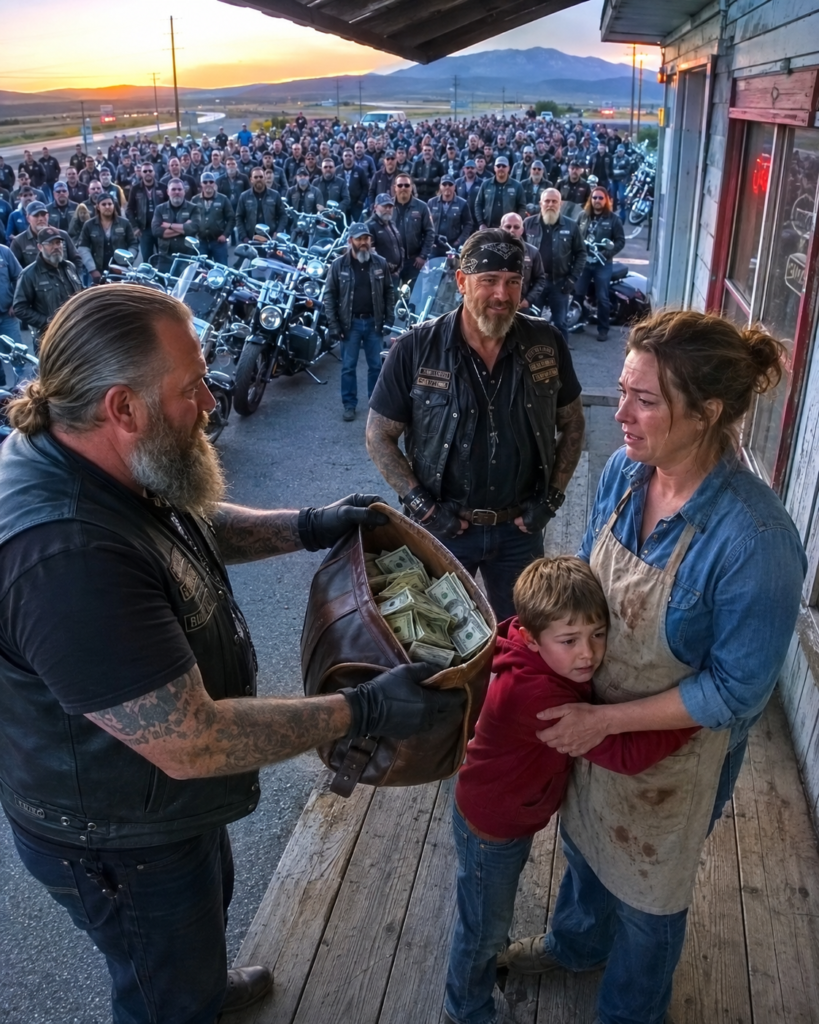
She slept on the old couch in the back office with Leo curled against her side, his small hand still clutching the toy motorcycle one of the bikers had given him.
Outside, rainwater dripped softly from the freshly repaired roof.
The refrigerator hummed steadily.
The neon sign glowed through the blinds.
OPEN.
It was such a simple word.
But to Sarah, it felt like a miracle.
By seven the next morning, she was back behind the counter, tying her apron and staring at shelves so full of food that she almost laughed.
Then she heard an engine.
Just one.
A black SUV pulled into the gravel lot.
Sarah’s smile disappeared.
She knew that vehicle.
The driver’s door opened, and a tall man in an expensive charcoal coat stepped out holding a leather folder.
Mr. Harold Pierce.
Vice president of Ridge County Community Bank.
The man who had spent the last four months reminding Sarah that compassion did not count as collateral.
He walked into the diner without removing his sunglasses.
“Morning, Sarah.”
Sarah placed the coffee pot down.
“Mr. Pierce.”
His eyes moved slowly around the room.
New wiring.
Fresh roof panels.
A repaired refrigerator.
Boxes of food stacked in the kitchen.
His expression tightened.
“I heard you had some visitors.”
Sarah said nothing.
Pierce sat at the counter and placed the leather folder in front of him.
“I’m afraid yesterday’s excitement doesn’t change the bank’s position.”
He slid a document across the counter.
Sarah looked down.
FINAL NOTICE OF FORECLOSURE.
Her stomach turned cold.
“But I have money now.”
“Your payment deadline was yesterday at five.”
“The highway was flooded.”
“The contract doesn’t care about weather.”
Sarah stared at him.
“You knew the road was closed.”
“I knew.”
“And you still expected me to somehow get to the bank?”
Pierce gave a thin smile.
“Business is business.”
Sarah’s fingers curled against the counter.
For years she had swallowed those words.
When her father died and left her the diner, Pierce had refinanced the property.
When Leo’s medical bills piled up after pneumonia, Pierce had offered another loan.
When winter traffic slowed, Pierce offered another extension—with another fee.
Every time Sarah fell behind, the bank had found another way to tighten the rope.
“What do you want?” she asked.
Pierce leaned back.
“The bank takes possession Monday.”
Sarah felt the room shrink.
“And me?”
“You vacate.”
“And my son?”
“That’s not the bank’s concern.”
A motorcycle engine rolled into the parking lot.
Pierce glanced toward the window.
Dutch stepped off his bike.
He wasn’t smiling.
Sarah closed her eyes for half a second.
Not now.
Dutch entered quietly and took a stool three seats away from Pierce.
“Coffee?” Sarah asked.
“Please.”
Pierce looked Dutch up and down.
“This is private business.”
Dutch nodded.
“Then pretend I’m not here.”
Sarah poured him coffee.
Pierce tapped the foreclosure paper.
“Monday morning, Sarah.”
He stood.
Then Dutch spoke.
“How much?”
Pierce stopped.
“Excuse me?”
“How much does she owe?”
Sarah shook her head.
“Dutch, don’t.”
But Dutch kept his eyes on Pierce.
“Total balance.”
Pierce laughed.
“You’re going to pay it?”
“No.”
Dutch took a sip of coffee.
“I’m asking a question.”
Pierce opened the folder again.
“One hundred eighty-seven thousand, four hundred and twelve dollars.”
Dutch nearly choked on his coffee.
Sarah stared at Pierce.
“What?”
Her original loan had been ninety thousand.
Pierce calmly turned the paperwork toward her.
“Interest. Penalties. Late fees. Emergency restructuring fees.”
“Emergency what?”
Pierce shrugged.
“You signed.”
Sarah’s face went pale.
Dutch slowly set down his cup.
“Mind if I look?”
Pierce hesitated.
Sarah pushed the papers toward Dutch.
He studied them for less than a minute.
Then he smiled.
It wasn’t the warm smile Sarah had seen the night before.
It was colder.
“Oh, this is interesting.”
Pierce’s jaw tightened.
“What?”
Dutch pointed at the page.
“You charged her a commercial restructuring fee three times.”
“It’s contractual.”
“And this one?”
“Administrative recovery.”
“And this?”
“Risk adjustment.”
Dutch nodded.
“Funny names.”
Pierce snatched the papers back.
“If you’re finished playing lawyer—”
“I’m not a lawyer.”
Dutch pulled out his phone.
“But my sister is.”
Pierce froze.
Dutch dialed.
“Morning, Elena. I need you to look at something.”
Twenty minutes later, another vehicle pulled into the diner lot.
This one was a silver sedan.
A woman in her forties stepped out wearing jeans, boots, and a navy blazer.
She looked nothing like the bikers who had filled the parking lot the day before.
But when Dutch opened the door for her, she punched him lightly in the shoulder.
“You only call me before breakfast when somebody’s either arrested or getting sued.”
“Good morning to you too.”
Elena Cross entered the diner carrying a laptop bag.
She introduced herself to Sarah, then sat down and examined every page.
Pierce grew visibly uncomfortable.
Five minutes passed.
Then ten.
Finally, Elena looked up.
“Mr. Pierce, are you personally responsible for this account?”
Pierce straightened.
“I’m vice president.”
“Good.”
She turned the laptop around.
“I’ve found six fees that appear to violate state lending regulations, two compound interest calculations inconsistent with the original loan agreement, and a foreclosure notice issued during a county-declared weather emergency.”
Pierce’s face changed.
Sarah stared at Elena.
“What does that mean?”
“It means,” Elena said calmly, “if these documents are authentic, the bank may owe you money.”
Pierce stood abruptly.
“This conversation is over.”
Elena smiled.
“No problem.”
She closed the laptop.
“I’ll send the complaint to the state banking commissioner.”
Pierce stopped walking.
“And the attorney general’s consumer finance division.”
He turned.
“And probably the local newspaper.”
Pierce looked at Sarah.
For the first time since she had met him, he looked afraid.
“This is unnecessary.”
Sarah’s hands were trembling.
But her voice wasn’t.
“Was taking my home necessary?”
Pierce said nothing.
Dutch stood beside her.
“You heard the lady.”
Pierce left.
Three days later, the foreclosure was suspended.
Two weeks later, Ridge County Community Bank’s internal audit uncovered dozens of questionable rural business loans processed under Pierce’s supervision.
Within a month, he resigned.
Sarah’s loan was recalculated.
Her actual balance after illegal fees were removed?
Sixty-one thousand dollars.
Sarah paid it off that afternoon using part of the money the bikers had raised.
But something else happened.
Something nobody expected.
The story spread.
First through biker clubs.
Then truckers.
Then local radio.
Then a reporter from the state capital arrived and wrote a feature titled:
THE DINER THAT FED TWELVE AND WAS SAVED BY EIGHT HUNDRED.
Within weeks, Sarah’s little roadside diner became a destination.
Truckers planned routes around it.
Veterans rode hours to eat breakfast there.
Families stopped just to see the famous neon sign.
Tourists took photographs beside the porch.
Sarah hated the attention at first.
Then she noticed something.
People weren’t coming because of the bikers.
Not really.
They were coming because they wanted to believe kindness still mattered.
So Sarah changed the menu.
At the bottom of every page she added one sentence:
IF YOU’RE HUNGRY AND CAN’T PAY, EAT ANYWAY.
The first person to use it was an elderly man named Frank.
He sat alone in a corner booth wearing a faded Army jacket and ordered coffee and toast.
When Sarah brought him eggs and bacon instead, he quietly cried.
The next customer secretly paid for his meal.
Then another customer left twenty dollars in a jar.
Someone wrote FREE MEAL FUND on the glass.
By the end of the week, the jar held four hundred dollars.
By Christmas, it held over six thousand.
The tradition grew.
Nobody went hungry at Sarah’s diner.
Not truckers.
Not stranded families.
Not runaways.
Not exhausted nurses driving home after night shifts.
Not veterans who had spent their last five dollars on gas.
One snowy night, almost a year after the storm, Sarah was closing when headlights appeared outside.
Twelve motorcycles pulled into the parking lot.
Sarah laughed before they even removed their helmets.
Dutch walked in first.
“Kitchen closed?”
“For you?”
Sarah shook her head.
“Never.”
The same twelve men took the same stools.
The same corner tables.
Leo, now seven, ran out from the back carrying a toy wrench and wearing a child-sized leather vest covered in harmless souvenir patches.
Dutch lifted him onto a stool.
“What are we eating?”
Sarah turned toward the grill.
“Eggs. Bacon. Potatoes. Toast.”
Dutch grinned.
“Sounds familiar.”
Sarah cracked the first egg.
Behind her, Dutch quietly placed an envelope beside the register.
She noticed.
“What’s that?”
“Nothing.”
“Dutch.”
He sighed.
“Open it later.”
Sarah wiped her hands and opened it immediately.
Inside was a photograph.
It showed the diner from the morning eight hundred motorcycles had filled the road.
On the back, someone had written:
You thought you fed twelve men.
You fed eight hundred brothers.
Sarah swallowed hard.
Then she noticed a second line.
And now you’ve fed thousands more.
She looked around the diner.
At the free-meal jar.
At the photographs covering the wall.
At Leo laughing with men who once would have terrified her.
At the steady neon light shining against the winter darkness.
She remembered that terrible night when the fridge had been almost empty.
She remembered counting the eggs.
Counting the slices of bacon.
Calculating exactly how much she would lose if she fed twelve strangers.
She had believed she was making the worst financial decision of her life.
Instead, she had made the decision that gave her life back.
Sarah placed the photograph behind the register.
Then she turned toward the twelve hungry men.
“All right,” she said, blinking away tears. “Who’s ready to eat?”
Twelve hands went up.
Outside, snow began falling across the highway.
Inside, the grill burned warm.
And beneath the glowing red neon sign, the little diner that had almost died stayed open long into the night.
Not because Sarah had become wealthy.
Not because eight hundred bikers had rescued her.
But because one stormy night, when she had almost nothing left, she had looked at twelve freezing strangers and decided that having little was never an excuse to give nothing.