The auction did not slow down when Lily Carter entered the converted hangar.
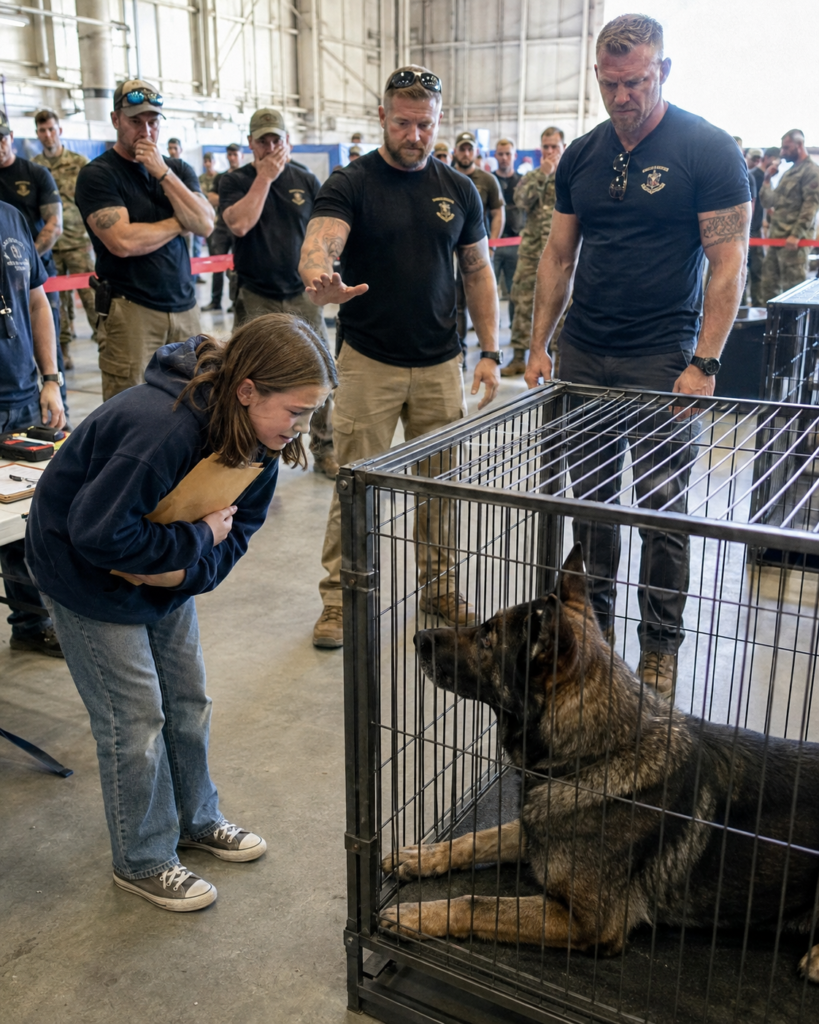
A handler’s pen remained suspended over a reassignment form, one retired dog quit panting, and the quiet click of identification tags against a metal kennel disappeared into a silence so complete that Lily could hear the rubber soles of her sneakers touching the concrete.
Fifty Navy SEALs were gathered inside the hangar at Naval Amphibious Base Coronado, surrounded by working-dog handlers, folding tables, clipboards, kennel gates, medical summaries, and the practical paperwork that separated one military life from the next.
Some of the dogs would leave with former handlers.
Others would enter carefully screened homes where their training, habits, and physical needs could be managed.
One dog in the far corner was not being offered to anyone.
Lily knew that before she walked through the door.
She was twelve years old, although the oversized navy hoodie she wore made her appear smaller.
The sleeves covered most of her hands, and the faded letters across the chest had cracked into pale lines after years of washing.
The hoodie had belonged to her father.
She carried a manila envelope against her ribs with both arms, pressing it close enough to bend the corners.
Chief Petty Officer Jack Reeves was the first man to step away from the tables.
He took in the child, the hoodie, the envelope, and the way every person nearest the entrance seemed to be waiting for someone else to decide what should happen.
“Hey there, sweetheart,” he said, softening his voice. “You lost?”
Lily lifted her chin without loosening her grip on the envelope.
“I’m here for the auction.”
A few men looked at each other, not because the answer was funny, but because there was no reasonable explanation for it.
The auction was restricted, the base was controlled, and children did not simply walk alone into a room filled with retired military dogs and special operations personnel.
Reeves lowered himself into a crouch so his height would not become another obstacle.
“This is Navy personnel only,” he said. “How did you get past the gate?”
Lily shifted the envelope beneath one arm and reached inside the neck of the hoodie.
She pulled out a laminated identification badge attached to an old cord and held it toward him.
Reeves recognized the face before he finished reading the name.
Master Chief Petty Officer Thomas J. Carter.
For a moment, Reeves did not look at Lily.
He looked at the badge, at the small scratches across its plastic surface, and at the photograph of a man who should have been standing somewhere in that hangar.
Then he looked into the girl’s face and saw enough of Tom Carter there to remove every remaining doubt.
“Lily Carter?”
“Yes, sir.”
Her father’s name passed through the room without anyone needing to call it out.
Men straightened near the kennels.
One handler lowered his clipboard.
Another turned away from a conversation and stared toward the entrance with the expression of someone who had just heard a voice from six months earlier.
Tom Carter had not been the loudest man in any room.
He had not needed to be.
He was an explosive ordnance specialist, a Navy SEAL, and the person others trusted when every wrong movement carried a price.
The stories told about him rarely involved speeches or medals.
They involved his hands remaining steady beside a live device, his voice staying level while rounds hit a wall, and the way he could give complicated instructions with the ordinary patience of a father reading items from a grocery list.
Six months earlier, an official report had described his death as a training accident.
The report used clean language.
It reduced the last minutes of a man’s life to procedure, location, equipment failure, and conclusion.
It did not describe what the people in the hangar had lost.
It did not explain why several of them still stopped speaking whenever his name came up.
Lily put the badge back beneath the hoodie and looked beyond Reeves.
Her gaze traveled past the auction tables, the handlers, and the dogs waiting beside their leads until it reached the farthest corner of the building.
“I came for Titan.”
The reaction was smaller than a gasp and heavier than one.
Behind a line of red tape, isolated from the other retired dogs, a massive dark sable German Shepherd lay inside a single kennel.
His ears bore old scars.
His coat, once dense and polished, had gone dull along his shoulders.
His eyes were open, but they did not track the movement around him.
He had the stillness of an animal that had not stopped breathing but had stopped expecting anything from the next moment.
K9 Titan had served beside Tom Carter for eight years.
They had completed fifty-three deployments together and earned three combat awards.
The numbers appeared in Titan’s service record as neat entries, but the men in the hangar knew what those entries could not hold.
They knew how many times the dog had entered a space before the humans behind him.
They knew how quickly Tom could read the smallest shift in Titan’s shoulders.
They knew that Titan had trusted the pressure of one hand against his harness and the sound of one particular voice above engines, shouting, and chaos.
After Tom died, Titan stopped responding.
Handlers tried familiar commands.
They tried changes in routine, quiet spaces, controlled introductions, and time.
Titan ate only when hunger forced him to, slept in short stretches, and watched doors that never opened for the man he expected.
Six months passed without a safe placement being approved.
The final assessment described him as reactive and unplaceable.
At dawn the following morning, he was scheduled to be euthanized.
Chief Sam “Doc” Torres came through the group before Reeves could answer Lily.
The lines around Doc’s eyes deepened when he saw the child and the envelope.
“Lily,” he said. “Honey, Titan isn’t part of the auction.”
“I know.”
Doc glanced toward the isolated kennel, then back at her.
“Then why are you here?”
Lily’s fingers tightened beneath the long sleeves of the hoodie, pressing new creases into the envelope.
“Because they’re going to kill him tomorrow.”
The bluntness of the sentence landed harder than any softened explanation could have.
Doc’s mouth opened, but he did not tell her she was mistaken.
He could not.
Lily watched his face and understood the answer before he found words.
“I’m not letting that happen,” she said.
Her voice remained level, but the envelope moved slightly with each breath.
A sharper voice came from behind the men.
“What exactly is going on here?”
Commander Marcus Webb walked toward the entrance with measured steps and a perfectly arranged uniform.
Nothing about him appeared rushed, although the men between him and Lily moved aside quickly enough to show the weight of his rank.
His eyes touched Lily’s face, the badge cord at her collar, and the envelope held against her chest.
Doc straightened.
“Sir, this is Master Chief Carter’s daughter.”
Webb’s expression changed only enough to acknowledge that he had heard.
“Miss Carter, I’m sorry for your loss,” he said. “But you need to leave immediately.”
Lily did not step backward.
“I’m claiming Titan under next-of-kin reassignment.”
The men nearest the kennel turned fully toward her.
Webb studied the child as if he could decide which sentence would make the problem disappear fastest.
“There is no applicable claim here,” he said. “Titan has been marked reactive and unplaceable.”
“He’s not reactive.”
Webb’s gaze narrowed.
Lily looked toward Titan and finished the thought.
“He’s grieving.”
One of the handlers lowered his eyes.
The difference between those two words—reactive and grieving—was not merely emotional.
One made the dog sound dangerous beyond recovery.
The other suggested that the people assessing him might have misunderstood what he was waiting for.
Webb’s jaw tightened.
“You are a child speaking about matters you do not understand.”
Lily brought the manila envelope away from her body and raised it high enough for everyone nearby to see.
“I understand my father didn’t die in a training accident.”
No one moved toward her.
No one interrupted her.
A clipboard hung loosely at one man’s side, its bottom edge touching his leg.
Another SEAL stared at the red tape around Titan’s kennel as if the thin strip had suddenly become evidence of something larger than a safety boundary.
Lily had not come into the room to ask them to remember her father kindly.
She had come to challenge the version of his death they had been ordered to accept.
“I know he filed a complaint two days before he died,” she continued. “I know he said the explosives protocols were unsafe.”
Webb’s face became still in a different way.
Lily’s voice did not rise.
“I know Titan was with him when it happened. And I know you signed the report that made the truth disappear.”
The accusation settled over the room with the weight of a live charge.
It connected the complaint, the accident report, the only surviving witness who could not speak, and the order scheduled for dawn.
Webb looked at the envelope again.
“That is a serious accusation.”
“My dad gave me this the morning he died.”
Lily’s thumb pressed into the folded seam.
“He told me that if anything happened, I should bring it here and get Titan.”
Webb extended his hand.
The gesture was controlled, almost patient, but it was not a request.
“Give me the envelope.”
Doc stepped between them before Lily could answer.
He did not touch Webb, and he did not raise his voice.
“With respect, sir, evidence shouldn’t disappear into your office.”
The next five seconds revealed more than a speech could have.
Webb kept his hand extended.
Doc remained where he was.
Lily stood behind him with the envelope held close again.
Then Reeves rose from his crouch and moved beside Doc.
Another SEAL crossed the concrete and took position near Reeves.
A third left the auction table.
The movement continued until the men formed a quiet wall between Lily and the commander.
They had not accused Webb of anything aloud.
They had made a simpler decision first: whatever was inside Tom Carter’s envelope would not be taken from his daughter in private.
Webb let his hand fall.
His eyes traveled across the men standing in front of him, measuring faces he had previously expected to obey without hesitation.
Then he gave a cold, controlled smile.
“Fine,” he said. “You want the dog? Prove he is safe.”
The challenge shifted every gaze toward the far corner.
Titan remained on the kennel floor with his head resting between his paws.
The other retired dogs had responded to the tension in the room.
Some stood alert beside their handlers.
Others turned their ears toward the voices.
Titan did nothing.
A handler near the red tape looked at Lily with open concern.
He had seen trained adults approach the kennel cautiously and leave without receiving so much as a focused glance.
Lily had no leash, no protective equipment, and no authority to order anyone to open the gate.
She had only the hoodie, the envelope, and whatever her father had believed would remain between his daughter and his partner after he was gone.
Doc turned slightly toward her.
“You don’t have to do this,” he said quietly.
Lily looked at him.
“If I don’t, they kill him in the morning.”
The answer carried no performance and no request for pity.
It was the calculation of a child who had already discovered that adults could call something official without making it true.
She moved toward the red tape until Doc gently lifted one hand, reminding her of the boundary.
Lily stopped several feet from the kennel.
From there, she could see the gray beginning around Titan’s muzzle and the worn fur where his working collar had once rested.
She could also see that his eyes were open.
He was not asleep.
He was waiting inside a silence no one else had managed to reach.
Lily pressed the envelope to her chest.
She remembered the way her father had spoken Titan’s name at home—not as an order shouted across a yard, but as if the dog were another person trusted with the same responsibility.
Tom never wasted commands around Titan.
He spoke clearly, and Titan listened because the voice had always meant that the next movement mattered.
Lily drew one breath.
“Titan.”
The German Shepherd’s right ear twitched.
It was a small movement, but every trained person in the hangar saw it.
The handler nearest the kennel leaned forward.
Reeves lowered his clipboard completely.
Doc’s shoulders tightened.
Lily did not repeat the command more loudly.
She waited.
For six months, Titan had ignored whistles, familiar cues, food rewards, and the careful voices of handlers who wanted him to return to the animal he had been.
Now his head rose from the concrete.
Slowly, heavily, and unmistakably, Titan looked across the red tape at Tom Carter’s daughter.
The dog’s eyes focused on her face.
The empty distance in them changed.
He did not look at the handlers.
He looked at Lily.
His front paws shifted beneath his chest, claws scraping softly against the kennel floor.
The sound was quiet, but it carried through the hangar because every conversation had stopped.
Titan pushed himself upright.
Lily took one step forward.
Webb’s hand came up from behind the line of men.
“Do not cross that line.”
She stopped where she was.
Titan did not.
The German Shepherd moved across the kennel, each step deliberate, until he stood directly behind the metal gate.
His nose was inches from the sleeve of the oversized hoodie Tom had once worn.
Lily lowered herself onto one knee without passing the red tape.
Her face remained level with Titan’s.
“My dad told me you’d remember,” she whispered.
Titan pressed his muzzle against the wire.
A low sound came from him.
It was not a warning, a bark, or the explosive reaction described in his final assessment.
It was a broken whine pulled from somewhere beneath months of waiting.
Doc turned his face away long enough to blink hard and regain control.
Reeves stared at the dog as if the movement had forced him to reconsider every line written in Titan’s file.
Lily slid two sleeve-covered fingers through the safe gap beneath the latch.
The nearest handler watched Titan’s shoulders and mouth, prepared to intervene if the dog showed tension.
Titan lowered his head.
Lily’s fingers touched the scarred fur between his ears.
There was no snap, no lunge, and no attempt to retreat.
Titan remained still beneath her hand, his eyes fixed on her face.
Lily’s mouth trembled for the first time since she entered the hangar.
She did not pull away.
Webb’s voice cut through the moment.
“An emotional response does not make him adoptable.”
The sentence drew several men’s attention back to the commander.
The test had been his challenge, but the result had not given him the answer he expected.
Lily kept one hand near Titan and lowered the envelope onto her knee.
She worked one covered finger beneath the sealed flap.
The paper tore unevenly because her hands were shaking now, and the sound made Webb move forward.
Doc shifted with him, keeping his body between the commander and the child.
Lily removed a single folded page.
It had been carried for six months, and the creases had softened from being opened at home and closed again without anyone else seeing it.
She did not offer it to Webb.
She held it toward Doc.
“My dad said someone he trusted had to read it in front of the team.”
Doc accepted the page with both hands.
He recognized Tom Carter’s handwriting before he reached the signature.
The first line made him stop.
He returned to the beginning and read it again, checking the date and the words as though disbelief might have rearranged them.
Reeves stepped closer.
“What does it say?”
Doc looked at Lily kneeling beside Titan.
He looked at the dog standing quietly against the kennel gate and at the men who had placed themselves between the child and Webb.
Then he looked toward the commander.
“It says Tom expected someone to call Titan unstable after his death.”
Webb’s expression did not break, but his shoulders became rigid.
Doc continued.
“He wrote that Titan might stop responding because Titan would keep waiting for the last command Tom never had time to give.”
Lily’s fingers remained in the fur between Titan’s ears.
The dog leaned a fraction closer to her sleeve.
Reeves glanced at the page.
“And the instruction?”
Doc’s thumb pressed against the lower crease.
Webb stepped toward him.
“That document has not been authenticated.”
Doc folded the page against his chest before Webb could reach it.
“The signature is Tom’s,” he said. “The date is two days before the accident.”
The same day Tom had filed his complaint.
That fact traveled through the men without needing explanation.
The letter was no longer only a dying father’s request for his daughter to protect his dog.
It belonged to the same narrow window in which Tom had warned that the explosives protocols were unsafe and had apparently prepared for the possibility that his warning would be buried with him.
Webb looked toward the auction tables.
“Nothing leaves this facility until command reviews it.”
Lily rose slowly, keeping herself between Titan and the commander’s line of sight.
“Then review it here.”
Her voice was quiet, but it carried.
“My dad said not to let the envelope disappear.”
Reeves moved closer to Doc, making clear that the page would remain visible.
The handler near Titan’s kennel looked from the dog to Webb.
“Sir,” he said carefully, “you ordered her to prove Titan could respond safely.”
Webb’s eyes narrowed.
The handler did not retreat from the statement.
“He responded to her voice, approached the barrier, accepted contact, and showed no aggressive behavior.”
It was not a speech or an accusation.
It was an observation made by the person trained to read the dog in front of them.
Webb could challenge Lily’s age and dismiss grief as emotion, but the behavior he had demanded was now visible to everyone in the hangar.
Lily looked at Doc.
“What was Dad’s instruction?”
Doc unfolded the page again.
His eyes moved down to the final paragraph.
Tom’s handwriting became tighter near the bottom, as though he had written the last lines quickly before leaving home.
Doc swallowed once.
He read the first part aloud.
“If Titan is declared unstable after my death, do not authorize his destruction until Lily Carter is present and allowed to approach him using my name.”
No one interrupted.
Doc continued.
“If he lifts his head for her, he is not unplaceable.”
Titan stood behind the gate with his head beneath Lily’s hand.
The instruction had already answered itself.
Doc reached the final sentence.
His voice roughened, but he did not stop.
“He is waiting for family.”
Lily closed her eyes for one second.
When she opened them, she looked at Titan instead of the men around her.
The dog’s scarred ear moved beneath her fingers.
For six months, every official description had measured Titan by what he no longer did.
He did not obey new handlers.
He did not engage with unfamiliar people.
He did not behave like a dog ready to be placed in another home.
Tom’s letter offered a different explanation.
Titan had not forgotten his training.
He had remained faithful to the person who had failed to return.
Webb extended his hand again.
“Give me the page.”
Doc did not move.
Lily lifted the envelope from her knee and felt something heavier slide against the inside seam.
The single page had not been the only thing her father placed there.
A second folded document remained inside, thicker than the letter and marked with the same date as the safety complaint.
Lily drew it out far enough for Doc to see the first line.
His eyes shifted from the document to Webb.
The commander’s attention left Titan for the first time since the dog stood.
Whatever calm he had carried across the hangar tightened into something more deliberate.
Lily held the second document against her father’s hoodie.
“My dad told me to get Titan first,” she said. “Then he told me to make everyone read what happened.”
Titan remained standing at the gate, no longer looking through the room for a man who would never enter it.
His eyes stayed on Lily.
And when Doc reached for the second page, Commander Webb finally understood that the dog scheduled to die at dawn was not the only witness Tom Carter had left behind.