The manager stared at me for several seconds before finally sitting down across from me.
“Lena, do you know what this card actually is?”
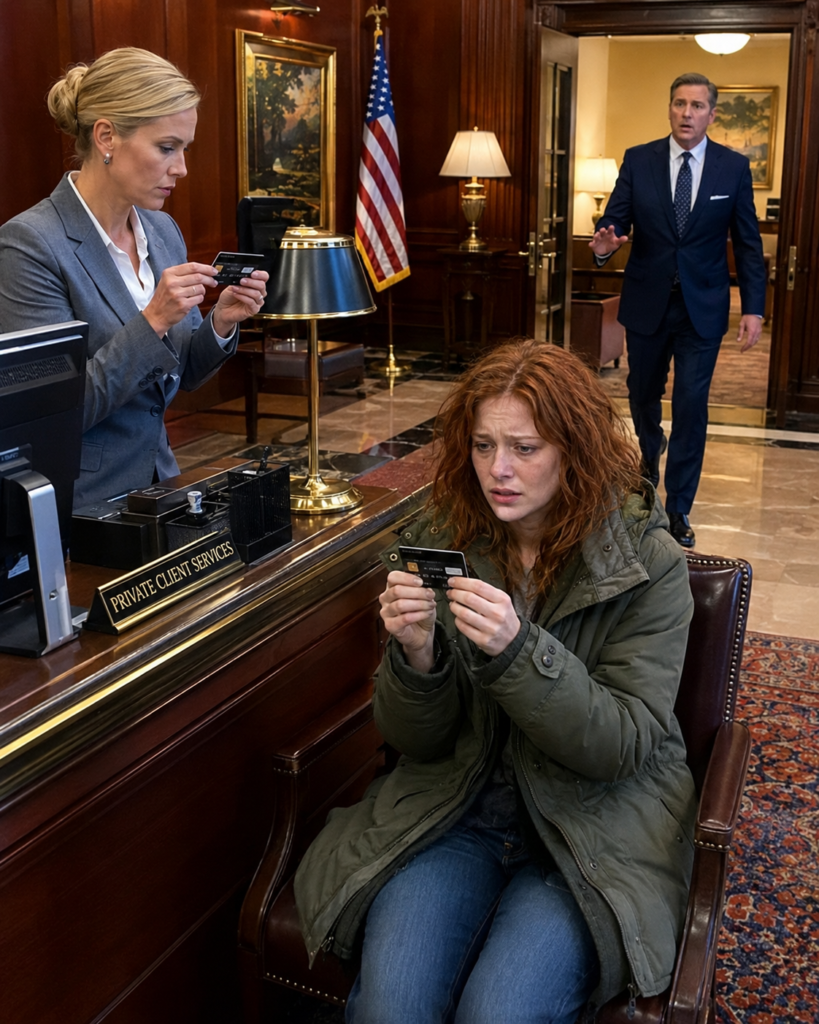
I shook my head.
“My grandfather told me it was for emergencies. He said I should never use it unless I had nowhere else to go.”
The manager slowly opened the red file.
“Your grandfather was very specific about that.”
My heart began pounding.
He turned the first page toward me.
At the top was my full name.
Lena Carrington.
Beneath it was a date from twenty-two years ago—the day my grandfather had taken me to his office when I was six.
I remembered that day.
I remembered sitting on the enormous leather chair, my legs dangling above the floor while my grandfather spoke quietly to someone behind his desk. I remembered the smell of cedar, the sound of an old clock, and the way he had looked at me before slipping the black card into my little hand.
But I had never understood why.
The manager reached into the file and removed another document.
“This card isn’t connected to a normal bank account.”
I frowned.
“Then what is it connected to?”
He looked directly into my eyes.
“Your grandfather’s trust.”
I stopped breathing.
“My grandfather had a trust?”
“He had several.”
He placed a thick folder on the desk.
“And this one was created specifically for you.”
I stared at the papers without touching them.
For years, my parents had told me my grandfather was simply an old-fashioned businessman who enjoyed pretending our family was more important than it really was. They said he had been difficult, stubborn, and overly protective of me.
Whenever I asked about him, my mother would change the subject.
When he died, they barely let me attend the funeral.
I had always assumed there was nothing more to know.
Now I realized they had lied.
The manager continued.
“Your grandfather understood that you might one day need independence from your parents. He instructed us not to contact you unless certain conditions were met.”
“What conditions?”
He slid the red file closer.
“Being removed from your family home without access to your own resources was one of them.”
My hands began to tremble.
“He knew?”
“He anticipated it.”
I looked up.
“Why?”
The manager didn’t answer immediately.
Instead, he opened another document.
It contained handwritten notes.
My grandfather’s handwriting.
If Lena ever comes here alone, frightened, without her parents, don’t ask her to explain herself. Give her a safe room. Give her food. Give her time. Then show her everything.
My eyes filled with tears.
He had known.
Not exactly what would happen.
But he had known enough to prepare for it.
The manager pushed a glass of water toward me.
“There is more.”
My heart sank.
“What more?”
“The trust contains properties, investments, and accounts. But that’s not the part your grandfather considered most important.”
He turned another page.
“He left you controlling interest in Carrington Holdings.”
I stared at him.
I almost laughed.
“That can’t be right.”
“It is.”
“My father runs Carrington Holdings.”
“Your father manages it.”
The distinction suddenly felt enormous.
“But why would he never tell me?”
The manager’s expression became serious.
“Because he wasn’t required to.”
Silence filled the room.
Then he handed me a copy of the original trust agreement.
My grandfather had written a clause that made my stomach turn.
Lena will assume full control of her inheritance upon reaching adulthood, unless she voluntarily signs away her rights. No family member may pressure, threaten, deceive, or financially manipulate her into surrendering those rights.
I remembered the argument from the night before.
The loan.
They hadn’t simply wanted money.
They wanted the loan in my name.
My credit.
My future.
My signature.
And suddenly every strange conversation from the past few years made sense.
The questions about my credit score.
The requests to “help with paperwork.”
The insistence that I should trust my family.
The repeated suggestion that I wasn’t capable of managing money myself.
My mother hadn’t been trying to protect me.
She had been trying to make sure I never discovered what belonged to me.
The manager leaned back.
“Your grandfather also left instructions regarding your parents.”
I looked at him.
“What did he say?”
He hesitated.
Then he handed me a sealed envelope.
My name was written across the front.
My grandfather’s handwriting.
My fingers shook as I opened it.
Inside was a single letter.
Dear Lena,
If you are reading this, then something happened that I hoped would never happen.
You may be angry. You may be confused. You may even believe that I abandoned you by leaving you with people who did not understand you.
But I never abandoned you.
I pressed my hand against my mouth.
Tears rolled down my face.
Your parents love you in the way they know how. But love without respect can become control. And control without accountability can become cruelty.
I had to stop reading for a moment.
The words were painful because they were true.
I have watched you become quieter over the years. I watched you apologize when you had done nothing wrong. I watched you doubt your own intelligence because someone repeatedly told you that you were incapable.
My vision blurred.
Lena, you are not helpless. You never were.
I cried silently.
The manager looked away, giving me privacy.
I continued.
The black card is not a reward. It is a door.
When you use it, you are telling me that you have finally decided to walk through that door.
At the bottom of the letter was one final sentence.
Do not go back just because they suddenly say they are sorry.
I folded the letter carefully.
For the first time in my life, I understood something.
My grandfather hadn’t given me money.
He had given me a choice.
The manager stood.
“There is a guest suite upstairs. It is yours for as long as you need it.”
I looked at him.
“How long?”
“As long as necessary.”
For the first time since my father slammed that door, I felt safe.
But safety wasn’t the only thing waiting for me.
The manager placed another folder on the desk.
“This arrived yesterday.”
I looked at the label.
Carrington Holdings — Emergency Board Review.
My stomach tightened.
“Why would there be a board review?”
He gave me a serious look.
“Because your father submitted documents yesterday attempting to transfer ownership of several company assets.”
My blood ran cold.
“Without my permission?”
“Exactly.”
I stared at the folder.
Then I understood.
My parents hadn’t thrown me out because I refused to help them.
They had thrown me out because I refused to sign.
And somewhere inside those documents was the real reason they had been so desperate.
I looked at the black card lying on the desk.
For years, I had thought it represented wealth.
Now I realized it represented something far more dangerous to the people who had controlled me.
Power.
And for the first time, that power was in my hands.