Reasonable.
Composed.
“I was only helping my wife,” he said.
Marissa looked at the monitor.
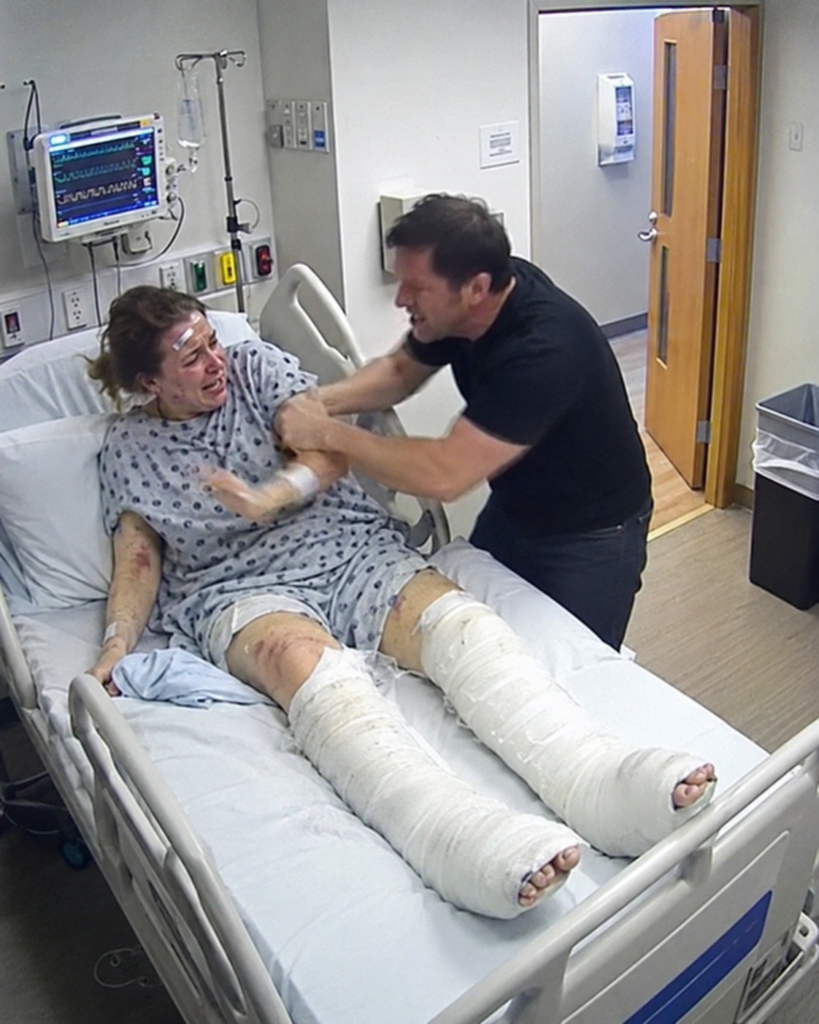
My heart rate was still racing.
Then she looked at me.
“Audrey?”
I swallowed.
My ribs ached every time I breathed.
“I’m okay.”
It was automatic.
The same answer I had given for years.
I’m okay.
Nothing’s wrong.
Julian didn’t mean it that way.
He’s just stressed.
He’s had a difficult week.
Marissa didn’t move.
“I’m not asking whether you can tolerate it,” she said gently. “I’m asking whether you want him touching you or helping you out of this bed.”
The room went completely still.
I looked at Julian.
His face had tightened again.
Not enough for anyone else to notice.
Enough for me.
He wanted me to choose carefully.
For eleven years, I had learned how much could be communicated without words.
A glance across a dinner table.
A silence in the car.
The way a cabinet door closed.
The way someone’s name was spoken.
And in that moment, I understood something that frightened me more than his anger.
I still wanted to protect him.
Even lying there with two broken legs and stitches in my head, part of me wanted to make his behavior sound smaller than it had been.
Because if I said the truth aloud, I would have to hear it too.
“No,” I whispered.
Julian’s eyes changed.
Marissa nodded once.
“Thank you.”
She turned toward him.
“You need to step outside.”
“This is ridiculous.”
“Sir.”
“She’s on medication. She doesn’t understand what’s happening.”
“I understand,” I said.
My own voice surprised me.
Julian stared at me.
I forced myself not to look away.
“I understand exactly what’s happening.”
For several seconds, nobody spoke.
Then he laughed under his breath.
It wasn’t a happy sound.
“Fine.”
He picked up his coat from the chair.
“Let everyone here treat me like some kind of villain because I’m the only person thinking realistically. Do you know what this is costing us?”
Marissa answered before I could.
“This is not a discussion about billing.”
“Everything is a discussion about billing eventually.”
He moved toward the door.
Then he stopped beside Chloe’s drawing.
His eyes lingered on the crooked purple house, the yellow sun in the corner, and the three stick figures holding hands beneath the words COME HOME SOON, MOMMY.
Something softened in his expression.
For one brief second, I saw the man I had married.
The man who once stood in our first apartment making pancakes at midnight because I had worked late.
The man who cried when Chloe was born.
The man I kept searching for every time he became someone I didn’t recognize.
He looked at me again.
“Audrey,” he said quietly, “don’t make decisions while you’re upset.”
Then he walked out.
Marissa followed him into the hallway.
The second nurse stayed with me.
Her name was Priya.
She began checking the leads attached to my chest.
“Your heart rate is coming down.”
“I’m sorry.”
She paused.
“For what?”
I looked toward the door.
“For causing a problem.”
Priya’s expression softened.
“You didn’t.”
Something about the simplicity of her answer nearly broke me.
I turned my face toward the window.
Outside, the hospital parking lot glittered beneath cold white lights.
Three weeks earlier, I had thought surviving the accident would be the hardest thing I ever did.
Now I wasn’t so sure.
A few minutes later, Marissa returned alone.
She closed the door behind her.
“Mr. Bennett has left the floor.”
I nodded.
“Thank you.”
She pulled the chair closer to my bed.
“There is something I need to ask you.”
My stomach tightened.
“Okay.”
“Do you feel safe going home with your husband when you’re discharged?”
The question seemed absurd.
Not because I didn’t understand it.
Because no one had ever asked me before.
I thought of our house.
The pale gray kitchen Julian had chosen because he said white showed fingerprints.
The living room where Chloe built blanket forts on Saturdays.
The upstairs hallway where family photographs hung in matching black frames.
Our life looked peaceful from a distance.
That had always mattered to Julian.
Appearances.
Schedules.
Controlled voices.
Order.
Even our arguments were usually quiet.
The most painful things in our marriage were rarely shouted.
They arrived as corrections.
You spent too much.
You worry too much.
You’re too sensitive.
Why would you embarrass me by saying that?
You wouldn’t understand the finances.
Let me handle it.
It was easier this way.
I hadn’t realized how many pieces of myself I had handed over one small decision at a time.
“I don’t know,” I said.
Marissa gave me a moment.
“That answer is enough for tonight.”
She told me the hospital could restrict Julian’s visits if I wanted.
She told me a patient advocate could speak with me privately.
She explained that discharge plans could be changed.
No dramatic promises.
No speeches.
Just options.
I had forgotten what options felt like.
After she left, I didn’t sleep.
At two in the morning, I asked Priya to bring me the blue canvas bag from the bottom drawer.
Inside were the belongings recovered after my accident.
My cracked phone.
One gold earring.
My wallet.
A house key.
A scarf still stained at one corner from the crash.
And a small black notebook I didn’t recognize.
I frowned.
“Was this mine?”
Priya checked the property list.
“It was recovered with your purse.”
I turned the notebook over.
No name.
No label.
The cover was soft leather, slightly worn around the edges.
I opened it.
The first several pages were blank.
Then, halfway through, I found handwriting.
Not mine.
Numbers.
Dates.
Initials.
Short notes.
3/14 — J.B. transfer approved.
3/27 — revised amount.
4/02 — A.B. signature still pending.
My pulse quickened.
A.B.
Audrey Bennett.
I turned another page.
There were bank names.
Account references.
Amounts.
Some small.
Some very large.
One number made me stop breathing for a moment.
$184,000.
I closed the notebook.
Maybe it wasn’t connected to me.
Maybe A.B. meant someone else.
Maybe J.B. wasn’t Julian.
But deep down, I already knew I wasn’t going to be able to dismiss it.
At seven the next morning, I called my sister.
Evelyn answered on the second ring.
“Audrey?”
She sounded half asleep.
“Can you come to the hospital?”
Silence.
Then blankets rustled.
“What’s wrong?”
“I need to talk to you.”
“I’m coming.”
Evelyn lived forty minutes away.
She arrived in twenty-eight.
She walked into my room wearing jeans, a cream sweater, and two different earrings.
I almost laughed.
Almost.
Then she saw my face.
“What happened?”
I held up the notebook.
“First, close the door.”
She did.
Then she sat beside me.
Evelyn was three years older than I was and had spent most of our lives saying the thing I was trying not to say.
When our parents divorced, she had been angry.
I had tried to keep everyone speaking.
When our father forgot birthdays, she stopped calling him.
I bought him cards.
When Julian and I got married, she told me she thought he was too controlling.
I stopped speaking to her for nearly four months.
She never mentioned it again.
Now I handed her the notebook.
She read the pages slowly.
Her eyebrows drew together.
“Where did you get this?”
“My things from the accident.”
“Was it in your purse?”
“The property sheet says it was.”
She flipped backward.
“Did you put it there?”
“No.”
“Did Julian?”
“I don’t know.”
Evelyn leaned back.
“Do you recognize any of this?”
I pointed to the initials.
“That could be us.”
“It could.”
“And this says my signature is pending.”
Evelyn looked at me.
“Have you signed anything recently?”
“No.”
“Bank paperwork? Insurance? Refinancing?”
I thought.
Julian handled most financial documents.
That realization came with a cold, uncomfortable clarity.
He handled the mortgage.
Taxes.
Investments.
Insurance.
Even our joint savings accounts.
At first, it had been practical.
I had stopped working after Chloe was born.
He earned the salary.
He was good with numbers too.
Or at least I had believed he was.
Over the years, whenever I asked questions, he gave answers just complicated enough to make me feel embarrassed for asking.
Then he would kiss my forehead and say, “That’s why you have me.”
I stared at the notebook.
“There was something.”
Evelyn waited.
“About two months ago, Julian asked me to sign a document. He said it was related to changing the beneficiary structure on one of our insurance policies.”
“Did you sign it?”
“No. Chloe had a fever, and I told him I’d look at it later.”
“And?”
“He never brought it up again.”
Evelyn’s face went pale.
“Why would your signature be required for a transfer of one hundred eighty-four thousand dollars?”
“I don’t know.”
She closed the notebook carefully.
“Audrey, you used to be an accountant.”
Used to be.
The words landed harder than she meant them to.
She saw it.
“I’m sorry.”
“No. You’re right.”
“You still understand this stuff.”
“Maybe.”
“No. Not maybe.”
She placed the notebook on the blanket.
“You spent eight years working in financial compliance. You were good at it.”
I stared at my hands.
My left wrist was still bruised.
The wedding ring had been removed because of swelling and placed in the hospital safe.
For the first time since the accident, I was relieved not to see it.
“I haven’t worked in ten years.”
“That doesn’t erase who you were.”
Her words stayed with me.
Who you were.
I didn’t know whether I wanted to become that woman again.
But I wanted to remember her.
Later that afternoon, Evelyn brought Chloe to visit.
The second my daughter entered the room, everything else disappeared.
“Mommy!”
She ran toward the bed, then stopped herself before reaching me.
Her face crumpled.
“You can’t hug me.”
“I can hug you carefully.”
She climbed onto the chair and leaned over.
I wrapped one arm around her shoulders.
Her hair smelled like strawberry shampoo.
For several seconds, I closed my eyes.
This was the reason I had survived.
Not Julian.
Not the house.
Not the marriage.
Her.
Chloe pulled back.
“I made you another picture.”
“Is it another masterpiece?”
“Yes.”
She handed me a drawing of a castle with three towers.
There were only two people in front of it.
A tall figure in a pink dress.
A smaller figure with yellow hair.
I looked at it.
“Where’s Daddy?”
Chloe shrugged.
“He’s working.”
Evelyn and I exchanged a glance.
“Has Daddy been home every night?” I asked casually.
Chloe thought about it.
“Mostly.”
“Mostly?”
“He goes out sometimes.”
Evelyn sat a little straighter.
“When?”
“At nighttime.”
“Where does he go?”
Chloe shook her head.
“I don’t know.”
I smiled.
“That’s okay.”
She began telling me about a science project at school.
I listened.
Or tried to.
But one sentence kept repeating inside my head.
He goes out sometimes.
That evening, Julian called.
I almost didn’t answer.
Then I saw Chloe’s face in my mind.
I pressed the green button.
“What?”
There was a pause.
He wasn’t used to me answering like that.
“I’ve been trying to reach you.”
“I was with Chloe.”
“Evelyn brought her.”
“Yes.”
Another silence.
Then his voice softened.
“Audrey, last night got out of hand.”
I waited.
“I was tired,” he continued. “The insurance company called me again. I haven’t been sleeping. Work has been a disaster.”
Still I said nothing.
“I’m sorry I upset you.”
Not I’m sorry I hurt you.
Not I’m sorry I tried to pull you out of bed.
I’m sorry I upset you.
I recognized the shape of the apology.
I had accepted hundreds like it.
This time, I didn’t.
“What insurance company?”
“What?”
“You said the insurance company called you.”
“Our health insurer.”
“Which one?”
He hesitated.
It lasted less than a second.
But I heard it.
“Why?”
“Because I want to know.”
“Audrey, you don’t need to worry about that.”
“I do now.”
His breathing changed.
“Aren’t you supposed to be resting?”
I looked at the black notebook on the table.
“What happened to my purse after the accident?”
“What kind of question is that?”
“Did you go through it?”
“No.”
“Did you pick up anything from the crash scene?”
“No.”
I stared at the notebook.
“Are you sure?”
“Yes.”
The answer came too quickly.
My mouth went dry.
Julian continued.
“Listen, I can come by tomorrow and we can talk about all this.”
“No.”
“Audrey.”
“I don’t want you visiting tomorrow.”
He went silent.
I thought my heart would start racing again.
Instead, something strange happened.
I felt calm.
“You can’t keep me from seeing my wife.”
“I can ask the hospital to restrict visitors.”
“You’d do that?”
“Yes.”
The word came easier this time.
He breathed out slowly.
Then his voice became almost gentle.
“This isn’t you.”
I looked toward the window.
Morning rain had dried into silver streaks across the glass.
“Maybe you don’t know me as well as you think.”
I ended the call.
My hand trembled afterward.
But I didn’t call him back.
The next day, the hospital patient advocate came to see me.
Her name was Lena Ortiz.
She was in her early forties, with warm brown eyes and a legal pad balanced on one knee.
She didn’t ask me to describe Julian as a bad man.
She didn’t label my marriage.
Instead, she asked questions.
Who controlled our finances?
Whose name was on the house?
Did I have access to bank accounts?
Did I have somewhere safe to recover after discharge?
Was Chloe safe?
That last question startled me.
“Yes.”
I answered immediately.
Then I stopped.
Was she?
Julian had never been physically rough with Chloe.
He adored her.
Attended school concerts.
Read bedtime stories.
Made pancakes shaped like animals.
But safety wasn’t only about bruises.
I thought about how quiet Chloe had become around him during the past year.
How she checked his face before asking for something.
How often she whispered to me, “Is Daddy in a good mood?”
My chest tightened.
“I think she is,” I said slowly.
Lena wrote something down.
“You’re allowed to change your answer later.”
After she left, Evelyn returned with my laptop.
“You asked for this.”
I opened it.
The familiar blue screen glowed.
For the first time in years, I logged into our joint bank portal.
Or tried to.
Password incorrect.
I entered the old password again.
Incorrect.
I tried resetting it.
A verification code had been sent to a phone number ending in 9914.
Not mine.
Not Julian’s usual number either.
Evelyn leaned over my shoulder.
“Whose number is that?”
“I don’t know.”
We tried our investment account.
Same problem.
Mortgage portal.
Password changed.
Credit card.
Access temporarily locked.
One account after another had been changed.
“Maybe he updated security after the accident,” I said.
Evelyn gave me a look.
“Why?”
I didn’t answer.
Then I remembered something.
Years earlier, while working in accounting, I had encouraged clients to keep independent copies of important records.
I hadn’t followed my own advice recently.
But perhaps I had once.
“Give me a minute.”
I opened an old cloud storage folder.
Photographs.
Tax forms.
Receipts.
Then a folder labeled HOUSEHOLD ARCHIVE.
Inside were financial statements from six years earlier.
I opened the most recent one.
Joint savings balance: $63,214.
Investment portfolio: $327,890.
Mortgage remaining: $248,600.
Nothing unusual.
Then I noticed the insurance folder.
A policy issued eight years earlier.
Insured person: Audrey Bennett.
Benefit amount: $750,000.
Beneficiary: Julian Bennett.
I read it twice.
“That doesn’t mean anything,” I said.
“Plenty of couples have life insurance.”
“I know.”
But there was another file.
A scanned amendment.
Created seven weeks earlier.
I clicked it.
The document requested an increase in coverage.
From $750,000 to $2.5 million.
I stopped breathing.
Evelyn whispered my name.
At the bottom of the page was a signature.
Audrey Bennett.
It looked almost exactly like mine.
Almost.
But I had worked with records long enough to recognize something subtle.
The capital A curved too sharply.
The final t in Bennett leaned the wrong direction.
I touched the screen.
“I didn’t sign this.”
Evelyn went still.
“Are you certain?”
“Yes.”
The date on the amendment was six weeks before my accident.
I felt cold despite the hospital blanket.
“Maybe it’s a digital authorization mistake.”
“Maybe.”
But neither of us believed it.
Evelyn stood.
“We need to call someone.”
“Not yet.”
She stared at me.
“Not yet?”
“I want to understand what I’m looking at.”
“Audrey—”
“If we accuse him of something without knowing the facts, he’ll say I’m confused because of the medication.”
“He may say that anyway.”
“I know.”
I closed the file.
“But I want evidence, not fear.”
For the first time in days, I sounded like the person I had been before Chloe was born.
Methodical.
Careful.
Patient.
Evelyn noticed too.
A faint smile touched her face.
“There she is.”
“Who?”
“My sister.”
That night, I couldn’t stop thinking about the accident.
Until then, my memories had been fragments.
Rain.
Headlights.
A horn.
The violent sound of metal.
Then darkness.
Police told me another vehicle had clipped the rear corner of my car at an intersection, sending me through the guardrail.
The other driver had not remained at the scene.
They were still investigating.
At least that’s what Julian had told me.
But I had never spoken directly to the officer.
Why hadn’t I?
Because every time I asked, Julian said I needed rest.
Don’t worry about paperwork.
I’ll handle it.
Let me take care of you.
My pulse began to rise.
I pressed the call button.
Priya entered a few minutes later.
“Everything okay?”
“Can I ask something strange?”
“Of course.”
“Do hospitals keep records of who calls asking about patients?”
“Usually there are notes, depending on the call.”
“Could someone tell me whether police contacted the hospital after my accident?”
She considered.
“I can ask medical records tomorrow.”
“Thank you.”
Then I remembered the black notebook.
“Actually, there’s one more thing.”
I handed it to her.
“When my belongings came in, do you know who brought them?”
She checked the property sheet again.
Then frowned.
“This is unusual.”
“What?”
She pointed to the signature line.
The belongings had not been delivered by Julian.
They had been delivered by an officer.
Officer Daniel Ross.
At 11:18 p.m.
The night of the accident.
Three days later, Julian had signed a release indicating that he had inspected my personal property but left everything in hospital storage because I was unconscious.
My stomach tightened.
“He saw the notebook,” I whispered.
“What?”
“Nothing.”
But now another question had appeared.
If Julian had seen the notebook three weeks ago, why had he never mentioned it?
The following morning, I asked Lena to help me contact Officer Ross.
He arrived shortly after lunch.
He was younger than I expected, perhaps thirty-five, wearing plain clothes instead of a uniform.
He introduced himself, then pulled the chair beside the bed.
“I’m glad you’re awake and doing better.”
“I’ve been awake for almost two weeks.”
His eyebrows lifted.
“I know. I requested an interview twice.”
I stared at him.
“No one told me.”
“Your husband said you were in no condition to speak.”
The room seemed to shrink.
“Did you call me directly?”
“I called the number listed in the file. Your husband answered the first time. The second time, a voicemail said family requested no investigative contact until your doctors cleared you.”
“I never requested that.”
Officer Ross watched me carefully.
“I see.”
I handed him the notebook.
“Was this with my things?”
“Yes.”
“Where did it come from?”
He looked surprised.
“We thought it belonged to you.”
“It doesn’t.”
His expression changed.
“You’re sure?”
“Yes.”
He opened it.
“I haven’t seen these pages.”
“You didn’t read it?”
“No. Personal notebooks generally aren’t examined unless there’s reason. It was lying on the passenger-side floorboard next to your purse.”
My skin prickled.
“There was no passenger.”
Officer Ross stopped turning pages.
“You remember that?”
“I was alone.”
He closed the notebook.
“Mrs. Bennett, do you remember where you were going that afternoon?”
“To pick up Chloe.”
“From school?”
I frowned.
“No. She was supposed to be at my mother’s.”
He leaned forward slightly.
“Your statement at the scene indicated you were driving toward Northbridge.”
“I don’t remember giving a statement.”
“You were conscious for approximately twelve minutes after emergency crews arrived.”
My head began to ache.
“What did I say?”
He hesitated.
“You kept asking whether someone was following you.”
Evelyn, who had been standing near the window, turned around sharply.
I stared at him.
“I said that?”
“Yes.”
“Who?”
“You never gave a name.”
The monitor quickened.
Officer Ross noticed.
“We don’t have to continue.”
“No. Tell me.”
He looked down at his notes.
“You also said the notebook wasn’t yours.”
A strange pressure built behind my eyes.
For a second, I could almost hear rain against my windshield.
A gas station glowing in the distance.
A car behind me.
Headlights.
Too close.
Then the memory vanished.
I pressed my fingertips to my temple.
“Do you know who hit me?”
“We haven’t identified the driver.”
“Did Julian tell you anything?”
“He said you had been distracted since your mother’s health declined.”
My mouth fell open.
“My mother died four years ago.”
Officer Ross went very still.
Evelyn crossed her arms.
“That’s interesting.”
He looked between us.
“Your husband told responding investigators she had recently been ill and that you had been under emotional strain.”
For several seconds, none of us spoke.
I felt as though the floor beneath my life had shifted a few inches.
Not enough to collapse.
Enough that everything now stood crooked.
“What exactly are you investigating?” I asked.
Officer Ross glanced toward the closed door.
“Initially, a hit-and-run.”
“Initially?”
He chose his next words carefully.
“We found something yesterday.”
My heart thudded.
“What?”
“A camera from a grocery store captured part of the intersection.”
“Did it show the other car?”
“Yes.”
“Who was driving?”
“We can’t see the driver clearly.”
Disappointment mixed with relief.
Then he added, “But we did identify the vehicle.”
Evelyn stepped closer.
Officer Ross took a photograph from his folder and placed it on my blanket.
The image was grainy.
Rain blurred the road.
My silver sedan was visible near the intersection.
Behind it was a dark SUV.
I stared.
There were thousands of dark SUVs.
Nothing remarkable.
Then I saw the sticker in the rear window.
A white mountain outline.
I knew that sticker.
Julian’s business partner, Marcus Hale, had one on his SUV.
He gave them to clients every year from the outdoor charity he sponsored.
Julian had one too.
But our SUV had been in the repair shop the week of my accident.
At least that’s what Julian had told me.
“Do you recognize it?” Officer Ross asked.
“Maybe.”
He slid another photograph toward me.
This one was clearer.
A license plate.
Not the whole number.
But enough.
8KJ.
Evelyn looked at me.
I knew that plate.
“That’s Marcus’s car,” I said.
Officer Ross didn’t react.
“Marcus Hale?”
“Yes.”
“How certain are you?”
“He’s been to our house dozens of times.”
Evelyn nodded.
“I recognize it too.”
Officer Ross wrote something down.
“Mr. Hale reported that SUV stolen the morning after your accident.”
The room became quiet again.
Something inside me resisted the obvious conclusion.
Marcus was Julian’s closest friend.
They had met in college.
Built the consulting company together.
Marcus had been at our wedding.
He was Chloe’s godfather.
He brought her a telescope for her ninth birthday.
“No,” I said.
Officer Ross looked up.
“What?”
“Marcus wouldn’t hurt me.”
“I didn’t say he did.”
“But you’re thinking it.”
“I’m thinking his vehicle was near your car shortly before the collision.”
He gathered the photographs.
“We need facts before conclusions.”
The words sounded familiar.
Evidence, not fear.
I nodded.
Then Officer Ross asked a question I wasn’t expecting.
“When did you last speak to Marcus?”
I thought.
“Maybe a week before the accident.”
“About what?”
“I don’t remember.”
Evelyn looked at me.
“Wasn’t he at the house?”
I turned to her.
“When?”
“The Saturday before the crash. I called you. You said Julian and Marcus were arguing in the garage.”
A faint memory surfaced.
Raised voices.
Julian shutting the kitchen door when I walked in.
Marcus leaving without saying goodbye.
“What were they arguing about?” Officer Ross asked.
“I don’t know.”
But I remembered something else.
Marcus had returned ten minutes later.
Julian had gone upstairs.
Marcus stood in our entryway, rain on his jacket.
He looked nervous.
He handed me something.
A black notebook.
My breath caught.
“I remember.”
Everyone looked at me.
“The notebook.”
I picked it up.
“Marcus gave it to me.”
Officer Ross sat forward.
“What did he say?”
I closed my eyes.
The memory came slowly.
Marcus near the front door.
His voice low.
Audrey, don’t give this to Julian.
“What else?”
I pressed harder against my temple.
“He said…”
The hospital room blurred.
“Take Chloe somewhere for a few days.”
Evelyn whispered, “Why?”
“I don’t know.”
Another piece returned.
Marcus looking over his shoulder.
His face pale.
If Julian asks, you never saw me.
I opened my eyes.
My heart was racing again.
Officer Ross stood.
“We’re going to pause.”
“No.”
“You’re under medical care.”
“I need to know.”
“And we need to verify this properly.”
He took the notebook.
I tightened my grip.
“Where are you taking it?”
“To evidence processing, if you consent.”
I hesitated.
Then released it.
He sealed it in a plastic evidence bag.
As he reached the door, I called his name.
“Officer Ross.”
He turned.
“If Marcus wanted to warn me, why would his car be following me?”
He looked at me for a long moment.
“That,” he said, “is exactly what I’m trying to understand.”
After he left, Evelyn sat beside me.
Neither of us spoke for several minutes.
Then she took my hand.
“Come stay with me when you’re discharged.”
I looked at her.
“You have stairs.”
“I’ll move your bed into the dining room.”
“Your dining room is tiny.”
“Then we’ll eat over the sink.”
Despite everything, I laughed.
It hurt my ribs.
But I kept laughing until tears filled my eyes.
Evelyn started crying too.
We sat there holding hands like children.
“I should have listened to you years ago,” I said.
“No.”
“You warned me.”
“I also judged you.”
“You were right.”
“That doesn’t make it easier.”
I looked down at our hands.
“What if I’ve wasted eleven years?”
Evelyn’s grip tightened.
“You raised Chloe. You loved people. You built a home. You learned things. You survived things. Years aren’t wasted just because they didn’t end the way you hoped.”
I wiped my eyes.
“When did you become wise?”
“Approximately ten minutes ago.”
I smiled.
Then my phone rang.
Unknown number.
Evelyn looked at the screen.
“Don’t answer.”
I almost agreed.
Then something told me to.
“Hello?”
No one spoke.
I could hear breathing.
“Who is this?”
A man’s voice answered.
Weak.
Uncertain.
“Audrey?”
My entire body went cold.
I knew that voice.
“Marcus?”
Evelyn’s eyes widened.
There was a long pause.
Then Marcus whispered, “Thank God.”
I sat straighter despite the pain.
“Where are you?”
“I can’t explain everything.”
“Your car was at the accident.”
Silence.
“Marcus?”
“I know.”
“Were you driving?”
“No.”
The answer came instantly.
“Then who was?”
Another pause.
“I don’t know.”
I closed my eyes.
“Why did you give me that notebook?”
“Because I found records I wasn’t supposed to find.”
“What records?”
“Transfers. Insurance documents. Company accounts.”
I looked at Evelyn.
“Connected to Julian?”
Marcus inhaled sharply.
“Yes.”
The word barely made a sound.
My fingers tightened around the phone.
“What was he doing?”
“I thought he was hiding money from the company. At first, that’s all I thought.”
“At first?”
“I kept looking.”
My heart pounded.
“And?”
Marcus didn’t answer.
Instead he asked, “Is Julian there?”
“No.”
“Are you alone?”
“My sister is here.”
“Good.”
His breathing sounded strange.
“Marcus, where are you?”
“I’m safe.”
“Then come to the police.”
“I can’t yet.”
“Why?”
“Because someone broke into my apartment two days after your crash.”
Evelyn put a hand over her mouth.
“Was anything taken?”
“Only files.”
“Did you report it?”
“Yes.”
“What did the police say?”
“They thought it was connected to my stolen vehicle.”
“Was it?”
“I don’t know.”
“Marcus, please stop saying you don’t know.”
My voice cracked.
“I almost died.”
He became silent.
When he spoke again, he sounded exhausted.
“I know.”
“Then tell me what you do know.”
Another long pause.
Finally, he said, “The insurance policy wasn’t the first one.”
My breath caught.
“What?”
“There were other policies.”
“How many?”
“Two that I found.”
“On me?”
“Yes.”
The room tilted.
Evelyn grabbed the edge of my bedside table.
I stared at the ceiling.
“How much?”
“I don’t remember exactly.”
“Try.”
“Close to four million combined.”
I felt nothing for several seconds.
No fear.
No anger.
Just disbelief.
Julian had complained about hospital bills.
He had told me we were drowning financially.
He had changed our passwords.
And somewhere, documents existed attaching millions of dollars to my death.
But facts mattered.
Facts.
“Were my signatures on them?”
“Yes.”
“I didn’t sign them.”
“I suspected that.”
“Why?”
“Because one application was submitted during the week you and Chloe were in Vermont with Evelyn.”
I looked at my sister.
She nodded slowly.
We had taken Chloe skiing.
Julian said he had too much work to come.
“Marcus,” I whispered, “why didn’t you tell me immediately?”
“I tried.”
The rain.
His visit.
The notebook.
Take Chloe somewhere for a few days.
“Then why were you following me?”
“I wasn’t.”
“Your car was.”
“My car had already been stolen.”
“You reported it stolen the next morning.”
“I know how that looks.”
“Then explain it.”
He exhaled.
“I didn’t realize it was gone until morning. I was out of town.”
“Where?”
“Northbridge.”
My skin prickled.
Officer Ross said I had been driving toward Northbridge.
“Why?”
“I went to meet someone.”
“Who?”
Marcus hesitated.
“Someone who used to work for Julian.”
“What was their name?”
“Audrey, I need you to listen.”
“No. I need you to answer.”
“You’re right.”
His voice softened.
“Her name is Rachel Stone.”
I had never heard it before.
“Who is she?”
“She handled internal accounts at our firm four years ago.”
“What happened to her?”
“She quit suddenly.”
“Why?”
“I thought she had another offer.”
“And now?”
“Now I think Julian wanted her gone.”
Evelyn leaned closer to the phone.
“Why?”
Marcus continued.
“Because she was the first person who noticed money moving between accounts.”
“Where is she now?”
“I don’t know.”
“You just said you went to meet her.”
“I did.”
“Then where is she?”
“She never showed up.”
A cold silence settled over the room.
My mouth went dry.
“Marcus.”
“Yes?”
“Why was I going to Northbridge?”
He didn’t answer.
“Marcus?”
His voice became very quiet.
“Because Rachel contacted you too.”
I stopped breathing.
“No.”
“Yes.”
“I don’t know her.”
“She emailed you the morning of the accident.”
“I never saw an email.”
“She told me she had documents for you.”
“What documents?”
“She didn’t say.”
I looked toward the laptop.
Julian had controlled passwords.
Phone access.
Accounts.
Messages.
How much of my life had passed through him before reaching me?
“How do you know she emailed me?”
“Because she copied me.”
“Send it.”
“I will.”
“Now.”
A few seconds later, my phone chimed.
A forwarded email appeared.
Sender: Rachel Stone.
Recipient: Audrey Bennett.
Subject: YOU DESERVE TO KNOW.
My hands shook as I opened it.
The message was short.
Audrey,
You don’t know me, but I worked with Julian.
I have information involving accounts in your name.
Please don’t discuss this with him until we speak.
Meet me at 5:30 p.m. at Northbridge Café.
Come alone.
Rachel
I stared at the timestamp.
4:02 p.m.
The day of the accident.
I had left home around five.
The crash occurred at 6:17.
I wasn’t going to pick up Chloe.
I had lied to myself because my injured brain had filled missing space with routine.
I had been going to meet Rachel.
“Why don’t I remember reading this?”
Marcus said nothing.
Then another memory flashed.
My kitchen.
My phone buzzing.
An email.
My finger hovering above delete.
No.
Not my finger.
Someone else’s hand.
Julian standing beside the kitchen island.
I squeezed my eyes shut.
“Audrey?”
“I remembered something.”
“What?”
“Julian was home.”
Evelyn frowned.
“The day of the crash?”
“He told everyone he was at work.”
I saw it more clearly.
Julian entering the kitchen in his gray suit.
Me holding my phone.
His face changing when he saw the screen.
What is that?
Nothing.
Who is Rachel Stone?
The memory ended there.
My chest tightened.
“Marcus.”
“Yes?”
“Did Julian know Rachel was contacting me?”
“I don’t know.”
“But he knew about the notebook.”
“Yes.”
I looked toward the hospital door.
A terrible thought arrived.
“If Julian knew I was meeting Rachel, why would he let me go?”
Marcus didn’t answer.
Then I heard a noise on his end.
A door.
Footsteps.
His breathing changed.
“Marcus?”
No reply.
“Marcus, are you there?”
He whispered, “I have to go.”
“Wait.”
“Audrey, listen to me.”
“What?”
“Do not go back to your house.”
My throat tightened.
“Why?”
“You need to find the envelope.”
“What envelope?”
“The one Rachel left for you.”
“She never met me.”
“No.”
His voice dropped lower.
“But according to her last message, she went to your house first.”
I stared at Evelyn.
“What?”
“She said she hid something there in case she couldn’t meet you.”
“Where?”
“She wouldn’t tell me.”
“Marcus—”
“I have to go.”
“Wait!”
The line went dead.
For several seconds, neither Evelyn nor I moved.
Then my phone chimed again.
A new message.
Unknown number.
I opened it.
Three words.
ASK CHLOE ABOUT THE BLUE BOX.
I read it twice.
Evelyn leaned over.
“What blue box?”
I shook my head.
“I don’t know.”
Then my blood went cold.
Because suddenly, I remembered Chloe sitting beside my hospital bed four days earlier.
She had been coloring quietly while Julian spoke to a doctor in the hallway.
Out of nowhere, Chloe had looked up and asked me something.
At the time, I had been tired and medicated.
I hadn’t understood why it mattered.
Mommy, why did Daddy tell me never to open the blue box in your closet?
I had smiled.
I had told her it was probably something boring.
I had forgotten all about it.
Until now.
Evelyn stared at me.
“Audrey?”
I looked toward the hospital window, toward the city beyond it, toward the neighborhood where my house waited behind a familiar front door.
Somewhere inside that house was a blue box.
Julian knew about it.
Rachel might have hidden something there.
And my ten-year-old daughter had already seen it.
But one question frightened me more than all the others.
If Julian had told Chloe never to open the box…
Then how long had he known it was there?
END OF PART 2 – LIKE, SHARE AND COMMENT “”THE ENTIRE STORY”” IF YOU WANT TO READ THE FULL STORY.