Part 1: The Voice At 2:46 In The Morning
The call reached me at 2:46 in the morning, and before the clock changed to 2:48, I already understood that someone inside my sister’s house had crossed a line that could not be explained away as marital conflict.
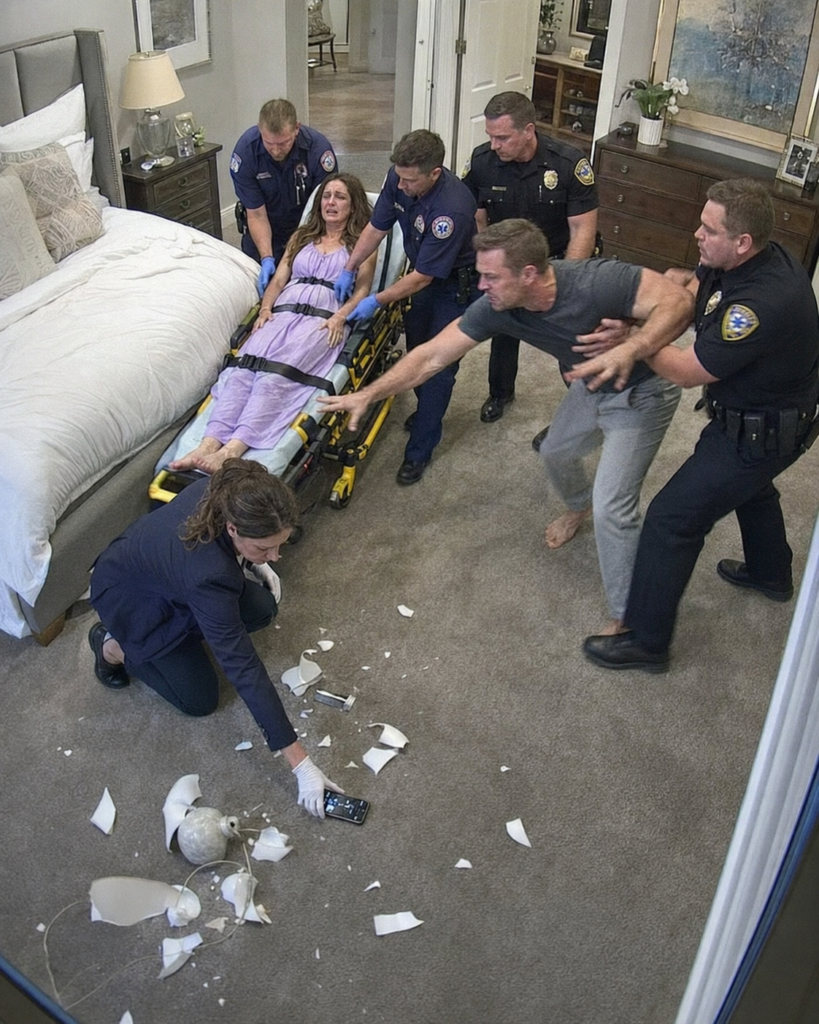
My identical twin, Emily Carter, was crying so violently that her words came apart between breaths.
“Rachel, please come get me. Mark is—”
Something heavy crashed in the background, followed by a sharp gasp and the sound of the phone striking a hard surface.
Then the connection ended.
My name is Rachel Carter, and at thirty-six I served as a detective with the domestic violence unit of the Columbus Police Department in Ohio. I had spent eleven years documenting injuries, interviewing frightened witnesses, reconstructing timelines, and listening to offenders explain why everyone except them caused the violence they chose.
However, when I heard my sister’s voice, professional training disappeared for one terrible second beneath something older and more primitive.
Emily and I had shared a crib, a bedroom, our father’s funeral, and every important secret until she married Mark Whitaker six years earlier. During the first years of their marriage, she called constantly. Gradually, those calls became shorter, less frequent, and carefully timed around Mark’s schedule.
She stopped attending Sunday dinners. She claimed her camera was broken whenever I suggested video calls. She wore long sleeves through warm weather and laughed whenever I asked whether something was wrong.
I had accepted explanations because forcing recognition before a victim feels safe enough to speak can push her deeper into isolation. Yet patience had slowly become the excuse I used to avoid admitting that my sister was disappearing inside her own home.
I called emergency dispatch from my personal phone, reported a suspected domestic assault, requested medical response, and provided Mark’s address in Upper Arlington. I deliberately did not identify myself as the responding family member until the dispatcher completed the initial report.
Then I dressed, placed my badge inside my jacket, secured my service weapon according to department policy, and drove through nearly empty streets while patrol units approached from another direction.
Mark opened the door before I knocked.
He wore gray sweatpants, no shirt, and the relaxed smile of a man who believed charm remained stronger than evidence.
“Emily is sleeping,” he said.
I noticed broken ceramic near the hallway table and a dark smear beside the staircase.
“I heard her call for help.”
Mark leaned against the frame, blocking the entrance.
“You heard a married couple arguing. This is private family business.”
“Move away from the doorway.”
His smile widened because he had always treated my career as an amusing performance. At family dinners, he called me a parking-ticket detective and asked whether my badge came with a discount at restaurants.
“You have no authority to enter my home without a warrant.”
A weak sound came from the second floor.
It was not crying.
It was a painful, unsteady moan.
I stepped forward.
Mark caught my wrist.
Training returned immediately. I rotated my arm through the weakest point of his grip, shifted my balance, and forced him against the wall without striking him.
“Touch me again, and the patrol officers approaching this house will add assaulting a police officer to whatever else happened tonight.”
His expression changed when the distant sirens became audible.
I released him and ran upstairs.
Emily lay beside the bed with one arm trapped beneath her body. Bruises covered her throat, shoulders, and forearms, while the swelling around her left eye had nearly closed it. Her breathing remained shallow, and dried blood darkened the corner of her mouth.
For half a second, I stopped being a detective.
I became the little girl who had once climbed into her sister’s bed during thunderstorms because neither of us could sleep alone.
Then Emily’s fingers moved.
“Rachel,” she whispered. “He said nobody would believe me.”
Mark appeared behind me.
“She fell after drinking. She always becomes dramatic when she drinks.”
I turned toward him with a calmness colder than anger.
Red and blue light moved across the bedroom walls.
I knelt beside Emily and held her hand without disturbing her position.
“They do not need to rely upon belief alone,” I said. “They only need to preserve what he left behind.”
Part 2: The Phone Beneath The Bed
Two patrol officers entered with paramedics. Mark’s personality changed before they reached the bedroom.
His voice softened. His shoulders lowered, and concern appeared across his face with the precision of a rehearsed expression.
“My wife has struggled emotionally for years,” he told Officer Luis Mendoza. “She drank too much, became aggressive, and fell when I tried to calm her.”
Emily flinched when he spoke.
That reaction would matter later, although no single detail would be allowed to carry the entire case.
Because I was Emily’s sister and a direct witness to the scene, I stepped away from the investigative role. Procedure mattered more than my desire to control every decision. If I interfered improperly, Mark’s attorney could argue that the arrest resulted from personal hostility rather than evidence.
Mark mistook my restraint for uncertainty.
“Even Rachel knows this is nothing,” he said. “She has always hated that Emily chose me.”
I did not answer.
The paramedics lifted Emily carefully. As they moved her, a cracked smartphone rolled from beneath the bed and struck the side of my boot.
The recording indicator still glowed.
Mark saw it at the same moment.
His face changed completely.
I used a clean tissue to avoid contaminating the device and handed it directly to Mendoza.
“Potential evidence. Please document where it was recovered and preserve the chain of custody.”
Mark lunged toward the phone.
Officer Mendoza forced him against the wall and secured his wrists.
“That belongs to me!” Mark shouted.
Emily’s voice came weakly from the stretcher.
“No. It belongs to me.”
At Riverside Methodist Hospital, imaging revealed three fractured ribs, a dislocated shoulder, a concussion, and bruising in different stages of healing. The injuries documented months rather than one argument.
Mark had already prepared his defense.
He possessed apologetic messages Emily had sent after previous assaults. He kept photographs of dishes he claimed she broke during emotional episodes. His mother, Patricia Whitaker, had repeatedly described Emily as unstable to friends, neighbors, and medical staff.
Several weeks earlier, Mark forced Emily to tell an urgent care nurse that she injured her shoulder after slipping in the bathroom.
By sunrise, Patricia arrived with an attorney.
She found me beside a vending machine drinking coffee that tasted like scorched water.
“You have always resented my son,” she said. “Now you are using your position to destroy his marriage.”
“Your son appears perfectly capable of destroying his own life.”
She moved closer.
“Mark knows judges, business owners, and senior officers. Complaints disappear when the correct people understand the situation.”
Then she smiled.
The confidence inside that smile told me the violence was only one part of the control surrounding Emily.
I requested earlier call records through official channels. Dispatch history revealed two disconnected emergency calls from Emily’s number, three neighborhood disturbance complaints, and one welfare check canceled after Mark claimed she was traveling.
Later that morning, Officer Mendoza called from the evidence unit.