Colonel Marcus Hale delivered the warning without turning his head as they approached the first security checkpoint outside the presidential reception hall in Washington. Rain darkened the stone pavement, military aides moved between arriving vehicles, and ceremonial guards stood beneath white awnings while checking credentials against restricted guest lists.
Marcus wore his Army dress uniform with the satisfaction of a man who considered every ribbon a public argument in his favor. He adjusted one cuff and looked briefly at his wife’s cream evening suit.
“Stay near me, avoid discussing classified work, and do not contradict anyone senior. General Foster may announce the selection board recommendations tonight.”
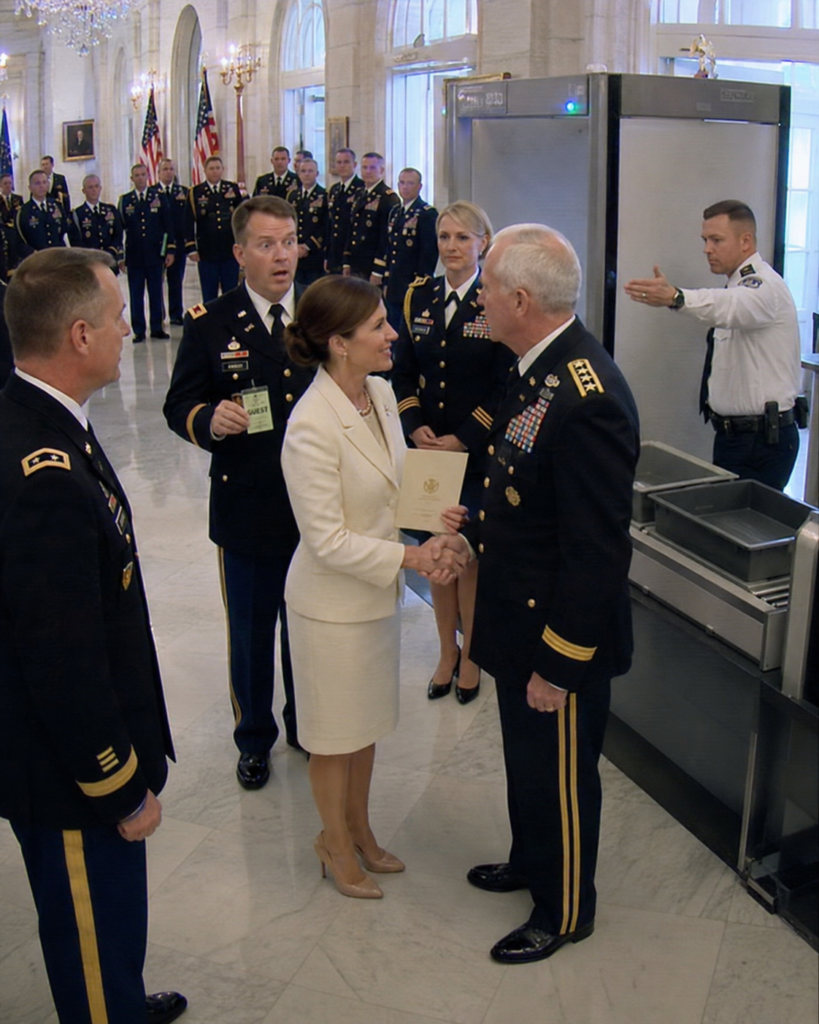
Lieutenant Colonel Evelyn Shaw said nothing.
Marcus had always interpreted her silence as agreement, partly because the truth would have required him to recognize the discipline behind it. He considered himself the visible soldier in their marriage: infantry assignments, command photographs, formal speeches, and stories involving difficult terrain. Evelyn’s work occurred inside secure planning centers, where success appeared as food arriving before shortages, hospital capacity expanding before casualties overwhelmed it, and aircraft landing at locations whose runways barely existed.
At the registration table, Marcus produced an embossed invitation.
“Colonel Marcus Hale, Army Futures Command, accompanied by spouse.”
The security officer scanned the code.
“Welcome, Colonel. Your assigned reception section is through the west corridor.”
Marcus smiled at Evelyn.
“Your guest credential should be in the smaller envelope.”
She opened her clutch and removed a second invitation printed on heavier paper. A red security stripe crossed the upper corner, and the seal belonged not to the reception office but to the National Security Council.
Marcus frowned.
“Where did you get that?”
Evelyn handed the envelope to the security officer.
The scanner produced a longer tone. The officer examined her military identification, straightened immediately, and turned toward a nearby brigadier general.
“Sir, Lieutenant Colonel Evelyn Shaw has arrived.”
General Adrian Cole crossed the entrance hall before Marcus could ask another question. He had supervised national emergency planning for several years and possessed the rare ability to silence a crowded space without raising his voice.
He shook Evelyn’s hand warmly.
“Colonel Shaw, the Secretary has been waiting to thank you personally. We were beginning to think you might avoid the ceremony altogether.”
“I considered it, sir.”
“Which is exactly why we added the security escort.”
Marcus stared between them.
“What ceremony?”
General Cole looked at him with polite surprise.
“The national resilience commendation, Colonel Hale. Your wife led the interagency operation being recognized tonight.”
The words seemed to reach Marcus slowly.
A uniformed aide approached Evelyn.
“Ma’am, your seat is in the front section beside the FEMA administrator and the Surgeon General. This way, please.”
Marcus stepped forward.
“She is attending with me.”
The aide answered carefully.
“Colonel Shaw has a separate principal invitation, sir. Your assigned section remains through the west corridor.”
For the first time that evening, Marcus looked at Evelyn without condescension. Confusion had replaced certainty, although he still expected her to explain herself and restore the hierarchy he understood.
She did not.
General Cole offered his arm toward the main hall.
“Shall we?”
Evelyn followed him beneath the chandeliers, leaving Marcus beside the registration desk with an unused spouse credential in his hand.
Part 2 – The Work He Reduced to Spreadsheets
The marriage had not always depended upon humiliation.
Evelyn met Marcus eleven years earlier during a joint logistics exercise at a training installation in Georgia. He was a newly promoted captain who admired her ability to redirect fuel convoys after a simulated bridge collapse. She admired his confidence, humor, and willingness to carry equipment when junior soldiers were exhausted.
During their first years together, Marcus introduced Evelyn as the smartest planner in any room. He asked her opinion before briefings and celebrated her promotions without comparing them to his own.
Then his career became more visible.
Marcus received battalion assignments, command photographs, and invitations to speak about operational leadership. His mother, Patricia Hale, treated every promotion as proof that her son belonged among the Army’s great commanders.
Evelyn’s responsibilities expanded as well, but much of her work remained classified or deliberately anonymous. She coordinated emergency medical supply networks, negotiated access to civilian transportation hubs, and designed contingency plans linking military units with state agencies.
Patricia called it clerical support.
During family dinners, she frequently asked Evelyn whether the Army still required officers to arrange warehouses personally.
“Marcus leads soldiers,” Patricia once said while serving dessert. “Evelyn manages boxes. Every marriage needs practical balance.”
Marcus laughed.
“She is the undefeated queen of color-coded spreadsheets.”
Everyone at the table joined him.
Evelyn smiled because discussing the real contents of those spreadsheets would have violated security restrictions. They mapped blood supplies, evacuation routes, portable water systems, and fuel reserves capable of sustaining communities after catastrophic infrastructure failure.
At first, Marcus’s jokes appeared careless rather than malicious. Eventually, repetition gave them purpose.
When Evelyn returned home after midnight, he asked whether she had spent another evening moving digital pallets. When secure calls interrupted dinner, he rolled his eyes and told friends that someone had probably misplaced a truck. At officers’ gatherings, he described her as a Pentagon desk specialist who had avoided the difficult side of service.
The contempt intensified after Evelyn received a temporary assignment to the National Continuity Coordination Cell. Marcus knew she worked eighteen-hour shifts and carried two secured phones, but he never asked what emergency required them.
That emergency arrived when a sequence of earthquakes struck the Pacific Northwest, damaging ports, rail lines, bridges, hospitals, and regional communication systems. Coastal communities lost access to fuel and medical supplies, while landslides isolated several mountain towns.
Evelyn became deputy director of Operation Harborline, an interagency response combining active-duty logistics units, National Guard aviation, Coast Guard vessels, federal emergency teams, civilian rail companies, and hospital networks across five states.
The planning room operated continuously for seventeen days.
Evelyn’s team converted commercial ferries into medical transport platforms, reopened an abandoned airfield for relief flights, and created mobile distribution corridors that adjusted whenever aftershocks blocked roads. When a children’s hospital lost generator capacity, her staff rerouted naval power equipment before the emergency batteries failed.
More than six thousand patients and vulnerable residents were evacuated without a fatal transportation incident.
Evelyn came home near dawn after the final major transfer.
Marcus sat in the kitchen drinking bourbon.
“Your legendary supply-chain emergency finally finished?”
She removed her coat.
“The immediate phase did.”
“Good. My mother’s retirement dinner is Saturday, and I need you presentable. She invited several people connected to the promotion board.”
Evelyn looked at him.
“Do you know where I have been for the past two weeks?”
“Inside a command center with excellent coffee and too many monitors.”
His answer carried no curiosity.
That evening, Evelyn understood that ignorance was no longer the problem. Marcus had chosen a version of her small enough to protect himself.
Part 3 – The Woman Called Forward
The presidential reception hall contained cabinet officials, senior military leaders, emergency-response directors, governors, rescue personnel, and families from the affected region. Large screens displayed images from Operation Harborline: washed-out roads, temporary medical hubs, helicopters landing beside flooded neighborhoods, and Coast Guard crews carrying patients through heavy rain.
Evelyn sat beside Dr. Marisol Grant, the federal public-health coordinator who had worked with her throughout the earthquake response.