The day they divided up my father’s estate, nobody used the word “fair.”
That would have made the room too honest.
My brother Michael got the house before the coffee in my mother’s mug had even gone cold. My sister Sarah got Dad’s old Tahoe because she said she “needed something dependable,” although she already had a leased Lexus parked in the driveway. My mother opened a little metal lockbox on the dining table and handed over savings passbooks, a stack of insurance folders, and the gold bracelets Dad had bought her back when he still had grease under his fingernails and hope in his chest.
She moved through it all with the calm efficiency of a woman sorting coupons.
And I sat on the edge of the couch like a guest who had arrived at the wrong address.
No one asked what I wanted.
No one asked what Dad would have wanted.
By the time my mother looked at me, the house was already spoken for, the vehicle was gone, the accounts had been “handled,” and the framed family photos had been stacked in piles with little sticky notes on them. Michael leaned back in Dad’s recliner—the one he used to complain smelled like machine oil—and crossed one ankle over his knee like he had been born there. Sarah stood by the fireplace taking pictures of the mantel clock for her husband, asking whether it was “actually antique or just old.”
Then my mother glanced toward the hallway and sighed.
“There’s the wardrobe in your father’s workroom,” she said. “If you want something.”
Something.
The way she said it, you would have thought she was offering me a broken toaster.
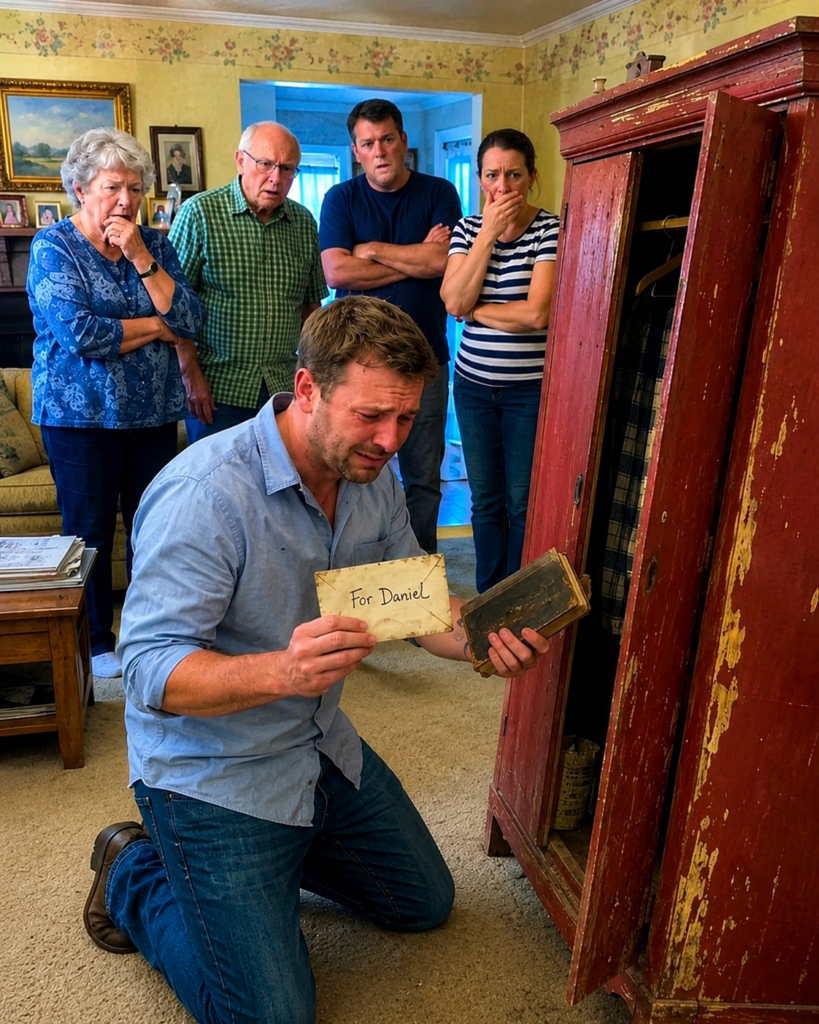
The wardrobe stood in the back room off the garage, where Dad used to keep tools, fishing rods, tarps, paint cans, and all the small stubborn things that made up a working man’s life. It was red, or had been once. Now the paint was chipped and peeling in strips, the left door hung a little crooked, and one back leg had been propped up for years with a brick wrapped in duct tape. It smelled faintly of sawdust, damp wood, and the peppermint lozenges Dad kept in his coat pocket.
Sarah laughed when she saw me looking at it.
“Oh, Daniel,” she said. “Please don’t tell me you’re actually taking that.”
Michael gave a low chuckle from the doorway. “Let him. He always liked rescuing junk.”
My mother didn’t laugh.
That was the first thing I noticed.
She stood behind them with one hand pressed against her stomach and the other gripping the frame of the door. Her mouth had gone tight on one side, the way it did whenever something didn’t move according to her plan.
For most of my life, my mother had never needed to raise her voice to make a room obey her. She could destroy a person with a church-lady smile and a sentence soft enough to put on a sympathy card. She called it keeping peace. In our family, keeping peace usually meant everybody else got what they wanted and I kept quiet about who paid for it.
I looked at the wardrobe again.
Dad had never let anyone touch it.
When we were kids, Michael once tried to stash fireworks inside it and Dad nearly took the door off the hinges getting him away from it. Sarah had borrowed a screwdriver from one of the drawers and forgotten to return it; Dad made her drive back from the mall to put it exactly where she found it. I was maybe nine when I reached inside for a hammer, and Dad tapped my wrist—not hard, just quick enough to stop me.
“Ask first,” he said.
I had sulked all evening.
Later that night, he came to my room with a powdered donut wrapped in a paper towel. That was Dad’s way of apologizing. He never used speeches when a donut would do.
He sat on the edge of my bed and said, “Some things aren’t valuable because they’re pretty, Danny. Some things are valuable because the wrong hands shouldn’t get to them.”
At nine years old, I thought he meant the hammer.
At forty-one, standing in the back room while my mother looked like she might be sick, I finally wondered if he had meant something else.
“I’ll take it,” I said.
Michael laughed harder.
Sarah rolled her eyes. “Of course you will.”
My mother’s face changed so quickly most people would have missed it. But I had spent the last three years watching expressions flicker across hospital rooms, pharmacy counters, and kitchen tables. I had learned to notice the tiny things people tried to swallow.
My mother was afraid.
Not sad. Not annoyed.
Afraid.
My uncle Ray helped me carry the wardrobe out.
Ray was Dad’s younger brother, though he looked older by then. He had the same broad hands, the same quiet manner, and the same way of measuring people before speaking to them. He had come after the funeral and stayed mostly silent through the division of the estate, standing near the front window with a paper cup of coffee, watching my mother pass out Dad’s life like party favors.
He didn’t say a word until he and I had the wardrobe halfway down the porch steps.
Then he grunted and said, “Good Lord, this thing’s heavy.”
It was.
An empty wardrobe with two loose doors and half-rotted panels should not have felt like a safe full of bricks. We eased it onto the moving blankets in the bed of my old pickup. Red paint flaked onto the faded blue blanket in little curls.
Michael stood in the doorway with his arms crossed.
“Careful, Danny,” he called. “Might be worth twelve bucks at a yard sale.”
Sarah’s husband, Brad, didn’t even look up from his phone. “Or landfill fees.”
My sister-in-law Denise smiled like she was being generous. “If it falls apart on the road, don’t bring it back here.”
I tied the straps tighter than necessary.
From the porch, my mother said, “Daniel.”
I turned.
For a second, I thought she might say something kind. Maybe grief had cracked something open in her. Maybe watching me take the only unwanted thing in the room had stirred some buried instinct.
Instead, she said, “You’ll need to clear out anything of your father’s before you throw it away. There may be old papers.”
Michael’s head snapped slightly toward her.
There it was.
Old papers.
I nodded once. “I’ll be thorough.”
Her fingers tightened around the porch railing.
I climbed into the truck with Ray beside me and pulled away from the house where I had grown up, the house my brother had just been handed like a reward for showing up at the end.
For the first five minutes, Ray didn’t speak.
We drove past the chain pharmacy where I had picked up Dad’s blood pressure medication every month. Past the diner where Dad used to order eggs over easy and pretend not to read the bill because he knew I was paying. Past the little brick church where the funeral ladies had set out ham sandwiches and lemon bars after the service, calling my mother “strong” while she accepted condolences with dry eyes.
Ohio looked ordinary that evening. July heat shimmered off the road. Sprinklers ticked across suburban lawns. A kid rode a bike in lazy circles around a cul-de-sac while somebody grilled hamburgers behind a privacy fence.
Nothing about the world seemed to know my father was gone.
Ray finally cleared his throat.
“Your dad loved that ugly red thing.”
“I know.”
“No,” he said. “I mean he loved it like a man loves a hiding place.”
I glanced over.
Ray kept staring out the windshield. “Your mother didn’t want you taking it.”
“I noticed.”
“She wanted you hurt enough not to look at it too closely.”
That landed in my chest with a weight I didn’t know what to do with.
I had been hurt. More than I wanted to admit. Not because of the house or the Tahoe or the bracelets. I had made peace long ago with not being the favorite. But there is a difference between knowing where you stand and watching everyone gather in a living room to prove it.
For three years, I had been the one who stayed.
I stayed through Dad’s first fall in the driveway, when Michael said he was “slammed at work” and Sarah said she couldn’t handle hospitals. I stayed when Dad forgot the stove on and burned a saucepan black. I stayed when he got embarrassed about needing help in the bathroom and told me to leave him alone, then cried five minutes later because he had never wanted his son to see him weak.
I filled pill organizers. I called insurance companies. I argued with billing departments. I learned which nurses were gentle and which ones needed to be watched. I used vacation days, sick days, unpaid days. I changed the air filter in the house, mowed the back strip when the weeds got tall, and paid for a new refrigerator when the old one died because Mom said the timing was “so unfortunate.”
Michael visited on holidays and called himself practical.
Sarah brought flowers when there were people watching.
Mom told everyone she was exhausted.
And now they had divided everything without even pretending to count me.
Ray shifted in the passenger seat.
“Don’t pick a fight tonight,” he said. “Not until you know what you’ve got.”
“You think there’s something inside?”
“I think your father was stubborn, private, and a lot smarter than people gave him credit for.”
That sounded like Dad.
We reached my apartment complex just after dusk. It was a low brick building outside Columbus, the kind with cracked sidewalks, shared laundry, and parking spots nobody respected. My unit was on the ground floor. Two rooms, a narrow kitchen, a bathroom with a fan that rattled like a lawn mower, and enough independence to make it feel like a mansion.
Ray and I wrestled the wardrobe inside, inch by inch. It scraped the doorframe and shed red paint across the threshold. By the time we shoved it against the spare room wall, both of us were sweating through our shirts.
Ray stood with his hands on his hips, breathing hard.
“Your dad ever tell you why he kept this?”
“No.”
“He wouldn’t,” Ray said. “Your dad believed secrets were like tools. Only useful if you knew when to pull them out.”
I looked at the wardrobe.
In the dim light of my spare room, it seemed less ridiculous than it had at my parents’ house. Crooked, yes. Worn out, yes. But solid in some hidden way. Like it had survived the people around it on purpose.
Ray put one hand on my shoulder.
“Call me before you call them,” he said.
Then he left.
For a while, I just stood there in the quiet.
Outside, someone’s television mumbled through the wall. A car alarm chirped twice in the parking lot. My refrigerator kicked on with a tired hum.
I opened the left door first.
Two bent wire hangers. A mesh bag of mothballs so old it had turned gray. A rolled-up tarp. A cracked yardstick from a hardware store that closed when I was in high school.
The right door stuck. I pulled once, twice, then braced my foot and yanked. It gave with a groan.
Inside were drawers.
Dad’s drawers.
The first held nails sorted into baby food jars, each lid labeled in black marker. The second held Home Depot receipts going back more than a decade, folded into rubber-banded stacks. The third had pocketknives, electrical tape, a tape measure, a broken watch, a box of old keys, and a photograph of me at twelve years old holding a stringer of bluegill at Buckeye Lake.
I sat back on my heels.
He had kept that picture.
Not Michael’s football trophy. Not Sarah’s graduation portrait.
Me, sunburned and grinning with fish slime on my shirt while Dad’s shadow fell across the dock.
I put the photograph on the floor beside me and kept going.
The bottom drawer wouldn’t come out all the way.
It slid about six inches, then stopped with a hard wooden knock.
I tugged again.
Nothing.
At first I thought the track was warped. Then I noticed the depth. The drawer was shorter than the others by nearly four inches.
My heart started to beat harder.
I grabbed my phone, turned on the flashlight, and aimed it along the inside panel. There, hidden under dust and shadow, was a seam. Too straight to be accidental.
I removed the drawer completely from its track and reached into the dark space behind it.
My fingers touched paper.
Then metal.
Then cloth.
One by one, I pulled them out.
A thick yellow envelope.
A small brass key wrapped in black electrical tape.
A thin ledger notebook with frayed edges.
A second envelope, sealed with packing tape and marked in Dad’s blocky handwriting:
FOR DANIEL. ONLY DANIEL.
I sat down hard on the floor.
For a full minute, I couldn’t open anything.
Dad’s handwriting did it. The sight of my name in those uneven letters broke through every wall I had built around the funeral, the will, the polite cruelty of the living room. My father had been gone for eight days. Until that moment, I had been too busy being useful to grieve.
I opened the first envelope.
Inside was one sheet of notebook paper, folded twice.
Danny,
If you’re reading this, then I’m gone and your mother has done what I was afraid she would do.
I am not leaving you this wardrobe because it is all you deserve. I am leaving it to you because you are the only one who ever understood the difference between something old and something useless.
You stayed when staying was ugly. You showed up when nobody wanted to smell the hospital, hear the coughing, or sit in waiting rooms with vending-machine coffee. You never made a speech about it. You just did it.
That counts.
Your mother has spent years saying family doesn’t keep score. She only says that because the score favors everybody but you.
I kept records. Not to punish them. To tell the truth when I couldn’t make anyone listen.
Read the black book. Then take the larger envelope to Mr. Henderson or to the county recorder. Do not hand it to your mother. Do not let Michael “look it over.” Do not let Sarah cry you into giving it back.
And remember this: peace is not the same as surrender.
Dad
I read it once.
Then again.
Then a third time, slower.
By the time I opened the black ledger, my hands were shaking.
The notebook was filled with dates, names, amounts, and short notes in Dad’s handwriting.
Loan to Michael for down payment: $10,000. Repaid: $0.
Sarah’s nursing school tuition balance paid from joint savings: $3,500.
Michael legal fee after DUI: $1,200. Family account. Never discussed.
Sarah’s Tahoe tires: $842. Said she would pay back after tax refund. Did not.
Daniel replaced refrigerator: $617. He told me not to note it. Noting it.
Daniel paid hospital parking for three months. Approx. $380. Would not accept reimbursement.
Daniel took unpaid leave after second surgery. I asked if he needed help. He said no. He lied.
There were pages of it.
Years of numbers that had been blurred, softened, and buried under my mother’s favorite sayings.
We don’t talk about money in this family.
Your brother has children.
Your sister is under pressure.
You’re single, Daniel, you don’t understand.
Be the bigger person.
Dad had understood.
He had seen every dollar, every excuse, every little imbalance dressed up as love. He had seen me standing in the kitchen after work, fixing the garbage disposal while Michael watched a game in the living room. He had seen Sarah call crying about a bill, then post pictures from a beach weekend three days later. He had seen my mother use guilt like a household tool.
I turned the pages until I reached one marked with blue painter’s tape.
At the top, Dad had written:
THE BACK LOT.
Behind my parents’ house was a long strip of land that ran past the garage, beyond the crabapple tree, and down to the chain-link fence near the old drainage ditch. To us, it had always been “the back.” As kids, we built forts there out of pallets. Dad stored scrap metal, spare tires, and a rusted-out boat trailer under a blue tarp. Mom hated it. She called it an eyesore.
But in the last few years, the neighborhood had changed.
The commercial avenue two blocks over had widened. A coffee chain went in. Then a dental office. Then a storage facility. Men in polos started leaving glossy flyers in mailboxes: WE BUY LAND. CASH OFFERS. QUICK CLOSING.
Michael had suddenly become very interested in Dad’s “junk.”
I opened the second envelope.
Inside were certified copies of county records, a deed, a transfer-on-death designation affidavit, tax parcel maps, and a letter from an attorney dated six months before Dad’s final hospital stay.
The back lot was not part of the main house.
Dad had purchased it separately years earlier with money from a workplace injury settlement, before the neighborhood had filled in around it. The parcel had its own number, its own tax record, and its own legal description.
And Dad had transferred it to me.
Not promised it.
Not mentioned it.
Recorded it.
My name was there in black ink.
Daniel Robert Whitaker.
I stopped breathing for a second.
The room seemed to tilt.
I read the documents again, looking for the catch. There had to be one. In my family, good news for me usually arrived with a bill attached. But the more I read, the clearer it became. Dad had done it properly. Quietly, stubbornly, and legally.
The old brass key was for a safe-deposit box at a credit union on the west side.
Taped to it was another note.
Don’t let them make you feel greedy for accepting what I chose to give you. They were never embarrassed taking from you. You don’t need to be embarrassed receiving from me.
I sat there on the spare room floor until the light outside went dark.
Then my phone rang.
Mom.
I watched it buzz until it stopped.
A minute later, Sarah called.
Then Michael.
Then Mom again.
At 7:14 the next morning, Sarah tried a text.
Mom says she may have left some old insurance papers in that wardrobe. Michael can swing by and get it so she doesn’t worry.
At 7:18, Michael texted.
Don’t make this weird. It’s Dad’s stuff. We handle it as a family.
I laughed then.
Not because it was funny.
Because the nerve of it had become almost beautiful.
As a family.
When Dad needed rides to chemo, we were not a family. When the insurance company denied a claim, we were not a family. When I was eating dinner from a vending machine at 10 p.m. in a hospital hallway while Michael took his kids to Disney and Sarah said illness “triggered her anxiety,” we were not a family.
But now that there might be papers in an ugly red wardrobe, suddenly everybody wanted a family meeting.
I called Ray first.
He answered on the second ring.
“You found something,” he said.
“Yes.”
“How bad?”
“For them?”
A pause.
Then Ray said, “I’ll make coffee.”
At four that afternoon, Ray took me to see Mr. Henderson.
Mr. Henderson had been Dad’s friend for thirty years. He had once been an attorney, though by then he spent most of his days on his porch in a Cleveland Guardians cap, drinking coffee strong enough to strip paint. His small ranch house smelled like lemon cleaner, old books, and the menthol ointment he rubbed on his knees.
He read everything slowly.
Not dramatically. Not like television.
He put on his glasses, took them off, cleaned them with the hem of his shirt, put them back on, and read again. He checked the parcel number against a county records website on an ancient desktop computer that took forever to load. He printed something. Compared signatures. Looked at the notary stamp.
At last, he leaned back.
“Your father knew exactly what he was doing.”
My throat tightened. “It’s real?”
“It’s recorded,” Henderson said. “That matters more than real in county government.”
Ray let out a low whistle.
Henderson tapped the paper. “Your brother can have the house. But he does not own that back parcel. If he tries to sell the whole property as one piece, this stops him cold.”
I looked down at the map.
The back lot, the junk strip, the useless eyesore, was nearly half an acre.
Henderson smiled faintly. “And based on what’s happening on that road, I’d say your father left you something your brother wanted very badly.”
I thought of Michael sitting in Dad’s recliner, smirking while Mom handed him the house.
“He knew?”
Henderson’s expression changed. “Your father came to me after Michael brought a developer to the house without telling him.”
The air went still.
“What?”
“About seven months ago,” Henderson said. “Your dad called me furious. Said Michael had been walking a man in polished shoes around the back fence, talking about access and frontage like he owned the place. Your father could barely stand by then, but he saw them from the kitchen window.”
Ray muttered something under his breath.
Henderson continued. “Your father asked me what would happen if he died and your mother handed everything to Michael. I told him the cleanest protection was to make sure the separate parcel had its own recorded designation. He said, ‘Good. Put Danny’s name on it.’”
My eyes burned.
I turned away and pretended to study a framed photo of Henderson holding a walleye.
For three years, I had wondered whether Dad noticed.
The answer was sitting in a folder on an old lawyer’s desk.
He had noticed everything.
Henderson gave me three instructions.
First, make certified copies.
Second, do not meet my family alone.
Third, file a notice with the county that any attempted sale involving the back parcel required contact with me directly.
“People like your brother count on speed,” Henderson said. “They rush, bully, confuse, and then call it done. Slow them down. Paper beats volume.”
That evening, I came home with a folder under my arm and found Michael waiting by my apartment door.
He was dressed for intimidation in the way men like him dress when they don’t want to admit that is what they’re doing—pressed polo, expensive watch, truck keys in hand, sunglasses hooked at his collar. He looked too large for the hallway, too clean for the chipped paint and stained carpet outside my unit.
“You’ve been dodging calls,” he said.
“I’ve been busy.”
“Mom is upset.”
“She’ll recover.”
His jaw tightened. “Don’t be cute.”
I slid my key into the lock but did not turn it. “Why are you here, Mike?”
“You know why.”
“I’d rather hear you say it.”
He looked down the hallway as if expecting witnesses. “Mom left documents in the wardrobe.”
“What kind of documents?”
His eyes hardened. “Don’t play games.”
“Funny,” I said. “Yesterday it was garbage. Today it’s important enough for you to stand outside my apartment.”
He stepped closer.
Once, that would have worked.
Michael had spent our childhood using his body like an argument. He was bigger, louder, quicker to anger, and protected by our mother’s endless explanations. He didn’t mean it. He’s under pressure. You know how your brother gets. Don’t provoke him.
But grief does strange things to fear.
Sometimes it hollows you out.
Sometimes it leaves room for a backbone.
I looked him in the eye and said, “The back lot is mine.”
His face changed.
Only for half a second.
But enough.
“You have no idea what you’re talking about,” he said.
“I have the recorded documents.”
“You have copies of something Dad probably didn’t understand.”
“Dad understood plenty.”
Michael gave a short laugh. “Dad was sick.”
“He was sick,” I said. “He wasn’t stupid.”
Down the hall, the outside door opened.
My mother came in holding her purse tight against her ribs.
She had put on lipstick.
That detail made me angrier than it should have. She had dressed for this like it was church, like clean shoes and a cardigan could make the ambush respectable.
“Daniel,” she said softly. “We need to talk.”
“No,” I said. “You need to explain why you tried to give Michael land that didn’t belong to you.”
Her eyes flicked toward Michael.
There it was again. Fear.
Not surprise.
Fear.
So she had known.
Maybe not all of it. Maybe not every legal detail. But she had known enough to be scared when I chose the wardrobe.
My mother lowered her voice. “This is not a conversation for a hallway.”
“It wasn’t a conversation at all yesterday.”
“That was different.”
“How?”
She inhaled. “Your father left me to make decisions.”
“Dad left recorded documents.”
Her mouth tightened. “Your father was not himself at the end.”
That sentence hit harder than I expected.
Not because I believed it.
Because I understood what she was doing.
She was reaching into the grave and trying to make him smaller.
My father, who had counted pills with trembling fingers because he didn’t want to be a burden. My father, who apologized to nurses for needing help. My father, who wrote my name in a wardrobe because he knew the living might lie after he was gone.
I opened my apartment door and stepped inside.
“You both need to leave.”
Michael put his hand against the door before I could close it. “This isn’t over.”
“No,” I said. “It isn’t.”
The next morning, I went to the county recorder’s office.
Not the dramatic courthouse kind with marble pillars and television cameras. Just a beige county building with metal detectors, scuffed tile, and clerks who had seen enough family disasters to stop reacting to them. A woman behind the glass took my paperwork, checked my ID, and stamped copies with a rhythm that sounded like a judge’s gavel.
I filed everything Henderson told me to file.
Then I went to the credit union.
The safe-deposit box was small.
Inside was another envelope, a flash drive, and a cashier’s check made out to me for $4,800.
The letter said:
Danny,
This is what I managed to put aside after selling the old Camaro parts and some tools your mother thought I gave away. It is not enough to repay you. It is enough to remind you that I knew you were spending money you never mentioned.
There is also a copy of the first offer Michael got for the back lot. He never brought it to me. I found it in the trash after your mother tried to tear it up.
Do not let them tell you this land is worthless.
Dad
The offer was from a development company.
$186,000.
For the “rear parcel and access rights.”
Dated eleven months before Dad died.
I sat in the little private booth at the credit union, surrounded by beige walls and the smell of printer toner, and laughed until my eyes filled.
Not because of the money.
Because Michael had called the wardrobe junk.
Because Sarah had mocked me for taking it.
Because my mother had tried to hand me the one thing in the house she thought she could shame me into refusing, not knowing Dad had turned her cruelty into a delivery system.
For the first time since the funeral, I felt something other than grief.
I felt awake.
By Friday, the family meeting happened.
Not at my mother’s house.
Not in Dad’s living room, where Michael could sit in the recliner and pretend the walls voted for him.
I insisted on Mr. Henderson’s office, though he called it “an office” generously. It was a room behind his nephew’s tax preparation business, with a conference table, a humming window AC unit, and a bowl of butterscotch candies near the door.
My mother came first.
She wore navy blue and pearls, funeral-adjacent but not quite. Sarah arrived behind her, already teary. Michael came last, carrying a folder he never opened.
Ray sat beside me.
Henderson sat at the head of the table.
For a moment, everyone performed civility.
“Daniel,” Sarah said, “I just hope we can all remember Dad wouldn’t want us fighting.”
I looked at her. “Dad wrote down exactly what he wanted.”
She blinked.
Michael leaned forward. “Let’s not act like a sick man’s private notes are the same as a legal plan.”
Henderson folded his hands. “They are not the same. Fortunately, we have both.”
The room went quiet.
He laid out the documents one by one.
The parcel map.
The deed.
The recorded transfer designation.
The tax record.
The prior developer’s offer.
The ledger.
When the ledger came out, my mother’s face went gray.
Sarah saw her name near the top and reached for it. Henderson gently moved it back.
“That is a copy,” he said. “You may read it after Daniel has finished.”
Sarah’s tears disappeared.
Michael stared at the table.
Henderson spoke in a calm voice, which made everything worse for them.
“The back parcel passed to Daniel outside the general distribution you discussed at the house. It is not part of the residence transfer to Michael. Any attempt to sell, encumber, or represent that parcel as Michael’s property would create legal problems none of you want.”
My mother pressed a hand to her chest. “I never meant—”
“Yes, you did,” Ray said.
Everyone looked at him.
Ray had barely spoken all week. Now his voice filled the room like weather.
“You meant to give Michael the house, Sarah the car, and Daniel the insult. You meant to watch him carry out that wardrobe like a fool so you could feel finished with him. Don’t sit here and dress it up.”
My mother’s lips parted.
Ray looked at Michael. “And you knew about that offer.”
Michael’s face darkened. “Stay out of this.”
“I was your father’s brother before you were his disappointment.”
The words landed so hard even Henderson looked down at his papers.
Sarah turned on Michael. “What offer?”
Michael didn’t answer.
That was answer enough.
My mother whispered, “It wasn’t final.”
I stared at her.
There it was.
Not confusion.
Not innocence.
Calculation.
“You knew,” I said.
Her eyes filled, but the tears looked practiced. “Daniel, your brother has a family. Children. A mortgage. You’ve always been more independent.”
Independent.
That old word.
The family word for alone.
I nodded slowly. “So because I didn’t drain Dad while he was alive, I didn’t deserve anything after he died?”
“That is not what I said.”
“It’s what you built a whole system around.”
Sarah’s voice sharpened. “We all loved Dad.”
“I didn’t say you didn’t.”
“You’re acting like you’re the only one who suffered.”
“No,” I said. “I’m acting like I’m done being the only one who is expected to suffer quietly.”
Michael slapped his palm on the table. “Enough. What do you want?”
There it was.
The first honest question anyone had asked me.
I looked at him, then at Sarah, then at my mother.
“I want the house cleared of anything Dad specifically marked for me. I want every document related to that developer offer. I want the keys to the back fence. I want written acknowledgment from all three of you that the back parcel belongs to me and was never yours to distribute.”
Michael scoffed. “And if we don’t?”
Henderson answered before I could.
“Then Daniel files a civil action, notifies the developer that Michael misrepresented ownership, and asks the court to preserve all estate-related documents. That would include financial records.”
My mother closed her eyes.
Sarah whispered, “What financial records?”
Nobody answered her.
That afternoon did not end with hugs.
Real life rarely does.
There was no sudden apology that fixed forty years. No dramatic collapse. No mother reaching across the table and admitting she had loved unevenly because she was scared or selfish or broken in ways that deserved understanding.
Instead, Michael signed with a hand so tense the pen dug into the paper.
Sarah signed after reading every line twice.
My mother signed last.
When she finished, she looked at me with an expression I had spent my whole life trying to avoid. Disappointment, sharpened into accusation.
“You’ve changed,” she said.
For once, I did not defend myself.
“I hope so.”
Two weeks later, I stood behind the house with a surveyor.
The back lot looked different once it had orange flags in the ground.
Still overgrown. Still cluttered. Still holding the rusted ribs of Dad’s old projects. But now I could see its shape, its borders, the way it opened toward the service road behind the new shopping strip. What everyone had called junk was actually access. What everyone had called an eyesore was leverage.
Michael watched from the deck.
He had not spoken to me since the meeting except through short, bitter texts.
Sarah sent one long message about how hurtful the ledger was and how Dad “must have been in a dark place” to write those things down. I didn’t answer. There are some messages people send not because they want peace, but because they want the last bruise.
My mother avoided me entirely until the day I came for Dad’s marked belongings.
She had placed them in cardboard boxes near the garage.
Not all of them.
Of course not.
I found his fishing photo album missing, along with a coffee can of old pocket watches he had labeled Danny someday.
When I asked, she said, “I don’t know what you’re talking about.”
I walked past her into the workroom.
The shelf was dusty, but the empty circles told the truth.
I took pictures.
Then I called Ray, who called Henderson, who called my mother with a sentence simple enough to end the performance.
By dinner time, the watches and photo album were on my apartment doorstep in a grocery bag.
No note.
That suited me.
The developer came back in September.
Not the same man Michael had tried to sneak around Dad’s yard. A different representative this time, a woman named Claire who wore practical heels and carried a binder thick enough to choke a printer. She met me at a diner off the main road, the kind of place where retirees drink coffee for two hours and waitresses call everyone honey without sounding fake.
She made an offer.
A better one.
Not life-changing in the way lottery commercials promise, but enough to change the shape of my life. Enough to pay debts. Enough to move out of the mildew apartment. Enough to put money aside and breathe without calculating every tank of gas.
I didn’t say yes right away.
Dad had taught me that too.
Never let the first number see you sweat.
I hired a real estate attorney Henderson trusted. I negotiated access terms. I made sure Michael could not profit from pretending his driveway mattered more than it did. I preserved the crabapple tree line Dad had planted because some things are not for sale, even when everything has a price.
When the final agreement came, I drove to the cemetery before signing.
Dad’s grave still looked too new.
The grass had not fully filled in. The temporary marker had been replaced with a modest stone my mother chose without asking anyone. His name, his dates, BELOVED HUSBAND AND FATHER.
I stood there with the folder under my arm and the old brass key in my pocket.
For a while, I said nothing.
Then I told him everything.
About the wardrobe.
About the ledger.
About Michael’s face when Henderson said recorded.
About Sarah suddenly wanting feelings once numbers appeared.
About Mom using the word independent like a punishment.
A breeze moved through the cemetery trees. Somewhere nearby, a mower droned over the hill. Life kept making ordinary sounds around grief. That still felt rude to me, but less surprising.
“I’m signing it,” I said finally. “Not because they made me. Not because I’m running. Because you gave me a way to stop begging them to see me.”
I touched the top of his stone.
“Thank you for seeing me first.”
I signed the papers the next day.
A month later, Michael put the house on the market.
He had to disclose the parcel boundaries. He had to explain why the back lot was not included. He had to accept less than he expected because the property was not the development prize he had bragged about to Denise’s relatives.
I know because Denise told Sarah, and Sarah told my cousin, and my cousin told Ray, and Ray told me while pretending he didn’t enjoy it.
My mother moved into a condo near Sarah.
She never apologized.
But she did call once, near Thanksgiving.
I almost didn’t answer.
When I did, she spoke in the careful voice she used when other people might be listening.
“I suppose you won,” she said.
I looked around my new house.
It wasn’t large. A small brick ranch with a covered porch, a maple tree out front, and a garage Dad would have loved. The red wardrobe stood in the spare room, cleaned, repaired, and polished just enough to keep its scars. I had replaced the broken leg but left the old paint as it was, worn down in places where Dad’s hands had opened it for years.
“No,” I said. “Dad told the truth. That’s different.”
She was silent.
Then she said, “You didn’t have to embarrass the family.”
I almost smiled.
Even after everything, she still thought the embarrassment was the truth coming out, not the years spent burying it.
“I didn’t embarrass the family,” I said. “I stopped protecting the lie.”
She hung up.
That Thanksgiving, I didn’t go to Sarah’s.
No one invited me until the last minute, which is not an invitation. It is a test.
Instead, Ray came over with a pie from the grocery store and a cooler full of beer. We roasted a small turkey, burned the rolls, and ate at my kitchen table with the Cowboys game on low in the living room even though neither of us cared who won.
After dinner, Ray stood in the spare room looking at the wardrobe.
“You fixed it up nice,” he said.
“Dad would’ve complained I sanded too much.”
“He complained when air moved.”
I laughed.
Ray opened one of the drawers and ran his fingers over the inside edge. “He knew what he was doing.”
“Yes,” I said. “He did.”
After Ray left, I sat alone for a while with a cup of coffee and the ledger open on the table.
I no longer read it for proof.
I had enough proof.
I read it because between the numbers, Dad had left me a second story. A quieter one. Not just who took what, but who noticed. Who cared. Who watched the son no one celebrated and wrote his name down anyway.
On the last page, in smaller handwriting, Dad had added one final line.
Daniel stayed.
That was all.
Not a speech.
Not a blessing.
Just two words and my name.
For most of my life, my family had treated staying like weakness. Like I stayed because I had no better place to be. Like loyalty was something they could spend until nothing was left.
But Dad knew better.
Staying had cost me.
Leaving would have cost me too.
In the end, he didn’t give me the red wardrobe because it was all that remained.
He gave it to me because it was the only thing in that house strong enough to carry the truth out with me.
And every morning now, when sunlight comes through the spare room window and touches that chipped red paint, I think about my mother standing on the porch, afraid of what I might find.
I think about Michael laughing.
I think about Sarah calling it junk.
Then I make my coffee in my own kitchen, unlock my own front door, and walk into a life they did not get to divide.
Not because they allowed it.
Because my father, quiet as ever, had left me the one inheritance they never expected.
A record.
A warning.
And a way out.