“Those medals are fake,” Mason Whitaker told the court.
He said it like a man who had been waiting years to finally use those words in public.
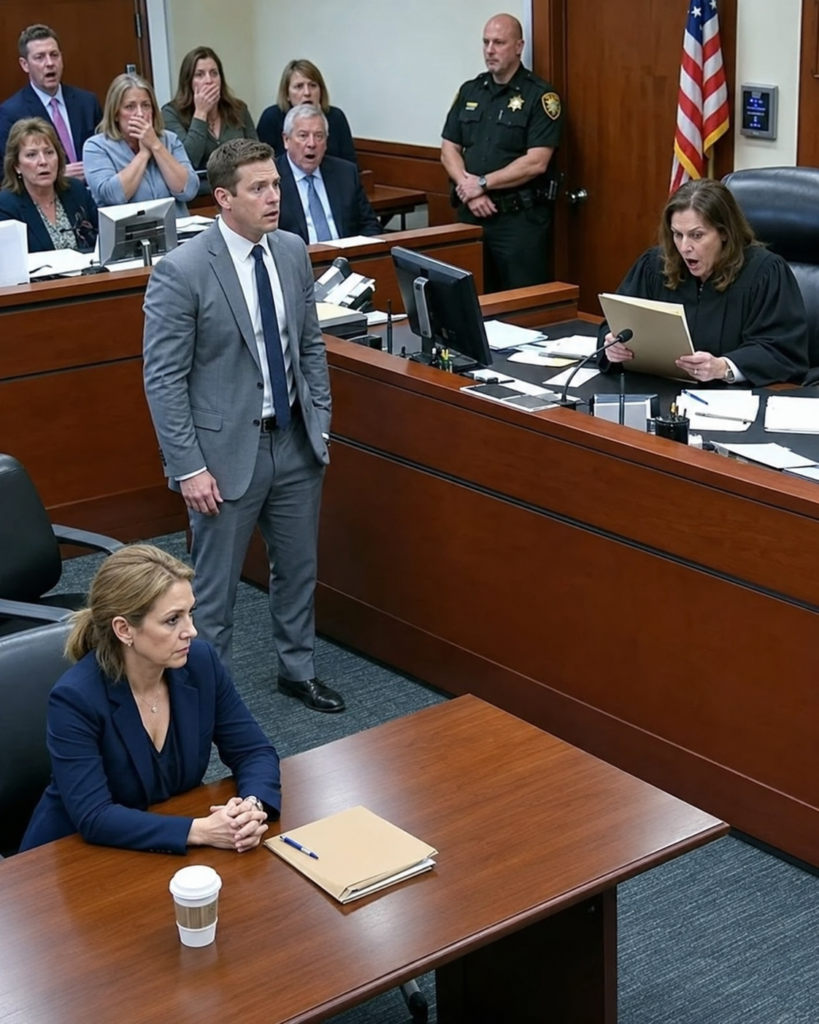
His voice carried through the Fairfax County family division courtroom, smooth and practiced, bouncing off the wood paneling and the rows of benches where strangers sat pretending not to listen too closely.
Image
The air smelled like floor polish, printer toner, and old paper.
The lights above us hummed softly, the kind of sound you only notice when your whole body is trying not to react.
I sat alone at the defense table with a black folder in front of me and an empty chair beside me.
That empty chair was supposed to belong to my lawyer.
It did not.
Mason stood across the room in a charcoal suit, one hand pressed against his chest as if his heartbreak needed staging.
My mother had probably paid for the suit.
She had always liked Mason better when he looked like someone who could still be saved.
“My sister, Erin Whitaker, has built a life on lies,” he said.
His attorney stood near him, chin lifted, hands folded around a legal pad.
“She claims military service, combat injuries, classified assignments,” Mason continued. “But we found no public record that proves any of it.”
Behind him, his witnesses nodded.
Two of Mason’s friends sat in the second row, both men I had seen at family cookouts, both men who had accepted beers from my grandfather under the shade tree in his backyard.
A former coworker of Mason’s sat beside them, looking serious and useful.
Then there was my aunt Denise, who had not spoken to me in eight years but apparently remembered everything she needed to remember once Mason’s attorney called.
My parents sat behind all of them.
My mother smiled into her lap.
My father stared straight ahead, calm and pleased, as if the courtroom itself had finally agreed with him.
They were not there because they wanted the truth.
They were there because they wanted my house.
The house was in Arlington, though “house” never felt like enough of a word for it.
It had a narrow driveway, an old porch rail that needed sanding, and a cracked front step my grandfather refused to repair because he said it kept salesmen from stepping too close.
There was a small American flag by the porch every Memorial Day, not because my grandfather was showy, but because he had believed memory was something you did with your hands.
He had left the house to me in a private trust before he died.
Not to Mason.
Not to my parents.
To me.
That decision had reopened every wound my family had spent years pretending was scar tissue.
Mason had debts.
My parents had excuses.
I had finally stopped writing checks.
For years, I had been the one who wired money when Mason’s car got repossessed, the one who covered the emergency dentist bill, the one who paid my mother’s mortgage shortfall after Mason borrowed against her good sense.
I never posted about it.
I never held it over anyone.
I just paid what I could and went back to the life they accused me of inventing.
Family only calls you selfish when your money stops moving in their direction.
The moment you stop rescuing someone, they start calling your boundaries proof that you were cruel all along.
Mason’s claim was simple enough to make strangers believe it.
He said I had manipulated our grandfather with false military stories.
He said I had used fake medals, fake injuries, fake classified assignments, and fake grief to isolate an elderly man.
He said the trust should be invalidated.
He said the house should return to the family.
By “family,” he meant himself.
The first sign that the day would not go the way anyone expected came before the hearing even began.
My lawyer did not arrive.
At 8:43 a.m., I checked my phone.
No message.
At 8:57 a.m., I called his office.
Voicemail.
At 9:05 a.m., the clerk called our case.
At 9:12 a.m., Judge Kathleen Monroe looked down from the bench over her glasses and said, “Ms. Whitaker, your counsel is absent. Do you wish to request a continuance?”
Before I could answer, Mason’s attorney stood.
“Your Honor, we oppose delay. Ms. Whitaker has had ample time.”
Mason looked at me then.
He almost smiled.
It was the same almost-smile he used when we were kids and he knew my father would blame me for something he had broken.
I looked at the empty chair beside me.
The legal pad was untouched.
The pen rested diagonally across the page.
My paper coffee cup from the courthouse lobby sat near my black folder, the lid dented where my thumb had pressed into it too hard.
Then I looked at Mason.
“No continuance,” I said.
A small sound moved through the room.
Not loud.
Just enough for me to know they had all heard me choose to stand there alone.
My mother’s smile sharpened.
Aunt Denise turned her head slightly toward Mason, like they had both just watched me step into a trap.
Mason’s attorney began with photographs.
Large prints of my living room.
Large prints of my shadow box.
Medals, ribbons, unit patches, coins, and small folded flags of memory that were never meant to become courtroom exhibits.
He held up one photograph so the judge could see it.
“This display, Your Honor, was presented to the decedent as proof of Ms. Whitaker’s alleged service.”
Alleged.
That word sat in the room like a stain.
He called the medals props.
He called the citations unverifiable.
He called my silence suspicious.
He said I had refused to answer reasonable family questions.
He said my privacy was calculated deception.
Every word landed, and I let it.
For one ugly heartbeat, I wanted to stand up and tell them what silence really costs.
I wanted to tell Mason what it felt like to wake up years after deployment and still listen for a sound that was not there.
I wanted to tell my parents that classified did not mean imaginary.
I wanted to ask my mother whether she had smiled like that when my grandfather signed the trust.
Instead, I kept my palms flat on the table and watched the judge’s pen move.
Restraint is not weakness.
Sometimes restraint is the only part of you nobody else gets to own.
Then Mason took the stand.
He adjusted his jacket before he sat down.
He placed one hand on the arm of the witness chair and took his oath with the solemn face of a man who had never feared consequences.
His attorney asked him how long he had known me.
“All my life,” Mason said.
The answer made a few people smile softly, the way courtrooms sometimes do when family history gets dressed up as credibility.
His attorney asked what changed after I came home.
Mason looked down, shook his head, and sighed.
“She disappeared for years,” he said. “Then she came back acting superior.”
My father nodded.
“My parents were afraid of her temper,” Mason added.
My mother lifted her tissue.
The tissue was clean.
“She used fake medals to pressure my grandfather,” Mason said. “He was vulnerable. She knew exactly what to say to him.”
Judge Monroe made a note.
Mason’s attorney stepped closer.
“In your opinion, did your sister manipulate your grandfather into leaving her the Arlington property?”
“Yes,” Mason said.
“Based on what?”
“Her lies,” he said. “The medals. The stories. The whole act.”
He did not look at me when he said it.
That was how I knew he was still afraid of one thing.
Not the law.
Not the judge.
Me.
Not because I had ever harmed him.
Because somewhere underneath the debt, the performance, and our parents’ permission, Mason knew there was a version of the truth he had never bothered to learn.
His witnesses followed.
One friend claimed he had heard Mason “ask normal questions” about my service and said I became hostile.
The former coworker said Mason had been worried for years.
Aunt Denise said I had always been secretive.
That one almost made me laugh.
Aunt Denise had once forgotten my birthday three years in a row, but suddenly my silence had become a lifelong pattern.
The courtroom froze around their confidence.
A woman in the back row stopped clicking her pen.
The bailiff’s hand rested still on the rail.
Mason’s attorney kept his face composed, but one of Mason’s friends shifted his knee away from the aisle, as if physical distance could keep him clean if the room changed direction.
Nobody looked at the shadow box photos anymore.
Nobody wanted to be caught choosing the wrong side too early.
Judge Monroe finally turned toward me.
“Ms. Whitaker,” she said, “do you have any evidence to present?”
I opened the black folder.
The sound of the folder cover lifting was small.
Somehow, everyone heard it.
“I do, Your Honor,” I said.
My voice did not shake.
“Some of it is sealed. Authorization for judicial review was granted this morning by the Department of Defense liaison’s office.”
Mason’s smile weakened.
His attorney turned his head just slightly.
My father stopped blinking.
I removed the certified packet and laid it on the table.
There were service records.
Promotion orders.
Deployment confirmations.
A Purple Heart citation.
A Bronze Star citation.
And one sealed personnel summary marked for court eyes only.
At 7:46 a.m. that morning, the liaison’s office had confirmed the judge could review the sealed summary in chambers and on the bench under restricted handling.
At 8:18 a.m., the clerk had logged the authorization.
At 8:31 a.m., the certified packet had been received.
I had not been waiting for my lawyer to save me.
I had been waiting for Mason to say the lie under oath.
The bailiff carried the folder to the bench.
Judge Monroe opened it.
The first page was ordinary enough.
Name.
Service number.
Dates.
Then her eyes moved lower.
Her expression changed.
Not dramatically.
Judges do not need theater.
Her face simply became still in a way that made Mason’s attorney straighten.
She turned one page.
Then another.
The courtroom seemed to shrink around the sound of paper moving.
My mother lowered the tissue from her face.
Mason leaned toward his attorney.
“What is that?” he whispered.
His attorney did not answer.
Judge Monroe reached the sealed page and paused.
That pause frightened Mason more than any argument I could have made.
The judge’s thumb held the corner of the paper.
Her eyes moved across the top line once.
Then again.
Slower.
My father’s face went pale.
“She’s a colonel,” Judge Monroe said.
The words were not loud.
They did not need to be.
They entered the room and rearranged every person in it.
Mason sat back like someone had pushed him.
Aunt Denise whispered, “No.”
My mother’s tissue fell into her lap.
My father looked at me then, really looked at me, and for the first time all morning he did not look pleased.
Judge Monroe continued reading.
“This court has reviewed certified service records, promotion orders, deployment confirmations, and sealed personnel documentation,” she said. “The allegation that Ms. Whitaker fabricated her military status is not supported by the evidence before this court.”
Mason’s attorney stood carefully.
“Your Honor, we were not aware—”
Judge Monroe looked at him.
He stopped.
That was the first fracture.
The second came when the clerk brought out Mason’s sworn affidavit.
The affidavit had been filed with his petition.
In it, Mason stated that he had personally verified no military record existed for me.
He stated that I had invented rank, medals, deployments, and injuries.
He stated that our grandfather had been deceived.
But attached to the court’s morning docket was a printed email timestamped 7:46 a.m.
It showed that Mason’s attorney had been warned not to make that claim as fact without proper review of restricted service records.
The email had been sent before the hearing.
Before Mason took the stand.
Before my brother looked at a judge and called my life a costume.
Judge Monroe placed the affidavit beside the sealed folder.
“Mr. Whitaker,” she said, “did you read this affidavit before signing it?”
Mason opened his mouth.
No sound came out.
His attorney whispered something, but the judge raised one hand.
“I asked Mr. Whitaker.”
Mason swallowed.
“Yes.”
“Did you understand that statements made in a sworn filing are not family opinions?”
My mother made a small sound.
It was not a sob.
It was panic trying to dress itself as grief.
Mason looked at our father.
For the first time, my father did not nod.
He bent forward on the bench with his elbows near his knees, staring at Mason as if he had just realized the debt was bigger than money.
Judge Monroe turned to my parents next.
“You both submitted declarations supporting this petition.”
My mother clutched her purse.
My father looked at the floor.
The judge picked up my mother’s declaration.
“Mrs. Whitaker, your statement says your daughter used false service claims to intimidate your father-in-law.”
My mother looked smaller suddenly.
“It’s what Mason told us,” she whispered.
There it was.
The sentence my family had built a courtroom around.
It was what Mason told us.
Not what they knew.
Not what they proved.
Not what they had cared enough to ask me.
Just Mason, telling them a story that let everyone keep needing me and blaming me at the same time.
Judge Monroe turned to my father.
“And you, Mr. Whitaker?”
My father’s lips pressed together.
He had spent my entire childhood teaching me that silence was respect.
That morning, silence looked a lot more like cowardice.
“I believed my son,” he said.
The judge looked at him for a long moment.
Then she looked back at the affidavit.
“I am going to be very clear,” she said. “This court will not entertain unverified attacks on protected service history as a litigation strategy.”
Mason’s attorney asked for a recess.
This time, the judge granted it.
No one moved at first.
The room stayed frozen, the way it had frozen earlier, only now the silence belonged to someone else.
Mason gathered his papers with hands that were not steady.
Aunt Denise would not look at me.
My mother started crying for real then, but even that felt less like remorse than fear.
My father stood halfway and then sat back down.
I remained at the table.
My coffee had gone cold.
My hands were still flat against the wood.
For years, they had mistaken my quiet for emptiness.
That morning, they learned silence can also be storage.
When the hearing resumed, Mason’s attorney tried to narrow the issue back to the trust.
He argued that even if my service was authentic, the court still had to consider whether my grandfather had been unduly influenced.
Judge Monroe allowed him to speak.
Then she asked for the trust file.
My grandfather had planned better than they knew.
The trust documents were not emotional.
They were specific.
They were dated.
They named his attorney.
They named his physician.
They included a competency letter and two witness acknowledgments.
They also included a handwritten note from my grandfather, not offered as the legal instrument, but attached as context.
The judge read it silently.
I knew the note by heart.
Erin does not ask for what she needs.
That is why I am writing this down while I still can.
She kept this family standing while others learned how to fall and call it an emergency.
The Arlington house is hers.
Let one thing in her life not have to be earned twice.
My throat tightened, but I did not cry.
Not then.
Mason did.
Not from regret.
From losing.
There is a difference.
Judge Monroe denied the request to invalidate the trust that day.
She did not award Mason the house.
She did not accept the story that my service had been fake.
She did not let my family turn rumor into evidence just because they delivered it confidently.
She also ordered the affidavit issue reviewed separately, and Mason’s attorney left the courtroom looking like a man already composing a letter to protect himself.
When it was over, my mother tried to approach me in the hallway.
“Erin,” she said.
Just my name.
As if my name were a bridge she could step onto without checking whether I had burned it.
I looked at her hands first.
The same hands that had held the tissue while Mason lied.
The same hands that had signed a declaration saying I had manipulated a dying man.
Then I looked at my father.
He stood behind her with his mouth tight and his eyes wet.
Not once had he said he was sorry.
Not once had he asked if I was all right.
Mason stood farther down the hallway, arguing in a whisper with his attorney.
He glanced at me only once.
There was fear in his face now.
Not of me.
Of a world where I no longer absorbed consequences for him.
My mother said, “We didn’t know.”
I nodded.
“No,” I said. “You didn’t ask.”
That was all.
I walked past them, through the courthouse hallway, past the bulletin board, past the security station, past the glass doors where daylight spilled across the floor.
Outside, the air felt sharper than it had that morning.
My phone buzzed with a voicemail from my lawyer, full of apology and traffic and excuses I did not have room for anymore.
I deleted it before it finished playing.
Then I drove back to the Arlington house.
The porch flag moved lightly in the afternoon wind.
The cracked front step was still cracked.
The mailbox leaned a little to the right.
Inside, my grandfather’s house smelled faintly of dust, lemon cleaner, and the cedar blocks he used to tuck into drawers.
My shadow box was still on the wall.
For a long time, I stood in front of it.
Not because the medals needed defending.
They never had.
I stood there because an entire courtroom had watched my family try to make me prove I was real.
And for the first time in years, I did not feel the need to call any of them and soften what the truth had done.
Service records proved one part of my life.
The trust proved another.
But the real proof was quieter.
I had sat alone while they smiled.
I had opened one sealed folder.
And when the judge read the file, the people who thought I was finished finally learned what my grandfather had known all along.
I was never the family lie.
I was the person they could not use anymore.