Max was standing under the patio lights like he was trying to disappear.
The birthday balloons kept bumping against the fence behind him.
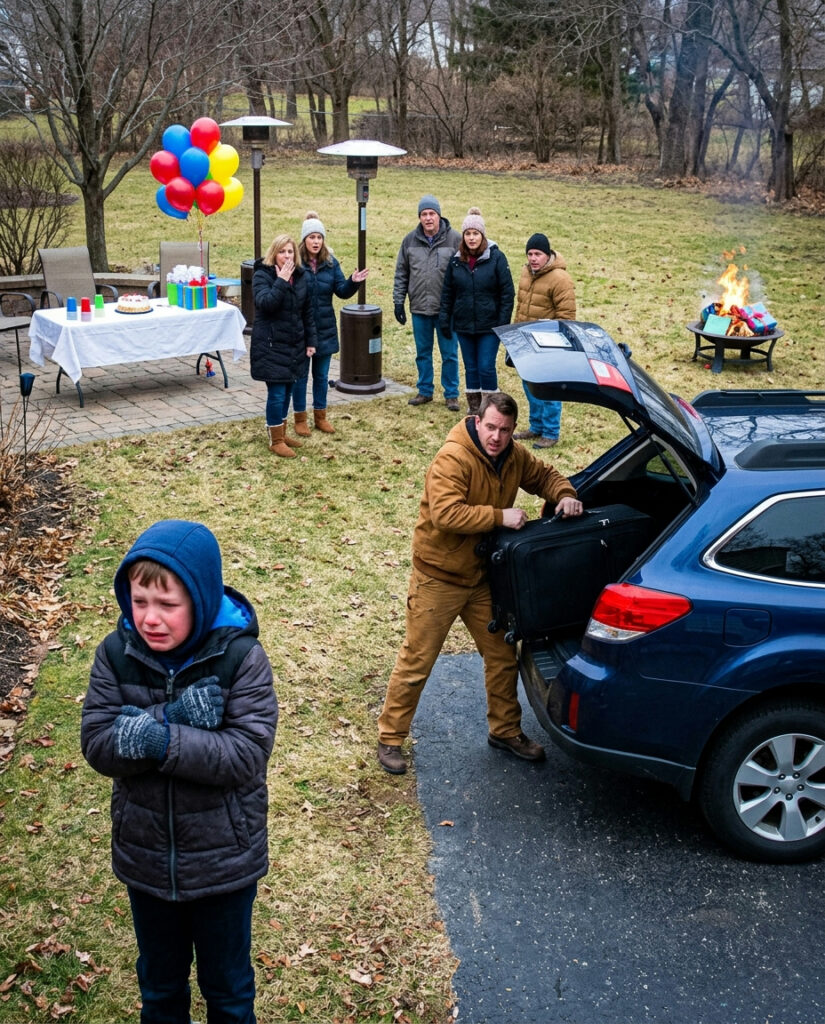
The string lights over Margaret Heath’s backyard made everything look warm from a distance, but the air was sharp enough to make breath hang white.
Image
My son did not have his jacket.
He had his arms locked over his chest, his chin tucked down, and the kind of silence a child learns when crying has already been used against him.
The fire pit snapped, and a piece of green dinosaur paper folded inward.
I knew that paper before my brain wanted to accept what my eyes were seeing.
I had bought it because Max was eight and still loved dinosaurs with the seriousness of a scientist.
He did not just say tyrannosaurus.
He said the full names, corrected adults gently, and looked offended when anyone called every long-necked one a brontosaurus.
That was why I had wrapped the gifts myself after midnight.
I was terrible at it.
One corner had too much tape, one box bulged where the toy packaging fought the paper, and I remember thinking Max would not care because he would be too excited to notice.
Now the paper was burning in front of him.
The smoke smelled like ink, cardboard, and something sweet from the cake table nearby.
Margaret stood close to the fire with her wineglass in one hand, completely comfortable in the cold.
That was Margaret’s gift.
She could turn cruelty into ceremony and make everyone else behave as if it were etiquette.
“These are from his real family,” she said, loud enough for the guests to hear. “Not from someone who couldn’t even bother to show up.”
For half a second, no one moved.
Then someone shifted by the outdoor heater.
A cousin looked at the cake.
Brenda, Kelly’s sister, lowered her eyes into her drink.
They all saw Max standing there.
They all saw the gifts burn.
Nobody moved toward him.
My wife did see me.
Kelly stood several feet behind her mother, wrapped in a cream sweater, one hand pressed against her side.
The instant her eyes met mine, her face changed.
It was not surprise.
It was calculation failing in real time.
She had not expected me to come through the side gate.
She had not expected me to know where the party was.
Most of all, she had not expected Max to see me before she could explain me away.
Max turned because the yard went too still.
His face did something I still cannot forget.
Relief tried to rise first, but fear blocked it.
That was when I understood how much work they had put into him before I ever arrived.
“Dad?” he whispered.
The word came out small.
It should have been the easiest word in the world.
Margaret’s smile froze, then tightened into something sharper.
“Daniel,” she said, like my name was a problem delivered to the wrong address. “This is a private family party.”
Private family party.
For my son.
With my gifts in the fire.
I walked past her and went to Max.
I did not give Peter Heath the stare he wanted.
I did not give Todd the fight he was hoping for.
I did not let Brenda’s embarrassed silence become something I had to comfort.
I went straight to the child standing in the cold.
When I wrapped my jacket around Max, his whole body leaned into me.
He grabbed my shirt with both hands.
His fingers were cold.
“They said you didn’t want to come,” he whispered against me. “They said you didn’t love me anymore.”
The sentence did not sound like a child’s guess.
It sounded rehearsed by adults.
That was the part that made my chest go still.
You can argue with a grown woman.
You can walk away from a mother-in-law who needs an audience.
You can survive being talked about like a problem.
But when someone teaches your child that your absence means abandonment, they are not attacking you anymore.
They are reaching into the one place you are not supposed to touch.
I looked at Kelly.
Her eyes dropped to the patio stones.
“That’s a lie,” I said. “I will always love you. Always.”
Max pressed his face harder into my shirt.
Margaret stepped closer, perfume cutting through the smoke.
“You need to leave,” she said. “You’re upsetting him.”
That was almost impressive.
My son was shaking in my coat.
The gifts I bought him were turning black in her fire pit.
A yard full of relatives had watched him be humiliated at his own birthday party.
And somehow I was the disturbance.
“I’m taking my son home,” I said.
Peter moved in then, slow and official, the way he did when he wanted everyone to remember he had money.
“Daniel, everyone knows you’ve been having problems. Kelly told us about the forgetfulness. The episodes. The way you’ve been acting.”
There it was.
The foundation they had been pouring under me for months.
At first, I had blamed work.
I had blamed stress.
I had blamed the kind of exhaustion that creeps up on a man who is trying to keep his marriage, his job, and his son’s routines from cracking at the same time.
I woke up foggy some mornings.
I found missed calls I did not remember silencing.
I stood in my own kitchen while Kelly reminded me of conversations from the night before and watched my face carefully as I tried to place them.
Her concern had been perfect.
Too perfect.
Then the small things started lining up.
The coffee tasted slightly wrong on mornings she insisted on making it.
Max looked at Kelly before answering questions that used to be easy.
Margaret’s texts came late at night, and Kelly stepped away to answer them.
When I asked simple things, like what time Max’s school event started or whether his birthday plans were set, Kelly gave me soft answers that produced no details.
The softness was the warning.
People think a lie always comes with sharp edges.
Sometimes it comes padded.
Sometimes it arrives with a worried voice and a hand on your shoulder.
But evidence does not care how gentle the lie sounds.
Evidence has a rhythm.
And I follow evidence for a living.
I am not a man who throws around job titles at dinner.
Margaret hated that about me because she could not measure it against the men at Peter’s club.
To her, quiet meant weak.
To Todd, restraint meant fear.
To Kelly, maybe it had started to mean useful.
That was their mistake.
Once I heard the pattern, I stopped arguing with it.
I started documenting it.
I wrote down the mornings.
I saved the call logs.
I took photos of the gifts before I loaded them.
I kept receipts, message times, and every small thing they expected me to be too embarrassed to preserve.
Not because I wanted a scene.
Because I knew they were building one.
Margaret pointed toward the gate.
“You are not taking that child anywhere.”
Max tightened around my neck.
Kelly finally spoke.
“Daniel, maybe we should talk inside.”
Her voice was shaking.
It was not shaking because she was afraid for Max.
It was shaking because witnesses were present, and the story was no longer moving in the direction she had planned.
“No,” I said.
Todd stood from the patio chair.
He was broad, clean-shaven, expensive watch flashing under the lights, wearing the expression of a man who had been waiting for permission to become useful.
“Put the kid down,” he said.
I looked at him once.
“Move.”
He stepped toward us anyway.
That was when Kelly snapped, “Todd, don’t.”
It was the first honest thing she had said all day.
Todd stopped because he heard something in her voice the others had not yet understood.
She knew I had not come empty.
I carried Max through the side gate, out of the backyard, and down the driveway toward my SUV.
Behind me, the party broke into sound.
Margaret’s voice rose first.
Peter’s came after it, low and angry.
Brenda said Todd’s name like she was trying to keep him from doing something that would finally make the night impossible to deny.
Kelly said mine.
She said it the way she used to say it when she wanted me to slow down.
That name did not belong to her anymore.
I opened the rear door and buckled Max into his booster seat.
He still had his hands inside the sleeves of my jacket.
His cheeks were wet, but he was watching me now like the world had started to rearrange itself back into something he recognized.
“Are we leaving?” he asked.
“In a minute, buddy.”
I shut the door gently.
Margaret came through the gate with her phone in her hand.
She had already called the police.
I could hear dispatch’s faint voice as she lowered the phone from her ear and looked at me with triumph returning to her face.
“You have no idea what you’ve done,” she said.
That was the line she had waited all night to say.
It should have made me nervous.
Instead, it made me calm.
“No,” I said. “You don’t.”
Then I opened the trunk.
The light came on over the hard black case I had placed there before I drove over.
It was not heavy, but every person in that driveway reacted as if it had weight.
Kelly saw it and took one step backward.
Peter’s jaw locked.
Todd’s eyes narrowed.
Margaret looked from the case to my face, trying to decide whether she still owned the room.
She did not.
I opened the case and lifted out the top folder.
I did not wave it.
I did not shout.
Men like Todd want shouting because shouting makes everything look like a fight.
Margaret wanted panic because panic would let her call me unstable.
Kelly wanted a private room because private rooms are where she had done her best work.
So I gave them paper.
The folder had Max’s name on it.
Inside were copies of the things they had counted on disappearing into confusion.
There were the receipts for the gifts.
There were photos of the wrapped boxes by my front door earlier that day.
There were the messages I had sent asking what time I should bring Max’s presents over.
There was the call log from that morning, with unanswered attempts marked one after another.
There were notes from the past month, plain and dated, showing every time a family plan had been changed only after it was too late for me to attend.
None of it was dramatic.
That was why it worked.
Truth does not always arrive like thunder.
Sometimes it arrives as a timestamp.
Margaret stared at the folder like it had insulted her.
Kelly put one hand against the SUV.
For the first time since I had known her, she had no immediate expression ready.
The patrol car turned the corner before anyone could rebuild the lie.
Blue light washed softly over the driveway, not flashing hard, just enough to make every face look exposed.
The officer who stepped out was not angry.
That mattered.
He came in with the patient caution of someone who had heard one story on the phone and was now looking at a very different one in person.
His eyes moved to Max in the back seat.
Then to my jacket wrapped around him.
Then to the smoke still rising over the backyard fence.
Then to the open folder in my hand.
Margaret started talking first.
Of course she did.
She spoke quickly, pointing toward me, then toward the house, then toward Max as if her finger could turn a child into evidence for her side.
The officer let her talk.
That was another thing people like Margaret misunderstand.
Being allowed to speak is not the same as being believed.
When she finished, the officer asked for my relationship to Max.
I answered plainly.
I showed my ID.
Kelly did not contradict me.
The officer then asked why an eight-year-old was in the back seat without a coat of his own in December.
No one rushed to answer that.
Peter looked toward the patio.
Todd looked at the ground.
Brenda covered her mouth.
Margaret began explaining the party, the misunderstanding, the emotions of the day, all the polished language people use when a simple answer would make them look guilty.
I opened the folder and handed the officer the first copies.
I told him I had brought gifts, that I had been told nothing clear about the party, and that when I arrived, those gifts were burning while my son stood outside in the cold.
I did not mention the coffee first.
I did not mention every foggy morning.
That part was in my notes, but it was not for the driveway.
A man has to know which proof belongs to which moment.
This moment was about Max.
The officer read long enough for the yard behind us to go quiet again.
That silence was different from the first one.
The first silence had been cruelty waiting to see if it would be challenged.
This one was recognition.
Max tapped the inside of the window.
I turned.
He lifted one hand, still swallowed by my jacket sleeve.
The officer noticed.
He walked closer to the car, lowering his body slightly so Max did not have to look up at a uniform towering over him.
He asked Max a simple question in a calm voice.
Max answered in a whisper.
He said the gifts were from me.
He said they had been thrown into the fire.
He said he had been told I did not want him anymore.
He said he was cold.
That was all.
Children do not have to make speeches when adults have already shown who they are.
Kelly closed her eyes.
Margaret’s face hardened, but even she knew better than to interrupt that.
The officer straightened and looked at Kelly.
This time, Kelly had to answer questions without her mother’s timing, without the patio audience, and without Max standing too far away to hear.
Her answers did not hold together.
They were soft in the places truth would have been firm.
She said there had been confusion.
She said emotions were high.
She said she never meant for Max to believe I did not love him.
Maybe that last part was true in the narrowest possible way.
Maybe she had only meant for him to doubt me enough to cling to her side of the family.
But children do not live in adult technicalities.
They live in the words you put inside them.
Margaret tried to step in again.
The officer stopped her with one raised hand.
No drama.
No shouting.
Just a boundary.
It was the smallest gesture, and it cut through her more cleanly than anything I could have said.
The second officer arrived a few minutes later.
Statements were taken in the driveway.
Names were written down.
The burned gifts were photographed from the side gate.
The officer asked whether Max had a safe place to go that night.
I said yes.
Kelly looked at me then, really looked at me, and I saw the moment she understood the difference between control and custody of the truth.
Control can last for months.
Truth only needs one clean opening.
No one in that driveway apologized.
Not Margaret.
Not Peter.
Not Todd.
Not Brenda.
Kelly’s mouth trembled once, but whatever she wanted to say was too small for what had happened.
The officers did not turn the night into a movie.
They did not drag anyone across the lawn.
They did what serious people do when the facts are ugly and a child is watching.
They documented.
They separated voices.
They made sure Max was warm.
They told Kelly the next conversations would need to happen properly and with records, not in a backyard full of smoke and humiliation.
When I finally got back into the driver’s seat, Max was still awake.
He had stopped crying.
That almost broke me more than the tears.
He looked at the empty space beside him where the gifts should have been.
“I thought you forgot,” he said.
I had to hold the steering wheel for a second before I could answer.
“I didn’t forget.”
He nodded, but he did not smile yet.
Trust does not come back because one adult tells the truth one time.
It comes back when the next morning matches the words from the night before.
So I drove him home.
Not fast.
Not triumphantly.
Just home.
At a stoplight, he asked if the dinosaurs were all gone.
I told him the burned ones were gone.
Then I told him I had kept one small thing back, not because I knew what Margaret would do, but because I always overpack where Max is concerned.
It was a card.
Badly drawn dinosaur on the front.
My handwriting inside.
Nothing expensive.
Nothing anyone could burn in a way that mattered.
He held it in both hands all the way back to my house.
Later, after a warm shower and a blanket on the couch, he fell asleep with the card tucked beside him.
I sat in the kitchen with the folder open.
The house was quiet.
My coffee maker sat on the counter, clean and ordinary.
For a long time, I looked at it and let myself admit how tired I was.
The foggy mornings were not solved that night.
The missing calls were not fully explained.
The marriage was not healed by one folder in a driveway.
But the lie they had planted in my son had been pulled up by the root.
That mattered first.
In the days that followed, the story Margaret had built did not spread the way she expected.
Too many people had been there.
Too many people had seen Max without his jacket.
Too many people had smelled the smoke.
Brenda called once and left a message I did not return.
Peter sent nothing.
Todd disappeared back into whatever men like Todd do when there is no weaker person standing in front of them.
Kelly asked to talk.
I told her everything involving Max would be written down.
No hallway whispers.
No missing details.
No private version of public harm.
The folder stayed with me.
So did the lesson.
I used to think a father protected his child by being strong enough to absorb insult.
That night taught me something harder.
Sometimes protection means refusing to absorb it quietly.
Sometimes it means letting the whole driveway watch the truth come out under a trunk light.
Max turned eight with smoke in his hair and my jacket around his shoulders.
That is not the birthday I wanted for him.
But it was the night he learned one thing nobody in Margaret Heath’s backyard could burn.
His father came.
His father had always been coming.
And this time, when they tried to make him believe otherwise, the proof was already waiting in the trunk.