The blood on the lobby doors should have sent me into motion.
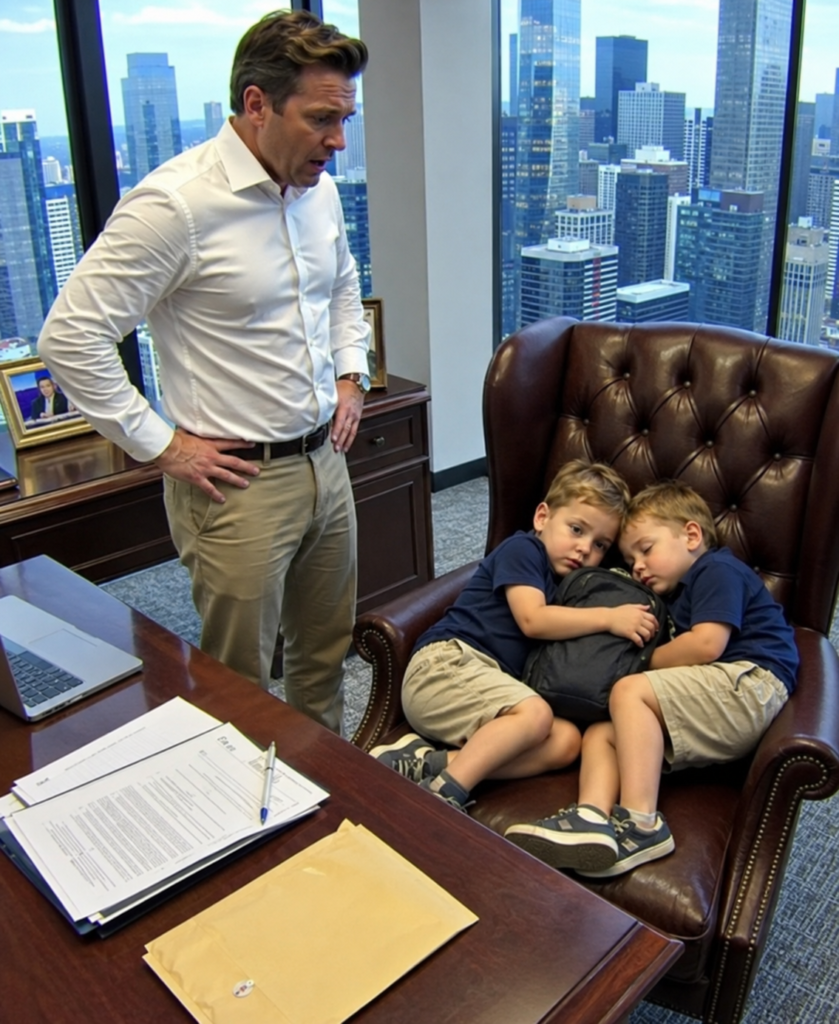
That was what people expected from me. Jason Miller, decisive. Jason Miller, controlled. Jason Miller, the man who could hear bad news and turn it into strategy before anyone else had finished panicking.
But for one full second, I did nothing.
I looked at Liam and Lucas.
Lucas had a smear of syrup at the corner of his mouth. Liam had stopped chewing, his small hand still wrapped around his fork. Both of them were watching me now, not Claire, not the door, not the city shining behind the glass.
Me.
As if I already knew what to do.
As if being their father meant I had been born with answers.
“Blood?” I repeated.
Claire nodded, lowering her voice even more, though the boys were close enough to hear every word. “A small amount. On the brass handle and near the revolving door. Security is checking the footage now.”
Liam’s fork clattered softly against the plate.
I turned to Claire. “Have they called the police?”
“Not yet. They were waiting for your instruction.”
That was the kind of thing I had trained everyone around me to do. Wait for Jason Miller. Never move until Jason Miller decided the shape of the room.
For the first time in years, that obedience felt useless.
“Call them,” I said. “Now.”
Claire blinked. “The police?”
“Yes. And have security send the footage to my private conference room. No one else sees it. No gossip, no staff messages, no internal chatter. Lock down the lobby footage from midnight onward.”
She nodded and stepped backward.
“Claire.”
She stopped.
I looked at the boys again. “And find somewhere quiet. Not here. Somewhere they can sit without strangers staring at them.”
“There’s the small executive lounge on forty-nine.”
“No windows facing the office floor?”
“No.”
“Good. Take them there.”
Lucas immediately hugged the backpack tighter.
“No,” he said.
It was the first word he had spoken since breakfast began that did not sound like it had been pulled from him by hunger.
I looked at him carefully. “Lucas—”
“No.” His lower lip trembled, but he did not cry. “Mommy said find you.”
“You found me.”
“Not leaving.”
The words were so small, but they settled in my chest with unbearable weight.
Liam slid off my chair and stood beside his brother. “Mommy said stay together.”
“I’m not separating you,” I said.
He studied my face with an expression too old for him. “And stay with you.”
The office went quiet.
For years, people had asked for my time in measured pieces. Ten minutes before a board meeting. Thirty minutes over lunch. Two hours for negotiations. Time had always been my most protected asset.
Now two little boys were asking for all of it with sleepy eyes and syrup on their fingers.
I looked at Claire. “Bring blankets to the conference room. And whatever toys we have in the building.”
“We don’t have toys in the building, sir.”
“Then send someone to buy them.”
Claire nodded, but there was something in her expression I had never seen before.
Concern, yes.
But also pity.
I hated it.
“Come on,” I said to the boys, forcing my voice to remain steady. “We’re going to look at some videos. You can sit with me.”
Liam reached for Lucas’s hand.
Lucas reached for mine.
The moment his small fingers curled around my index finger, the room changed.
Not visibly. The skyline remained in place. The leather chair, the glass desk, the silver pen, the agenda for the nine o’clock acquisition meeting—all of it was still there.
But the center of gravity had moved.
For most of my life, everything had revolved around me.
Now I was being pulled by the hand of a four-year-old boy who might be my son.
My son.
The word felt impossible.
And yet his hand fit around my finger as if he had always known where it belonged.
We walked down the private corridor in silence. Claire moved ahead of us, speaking quickly into her phone, arranging what needed to be arranged. Employees turned as we passed. Some pretended not to stare. Others failed.
I gave them one look.
They remembered their work.
The private conference room was colder than my office, built for negotiations that made people sweat. A long black table ran down the center. Screens covered one wall. I had closed billion-dollar deals there. I had watched men twice my age fold under pressure.
Now Liam and Lucas climbed into two oversized chairs while Claire brought in a tray of juice boxes, napkins, and a stack of printer paper with colored pens.
“Best I could do until the toys arrive,” she said.
“Thank you,” I replied.
She looked startled. Maybe because I rarely said it. Maybe because I meant it this time.
The head of security, Martin Hale, arrived minutes later. Former police, mid-fifties, broad-shouldered, calm in the kind of way that came from having seen enough trouble to stop being impressed by it.
He paused when he saw the boys.
“Mr. Miller,” he said carefully.
“What do you have?”
Martin set a tablet on the table, but his eyes flicked toward Liam and Lucas.
“They stay,” I said.
Martin hesitated. “Some of the footage may be upsetting.”
Lucas slid closer to Liam.
I leaned down until I was at their eye level. “You don’t have to watch. You can draw. But I need to see if your mom was here.”
“Mommy came with us,” Liam whispered.
Every adult in the room went still.
I kept my voice gentle. “She did?”
Liam nodded.
“When?”
He pressed his lips together, thinking hard. “It was dark. She said we had to be very quiet. The tall man at the door was sleeping.”
Martin looked sharply at me. “Night guard on north entrance reported no disturbance.”
“Keep going,” I said.
“She held Lucas because he was tired,” Liam said. “I walked. Mommy had her coat. The blue one.”
Lucas shook his head. “Gray.”
“It was blue.”
“It was gray because it was raining.”
Liam frowned. “It looked blue.”
“What happened after that?” I asked.
Liam’s face closed a little. “She cried in the elevator.”
The sentence was so simple that it cut through me.
Emma Reed did not cry easily.
At least, not the Emma I remembered.
The Emma I had known was sunlight through kitchen windows and bare feet on hardwood floors. She laughed with her whole body. She argued like she was trying to save your soul. She believed in people long after they had stopped deserving it.
Including me.
Five years earlier, she had stood in my apartment wearing one of my dress shirts, her hair tied loosely on top of her head, and asked me what kind of life I wanted.
I had said, “A successful one.”
She had looked at me as if I had missed the question completely.
And maybe I had.
Martin tapped the tablet. “This is from 4:38 a.m.”
The screen lit up.
The lobby appeared in grainy color. Marble floors. Brass fixtures. The revolving doors turning slowly as wind pushed rain against the glass.
Then Emma entered.
I knew her instantly.
Even blurred by camera angle and shadow, even thinner than I remembered, even wearing a hood pulled low over her face, I knew the way she moved. One arm wrapped around Lucas. Liam walking beside her, one hand gripping the hem of her coat.
Her coat was gray.
Or maybe blue once, faded by time and rain.
My throat tightened.
She crossed the lobby quickly, looking over her shoulder twice. Her movements were careful, not frantic. She wasn’t running. She was making herself stay calm for the children.
She reached the reception desk, leaned over, and wrote something on a notepad. The note.
Then she turned toward the elevators.
At the edge of the frame, she stumbled.
Lucas leaned forward in his chair. “Mommy fell.”
On the screen, Emma caught herself against the brass handle of the security gate. Her hand left a dark smear.
Blood.
Not much, but enough.
I heard my own breathing.
“Zoom in,” I said.
Martin did.
Emma’s left sleeve was torn near the wrist. Her hand was trembling. She looked down at the blood, then wiped it quickly against the inside of her coat, as if hiding it from the boys.
“She was injured,” Claire said softly.
I didn’t answer.
The footage skipped to the elevator camera.
Emma knelt in front of the twins. She touched Liam’s face, then Lucas’s. She said something, but there was no audio. Lucas began crying silently, his mouth open, his cheeks wet.
Liam shook his head hard.
Emma hugged them both so tightly that I had to look away for half a second.
Then the elevator doors opened on my floor.
She led the boys down the corridor to my office.
Martin changed the view.
My office door opened.
Emma entered with the boys.
She looked around the room.
At the desk.
The chair.
The windows.
For one strange moment, she smiled.
Not happily.
Sadly.
As if she recognized the man I had become and mourned him.
She helped the boys into my chair. Lucas was already half-asleep. Liam clung to her sleeve. She kissed both their foreheads, placed the backpack beside them, then stood motionless.
The camera in my office had no audio either, but I saw her mouth form the words.
Be brave.
Then she wrote the note, placed it on my desk, and turned toward the door.
Liam suddenly climbed down and ran to her.
Emma sank to her knees and wrapped him in her arms.
On the screen, my son—my son—pressed his face into her neck.
She held him for three seconds.
Four.
Five.
Then she gently pulled his hands away.
She pointed to my chair.
Liam shook his head.
She pointed again, more firmly.
He obeyed.
And then Emma walked out of my office alone.
Martin paused the footage.
No one spoke.
I stared at the frozen image of her back turned toward the camera. Her shoulders were squared. Her head held high. She looked like a woman stepping into a storm because there was no other way to keep it from reaching her children.
“Where did she go?” I asked.
Martin resumed the footage from the hallway.
Emma entered the elevator.
Down to the lobby.
She walked toward the side exit, away from the main doors.
Then, at 4:51 a.m., the camera at the service entrance caught her leaving the building.
Rain blurred the glass.
A dark sedan was parked across the street.
Emma saw it.
She stopped.
The sedan’s headlights turned on.
She did not approach it.
Instead, she stepped backward into the shadows beside the building and disappeared from the camera’s view.
“That’s it?” I asked.
Martin’s jaw tightened. “There’s a blind spot near the loading bay. The next exterior camera lost visibility because of a delivery truck.”
“Convenient.”
“Yes, sir.”
“License plate on the sedan?”
“Obscured. Deliberately. Mud or tape over the plate.”
I looked at the boys.
Lucas was no longer drawing. He had taken one of the blue pens and was coloring the same circle over and over until the paper nearly tore.
Liam watched the blank screen.
“She said she’d come back,” he whispered.
I looked at him.
His eyes were dry, which somehow made it worse.
“She always comes back.”
The police arrived within twenty minutes.
Detective Maria Alvarez was not impressed by my name, my office, or the fact that three partners were waiting downstairs for a meeting I no longer cared about. She had short dark hair, a calm face, and eyes that missed very little.
She asked for the footage. She asked about Emma. She asked about the boys.
Then she asked me when I had last seen Emma Reed.
“Five years ago,” I said.
“And you had no knowledge of the children?”
“No.”
Her pen moved across her notebook. “Did Ms. Reed ever try to contact you?”
“No.”
I paused.
At least, that was what I had believed.
Detective Alvarez noticed.
“What is it, Mr. Miller?”
I glanced at Claire, then at the boys asleep now on the couch in the corner of the conference room. The toys had arrived—blocks, stuffed animals, coloring books—but exhaustion had taken them before they could open most of it.
“There may have been messages I didn’t receive.”
“Because?”
Because my life was managed by layers of protection I had built around myself and mistaken for discipline.
“My staff filters all personal communication.”
Claire’s face changed. She understood before I did.
“Sir,” she said quietly. “Five years ago, I wasn’t your assistant yet.”
“No,” I said. “Nadia was.”
Claire’s eyes lowered.
Nadia Vale had been efficient, elegant, and completely loyal to the version of me that treated human inconvenience as contamination. She had left two years ago to work for another firm in Boston.
“Find her,” I said.
Detective Alvarez looked between us. “Who is Nadia?”
“My former executive assistant.”
“Why does she matter?”
I looked again at Emma’s frozen image on the tablet. “Because if Emma tried to reach me, Nadia might have decided I didn’t need to know.”
Claire went pale.
“That’s a serious accusation,” the detective said.
“It’s not an accusation yet.”
But in my chest, something old and ugly began to stir.
I remembered a night four years ago. I had been leaving a charity dinner when Nadia mentioned, almost casually, that a woman had called the office several times.
“An Emma something,” she had said.
I had stopped.
“What did she want?”
“She wouldn’t say. She sounded emotional. I told her personal calls should go through your attorney if they concern legal matters.”
I had stared at the city through the car window and said nothing.
Then Nadia had added, “Some people only reach out when they want something.”
And because I was proud, wounded, and afraid that Emma might indeed want something I did not know how to give, I had nodded.
I had let the car drive on.
Now two sleeping boys breathed softly in the corner of my conference room.
And Emma was missing.
By noon, my perfect life had fully cracked.
The acquisition meeting was canceled. The board call was ignored. My phone became a buzzing rectangle of impatience until I handed it to Claire and told her only calls about Emma or the children mattered.
A doctor arrived to examine the boys.
“They’re tired,” she said afterward. “Underweight but not dangerously so. No signs of serious injury. They need rest, regular meals, and stability.”
Stability.
The word landed like an accusation.
Detective Alvarez arranged for a child welfare representative to come by, which made Lucas cling to my jacket with both hands.
“They’re not taking you anywhere right now,” I told him.
“Promise?”
I had broken many promises by omission in my life. I had walked away from love because promises frightened me more than loneliness.
But Lucas looked at me with Emma’s mouth and my eyes.
“I promise,” I said.
The representative, a kind woman named Mrs. Patel, asked careful questions. Did I have proof of paternity? No. Did I have a safe residence? Yes. Did I have experience caring for children? No, and pretending otherwise would have been ridiculous.
But I had money, attorneys, space, and the cooperation of the police. More importantly, I had two children who became visibly distressed whenever anyone suggested removing them from my care.
Temporary emergency placement was granted pending investigation and DNA confirmation.
It sounded clinical.
Temporary emergency placement.
As if Liam and Lucas were fragile documents being filed in the correct cabinet.
By late afternoon, I took them home.
Home had always been a word I used loosely.
My penthouse overlooked Central Park from a height that made the trees seem decorative rather than alive. It had four bedrooms, Italian marble, museum-white walls, and a kitchen mostly used by people I paid. It was beautiful in a way that discouraged touching anything.
The twins stepped inside and froze.
Lucas whispered, “Do we have to be quiet?”
I looked around at the spotless floors, the expensive silence, the cold perfection I had once mistaken for peace.
“No,” I said. “You don’t.”
Liam glanced at a sculpture near the entryway. “What if we break something?”
“Then it breaks.”
He looked skeptical.
“Really?”
I loosened my tie. “Really.”
Ten minutes later, Lucas spilled apple juice on a white rug that had cost more than my first car.
He burst into tears before I could speak.
“I’m sorry,” he sobbed. “I didn’t mean it. I didn’t mean it.”
I knelt beside him, startled by the intensity of his fear.
“It’s just a rug.”
He covered his face.
“Lucas. Look at me.”
He shook his head.
I gently moved his hands away. “You are more important than the rug.”
His crying slowed.
I had no idea where the sentence came from.
Maybe from the version of me that Emma had once believed existed.
Liam watched from the doorway, his small face guarded.
“Mommy used to say that,” he said.
“What?”
“People are more important than things.”
The room blurred for a moment.
I turned away under the pretense of finding towels.
That evening, Claire arrived with bags of clothes, pajamas, toothbrushes, picture books, bath toys, and a stuffed dinosaur for Liam because she had remembered his sweatshirt. For Lucas, she brought a small stuffed fox.
Lucas held it by one ear.
“What do you say?” Liam whispered.
“Thank you,” Lucas murmured.
Claire smiled. “You’re welcome.”
She looked at me over their heads.
There was a question in her eyes.
Are you all right?
The answer was obvious.
No.
But I nodded anyway.
The boys refused separate bedrooms.
“They shared with their mom,” Mrs. Patel had explained earlier. “Do what comforts them tonight.”
So I put them in the guest room with the softer bed, pulled an armchair beside it, and sat while they lay under a blanket too large for their small bodies.
Liam fought sleep.
Lucas surrendered to it quickly, one hand wrapped around the stuffed fox.
“Jason?” Liam whispered.
The word hurt.
Not Dad. Not Daddy.
Jason.
“Yes?”
“Are you mad at Mommy?”
“No.”
“People get mad when she asks for help.”
I leaned forward. “Who got mad?”
He looked at his brother, then back at me. “The man with the shiny watch.”
My body went still.
“What man?”
Liam’s eyes grew heavy. “Mommy said not to talk about him.”
“All right.”
“She said grown-up secrets are heavy, and kids shouldn’t carry them.”
That sounded exactly like Emma.
“Then you don’t have to carry them tonight.”
Liam relaxed a little.
“Will you find her?”
“Yes.”
This promise came easier.
He closed his eyes.
“Mommy said you were brave,” he murmured.
I nearly laughed, but there was no humor in it.
Emma had been wrong about many things.
Or maybe she had simply seen something I had buried too deep to recognize.
When both boys were asleep, I went into the hall and found Claire waiting near the living room windows, phone in hand.
“We found Nadia,” she said.
I closed the guest room door softly. “Where?”
“Boston. She’s now chief of staff for Ellison Rowe.”
The name was familiar. Most names attached to money were.
“Call her.”
“I did. She said she has nothing to say without counsel.”
“That was fast.”
Claire swallowed. “There’s more.”
Of course there was.
“She checked the archived call logs from five years ago. Emma Reed called your office seventeen times over a six-month period.”
The apartment became very quiet.
“Seventeen?”
Claire nodded. “And sent three letters.”
I felt something inside me move out of place.
“Where are they?”
“Not in our files.”
“Nadia removed them.”
“I can’t prove that.”
“But she did.”
Claire didn’t answer.
I walked to the window. The city below glittered like nothing bad could ever happen there, which was one of New York’s most convincing lies.
“What else?”
Claire hesitated.
“Tell me.”
“There was also a wire transfer.”
I turned.
“From one of your personal accounts to Emma Reed. Four years and seven months ago. Fifty thousand dollars.”
“I never authorized that.”
“I know.” Her voice was careful. “It was processed through your family office.”
My family office was run by people who handled tax structures, trusts, charitable giving, and anything else that could be wrapped in discretion.
“Who signed it?”
Claire looked down at her phone.
“Your father.”
The name struck harder than I expected.
Charles Miller had been dead for eight months. Even in death, he managed to enter rooms like a cold draft.
My father had hated mess. Emotions, illness, debt, scandal, children born outside approved circumstances—all of it was mess. He had taught me that control was the only virtue that mattered.
I had spent most of my adult life proving I could be harder than he was.
“What did the transfer memo say?” I asked.
Claire’s voice softened.
“Settlement.”
The word opened a dark corridor in my memory.
I saw my father’s study. The leather-bound books no one read. The smell of cigar smoke. His voice when he told me Emma was not suited for my life.
“She’ll make you small,” he had said.
I had been twenty-nine, ambitious, angry at the world and addicted to his approval though I would have denied it under oath.
“She makes me happy,” I had said.
He had looked at me with disappointment so complete it felt like disgust.
“Happiness is what undisciplined people chase when they have no purpose.”
I had left Emma three weeks later.
Not because I stopped loving her.
Because I believed love was a luxury I would eventually outgrow.
Claire’s phone rang.
She checked the screen. “Detective Alvarez.”
I nodded.
She answered, listened, and her expression changed.
“What is it?” I asked.
Claire lowered the phone. “They found Emma’s car.”
My pulse sharpened.
“Where?”
“Queens. Parked behind a closed clinic.”
“Is she—”
“No sign of her. But they found something inside.”
I took the phone from Claire.
Detective Alvarez came on the line. “Mr. Miller?”
“What did you find?”
“A hospital wristband. Cut off. Name: Emma Reed. Date from two days ago.”
“Was she admitted?”
“We’re checking. There was also a prescription bottle, empty, and a child’s drawing in the glove compartment.”
“What kind of drawing?”
The detective paused.
“A house. Three stick figures holding hands. Two small, one adult. And above them, someone wrote: When we find him.”
I closed my eyes.
The next morning began before sunrise.
Not because of markets.
Because Lucas woke screaming.
I found him sitting upright in bed, tangled in the blanket, calling for Emma.
Liam was already awake beside him, trying to calm him with a seriousness that broke my heart.
“It was a dream,” Liam whispered. “Lucas, it was a dream.”
Lucas shook his head, sobbing. “She didn’t come back.”
I sat on the edge of the bed.
He looked at me with terror, then climbed into my lap as if his body had chosen before his mind could object.
I froze.
Then slowly, awkwardly, I wrapped my arms around him.
He was so small.
His back shook beneath my hand.
I had held fragile things before—crystal glasses, rare watches, signed agreements worth fortunes—but never anything this fragile that trusted me anyway.
Liam watched us.
There was longing in his face, hidden quickly.
I opened my other arm.
He hesitated only a second before crawling in too.
So that was how Claire found us at seven-thirty when she arrived with coffee and updates: Jason Miller sitting on a guest bed in yesterday’s wrinkled shirt, holding two children while sunlight crept over the city.
She wisely said nothing about it.
The DNA test was arranged privately but legally. Detective Alvarez continued searching for Emma. The hospital wristband led to an urgent care clinic in Brooklyn, where Emma had been treated for a cut on her forearm and mild dehydration under her own name.
“She left before speaking to the social worker,” Alvarez told me. “Paid cash. No insurance.”
“Was she alone?”
“Yes.”
“What happened to her arm?”
“She said she cut it on broken glass.”
“Did they believe her?”
“They treated the wound. Belief isn’t always part of the paperwork.”
By midmorning, my attorney, Daniel Price, arrived at the penthouse. Daniel had been with me through acquisitions, lawsuits, regulatory investigations, and the occasional wealthy person’s tantrum disguised as a legal dispute. He was brilliant, discreet, and allergic to sentiment.
He stood in my living room watching Liam and Lucas build a crooked tower of blocks on the floor.
Then he looked at me.
“Well,” he said quietly, “this is new.”
“Can we keep them with me?”
“Temporarily, yes. Permanently depends on paternity, Emma’s status, and whether any other legal guardian appears.”
“No one appears.”
“You don’t know that.”
“I know Emma.”
Daniel’s expression softened slightly. “You knew Emma five years ago.”
The correction irritated me because it was true.
People do not remain frozen in the shape we abandoned them.
“What about my father?” I asked.
Daniel’s brows drew together. “What about him?”
“He sent Emma money. Labeled it settlement.”
Daniel was too practiced to react much, but I saw the flicker.
“You knew,” I said.
“I knew there was a payment.”
“And you never told me?”
“I wasn’t your personal counsel at the time. I was junior corporate counsel. Your father handled it through outside advisors.”
“Handled what?”
Daniel glanced at the boys.
I led him into the study and closed the door.
“Say it.”
Daniel exhaled. “Jason, I don’t know the details. I heard rumors. Your father believed Emma was pregnant.”
The room seemed to tilt, just as it had when Liam first said the word daddy.
“He knew?”
“I think so.”
“And he didn’t tell me?”
Daniel said nothing.
Rage came slowly.
Not hot. Not loud.
Cold, spreading through every part of me.
“He let me walk around this city for five years not knowing I had children.”
Daniel’s voice was low. “It appears possible.”
“Possible?”
“I am your attorney. Possible is the word I can defend.”
I almost smiled. Almost.
“What else did he do?”
“We need records. Old correspondence. Family office files. Nadia’s emails if we can get them. Your father’s private documents.”
“My father’s private documents are sealed at the estate archive.”
“You have access.”
“No,” I said. “I have keys. That’s not the same thing.”
My father’s archive was in the old Miller townhouse on the Upper East Side, a place I had avoided since the funeral. The house had belonged to my grandfather, then my father. I had inherited it and left it empty, unable to sell it, unwilling to enter it.
That afternoon, I took the boys there.
Daniel thought it was unwise. Claire thought it was emotionally reckless. Detective Alvarez thought it might contaminate some vague chain of evidence if we stumbled into anything relevant without notifying her.
But Liam overheard us talking about “Grandfather Miller’s house” and asked, “Is that where the man with the shiny watch lives?”
The entire room went silent.
I knelt in front of him. “What did you say?”
Liam’s face tightened, as if he regretted speaking.
“The man with the shiny watch,” I said gently. “Did he know your mommy?”
Liam nodded.
“Did he come to your house?”
“Sometimes.”
Lucas threw a block across the room.
It hit the wall and dropped onto the rug.
“Bad man,” Lucas said.
Not loud.
Not dramatic.
Just certain.
Claire covered her mouth.
“What did he look like?” I asked.
Liam shrugged. “Old.”
“All adults are old to you.”
He considered this. “White hair. Big eyebrows. Walked with a stick.”
My father had used a cane in the last year of his life.
I sat back slowly.
“That’s not possible,” Daniel said.
I looked at him.
He understood.
Charles Miller had died eight months ago.
Emma had disappeared yesterday.
But the boys were four. “Sometimes” could mean a long time ago to them.
Still, the air had changed.
The Miller townhouse smelled like waxed wood, old paper, and ghosts with good manners.
Liam and Lucas walked close to me through the foyer. Their sneakers squeaked faintly on the marble floor.
On the wall hung a portrait of my father, stern and unsmiling in a dark suit.
Lucas stopped.
His face went pale.
“Him,” he whispered.
My chest tightened.
Liam stepped behind me.
“That’s the shiny watch man.”
I stared at my father’s painted face.
Even dead, he seemed to be judging the room.
Claire, who had insisted on coming, crossed her arms tightly. Daniel looked like a man watching legal trouble grow teeth.
“You’re sure?” I asked.
Liam nodded.
“He told Mommy not to cry.”
A memory surfaced from childhood.
My mother at the dining table, one hand pressed to her mouth.
My father saying, “Tears are for people who think feelings are evidence.”
I turned away from the portrait.
The archive room was on the second floor behind a locked mahogany door. Inside were file cabinets, banker’s boxes, old ledgers, photographs, and a massive desk where my father had signed decisions that shaped other people’s lives.
We searched for three hours.
At first, we found nothing but tax records, trust amendments, and correspondence so dry it could have turned rain into dust.
Then Claire found a folder tucked behind a row of estate binders.
It was labeled simply: REED.
My hands went cold.
Inside were copies of Emma’s letters.
The first was dated five years ago.
Jason,
I know you asked me not to call, and I am trying to respect that. But there is something you need to know, and I cannot put it in a voicemail filtered by people who do not know us.
Please call me. It matters.
Emma.
The second was longer.
Jason,
I’m pregnant.
I have written that sentence twelve times and erased it eleven. I don’t know how you will feel. I don’t even know if you will believe me. But these babies are yours. Yes, babies. The doctor said twins.
I’m scared, but I am not sorry.
I won’t ask you for anything you cannot give. I only ask that you know they exist.
Emma.
I had to sit down.
The paper trembled in my hand.
There was a third letter, written months later.
Jason,
Your father came to see me.
He said you knew about the pregnancy and wanted no contact. He offered money and documents. I refused the documents. I took the money because rent was due, I was sick every morning, and pride does not buy vitamins.
I don’t believe you would send him instead of coming yourself.
But I also don’t know who you are anymore.
If someday you want to meet them, I will not keep them from you.
Their names are Liam and Lucas.
They were born early, but they are fighters.
Emma.
I pressed the heel of my hand against my eyes.
For years, I had told myself Emma vanished because what we had was not strong enough to survive ambition.
But she had reached for me.
Again and again.
And everyone around me—my assistant, my father, maybe even my own pride—had made sure I never reached back.
Daniel’s voice came from the far cabinet.
“Jason.”
I lowered my hand.
He was holding a sealed envelope.
On the front, in my father’s handwriting, were three words.
For my son.
I took it.
The envelope had never been opened.
Inside was a letter dated six months before my father died.
Jason,
There are facts I withheld from you.
At the time, I believed I was protecting the family name and your future. I understand now that this may have been arrogance dressed as judgment.
Emma Reed had children. Twin boys. I had reason to believe they were yours.
I arranged financial support through channels that would leave you untouched. She resisted. She had more dignity than I expected.
If you are reading this after my death, then I lacked the courage to speak while alive.
You may hate me for this.
You may also understand, one day, that every empire is built by choosing what must be sacrificed.
C.M.
I read it once.
Then again.
Then I folded it carefully because tearing it would not change the fact that he had written it.
Liam appeared beside me, holding the stuffed dinosaur Claire had brought him.
“Are you sad?” he asked.
I looked at his small face.
“Yes.”
“Because of Mommy?”
“Because of a lot of things.”
He leaned against my knee.
It was not much.
It was everything.
Lucas had wandered toward my father’s desk. Before Claire could stop him, he tugged open the bottom drawer.
Something inside shifted.
A false panel slid loose.
Lucas jumped back.
“I didn’t break it,” he said quickly.
I crossed the room.
Behind the panel was a small black notebook and an old phone wrapped in a cloth.
Daniel muttered something under his breath.
Claire looked at me. “Should we call Detective Alvarez?”
“Yes,” I said.
But I picked up the notebook first.
The pages were filled with dates, initials, and payments. Most meant nothing to me.
Then I found Emma’s name.
REED — relocation attempt failed.
REED — refuses NDA.
REED — children confirmed.
REED — monitor contact.
My pulse hammered.
A later entry, dated eleven months ago, made my hands tighten.
E.R. contacted J.M. office again. Intercepted.
Eleven months ago.
Emma had tried again less than a year earlier.
The next line was worse.
Discussed matter with N.V. She remains cooperative.
Nadia.
Claire read over my shoulder and whispered, “Oh my God.”
The old phone was dead, but Daniel found a charger in the desk that fit. We plugged it in and waited.
The screen lit after several minutes.
There were no contacts saved, only numbers.
And one unread message.
It had arrived yesterday at 3:12 a.m.
My heart began pounding before I opened it.
The message contained no greeting.
Just a photo.
Emma.
She was standing in what looked like a dim hallway, face pale, hair damp from rain. Her left sleeve was wrapped in cloth. She held up a folded piece of paper.
On it, written in thick black marker, were the words:
JASON DOESN’T KNOW. I HAVE PROOF.
Below the photo was one line of text.
Bring the boys to him before sunrise, or disappear with them forever.
The sender’s number was blocked.
Nobody spoke.
Then another sound broke the silence.
A soft knock from downstairs.
Not the front door.
The back entrance.
Three slow knocks.
Then two.
Liam grabbed my hand.
Lucas whispered, “Mommy said that was the safe knock.”
I turned toward the hall as every breath left my body.
END OF PART 2 – LIKE, SHARE AND COMMENT “THE ENTIRE STORY” IF YOU WANT TO READ THE FULL STORY