It would just be twelve this year, Ashley said.
She said it with her eyes still fixed on the little notepad in front of her, the tip of her pen moving quickly across the page like she was running a meeting instead of sitting at my dining table on a Tuesday evening.
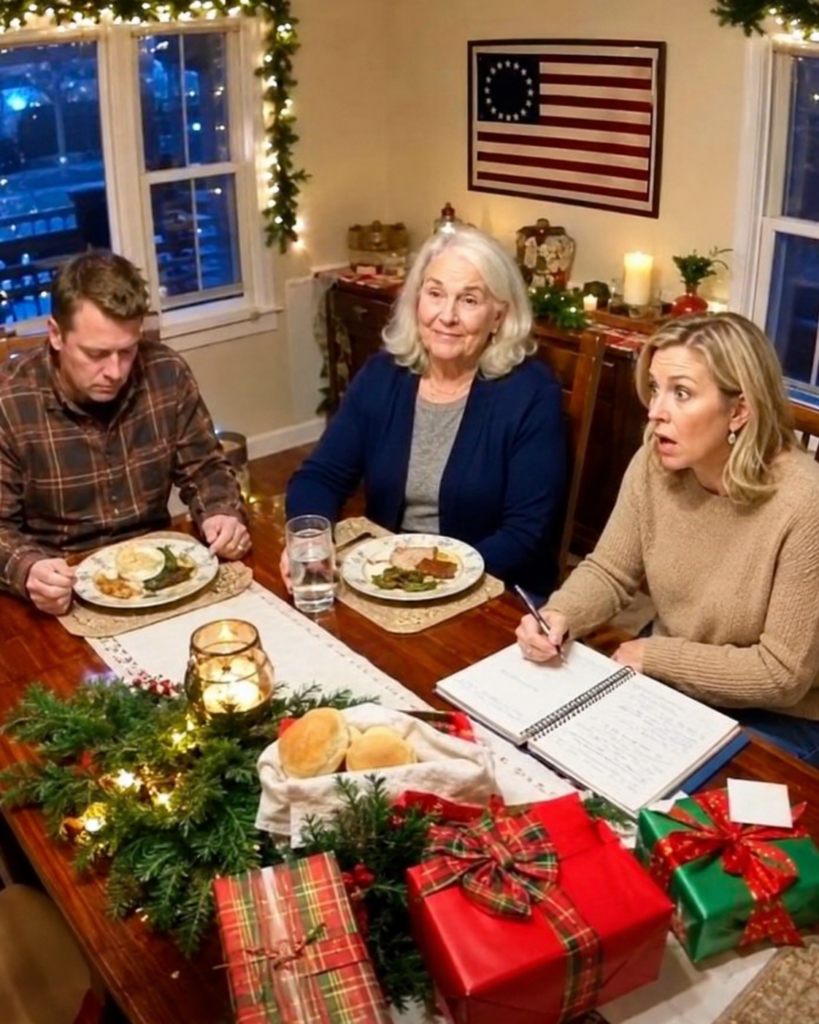
“My parents, my brothers, their wives, and the kids,” she said. “Plus us, of course. So you’ll host.”
The words came out smooth and certain, as though there had never been a question to begin with.
She did not pause to see my reaction. She simply turned to the next page of her notes.
“My dad doesn’t eat pork anymore,” she went on, “so maybe turkey and beef. My mom likes the guest room at the end of the hall. It’s quieter. The kids can sleep in the den. You still have those fold-out couches, right?”
I sat with both hands around my water glass.
The glass was cool against my palms.
Across from me, Ashley kept listing one expectation after another. Food. Bedrooms. Towels. Decorations. Breakfast. Coffee. Sleeping arrangements.
She did not look up.
Fred sat beside her, my son, tapping his fork lightly against his plate. He heard every word. He knew exactly how she sounded. Still, he said nothing.
He never did anymore.
Ashley moved from meals to decorations without taking a breath.
“Oh, and maybe fewer candles this year,” she said. “My brother’s daughter gets headaches. Maybe you could do more lights outside instead.”
She said it like I was someone she had hired.
I took a slow sip of water and placed the glass back on the coaster.
Then I smiled.
It was not the polite smile I had used for years. It was not the smile I wore when I swallowed my own exhaustion so no one else would feel uncomfortable.
It was a different kind of smile.
The kind that comes when you finally know something no one else at the table expects.
“Perfect,” I said. “I’ll be traveling this Christmas. You and your family can handle it.”
Ashley froze.
Her pen stopped in the middle of a word.
Fred finally looked up from his plate.
“I’m sorry,” Ashley said.
Her voice was sharper now, as if I had missed the line in a script she believed I knew by heart.
“What?”
“I’ll be gone December twenty-third through New Year’s Day,” I said evenly. “So you and your family can do whatever you like.”
The dining room went quiet.
Not angry quiet.
Not even hurt quiet.
Shocked quiet.
The kind of quiet that follows the sound of a dish slipping from someone’s hands and hitting a tile floor.
Ashley blinked at me. I could see her waiting for me to soften, to laugh, to explain that I was only joking.
But I did not.
I stood, gathered the side plates from the table, and carried them into the kitchen.
Neither of them followed.
I rinsed the dishes under warm water, dried my hands, and hung the towel back neatly on the oven handle.
When I returned, Ashley still had not spoken. Fred looked like he wanted to, but no words came.
The difference this time was not only in what I had said.
It was that I meant it.
For the first time in years, I did not feel guilty.
Not even a little.
I used to love Christmas back when it felt shared.
There had been a time when Ashley would ask if she could bring dessert and actually arrive with a homemade pie. There had been a time when Fred would haul the tree into the living room, pine needles falling across the carpet while he grumbled the whole way, and still he would smile when the lights came on.
After dinner, he would hug me and say, “Smells like Christmas in here, Mom.”
Those holidays were never perfect.
The oven ran hot. The kids spilled juice. Someone always forgot batteries. The tree lights tangled every year no matter how carefully I packed them away.
But the work felt lighter then because it was shared.
Everyone pitched in. Everyone brought something. Even when the house was loud and the schedule was messy, there was gratitude in it.
Somewhere along the way, that changed.
At first, the shift was small enough that I could pretend not to notice.
One year, Ashley asked if her parents could come for Christmas dinner too.
“Just for a few hours,” she promised.
Of course, I said yes. I thought it would be nice to have everyone together.
The next year, they stayed the whole day.
After that, the whole weekend.
Soon it became the full week leading up to Christmas, and sometimes they stretched their stay close to New Year’s.
Then came Ashley’s brothers. Then their wives. Then cousins. Then friends passing through who had nowhere else to go.
My guest rooms filled first.
Then the living room couches.
Then air mattresses appeared on the den floor.
At first, I told myself it was what families did. I told myself a full house was a blessing. I told myself that one day I would miss the noise.
But the more people came, the less anyone helped.
They unloaded their bags and went straight to the table.
“What’s for dinner, Deborah?”
“Do you have extra towels?”
“Is there more coffee?”
“Could you pick up decaf tomorrow?”
“Do you mind if the kids sleep in the den?”
“Do you still have the big roasting pan?”
The questions always sounded small by themselves.
Together, they became a job.
My grocery bills doubled, then tripled. The electric bill climbed from extra heat, extra laundry, extra showers, and lights left on in rooms no one was using.
The water heater struggled to keep up, and I was the one taking lukewarm showers late at night after everyone else had gone to bed.
No one asked if I needed help with the cost.
What they gave me were compliments.
“You always make Christmas so special, Deborah.”
“We love coming here.”
“Nobody does the holidays like you.”
Words were easy.
Not one of them reached for a sponge when the sink was full.
Not one of them said, “Let me handle the turkey next year.”
Last Christmas was the year I finally understood how far things had gone.
There were fourteen people in my house. Every bed was taken. The fold-out couches were open. Air mattresses covered the floor. The hallway was lined with shoes, coats, gift bags, and coolers.
I cooked all day and cleaned all night and still felt behind.
By the second day, my legs hurt so much I had to sit on a stool while chopping vegetables.
I remember standing at the stove with the oven heat against my back, pots boiling on every burner, and Ashley’s mother walking into the kitchen with her empty mug.
“Do you have more honey?” she asked. “For my tea?”
She did not ask if I needed help.
She did not notice the sweat on my forehead or the way I was leaning against the counter to keep pressure off my knees.
She set the mug down and walked away.
Ashley’s father made himself comfortable in the den watching old westerns on the television as if he were in his own house. He asked Fred for another blanket because the draft bothered him.
I almost laughed.
That draft had been in the house for years. Somehow it only became urgent when he felt it.
Ashley’s brothers treated my home like a hotel. They left wet towels on the bathroom floor, used up my laundry detergent, filled my garage with coolers, and asked where I kept the good knives.
Fred was busy with the kids, and I understood that. But being busy with the kids also meant he was not paying attention to me.
He chased them through the hallway, kept them out of the pantry, and then dropped onto the couch with his phone in one hand and football on the television.
When I asked him to take out the trash, he said, “I’ll get to it later.”
Later never came.
Ashley spent half the time on her phone taking photos of the children by the tree. Every so often she would glance up and tell me how good the food smelled.
She never rolled up her sleeves.
She never said, “Here, let me help.”
By the time dinner was over, I was running on fumes.
Fourteen plates.
Fourteen glasses.
Fourteen sets of forks, knives, and spoons.
Three meals a day.
Snacks in between.
Cups left on side tables.
Crumbs under chairs.
Sticky places on the counter.
I washed dishes until my back ached and my arms trembled. I kept thinking that if I stopped moving, I might not start again.
When the last person finally left after five days, I stood in a kitchen that looked like a storm had blown through it.
Trash bags were stacked by the back door. Crumbs sat in the corners. The counters were dull with spills I had not had time to wipe properly.
I was one person cleaning up after fourteen.
Not one of them seemed to think twice about leaving it that way.
That night, I nearly could not get up from the edge of my bed.
I sat there with my feet on the floor, my legs tingling from exhaustion, and wondered what would happen if my body simply refused to do it again.
What if this was the last Christmas I could physically carry?
I should have said something then.
I did not.
I stayed quiet because I did not want to start an argument. I did not want to sound ungrateful for having family around. I did not want to be the older woman who complained when everyone was trying to celebrate.
So I told myself what I had told myself too many times before.
Next year will be better.
Maybe they will notice.
Maybe they will help more.
They did not.
That November, the group message arrived.
It was cheerful, full of Christmas tree emojis and exclamation marks.
“We’ll all be at your house, Deborah. Thanks in advance. You’re the best.”
There was no question mark.
No pause.
No “Is that okay?”
No “How are you feeling?”
No “What can we bring?”
I sat in my kitchen and stared at that message until the screen dimmed.
That was the moment it hit me.
I was not being invited into a family holiday.
I was being scheduled.
For years, I had been the cook, the decorator, the cleaner, the babysitter, the grocery buyer, the background to their holiday photographs.
But me, the actual person, had disappeared.
They wanted the meals, the warmth, the house, the beds, the tree, the lights, and the clean bathrooms.
They did not seem to need me except as the one who provided all of it.
I closed the message without replying.
My hands shook a little, but not from anger.
From realization.
I thought about the times I had slipped money into Fred’s coat pocket when he and Ashley were struggling. The times I had watched the children so they could take weekend trips. The times I covered groceries without mentioning the bill because I did not want anyone to feel embarrassed.
None of that was bad.
I had done those things out of love.
But love that is never seen becomes labor.
That night, I lay awake for a long time thinking about all of it.
The tablecloths I ironed.
The bathrooms I scrubbed before and after guests arrived.
The folding chairs I dragged from the garage.
The turkeys, hams, pies, casseroles, rolls, cider, cocoa, and coffee.
The gifts I wrapped after midnight because I had spent the whole day feeding everyone.
And somewhere in the darkness, a simple thought settled in me.
If I did not draw a line now, there would never be one.
If I did not say no this year, I would still be standing at that sink ten years from now, older, weaker, and still overlooked.
So when Ashley sat across from me at dinner and began giving instructions, I already knew my answer.
“Perfect. I’ll be traveling this Christmas. You and your family can handle it.”
I was not bluffing.
After Fred and Ashley left that night, I sat alone in the kitchen.
The house was quiet, but my mind was not.
I poured myself a cup of tea and placed it on the table. At first, I did not drink it. I only watched the steam rise from the mug while the silence settled around me.
Then I opened the drawer beside the stove and pulled out an old spiral notebook.
I had not written in it for years, but I needed to see the truth laid out in front of me.
On the first page, I wrote:
“What I’ve given.”
I started with money.
A few years earlier, Fred called late one night because their water heater had gone out. They did not have enough to cover the repair. I wrote them a check for a thousand dollars.
“Don’t worry about paying me back right away,” I told him.
He never did.
I never asked.
Another time, when Ashley was trying to get her little business off the ground, I slipped a few hundred dollars into an envelope and tucked it into her purse.
She hugged me and cried.
I told her it was no big deal.
It was a big deal, but I pretended it was not because I did not want her to feel small.
Then I wrote about groceries.
All the times they came over with half-empty hands. A store-bought pie. A box of cookies. A bottle of soda.
Everything else was mine to cover.
I remembered standing in the checkout line the previous December with a cart piled high: two turkeys, three hams, vegetables, butter, milk, eggs, sugar, coffee, rolls, fruit, snacks for the children, and extra paper towels.
The bill had been nearly four hundred dollars.
No one offered to split it.
Child care became another page.
I had watched the kids for whole weekends so Fred and Ashley could get away. I loved my grandchildren, and I still do. But when I counted it up, I realized how many nights I sat rocking a crying baby while they posted photos from a concert, a hotel balcony, or a trip to the lake.
Then came the cooking and cleaning.
There were not enough lines in the notebook.
Every year, I woke before sunrise to start the meal. I scrubbed pots until my knuckles were sore. I ironed tablecloths and folded napkins while everyone else watched movies. I cleaned bathrooms before guests arrived and again after they left, so no one had to think about what they had used.
By the time I put the pen down, I had filled three full pages.
I sat back and looked at them.
The words seemed to echo in the kitchen.
They do not really want me.
They want what I provide.
That thought hurt.
It also cleared the fog.
They did not seem to care whether I sat at the table or not, as long as the food was hot, the beds were ready, and the house looked warm in photographs.
I closed the notebook and felt something I had not felt in a long time.
Clarity.
I opened my laptop.
In the search bar, I typed:
Christmas getaways in Tennessee.
I did not know exactly what I wanted. I only knew it had to be away from my house. Away from the stove. Away from the guest towels and grocery lists and people asking me where I kept things.
Dozens of results appeared.
Cabins in the Smoky Mountains. Small places with porches, fireplaces, rocking chairs, and pine trees dusted with snow.
One cabin caught my eye.
It was simple, just two rooms tucked near a stream. The photos showed a porch swing, a stone fireplace, a small kitchen, a quilt folded at the foot of the bed, and a window with a view of the mountains.
The description said it was available December twenty-third through January second.
My heart gave a little jump.
It felt as if the universe had left it there for me.
The price was not cheap, but it was not impossible either.
For once, I did not talk myself out of it.
I did not say maybe next year.
I did not say the money should go toward gifts, groceries, or extra snacks for people who would not notice.
I pulled out my credit card, entered the numbers, and clicked “Book Now.”
When the confirmation page appeared, I stared at it for a long time.
I felt nervous, as if I had just done something reckless.
But beneath the nerves was something stronger.
Relief.
It was the first thing I had bought in years that was truly just for me.
Not food for everyone else.
Not toys for the grandchildren.
Not gifts for Fred and Ashley.
Just me.
I printed the receipt and folded it neatly into my notebook.
I told myself I did not need to announce it.
I did not need to defend it.
The choice was mine, and that was enough.
As I turned off the kitchen light and went to bed, I felt lighter than I had in years.
For once, I was not lying awake dreading the holiday season.
For once, I had something to look forward to.
This Christmas, I would not be bent over a stove while everyone else laughed in the other room.
I would not be scrubbing a sink after midnight.
I would not be holding together a celebration that treated me like a service and called it tradition.
This Christmas, I was going to the mountains.
They were going to have to handle the rest.
Once I booked the cabin, everything else began to fall into place.
I did not rush.
I did not panic.
I moved calmly, step by step, as if I were finally in control of my own holiday.
The first thing I did was print the group message they had sent me.
The one with all the emojis, exclamation marks, and the line that said, “Thanks in advance, Deborah. You’re the best.”
I folded it in half and slipped it into a plain white card I had in a drawer.
On the back of the card, in steady handwriting, I wrote:
“This home will be unoccupied from December twenty-third to January second. Wishing you joy wherever you gather.”
No excuses.
No guilt.
No long explanation.
Just the truth written clearly.
I walked down to the end of my driveway and taped that card to the side of the mailbox, right where anyone coming to the house would see it first.
Not hidden.
Not tucked away.
Out in the open.
When I stepped back and looked at it, something settled inside me.
For the first time, the responsibility was off my shoulders.
I had told them everything they needed to know.
What they did with that information was not mine to carry.
Back inside, I began preparing the house for my absence.
Usually, by that time in December, the place would already be full of decorations. A tree in the living room. Stockings by the fireplace. Candles on the counters. Garland wrapped around the banister. A wreath on the front door.
This year, everything stayed packed away.
No garland.
No wreath.
No stockings.
No tree.
The dining table was bare, just polished wood waiting to be left alone.
I opened the kitchen drawers and checked the stove. I thought about how many years that stove had worked overtime for everyone else.
This year, it would rest.
In the living room, I unplugged the lamps I usually kept on for visitors. I stood by the porch light switch for a moment before turning it off.
That light had always been a signal of welcome.
This year, it would stay dark.
I set the thermostat to away mode, locked the windows, and double-checked the doors.
I did not feel sadness.
I felt order.
Packing my suitcase was simpler than I expected.
I did not need much.
Warm clothes. A good pair of boots. Toiletries. A few books. My notebook.
I folded each item neatly, laid it in the bag, and zipped it closed.
For once, I was not packing for anyone else.
No extra gifts.
No casserole dishes.
No wrapping paper hidden in the trunk.
No emergency snacks for children.
Just what I needed.
I paused at my closet and looked at the holiday dress I usually wore every Christmas Eve. I touched the fabric, then let it go.
I did not need it this year.
No fancy dinner.
No hosting duties.
No pretending I was fine while my back ached and my feet throbbed.
Just me and the quiet I had chosen.
Before bed, I walked through the house one last time.
I ran my hand along the kitchen counter, glanced at the empty hooks where stockings used to hang, and felt no regret.
Everything looked bare.
It also looked peaceful.
Outside, I stood in the driveway and looked back at the house.
The windows were dark. The porch light was off. The yard was quiet. A small American flag moved gently from the porch post in the cold evening air.
For the first time in a long while, my home did not feel like a stage set for everyone else’s celebration.
It felt like mine.
That night, I slept better than I had in weeks.
When I woke the next morning, I was not filled with dread about shopping lists or cooking schedules.
I ate a small breakfast, washed the dish and mug I had used, and put them away, knowing they would stay clean until I came back.
As the day of departure approached, I felt lighter.
I did not announce anything to anyone.
I did not need to.
The card on the mailbox said all that needed to be said.
On December twenty-third, I rolled my suitcase to the car.
I lifted it into the trunk, closed it, and took one more look at the house.
I did not linger out of guilt.
I only wanted to remember the moment.
The moment I finally put myself first.
I got into the car, started the engine, and pulled out of the driveway.
As I passed the mailbox, I glanced at the white card taped to the side.
It fluttered a little in the winter breeze, clear as day.
It did not feel like running away.
It felt like stepping into my own life for the first time in years.
With every mile I drove toward the Smoky Mountains, the weight I had carried for so long fell farther behind me.
By the time I reached the cabin, the sky had turned soft gray, and the air felt cooler than it did back home.
The cabin sat near the edge of a ridge, tucked between tall trees. I carried my suitcase inside, set it down, and took a deep breath.
The air smelled of wood and pine.
No noise.
No clutter.
No one asking where something was.
Just stillness.
That evening, I made myself a simple supper of eggs and toast. I sat by the small fireplace with a book and did not look at the clock.
I did not need to.
Time finally felt like mine.
On Christmas Eve, around the time I knew they would be pulling into my driveway back home, my phone buzzed on the table.
I did not pick it up right away.
I let it sit there, the screen lighting up in the dim cabin.
I knew what they would see when they arrived.
Two cars pulling up. Children half-asleep in the back. Coolers and gift bags stuffed in the trunk. Ashley’s parents stepping out and waiting for the porch light to glow, for the smell of turkey or ham to drift from the kitchen, for me to open the door with an apron around my waist.
Instead, they would find a dark house.
Every door locked.
Every window shut.
The first text came from Fred.
“Mom, we’re here. Where are you? Are you okay?”
I stared at the words.
Not with guilt.
With calm.
I had told them.
They knew.
They simply had not believed me.
Another message buzzed in, this time from Ashley.
“We’re outside. The gate’s locked. Lights are off. Did you forget we were coming?”
I set the phone back down and took another sip of tea.
I did not forget.
I had chosen.
Minutes later, the tone of the messages shifted.
“This isn’t funny.”
“You’re making a scene.”
“Open the door.”
Then came the word I knew would come eventually.
“Selfish.”
I looked at it on the screen for a long moment.
Selfish.
After all the years I had cooked until my knees hurt.
After all the nights I scrubbed pots while everyone else played games.
After the money, the groceries, the babysitting, the cleaning, the extra beds, the quiet sacrifices.
One no, and suddenly I was selfish.
I picked up the phone, read the messages once, and placed it face down on the nightstand.
I was not going to defend myself.
Not this time.
Back at my house, I imagined them standing near the locked gate, adults muttering, children restless from the drive, everyone trying to decide what to do next.
They had plans they assumed I had arranged for them.
Now they had to make their own.
Maybe they would call a neighbor. Maybe they would drive to one of Ashley’s brothers. Maybe they would find a hotel. Maybe they would be uncomfortable for one night.
None of it was mine to fix.
I had made my choice clear.
I walked to the cabin window and looked out at the snow falling through the trees.
The silence outside matched the silence inside.
It was not the heavy silence I used to feel after past holidays when everyone left me alone with a ruined kitchen.
This silence was clean.
Like fresh air.
I lit the small lamp by the bed, wrapped a blanket around my shoulders, and opened my book.
My phone buzzed again and again.
I left it there.
For years, I had rushed to fix everything.
If someone forgot something, I found it.
If the children were hungry, I cooked.
If the house was messy, I cleaned.
If someone felt uncomfortable, I jumped in before anyone else had to deal with it.
This time, I let the discomfort sit where it belonged.
With them.
They could figure out where to stay.
They could make their own meals.
They could manage their own disappointment.
For the first time in a long time, I was not rushing to patch every hole.
I was sitting in a quiet cabin while snow fell outside, and I felt steady.
Eventually, the phone stopped buzzing.
I closed my book and leaned back in the chair.
My body felt lighter than it had in years.
No one was knocking on the door.
No one was calling my name from the other room.
No one was asking what was for dinner.
Just me, my choice, and the sound of the wind moving through the trees.
That night, when I climbed into bed, I did not toss and turn.
I did not lie awake making lists in my head.
I pulled the blanket up to my chin, closed my eyes, and slept without worry.
For once, the holiday belonged to me.
The next morning, I woke in the cabin to quiet air and the smell of pine from the wood stacked near the fireplace.
I made a small pot of coffee, poured it into a mug, and stepped out onto the porch.
The ground was covered in a thin layer of snow. The mountains stretched into the distance, blue and soft beneath the winter sky.
For the first time in years, Christmas morning was not about rushing.
It was about sitting still and letting the day come to me.
Later that afternoon, my neighbor back home, Mrs. Bennett, called.
She lived across the street and noticed everything that happened on our block.
“Well, Deborah,” she said, “they all showed up at your house last night. Big commotion. Cars lined up. Kids running around. But when they saw that card on your mailbox, you should have seen their faces.”
I could hear the humor in her voice, though she tried to soften it.
She told me Ashley’s family ended up hauling everything over to Ashley’s brother’s small apartment a few towns away.
“Looked like they were packed in tight,” Mrs. Bennett said.
I could imagine it.
A narrow kitchen where opening the oven meant bumping into the refrigerator. Children cranky from the long drive. Adults stepping around luggage and coolers. People arguing quietly over who would sleep where.
Mrs. Bennett said they tried to cook a turkey in Ashley’s brother’s oven. It looked fine from the outside, but when they sliced it, part of it was not cooked through.
They cut around it and called the rest good enough.
The children did not eat much.
Ashley’s mother complained about the space.
By midnight, someone’s air mattress had gone flat.
I listened.
I nodded.
But I did not feel smug.
I did not even feel sorry.
I felt separate.
For once, their chaos was not mine to manage.
When I hung up, I sat back in the cabin chair and pulled my blanket tighter around my shoulders.
My Christmas was quiet.
No one called from the kitchen asking where I kept the serving spoons.
No pile of dishes waited for me after dinner.
No noise echoed through the hall.
I had snow outside, a warm drink in my hand, and a small meal I could eat slowly without interruption.
That afternoon, I made myself a bowl of soup with crackers.
Nothing fancy.
Enough.
It surprised me how little I needed to feel content.
I took a walk down one of the trails behind the cabin. The snow crunched beneath my boots, and the air felt crisp in my lungs.
I stopped by a stream and listened to the water move over the stones.
A simple truth came to me there.
I did not miss a thing.
Not one thing.
I did not miss children bickering while I tried to keep dinner on schedule.
I did not miss Ashley’s mother telling me what candles not to use.
I did not miss Ashley’s father asking for another chair.
I did not miss Fred drifting into the den while I stood at the sink.
What I felt instead was peace.
A kind of peace I had not tasted in decades.
That night, as the wind moved softly through the trees, I made another cup of tea and sat near the fire.
I thought about how hard it had been for me to finally say no. How long I had confused guilt with love. How many times I had chosen discomfort for myself so others could stay comfortable.
Sitting there in the quiet room, I saw the truth clearly.
The guilt had never been mine to hold.
Their Christmas went on without me, messy and crowded.
Mine went on without them, calm and steady.
Both happened at the same time.
Only one of them belonged to me.
Two days after Christmas, my phone rang.
Fred’s name appeared on the screen.
For a second, I considered letting it go to voicemail.
Then I answered.
“Mom,” he said, his voice tight. “You really left us hanging. That’s not like you.”
I did not rush to respond.
I let the words sit there.
In the background, I could hear children talking and dishes clanking.
“I told you where I’d be,” I said. “It was written clear as day.”
He sighed.
“You should have given us more warning. We drove all that way. The kids were disappointed.”
“I’m glad the kids are okay now,” I said.
He paused.
He was waiting for an apology.
I did not give one.
Eventually, he said he had to go and hung up.
A week later, he called again.
This time, his voice was lighter, almost casual.
“Mom, next time, just let us know earlier so we can plan around your mood.”
That word stayed with me.
Mood.
My choice, my boundary, my decision after years of being taken for granted, reduced to a mood.
Something temporary.
Something they could wait out.
Something they did not have to respect.
But it was not a mood.
It was a line.
“I didn’t take a trip because I was moody,” I said. “I took a trip because I was tired of being taken for granted.”
Silence filled the line.
He did not know what to say.
I realized then how easy it was for them to rewrite my choices.
If they called it a mood, they did not have to face what it really was.
They did not have to admit that I had stopped giving them something they assumed would always be theirs.
I did not get angry.
I did not raise my voice.
I spoke plainly.
“I’ve mistaken guilt for love too many years. That ended this Christmas.”
There was another pause.
Then Fred mumbled something about checking in later and hung up.
After that call, I sat in my living room while late afternoon sunlight came through the blinds.
I felt steady.
For the first time, I did not second-guess myself.
I did not replay the conversation and wonder if I had been too harsh.
I felt clear.
In the days that followed, I began cleaning out the attic.
Not in anger.
Not in a frenzy.
One box at a time.
I pulled down tubs of holiday decorations I had not used in years. Strings of lights that no longer worked. Plastic bins filled with ornaments I had bought only because someone thought I needed more. Folding tables I only dragged out when the crowd came.
I kept a few things.
The wooden ornament Fred made in elementary school.
The little ceramic angel my mother gave me.
Those mattered to me.
The rest I donated.
Some boxes went to a local shelter. Others went to a church rummage sale.
I did not make an announcement.
I did not post about it.
It was not for anyone else.
It was for space.
The garage that used to hold bins stacked to the ceiling now had room to breathe. I could walk through without turning sideways around piles of things meant to serve everyone else’s comfort.
As I worked, I thought about all the years I had held on to objects for the sake of other people.
Extra linens for guests.
Extra chairs for large dinners.
Extra dishes for meals I did not want to host.
Boxes of decorations meant to make the house look festive for visitors who never helped take them down.
Almost none of it had been for me.
Letting it go felt like lifting weight from my shoulders.
I was not angry.
I was finished.
Finished keeping things only to be appreciated after the fact.
Finished storing reminders of exhaustion and calling them tradition.
Finished bending my life around expectations that were never mine to begin with.
When I looked around my house after the clutter was gone, it felt lighter.
It felt as if the walls had more air between them.
It felt like it belonged to me again.
Fred did not call for a while.
Ashley did not either.
I imagined they were adjusting, trying to explain what happened in a way that did not make them uncomfortable.
Maybe they told people I had been overwhelmed.
Maybe they said I was tired.
Maybe they said I had become difficult with age.
I did not know.
For once, I did not let their version matter more than mine.
Winter passed.
With it came the quiet relief of knowing I had not broken from my decision.
I had worried at first that regret might come later.
It did not.
Not at Easter.
Not on Mother’s Day.
Not on any of the days when the phone stayed silent.
For Easter, I baked myself a small pie.
I set the table with one plate, one fork, and one napkin. I ate slowly, enjoying each bite in a quiet kitchen.
It was not lonely.
It was peaceful.
When Mother’s Day arrived, there was no card in the mailbox.
No call from Fred.
Instead, I saw a photo online.
Fred and Ashley were smiling on a beach somewhere. The caption read, “Much needed family reset.”
I looked at the photo and waited for the old ache.
It did not come.
I did not feel hurt.
I felt free.
Free from expectations I could never meet.
Free from traditions that left me drained.
Free from waiting for appreciation that never arrived.
For so long, I had believed that if I gave enough, they would finally see me.
But waiting to be seen had only made me tired.
So I stopped waiting.
In the spring, I joined a walking group that met on Saturday mornings at a local park.
At first, I was nervous.
I had spent so many years being useful that I was not sure how to simply show up as myself.
But before long, I found myself laughing with women I had never met before. We talked about the weather, about gardening, about books, about families in small pieces that did not weigh the whole conversation down.
Those mornings became something I looked forward to.
I did not have to be the planner.
I did not have to be the cook.
I did not have to fix anything.
I could just walk, breathe, and talk.
I started doing other things for myself too.
I painted the guest room a soft blue, a color I had always liked but never chosen because it did not fit what everyone else preferred.
I planted herbs on my kitchen windowsill and used them in meals I cooked only for myself.
I bought books and let them pile up on my nightstand without guilt.
I moved through my home differently.
Slower.
Quieter.
As if I had finally stopped renting space in my own life.
By September, I was already planning ahead.
This time, with no fear and no guilt, I booked another cabin.
Not in the Smoky Mountains, but near a quiet lake a few hours away.
It had a wood stove, a little dock, and no Wi-Fi.
The listing said it was perfect for reflection.
That was exactly what I wanted.
Marking it on my calendar felt like marking a holiday that finally belonged to me.
Then November came.
Just like clockwork, a text from Fred lit up my phone.
“You’re still hosting Christmas, right?”
No greeting.
No real question.
Just the same expectation wrapped in softer words.
I read it once.
Then again.
This time, I did not hesitate.
“No,” I wrote. “But I hope it goes well.”
That was all.
No excuses.
No long explanation.
No apology.
No open door for negotiation.
When I set the phone down, I felt no weight on my chest.
Only lightness.
Because once you stop performing, you start living.
And I was finally living.