The doors closed with a sound that seemed too soft for the terror it sealed inside.
Emma Sterling stood beside the casket, one wrist still caught in Aleandro Caruso’s hand, while the last murmurs of the ballroom faded beyond the thick oak doors. A minute earlier, the room had been full of silk, polished shoes, champagne flutes, and careful grief. Now it felt enormous and hollow, like a cathedral after midnight.
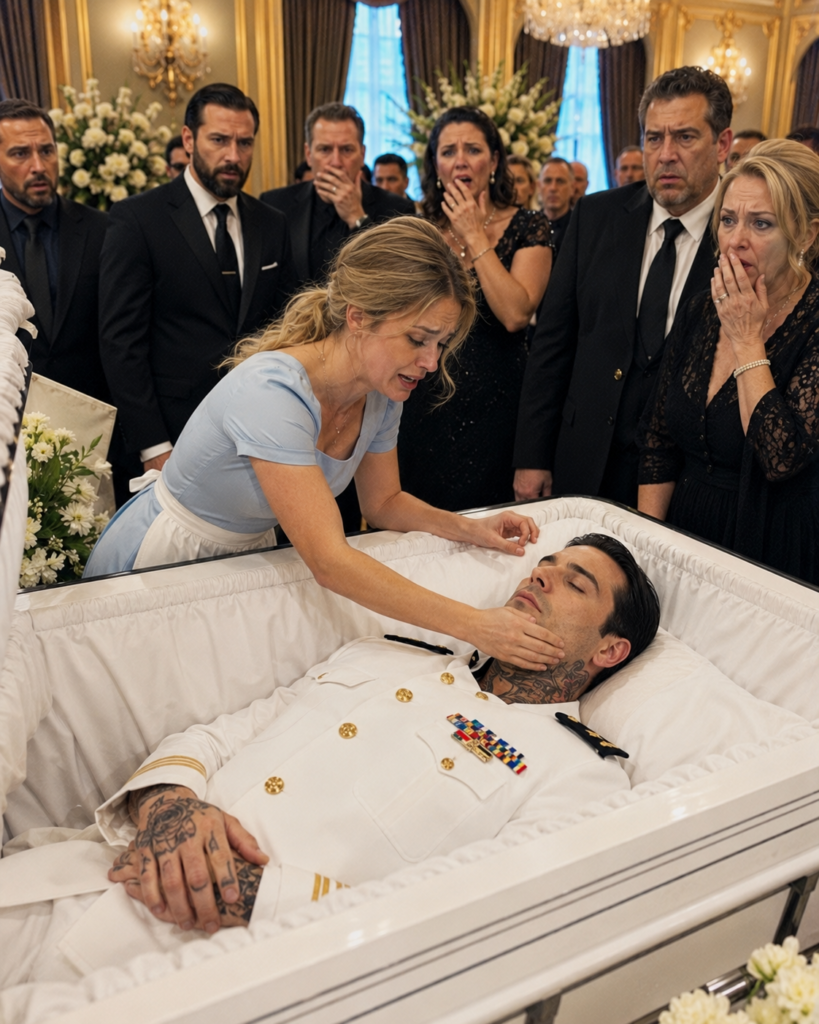
Aleandro looked nothing like a man who had just awakened at his own funeral.
Pale, yes. Unsteady, yes. There was a grayness beneath his skin that made Emma’s stomach twist when she noticed it. But his eyes were alive with a sharpness that seemed to cut through the lingering scent of lilies and wax. He sat in the open casket as though it were a chair at the head of a boardroom table, one hand pressed against the velvet lining, the other still wrapped around her wrist.
Emma swallowed.
“I’m not part of anything,” she said, her voice barely carrying across the marble floor. “I don’t know you. I don’t know these people. I was hired through the catering company. That’s all.”
Aleandro studied her face as though every blink might betray a lie.
“Who hired the catering company?”
“I don’t know. My supervisor gave me the address and told me to wear black.”
“What is your supervisor’s name?”
“Lydia Marsh.”
“Is she here?”
Emma looked toward the doors. “She was. I saw her arguing with one of your men near the kitchen earlier.”
His expression changed. Only slightly, but enough for her to notice.
“What man?”
“I don’t know his name. Tall. Dark hair. Scar near his chin.”
“Vittorio,” he said under his breath.
The name meant nothing to Emma, but the way he said it made the room feel colder.
Aleandro released her wrist, and for a strange second Emma felt the absence of his grip more strongly than she had felt the grip itself. He swung his legs over the side of the casket. The movement was too fast. His face tightened, and one hand clutched the polished edge.
Emma reached forward before she could stop herself.
“You shouldn’t stand.”
He looked at her hand where it hovered near his arm.
“I was about to be buried,” he said. “Forgive me if I don’t feel like lying down.”
“You still need a doctor.”
“A doctor was present when I was declared dead.”
That silenced her.
The ballroom doors opened just enough for the large man Aleandro had called Marco to step inside. He was broad-shouldered, clean-shaven, with kind eyes that did not match the hard line of his jaw. He stopped when he saw Aleandro sitting upright, and something complicated crossed his face. Relief first. Then guilt. Then fear.
“Boss,” Marco said quietly. “Everyone has been moved to the east hall. Security has the exits covered. No one has left.”
“Good. Find Dr. Bellini.”
Marco’s hesitation was almost invisible.
Aleandro noticed it. “What?”
“Dr. Bellini left before the service began.”
Aleandro’s eyes narrowed. “Left?”
“Said he was ill.”
“And no one thought to mention this?”
Marco lowered his gaze. “We were preparing for the service.”
Aleandro let out a breath that was almost a laugh, except there was no humor in it. “For my burial.”
Marco’s mouth tightened. “Yes.”
Emma shifted her weight. The blister on her heel burned, reminding her suddenly and absurdly that she was still carrying a silver tray in one hand. Six champagne flutes sat on it, untouched, each catching the chandelier light. She lowered the tray onto the nearest table with trembling fingers.
Aleandro looked at her again.
“You said you saw Lydia Marsh arguing with Vittorio near the kitchen.”
“Yes.”
“When?”
“Maybe an hour before I came to fix the flowers.” She frowned, forcing herself to remember through the fog of fear. “She looked upset. He had his hand on her elbow. Not hurting her exactly, but… not friendly.”
“What did you hear?”
“Only a few words.”
“Say them.”
Emma rubbed her palms against the sides of her black dress. “He said, ‘You were paid to follow instructions.’ And she said, ‘Not for this.’ Then he saw me, and they stopped talking.”
Marco went very still.
Aleandro noticed that too. “You know something.”
Marco glanced at Emma.
“She stays,” Aleandro said.
Marco drew in a slow breath. “Vittorio oversaw the staff list.”
Emma’s heart sank. “What does that mean?”
“It means,” Aleandro said, his eyes never leaving Marco, “that your presence here may not have been random.”
“That’s impossible,” Emma said. “I picked up the shift yesterday. Someone else canceled.”
“Who?”
“I don’t know. Lydia called and said they needed an extra server. I needed the money.”
Aleandro was silent for several seconds.
Then his expression softened, but only by a fraction. “How old are you, Emma?”
“Twenty-six.”
“Family?”
The question landed like a hand pressing against an old bruise.
“My mother,” she said. “She’s in a care facility upstate.”
“What facility?”
Emma’s suspicion flared. “Why?”
“Because if someone placed you here, there may be a reason.”
“No one placed me here.” Her fear made her voice sharper. “I’m not important enough for whatever this is.”
Aleandro’s gaze held hers. “People who think they are not important are often the easiest to use.”
Emma looked away first.
Outside the ballroom, raised voices echoed faintly through the halls. The house was enormous, all marble corridors and oil paintings, a place built for secrets to move comfortably from room to room. Emma had served in grand homes before, but the Belmont estate felt different. It did not feel lived in. It felt guarded.
Aleandro slid down from the casket.
This time his knees buckled.
Marco crossed the room in two strides, but Emma reached him first. She caught Aleandro’s arm, surprised by the weight of him, by the warmth of him, by the human frailty beneath the legend. For half a heartbeat, he leaned against her.
Close up, she noticed the faint puncture mark near the inside of his elbow.
“Wait,” she whispered.
Aleandro followed her gaze.
Marco did too.
The puncture was small, nearly hidden by the cuff of his shirt, but there it was: a tiny dark dot surrounded by a pale bruise.
Emma looked up. “Did you have an IV?”
“No.”
Marco cursed under his breath.
Aleandro pulled back his sleeve. His expression did not change, but something in his stillness became more dangerous than anger.
“Someone gave me something,” he said.
Emma’s mouth went dry. “Something that made you seem dead?”
“Or close enough.”
Marco stepped toward the doors. “I’ll find Bellini.”
“No.” Aleandro straightened with visible effort. “Find Lydia Marsh first. Quietly.”
“Boss—”
“If she is innocent, she is afraid. If she is involved, she is useful. Either way, I want her found before Vittorio reaches her.”
Marco nodded once and left.
The doors closed again.
Emma and Aleandro were alone.
It should have made her more afraid. In a way, it did. But without the crowd, without all those watchful eyes measuring every breath, he seemed less like a figure from whispered city stories and more like a man standing barefoot at the edge of a cliff he had not known was there.
He turned toward the casket.
For the first time, Emma saw his face crack.
Not much. Not dramatically. His jaw tightened. His eyes lowered to the white satin pillow, to the place where his head had rested while people filed past and bowed over him. His fingers touched the rim of the casket.
“I heard them,” he said.
Emma barely breathed. “Who?”
He blinked, as if surprised he had spoken aloud.
“When I was under, I wasn’t gone the whole time. There were moments. Sounds. A woman crying. A man saying prayers. Someone laughing in the hallway.” His hand closed around the edge of the casket. “And once, I heard my sister say goodbye.”
Emma’s chest ached in spite of herself.
“You have a sister?”
“Lucia.”
“Was she here?”
“Yes.”
He said nothing else, but the one word held more than he meant it to. Emma thought of the dry-eyed women in black silk, of practiced grief and polished masks. Then she thought of one woman she had noticed near the front row earlier. Dark-haired, slender, her hands folded so tightly in her lap that her knuckles had gone white. She had not spoken to anyone.
“I saw her,” Emma said. “She was crying.”
Aleandro looked at her.
“She tried to hide it,” Emma added. “But she was.”
For the first time, something like relief crossed his face.
Then it vanished.
“Lucia must not know everything yet.”
“She saw you sit up in your coffin. I think she knows something.”
A faint, tired smile touched his mouth. “You have a fair point.”
The smile changed him. It took away, for one fleeting second, the cold authority and left behind a man who might have laughed easily once, before too many rooms like this made laughter dangerous.
Emma regretted noticing.
She stepped back. “I should go.”
“No.”
The word was quiet, but final.
“I saved your life,” she said, her courage rising because fear had nowhere else to go. “Or helped save it. And now you’re keeping me here like a prisoner?”
Aleandro’s gaze sharpened. “You are not a prisoner.”
“Then open the door.”
He did not move.
Emma nodded once, bitterly. “That’s what I thought.”
He looked away first this time.
A silence stretched between them. Then he walked to a side table where a crystal pitcher of water sat untouched beside rows of glasses. His hand trembled slightly as he poured. He drank half the glass and set it down too hard.
“I am trying to keep you alive,” he said.
Emma stared at him. “What?”
“Whoever did this did not expect me to wake up. They certainly did not expect a waitress to notice.” He turned back to her. “You are now the only person outside my inner circle who touched me, checked my pulse, and shouted the truth in front of everyone. That makes you either a witness or a loose end.”
The phrase made her stomach turn.
He saw it and seemed to regret his choice of words. “I mean that practically, not cruelly.”
“That doesn’t make it better.”
“No,” he admitted. “It doesn’t.”
The honesty caught her off guard.
Before she could answer, the doors opened again. Marco entered with Lydia Marsh beside him.
Emma had never seen her supervisor look so small.
Lydia was usually brisk, sharp-tongued, and impossible to impress, a woman with a pencil always tucked behind one ear and a schedule clenched in her hand. Now her face was pale, her lipstick faded at the edges. She clutched a black handbag to her stomach like a shield.
Behind her came Lucia Caruso.
Emma recognized her instantly. She moved with the same controlled grace as Aleandro, but her grief had stripped the performance from her. Her eyes were red. When she saw her brother standing beside his own casket, she stopped as though the floor had disappeared beneath her.
“Aleandro,” she whispered.
Something passed between them that did not need words.
Lucia crossed the room quickly. Aleandro met her halfway, and she threw her arms around him with a force that made him wince. He held her anyway. His eyes closed briefly over her shoulder.
Emma looked away, feeling suddenly like an intruder.
“I thought you were gone,” Lucia said, her voice breaking.
“I know.”
“They told me—Bellini told me there was nothing—”
“I know.”
Lucia pulled back, touching his face as if proof required contact. “How is this possible?”
“That’s what we’re going to find out.”
Her gaze shifted to Emma. “You’re the girl who screamed.”
Emma gave a small nod. “I’m sorry.”
Lucia looked startled. “Sorry?”
“For causing chaos.”
Lucia’s eyes filled again. “You gave him back to me.”
The simple sentence settled over Emma more heavily than suspicion had. She did not know what to do with gratitude from people like this. She knew how to carry trays, how to keep her head down, how to accept a tip with a smile even when the customer did not look at her face. She did not know how to stand in the center of a ballroom while a woman looked at her as if she had performed a miracle.
Lydia made a faint sound.
Aleandro turned.
“Ms. Marsh,” he said. “Tell me about the staff change.”
Lydia’s grip tightened on her handbag. “I run a catering team, Mr. Caruso. Staff changes happen.”
“Not this one.”
Her eyes darted toward Emma.
“Don’t look at her,” Aleandro said. “Look at me.”
Lydia looked at him, then immediately wished she had not.
“Who canceled?”
Lydia hesitated.
Marco stepped closer to the door, blocking the exit without saying a word.
Lydia’s shoulders sagged. “Nina Alvarez.”
Emma frowned. “Nina never cancels. She needs the shifts more than I do.”
“She called in sick,” Lydia said.
“When?” Aleandro asked.
“Yesterday afternoon.”
“Did you speak with her?”
A pause.
“No.”
“Text?”
“Email.”
Emma felt cold spread across her back. “Lydia, Nina doesn’t email. She says it feels like sending letters into a cave.”
Lydia’s eyes flicked to her, startled.
Aleandro caught it. “You knew that.”
“No.” Lydia shook her head. “No, I didn’t know. I just received the message and called Emma. That’s all.”
“Then why were you arguing with Vittorio?”
Lydia’s lips pressed together.
Aleandro waited.
The silence became unbearable.
Finally Lydia opened her handbag and took out a folded envelope. Her hand shook as she held it out.
Marco took it first and gave it to Aleandro.
Inside was cash. A lot of it. More than Emma earned in months.
Aleandro looked at the money, then at Lydia.
“I was told to put Emma on the shift,” Lydia whispered.
Emma’s breath caught.
“What?”
Lydia turned toward her, tears bright in her eyes. “I’m sorry.”
Emma stepped back. “You lied to me?”
“I didn’t know what it was for.”
“You were paid to send me here.”
“I thought maybe someone wanted a pretty girl serving near the family table. That happens, Emma. You know it does. Rich people are strange. They ask for certain staff all the time.”
Emma felt humiliation burn through her fear. “So you sold me for tips?”
“No.” Lydia’s voice cracked. “No, I made a terrible choice. But I swear, I didn’t know anyone would be hurt.”
Aleandro’s voice was soft. “Who gave you the envelope?”
“Vittorio.”
“And what instructions?”
“To call Emma Sterling. To make sure she worked the wake. To assign her to the ballroom. And…” Lydia’s voice faded.
“And?” Aleandro pressed.
Lydia looked at Emma with something like apology and terror.
“And to make sure she went near the casket before the service ended.”
The room seemed to tilt.
Emma heard the words, but they did not make sense. She looked from Lydia to Aleandro to Lucia, waiting for someone to explain the impossible shape forming around her.
“You’re saying someone wanted me to find him,” Emma said.
Aleandro’s expression had gone unreadable.
Marco spoke first. “Or wanted it to look that way.”
Lucia wrapped her arms around herself. “Why Emma?”
No one answered.
Because there was no answer.
Aleandro unfolded the envelope completely. Something slipped from inside and fluttered to the floor.
Emma bent automatically and picked it up.
It was a photograph.
Old. Creased. Soft at the corners from being handled too often.
A woman stood outside a brick apartment building, laughing at something beyond the frame. She had light brown hair pulled over one shoulder and a hand resting protectively on the shoulder of a little girl with solemn eyes and a crooked fringe of bangs.
Emma stopped breathing.
The little girl was her.
The woman was her mother.
For several seconds, no one spoke.
Emma’s hand trembled around the photograph. “Where did you get this?”
Lydia looked baffled. “I’ve never seen that before.”
Aleandro stepped closer, but Emma moved away from him.
“No,” she said. “Don’t.”
His face hardened, though not with anger. With focus.
“Emma.”
“Why do you have a picture of my mother?”
“I don’t.”
“It came from the envelope your man gave her.”
“Vittorio is not my man if he did this.”
Emma stared at the photograph until the little girl in it blurred.
Her mother had been young then. Healthy. Before the tremors started. Before the bills. Before the long quiet afternoons when she stared at the wall and seemed to be listening to memories Emma could not hear.
“What is your mother’s name?” Aleandro asked.
Emma almost did not answer.
Then Lucia said gently, “Please.”
Emma looked at her. The softness in Lucia’s voice undid something in her.
“Rose Sterling.”
Aleandro went completely still.
It was not dramatic. He did not gasp or step back. But Emma saw the name hit him. Saw it land somewhere deep.
Lucia saw it too.
“Aleandro?” she asked.
He did not answer her.
Emma’s heart began to pound. “You know her.”
Aleandro looked at Marco. “Get Vittorio.”
Marco nodded and left immediately.
Emma stepped closer, anger finally finding its feet inside her. “Don’t do that. Don’t order people around instead of answering me. Do you know my mother?”
Aleandro’s eyes returned to hers.
“I knew someone named Rose,” he said.
“That’s not an answer.”
“No,” he agreed. “It isn’t.”
Lucia’s face had gone pale again. “Rose Sterling,” she repeated slowly. “That was the nurse.”
Aleandro’s jaw tightened.
Emma looked between them. “What nurse?”
Lucia seemed to realize too late that she had spoken.
Aleandro said her name quietly, a warning.
But Emma was done being handled.
“What nurse?” she demanded.
Lucia met her brother’s eyes. Something silent passed between them. A family argument compressed into a glance.
Then Lucia turned to Emma.
“When my father died,” she said carefully, “there was a private nurse who cared for him during his final months. Her name was Rose. I was young, but I remember her. She was kind to me.”
Emma shook her head. “My mother was a nurse before I was born, but she never worked for people like you.”
“She did,” Aleandro said.
The words were quiet. Final.
Emma’s anger faltered.
Her mother had told her so little about those years. Only fragments. Night shifts. A patient who liked opera. A house with too many locked rooms. Then nothing. Whenever Emma asked about her father, Rose grew distant and said some doors were closed because they had to be.
Emma had thought it was pain.
Now she wondered if it had been fear.
“What does my mother have to do with someone trying to bury you alive?” Emma asked.
Aleandro looked toward the closed doors. “I don’t know.”
But Emma could tell he knew something.
Maybe not the whole answer. Maybe not enough to speak with certainty. But enough to make him careful.
And his carefulness frightened her more than any threat would have.
Marco returned twenty minutes later without Vittorio.
By then the ballroom had been transformed from funeral chamber to investigation room. The casket remained open at the center like an accusation. The flowers had been pushed aside. Aleandro sat in a high-backed chair near the fireplace, wrapped in a dark coat Marco had brought him, while Lucia hovered close enough to catch him if his strength failed. Lydia sat on a small sofa, crying silently into a napkin.
Emma stood apart from all of them, the photograph folded in her hand.
“He’s gone,” Marco said.
Aleandro looked up. “Gone.”
“His car is still here. His phone is in his room. Security has no record of him leaving the estate.”
“Then he is somewhere on the grounds.”
“We’re searching.”
Aleandro’s eyes moved to the windows. Night pressed against the glass. Beyond it, the estate grounds stretched into dark lawns, hedges, guest houses, garages, and winter-bare trees shifting in the wind.
Emma imagined a man moving through that darkness with secrets in his pockets.
She wrapped her arms around herself.
Marco continued, “There’s something else.”
Aleandro’s expression told him to speak.
“The west security cameras went down for eleven minutes before the service began.”
“When?”
“Four thirteen to four twenty-four.”
Emma felt a prickling at the back of her neck.
“What?” Aleandro asked her.
She looked at him. “That’s when Lydia sent me to the ballroom.”
Lydia lifted her head. “I sent you at four fifteen.”
Marco’s face darkened.
Aleandro leaned back slowly, fatigue and calculation warring across his features. “Someone needed her alone with the casket while the cameras were blind.”
“But why?” Lucia asked. “If the goal was to save you, why hide it? Why not call an ambulance?”
“Because saving me was not the only goal,” Aleandro said.
Emma understood before anyone said it.
“They wanted me seen,” she said. “Touching you. Finding you. Screaming.”
Aleandro’s eyes met hers.
“Yes.”
Lydia let out a shaky breath. “Oh, Emma.”
Emma barely heard her.
All day, she had thought she was invisible. Just a waitress moving through the edges of other people’s lives. But someone had seen her clearly enough to choose her. To bring her into a room full of powerful strangers. To place her beside a man who was not dead.
A man connected to her mother’s hidden past.
She unfolded the photograph again.
On the back, in faded blue ink, were three words she had not noticed before.
Tell him Rose.
Emma frowned. “There’s writing.”
Aleandro stood too quickly.
Lucia caught his arm. “Careful.”
Emma handed him the photograph before fear could stop her.
He turned it over. Read the words.
For the first time since waking, Aleandro Caruso looked truly shaken.
“Tell him Rose,” Lucia whispered. “Tell who?”
Aleandro did not answer.
Emma’s patience snapped. “I am tired of being the only person in this room who doesn’t know what’s happening.”
Aleandro looked at her, and the command in his face softened into something else. Not trust. Not yet. But perhaps recognition that she deserved more than fragments.
“My father was named Salvatore Caruso,” he said. “He died nineteen years ago. Officially, from complications after a stroke.”
Emma waited.
“Unofficially,” he continued, “there were questions.”
Lucia’s face tightened. “Aleandro.”
“She’s already in this.”
Emma looked at Lucia. “Questions about what?”
Aleandro held the photograph carefully, as if it might break. “My father had enemies. But near the end, he also had regrets. He became convinced someone close to him was stealing from the family accounts and using the money to build something separate. Something hidden.”
“A rival business?” Emma asked.
“A safety net,” Lucia said softly.
Aleandro looked at her, surprised.
Lucia’s eyes glistened. “I was twelve, not deaf. I heard things.”
He absorbed that with visible pain.
Emma thought of Lucia as a girl in this enormous house, listening behind doors while adults mistook silence for innocence.
“What does that have to do with my mother?” Emma asked.
“Rose was with him the night he died,” Aleandro said. “She disappeared the next morning.”
Emma shook her head. “No. She would never abandon a patient.”
“She left behind a note saying she was afraid.”
“My mother doesn’t run from things.”
“Everyone runs from something,” Aleandro said.
Emma hated how gently he said it.
She looked down at the photograph in his hand. Rose was laughing in it. Emma could not remember the sound clearly anymore. Illness had made her mother quieter year by year, as though it were stealing not just movement but music.
“I need to call her,” Emma said.
Aleandro reached for a phone on the table and handed it to her.
She dialed the care facility from memory.
The first call rang until it disconnected.
She tried again.
This time a nurse answered, cheerful and rushed. “Willow Creek Residence, this is Dana.”
“This is Emma Sterling. I’m calling for Rose Sterling.”
A pause.
Emma’s stomach dropped.
“Ms. Sterling,” Dana said, and the cheer had vanished from her voice. “We were trying to reach you.”
Emma closed her eyes. “What happened?”
“Your mother is safe,” Dana said quickly. “But she had an episode earlier this evening. She became very agitated and kept asking for you.”
Emma gripped the phone. “Is she hurt?”
“No, no. She’s resting now. But she said something strange. We thought it might be confusion, but she repeated it several times.”
Emma opened her eyes.
Aleandro was watching her.
“What did she say?” Emma asked.
Dana hesitated. “She said, ‘Don’t let Emma go to the funeral.’”
The room around Emma seemed to recede.
Her voice came out thin. “When did she say that?”
“Around three o’clock.”
An hour before Emma had gone to the casket.
Before she screamed.
Before Aleandro opened his eyes.
Emma looked at him, the phone still pressed to her ear.
“My mother knew,” she whispered.
Aleandro’s face became unreadable again, but this time Emma could see what it cost him.
Dana continued speaking, but Emma barely heard the words. Something about medication, about Rose sleeping, about calling back in the morning. Emma thanked her automatically and ended the call.
For a moment, no one moved.
Then Aleandro said, “We need to speak with her.”
Emma laughed once, sharp and disbelieving. “No.”
“Emma—”
“No. You don’t get to drag my mother into this.”
“She is already in this.”
“She is sick.”
“I understand.”
“You don’t.” Her voice trembled now, and she hated that it did. “You have no idea what it’s like to watch someone disappear slowly while the bills keep coming and everyone tells you to be grateful for the care you can barely afford. My mother has spent years trying to be left alone. I won’t let you turn her into evidence.”
Aleandro said nothing.
It was Lucia who stepped forward.
“My brother is not asking because he wants to frighten her,” she said. “He is asking because whoever did this may know where she is. They may already have reached her.”
Emma’s anger collapsed into a colder fear.
Lucia’s voice softened. “You saved Aleandro because you noticed what everyone else missed. Let us help you notice what you may not be able to see from the middle of it.”
Emma wanted to refuse.
She wanted to walk out, take a bus home, wash the smell of lilies from her hair, and pretend she had never heard the name Caruso. She wanted her life back, even the hard parts. The bills. The double shifts. The apartment radiator that clanked all night. The ordinary exhaustion that belonged to her.
But ordinary had ended when a dead man breathed under her fingers.
“What happens now?” she asked.
Aleandro looked at Marco. “We move Lucia and Emma somewhere secure tonight. Quietly. Lydia too until we know what she knows.”
Lydia’s head jerked up. “Me?”
“You accepted money from a man who has disappeared during an attempted murder investigation,” Aleandro said. “You are either in danger or still lying. Possibly both.”
Lydia looked as if she might faint.
Emma should have felt sorry for her. Part of her did. Another part remembered the envelope of cash.
“I’m not going anywhere with you,” Emma said.
Aleandro met her gaze. “Then Marco will take you wherever you choose, and two men will watch from outside.”
“No.”
“Emma.”
“No men outside my apartment. No one following me. No one scaring my neighbors.”
“Whoever arranged this knows your name, your mother’s face, and your work schedule.”
The truth settled between them.
Emma closed her eyes briefly.
Then she opened them and said, “I choose where we go.”
Aleandro looked almost amused. “Do you?”
“Yes. Not one of your houses. Not somewhere your people control. Somewhere public enough that no one can make me vanish and private enough that we can talk.”
Marco frowned. “That narrows it down.”
Emma thought of all the places she had worked, all the back rooms, late-night counters, kitchens where nobody asked questions because everyone was too tired to care.
“There’s a diner in Queens,” she said. “Maribel’s. Open all night. I used to work there. The owner knows me.”
Aleandro stared at her. “You want to take me, hours after I woke in a coffin, to a diner.”
“You said I’m not a prisoner.”
Lucia looked between them, then unexpectedly smiled. “I think it’s a good idea.”
Marco looked pained. “Of course you do.”
Aleandro studied Emma for a long moment.
Then he nodded. “The diner.”
Getting out of the estate was like moving through the backstage of a play after the audience had been told to remain seated. The public rooms were silent, but behind doors, voices rose and fell. Security men spoke into radios. Guests were held in separate rooms under polite pretenses. Somewhere, a woman was crying. Somewhere else, glass broke.
Emma walked beside Lucia through a corridor lined with portraits. Aleandro followed with Marco, moving more slowly than he wanted anyone to notice.
At the service entrance, Emma paused.
Her coat hung on a hook beside the kitchen door, a cheap gray wool blend with one missing button. She reached for it, but Aleandro got there first and held it out to her.
The gesture was small. Almost old-fashioned.
Emma hesitated before slipping her arms into the sleeves.
“Thank you,” she said, because manners were hard to kill.
He nodded once.
Outside, the night air struck her face like cold water. The estate grounds stretched wide and dark, the driveway curving between black trees. Two cars waited near the service entrance, engines running without headlights.
As they crossed the gravel, Emma glanced back at the house.
In an upstairs window, someone stood watching.
A figure behind the glass. Still. Half-hidden by the curtain.
Emma stopped.
“What is it?” Aleandro asked.
She looked again.
The window was empty.
“I thought I saw someone.”
Marco’s hand moved toward his jacket, but Aleandro shook his head slightly. Not here. Not in front of her.
Emma noticed the restraint and wondered if it was for her benefit.
The ride to Queens took forty minutes.
Emma sat in the back seat beside Lucia, while Aleandro sat up front with Marco driving. No one spoke much at first. The city slid past in fragments: wet pavement, closed storefronts, glowing pharmacy signs, steam rising from grates, people hurrying home beneath umbrellas though the rain had thinned to mist.
Lucia broke the silence.
“Rose used to braid my hair,” she said.
Emma turned to her.
“At the house,” Lucia continued. “My mother was already gone by then, and my father was ill. Everyone treated me like furniture. Rose didn’t. She would sit with me in the kitchen and braid my hair before school.”
Emma tried to imagine her mother there. Younger, stronger, moving through the Caruso house with gentle hands.
“She never told me,” Emma said.
“Maybe she wanted to protect you from us.”
Aleandro looked out the windshield. “That would have been wise.”
Lucia glanced at him sadly. “You were fifteen. You were not the family.”
“I became it.”
“No,” she said. “You inherited it. That isn’t the same.”
The words stayed in the car long after she said them.
Emma watched Aleandro’s reflection in the window. His face gave little away, but his eyes lowered.
For the first time, she wondered what it had cost him to be Aleandro Caruso. Not the money or the fear or the power people whispered about, but the boy beneath it. Fifteen years old. Father dead. Sister twelve. A name too heavy to put down.
Maribel’s Diner glowed at the corner of a tired block, its red neon sign buzzing in the mist. Inside, the floor tiles were cracked, the booths were patched with silver tape, and the air smelled like coffee, onions, and pancakes. To Emma, it felt safer than any mansion.
Maribel herself stood behind the counter, a stout woman with silver hair and a stare that had ended more arguments than police sirens.
When Emma walked in with a pale mafia boss, his sister, a bodyguard, and her crying former supervisor, Maribel looked over the top of her glasses.
“No,” she said.
Emma almost smiled. “Hi, Maribel.”
Maribel’s eyes moved across the group. “You bring trouble into my diner at midnight?”
“A little.”
“How little?”
Emma glanced at Aleandro.
Maribel sighed. “Back booth. Nobody bleeds on my floor.”
“No one is bleeding,” Emma said.
“Good. Keep it that way.”
They took the booth farthest from the windows. Marco sat facing the door. Lydia slid in beside the wall, exhausted and silent. Lucia ordered tea. Aleandro ordered black coffee, which Maribel refused to bring until he also agreed to toast.
“You look like a ghost with good shoes,” Maribel told him.
For reasons Emma could not explain, that made Aleandro laugh.
A real laugh. Brief, rough, surprised out of him.
The sound loosened something in the booth.
Maribel brought coffee, tea, toast, and a plate of fries no one had ordered. Then she leaned close to Emma and murmured, “You okay?”
Emma nodded.
Maribel did not believe her, but she let it go.
When they were alone again, Aleandro placed the photograph on the table between them.
“My father’s last weeks were chaotic,” he said. “He trusted almost no one. But he trusted Rose.”
Emma wrapped both hands around her coffee mug. “Why?”
“Because she was not impressed by him.”
Lucia smiled faintly. “That sounds like her.”
Aleandro continued, “The night he died, there was a storm. Phone lines went down in part of the city. I remember because I was trying to get back from school and the roads were flooding. By the time I reached the house, my father was gone. Rose was gone too.”
Emma’s voice was quiet. “And you blamed her.”
“I blamed everyone.”
“That’s not an answer.”
He looked at her. “Yes. At first, I blamed her.”
Emma flinched despite herself.
“But then I found something,” Aleandro said. “A note from my father. Hidden in a book only he and I used.”
“What did it say?”
Aleandro reached into his coat and removed a folded piece of paper so worn it seemed held together by memory. He did not hand it to her immediately.
“My father wrote that if anything happened to him, I should find Rose. He said she had the key to the truth.”
Emma stared at the paper.
“Why didn’t you find her?”
“I tried. For years.” His voice lowered. “Rose Sterling vanished. No work records. No forwarding address. Nothing. Whoever helped her disappear knew what they were doing.”
Emma thought of her childhood. Moving apartments twice in one year. Her mother changing phone numbers. The way Rose always chose seats facing doors. The way she once pulled Emma out of a grocery store because a man in line had looked familiar.
Not anxiety, Emma realized.
Memory.
Fear.
Aleandro unfolded the note and slid it across the table.
Emma read the slanted handwriting.
Aleandro,
Trust Rose. I was wrong about many things, but not about her. If I do not survive this, find what she kept safe. It belongs to the children before it belongs to the family.
S.C.
The children.
Emma looked up. “You and Lucia?”
“That is what I thought.”
“But now?”
Aleandro’s gaze dropped to the photograph of Emma as a child.
No one spoke.
Emma felt the diner noise around them: the hiss of the grill, the clink of Maribel stacking cups, the low murmur of a truck driver talking on his phone. Ordinary sounds. Human sounds. They made the silence at the booth feel even more fragile.
“My father wasn’t a saint,” Aleandro said. “I won’t pretend otherwise. But near the end, he was trying to undo something. I never learned what.”
Lydia, who had been silent for so long Emma had nearly forgotten her, spoke in a small voice.
“Vittorio asked about Rose.”
Everyone turned.
Lydia looked down at her hands. “A week ago. He came to the catering office. I thought he was just confirming arrangements. But he saw Emma’s emergency contact form on my desk. Her mother’s name was listed.” She swallowed. “He asked if Rose Sterling was her mother.”
Emma’s fingers tightened around the mug.
“What did you say?” Aleandro asked.
“I said yes.”
Emma closed her eyes.
“I’m sorry,” Lydia whispered again.
This time Emma heard something different in it. Not an excuse. Not panic. Shame.
“Why didn’t you tell me?” Emma asked.
“I didn’t think it mattered.”
“That seems to be a pattern with you.”
Lydia accepted the words like she deserved them.
Aleandro leaned forward. “Did Vittorio say anything else?”
“He asked about Willow Creek. Whether Rose had visitors. Whether Emma paid the bills herself.” Lydia’s voice trembled. “I told him I didn’t know.”
“But you knew the facility.”
“It was on the form.”
Emma pushed the coffee away. Her stomach turned.
Aleandro looked at Marco. “Call Willow Creek. Put someone outside, discreetly.”
Emma began to protest, then stopped.
Her pride was not more important than her mother.
Marco made the call from outside the booth.
Lucia reached across the table and touched Emma’s hand. “We’ll make sure she’s safe.”
Emma wanted to pull away. She didn’t.
“Why do you believe me?” Emma asked.
Lucia seemed surprised. “About what?”
“Not being part of it.”
Lucia glanced at Aleandro, then back at Emma. “Because when my brother opened his eyes, everyone else saw a problem. You looked relieved.”
Emma had no answer to that.
A few minutes later, Marco returned. His expression was tense.
“There’s already someone at Willow Creek,” he said.
Emma stood so fast the mug rattled. “What?”
“Not ours,” Marco added.
Aleandro rose too, one hand braced against the table.
Marco continued, “Nurse says a man came by asking for Rose Sterling ten minutes ago. Claimed to be family.”
Emma’s voice failed.
Aleandro’s did not. “Is he still there?”
“No. He left something for Emma.”
The diner seemed to quiet around them, though no one outside the booth had changed.
“What?” Emma asked.
Marco looked at her with an expression she could not read.
“A sealed envelope.”
Emma’s phone rang.
The sound made her jump.
The screen showed Willow Creek Residence.
She answered with shaking hands. “Hello?”
A different voice came through this time. Older. Thin. Familiar.
“Emma?”
The world stopped.
“Mom?”
Rose Sterling breathed unevenly into the phone.
“Listen to me,” Rose whispered. “There isn’t much time.”
Emma gripped the table. “Mom, are you okay? Who came to see you?”
“Don’t trust the man who wakes from the coffin.”
Emma looked at Aleandro.
He went still.
Rose’s voice broke with fear and urgency. “And don’t trust the name Caruso. Not until you know which brother is buried in the grave.”
Emma’s blood turned cold.
“What does that mean?” she whispered.
But the line crackled.
In the background, a nurse said Rose needed to rest. Rose began speaking faster, each word trembling.
“The key is not metal. It’s blood. I should have told you before, but Salvatore made me promise. Emma, your father—”
The call went dead.
Emma stood frozen, the phone pressed to her ear.
Aleandro’s face had lost every trace of color.
Lucia whispered, “Aleandro?”
Emma lowered the phone slowly.
“What did she say?” Aleandro asked.
Emma looked at him, at Lucia, at the old photograph lying between them like a door finally opening.
“She said not to trust the man who wakes from the coffin,” Emma said.
Aleandro did not move.
Emma’s voice dropped to a whisper.
“And she said the key is blood.”
END OF PART 2 – LIKE, SHARE AND COMMENT “THE ENTIRE STORY” IF YOU WANT TO READ THE FULL STORY