I Came Home to My Wife’s Coffin… But the Cry Upstairs Told Me the Truth Was Still Alive
PART 2
Caleb’s hand disappeared behind his back.
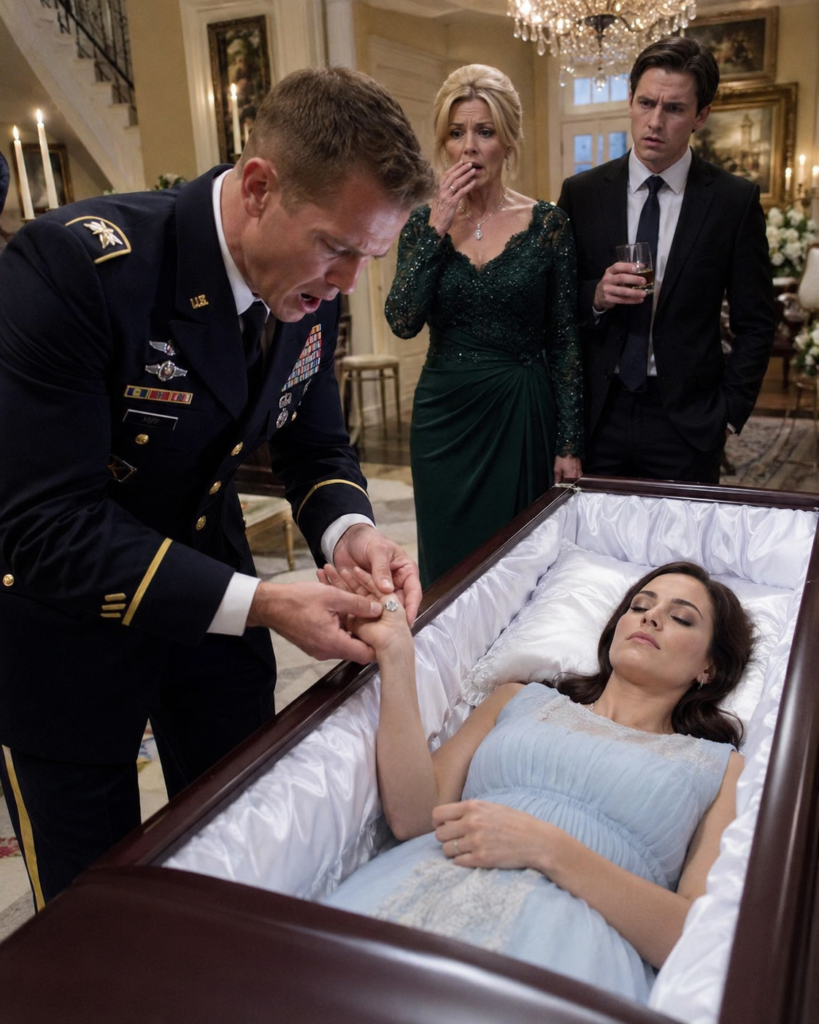
In the space between one breath and the next, the room changed.
The coffin, the pale blue dress, the whiskey glass, my mother’s empty expression—all of it faded into the background as training took over. I didn’t move like a grieving husband then. I moved like a man who had spent eleven months learning how to survive the second before danger revealed its name.
“Caleb,” I said, my voice low. “Don’t.”
His eyes flicked toward mine.
For the first time since I’d walked into that house, the lazy confidence slipped from his face.
My mother whispered, “Daniel, please.”
Caleb’s jaw tightened. “You always do this.”
“Do what?” I asked.
“Act like you’re the only one who knows how to handle things.”
His hand came out slowly.
There was no gun.
Only a phone.
An old black phone with a cracked corner and a strip of silver tape across the back. He held it so tightly his knuckles had gone pale.
I didn’t relax.
Not yet.
“What were you doing?” I asked.
He looked at the phone, then at the coffin, then toward the ceiling where the baby’s cry had softened into small, tired whimpers.
“I was going to call someone,” he muttered.
“Who?”
He didn’t answer.
My mother stepped between us, her black dress rustling around her ankles. “Your brother is upset. We all are. This is a terrible day.”
“A terrible day?” I repeated.
The words left my mouth before I could stop them, quiet but sharp enough to make her flinch. “I came home to find my wife in a coffin in our living room and my newborn son hidden upstairs. Nobody called me. Nobody notified command. Nobody told Emily’s parents. And now my brother is reaching for a phone like he’s afraid I found something I wasn’t supposed to find.”
Margaret’s lips parted.
For a moment, she looked older than I remembered. Smaller too. The proud woman who used to correct waiters for folding napkins wrong suddenly seemed to be standing in a room that no longer obeyed her.
“Daniel,” she said carefully, “you’re in shock.”
“No,” I said. “Shock comes later.”
The baby cried again.
That sound cut through the house like a thread pulling me back to what mattered most. My son. Emily’s son. A child I had never held, never seen, never heard until this nightmare of a homecoming.
I turned toward the staircase.
My mother moved quickly, too quickly for a grieving woman.
“Let me bring him down,” she said.
I stopped on the first step and looked back.
“No.”
Her face tightened. “He’s fragile.”
“Then I’ll be careful.”
“You don’t understand. He’s been through a difficult birth. The doctor said—”
“What doctor?”
Silence.
It was not a long silence, but it was enough.
Caleb looked away.
My mother swallowed. “Dr. Harlan.”
“First name?”
“I don’t remember.”
“You don’t remember the first name of the doctor who delivered my son and pronounced my wife dead?”
Her hand lifted to her pearls. It was an old habit. She touched them whenever she was cornered, thumb rolling over the largest bead as if it could provide an answer.
“You were unreachable,” she said. “Everything happened so fast.”
“I spoke to Emily four days ago.”
Margaret blinked.
I continued, watching both of them. “She told me her blood pressure was fine. She told me the nursery was finished. She told me she had an appointment Thursday morning, and she laughed because the baby kicked every time she heard my voice.”
My voice almost broke on that last part, but I held it together.
“She was alive four days ago,” I said. “Healthy enough to argue with me about whether our son should have my father’s middle name.”
Caleb stared down into his whiskey. “People die suddenly.”
I took one slow step toward him.
He didn’t back away, but his shoulders stiffened.
“Not in my house,” I said. “Not without records. Not without calls. Not without answers.”
The stairs creaked above us.
A soft female voice called down, “Mrs. Halloway?”
Not my mother’s housekeeper. Not a relative. I knew every voice that belonged in this home. That one didn’t.
My head lifted. “Who’s upstairs?”
Margaret closed her eyes.
The woman appeared at the top of the staircase, holding a small bundle wrapped in a cream-colored blanket. She was perhaps in her late fifties, with gray hair pinned at the back of her neck and the tired posture of someone who had spent too many years soothing other people’s emergencies. When she saw me in uniform, her face changed.
Recognition.
Not of me as a person.
Of what I represented.
“Are you Daniel?” she asked softly.
I climbed the stairs before my mother could speak.
The woman did not retreat. She held the baby carefully, protectively, as if she had already decided that whatever was happening downstairs had nothing to do with the child in her arms.
“I’m Ruth,” she said. “I was helping Emily.”
Helping.
Not helped. Not delivered. Not attended.
Helping.
My throat tightened as I reached the landing.
The baby’s face was smaller than I had imagined. Red from crying, eyes squeezed shut, one tiny fist tucked beside his cheek. He had dark hair, just a little of it, lying soft against his head.
For one terrifying second, I couldn’t move.
I had known explosions. Ambushes. Nights where the darkness itself seemed to breathe.
Nothing had ever frightened me like the weight of that child being placed into my arms.
Ruth guided my elbow. “Support his head.”
“I know,” I whispered, though I barely did.
The baby shifted against my chest. His crying faded into a broken hiccup, then another. His tiny mouth opened, searching for comfort he could not name.
A sound escaped me that was almost a laugh and almost grief.
“Hey,” I whispered. “Hey, little man.”
His eyes fluttered.
I forgot the coffin. I forgot my mother. I forgot Caleb’s phone.
For those few seconds, there was only my son’s warmth against me and the impossible cruelty of the fact that Emily was not there to see it.
“What’s his name?” I asked.
Ruth looked uncertain.
My mother answered from below. “Nathaniel.”
I looked down the stairs.
“That wasn’t the name Emily and I chose.”
Margaret’s face hardened. “Emily changed her mind.”
“No,” I said.
One word. No raised voice. No anger on display. But the room received it like a slammed door.
I looked back at Ruth. “His name is James Alexander Halloway.”
The baby stirred, as if the sound of his own name mattered.
Ruth’s eyes filled with something like relief.
“She called him James,” Ruth said quietly. “Every time.”
My mother’s expression sharpened. “Ruth.”
The older woman flinched at her tone, but she did not lower her eyes.
That told me more than she knew.
I carried James downstairs slowly. Each step felt unreal. By the time I reached the living room, Caleb had set his glass on the mantel and shoved both hands into his pockets.
My mother watched the baby with an expression I could not read.
Possession, maybe.
Or fear.
I moved to the armchair by the window, the one Emily used when she read at night, and sat with my son against my chest.
“Ruth,” I said, “tell me what happened.”
Margaret snapped, “She’s exhausted. She’s been up all night.”
Ruth remained at the foot of the stairs. Her gaze moved from Margaret to Caleb, then to me.
“I don’t know everything,” she said. “I only know what Emily told me.”
“When did you last see her alive?”
Ruth’s mouth trembled. “Yesterday evening.”
My hand tightened carefully around James’s blanket.
Yesterday.
Not days ago. Not some vague medical emergency I couldn’t verify.
Yesterday.
“What time?”
“Around seven,” Ruth said. “Maybe a little after. She was upstairs in the nursery. She was frightened.”
Margaret took a step forward. “That is enough.”
“No,” I said. “It isn’t.”
The room went still again.
Ruth pressed her palms together. “Emily called me two weeks ago. She found my number through a women’s support group at the church. She said she needed someone with nursing experience. Someone discreet.”
“Why discreet?” I asked.
Ruth looked at Margaret.
My mother’s mouth became a thin line.
“Because she didn’t feel safe,” Ruth said.
Caleb let out a humorless breath. “That’s ridiculous.”
Ruth’s eyes flashed, not with anger but with exhaustion. “She thought someone was tampering with her prenatal vitamins. She thought someone had been going through her desk. She said documents were missing.”
The memory card felt suddenly heavy in the pocket of my uniform.
“What documents?”
Ruth shook her head. “I don’t know. She didn’t tell me everything. She was careful. But yesterday she called me in tears and asked me to come over. When I arrived, she was packing a bag.”
My mother’s face went rigid.
“She was leaving,” Ruth said.
I looked at Margaret.
For the first time, something inside me cracked open.
Emily had been leaving.
While I was across the world counting the days, she had been alone in this house, pregnant with our child, afraid enough to call a stranger from church.
“Where was she going?” I asked.
“To a friend,” Ruth answered. “I don’t know the name. She said she had proof. She said she couldn’t wait for you anymore.”
Couldn’t wait for me.
Those words landed harder than they should have.
I had promised her I would protect her from anything. From anyone. Then deployment came, and with it the kind of distance love cannot negotiate with. I had thought encrypted calls and careful plans were enough.
They weren’t.
My mother’s voice turned cold. “Emily was unstable toward the end. Pregnancy can do that. She imagined enemies everywhere.”
Ruth turned toward her. “She was scared, not unstable.”
“You barely knew her.”
“I knew enough.”
Caleb stepped in then, his face tight. “This is getting out of hand. Daniel, you need to call the funeral home and let them take her back before this turns into something uglier.”
“Back?” I asked.
Caleb’s eyes flickered.
I stood slowly, keeping James secure against my shoulder.
“You said ‘back.’”
Caleb’s throat moved.
My mother recovered first. “He means the arrangements were already made.”
“No,” I said. “He means she was somewhere else before she was placed in my living room.”
Neither of them answered.
I looked at Ruth. “Was Emily here when she died?”
Ruth began to cry silently.
That was answer enough.
I walked to the coffin.
James slept against me, unaware of the room, unaware of the woman lying just beyond his father’s reach.
Emily looked peaceful in the cruelest way. Peaceful because someone had made her look that way. Her lashes brushed her cheeks. Her lips had been colored softly. Her hands, one now loose and empty, rested against the blue fabric.
But beneath the polish, I saw the truth.
Her left wrist had a faint red mark.
Her dress sleeve almost covered it.
Almost.
I leaned closer.
My mother inhaled sharply. “Daniel.”
“Who dressed her?”
No answer.
“Who dressed my wife?”
Caleb rubbed both hands down his face. “Mom, just tell him.”
Margaret turned on him. “Don’t you dare.”
His eyes were suddenly wet. That surprised me more than anything else had.
Caleb was many things—reckless, resentful, charming when it benefited him—but he was not usually transparent. Now he looked like a man standing on a frozen lake and hearing the first crack beneath his feet.
“I didn’t think she would die,” he said.
My mother’s hand flew to her mouth.
Ruth whispered, “Oh my God.”
I felt the room tilt, but I forced myself to remain standing.
“What does that mean?” I asked.
Caleb looked at Emily, and every drop of arrogance left him.
“She came to me,” he said. “Three weeks ago. She asked if I knew anything about the accounts.”
“What accounts?”
He swallowed. “The trust distributions. The investment fund. Mom had been moving money.”
“I know.”
That startled him.
I said nothing more.
Caleb looked at Margaret. “She told me it was family money. That Daniel was hiding it from us. That Emily had turned him against us.”
My mother’s voice was a whisper. “I raised you both.”
Caleb laughed once, but there was no humor in it. “You raised us to need you.”
Her eyes flashed with hurt.
For a moment, the mask dropped. I saw not a criminal mastermind, not a grieving mother, but a woman who had spent decades confusing control with love until she could no longer tell the difference.
“You were never here,” she said to me. “You were always leaving. Your father left me with debts, with a house full of memories and two boys who looked at me like I was supposed to hold the world together. I did what I had to do.”
“You stole from us,” I said.
“I borrowed.”
“From my wife. From our child.”
Her chin lifted. “Emily was going to ruin this family.”
“No,” Ruth said softly. “She was trying to save herself.”
Margaret turned toward her. “You have no idea what she was doing.”
I looked at Caleb. “Continue.”
He stared at the carpet. “Emily showed me copies of transfers. Not just from you. From the charity account too. The veterans’ foundation Dad started.”
That hit me in a place I hadn’t expected.
My father’s foundation had been small but meaningful. Scholarships. Emergency rent payments. Therapy grants for families waiting too long for government help. After his death, I had let my mother sit on the board because I thought it gave her purpose.
I had not imagined she would hollow it out.
“What did Emily want from you?” I asked.
“She wanted me to help her get the original records from Mom’s office. She thought Mom had forged board approvals.”
“And did you?”
Caleb’s shame was visible now. “I told Mom.”
Ruth closed her eyes.
My mother stood motionless beside the coffin.
“I thought Emily was overreacting,” Caleb said. “Mom said she was trying to steal the house. She said the baby wasn’t safe with her acting like that. She said we just needed to slow her down until you came home.”
“Slow her down how?”
Caleb’s face went pale.
“I don’t know what happened yesterday,” he said quickly. “I swear I don’t. Mom told me Emily went into labor early and panicked. She told me to call Ruth because Emily trusted her. By the time I got here, James had already been born.”
Ruth shook her head. “That’s not true.”
Caleb stared at her.
Ruth wiped her cheeks. “When I arrived yesterday, Emily was still pregnant. She was frightened, but she was clear. She told me she’d hidden copies of everything in a place only Daniel would understand. Then Mrs. Halloway came in.”
My mother’s voice was barely audible. “Stop.”
“She begged Emily to stay,” Ruth continued. “She cried. She apologized. Emily said she would speak to Daniel first. Then she asked me to take a bag to my car.”
“What happened when you came back?” I asked.
Ruth’s hands trembled. “The nursery door was locked. I heard voices. Not shouting. Just… low. Emily sounded upset. Mrs. Halloway told me to wait downstairs. Then Caleb came. He was nervous. He kept asking where his mother was.”
Caleb looked stricken. “I didn’t know.”
“I believe you,” Ruth said, and somehow that made him look worse.
She turned back to me. “About an hour later, Emily went into labor. It was sudden. Too sudden. She kept saying she felt strange. I wanted to call an ambulance, but Mrs. Halloway said Emily had insisted on a private birth and that any hospital record would create problems with your security clearance.”
I looked at my mother in disbelief.
She met my eyes.
For the first time, I saw a flicker of regret.
Not enough.
But it was there.
“Emily knew better,” I said.
“Yes,” Ruth whispered. “She kept asking for a phone. I couldn’t find mine. Her phone was missing. The house line was dead.”
Caleb’s face twisted. “Mom…”
Margaret’s shoulders stiffened. “I was trying to keep everything quiet until Daniel arrived.”
“Emily died,” I said.
My mother looked at the coffin.
Something in her expression collapsed.
“She wasn’t supposed to,” she said.
The words came out as if they had been trapped behind her teeth for hours.
Nobody moved.
Even James seemed to sleep more deeply, his tiny breath warm against my neck.
“She wasn’t supposed to,” Margaret repeated, and this time her voice broke. “I only wanted time. She was going to take Daniel away completely. She was going to expose everything before I could fix it.”
“Fix it?” I asked.
“I had a buyer lined up for the lake property. The money would have gone back. No one would have known.”
“The foundation would have known.”
Her eyes filled. “I was desperate.”
“No,” I said. “Emily was desperate. You were cornered.”
That landed.
Margaret turned away as if I had struck her, though I had not moved.
Caleb sank onto the edge of the sofa and covered his face with both hands.
“What did you do with her phone?” I asked.
My mother shook her head. “I don’t know.”
“Don’t lie.”
“I don’t know,” she snapped, tears finally spilling over. “She must have hidden it.”
I thought of the memory card in my pocket.
Emily had not hidden everything in one place. She was too smart for that. Too careful.
I looked around the room again, not as a husband this time, not as a son, but as the man Emily had trusted when she said someone was stealing from us.
The room was manufactured.
The grief was arranged.
The coffin was staged.
But Emily had left me a path.
I just had to see it.
“Ruth,” I said, “where is the bag Emily packed?”
My mother’s head turned sharply.
Ruth looked toward the hallway.
“I put it in the downstairs closet when Mrs. Halloway told me Emily had changed her mind.”
I moved before anyone else could.
The hall closet smelled of cedar and dust. Coats hung neatly in a row, most of them my mother’s, though this was my house. Behind an umbrella stand, half-hidden beneath a folded blanket, sat Emily’s canvas overnight bag.
I knew it instantly.
She had carried it on our first weekend trip after we got married. A cheap cream-colored bag with brown straps and a little embroidered sunflower near the zipper. She had joked that it was ugly enough to never get stolen.
My hand paused on the strap.
For one second, grief came so fiercely I almost couldn’t breathe.
Then James stirred against me, and I remembered that grief could wait. Truth could not.
I carried the bag into the living room and set it on the coffee table.
My mother whispered, “Daniel, don’t.”
I unzipped it.
Inside were practical things. A change of clothes. Baby blankets. A folder of medical records. A small framed ultrasound photo. A notebook. A sealed envelope with my name written across it in Emily’s handwriting.
Daniel.
My knees weakened.
That one word broke through every defense I had left.
I sat slowly on the sofa, James still tucked safely in one arm, and opened the envelope with my free hand.
The letter inside was written on yellow legal paper. Emily always hated wasting stationery on serious things. She said pretty paper made hard truths look like invitations.
My hands shook as I unfolded it.
Daniel,
If you are reading this, it means I was not able to tell you everything myself.
First, I need you to know that I tried to wait. I really did. I kept telling myself you would come home and we would sit at the kitchen table and make a plan like we always do. You would make coffee too strong, I would pretend to hate it, and everything would feel possible again.
But something is wrong here.
Your mother has been taking money. Not only from us. From the foundation. I found the transfers by accident when the insurance notice came to the house. At first, I thought it had to be a mistake. Then I found Caleb’s name on one of the holding accounts.
Caleb made a sound like he’d been punched.
“I didn’t know,” he whispered.
I kept reading.
I do not know how much Caleb understands. I think she uses him. I think she always has. Please don’t let anger make you miss that.
That sentence stopped me.
Even afraid, even alone, Emily had thought of my brother with more grace than he had shown her.
I continued.
I’m scared because Margaret knows I found the records. She keeps saying I’m confused, that pregnancy has made me emotional, but I know what I saw. I made copies. The memory card has videos and account screenshots. There is another copy somewhere safe.
If anything happens, find the music box in the nursery.
My eyes lifted.
The nursery.
Margaret’s face had gone empty again.
That frightened me more than her tears had.
The letter continued.
There is one more thing. I didn’t tell you because I wanted to be certain. I thought I could handle it until you came home. I was wrong.
Your father’s death may not have happened the way we were told.
For a moment, the words did not make sense.
My father had died six years earlier. A heart attack in his study, according to the medical report. Sudden. Tragic. Clean.
I looked at my mother.
She was staring at the letter, not breathing.
Caleb stood slowly. “What?”
I read the last lines.
I found an old recording in the foundation archive. Your father was afraid of someone close to him. He said if anything happened to him, Daniel would know where to look.
I love you. I’m sorry I couldn’t wait.
Protect our son.
Emily
The letter slipped slightly in my hand.
My father.
Emily.
The foundation.
This was no longer only about stolen money or a staged tragedy. It was a line stretching backward through years of family history, through every silence I had mistaken for grief, every argument my mother had ended by saying, “Your father wouldn’t have wanted this.”
Caleb stood in the center of the room, face drained.
“Dad?” he whispered.
Margaret’s tears had stopped.
That was when I understood something important.
She had cried over Emily.
She had cried over being exposed.
But she did not cry when my father’s name entered the room.
“Mom,” Caleb said, voice breaking. “Tell us that’s not true.”
She looked at him.
Then she looked at me.
“I loved your father,” she said.
It was not an answer.
I moved toward the staircase with James in my arms.
Nobody tried to stop me this time.
The nursery door was half-open, pale morning light spilling across the hallway. Emily had painted the walls a soft green because she didn’t want “a room that shouted boy or girl before the baby could even open his eyes.” Tiny clouds drifted across the ceiling. A wooden rocking chair sat beside the window. On the dresser stood the music box.
It was old, carved dark wood with a brass key at the back. My father had given it to Emily when we announced the pregnancy. I remembered the strange look on his face in the photo she’d shown me from that day, though of course that was impossible. He had been dead for years.
No.
I stopped.
My father had not given Emily the music box.
My mother had.
She had said it belonged to him.
The realization moved through me slowly.
I placed James in the crib, careful and gentle. He remained asleep, one tiny hand open beside his face.
Then I picked up the music box.
It played when I turned the key, a soft, familiar melody. My father used to hum it while fixing things in the garage. Not a lullaby. An old folk song his mother had taught him.
At first, I saw nothing unusual.
Then I noticed the bottom panel.
One screw was newer than the others.
I found a small screwdriver in the nursery drawer, exactly where Emily would have left it, and removed the panel.
Inside was a folded photograph, a flash drive, and an old microcassette recorder.
My heart slammed once.
Behind me, a floorboard creaked.
I turned.
Caleb stood in the doorway.
His eyes were fixed on the recorder.
“I remember that,” he said quietly.
“You do?”
He nodded, almost dazed. “Dad used to carry it everywhere. Said phones made people careless, but tapes made them honest.”
I looked past him.
Margaret stood at the end of the hall.
She did not come closer.
I pressed play.
At first there was only static.
Then my father’s voice filled the nursery.
Thin from age, distorted by the tape, but unmistakably his.
“If this reaches Daniel, then I waited too long.”
Caleb gripped the doorframe.
My father continued.
“Margaret has gotten involved with people she should have stayed away from. I thought it was debt. It isn’t. The foundation money is being used to move funds for someone else. I confronted her tonight. She said I didn’t understand what she’d sacrificed. Maybe I don’t.”
There was a pause on the tape.
A faint sound in the background.
A door closing.
Then my father’s voice lowered.
“I’ve hidden the ledger where Daniel will look when he stops grieving and starts thinking.”
The recording crackled.
A woman’s voice sounded faintly in the distance.
Margaret’s voice.
“Arthur? Who are you talking to?”
My father whispered one final sentence.
“Tell my son the key is not in the house.”
The tape clicked off.
For several seconds, the nursery held only silence.
Then, from downstairs, the front door opened.
A man’s voice called into the house.
“Margaret? It’s Dr. Harlan. Is Daniel home yet?”
Caleb and I looked at each other.
Because at the exact same moment, we both understood.
My mother had said she couldn’t remember the doctor’s first name.
But Dr. Harlan was not a doctor.
He was my father’s former attorney.
END OF PART 2 – LIKE, SHARE AND COMMENT “THE ENTIRE STORY” IF YOU WANT TO READ THE FULL STORY.