PART 2
The baby stopped crying the moment I lifted him.
It was not peace exactly. More like recognition. His tiny body curled against my chest, mouth open, breath hiccupping in broken little gasps, and something in me cracked so cleanly that the sound of it seemed to echo through the room.
My son.
Not the son Margaret had already renamed.
Not the son Caleb was waiting to steal with a forged signature.
Mine.
Emily’s.
The woman with the adoption papers backed away until her shoulder hit the painted wall. She was young, maybe twenty-five, with nervous eyes and a badge clipped crookedly to her sweater. Her lips parted, but no words came out.
“What is your name?” I asked.
She swallowed. “Lydia.”
“Who sent you, Lydia?”
From the doorway, my mother’s voice cut through the nursery.
“Daniel, you are emotional. Give me the child.”
I did not turn around.
The video file on my phone waited like a loaded gun. The screen glowed against the dim room, those three words burning up at me.
If I vanish.
My thumb hovered over it.
“Daniel,” Margaret said again, calmer this time. That was always her most dangerous voice. Soft, almost kind. “You do not understand what you’re holding.”
I laughed once. It came out hollow.
“I’m holding my son.”
“No,” Caleb said behind her. “You’re holding evidence.”
That made me turn.
Caleb stood beside my mother in the hallway, his funeral suit perfect, his tie loosened just enough to suggest grief without surrendering vanity. His eyes were not on the baby. They were on my phone.
He knew.
Maybe not everything, but enough.
I looked back at Lydia. “Were you here when my wife died?”
Her face went pale.
“She didn’t die here,” Lydia whispered.
Margaret moved so fast I almost didn’t see it. “That’s enough.”
I pressed play.
Emily’s face filled the screen.
For a second I forgot the room, the coffin downstairs, the people closing in behind me. I forgot the adoption papers and the forged signature. I forgot the sick sweetness of lilies drifting up from the foyer.
She was alive.
Sitting in our bedroom, wearing my old navy sweater, hair tied back messily the way she did when she was thinking hard. She looked tired, frightened, but steady. Behind her, rain tapped against the window.
“Daniel,” she said on the recording, and my name in her voice almost brought me to my knees. “If you’re watching this, it means I couldn’t get to you first. It means they moved faster than I expected.”
My son stirred against me. I held him closer.
Emily glanced off-camera, then back.
“I need you to listen carefully. Do not trust your mother. Do not trust Caleb. And if anyone tells you I died in childbirth, they are lying.”
A sound came from Lydia, small and terrified.
Caleb stepped into the room. “Turn that off.”
I took one step back, putting the crib between us.
Emily continued.
“I found out six weeks ago that your mother had been transferring money through the foundation. Not small amounts, Daniel. Enough to ruin her. Enough to ruin Caleb too. I didn’t understand at first why she was so interested in my pregnancy, why she kept insisting on private doctors, private nurses, private arrangements.”
The old floorboard creaked under Caleb’s shoe.
“I said turn it off.”
Emily’s face tightened.
“Then I found the agreement.”
The video shook slightly as if she had lifted something in her hands. A document appeared, blurred but readable in parts.
Custody transfer.
Irrevocable consent.
Infant male.
My stomach turned cold.
“She promised my baby to someone,” Emily said. “Not adoption the way normal people mean adoption. A transaction. A cover. She needed money clean enough to hide what she’d stolen, and Caleb helped broker it.”
“That’s not true,” Margaret said.
But her voice had lost its shape.
On-screen, Emily leaned closer.
“If they have him, take him and run. Don’t go to the police in this town. They already know some of it, and at least one of them is helping her. Go to the chapel outside Graymere. Ask for Ruth Bell. She delivered me once when I was a child. I trust her.”
The recording glitched. Emily looked over her shoulder.
Someone had knocked on a door.
Her voice dropped to a whisper.
“One more thing. The baby may not be where they say he is. Your mother planned for two births.”
The video froze.
Then the screen went black.
For three seconds, nobody breathed.
Two births.
I looked down at the baby in my arms.
His eyes were closed now, lashes dark and damp against his cheeks. He was so small, so impossibly real. But Emily’s words moved through me like winter.
The baby may not be where they say he is.
“What does that mean?” I asked.
Margaret stared at me as if she could still command the world into silence.
“It means your wife was unstable.”
“She sounded pretty clear to me.”
“She was paranoid. Pregnancy can change a woman.”
“Don’t,” I said.
Caleb’s jaw flexed. “You think a little video proves anything? She recorded that before the complications. Before she lost blood. Before she panicked.”
“Lydia said she didn’t die here.”
Caleb’s gaze snapped to Lydia.
The young woman flinched as if he had struck her without touching her.
I shifted the baby to one arm and held the phone tighter.
“Where is Emily?”
My mother’s face softened into grief so perfectly I almost hated her for the talent of it.
“She is downstairs, Daniel.”
“No,” I said. “A body is downstairs.”
Silence.
The house seemed to lean inward. The nursery mobile turned slowly in the draft, little silver moons circling above the crib. In the hall, the low murmur of funeral guests floated up, unaware that the dead woman they had come to mourn might not be dead at all.
I walked toward the door.
Margaret blocked me.
For the first time in my life, I saw fear in her eyes.
Not fear of losing me.
Fear of losing control.
“Move,” I said.
“You cannot take that child out of this house.”
“You mean my child?”
She glanced at Caleb.
That glance told me enough.
I stepped past her.
Caleb grabbed my arm.
Not hard enough to hurt the baby. Hard enough to remind me of every summer he had been bigger than me, older than me, better loved by my mother when she needed a weapon and not a son.
“Be smart,” he said quietly. “You don’t even know what you’re protecting.”
I met his eyes.
“Then I’ll find out.”
He tightened his grip.
The baby woke and cried.
Something in Lydia broke.
“Stop,” she said.
All three of us looked at her.
Tears had gathered on her lashes. She clutched the adoption papers against her chest like a shield that had failed her.
“I didn’t know what it was at first,” she whispered. “They told me the mother had died. They told me the father had signed. I only came to finalize transport.”
“Transport where?” I asked.
Lydia looked at Margaret.
My mother’s mouth barely moved. “Careful.”
That one word carried a lifetime of threats.
Lydia’s voice shrank. “North.”
“Where north?”
“I don’t know the final location. I swear. I only have the first address.”
She reached into the stack with shaking hands and pulled free a folded page.
Caleb lunged.
I moved without thinking.
I turned my body away, shielding my son, and Caleb’s hand struck the crib rail instead. Lydia screamed. Margaret shouted his name, not in horror but warning.
The house below fell silent.
Then footsteps.
Many of them.
Funeral guests were coming.
I took the folded page from Lydia and shoved it into my jacket pocket.
Caleb stared at me with open hatred now.
“You always needed rescuing,” he said. “From school, from father, from yourself. Emily made you feel brave, but you’re still the same weak little boy.”
“Maybe,” I said. “But I’m the weak little boy holding the thing you’re all afraid of.”
My mother’s face hardened.
“Take him,” she said.
Caleb moved.
I ran.
I do not remember deciding to. One second I was in the nursery, the next I was down the hall, baby pressed to my chest, my shoulder slamming into a framed portrait of my parents. Glass cracked behind me. Someone shouted. Guests gasped as I reached the staircase.
Below, mourners turned their pale faces upward.
My wife’s coffin sat in the center of the foyer beneath the chandelier.
Closed.
I froze halfway down.
Closed, though Margaret had insisted earlier that Emily was “too changed” for viewing.
Closed, though Emily’s parents had never been called.
Closed, though the funeral had been arranged in less than a day.
The answer was downstairs.
But Caleb was behind me, and my son was in my arms.
I kept moving.
“Daniel!” Margaret cried from above. “He’s not yours!”
The words struck the room like a thrown knife.
Every face turned to me.
I stopped at the bottom step.
My mother descended slowly, one hand on the rail, black dress whispering around her ankles. She had chosen her moment perfectly. An audience always made her stronger.
“You deserve the truth,” she said, voice trembling just enough. “Emily was unfaithful. We were trying to spare you.”
My vision narrowed.
Caleb came to stand beside her.
The mourners watched us as if this were theater, and Margaret had always known how to hold a stage.
“That child,” she said, pointing toward the bundle in my arms, “may not be your son.”
For one terrible moment, the world tilted.
Then the baby opened his eyes.
They were gray.
Emily’s gray.
Not proof. Not science. Not certainty.
But enough to keep me standing.
I looked at the coffin.
“Open it.”
Margaret’s expression went still.
“What?”
“If Emily is inside, open it.”
No one moved.
Even the house seemed to stop breathing.
Caleb’s voice turned low. “Don’t make this uglier than it is.”
“Open it,” I repeated.
An older man near the door, one of my father’s former business partners, shifted uncomfortably. “Margaret, perhaps it would be best to—”
“No,” she snapped.
Too fast.
Too sharp.
The room heard it.
I walked toward the coffin.
My mother stepped in front of me.
“Daniel, I am warning you.”
“You’ve been warning me my whole life.”
I handed my phone to Lydia, who had followed halfway down the stairs, pale but determined.
“Keep recording.”
Then I placed one hand on the coffin lid.
Caleb grabbed my shoulder.
This time, I did not retreat.
I turned and hit him.
It was not heroic. It was clumsy, fueled by terror and grief, and it caught him on the cheek rather than the jaw. But it was enough. He stumbled back into a table of sympathy cards, sending white envelopes scattering like birds across the marble floor.
A woman screamed.
I lifted the coffin lid.
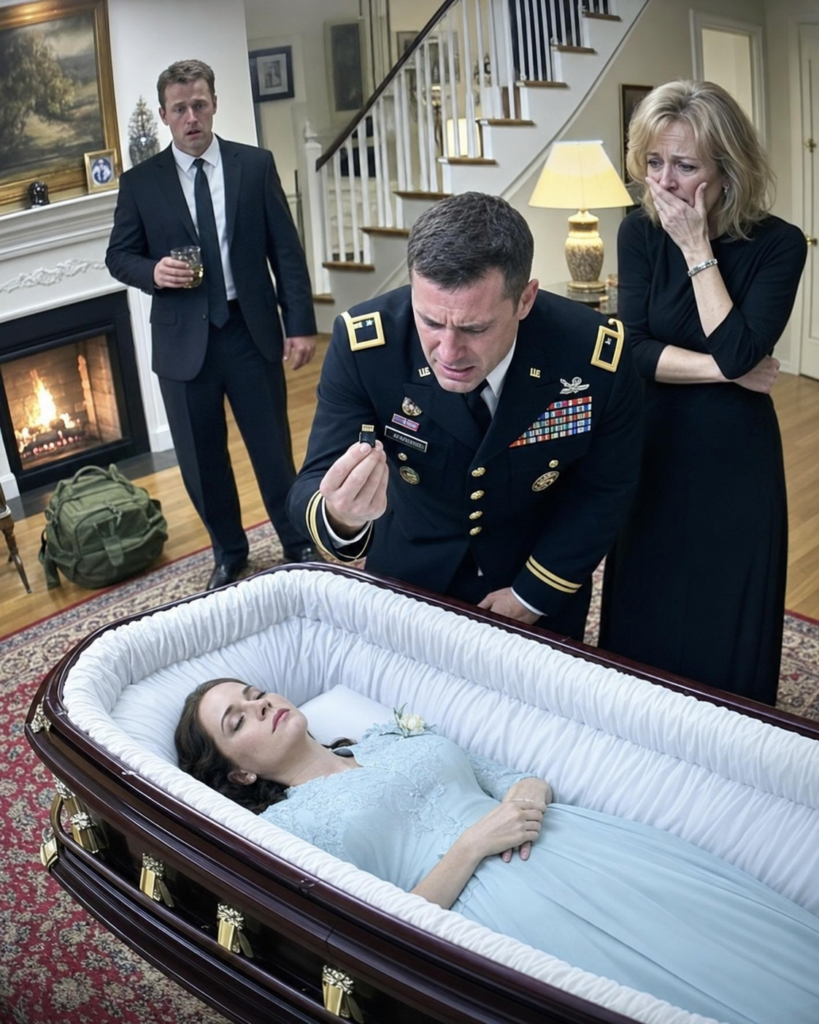
Inside was not Emily.
At first the room did not understand what it was seeing.
There were blankets arranged in the shape of a body. A dark wig. A dress Emily had worn once to my company dinner. A sealed pouch of lavender tucked near the collar to mask the wrongness of it all.
No face.
No wife.
No corpse.
Only a performance.
The room erupted.
Margaret’s composure finally cracked.
“Close it,” she hissed.
But the mourners were backing away from her now. Phones appeared. Whispers became accusations. Someone said police. Someone else said fraud. Lydia stood on the stairs with my phone raised, recording everything.
Caleb wiped blood from the corner of his mouth and smiled.
It chilled me more than my mother’s fury.
Because he did not look defeated.
He looked relieved.
Then the front doors opened.
Two police officers stepped in.
For one wild second I thought help had arrived.
Then I saw Margaret exhale.
The taller officer, a broad man with sandy hair, scanned the room and found me immediately.
“Daniel Whitmore?”
I held my son tighter.
“Yes.”
“We received a report of a disturbance. Also a report that you may be attempting to abduct an infant.”
The room spun.
“My infant,” I said.
The officer glanced at the empty coffin, but not with surprise.
He already knew.
Emily had warned me.
Don’t go to the police in this town.
Margaret stepped forward, suddenly fragile again. “Officer Hale, thank God. He is grieving. He has become violent.”
Officer Hale.
The name landed somewhere deep in memory. I had seen him at my mother’s charity dinners. Standing near the bar. Laughing with Caleb. Accepting envelopes during silent auctions.
My mother had built a town out of favors.
And now the town had come to collect me.
“Sir,” Hale said, “put the child down.”
“No.”
His hand moved toward his belt.
The baby fussed.
The room blurred at the edges. I could run through the back hall, maybe reach the kitchen, maybe the garden door. But with a newborn? With officers at the entrance and Caleb near the stairs?
Then Lydia did something brave.
She screamed.
Not a normal scream. A sharp, piercing sound that made everyone turn.
Then she threw the adoption papers into the air.
Pages flew everywhere.
“Forgeries!” she shouted. “They’re all forgeries! Look at the dates!”
Chaos broke open.
Mourners grabbed pages. Someone cursed. Someone shoved past the officers to get away from the scene. In the confusion, I saw the narrow gap by the dining room door.
I ran.
Behind me, Hale shouted.
I cut through the dining room, past silver trays of untouched food, past photographs of Emily smiling beside me, past a life that had apparently been built over a trapdoor. My son cried against my chest, and I whispered nonsense to him as I burst into the kitchen.
The back door was locked.
Of course it was.
I grabbed a chair and smashed the glass panel.
No time for keys. No time for pain. I cleared the jagged edges with my sleeve and pushed through into the cold afternoon.
The garden was wet from rain, the grass slick beneath my shoes. My car was in the front drive, impossible to reach. But Emily’s old green hatchback sat beside the greenhouse under a tarp.
She had refused to sell it.
“It has a loyal soul,” she used to say.
I tore the tarp off with one hand.
The keys were not in it.
A shout came from the house.
I searched the visor. Empty.
Glove compartment. Empty.
Then I remembered Emily’s habit of hiding things where no one practical would ever look.
I opened the ashtray.
The keys were inside, attached to a tiny silver moon.
I almost laughed.
The engine coughed twice before starting.
As I pulled away, Caleb appeared at the garden gate with Officer Hale behind him. Hale raised his arm, but Caleb stopped him. Not out of mercy. Never that.
He wanted me to run.
He wanted the story to become kidnapping, hysteria, guilt.
I drove anyway.
The baby quieted once the car reached the old road out of town. His breathing settled into small uneven sighs. I kept one hand on the wheel and one hand on his blanket, as if touching him could keep the world from taking him.
Only when the house disappeared behind the trees did I pull the folded page from my pocket.
An address.
Not a hospital. Not an agency.
A motel outside Graymere.
Room 6.
Beneath the address, in hurried handwriting, were two words that made my pulse slow to a dangerous calm.
Second child.
I drove to the chapel first.
It stood alone on a hill five miles outside Graymere, a white wooden building with peeling paint and a bell tower that leaned slightly against the sky. The cemetery behind it was old, stones tilted like tired teeth. No cars waited outside.
I parked behind a line of cedar trees.
Inside, the chapel smelled of dust, candle wax, and rain-soaked wood.
A woman sat in the first pew.
She was small, elderly, wrapped in a brown coat, with silver hair pinned at the back of her head. She did not turn when I entered.
“You’re late,” she said.
I stopped.
“Ruth Bell?”
She turned then.
Her eyes went first to the baby.
Then to my face.
“Oh,” she whispered. “She got one out.”
My mouth went dry.
“One?”
Ruth stood slowly, gripping the pew for support.
“Give him here. Let me see.”
Every instinct in me resisted.
She noticed.
“Good,” she said. “Don’t trust easily. Emily chose well.”
At the sound of Emily’s name, my chest tightened.
“Is she alive?”
Ruth’s expression changed.
Not grief.
Not hope.
Something guarded.
“I don’t know.”
It was the most honest answer anyone had given me all day.
She led me into a small room behind the altar where a stove ticked in the corner and a kettle sat untouched. There was a bassinet there. Clean blankets. Bottles. Supplies.
Prepared.
“Emily came to me three weeks ago,” Ruth said. “She said Margaret planned to take the child. I thought she meant one baby.”
“She was carrying twins?”
Ruth nodded.
The room seemed to fall away beneath me.
Twins.
My son had a brother. Or a sister.
“Why didn’t anyone tell me?”
“Because Emily only found out late, and the second baby was smaller. Hidden on early scans, she said, or hidden from you. I don’t know which.” Ruth’s mouth tightened. “She believed your mother knew before either of you did.”
I sat down hard.
The baby in my arms made a sleepy sound.
“What happened the night she disappeared?”
Ruth looked toward the chapel door as if expecting footsteps.
“Emily called me. She was frightened. She said labor had started and she was being moved. Not to a hospital. To a private place. I drove toward the address she gave, but when I arrived, there were already men outside. Not doctors. Not family.”
“Where?”
Ruth hesitated.
“The old Bellweather clinic.”
My blood went cold.
The Bellweather clinic had closed twenty years ago after funding scandals tied to my father’s company. Margaret had always called it “an unfortunate chapter.”
Another lie buried under another polished phrase.
“Did you see Emily?”
“No. But I saw Caleb leave with a woman wrapped in a blanket. She was alive, Daniel. Weak, but alive.”
I closed my eyes.
Alive.
The word hurt more than death because it gave me something to lose again.
“And the babies?”
“I saw one carried out by a nurse. A boy. That must be him.” Ruth looked at the child in my arms. “The second was taken in a black car before dawn.”
My hand went to the folded page.
“Motel outside Graymere. Room 6.”
Ruth’s face drained of color.
“No.”
“What?”
She crossed the room and locked the chapel door.
“What?” I demanded.
“That motel is not where they keep children,” she said. “It’s where they exchange them.”
We left the chapel ten minutes later in Ruth’s truck.
Emily’s hatchback stayed hidden behind the cedars. Ruth said my mother would have every road watched by now, every camera checked, every version of me rewritten before sunset. Grieving husband. Unstable man. Violent son. Kidnapper.
The story was already moving without me.
The motel sat off a dead highway, half its sign burned out so that GRAYMERE REST read only GRAY REST in flickering red letters. Six rooms. Six doors. One vending machine humming beside an ice chest.
Room 6 had its curtains drawn.
No cars in front.
Ruth parked behind a gas station across the road.
“You stay with the baby,” she said.
“No.”
“Daniel—”
“I have lost enough rooms by standing outside them.”
So we crossed together.
Every step felt too loud.
At Room 6, Ruth knocked twice, paused, then once more.
Nothing.
She tried the handle.
Unlocked.
The room smelled of bleach and old smoke.
At first, it looked empty.
Bed made. Lamp on. Television muted. A paper cup beside the sink. Then I saw the envelope propped against the mirror.
My name was written on it.
Not Daniel.
Danny.
Only Emily called me that.
I opened it with numb fingers.
Inside was a photograph.
Emily sat in a chair, alive, holding a newborn wrapped in a white blanket. Her face was pale, her eyes exhausted, but she was looking directly at the camera.
On the back, one sentence was written.
Choose which son you want to save.
The room tilted.
Ruth reached for the wall.
I turned the photograph over again, searching for anything, any clue in the background. A curtain. A table. A shadow. There was something behind Emily’s shoulder: a painted blue door with a brass number.
Then my phone buzzed.
Unknown number.
A message appeared.
You opened the coffin. Poor choice.
Another buzz.
A video.
My hand shook as I tapped it.
The screen showed Emily in the same chair from the photograph. She looked into the camera, but her expression was strange. Not afraid exactly.
Warning.
A man’s voice spoke from behind the phone.
“Tell him.”
Emily swallowed.
“Daniel,” she said. “Listen to me. Don’t bring him to the police. Don’t bring him to Ruth again. Don’t trust the baby.”
I stopped breathing.
The camera moved.
For one second, it pointed down.
At the newborn in her arms.
Then farther.
At a small plastic hospital bracelet around the baby’s ankle.
Baby B.
The video ended.
Ruth whispered a prayer.
I looked down at the child sleeping against my chest.
My son.
Baby A.
The baby Emily had told me to take and run with.
The baby my mother had tried desperately to keep in the house.
The baby Caleb had called evidence.
Don’t trust the baby.
The words made no sense.
Then, from somewhere inside the motel wall, another baby began to cry.
Not from Room 6.
From behind it.
Ruth and I stared at each other.
The cry came again, thin and urgent, muffled by plaster.
I crossed the room and pressed my ear to the wall.
There was a door hidden behind the full-length mirror.
And on the floor beneath it, someone had slipped a second envelope.
This one was sealed with Margaret’s black wax.
My son opened his gray eyes.
And smiled.
…If you want to know what happened next, please type “YES” and like for more.