March arrived with mud, wind, and a kind of work that did not care how tired Martha was. The first week nearly broke her hands. The old chicken coop had to be shoveled out before the hens could settle properly, and the smell was so sharp that her eyes watered even with both doors open. The nesting boxes had rotted through in places. One wall had pulled away from its frame. Mice had chewed through feed sacks abandoned years before. Every corner of the place seemed to contain another problem hiding behind the last one.
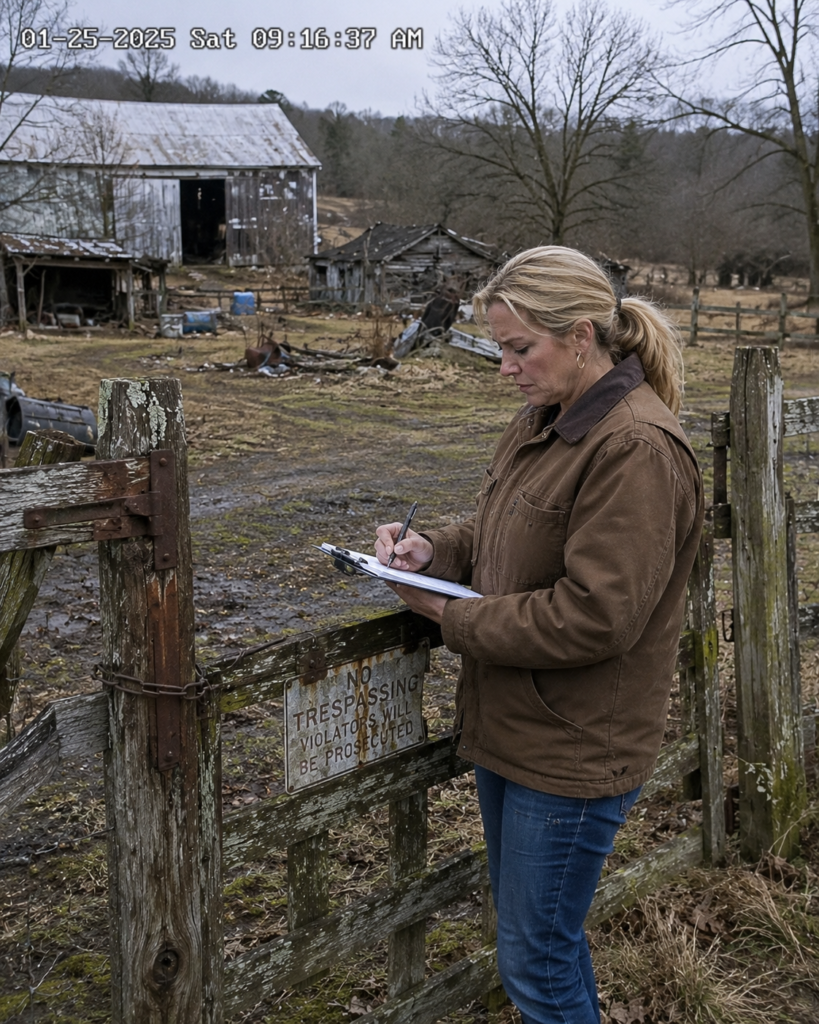
Martha worked through them one at a time.
At dawn, she fed the hens and checked water. After that, she walked the perimeter fence with a roll of wire and a pocket full of staples. She learned quickly that the farm looked smaller from the road than it felt on foot. Sixty-five acres could stretch into eternity when every fence post leaned, every gate stuck, and every pasture held brambles thick enough to claw through denim. By noon, she was usually sweating through her shirt beneath her coat. By evening, her shoulders trembled when she lifted a mug of coffee.
Dale came on weekends from Maryland, arriving in a dented blue truck with tools, sandwiches, and the cautious expression of a man who loved his sister enough to help her attempt disaster. He never said he thought she was crazy. That was why Martha trusted him more than anyone.
“You know,” he said one Saturday, standing in the barn beside the old John Deere, “normal people buy a hobby garden first.”
Martha was crouched by the tractor’s front tire, studying cracked rubber and rusted bolts. “Normal people also spend thirty years complaining about the life they never tried.”
Dale grinned. “Fair.”
Together they replaced the tires, cleaned the fuel lines, changed filters, and coaxed the tractor back from the dead with more patience than confidence. When the engine finally coughed, sputtered, and roared awake, Martha stepped back as if something holy had happened. The sound rolled out of the barn and across the neglected fields, loud enough that a flock of blackbirds lifted from the trees.
She laughed then, suddenly and hard, with grease on her cheek and tears in her eyes.
The greenhouse came next. Many of the panels were cracked, but the frame still held. Martha patched what she could, replaced what she had to, and sealed gaps with numb fingers while cold wind cut across the yard. Inside, the remnants of old tomato vines clung to wires like brittle ghosts. She cleared them away carefully, swept broken glass from the benches, hauled in trays, soil blocks, and seeds, and planted kale, spinach, and mixed greens that could handle the lingering cold.
At night, after the animals were settled and the farmhouse groaned around her, Martha sat at the kitchen table with her three-ring binder open beside a plate of whatever meal she had been too tired to cook properly. The binder had tabs for livestock, soil, markets, repairs, restaurants, CSA models, crop calendars, feed costs, and emergency plans. It was not pretty. It was not romantic. It was full of notes, numbers, diagrams, and handwritten warnings she had copied from farmers who knew more than she did.
She trusted that binder because she had built it before she bought hope.
The pigs were the first real test. Martha set up portable electric fencing and moved them into a section of overgrown pasture where the soil had been compacted by years of neglect. The Berkshire pigs were strong, clever, and deeply uninterested in Martha’s schedule. They rooted where they pleased, tested every weak spot in the fence, and once managed to escape just far enough to send Martha sprinting through mud while Dale laughed so hard he nearly dropped the feed bucket.
But they did what she had hoped they would do. They disturbed the ground. They tore through weeds. They turned hidden soil to the surface. After they moved on, Martha followed with seed and compost, beginning a rhythm that felt less like control and more like cooperation.
Neighbors noticed.
At first they noticed in the way rural people notice things: quietly, from trucks that slowed near the gate, from glances cast over fence lines, from conversations in feed stores that stopped when Martha walked in. She understood. Farming communities respected work, but they did not hand out trust quickly, especially to someone who had arrived with savings, no recent farming experience, and a binder.
One afternoon in April, a man named Calvin Reist knocked on the farmhouse door. He lived down the road and had farmed his place for thirty years. Martha recognized his truck before she recognized him. He stood on her porch with his cap in his hands and looked past her toward the southern pasture.
“I’m not here to be rude,” he said, which usually meant rudeness was coming. “But that ground down there is dead.”
Martha wiped her hands on a towel. “Dead?”
“Worn out. Sour. Compacted. Whatever word you like. Harold stopped working it right years before he left. You’ll waste money trying to get anything out of that section before two years of remediation. Maybe more.”
She looked toward the pasture where the pigs were busy making a mess that, to her, looked like possibility.
“I appreciate you telling me,” she said.
Calvin seemed surprised by her calm. “I mean it. You can’t rush land.”
“No,” Martha said. “But you can listen to it.”
He studied her for a second, perhaps trying to decide whether that was wisdom or nonsense. Then he nodded once and left.
Martha went back to work.
By May, the greenhouse had changed from a cracked shell into a green room full of life. The first spinach leaves were tender and dark. The kale stood firm. The mixed greens came up in thick, bright rows that made Martha pause every time she opened the door. She harvested carefully, washed everything in cold water, packed the greens in clean bags, and loaded them into the pickup before sunrise on a Saturday.
The Lancaster City farmers market was already busy when she arrived. Around her, established vendors arranged perfect displays with the ease of people who had done this for years. Martha’s table looked plain by comparison. A white cloth. A hand-painted sign that read Bowman Hollow Farm. Greens stacked in neat rows. A cooler with eggs from the first hens beginning to lay steadily.
She stood behind that table with mud still beneath one fingernail and told herself not to expect too much.
The first customer was an older woman in a wool coat who picked up a bag of spinach, turned it over, and asked, “You’re new?”
“Yes, ma’am.”
“Where’s your farm?”
“Outside Quarryville. Old Grath place.”
The woman looked up sharply. “That place? Someone bought it?”
“I did.”
The woman stared at Martha, then at the greens. “Well,” she said, placing two bags on the table, “let’s see what kind of miracle you’re growing out there.”
By ten-thirty, Martha had sold everything.
She sat in her truck afterward with the empty crates stacked behind her and both hands wrapped around the steering wheel. She had not made a fortune. After market fees, fuel, packaging, and seed costs, the profit was modest. But it was real. The farm had produced something. People had paid for it. The land that everyone had called useless had sent food into town.
The next Saturday, she sold out again.
By June, two local restaurants had called.
Part 3
The first restaurant chef arrived on a Tuesday morning wearing clean boots that proved he had expected a charming farm tour rather than the muddy truth of Bowman Hollow. His name was Evan Rourke, and he ran a small restaurant in Lancaster that had built its reputation on seasonal food and expensive simplicity. He walked through the greenhouse with Martha, pinching leaves between his fingers, tasting carefully, nodding as if each plant were answering a question.
“You’re growing this here?” he asked.
Martha looked around at the rows of greens surrounding them. “Unless someone is sneaking in at night and helping.”
He smiled. “You’d be surprised what people claim at markets.”
“I don’t have time to claim anything I’m not doing.”
That made him laugh, and by the time he left, he had asked for weekly deliveries of greens and herbs once her herb beds came in. A second restaurant followed soon after. Then a café owner asked about eggs. Then a small bakery wanted to know if Martha could supply them regularly when her flock expanded.
The expansion was already underway.
Those first forty hens had become the beginning of a system Martha had studied for months. She built mobile shelters with Dale, lightweight enough to move but sturdy enough to protect the birds. She rotated the flock across pasture behind the pigs and ahead of her planting plans, letting the hens scratch, fertilize, and clean up what the larger animals disturbed. It required timing, fencing, water lines, feed calculations, predator precautions, and constant observation. It was not simple. It was not cute. It was logistics with feathers.
And logistics, Martha understood.
By midsummer, the flock had grown to more than two hundred birds. The eggs came in shades of brown and cream, some speckled, some smooth, all with yolks so rich and golden that customers began talking about them before Martha ever had to advertise. She hand-stamped plain cartons with the words Bowman Hollow Farm and sold them at market, then through subscriptions, then from a cooler at the end of her lane with a lockbox bolted to the stand.
One Friday evening, Dale filmed her collecting eggs at sunrise. The video was nothing special in Martha’s mind. She wore an old flannel shirt, her hair pinned badly under a cap, the sky pale pink behind the barn. The hens moved around her boots, murmuring and scratching. She lifted warm eggs from the nesting boxes and placed them carefully into a basket, speaking softly to the birds as if they were coworkers who deserved respect.
Dale posted it online without much thought.
By Monday, the video had been shared thousands of times.
Martha found out when her phone began buzzing so often she thought something was wrong. Strangers were asking where they could buy eggs. Local pages were sharing her story with captions about the woman who brought the old Grath farm back to life. People she had not spoken to in years sent messages saying they were proud of her, as though pride were easier after evidence appeared. A former coworker from the warehouse wrote, I guess you knew what you were doing after all.
Martha stared at that message for a long time before setting the phone face down.
The attention did not change the work. If anything, it complicated it. More customers meant more pressure, and farms did not produce on command simply because people were suddenly interested. Rain came when it wanted. Heat came hard. Animals got sick at inconvenient times. Equipment broke at the worst possible moment. One humid July afternoon, a water line failed near the pig pasture, and Martha spent four hours repairing it while thunder rolled in the distance. Another morning, she found a fox had tested the edge of a poultry fence, leaving feathers and panic but, by luck and reinforcement, no dead hens.
Still, the farm kept moving.
The southern pasture became Martha’s private obsession. Calvin’s warning had lodged somewhere in her mind, not as discouragement but as a challenge she wanted the land itself to answer. She had not dismissed him. He knew farming. He knew that soil could be exhausted past usefulness for a time. But Martha also knew that neglected did not always mean dead. Sometimes it meant waiting for the right disturbance, the right cover, the right amendment, the right rhythm.
After months of pig rotation, compost application, cover cropping, and careful rest, she sent soil samples for testing. Then she tried not to think about them. When the results came back, she opened the email at the kitchen table with rain hitting the windows and one boot still unlaced.
The organic matter levels had improved more than anyone had predicted.
Not perfect. Not magical. Not the fairy tale version people preferred when they told stories after the struggle was over. But healthy. Alive. Recovering.
Martha printed the results and slipped them into the binder behind the soil tab. Then she stood at the sink, looked out toward the southern field, and whispered, “I knew you were still in there.”
In late July, she planted winter squash in that pasture. It felt risky enough to wake her at night. She walked the rows daily, checking leaves, moisture, pests, growth. The plants took hold. Then they spread. By September, vines ran across the field in thick green arms, and squash swelled beneath broad leaves like proof hiding in plain sight.
That was when Calvin Reist came back.
Martha saw his truck before she saw him. It rolled slowly down the lane and stopped near the southern pasture. Calvin got out and walked to the fence without calling for her. He stood there a long while, one hand resting on a post, staring at the squash.
Martha left the barn and crossed the yard. She did not hurry. Something told her not to interrupt whatever was happening inside him.
Finally, Calvin turned. His face carried no embarrassment, only a kind of humbled curiosity that made him look younger.
“I don’t know what you did,” he said, “but I’d like to learn.”
Martha leaned against the fence beside him. “The pigs did most of the rude work.”
He gave a short laugh. “Maybe I’ve been too polite with my fields.”
They stood in silence, watching the pasture that had been called dead produce food under the September sun. After that day, Calvin stopped being one of the men who drove past slowly and became one of the men who pulled in. He asked questions. He offered advice when it was useful. He sent customers to her farm stand when he had more than he could supply. In a place where approval was rarely announced, that was as close to a blessing as Martha could have hoped for.
But success brought its own kind of strain. By autumn, Martha was running on discipline more than energy. The CSA she had launched had grown faster than expected, with families signing up for eggs, greens, herbs, and future pork shares. Sixty-seven members came every other week, parking near the barn and walking through a farm that no longer looked abandoned. Children pointed at goats. Restaurant buyers checked crates. Neighbors who once whispered now asked whether she needed help.
The farmhouse still needed repairs. The barn roof still leaked in one corner. The driveway became a river of mud after hard rain. Martha’s back hurt most mornings before she even stood up. Some nights, she was too tired to eat. Some nights, the loneliness hit harder than the labor, and she sat at the old kitchen table with invoices spread around her, wondering whether a life could be right and still hurt this much.
Then dawn would come. The hens would call. The goats would complain. The greenhouse would glow faintly in the first light.
And Martha would get up.
Part 4
Winter did not arrive as an ending. It arrived as an audit.
By November, the farm looked different from the forgotten place Martha had purchased nine months earlier, but difference did not mean ease. The growing season slowed, the air sharpened, and every weakness in her system announced itself. A cracked water fitting that had been merely annoying in September became urgent when nighttime temperatures dropped below freezing. Feed costs climbed. Restaurant orders shifted with seasonal menus. Customers who had loved the romance of summer farm pickups were less enchanted when the wind cut across the yard and mud sucked at their shoes.
Martha had expected this. Her binder had warned her. Farmers she visited before buying the land had warned her. Winter, one of them told her, tells you whether you built a farm or just survived a season.
So she adjusted. The greenhouse became the heart of the cold months. She planted more kale, spinach, chard, parsley, cilantro, and hardy herbs, using row cover inside the patched structure when the nights grew bitter. The goats were moved closer to the barn. The pigs were bedded deep and monitored carefully. The hens kept laying, though at a slower rate, and Martha communicated honestly with subscribers instead of pretending production could remain unchanged.
That honesty did something advertising could not. People trusted her.
At the CSA pickup before Thanksgiving, Martha stood in the barn beneath strings of plain work lights while members collected eggs, greens, herbs, squash, and the first pork shares from the Berkshire pigs. The barn smelled of hay, cold air, coffee from a thermos, and the faint sweetness of stored squash. A mother with two young children told Martha her son had started eating spinach because he knew “Miss Martha grew it.” An older man said the eggs reminded him of the ones his mother used to buy before supermarkets made everything taste the same. One restaurant chef brought her a container of soup made from her greens because, he said, “You feed everyone else. Someone ought to feed you.”
Martha took it home that night and cried while eating it at the stove.
Not because she was sad. Because for the first time in years, she felt the strange weight of belonging somewhere that demanded everything from her and still gave something back.
In December, the county agricultural office called.
At first, Martha assumed there was a permit issue or a form she had forgotten. She answered the phone in the greenhouse, tucking it between her shoulder and ear while trimming greens.
“Martha Bowman?” a woman asked.
“This is Martha.”
“This is Elaine Porter from the county agricultural office. We spoke last year before you purchased the Grath property.”
Martha remembered. Elaine had been kind, professional, and clear. The soil was in poor condition. The property required serious remediation. Expectations should be realistic. Martha had not resented her for it. Warnings were not the same as insults.
“Yes,” Martha said. “I remember.”
“I’ve been following what you’ve done out there,” Elaine said. “And I wanted to ask whether you’d consider speaking at our farmland preservation conference in February.”
Martha straightened so quickly she nearly dropped the shears.
“Speaking?”
“Yes. We’re putting together a session on small-scale recovery of neglected agricultural land. Your first-year results are unusual, and frankly, a lot of people are curious.”
Martha looked through the cloudy greenhouse glass toward the pasture beyond. Curious was a mild word for what the town had become. People who once called her reckless now wanted tours. Farmers who once shook their heads now asked about her rotation schedule. Former coworkers sent messages asking if she was hiring, as if leaving fluorescent lights had suddenly become less foolish because it had produced a number.
“What would you want me to talk about?” Martha asked.
“Your process. The challenges. What worked. What didn’t. And perhaps what you think others misunderstand about bringing land back.”
Martha almost laughed. She could talk about that for hours. People misunderstood the timeline. They wanted transformation to look like a before-and-after photograph, clean and dramatic. They did not see the mornings when nothing worked, the invoices that made her stomach clench, the animals that refused to cooperate, the seeds that failed, the repairs that stole money from prettier plans. They misunderstood hope, too. They treated it like a feeling. Martha had learned hope was more like a tool. It had to be picked up daily, used hard, and maintained.
“I’ll do it,” she said.
After the call ended, she stood alone in the greenhouse while the cold pressed against the glass. She thought of her mother, who had never seen the farm. She thought of her uncle’s words at the funeral. She thought of that first morning at the gate and the way everyone had seemed so certain she was walking into failure.
By January, Martha’s records showed what her aching body already knew: the farm had produced real revenue in its first year. Just over $94,000 gross. After expenses, the profit was not huge, but it was profit. Real, actual profit from land that had not earned a dollar in over a decade. Bowman Hollow Farm was now supplying four local restaurants, selling at two weekly markets, supporting sixty-seven CSA members, and maintaining more than two hundred pastured hens, twelve Berkshire pigs, four dairy goats, and a greenhouse that produced through the cold.
The numbers mattered because numbers silenced certain kinds of doubt. But Martha knew the real proof was not only in the ledger. It was in the soil test results. It was in the customers who came back. It was in Calvin Reist standing beside the southern pasture, admitting he wanted to learn. It was in the tractor running again, the barn full again, the greenhouse breathing green into winter air.
Still, the conference frightened her more than she expected.
She was not afraid of work. She was not afraid of mud, blood, bills, broken machines, or skeptical men leaning on fence posts. But standing at a podium in front of farmers, extension agents, county officials, and people who knew enough to recognize every mistake she had made—that was different.
Dale found her one evening at the kitchen table surrounded by note cards.
“You look like you’re preparing to testify before Congress,” he said.
“I might prefer Congress.”
He picked up one of the cards. “Organic matter levels. Rotation schedule. Cost per unit. Martha, half the people in that room won’t be this organized.”
“That’s what worries me.”
“Being organized?”
“No. Looking like I think organization replaces experience.”
Dale set the card down and leaned against the counter. “You don’t act like that. You ask questions. You listen. Then you work harder than everyone expected. That’s why they’re inviting you.”
Martha rubbed her eyes. “Some of them still think I got lucky.”
“Then tell them luck favors people who fix fences in freezing rain.”
She smiled despite herself.
The night before the conference, Martha walked the farm after dark. The moon was thin. The barn lights glowed softly. The hens murmured in their shelters. The goats shifted in the straw. The greenhouse stood patched and imperfect, but alive. She stopped at the rusted iron gate, the same gate she had opened one year before.
It no longer looked like an entrance to ruin.
It looked like a threshold.
Part 5
The conference hall in Lancaster was warmer than Martha expected, and brighter. Rows of chairs faced a wide stage with a podium at the center. Farmers arrived in clean jeans and good boots. County officials moved between tables with folders and name tags. Extension agents spoke in clusters near the coffee urns. Martha recognized a few faces from markets, feed stores, and the slow education of being watched by a town that had once expected her to fail.
She wore a simple dark sweater, work pants without stains for once, and boots polished as much as farm boots could be polished. Her note cards were tucked inside a folder, but as she sat waiting for her name to be called, she realized she did not want to read from them. The story was not in the cards. It was in her hands, in the calluses she had earned, in the soil she had learned to stop treating as an object and start treating as a living record.
Elaine Porter introduced her with professional warmth, describing Bowman Hollow Farm, the neglected acreage, the first-year revenue, the livestock rotation, the CSA, the restaurant accounts, and the unexpected improvement in soil health. Martha heard the facts as if they belonged to someone else. They sounded too clean. Too complete. They did not include the terror of signing away her savings, the humiliation of being doubted, the nights she fell asleep in a chair with mud still on her jeans, or the morning she had cried because a tractor engine finally turned over.
Then Elaine said, “Please welcome Martha Ellen Bowman.”
The applause was polite at first. Martha walked to the podium, placed her folder down, and looked out at two hundred people who understood land better than most of the world ever would. That made them intimidating, but it also made them the right audience.
She began without opening the folder.
“A year ago,” she said, “I stood in front of a rusted gate outside Quarryville and looked at a farm most people had already given up on.”
The room settled.
“I don’t blame them. The pastures were overgrown. The farmhouse was boarded up. The greenhouse had cracked glass. The tractor had flat tires. The soil reports were not encouraging. I had no recent farming experience, no agriculture degree, and no family land waiting for me. What I had was eighteen years of warehouse logistics, a binder full of research, and enough grief in my chest to make me honest about what kind of life I did not want anymore.”
A few people nodded. Not many, but enough.
Martha told them about her grandfather’s homestead in Berks County, about collecting eggs before sunrise, about losing that life without noticing until her mother’s funeral brought it back like a bell ringing in another room. She told them what her uncle had said: “The land doesn’t care how long you’ve been gone. It’ll take you back.”
Then she told them what that sentence did not mean.
“It does not mean the land makes it easy,” she said. “It does not mean neglected soil turns healthy because you love it. It does not mean animals behave because you have good intentions, or customers appear because your story is touching. Land will take you back, but it will also tell the truth about your preparation.”
The polite attention sharpened into something stronger.
She spoke about rotational grazing, not as a miracle cure, but as a disciplined system. She described the pigs disturbing compacted pasture, the hens following through, the compost amendments, the cover crops, the soil testing, the failures, the timing, the cost of fencing, the mistakes she would not repeat. She admitted where she had underestimated labor and overestimated her own stamina. She explained how logistics helped her plan production around market demand, restaurant needs, subscription commitments, and seasonal limits.
She did not pretend to know everything. That, more than anything, seemed to make the room trust her.
When she showed photos of the southern pasture before and after, the audience grew quiet. The first image showed weeds, hard ground, and neglect. The second showed squash vines spreading thick under September sun. Martha did not dramatize it. She simply explained what had been done, what the soil tests showed, and what still needed years of care.
At the back of the room, Calvin Reist stood with his arms crossed. When Martha glanced his way, he gave a small nod.
That almost undid her.
She finished with the numbers because numbers mattered here. Two hundred twenty pastured hens. Twelve Berkshire pigs. Four dairy goats. Year-round greenhouse greens and herbs. Four restaurant accounts. Two farmers markets. Sixty-seven CSA members. Just over $94,000 in first-year gross revenue. A modest profit in year one.
Then she closed the folder she had never opened.
“I’m not standing here because I saved a farm by myself,” she said. “That sounds nice, but it isn’t true. The farm was not dead. The knowledge I needed already existed in other farmers, in research, in county records, in mistakes people were generous enough to tell me about. My brother helped me. My customers showed up. My neighbors challenged me, and some of them eventually taught me. The land responded because I stopped asking it to prove something quickly and started asking what it needed next.”
Her voice tightened, but she did not let it break.
“A year ago, people saw that property and thought it was finished. I understand why. We do that with land. We do it with people, too. We see neglect, age, silence, failure, and we decide the story has already ended. But sometimes what looks finished is only waiting for someone stubborn enough to begin again.”
For a moment after she stopped speaking, the hall was still.
Then someone stood. Martha did not see who it was. Then another person rose, and another. The applause grew, filling the room, rolling toward the stage with a force that made Martha grip the sides of the podium. Calvin was standing now. Elaine was standing. Farmers who had doubted her, officials who had warned her, strangers who knew exactly how hard one year of work could be—all of them were on their feet.
Martha lowered her head, not in performance, but because she needed a second to breathe.
Afterward, people surrounded her with questions. Some wanted her rotation schedule. Some asked about CSA pricing. A young woman whose parents owned unused acreage asked if it was too late to start learning. An older farmer admitted he had dismissed her when he first heard about the purchase. “I was wrong,” he said simply.
Martha found that she valued those three words more than praise.
When the conference ended, she drove home alone. The late February light lay soft over Lancaster County, touching the fields in silver and gold. Farms rolled past her windows, some thriving, some struggling, some waiting for decisions that had not yet been made. She thought about how many stories were hidden behind gates, behind barns, behind people who appeared ordinary until they did something everyone else called impossible.
At Bowman Hollow, she parked near the barn and sat for a moment before getting out. The farm was not a fairy tale now. It was better than that. It was real. The work still waited. The hens needed checking. The greenhouse needed watering. The goats would complain the second they heard her boots. The barn roof still needed repair, and spring would bring more planting than she was fully ready for.
But the farm was alive.
Martha stepped out of the truck and walked toward the gate. She ran one hand over the rusted iron, remembering the woman she had been one year earlier, standing on the road with everyone’s doubts pressing at her back. That woman had been afraid. Martha could admit that now. She had been afraid of losing her savings, afraid of proving everyone right, afraid that grief had disguised itself as courage.
But courage, she had learned, did not always feel like certainty. Sometimes it felt like signing the deed anyway. Sometimes it felt like buying hens while strangers laughed. Sometimes it felt like thanking a neighbor for his warning and going back to work. Sometimes it felt like opening the same gate every morning until the land stopped looking forgotten and started looking like home.
Near the barn, the hens moved through the pasture, bright and busy in the fading light. The greenhouse windows glowed faintly. In the southern field, the soil rested under winter cover, no longer dead, no longer ignored. Martha stood there until the cold reached through her coat, and then she smiled.
The town would talk about Bowman Hollow Farm for a long time. They would talk about the woman who bought sixty-five forgotten acres with no credentials and turned them into a working farm in a year. They would talk about the eggs, the greens, the pigs, the soil tests, the conference, the standing ovation. Some would call it inspiring. Some would call it surprising. Some would still call it luck because luck was easier to believe in than relentless work.
Martha knew the truth was simpler and harder.
She had come back to the land.
And the land, just as her uncle promised, had taken her back.
THE END