My daughter begged me not to go on my business trip.
“Daddy,” she whispered, her little hands twisting the hem of her pajama shirt, “when you leave, Grandma takes me somewhere.”
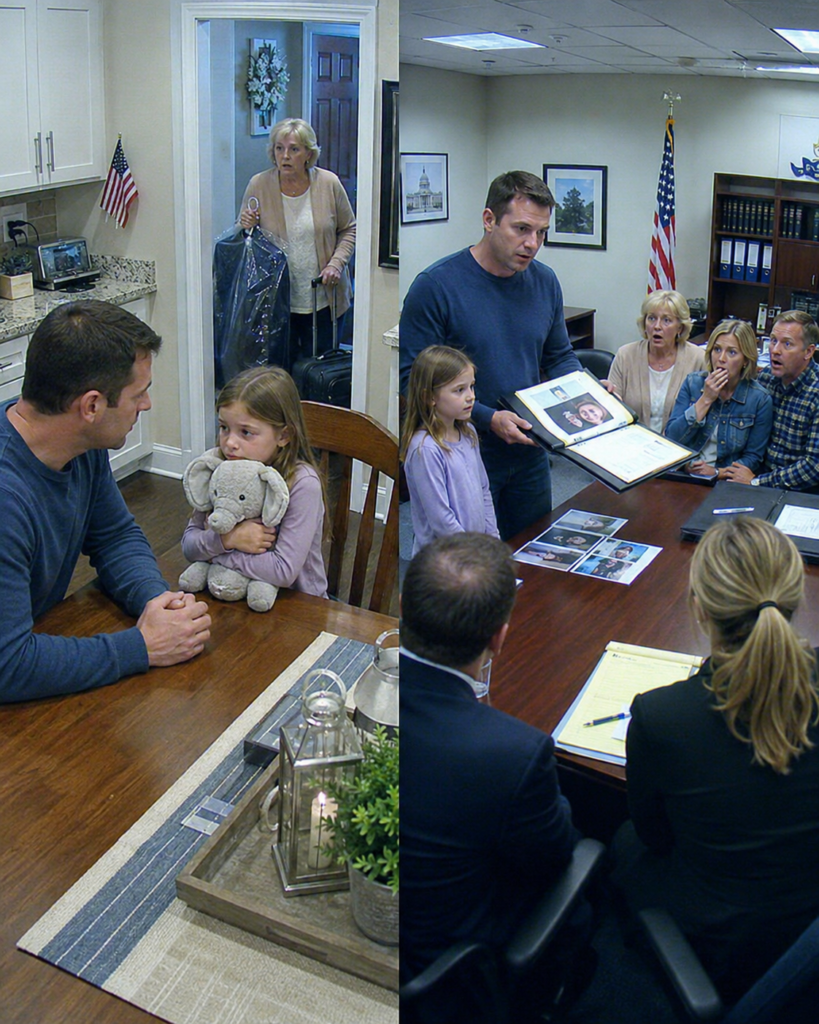
At first, I thought she meant the park.
Or the craft store.
Or one of those little tea rooms my mother-in-law liked because the chairs were uncomfortable and the women inside spoke as if every napkin had a family history.
Then Emma looked toward the hallway, lowered her voice until it barely existed, and said, “She tells me not to tell you.”
That was the moment my coffee went cold in my hand.
The Tuesday morning sunlight filtered softly through the narrow kitchen blinds, painting pale stripes across the worn oak table where I stood with a mug decorated in tiny cartoon elephants. Emma had picked it out for me on Father’s Day and insisted it made coffee taste “less grumpy.”
Across from me, she sat unusually still in her chair, pushing scrambled eggs around her plate in slow, distracted circles.
Breakfast had always been Emma’s favorite part of the day. She usually talked through it without breathing: school projects, playground politics, imaginary creatures who lived in the pantry, the complicated emotional life of her stuffed elephant, Mr. Noodle.
But that morning, the kitchen was too quiet.
The refrigerator hummed.
A delivery truck passed outside.
Somewhere in the guest house behind our property, my mother-in-law, Agnes Taylor, was probably opening her curtains and arranging her face into the pleasant widowhood she wore whenever neighbors were watching.
“Dad,” Emma said.
I turned from the counter.
“Yeah, baby?”
“Do you really have to go to Boston?”
It was the third time she had asked since the night before.
I felt the familiar ache of work-trip guilt. The documentary film conference had been circled on my calendar for months. Three days of meetings, producers, screenings, and conversations that might help fund my next project on forgotten neighborhoods in post-industrial cities. For independent filmmakers, opportunities like that did not just appear. You chased them, paid too much for flights, wore shoes that hurt, smiled through bad coffee, and hoped someone with money cared about the truth as much as you did.
But Emma’s face made all of that feel suddenly small.
“It’s only three days, Em,” I said gently. “You’ll be here with Mom and Grandma Agnes.”
Something flickered across her face.
Fear.
Not sadness.
Not missing-Dad fear.
Real fear.
I put the mug down slowly and crouched beside her chair.
“What’s wrong?”
Emma’s eyes darted toward the hallway.
Then she leaned forward.
“When you leave,” she whispered, “Grandma Agnes takes me somewhere.”
My chest tightened.
“Where?”
She shook her head.
“I don’t know what it’s called. It’s a big house with a blue door.”
A blue door.
The phrase entered the kitchen and changed the air.
“Does Mommy know?”
Emma shook her head faster.
“Grandma says not to tell you or Mommy. She says it’s our special secret.”
I had spent twelve years as a documentary filmmaker following stories people wanted buried.
I had interviewed whistleblowers in parking garages, survivors behind frosted glass, former caseworkers who cried when the cameras stopped rolling. I had filmed inside neglected state facilities, tracked shell companies through courthouse records, and sat across from people who described respectable-looking men doing terrible things behind locked doors.
So I knew something most people spend their lives trying not to know:
When a child uses the phrase special secret and looks scared instead of excited, you stop everything.
“What happens there, sweetheart?” I asked.
My voice stayed calm.
I have never been more proud of my voice.
Emma’s eyes filled.
“There are other kids sometimes.”
I swallowed.
“And grown-ups?”
She nodded.
“What do they do?”
She pressed her lips together.
For a moment, I thought she would not answer.
Then she whispered, “They take pictures. They make us change clothes. They tell us how to stand. They get mad if we don’t smile right.”
The rest dissolved into sobbing.
I pulled her into my arms, holding her so tightly I could feel her heart pounding against my chest. She was seven years old. Seven. Her hair smelled like strawberry shampoo. One of her socks had slid halfway off her foot. She was still young enough to believe stuffed animals needed blankets.
And someone had taught her to keep a secret that made her shake.
“Emma,” I said, lifting her chin with one finger, “you did exactly the right thing telling me.”
Her cheeks were wet.
“Grandma said if I tell, something bad will happen to you and Mommy.”
The rage that moved through me then was not hot.
It was cold.
Clean.
Focused.
“Nothing bad is going to happen to us,” I said. “And nothing bad is going to happen to you. I promise.”
She looked at me as if promises had become dangerous.
That hurt more than anything.
“I’m not going to Boston,” I said.
Her breath caught.
“You’re not?”
“No.”
“But Grandma will know.”
“No,” I said. “Grandma won’t know anything until it’s too late.”
After I settled Emma on the couch with cartoons and Mr. Noodle tucked under one arm, I walked into my office and closed the door.
My hands shook only after she could no longer see them.
I texted the conference organizer.
Family emergency. I can’t travel this week. I’m sorry.
Then I called my wife.
Helen answered on the second ring.
“Tony? What’s wrong?”
“I need you to come home.”
“Is Emma sick?”
“It’s about Emma.”
The silence on the line sharpened.
“What happened?”
“Come home now. And don’t tell your mother.”
Another silence.
This one was different.
“My mother?”
“Please trust me.”
Thirty minutes later, Helen walked through the front door with the controlled posture she used in courtrooms and boardrooms when bad news had to wait behind composure. She was a corporate attorney, brilliant, precise, and hard to frighten. But when I told her what Emma had whispered, the color drained from her face.
“No,” she said at first.
Not denial exactly.
A reflex.
“My mother loves Emma.”
I opened my laptop.
“Helen.”
She stopped.
I pulled up the scanned drawings Emma’s school counselor had sent weeks earlier after noticing that Emma had become anxious during class. At the time, everyone thought grief was the reason. Agnes’s husband had died six months earlier. Agnes had moved into the guest house behind our home. Emma was adjusting, we told ourselves.
Now the drawings looked different.
A blue door.
Stick figures.
A rectangle on a stand that looked very much like a camera.
Helen sat down slowly.
“Oh my God.”
“I recorded what Emma told me this morning.”
Helen looked up sharply.
“For the police?”
“For evidence.”
I played the audio.
Emma’s tiny voice filled the office.
Helen covered her mouth.
When it ended, she was crying silently.
“We should go to the police,” she said.
“Yes.”
But then her lawyer brain caught up with her mother heart, and I saw the battle happen in her eyes.
“What?” I asked.
Helen wiped her face.
“Right now, we have a child’s statement, drawings, and suspicion.”
“And that’s enough to start.”
“It is enough to start,” she said carefully. “But you know how these cases are attacked. They’ll say she misunderstood. They’ll say she imagined things. They’ll say my mother is a grieving widow and Emma is an anxious child.”
My jaw tightened.
“So we need more.”
Helen looked at me.
“What are you thinking?”
“I leave tomorrow morning like planned. You drive me to the airport. Agnes sees me go.”
“No.”
“I come back quietly. I park down the street. If Agnes takes Emma somewhere, I follow.”
Helen stood.
“That’s dangerous.”
“I’ve done surveillance in worse places.”
“This is not a documentary.”
“No,” I said. “This is our daughter.”
She looked toward the living room, where Emma’s cartoon voices floated through the hallway.
Helen closed her eyes.
When she opened them, she was no longer only a terrified mother.
She was a woman preparing for war.
“Fine,” she said. “But if she takes Emma anywhere, you call Detective Hatch before you move.”
Dennis Hatch had been one of my sources years earlier on a documentary about trafficking routes through Pennsylvania and Ohio. He had since become a detective in a regional task force. He trusted me. More importantly, I trusted him.
“I will.”
“Tony.”
“I promise.”
The next morning unfolded like theater.
At 6:30, I loaded my suitcase into Helen’s car while Agnes waved from the guest house window, wrapped in a pale blue cardigan, smiling as if she had never stood near anything darker than a funeral buffet.
Emma stood on the porch, clutching Mr. Noodle.
I knelt and hugged her.
“I love you,” I whispered.
“You’re really staying?” she breathed into my ear.
“I’m really staying.”
Helen kissed me in the driveway loudly enough for Agnes to hear.
“Call when you land.”
“I will.”
The lie made my stomach twist.
Twenty minutes later, Helen dropped me at the airport parking structure. I waited until she drove away, then ordered a rideshare to a street three blocks from our house. By 8:43, I was parked behind an overgrown hedge with a clear view of our driveway, my long-lens camera mounted and recording.
I felt ridiculous for about four minutes.
Then Agnes walked out of the guest house.
She carried a purse and a folded garment bag.
At exactly 9:00, she entered our house with her key.
At 9:04, she came out holding Emma’s hand.
My daughter was wearing a yellow dress I had never seen before.
My fingers tightened on the camera.
Agnes opened the car door. Emma looked back toward the house once.
Then she got in.
I waited until Agnes pulled out before starting my engine.
Then I followed them.
Agnes drove with relaxed confidence through Mapleton Heights, past the elementary school, past the library, past the small shopping plaza where Helen bought birthday cakes. She did not look like a woman committing a crime. She looked like a grandmother running an errand.
That is what terror looks like in real life.
Ordinary.
She turned away from the neighborhoods and toward the eastern edge of the city, where old warehouses sat between newer storage facilities and forgotten storefronts. I kept three cars behind her. My camera ran from the passenger seat. My phone tracked time and location.
At 9:23, Agnes slowed in front of a tall two-story house surrounded by overgrown hedges.
The front door was blue.
I parked down the block.
My breath felt too large for my chest.
Agnes helped Emma from the car and guided her up the walkway. The blue door opened before she knocked.
Someone had been expecting them.
I lifted the camera.
A man stood inside the doorway.
Gray hair.
Dark suit.
Expensive watch.
He smiled at Agnes like this was routine.
I zoomed in.
Got his face.
Got the house number.
Got Agnes placing her hand on Emma’s shoulder.
Then the blue door closed.
I called Dennis.
He answered gruffly.
“Glass. Thought you were in Boston.”
“I need you at an address right now. I’m watching what appears to be an organized child exploitation operation. My daughter is inside.”
Silence.
Then his voice changed.
“Send the address. Do not go in.”
“I’m filming.”
“Good. Keep filming. Backup is moving.”
I circled the property on foot, staying behind hedges, fences, parked cars. Years of documentary work had taught me how to be unseen. How to move only when traffic noise covered your steps. How to become part of a street.
Three more adults arrived in the next fifteen minutes.
A woman with a large tote bag.
Two men in separate vehicles.
All had keys.
All entered through the blue door.
This was not a misunderstanding.
This was a system.
On the far side of the house, I found basement windows half-obscured by dirty glass. I crouched behind a rusted garden gate and lifted the camera.
Inside was a large white room with professional lights.
A backdrop.
Equipment.
Several children.
My Emma among them.
No graphic detail. Nothing I could later be accused of misunderstanding. But enough. Enough to show frightened children being arranged, directed, handled, photographed, and made to participate in something no child should ever have to understand.
My vision narrowed.
For one second, I almost ran straight through the door.
Then I heard sirens.
So did they.
Inside the room, panic moved like fire.
Adults grabbed equipment.
The suited man shouted something.
Agnes pulled Emma toward a rear hallway.
I ran.
Not with thought.
With every instinct that had ever existed inside a father’s body.
I reached the back door just as Agnes burst out, dragging Emma by the wrist.
She saw me.
Her face went white.
Then twisted into something I had never seen on her before.
Not fear.
Hatred.
“You,” she hissed. “You couldn’t just go on your little trip?”
“Let go of my daughter.”
Agnes tightened her grip.
“Do you have any idea what you’re ruining?”
Emma bit her hand.
Agnes cried out and loosened her grip.
Emma tore free and ran to me.
I caught her with one arm and pulled her behind me.
“It’s over,” I said.
Agnes laughed.
“You think I’m the only one? You think you can touch people like this and walk away? There are lawyers, donors, judges, business owners—people you can’t imagine.”
Police cars screamed into the lot.
Officers poured out.
“Hands where we can see them!”
Agnes lifted both hands but kept talking.
“He’s lying. He staged this. It’s just children’s portfolio work. I’m her grandmother.”
Dennis Hatch came behind the first wave of officers, eyes taking in everything.
“Tony,” he called, “step back.”
I did not move until an officer had Agnes in cuffs.
The suited man came out next, shouting about warrants and harassment. The woman with the tote bag was crying. Another man tried to say he had only come to “observe.” Nobody believed him.
Emma clung to my waist so tightly I could feel her shaking through my shirt.
Dennis crouched several feet away.
“Hey, Emma,” he said gently. “My name is Dennis. I’m here to help your dad keep you safe.”
Emma did not answer.
That was all right.
She had already done the bravest thing anyone in that lot had done.
She had told.
The next six hours blurred into statements, evidence bags, interviews, waiting rooms, and the strange sterile kindness of professionals trained to handle broken things carefully.
Emma spoke with a forensic interviewer named Dr. Sarah Chun, whose voice was soft enough to make even silence feel invited. Helen arrived within the hour, still in heels from the office, her face carved out of fear and fury. When Emma saw her, she ran so hard she nearly knocked Helen backward.
Agnes was in custody.
So were the others.
The search of the blue-door house uncovered hard drives, schedules, coded payment records, props, clothing racks, and lists of names that made even Dennis’s face change.
“This is bigger than one house,” he told me late that evening.
We were standing in my driveway. The guest house behind us was dark.
“How much bigger?”
“Multiple cities. Maybe multiple states. We’ve suspected something like this existed for two years, but we couldn’t locate the hub.”
He looked at the camera bag in my hand.
“Your footage may be the reason we finally can.”
I should have felt relief.
I felt sick.
Because all I could think was: if Emma had not told me, if I had boarded that plane, if I had dismissed her fear as separation anxiety, if I had trusted Agnes because family is easier to believe than danger—
I had spent years telling audiences to listen to survivors.
My daughter had been the one survivor I almost missed.
That night, after Emma finally slept, Helen sat in the chair beside her bed and stared at nothing.
“How could my mother do this?” she whispered.
I knelt beside her.
“I don’t know.”
“She held Emma when she was born.”
“I know.”
“She came to birthday parties.”
“I know.”
“She ate dinner in our house.”
“I know.”
Helen looked at me then.
Her eyes were red.
“I want her gone from every memory.”
I understood.
But memory does not work that way.
The monster is not kind enough to stay out of photographs.
Two weeks passed in a strange suspension of normal life.
Emma saw Dr. Chun three times a week.
Helen took leave from work.
I turned my home office into a war room.
Not because the police needed me to.
Because I needed somewhere to put the rage.
The case grew wider.
The suited man was identified as Kenneth Booth, a freelance photographer who had slipped away from previous investigations without charges sticking. The woman with the tote bag was Patricia Dyer, a former social worker. The others were buyers, coordinators, middlemen. Agnes was not the mastermind. She was a supplier.
That word nearly broke Helen.
Supplier.
A grandmother who supplied access.
Dennis called with updates when he could.
“The digital evidence is strong,” he said. “But the defense will attack your footage.”
“On what grounds?”
“Trespass. Surveillance. Chain of custody. They’ll try to suppress whatever they can.”
I had expected it.
Still, anger moved through me.
“They were inside a house hurting children.”
“Yes,” Dennis said. “And their lawyers will do everything possible to make the case about your methods instead of their crimes.”
That was how systems protect themselves.
Not always intentionally.
But often enough.
I called Marty Holloway, my oldest friend and editor, the man who had sat beside me through thousands of hours of footage that would have made most people quit documentary work forever.
He came over the next morning.
I showed him what I had.
He watched in silence.
When the screen went black, he said, “Tony, this is dynamite.”
“I want to expose all of them.”
“I know.”
“No. Not just the ones arrested. Everyone connected.”
Marty leaned back.
“Careful.”
“Don’t say careful.”
“I have to. You are a father, and I understand that. But you’re also a filmmaker. If you release names before the cases are done, you could compromise prosecutions.”
“So I do nothing?”
“You already did something. You saved Emma. You gave the police the blue door.”
“It won’t be enough.”
“Maybe. But if you burn the process down, some of them walk.”
I hated him for being right.
I hated everyone for requiring patience after my daughter had been brave.
But we did not release anything.
Not then.
We built instead.
A timeline.
A case map.
Faces.
Vehicles.
Corporations.
Payments.
Names mentioned in court filings.
Everything documented, verified, duplicated, encrypted, stored with attorneys and journalists who knew what they were holding.
If the system failed, the truth would not disappear.
The investigation eventually reached a man named Clayton DeLeo.
He was everything monsters prefer to be.
Respectable.
Polished.
Philanthropic.
A consultant for youth programs and nonprofits across several states. A man photographed at charity events, shaking hands with mayors, smiling beside banners about opportunity and community engagement.
He did not stand in rooms with blue doors.
He built the roads that led to them.
Patricia Dyer cooperated first.
Then another coordinator.
Then a financial assistant who had processed payments through shell companies and finally panicked when federal agents arrived with a warrant.
Agnes refused to cooperate.
She insisted she had done nothing wrong.
She called Emma confused.
She called me obsessive.
She called Helen ungrateful.
Helen listened to that from across a courtroom during a preliminary hearing and did not blink.
Later, in the parking lot, she vomited behind our car.
Rage has to leave the body somehow.
Agnes’s trial began in November.
The courtroom was packed.
Reporters sat along the back wall. Families of other children sat together, holding hands, tissues, each other’s grief. Emma did not attend. We would not let that room have her.
The prosecution presented the evidence carefully.
My footage.
Digital records.
Payments.
Testimony from Patricia Dyer.
Statements from forensic interviews.
Agnes’s defense attorney tried to paint her as a lonely widow manipulated by sophisticated criminals. He said she believed the sessions were innocent portfolio work. He said she was grieving. He said she trusted the wrong people.
Then the prosecutor played a message from Agnes’s phone.
Agnes: She’s nervous today. I’ll bring her anyway.
Unknown contact: Keep her quiet. Extra payment if she cooperates.
Agnes: She will. She knows not to tell.
No one in the courtroom moved.
Helen’s hand found mine.
The jury took three hours.
Guilty on all counts.
Agnes showed no emotion when the verdict was read.
But as the bailiff led her away, she turned toward us.
For one second, I saw the woman behind the grandmother.
Empty.
Furious.
Unrepentant.
Sentencing came in March.
The judge, a woman in her sixties with silver hair and a voice like a closed door, looked directly at Agnes.
“You were trusted,” she said. “That trust was not incidental to your crime. It was the instrument of it.”
Helen’s breath caught.
The judge continued, “You had access because you were family. You used that access to deliver a child into harm. This court finds no remorse, no mitigation sufficient to outweigh the gravity of your actions.”
Thirty years.
No possibility of parole.
Agnes did not cry.
Helen did.
Outside the courthouse, reporters pushed microphones toward us.
“Mr. Glass, how do you feel about the sentence?”
I looked into the nearest camera.
“My daughter was believed. Today, that matters.”
“What message do you have for other parents?”
I thought of the kitchen.
The eggs cooling on Emma’s plate.
Her whisper.
The blue door.
“Listen to your children,” I said. “If they tell you something feels wrong, stop what you are doing and listen. Do not protect an adult’s reputation at the expense of a child’s fear.”
That clip ran everywhere.
Some people called me brave.
Some called me reckless.
I was both.
Kenneth Booth received decades in prison.
Patricia Dyer got a reduced sentence for cooperation.
Several others were convicted.
Clayton DeLeo, the polished consultant, took a plea deal that left a rotten taste in my mouth.
Fifteen years.
Eligible for parole in seven.
Seven.
For building roads to blue doors.
For hiding behind nonprofits, shell companies, and handshakes.
For turning trust into infrastructure.
I nearly broke when Dennis told me.
“It’s the best they could get,” he said.
“No.”
“It is.”
“It isn’t justice.”
“No,” he admitted. “But it is prison.”
That night, I opened the documentary file Marty and I had been building.
We had called it THE BLUE DOOR.
Not for release.
Not yet.
But after DeLeo’s plea, the project changed.
Ruby Crawford, a producer from a respected investigative television program, called two weeks later.
“I want to do this right,” she said. “Not sensational. Not exploitative. No details that retraumatize children. But names. Systems. Structures. How this happened. How people missed it. How families can listen better.”
I met her in a small conference room downtown.
She was in her fifties, sharp-eyed, careful with words, the kind of journalist who understood that exposure without ethics can become another form of harm.
“We will not show children,” she said.
“Good.”
“We will not describe what does not need describing.”
“Good.”
“We will focus on the network, the adults, the money, the institutional failures, and the courage it took for a child to speak.”
That was when I agreed.
The program aired one year after Emma first told me about the blue door.
Deep Dive: The Blue Door Network was ninety minutes of devastating, controlled journalism. It opened not with Emma, but with the house. The blue door. The driveway. The adults entering with keys.
Then it widened.
Court records.
Shell companies.
Testimony.
Expert interviews.
Maps showing how respectable access points became pipelines.
Clayton DeLeo’s segment was the most damning because it showed exactly what men like him fear most: not rage, but clarity. His charity photos. His consulting website. His public language about trust. Then the money. The plea. The testimony linking him to recruitment and payments.
No exaggeration.
No shouting.
Just facts arranged so cleanly he could not hide between them.
The episode ended with me speaking into the camera.
“These networks survive because they rely on silence, shame, and respectability. They count on children being too scared to speak and adults being too polite to listen. The first defense is not paranoia. It is attention. It is believing a child long enough to ask the next question.”
The response was overwhelming.
Parents wrote to us.
Survivors wrote to us.
Lawmakers called hearings.
Schools requested training.
Youth organizations reviewed background checks and access policies.
Three more families came forward with information connected to related cases.
For the first time in a year, I felt that the truth had become larger than our pain.
Not gone.
Never gone.
Larger.
Emma healed slowly.
There is no montage for healing.
No single scene where a child smiles and the music swells and everyone knows the worst is over.
There were nightmares.
Regressions.
Months where she refused to wear dresses.
Weeks where she could not be photographed, even by us.
We removed every family photo session from our life until she asked for one herself.
Dr. Chun taught us how trauma hides inside ordinary things. A doorbell. A dress. A camera click. A grandmother in a grocery store. A blue paint sample in a hardware aisle.
We learned to ask before hugging.
To announce visitors.
To let Emma choose clothing.
To give her control over small things until the world became a place she could enter without flinching.
One spring afternoon, almost two years after the blue door, Emma asked if we could paint the garden shed.
Helen froze.
“What color?”
Emma looked at me.
“Blue.”
My throat tightened.
“Are you sure?”
She nodded.
“Not that blue.”
So we went to the hardware store. Emma selected a bright sky blue, the color of cartoons and summer pools and sidewalk chalk. We painted the shed together over two weekends. She got more paint on her knees than the wood. Helen painted one corner badly and insisted it was abstract. I spilled half a tray and Emma laughed so hard she snorted.
When we finished, she stood back with her hands on her hips.
“That’s a good blue,” she said.
It was.
The color did not belong to fear anymore.
That was victory.
Not the verdicts.
Not the documentary.
Not even DeLeo’s reputation burning to ash.
Victory was my daughter reclaiming a color.
Years later, people still ask me whether I regret following Agnes.
The honest answer is complicated.
I regret that I had to.
I regret that my daughter’s words were not enough by themselves to stop the world.
I regret every second I waited outside that house filming instead of running in.
I regret nothing about saving her.
All those truths coexist.
Parenthood is full of impossible math.
One evening, after Emma turned twelve, she found the elephant mug in the back of the kitchen cabinet.
“You still have this?” she asked.
“Of course.”
“It makes coffee taste less grumpy.”
“That is scientifically established.”
She smiled, then grew quiet.
“Do you still think about it?”
I did not pretend not to understand.
“Yes.”
“Every day?”
“Not every day the same way.”
She nodded.
“I don’t remember everything.”
“That’s okay.”
“Sometimes I feel bad about that.”
“You don’t owe anyone a perfect memory of what hurt you.”
She looked at me then.
Older than seven.
Still my child.
“Did I save the other kids?”
I sat down across from her.
“You told the truth. That helped save many people.”
She looked at the mug.
“I was scared.”
“I know.”
“I almost didn’t tell you.”
My chest tightened.
“But you did.”
She nodded slowly.
“Because you always listen when I talk at breakfast.”
That sentence broke something in me and healed something else at the same time.
All the documentaries.
All the investigations.
All the footage.
All the courtrooms.
And in the end, the first key had been breakfast.
A father listening long enough.
I reached across the table.
She let me take her hand.
Years after Agnes went to prison, Helen and I visited the courthouse for the dedication of a new child advocacy wing funded partly by reforms that followed the Blue Door case. Emma did not come. Her choice. Her story belonged to her.
A plaque on the wall read:
FOR EVERY CHILD WHO FOUND THE COURAGE TO SPEAK,
AND EVERY ADULT WHO CHOSE TO LISTEN.
Helen cried when she saw it.
I did too.
Quietly.
We had lost a mother-in-law, a grandmother, a version of family, a sense of safety that would never return in its old form.
But we had gained clarity.
Hard, costly clarity.
Trust is not the absence of doubt.
It is the presence of attention.
Family is not proven by access.
It is proven by protection.
And love, real love, does not ask a child to keep secrets that make them afraid.
That night, I went home and finally took down the last wall of my office war room.
The maps.
The printed photos.
The timelines.
The court schedules.
The names.
I placed them in labeled archive boxes and locked them away.
Not because the story was over.
Because it no longer needed to live on the walls.
Emma was upstairs doing homework. Helen was in the kitchen making tea. The garden shed outside glowed sky blue beneath the porch light.
I stood in the office doorway and looked at the empty walls.
For twelve years, I had been a documentary filmmaker.
A witness.
A collector of stories.
A man who believed truth needed a camera to become real.
Then my daughter whispered one morning over cold eggs, and I learned something more important.
Truth begins before the camera.
It begins in the pause after a child asks, “Do you really have to go?”
It begins when an adult puts down the coffee, kneels beside the chair, and says, “What’s wrong?”
The blue door took many things from us.
But it did not take Emma.
It did not take her voice.
It did not take her future.
And if there is one thing I know now, it is this:
Evil does not always arrive as a stranger in a dark alley.
Sometimes it smiles from a guest house window.
Sometimes it carries a purse.
Sometimes it knows where you keep the cereal bowls.
Sometimes it calls itself family.
So listen.
When the room goes quiet.
When the child stops eating breakfast.
When the question comes a third time.
Listen.
Because a child may not have every word.
She may not understand the shape of what frightens her.
She may only be able to say there is a blue door.
And if you are lucky, if you are brave, if you love her more than you love the comfort of disbelief, that will be enough.
It was enough for me.
I canceled my flight.
I followed the car.
And when the blue door opened, I finally saw the truth my daughter had been carrying alone.
After that, there was no going back.
Only forward.
Into the courtroom.
Into the light.
Into the long, imperfect work of healing.
And every morning now, when Emma sits across from me at breakfast and talks too fast about school, books, friends, music, and the small ordinary problems of being alive, I do not interrupt.
I let my coffee go cold.
I listen to every word.