The courtroom smelled faintly of polished wood, paper, and something heavier that hung in the air like a storm waiting to break. I sat at the defendant’s table with my hands folded tightly in my lap, pressing my fingers together to keep them from trembling. Every small sound felt amplified, from the shuffle of papers to the quiet murmur of attorneys whispering to their clients, and my heartbeat seemed louder than all of it.
Across the aisle, my sister Amber sat beside our parents, their posture relaxed, their expressions glowing with quiet confidence. They looked like people attending a ceremony they were certain they would win, and the sight of their calm made my stomach twist painfully. I tried to avoid their eyes, but I could feel their attention flicking toward me like needles.
My attorney, Diana Klov, flipped through her neatly organized binder with steady hands. Her calmness radiated outward, grounding the space around her as if she carried her own quiet gravity. She had told me earlier that morning that we had a strong case, but the smugness on my family’s faces made doubt creep into my thoughts like fog.
The bailiff’s voice broke through the tension as he called the courtroom to order. Everyone stood as Judge Margaret Sullivan entered, her black robe flowing behind her with deliberate authority. She moved with the confidence of someone who had seen every version of family conflict imaginable and had long ago learned not to be impressed by theatrics.
Judge Sullivan settled into her seat and adjusted her glasses, her sharp eyes sweeping across the room. She looked to be in her early sixties, her expression composed and unreadable, but there was an unmistakable firmness in her posture. The kind of presence that made it clear she had no patience for games or emotional manipulation.
“We’re here for the matter of custody petition,” she began, her voice steady and controlled. “Amber Louise Morrison versus Rachel Morrison regarding the minor child Lily Grace Morrison, age five. Let’s begin with opening statements.”
Amber’s lawyer stood first, smoothing the front of his tailored suit as he stepped forward. Gerald Hutchkins had the polished confidence of someone who had spent years mastering courtroom performance. His smile was measured, his tone carefully sympathetic, as if he were delivering bad news to a friend.
“Your honor, this case is straightforward,” he began, glancing briefly toward Amber. “My client, Amber Morrison, is seeking custody of her niece, Lily, based on substantial evidence that the child’s mother, Rachel Morrison, is unfit to parent. We will demonstrate that Ms. Rachel Morrison has created an unstable environment and lacks the emotional maturity necessary to raise a child.”
Each word struck like a small blow, though I forced myself to keep my expression neutral. My hands tightened in my lap as I focused on breathing slowly. Diana stood moments later, her posture relaxed but commanding in a quieter way.
“Your honor, this petition is nothing more than a family vendetta disguised as concern,” she said calmly. “The evidence will show that Lily is thriving in her mother’s care and that this proceeding is motivated by jealousy and long-standing family dysfunction.”
Judge Sullivan nodded once, then looked toward Hutchkins. “Call your first witness.”
“The petitioner calls Amber Morrison to the stand.”
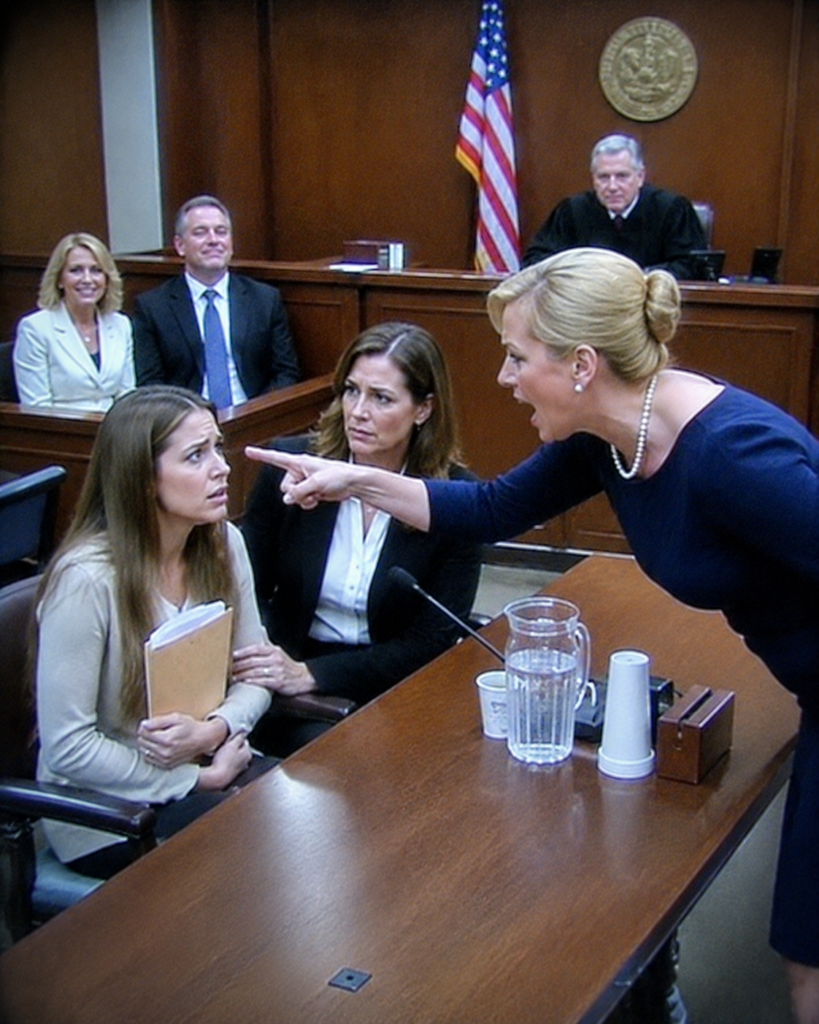
Amber stood gracefully, smoothing her navy dress as she walked to the witness box. She looked composed, almost elegant, with her hair pulled into a neat bun and a string of pearls resting at her collarbone. She appeared calm and sympathetic, the perfect image of a concerned older sister.
After she was sworn in, Hutchkins began his questioning with a gentle tone. “Ms. Morrison, can you explain your relationship with your sister Rachel?”
Amber folded her hands neatly. “We grew up together. I’m three years older, and I’ve always tried to look out for her, even when she made choices I didn’t agree with.”
“And can you describe some of those choices?”
“Well, she got pregnant at twenty-two without being married,” Amber said, her voice smooth and practiced. “The father left before Lily was born, and she’s been raising her daughter alone ever since.”
The lie slid effortlessly from her lips, so calm and convincing that for a moment it sounded believable. My chest tightened as I stared at the tabletop, forcing myself not to react. I knew that any emotional outburst would only reinforce the narrative they were building.
“I’ve offered to help countless times,” Amber continued. “But Rachel is too proud to accept it. She’s struggling, and Lily deserves stability.”
Hutchkins nodded thoughtfully. “Have you observed Ms. Morrison’s parenting directly?”
“Yes, many times. I’ve seen Lily wearing clothes that don’t fit properly. The child often looks tired, probably because Rachel works late shifts.”
Her words felt carefully chosen, designed to paint a picture without giving specifics. I clenched my jaw, remembering the nights I worked double shifts, then came home to pack Lily’s lunch for preschool.
“You’re married, correct?” Hutchkins asked.
“Yes. My husband Nathan and I have been married eight years. We have a home in Riverside Heights, and Nathan has a successful career in finance.”
I watched the judge’s face, searching for any hint of reaction, but she simply wrote notes. Her expression remained neutral, giving nothing away.
When Diana stood for cross-examination, her tone was polite but precise. “Ms. Morrison, you testified that you’ve offered help many times. Can you provide specific examples?”
Amber blinked slightly. “Well, general offers. Letting her know I’m there.”
“So no specific financial assistance or childcare?”
“I offered emotional support.”
Diana nodded, jotting something down. “When was the last time you saw Lily in person?”
Amber hesitated. “A few months ago.”
“How many months?”
“Six or seven.”
“So you haven’t observed Lily’s current situation recently?”
“No.”
Amber shifted slightly, her composure cracking just enough to notice. Diana continued with calm efficiency, each question narrowing the space around her testimony.
After Amber stepped down, my mother took the stand. She wore a sharp designer suit, her posture straight with familiar superiority. Her voice carried a polished confidence as she described me as rebellious and irresponsible.
“When Rachel got pregnant, we encouraged her to consider adoption,” she said. “She refused out of stubbornness.”
I felt my chest tighten again, remembering the day she’d said those words. The way she’d looked at Lily as if she were a mistake instead of a miracle.
“And how has she managed financially?” Hutchkins asked.
“Poorly,” my mother replied smoothly. “We’ve helped pay her rent, bought groceries, covered medical bills.”
Another lie. I stared down at my hands, resisting the urge to shake my head.
My father followed with similar testimony, echoing her claims while adding his own embellishments. He spoke about impulsive decisions and irresponsibility, painting a version of me that felt like a stranger.
During the lunch recess, I stepped into the hallway to breathe. The air felt cooler there, but the tension followed me like a shadow.
Amber approached me with our parents beside her, their expressions shifting from courtroom politeness to something colder. The performance had ended, replaced by the familiar edge I knew too well.
“I want to see the look on your face when we take away your daughter,” Amber said quietly, her voice dripping with satisfaction.
My parents laughed softly, the sound sharp and unsettling in the quiet hallway. Their amusement felt heavier than any insult they’d thrown at me.
“Get ready to be publicly humiliated,” my mother added, her eyes gleaming. “By the end of today, everyone will know what a failure you are.”
Their words hung in the air, heavy and deliberate. I felt anger rise in my chest, hot and sharp, but I swallowed it down as I met their gaze.
I wanted to scream at them, to defend myself, to list every sacrifice and every sleepless night. Instead, I…
Continue below
The courtroom smelled like old wood and anxiety. I sat at the defendant’s table, my hands folded in my lap to keep them from shaking. Across the aisle, my sister Amber sat with our parents. All three of them radiating confidence that made my stomach turn. My attorney, Diana Klov, was reviewing her notes with the kind of calm focus that came from 20 years of family law practice.
She told me this morning that we had a strong case, but looking at the smug expressions on my family’s faces, I struggled to believe her. The baiff called the courtroom to order. Judge Margaret Sullivan entered, her black robe flowing behind her as she took her seat at the bench. She was in her early 60s with sharp eyes that missed nothing and a reputation for having zero tolerance for games.
We’re here for the matter of custody petition. Amber Louise Morrison versus Rachel and Morrison regarding the minor child Lily Grace Morrison, age five, Judge Sullivan said, adjusting her glasses. Let’s begin with opening statements. Amber’s lawyer, a slick-looking man named Gerald Hutchkins, stood first.
He was expensive, paid for by our parents, and he knew how to put on a show. Your honor, this case is straightforward. My client, Amber Morrison, is seeking custody of her niece, Lily, based on substantial evidence that the child’s mother, Rachel Morrison, is unfit to parent. We will demonstrate that Ms.
Rachel Morrison has created an unstable environment, makes poor financial decisions, and lacks the emotional maturity necessary to raise a child. I kept my face neutral, even as each word landed like a punch. Diana stood, her posture relaxed, but commanding. Your honor, this petition is nothing more than a family vendetta disguised as concern for a child’s welfare.
The evidence will show that Lily is thriving in her mother’s care, that Ms. Rachel Morrison is a devoted and capable parent, and that this entire proceeding is motivated by jealousy and long-standing family dysfunction rather than genuine concern for the child. Judge Sullivan nodded. Mr. Hutchkins, call your first witness. The petitioner calls Amber Morrison to the stand.
My sister walked to the witness box like she was accepting an award. She wore a conservative navy dress and pearls, her hair pulled back in a neat bun. The picture of respectability and concern. After she was sworn in, Hutchkins began his questioning. Ms. Morrison, can you explain your relationship with your sister Rachel? We grew up together.
Obviously, I’m 3 years older. Amber’s voice was smooth, practiced. I’ve always tried to look out for her, even when she made choices I didn’t agree with. Can you describe some of those choices? Well, she got pregnant at 22 without being married. The father left before Lily was even born. She’s been raising her daughter alone in a one-bedroom apartment, working multiple jobs just to make ends meet.
I’ve offered to help countless times, but Rachel is too proud to accept it. The lie was so smooth, I almost believed it myself. The truth was that Amber had never offered help. She’d shown up at the hospital when Lily was born, taken one look at my daughter, and said, “Well, you’ve really made a mess of your life now, haven’t you? Have you observed Ms.
Rachel Morrison’s parenting directly?” Hutchkins continued, “Yes, many times. I’ve seen Lily wearing clothes that don’t fit properly. The child is often tired, probably because Rachel works late shifts and has to drag her to various babysitters. Lily deserves stability, a proper home, parents who can give her advantages. You mentioned parents. You’re married.
Is that correct? Yes. To my husband, Nathan. We’ve been married for 8 years. We have a beautiful home in Riverside Heights, and Nathan has a successful career in finance. We’re ready to give Lily everything she deserves. I watched the judge’s face trying to read her reaction. She was taking notes, her expression neutral.
Ms. Morrison, why are you seeking custody rather than simply offering more support to your sister? Amber leaned forward slightly, her face arranged in an expression of deep concern because I love my niece and I can see that Rachel is drowning. She won’t admit it, but she’s struggling. Lily needs more than one frazzled parent who can barely afford rent.
She needs a stable family. Thank you. No further questions. Diana stood for cross-examination. Ms. Morrison. You testified that you’ve offered help to your sister many times. Can you provide specific examples? Amber blinked. Well, general offers, you know, let me know if you need anything. So, no specific offers of financial assistance, child care, or material support.
I offered emotional support. I see you mentioned observing Lily in ill-fitting clothes. When was the last time you actually saw Lily in person? I It’s been a few months. How many months? Maybe six or seven. So, you haven’t actually observed Lily’s current living situation or wardrobe recently? No.
But you also mentioned Lily being dragged to various babysitters. Are you aware that Rachel’s mother, your own mother, provides child care 3 days a week? My mother mentioned it. Yes. And are you aware that on the other days Lily attends a licensed preschool program? Amber shifted in her seat. I knew she was in some kind of daycare. Not daycare. A preschool program. One that provides educational activities and socialization with peers. Correct. I suppose Diana glanced at her notes. Ms. Morrison, isn’t it true that you’ve been trying to have a child for the past 5 years without success? Hutchkins shot to his feet. Objection. Relevance. Your honor, it goes to motivation, Diana said calmly.
I’ll allow it. Answer the question, Ms. Morrison. Amber’s face flushed. My fertility struggles have nothing to do with this case. They do if they explain why you suddenly want custody of your niece after years of minimal contact. You can’t have a baby of your own. So, you’ve decided to take your sister’s child instead.
Isn’t that true? That’s not I’m doing this for Lily’s benefit. Are you? Or are you doing this because you’re jealous that your younger sister has something you want? Objection. Hutchkins was red-faced now. Council is badgering the witness. Sustained. Move on, Miss Klov. Diana smiled slightly. No further questions, your honor.
My mother was called next. She took the stand with her usual air of superiority, dressed in an expensive suit that probably cost more than my monthly rent. Under Hutchkins’s questioning, she painted a picture of me as an irresponsible child who’d never grown up. Rachel was always the difficult one, she said.
Rebellious, unwilling to listen to guidance. When she got pregnant, we tried to encourage her to consider adoption, to give the child to a family that could provide properly. She refused out of pure stubbornness. “And how is she managed financially?” Hutchkins asked. “Poorly. She’s constantly asking for money, though she’ll never admit it.
We’ve helped pay her rent multiple times, bought groceries, covered medical bills. She’s completely dependent on us.” Another lie. I’d borrowed money exactly three times in 5 years, and I’d paid back every cent. But I couldn’t prove it because the transactions had been cash. My father went next, essentially echoing my mother’s testimony with his own embellishments.
Rachel has always made impulsive decisions. He said, “Getting pregnant was just another example. She’s not equipped to raise a child alone.” During the lunch recess, Amber cornered me in the hallway outside the courtroom. Our parents flanked her, a united front of family disapproval. “I want to see the look on your face when we take away your daughter,” Amber said. her voice low and vicious.
The concerned sister act had vanished now that the judge wasn’t watching. My parents laughed, actually laughed at the expression on my face. Get ready to be publicly humiliated, my mother added. By the end of today, everyone will know what a failure you are. I wanted to scream at them to defend myself, to explain that everything they’d said was a distortion of the truth.
Instead, I stayed silent, turned around, and walked back to where Diana was waiting. “They’re very confident,” I said quietly. “They should be less confident and more concerned,” Diana replied. “We haven’t presented our case yet,” Tabby’s thoughts. “Oh, no. Just no. Your sister literally said she wants to take your daughter away, and your parents are just laughing like it’s a joke.
Are you kidding me?” The audacity, the smug faces, the fake concerned aunt parent act. It’s disgusting. I’m sitting here yelling at my screen for you. And Amber acting all perfect in court, pretending she’s worried about Lily’s well-being. Total lie. The hallway moment where she cornered you. Holy hell.
That was pure villain energy. The way she said it and your parents laughed. Absolute nightmare. You stay calm. You stay silent and wait for that judge’s question. I swear when it hits, it’s going to wipe that smug smirk off Amber’s face and probably leave your parents and her lawyer shaking. I am so ready for that moment.
This is peak family betrayal and gaslighting and you’re about to own the room. Mrs. Foster, how long have you known Lily Morrison? Diana asked. She’s been in my class for the past year and a half. Can you describe Lily as a student? Mrs. Foster smiled warmly. Lily is a delightful child. She’s curious, social, well adjusted.
She participates enthusiastically in activities and has made several close friends in the class. Have you ever had concerns about her well-being or home life? Never. Lily always arrives clean, properly dressed, and wellfed. She talks fondly about her mother and seems very securely attached to her. What about Ms.
Morrison’s involvement in Lily’s education? Rachel is one of our most engaged parents. She attends every parent teacher conference, volunteers for field trips when her work schedule allows, and follows up on any educational suggestions I make. Last month, she spent her day off helping us build new bookshelves for the classroom. Thank you, Mrs. Foster.
Hutchkins’s cross-examination was brief and ineffective. Mrs. Foster wouldn’t budge on her assessment of Lily as a happy, well-ared for child. Next, Diana called Dr. James Whitmore, Lily’s pediatrician. Dr. Whitmore, how often do you see Lily Morrison for all her regular checkups and sick visits? I’ve been her doctor since birth and her health.
Excellent. She’s up to date on all vaccinations, meeting all developmental milestones, healthy weight and height. No concerns whatsoever. What about Ms. Morrison as a parent. Does she seem attentive to Lily’s medical needs? Very much so. She asks thoughtful questions, follows medical advice, brings Lily in promptly when she’s ill.
She’s exactly the kind of parent we hope to see. The parade of witnesses continued. My landlord testified that I paid rent on time every month and kept my apartment clean and quiet. My supervisor from work explained that I was a reliable employee who’d worked my way up from entry level to assistant manager in three years.
Lily’s former babysitter before she started preschool described me as a loving, attentive mother who always picked up her daughter on time and clearly adored her. With each witness, I watched the confidence drain from Amber’s face. My mother’s smile became more forced. My father stopped meeting anyone’s eyes.
Then Diana called me to the stand. I swore to tell the truth and sat down, my hands gripping the armrests to keep them steady. Ms. Morrison, let’s address the claims made against you directly. Your sister testified that you live in a one-bedroom apartment and struggle financially. Is that accurate? I do live in a one-bedroom apartment, I said carefully. Lily has the bedroom.
I sleep on a sofa bed in the living room. It’s small, but it’s clean, safe, and in a good school district. As for finances, I work full-time as an assistant manager at Henderson’s department store, and I also do freelance graphic design in the evenings. Between both jobs, I earn approximately $52,000 a year. I saw my mother’s eyes widen.
She hadn’t known about the freelance work. And you manage your expenses. How? Carefully. I budget everything. Lily’s needs always come first. Her preschool tuition, her clothes, healthy food, books, and activities. We live modestly, but we’re stable. I have $6,000 in savings for emergencies. Your mother testified that you frequently ask them for money.
That’s not true. I’ve borrowed money three times in 5 years during genuine emergencies. When my car broke down and I needed it for work, when Lily had to go to the emergency room for a broken arm, and when I was between jobs for six weeks, I paid back every dollar. Can you prove that? No, because the loans and repayments were in cash, but I have a ledger where I tracked every payment with dates and amounts.
Diana nodded. Let’s talk about why you think your sister is really seeking custody. I took a breath. Amber has struggled with infertility for years. I’ve been sympathetic to that struggle. But about eight months ago, she and Nathan decided to pursue adoption. They were matched with a birth mother who was due in December.
Amber called me to share the good news, and I was genuinely happy for her. What happened? The birthother changed her mind at the last minute. She decided to parent her baby instead. Amber was devastated, and I understood that. But shortly after, her behavior toward me and Lily changed. She started making comments about how I didn’t deserve to be a mother, how I’d gotten lucky when I didn’t even want to be pregnant.
She started questioning my parenting choices, criticizing everything I did. When did she file for custody? 3 months ago. Right after she and Nathan were told they’d been rejected by another adoption agency because of some issues with their home study. Hutchkins objected. Your honor, this is speculation about my client’s motivations. Overruled.
The witness may testify about her observations and the timeline of events. I continued. I believe Amber sees taking Lily as the solution to her fertility problems. She doesn’t want to be Lily’s aunt. She wants to be her mother. Thank you, Ms. Morrison. Hutchkins approached for cross-examination. Ms. Morrison, you admit you live in a one-bedroom apartment and work two jobs.
Doesn’t that suggest Lily would be better off in your sister’s four-bedroom home where she’d have two parents and more resources? No, I said firmly. Lily doesn’t need a mansion. She needs love, stability, and consistency. She has that with me. Moving her to Amber’s house would uproot her from her school, her friends, her routine, and the only parent she’s ever known.
That would be traumatic, not beneficial. Your sister and parents all testified that you’re financially unstable. My sister hasn’t seen my bank statements. Neither have my parents. They’re basing that claim on assumptions, not facts. You were pregnant at 22 and unmarried. Don’t you think that shows poor judgment? I think it shows that life happens.
Lily’s father and I were in a relationship. When I got pregnant, he left. That was his choice and his failure, not mine. I chose to keep my daughter and raise her to the best of my ability. I don’t consider that poor judgment. I consider it taking responsibility. I saw Judge Sullivan’s lips twitch slightly, almost like she was suppressing a smile.
After a few more questions that went nowhere, Hutchkins dismissed me. I returned to my seat beside Diana, my heart pounding. The petitioner rests, Hutchkins announced. The respondent rests as well, Diana said. Judge Sullivan leaned back in her chair. Before we move to closing arguments, I have a few questions of my own.
My stomach dropped. This wasn’t standard procedure. Ms. Rachel Morrison, please return to the stand. I walked back on shaking legs and sat down. Judge Sullivan looked at me over her glasses. Ms. Morrison, I’ve reviewed all the documentation submitted in this case. Your employment records, tax returns, bank statements.
I have a question about something that seems inconsistent. Here it comes. I thought she’d found something, some mistake in my paperwork that would be used against me. According to your tax returns, you’ve been claiming a dependent exemption for Lily since her birth. But you’ve also been filing as head of household. However, I noticed something interesting in your most recent tax return.
You reported income from a freelance graphic design business, but you also reported income from a trust distribution. Can you explain the source of that trust? My mouth went dry. I glanced at Diana, who looked as confused as I felt. We hadn’t discussed this because I’d asked her not to. Your honor, I that’s complicated.
I have time. Explain, please. I looked across the courtroom at my family. Amber was frowning, clearly confused. My parents were leaning forward, trying to hear better. When I was born, my maternal grandmother established an educational trust in my name. It was set up to pay for college expenses, but the term specified that any funds not used for education could be distributed to me starting at age 25.
And how much was in this trust? approximately $200,000. The courtroom went silent. Amber’s mouth fell open. My mother looked like she’d been slapped. When did you gain access to these funds? Two years ago on my 25th birthday. And what have you done with the money? I used some to pay off my student loans and my car.
I invested the rest in a diversified portfolio. The trust distribution on my tax return reflects the dividends and interest from those investments. Judge Sullivan nodded slowly. So when your family testified that you were financially struggling and dependent on them for support, were they aware of this trust? No, your honor.
My grandmother specified in the trust documents that my parents weren’t to know about it. She didn’t trust them with money. Neither did I. Why not disclose it during these proceedings? I took a breath because I wanted this case to be decided on the truth about my parenting, not my bank account. I didn’t want the judge to rule in my favor just because I have money.
But I also didn’t want to lie under oath when directly asked. Tabby’s thoughts. Are you kidding me? This is Chef’s kiss, savage. Your sister comes in acting all perfect, talking about your struggles and painting herself as the saintly aunt. Your parents backing her lies, laughing at you, and then bam, the judge hits with the trust bomb.
$200,000 in a trust your family didn’t even know about, invested wisely, and they were all pretending you were struggling. The courtroom must have gone ice cold. Amber’s smug little act gone. Your parents forced smiles, shattered. Even her lawyer is probably sweating bullets. And the best part, you didn’t even let it be about money.
You played it smart. parenting, love, stability, not wealth, pure strategy, pure dominance. The look on their faces right now, priceless. I’d pay to see it. E. Judge Sullivan turned her attention to the other side of the courtroom. Ms. Amber Morrison, please approach the stand. Amber stood slowly, her face pale.
She was sworn in again. Ms. Morrison, you testified extensively about your sister’s financial struggles. You said she was constantly asking your parents for money and could barely afford rent. Were you aware of the trust? No. Amber whispered. So your testimony about her financial situation was based on assumptions, not facts.
I we thought she lives in a small apartment and works retail. Did you ever ask your sister directly about her finances before filing this custody petition? No. Did you review her bank statements, tax returns, or any actual financial documents? No. So, you asked this court to remove a child from her mother’s custody based on financial instability that you never actually verified existed.
Amber’s hands were shaking. We were trying to help. Help or take. Judge Sullivan’s voice was sharp. Ms. Morrison, I’ve presided over hundreds of custody cases. I can usually tell within the first hour whether a petition is genuine or malicious. This case set off alarm bells from the opening statements. She turned to address the whole courtroom.
I’ve heard testimony from multiple credible witnesses that Lily Morrison is a healthy, happy, welladjusted child. Her teacher says she’s thriving. Her doctor says she’s healthy. Her mother’s employer says Ms. Rachel Morrison is responsible and hardworking. Her landlord says she’s a model tenant. Every objective measure indicates this child is being raised well.
Judge Sullivan looked at my parents. I’ve also heard testimony that was less credible. Claims of financial instability that were untrue. Suggestions of neglect that were unsupported by any evidence. Character attacks that seemed to stem from family dysfunction rather than genuine concern. My father started to stand, but the judge held up her hand.
I’m not finished. What disturbs me most about this case is the motivation behind it. This is not a loving aunt concerned about her niece’s welfare. This is a woman who wants a child and has decided to take her sister’s daughter rather than continue the difficult adoption process. Amber was crying now, tears streaming down her face.
The evidence shows that Ms. Rachel Morrison is a capable, loving parent who provides everything her daughter needs. She works hard to support her child, maintains a stable home environment, and prioritizes Lily’s well-being above her own comfort. The fact that she does this while living modestly by choice with significant financial resources available is actually a point in her favor. It shows judgment and restraint.
Judge Sullivan picked up her gavl. The petition for custody is denied. Full custody remains with Rachel Morrison. Furthermore, I’m ordering a psychological evaluation of both Amber Morrison and the minor child Lily to assess whether continued contact between them is in Lily’s best interest. Your honor, please.
Amber tried to speak, but the judge cut her off. “I’m also ordering that Amber Morrison and her parents, as co-etitioners in spirit, if not in name, participate in family therapy before any unsupervised visits with Lily are permitted. This family has serious dysfunction that needs to be addressed before I’m comfortable with extended contact.
She banged the gavl. This court is adjourned. I sat frozen in my chair as the courtroom erupted around me. Diana was gripping my arm, saying something I couldn’t quite hear over the ringing in my ears. Across the aisle, Amber had collapsed in her chair, sobbing. My mother was shouting something at Hutchkins, who looked like he wanted to be anywhere else.
My father sat in stunned silence. Security escorted my family out when my mother’s shouting got louder. I caught fragments of her words. Ungrateful. Keeping secrets ruined everything. Diana waited until we were alone in the courtroom before she spoke. You have a trust worth $200,000 and you didn’t think to mention this to your attorney.
I wanted to win on my own merit. You did, but Rachel, you took a huge risk. If that information had come out differently, it could have backfired. I know, but I had to know that the judge believed I was a good mother because of who I am, not what I have in the bank. Diana shook her head, but she was smiling.
You’re either very brave or very foolish. Possibly both. Can they appeal? They can try, but they have no grounds. The judge didn’t rule on a technicality. She ruled on the evidence and the evidence overwhelmingly favored you. Plus, ordering psych evaluations and family therapy before visitation sends a strong message about how she views their motivations.
What happens now? You go home to your daughter and live your life. And maybe eventually you use some of that trust money to get a two-bedroom apartment so you don’t have to sleep on the couch. I picked up Lily from my neighbor’s house an hour later. Mrs. Chen had been watching her during the trial, and Lily ran to me the moment I walked in the door. “Mommy, I missed you.
” I scooped her up, holding her tight, breathing in the apple shampoo scent of her hair. “I missed you, too, baby. Did you win?” I told her in age appropriate terms that Aunt Amber wanted her to live at her house, but mommy was talking to a judge about why that wasn’t going to happen. Yes, sweetie.
We get to stay together just like I promised. Good. I don’t want to live with an Amber. She’s not fun like you. Mrs. Chen gave me a knowing look over Lily’s head. Everything worked out. Everything worked out perfectly. That night after Lily was asleep in her room, I sat on my sofa bed and finally let myself feel everything I’d been holding back.
Relief, anger, exhaustion, vindication. I’d won, but the victory felt hollow in some ways. My family had shown me exactly who they were, and there was no coming back from that. My phone rang, an unknown number. I almost didn’t answer, but something made me pick up. Rachel, it’s Aunt Paula. my mother’s sister. We’d never been particularly close, but she’d always been kind to me. Hi, Aunt Paula.
I heard about the trial. Your mother called me absolutely furious. I wanted you to know that I’m proud of you. Thank you. I also wanted to tell you something about that trust. Your grandmother told me about it before she died. She made me promise not to tell your parents, but she wanted someone in the family to know in case anything ever happened.
Why didn’t she trust them? Paula was quiet for a moment. Because she saw how they treated you growing up, always comparing you to Amber, always finding fault. She knew they’d either try to control the money or convince you to give it to Amber. She wanted you to have something that was just yours that they couldn’t touch or ruin.
She was right. she usually was. Get some rest, Rachel. You’ve earned it. Over the next few weeks, life slowly returned to normal. Amber tried to call twice, but I didn’t answer. My parents sent a certified letter demanding I return money they claimed to have loaned me, which Diana promptly answered with copies of my ledger showing I’d repaid every cent.
The psychological evaluation happened. The therapist reported to the court that Lily showed no signs of distress about limited contact with her aunt and grandparents. In fact, she seemed relieved. The family therapy order was modified to individual therapy for Amber, who apparently had a breakdown during the first session and needed more intensive treatment than group therapy could provide.
I did eventually get a two-bedroom apartment, but I took my time finding the right one. When I did move, I made sure it was in the same school district so Lily didn’t have to change schools. Six months after the trial, I was putting away groceries when Lily asked a question I’d been dreading. Mommy, why don’t we see Grandma and Grandpa anymore? I sat down at the kitchen table pulling her onto my lap.
Because they weren’t being kind to us, sweetie. And sometimes when people aren’t kind, we have to have space from them to stay safe and happy. Are they mad at us? They’re mad at me, not you. But that’s a grown-up problem, not something you need to worry about. Will they ever stop being mad? I don’t know. Maybe someday.
But even if they do, things might not go back to how they were before. And that’s okay. We have each other and Mrs. Chen and your teachers and all the people who love us. That’s enough. She hugged me tight. You’re the best mommy. You’re the best daughter. A year after the trial, I used some of the trust money to start my own graphic design business.
It was risky, leaving the stability of my retail job, but I built up enough freelance clients that I felt confident I could make it work. Lily started first grade. She made the honor role. She joined soccer and discovered she loved it. We went to Disneyland for her seventh birthday, the first big vacation we’d ever taken. I never heard from Amber again.
According to Paula, who I’d stayed in touch with, Amber and Nathan eventually divorced. The stress of the failed custody case and her ongoing fertility struggles had destroyed their marriage. She’d moved to another state, trying to start over. My parents sent a Christmas card the first year, addressed only to Lily.
I threw it away without opening it. By the time Lily was eight, the trial had faded into the past. We built a life that didn’t include my family, and we were happier for it. Tabby thoughts. This courtroom scene is chef’s kiss. Your sister thought she could steamroll you. Your parents laughing like vultures.
Then the judge exposes every lie. Amber’s face pale, tears streaming. Your parents stunned. All your witnesses, teacher, doctor, babysitter, lined up to prove Lily is happy, healthy, and loved. Every attack your family made destroyed and that trust reveal 200 grand they didn’t even know about proving they had zero idea about your stability.
Judge Sullivan slams it down. Custody denied. Family therapy ordered. Psych evaluations. Full vindication. Amber sobbing. Parents fuming. You walk out with Lily in your arms. Iconic life after you start your business. Lily thrives. Amber’s marriage crumbles. Karma served perfectly. Absolute legend energy. One afternoon when Lily was nine, we were at the park when a woman approached us.
It took me a moment to recognize her. Amber, looking older and thinner than I remembered. Rachel, please can we talk? Lily looked up at me, uncertain. Who’s that, Mom? Someone I used to know. Why don’t you go play on the swings for a minute? After Lily ran off, I turned to Amber. What do you want? I’ve been in therapy. A lot of therapy. I wanted to apologize.
Okay, that’s it. Just Okay. What do you want me to say, Amber? You tried to take my daughter. You convinced our parents to lie in court. You put Lily through months of uncertainty and stress. An apology doesn’t fix that. I know. I was in a really dark place and I handled it terribly. I see that now. Good.
I’m glad you’re getting help, but that doesn’t mean I have to forgive you or let you back into our lives. Tears filled her eyes. I don’t expect forgiveness. I just wanted you to know that I’m sorry and that you were right about everything. I was jealous. I did see taking Lily as the solution to my problems. It was wrong. And I’ve spent the last few years trying to understand why I thought it was acceptable.
Have you figured it out? Partly mom and dad always taught us that we deserved whatever we wanted that the world owed us. When I couldn’t have a baby, I couldn’t accept it. I thought I deserved motherhood, so I tried to take yours. It was entitled and cruel, and I’m ashamed of it. I watched Lily on the swings, her hair flying as she pumped her legs higher.
I hope you find peace, Amber. I really do. But that peace can’t involve me or Lily. I understand. She hesitated. For what it’s worth, you’re a great mom. You always were. I should have told you that instead of trying to prove you weren’t. She walked away before I could respond. That night, I told Lily a simplified version of who the woman at the park had been. That was an Amber. She looked sad.
She is sad, baby. But sometimes people make choices that hurt others and then they have to live with being sad about those choices. Do you think she’ll be happy again someday? I hope so. Everyone deserves the chance to be happy if they’re willing to change and grow. Are you happy, Mommy? I pulled her close.
I’m the happiest I’ve ever been. And it was true. The trust my grandmother had left me wasn’t just money. It was freedom, security, and the knowledge that someone had believed in me enough to protect my future. The trial hadn’t just been about keeping custody of Lily. It had been about proving to myself that I was enough, that I could stand up to my family and survive.
In the end, Judge Sullivan’s one question hadn’t just revealed my secret. It had revealed the truth about my family, that they’d never really known me at all. They’d made assumptions based on appearances, built a case on lies, and never once asked me about my actual life. The look on Amber’s face when the trust was revealed, the way my parents smug confidence evaporated, Hutchkins’s visible panic as he realized his entire case was built on false premises.
Those moments hadn’t just been satisfying, they’d been liberating. I’d walked into that courtroom expecting to fight for my daughter. I’d walked out having proven not just that I was a fit mother, but that I was stronger, smarter, and more capable than my family had ever given me credit for. They’d wanted to see me publicly humiliated.
Instead, they’d been exposed as the liars and manipulators they were, and I’d done it by staying silent when they expected me to beg, by letting them hang themselves with their own false testimony, and by trusting that the truth would speak louder than their lies. The secret hadn’t been the trust fund. The secret had been that I’d never needed their approval, their money, or their validation to be a good mother.
I’d already been enough all along. They just hadn’t bothered to notice.