The sound was wrong.
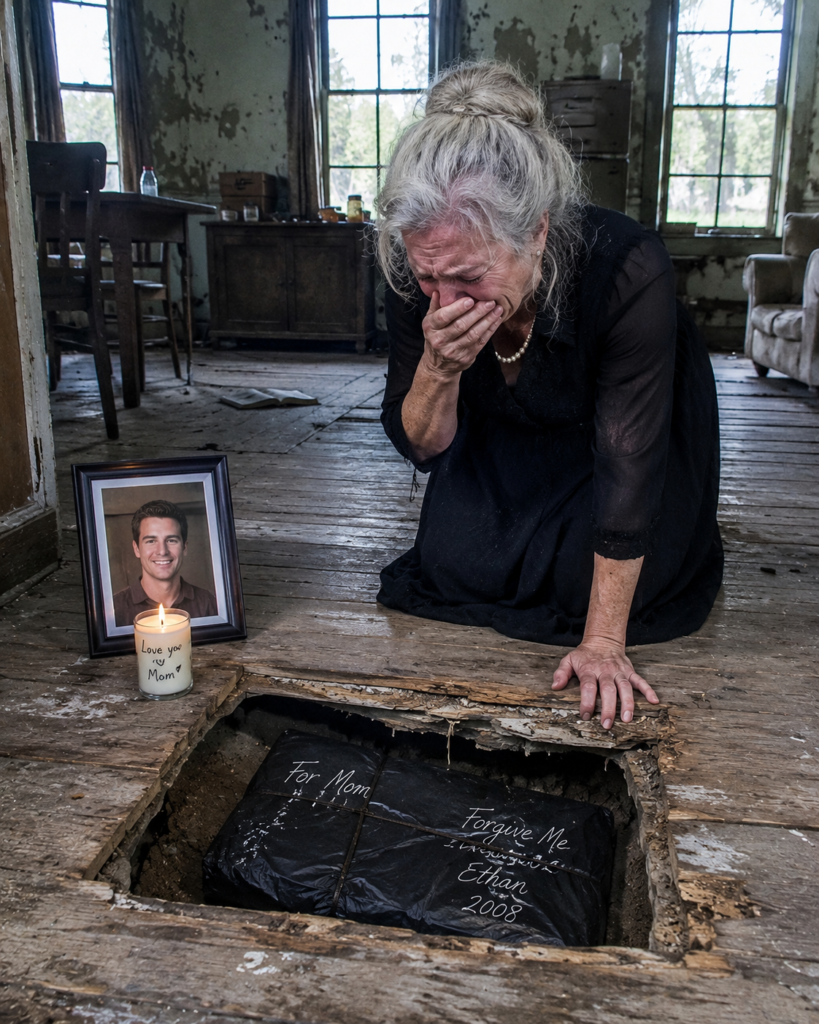
It was not the dead thud of rotten wood. It was hollow. Clean. Hidden. Eulalia stopped breathing for a second, then slowly lowered herself to her knees.
She ran her fingertips over the floor until she found the seam. It was narrow, straight, and too deliberate to be damage. Someone had cut that line with purpose.
At 6:43 a.m., she dug her nails into the edge and pulled.
The board lifted.
Beneath it was a metal box wrapped in oilcloth and sealed with black tape. Across the top, in Neftalí’s handwriting, were two words that made her chest tighten: MAMA ONLY.
Inside were three things: a deed transfer, a notarized letter dated 8 days before his death, and a USB drive taped behind a photograph of the four-million-dollar house.
The deed named a trust Eulalia had never heard of. The letter named her as protected resident of the mountain property and beneficiary of a separate instruction file. The USB drive had a paper tag folded around it.
On that tag, Neftalí had written: If she removes you from the house, give this to Attorney Salazar.
Eulalia sat back on her heels. Her mind could not take in all of it at once. The cabin walls seemed to tilt around her, and the candle on the altar flickered like it knew something she did not.
For years, she had believed her son had been blind to his wife’s cruelty. But the papers in the box told a different story. He had seen. He had documented. He had prepared.
Not silence. Not neglect. Not abandonment. A plan.
At the bottom of the notarized letter was the name of the county records office and a stamped filing number. Attached to it was a copy of a property trust instruction labeled private family holding.
Eulalia did not understand every legal word, but she understood enough. Neftalí had left her a path. He had hidden it where only she, desperate and exiled, would ever be likely to find it.
Then she heard tires outside.
The sound came slowly up the wet gravel road. Eulalia froze with the box in her lap. No one visited that cabin by accident. No neighbor could have wandered there. No delivery truck came that far into the mountains.
A car door opened.
Through the cracked window, she heard her daughter-in-law’s voice. “She better not have found it.”
Those words changed everything. They proved the widow knew something had existed. She may not have known where Neftalí hid it, but she knew enough to be afraid.
Eulalia moved faster than she thought her old body could move. She slid the deed transfer and letter beneath her dress, tucked the USB drive into the lining of her sleeve, and pushed the metal box under the altar cloth.
When the door opened, her daughter-in-law stepped inside with polished boots and a face arranged into false concern.
“Eulalia,” she said, looking around too quickly. “I came to see if you were comfortable.”
Comfortable. In a cabin with cracked windows, no water, and a floor that had just given up her son’s secret.
Eulalia looked at the woman who had stolen her home and nearly smiled. Not kindly. Not warmly. The kind of smile that arrives when fear finally leaves the room.
“I found a broom,” Eulalia said.
Her daughter-in-law’s eyes went to the altar. Then to the floor. Then to the candlestick lying beside the lifted board.
Her confidence drained out of her face like water.
“You had no right touching anything here,” she snapped.
That was how Eulalia knew. Innocent people ask what happened. Guilty people announce ownership before anyone accuses them.
Eulalia stood carefully, one hand against the wall, the hidden papers warm against her body. “You told me this ruin was mine,” she said. “Now you say I have no right to touch it?”
Her daughter-in-law stepped forward. “Give me what you found.”
The cabin went still. The candle flame trembled. Eulalia thought of every cold plate, every insult, every year she had made herself smaller so her son would not be forced to choose between wife and mother.
Then she thought of his handwriting. MAMA ONLY.
“No,” Eulalia said.
It was a small word. It shook when it came out. But it stood.
Her daughter-in-law lunged toward the altar, and Eulalia did the only thing she could. She grabbed the iron candlestick and held it between them, not to strike, but to stop.
For one ugly heartbeat, she imagined raising it. She imagined all that polished cruelty cracking open. Then she tightened her grip and did not move.
That restraint saved her.
Because when Attorney Salazar’s truck appeared at the cabin twenty minutes later, Eulalia was standing by the door with no blood on her hands and Neftalí’s letter hidden safely beneath her dress.
Salazar had received a scheduled email from Neftalí’s account that morning. It had been set to send if Neftalí failed to cancel it after his death. The email contained coordinates, instructions, and one sentence: My mother will be in danger if she finds the box.
The attorney read the documents at the cabin table while Eulalia’s daughter-in-law stood near the window, pale and silent.
The four-million-dollar house was not as simple as she had believed. Neftalí had placed several assets into a family trust before his death. His widow had access to some property, but not unlimited control over everything.
More importantly, the notarized letter documented his fear that his mother would be removed, isolated, or pressured. It named Eulalia’s right to housing support and instructed Salazar to challenge any coercive transfer.
The USB drive contained photographs of documents, copies of messages, and a recording in which his wife had demanded he “cut the old woman out before she becomes a burden.”
Eulalia listened once. Only once. The sound of her daughter-in-law’s voice on that recording did not surprise her. What broke her was hearing Neftalí answer.
“She is my mother,” he said on the recording. “She stays protected.”
For the first time since the funeral, Eulalia cried without anger.
The legal process did not become easy. Nothing involving grief, money, and family ever does. There were filings, hearings, inventories, and arguments over signatures. There were long afternoons when Eulalia sat in Salazar’s office with tea cooling in her hands.
But she was no longer alone in a ruined cabin with only silence for a witness.
County records confirmed the trust instruction. The notarized letter held. The recording supported the attorney’s claim that Neftalí had anticipated pressure against his mother. The widow’s control over the house was challenged and limited.
Eulalia did not ask for revenge. She asked for shelter, dignity, and the photograph of her son that had nearly been denied to her.
In the end, she did not return to live in the four-million-dollar house. Too much grief lived in those rooms. Too many walls had learned to echo insults.
Instead, the mountain cabin was repaired using funds Neftalí had set aside. Electricity came first. Then water. Then new windows. The little wooden altar stayed exactly where she had found it.
On the day the workmen finished the floor, Eulalia asked them to leave one old board in place near the altar. Not loose. Not dangerous. Just visible.
A reminder.
People often think love protects by standing in front of you. Sometimes it protects by hiding proof beneath your feet, waiting for the night you finally have nowhere else to go.
Eulalia had believed her son left her alone with the woman who despised her most. But beneath the cabin floor, Neftalí had left evidence that he had seen everything.
He had not left her with nothing.
He had left her a door.