The snow was falling softly as I pulled into the parking lot of Riverside Country Club at 6:15 on Christmas Eve.
The building glowed with warm light, every tall window framed with elegant white garland and tiny golden lights. From the outside, it looked like something printed on a holiday card and sold in a shop on Main Street, the kind with perfect snow, polished brass door handles, and families who smiled like they had never said a cruel thing to each other.
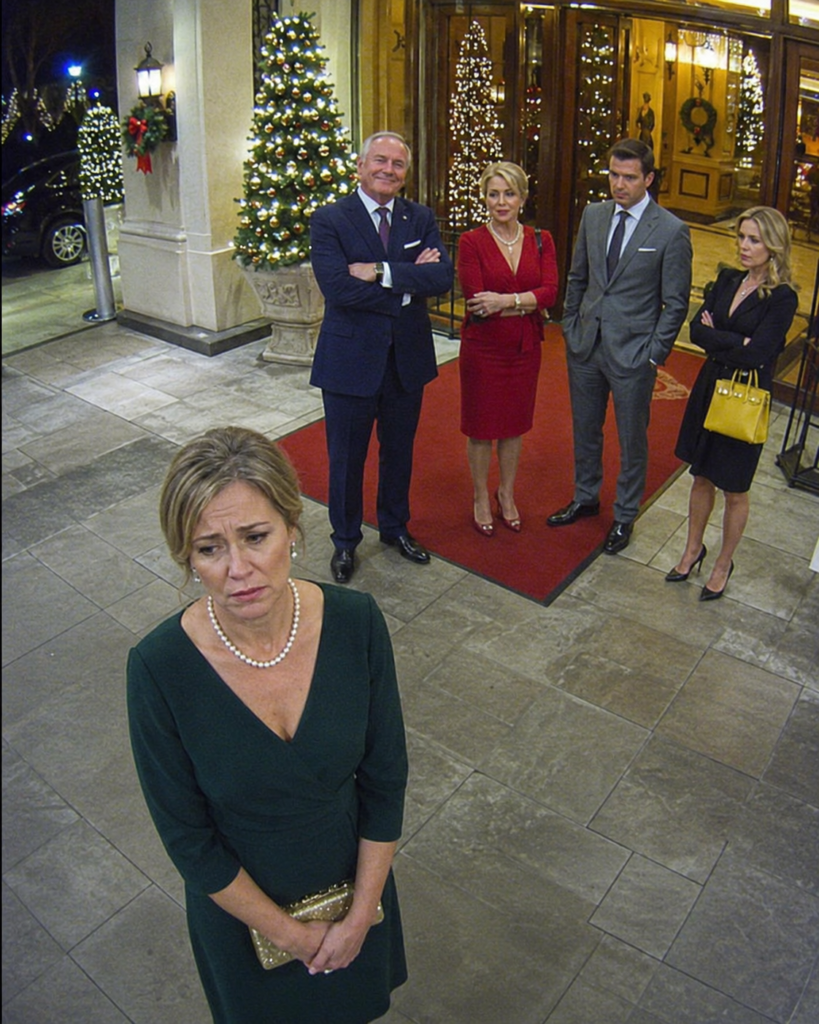
I had worn a dark green dress, simple but nice, with my grandmother’s pearl necklace resting against my collarbone. Nothing flashy. Nothing that would draw attention. I had learned years ago that blending in made things easier with my family.
The valet station was busy. Luxury cars pulled up one after another beneath the covered entrance. BMWs. Mercedes. A black Bentley with a bow tied around the hood like it had rolled straight out of a Christmas commercial.
I drove past them to the self-park area and found a spot near the back. My four-year-old Subaru looked out of place between the polished SUVs and imported sedans, but I was used to that. I liked that car. It started when I needed it to start. It got me through snow. It did not require me to explain myself to anyone.
As I approached the main entrance, my heels crunching over a thin dusting of snow, I saw my family gathered near the doors.
My father stood at the center in his tailored navy suit, his shoulders squared as if he were guarding the entrance himself. My mother stood beside him in a red cocktail dress that probably cost more than my monthly rent. My older brother, Derek, and his wife, Cynthia, were there too, both looking polished and expensive under the warm lights from the awning.
“Emma,” my father said as I reached the steps.
His tone was not warm.
“Hi, Dad. Merry Christmas.”
He did not move aside.
“Emma, there’s been a change of plans.”
I stopped walking. Behind him, through the glass doors, I could see the lobby glowing with chandeliers, garland, and candlelight. A host in a black jacket was laughing with an elderly couple near the coat check.
“What kind of change?” I asked.
“Tonight’s dinner is members only,” he said, crossing his arms. “The club is very strict about it, especially on holidays.”
I blinked. “But I’m family. I thought—”
“You’re family,” my mother interrupted, her smile sharp enough to cut ribbon, “but you’re not a member.”
“The club has standards, dear. You understand.”
Derek stepped forward, smoothing his tie like he had rehearsed this part in the mirror.
“Come on, Emma. Don’t make this difficult. You had to know this might happen. We told you weeks ago that we were upgrading our membership status here. Platinum level. Very exclusive.”
“You told me you were having Christmas dinner here and I should come,” I said quietly. “You didn’t mention anything about members only.”
“Well, circumstances change,” Cynthia said, examining her manicured nails. “Platinum members get priority access during peak times. The club can’t have nonmembers cluttering up the dining room. It affects the atmosphere.”
“Cluttering up,” I repeated.
“You know what she means,” Mom said. “It’s about maintaining a certain level of quality ambiance. People expect that when they pay premium membership fees.”
“I see.”
Dad’s expression softened slightly, which somehow made it worse.
“Look, Emma, we’re not trying to be cruel. It’s just reality. You’re not at the same level as the rest of us. You work at that nonprofit. You live in that little apartment. You drive that—”
He gestured vaguely toward the parking lot.
“That economy car. This club is for people who’ve achieved certain things in life.”
“And I haven’t achieved those things,” I said.
“Not yet,” Mom said, as if she were being generous. “Maybe someday. But tonight, you really should find somewhere more appropriate.”
She tilted her head toward the road beyond the club’s long driveway.
“Maybe try Applebee’s. They’re usually open on Christmas Eve. Very festive.”
Derek shifted uncomfortably, but not enough to help me.
“Emma, don’t take this personally. It’s not about you specifically. It’s about the club’s standards.”
“Right,” I said. “The standards.”
“Exactly,” Cynthia said brightly. “I’m sure you understand. It’s like how some restaurants have dress codes. This club has membership codes. It’s perfectly reasonable.”
A couple walked past us into the club. The man nodded to my father.
“George. Looking forward to dinner.”
“Patricia. Lovely as always.”
“Wonderful to see you, Harold,” Mom called back, her voice suddenly warm and friendly.
The moment they passed through the doors, her expression cooled again.
“Emma, you really need to go now. People are starting to notice, and it’s embarrassing.”
“Embarrassing for who?”
“For everyone,” Dad said firmly. “We’re trying to build relationships here. Important relationships. Having you standing at the entrance like—well, it doesn’t look good.”
“Like I’m some kind of beggar,” I said softly.
“Don’t be dramatic,” Mom snapped. “We’re just being realistic about social hierarchies. You’re thirty years old, Emma. You should understand how the world works by now.”
I looked at each of them.
My father stood like a security guard, blocking entry to a place I supposedly was not good enough to enter.
My mother looked embarrassed by my very existence.
My brother looked uncomfortable, but not uncomfortable enough to actually say anything.
His wife looked like she was enjoying the scene more than she wanted to admit.
“Okay,” I said. “I’ll go.”
“Good girl,” Mom said, already turning away. “Maybe next year you’ll have improved your situation enough to join us.”
I turned toward the parking lot. The cold air caught my face. My heels crunched softly in the snow, and behind me, I heard my family greeting more arrivals in bright, cheerful voices.
None of that warmth had been for me.
I had made it about three steps when rapid footsteps sounded behind me.
“Miss Anderson. Miss Anderson, wait.”
I turned to see Richard Chin rushing out of the club’s main entrance.
Richard was the club director, a position he had held for fifteen years. He was usually calm, composed, and precise, the kind of man who could handle a holiday seating crisis with a smile and a clipboard.
Right now, he looked almost panicked.
“Richard, it’s fine,” I started.
“It is absolutely not fine,” he said, slightly out of breath.
He looked past me to where my family stood frozen on the steps.
“What is going on here? Why are you leaving?”
“Members only tonight,” I said quietly. “My family explained the policy.”
Richard’s expression shifted from concerned to confused.
“Members only? We don’t have a members-only policy on Christmas Eve. We’re fully booked tonight, yes, but that’s because—”
He stopped and stared at my family.
“Did you tell Miss Anderson she couldn’t enter?”
“Now look here,” Dad said, stepping forward. “I don’t know who you think you are, but we’re platinum members of this club, and we have every right to determine who we dine with.”
“I’m Richard Chin, the club director,” Richard said. “We’ve met several times, Mr. Anderson, during your membership application process.”
“Exactly,” Dad said. “So you know we’re valued members, and we’re telling you that our dinner party tonight is members only. Our family members only.”
“Your family members only,” Richard repeated slowly.
His eyes moved to me, then back to my father.
“Mr. Anderson, do you know who Ms. Anderson is?”
“Of course I know who she is,” Dad said impatiently. “She’s my daughter. And while we love her, she’s not a member of this club, so she can’t join us tonight.”
“Mr. Anderson,” Richard said carefully. “Emma Anderson is not just a member of this club.”
“She’s not a member at all,” Cynthia interjected. “That’s what we’ve been saying.”
“No, Mrs. Anderson. I mean Emma Anderson is not just a member.”
Richard’s voice took on a strange quality.
“She’s the owner.”
The silence that followed was profound.
Snow drifted from the edge of the awning. Somewhere inside, a burst of laughter rose from the lobby and then faded behind the glass doors.
“The what?” Mom said faintly.
“The owner,” Richard said. “Ms. Anderson owns Riverside Country Club. She has owned it for the past six years.”
Derek laughed, but it sounded nervous.
“That’s impossible. Emma works at a nonprofit. She barely makes forty thousand a year.”
“I work for a charitable foundation,” I said quietly. “I never said it was my only job.”
“But you—” Mom looked at me like she was seeing a stranger. “You drive a Subaru.”
“I like my Subaru.”
“You live in a two-bedroom apartment.”
“I like my apartment.”
Dad’s face had gone red.
“This is some kind of mistake. Emma can’t afford to own a country club. Look at her. She shops at Target.”
“Mr. Anderson,” Richard said, his professional composure starting to crack. “I assure you there is no mistake. Ms. Anderson purchased Riverside Country Club six years ago through Anderson Holdings, LLC. She owns this property, the golf course, the tennis facilities, and all associated assets.”
A woman in an elegant pantsuit emerged from the entrance. Her name tag identified her as Sharon Mitchell, assistant director.
“Richard, is everything all right? Several members are asking about the commotion.”
“Sharon, could you please confirm Miss Anderson’s ownership status for her family?”
Sharon looked confused, then saw me standing there in the snow.
“Miss Anderson, I didn’t realize you were here. Of course.”
She turned to my family.
“Emma Anderson is the sole owner of Riverside Country Club. She’s also been incredibly gracious about maintaining our traditions and supporting the staff. We’re lucky to have her.”
“This doesn’t make any sense,” Cynthia said, her voice rising. “How could Emma possibly afford to buy a country club?”
“The same way I afford everything else,” I said. “I work for it.”
“You said you work at a nonprofit.”
“I do. The Anderson Foundation, which I founded eight years ago after I sold my software company.”
Derek’s mouth opened and closed.
“You sold a software company?”
“I started it when I was twenty-two. Sold it when I was twenty-six for forty-three million dollars. I used part of the money to start the foundation, and I invested the rest in various properties, including this club.”
“Forty-three million,” Mom repeated numbly.
“That was the initial sale price. With the equity options and performance bonuses, it ended up being closer to sixty million, but I try not to be too specific about finances. It seems tacky.”
Dad sat down heavily on the steps.
“You’ve had sixty million dollars for six years, and you never told us.”
“You never asked. You just assumed I was poor because I didn’t perform wealth the way you wanted me to.”
“But why?” Mom demanded. “Why would you live like that if you have money?”
“Because I like my life. I like my apartment. I like my car. I like working at the foundation and actually helping people instead of just talking about wealth and status at country club dinners.”
Richard cleared his throat.
“Ms. Anderson, I apologize profusely for this situation. If I had known your family was turning you away, I would have intervened immediately.”
“It’s all right, Richard. You didn’t know.”
“It’s not all right,” he said firmly.
He turned to my father.
“Mr. Anderson, I’m going to need to have a serious conversation with you about club conduct policies.”
“Conduct policies?” Dad stood up quickly now. “Wait a minute. We’re platinum members. We’ve spent a fortune on this membership.”
“You’ve spent twelve thousand dollars on your membership,” Richard corrected. “Which is our standard platinum rate. However, that membership comes with certain behavioral expectations, including treating all members and guests with respect.”
“We weren’t disrespecting anyone,” Cynthia protested. “We were just explaining the reality of the situation.”
“The reality,” Sharon said coldly, “is that you were preventing the club’s owner from entering her own property on Christmas Eve.”
A man in a dark suit joined the growing group near the entrance. His badge read Thomas Warren, Head of Security.
“Richard, we have a situation developing. Multiple members are gathering in the lobby wanting to know what’s happening. Some are concerned about a disturbance.”
“There’s no disturbance,” Dad said quickly. “Just a family misunderstanding. Everything’s fine now.”
He turned toward me with a smile so strained it barely fit his face.
“Emma. Sweetheart. Why don’t you come join us for dinner? We’d love to have you.”
I looked at him.
His expression was desperate now. All the superiority had drained out of him, leaving only calculation.
“Would you?” I asked.
“Of course. You’re family. We just didn’t understand the full situation.”
“The situation where I own the building.”
“That’s not what I meant.”
“But it’s what you mean now. Five minutes ago, I wasn’t good enough to enter. Now I own the place, so suddenly I’m welcome.”
“Emma, don’t be difficult,” Mom said, but her voice shook. “We made a mistake. Can’t you forgive a mistake?”
“A mistake?” I repeated. “Is that what we’re calling it?”
Another person emerged from the club, an elderly gentleman in an expensive suit walking with a cane. I recognized him immediately.
Charles Peyton, president of the club’s member board.
“What on earth is going on out here?” he demanded. “Richard, we have guests waiting for tables and half the staff is distracted by some drama at the front entrance.”
“Mr. Peyton,” Richard said. “I apologize for the disruption. There’s been an incident involving Ms. Anderson.”
Charles’s expression changed instantly.
“Emma, what happened? Are you all right?”
“I’m fine, Charles. Just a misunderstanding with my family.”
He looked at my parents, then back at me, his expression sharpening.
“What kind of misunderstanding?”
“The kind where they told me I couldn’t enter because I’m not a member,” I said quietly.
Charles’s face flushed.
“They did what?”
“It was a mistake,” Dad said desperately. “We thought there was a members-only policy tonight.”
“There is no such policy,” Charles said. “And even if there were, Emma Anderson could enter this club at any time, for any reason, because she owns every square inch of it.”
Charles turned to Richard.
“Tell me their membership status.”
Richard pulled out his phone and tapped a few times.
“George and Patricia Anderson. Platinum membership initiated eight weeks ago. Twelve-thousand-dollar annual fee paid in full. Currently applying for Heritage Club status, which would give them access to the private dining rooms and golf priority booking.”
“Heritage Club status,” Charles said slowly. “That’s under my committee’s review, correct?”
“Yes, sir. We were planning to make our final decision on their application after the holiday.”
“That’s correct.”
Charles looked at my parents.
“Were you aware that Heritage Club status requires not just financial standing, but also demonstrated good character and positive contribution to the club community?”
“We—yes,” Mom said weakly.
“And you thought turning away the club owner from her own property on Christmas Eve demonstrated good character.”
“We didn’t know she was the owner,” Cynthia burst out. “She never told us. She let us think she was poor.”
“I never said I was poor,” I corrected. “You assumed it because I didn’t buy expensive cars or designer clothes. I didn’t correct you because it didn’t matter to me what you thought.”
“Didn’t matter?” Mom’s voice cracked. “Emma, we’re your family.”
“Are you? Because family doesn’t usually suggest I eat at Applebee’s while they dine at a country club.”
Derek stepped forward.
“Emma, come on. This has gone far enough. Yes, we were wrong. We admit it. Can’t we just go inside and have a nice dinner and work this out?”
“Work it out?” I said. “You mean pretend the last six years didn’t happen? Pretend you haven’t spent every family gathering making comments about my little apartment, my starter car, and my entry-level job? Pretend you didn’t just try to keep me outside a building I own?”
“We didn’t know you owned it.”
“That’s the point, Derek. You didn’t know, but you still treated me like I was beneath you. The only thing that changed is that now you know I have money. I’m the same person I was ten minutes ago. But ten minutes ago, I wasn’t good enough for your platinum-members dinner party.”
A younger woman appeared wearing the club’s staff uniform.
“Mr. Chin, I’m sorry to interrupt, but we have guests asking about Ms. Anderson. The Robertson family would like to say hello, and the Martinez group is requesting a photo with her.”
“Photo?” Dad said blankly.
The staff member looked confused.
“Ms. Anderson is quite popular with our members. She attends several events throughout the year, and she’s personally funded three scholarship programs for local students. Many members consider her a friend.”
“You come here regularly?” Mom asked me.
“Every few weeks. I like to check on operations and attend community events.”
“But we’ve been members for two months. Why haven’t we seen you?”
“You have,” I said. “Three times.”
Mom went still.
“Once in the parking lot when you drove past me without acknowledging me. Once in the lobby when you were showing off for your friends and pretended not to notice me. And once on the patio when you made a joke to someone about how even the staff dressed better than some people’s families.”
Mom’s face went white.
“That was about you?”
“I was sitting two tables away.”
Richard’s expression had gone from professional concern to cold anger.
“Ms. Anderson, I apologize that you experienced that treatment at your own club. That’s unacceptable.”
“It’s fine.”
“Richard,” I added gently, “it’s not your fault.”
“It may not be my fault,” he said, “but it happened here.”
He turned to Thomas.
“I want a full review of the Anderson family’s interactions with staff and other members tonight.”
“Immediately, sir,” Thomas said, pulling out a radio.
“Hold on,” Dad protested. “You can’t investigate us like we’ve done something terrible. We’re platinum members. We’ve donated to club causes.”
“You’ve paid your membership fees,” Charles corrected sharply. “That is not the same as donating. And frankly, Mr. Anderson, your behavior tonight calls into serious question whether you understand what this club stands for.”
A couple approached from the parking lot, older and distinguished looking. The man nodded to me warmly.
“Emma, wonderful to see you. Are you joining the Christmas dinner?”
“Hi, Dr. Robertson. Mrs. Robertson. I’m not sure yet.”
“Well, we hope you do,” Dr. Robertson said. “Sarah was just saying how lovely it would be to have you at our table. You’re always such delightful company.”
They continued inside.
Mom stared after them.
“You know the Robertsons?”
“Of course. They’ve been members here for thirty years. Dr. Robertson serves on the foundation board with me.”
“The foundation board,” Mom repeated.
“The Anderson Foundation has twelve board members, all prominent community leaders. We allocate approximately eight million dollars annually to local education and healthcare initiatives.”
“Eight million a year,” Derek said numbly.
Another family passed us on the way in.
“Emma, Merry Christmas.”
“Merry Christmas, Mr. Tanaka.”
Then another woman stopped near the steps.
“Ms. Anderson, my daughter wanted me to thank you again for her scholarship. She’s doing wonderfully at Princeton.”
“I’m so glad to hear that, Mrs. Chin. Tell her I said congratulations.”
Each greeting made my family shrink a little smaller.
These were people I had apparently been interacting with for years, people who knew pieces of my life that my family had never bothered to ask about.
Sharon’s radio crackled. She listened, then looked at Richard.
“Sir, we have a situation in the dining room. Several members are asking about the delay in seating, and the Anderson party’s table is currently the focal point of attention.”
“The focal point?” Cynthia said nervously.
“The Robertson family has been asking other members if they knew about the incident at the entrance,” Sharon explained. “It’s creating significant conversation.”
Charles made a disgusted sound.
“Of course it is. Emma, I’m deeply sorry about this. This club is supposed to be a place of community and respect.”
“It usually is,” I said. “Tonight was just unusual.”
“Unusual,” he repeated. “That’s generous of you.”
He turned to my parents.
“Mr. and Mrs. Anderson, I think you should know that your behavior tonight will be discussed at the next Heritage Club committee meeting.”
“Discussed how?” Dad asked, fear creeping into his voice.
“Discussed in terms of whether individuals who treat the club owner with such disrespect are suitable for elevated membership status or any membership status at all.”
Mom gasped.
“You can’t revoke our membership. We’ve paid for the full year.”
“We can absolutely revoke membership for conduct violations,” Charles said. “It’s in the contract you signed. Section twelve, paragraph three.”
Richard was typing on his phone.
“I’m pulling up their file now. I’m also seeing several incident reports from staff members.”
“Incident reports?” Derek said.
“Three separate complaints from servers about dismissive treatment. Two complaints from the valet staff about rude remarks. One complaint from the golf course superintendent about damage to the green that was never reported or paid for.”
“That was an accident,” Cynthia said.
“Accidents that are not reported become patterns of disrespect,” Richard said coldly. “And now we add attempting to bar the owner from her own property.”
He turned to me.
“Miss Anderson, what would you like us to do?”
All eyes turned to me.
My family looked terrified. The staff looked angry on my behalf. Charles looked like he wanted to escort my parents out personally.
“I’d like,” I said slowly, “to have Christmas dinner.”
“Of course,” Richard said immediately. “Your usual table.”
“Actually, I saw that Dr. and Mrs. Robertson invited me to their table. I think I’ll join them, if that’s all right.”
“I’m sure they’d be delighted.”
“And the Anderson party?” Sharon asked, glancing at my family.
I looked at my parents, my brother, and his wife. All of them stood in the snow, their expensive clothes and jewelry suddenly seeming costume-like and fragile.
“The Anderson party is welcome to stay for their dinner,” I said, “at their reserved table.”
Dad sagged with relief.
“Thank you, Emma. Thank you so much. We’ll never—”
“However,” I continued, “their membership status is under review pending the Heritage Club Committee’s investigation into tonight’s incident.”
Richard nodded.
“Please make a note,” I said, “that any future complaints about the Anderson family should be reported directly to me.”
“Understood.”
“And Charles, at the next board meeting, I’d like to propose a new club policy. Any member who demonstrates discriminatory behavior toward other members or guests based on perceived economic status should face immediate membership suspension.”
“I’ll add it to the agenda personally,” Charles said with grim satisfaction.
“One more thing,” I said.
My mother’s lips parted, but no sound came out.
“The Anderson party’s application for Heritage Club status is denied permanently.”
“Emma, please,” Mom said, tears beginning to form. “We made a mistake. Don’t punish us forever for one mistake.”
“Heritage Club status isn’t a punishment to deny. It’s an honor to grant. And you haven’t earned it.”
“But everyone we know is Heritage Club level,” Cynthia protested. “How will it look if we’re rejected?”
“It will look like you faced consequences for your behavior,” I said. “I imagine it will be very embarrassing for you.”
I paused.
“Maybe you could try Applebee’s.”
Mom made a small wounded sound.
Thomas spoke into his radio, listened, then looked at Richard.
“Sir, we have multiple members asking to speak with Ms. Anderson. The Martinez family, the Patel family, the Johnsons.”
“Tell them I’ll be in shortly,” I said. “I just need to finish up here.”
“Ms. Anderson,” Sharon said hesitantly, “about the Anderson party’s table. It’s currently positioned in the main dining room with good visibility. Given the circumstances, should we relocate them somewhere more discreet?”
I considered this.
My family waited, hardly breathing.
“No,” I said finally. “Leave them at their original table. Let them eat their Christmas dinner in full view of everyone.”
“Emma, please don’t do this,” Derek said quietly. “People will ask questions. They’ll want to know why we’re not sitting with you.”
“Yes, they will.”
“What will you tell them?”
He had no answer.
“You’ll tell them the truth. That you tried to turn away your own sister from a country club she owns because you thought she wasn’t good enough. Then you’ll sit there, eat your dinner, and think about what kind of people that makes you.”
“That’s cruel,” Cynthia whispered.
“Is it?” I asked. “Or is it just the natural consequence of your own behavior?”
Another group approached from the parking lot, a young couple with two small children bundled in winter coats.
“Miss Anderson. Merry Christmas.”
“Merry Christmas, Taylor. Josh. Hi, Lily.”
I waved at the children, who beamed at me.
“The kids wanted to thank you again for the playground donation,” Taylor said. “It’s been such a joy for the whole community.”
“I’m so glad. Have a wonderful dinner tonight.”
They went inside, the children chattering excitedly about Santa Claus.
Dad watched them go, then looked at me as if he were seeing me for the first time.
“A playground donation?” he asked weakly.
“The elementary school needed new equipment. The foundation covered it.”
“How much?” Derek asked.
“Four hundred thousand dollars.”
“Four hundred thousand dollars for a playground.”
“It’s a very nice playground,” I said. “Safe, accessible, educational. Everything children deserve.”
Mom’s voice was small.
“Why didn’t you tell us you were doing things like that?”
“You never asked what I did with my time. You just assumed I wasn’t doing anything important because I wasn’t buying luxury cars or designer purses.”
Richard’s phone buzzed. He looked at it, then at me.
“Ms. Anderson, the Robertson table is asking when you’ll be joining them. Should I tell them you’ll be delayed?”
“No. I’m ready now.”
I started toward the entrance, then paused.
“Oh, one more thing. Richard, what’s the status of the Anderson party’s bar tab?”
“They have a platinum membership, so they currently receive a twenty-five percent discount on all food and beverages.”
“Please remove that discount effective immediately. Standard pricing only.”
“Emma,” Dad protested.
“Platinum members receive discounts based on their standing in the club community,” I said. “I don’t think your standing is particularly high right now, do you?”
I walked toward the entrance.
Richard and Sharon fell into step beside me. Charles followed. Thomas remained with my family, presumably to escort them to their table.
As we entered the warm, beautifully decorated lobby, I could see members milling around, clearly aware that something significant had happened outside. Several people waved to me. A few called out greetings.
“Ms. Anderson,” Richard said quietly as we walked, “I need to ask. How would you like us to handle this going forward? Your family’s membership, I mean.”
“Honor their current annual contract,” I said. “But make it clear that renewal is not guaranteed and will be subject to demonstrated improvement in behavior and community contribution.”
“And if they don’t improve?”
“Then next year they can have their Christmas dinner somewhere else.”
Sharon leaned closer.
“Between you and me, I hope they don’t improve. Watching them have to explain to their friends why their membership wasn’t renewed would be enormously satisfying.”
I smiled despite myself.
“That’s unprofessional, Sharon.”
“Yes, ma’am. But still true.”
We reached the entrance to the main dining room.
Through the doorway, I could see the Robertson table waving at me, welcoming. I could also see my family being seated at their table near the center of the room.
My mother’s face was pale. My father’s expression was hollow. Derek stared straight ahead, and Cynthia kept glancing around as if every chandelier had become a spotlight.
“One last thing,” I said to Richard. “I want a full report on my desk after the holidays detailing every interaction my family has had with staff and other members since they joined. Everything. I want to know if this kind of behavior is a pattern or just tonight’s spectacular failure.”
“You’ll have it by December twenty-seventh,” he promised.
“Thank you. And Richard, have a merry Christmas. You’ve handled this with remarkable professionalism.”
“Thank you, Miss Anderson, though I wish the circumstances had been different.”
“So do I.”
I walked into the dining room.
The Robertsons stood to greet me, Dr. Robertson pulling out my chair personally.
“Emma, we’re so delighted you’re joining us.”
“Thank you for having me.”
As I sat down, I had a clear view of my family’s table. They were staring at their menus like the pages contained the secrets of the universe, clearly trying to avoid eye contact with anyone.
Several nearby tables were whispering, glancing between them and me.
Mrs. Robertson followed my gaze.
“Is everything all right, dear? You seemed a bit delayed coming in.”
“Just a family matter,” I said. “Nothing serious.”
“Family,” she said knowingly. “Sometimes they’re the most complicated relationships we have.”
“Sometimes,” I agreed.
A server appeared with champagne.
“Compliments of the house, Ms. Anderson. The chef wanted to wish you a merry Christmas.”
“Please give him my thanks.”
Across the room, I saw my mother watching the exchange. Her face held a mixture of confusion and misery.
Dad was talking to a server, probably asking about prices now that they had lost their discount. Derek sat with his arms crossed while Cynthia kept glancing around nervously, aware of the attention they were receiving.
Dr. Robertson raised his glass.
“A toast to kindness, generosity, and the true spirit of the season.”
“Hear, hear,” several voices chorused.
I raised my glass and smiled. For the first time that evening, the smile was genuine.
The rest of the dinner passed pleasantly. The Robertsons were warm and funny, telling stories about their grandchildren and their recent trip to Italy.
Other members stopped by to say hello, to thank me for various foundation initiatives, and to wish me happy holidays. I felt surrounded by real community and real connection.
My family, meanwhile, sat at their table eating in near silence.
I watched them occasionally, not out of vindictiveness, but out of a kind of sad curiosity. Had they always been like this? Had I just never noticed because I had been too busy trying to meet their impossible standards?
Around 9:30, as dessert was being served, Richard appeared at my table. He leaned down discreetly.
“Ms. Anderson, the Anderson party is requesting their check. They’d like to leave already.”
“Dinner service usually runs until eleven on Christmas Eve.”
“Yes. They seem uncomfortable.”
“I imagine they are.”
I thought for a moment.
“Process their check at standard rates, as discussed. And Richard, make sure the itemized receipt shows the discount they would have received as platinum members, then shows it being removed. I want them to see exactly what their behavior cost them.”
A small smile played at Richard’s lips.
“Understood.”
Ten minutes later, I saw my parents standing at their table. My father held what looked like a bill, his face turning red as he read it.
He said something sharp to the server, who remained professionally calm and pointed toward Richard, who stood near the exit with his tablet, ready to explain the charges.
I watched my father argue. I watched my mother try to pull him away. I watched Derek hand over a credit card with shaking hands. I watched Cynthia walk quickly toward the exit, her head down.
They never looked in my direction as they left.
Dr. Robertson had noticed too.
“Friends of yours?” he asked gently.
“Family, actually.”
He did not press further, which I appreciated.
“Well, their loss is our gain. We’ve enjoyed your company immensely tonight.”
“Thank you. That means a lot.”
Mrs. Robertson reached across the table and patted my hand.
“Emma, whatever happened tonight, I hope you know that the community here values you tremendously. Not because of your ownership of the club or your foundation work, though those are wonderful. We value you because you’re kind, thoughtful, and genuine. Those qualities are far rarer than money.”
I felt my eyes prickle with unexpected tears.
“Thank you. That’s—thank you.”
“Merry Christmas, dear,” she said warmly.
“Merry Christmas.”
I stayed until nearly eleven, talking and laughing with the Robertsons and the other families who joined our table throughout the evening.
People who knew me truly knew me, and valued me for who I was rather than what I had.
As the evening wound down and I finally prepared to leave, Charles found me in the lobby.
“Emma, a word?”
“Of course.”
He guided me to a quiet corner near a tall Christmas tree decorated with gold ribbon and white lights.
“I wanted you to know that I’ve already begun documenting tonight’s incident for the board. Your family’s behavior was unacceptable, and I want to ensure there are consequences.”
“Thank you, Charles. I appreciate that.”
“I also want to apologize. As president of the member board, I should have been more aware of how new members were treating staff and other members. The fact that your family was able to behave badly for two months without facing consequences is my failure.”
“It’s not your failure. They’re very good at presenting well to people who matter to them. Staff and people they consider beneath them get different treatment.”
“Which is exactly why they shouldn’t be members at all,” he said firmly. “Emma, with your permission, I’d like to recommend immediate membership revocation rather than waiting for their annual renewal.”
I considered this.
The vindictive part of me wanted to say yes. But the part of me that had built a successful foundation on principles of redemption and growth hesitated.
“Let’s wait,” I said finally. “Let’s see if they learn anything from tonight. If they improve their behavior, genuinely improve it, then maybe they deserve a second chance. If they don’t, then we’ll revisit the revocation discussion.”
Charles nodded slowly.
“You’re more generous than I would be.”
“Maybe. Or maybe I just want to see if people can actually change when they’re forced to face consequences.”
“A fair experiment,” he said, “though I’m not optimistic about the results.”
“Neither am I,” I admitted. “But I’d rather be surprised by growth than proven right about their inability to change.”
He smiled.
“This is why the club is lucky to have you as owner. Merry Christmas, Emma.”
“Merry Christmas, Charles.”
I walked out into the cold night air.
The snow had stopped, leaving everything covered in a clean white blanket that sparkled under the parking lot lights. My Subaru sat where I had left it, humble and practical among the luxury vehicles.
I sat in the driver’s seat for a moment before starting the engine, processing everything that had happened.
My phone buzzed.
A text from my mother.
We need to talk about tonight.
Not an apology. Not an acknowledgment of what they had done. Just a demand for more of my time and attention.
I deleted the message without responding.
Another text came through. This one was from my brother.
Emma, please. Let’s fix this.
I stared at it for a long moment, then typed back.
There’s nothing to fix, Derek. You showed me exactly who you are tonight. I believe you.
I turned off my phone and started the car.
As I drove out of the parking lot, I glanced in the rearview mirror. Riverside Country Club glowed in the darkness behind me, warm and welcoming, full of people who valued kindness over status.
My family had tried to keep me out.
They had not realized I owned the key to every door.
And tomorrow, they would wake up to a world where everyone they wanted to impress would know exactly what they had done.
I smiled and turned toward home, ready to spend the rest of Christmas Eve in my comfortable apartment with my practical car parked outside, living the life I had chosen rather than the one my family thought I should want.
Sometimes the best gift you can give yourself is the freedom to stop caring what people think.
Even when those people are family.