On the morning we were supposed to move out, I woke before sunrise and stood alone in the kitchen of the house on Willow Creek Drive, staring at half-packed boxes and the coffee mug my husband had once given me on our first anniversary. It said Home is wherever we are. By noon, I would know that was a lie.
My name is Claire Bennett, and for eleven years I had been married to Daniel Bennett, a man who spoke softly in public and made decisions in private as if my life were an item on a checklist. His sister, Vanessa Cole, had moved through our marriage like a seasonal storm—dramatic, temporary, destructive. When her divorce was finalized, she started showing up at our place nearly every day with her two children, Mason and Lily. At first I sympathized. She cried at my dining table, said she needed family, said she just needed a little time. But “a little time” became seven months of dinners, laundry, overnight stays, noise, and Daniel insisting that “she has nowhere else to go.”
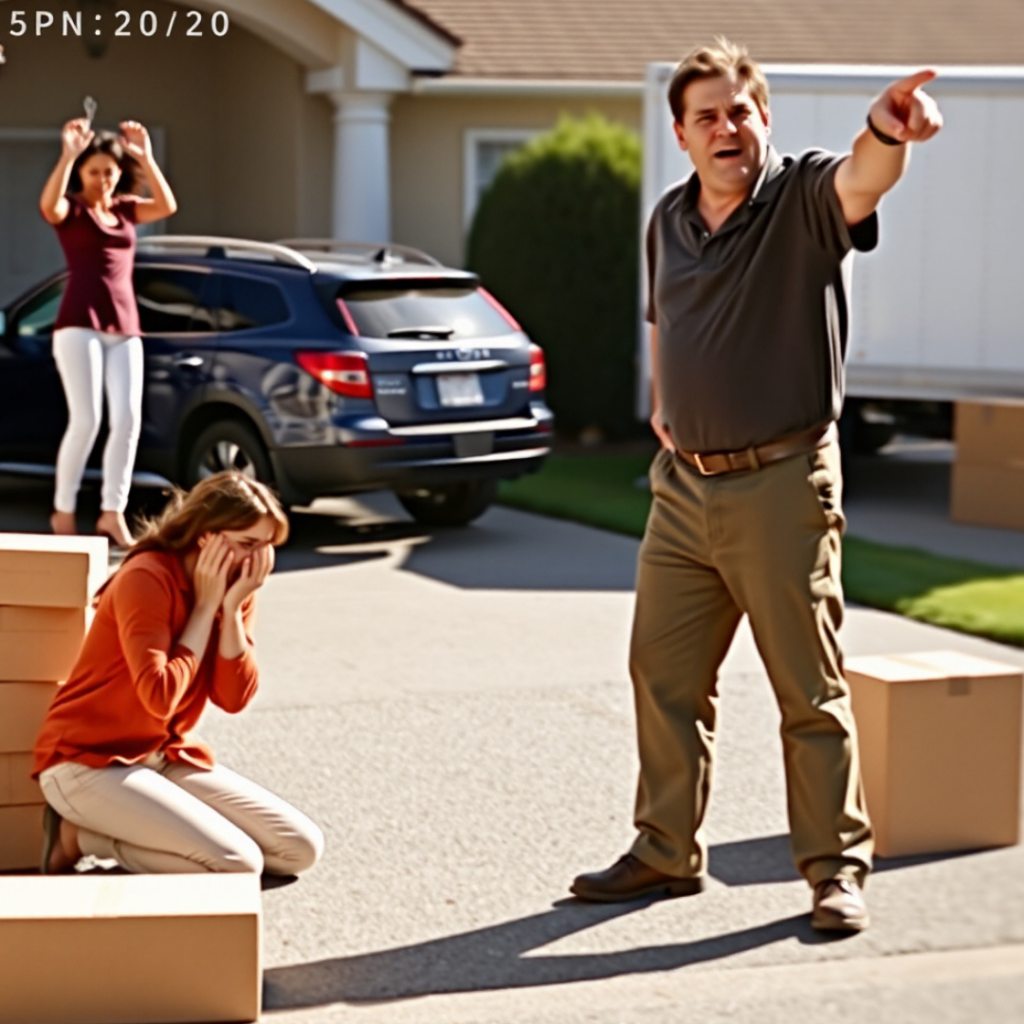
I was the one who suggested we move to a condo downtown. Smaller space, firmer boundaries. Daniel agreed too quickly. I should have understood then that he already had another plan.
The movers were due at ten. I had already loaded my car with important documents, jewelry, and a suitcase. Daniel said he would bring the last of the garage boxes. Instead, a silver SUV pulled into the driveway. Vanessa stepped out first, wearing sunglasses and a smile that made my stomach turn. Her kids trailed behind her with backpacks. Daniel came around from the driver’s side holding a folder.
“What is this?” I asked.
He looked almost amused. “Actually, this house is spacious enough for all of us to live here.”
I laughed once, sharply, because the sentence was so absurd it sounded rehearsed. “We’re moving.”
“No,” he said. “You’re leaving.”
For a second the whole world narrowed to the twitch in his jaw. Vanessa climbed the porch steps, brushing past me as though she belonged there. “Obey your landlord,” she said lightly, as if it were a joke she had been saving.
“My landlord?” I repeated.
Daniel opened the folder and pulled out a lease agreement with my name typed where the tenant’s should have been. “The property is under a trust now. You have thirty days. But since you were already planning to go, this is easier.”
My pulse thundered in my ears. “That house was my mother’s.”
“It was transferred after the marriage,” he said. “You signed papers.”
I stared at him. Six months earlier he had rushed me through a stack of refinancing documents while I was recovering from surgery. I had signed because he said it was just to lower insurance and property taxes.
Behind me, one of the movers asked, “Ma’am, do you still want us to load?”
Before I could answer, Daniel took my house key from the bowl by the door. Vanessa held the door open for a locksmith standing beside the hedges, a man I had not even noticed. They had planned every minute.
“Daniel,” I said, my voice shaking now, “you cannot do this.”
He met my eyes without warmth. “It’s done.”
The new locks clicked into place while I stood on my own front walk, surrounded by boxes, watching my husband and his sister disappear inside my mother’s house.
And then I remembered something Daniel had forgotten.
The house had never legally been his to touch.
I did not scream. That surprised me later.
I thought betrayal would sound loud when it arrived—shouting, shattered glass, neighbors staring from their lawns. Instead, it felt cold and precise, like a knife laid against skin before the cut. I stood in the driveway, one hand gripping my car keys so tightly the metal pressed crescents into my palm, and watched the movers avoid my eyes. The locksmith finished his work, packed his tools, and drove away. Daniel didn’t come back outside.
Vanessa did.
She opened the front door just enough to lean against the frame. “Claire, don’t make this uglier than it needs to be. You already said you wanted a condo.”
“I said we needed space.”
She gave a small shrug. “Plans change.”
Her tone almost steadied me. Cruelty is easier to fight when it stops pretending to be kindness.
I told the movers to put my boxes into a storage unit instead. Then I drove to the one person Daniel always hated me confiding in—my cousin Rebecca Shaw, an accountant in Arlington who had spent twenty years developing a talent for reading financial deception the way other people read weather. She opened the door, saw my face, and said only, “Come in.”
Within an hour, I had laid everything out: Vanessa’s constant presence, Daniel’s sudden enthusiasm about moving, the mysterious documents from six months earlier, the fake lease, the lock change. Rebecca listened with the stillness of someone already building a case in her head.
“Bring me every copy you have,” she said.
I had one advantage Daniel didn’t know about. I am not sentimental with paperwork. In the glove compartment of my car sat a blue accordion folder containing tax returns, deed copies, insurance records, mortgage statements, my mother’s estate documents, and the trust paperwork created after her death. My mother, Eleanor Hayes, had been meticulous and suspicious by nature. She had transferred the house into the Eleanor Hayes Residential Trust, naming me sole beneficiary and sole successor trustee. After I married Daniel, the property remained protected unless I signed a notarized transfer specifically removing it from the trust.
Rebecca spread the documents across her dining table. We found the deed. We found the trust certification. We found the notarized signatures from the so-called refinance packet Daniel had rushed me through.
Then Rebecca’s mouth hardened.
“This notarization is wrong,” she said.
I leaned closer. “What do you mean?”
“The notary commission number is expired. And the signature doesn’t match the name stamped underneath.”
My heart started beating faster again, but this time not from panic. From direction.
By five o’clock, Rebecca had contacted a real estate attorney she worked with often, Michael Torres. He agreed to meet us that evening. Michael was the kind of man who wore a loosened tie and looked permanently unimpressed by human stupidity. After hearing the story and reviewing the documents, he gave me the first clear sentence I had heard all day.
“If these are forged or fraudulently executed, your husband has no lawful claim to possession,” he said. “Changing the locks doesn’t make him owner. A fake lease doesn’t make you a tenant.”
“And Vanessa?” I asked.
“She’s a guest of someone who likely had no authority to invite her.”
I almost laughed from sheer relief.
Michael moved quickly. He called the county recorder’s office emergency contact, confirmed that a transfer deed had been recorded three months earlier purporting to remove the house from the trust and place title into an LLC called Bennett Residential Holdings. Daniel had formed the LLC two weeks before that. Vanessa was listed as its secretary.
The audacity of it left me dizzy.
We also learned something worse: Daniel had stopped making payments on our joint credit card accounts while secretly drawing cash advances. He had told Vanessa he would “secure the property,” let her and the children move in, and then file for divorce claiming I had abandoned the marital home. The condo story had been bait. He had counted on me leaving quietly with whatever I could carry.
Michael filed for an emergency hearing the next morning, along with a motion challenging the deed transfer and requesting immediate restoration of possession. He also advised me to make a police report regarding the suspected forgery and unlawful exclusion from my residence. Rebecca accompanied me to the station.
The officer on duty, Sergeant Lisa Monroe, listened carefully and asked for copies. When she saw the trust documents and the questionable notary seal, her expression changed from polite skepticism to focused attention. “People think property fraud is complicated enough that no one fights back,” she said. “They count on confusion.”
That night I stayed in Rebecca’s guest room, staring at the ceiling fan turning in slow circles. I kept replaying small moments from the last year: Daniel insisting I let him handle the bills, Daniel dismissing my questions, Daniel telling Vanessa in the backyard that “it’ll all be settled soon” when he thought I was inside. I had mistaken secrecy for stress. I had mistaken patience for loyalty.
At 6:43 the next morning, my phone buzzed.
It was a text from Daniel.
You are embarrassing yourself. Don’t involve the police over a family matter. Take the condo money and walk away.
There was no condo money, of course. Another lie. I showed the message to Michael, who smiled without humor.
“Good,” he said. “Now he knows you’re not leaving.”
By afternoon, the county office confirmed in writing that the original trust was still valid on its face pending judicial review, and that the deed out had irregularities substantial enough to warrant investigation. Michael sent formal notice to Daniel and Vanessa demanding they vacate immediately and preserve all records relating to the LLC, the deed filing, and any occupancy agreements.
Daniel called me six times. I did not answer.
Vanessa left a voicemail instead. Her voice had lost all its smugness.
“Claire, you’re overreacting. The kids are here. Do you really want deputies showing up and traumatizing them?”
I listened to it twice. Not because I doubted myself, but because it was the first crack in their confidence.
They had expected me to be stunned, ashamed, and compliant.
They had forgotten that the house came from my mother.
And my mother had raised me to keep receipts.
The emergency hearing took place three days later in a county courthouse thirty minutes from the house Daniel had tried to steal.
I wore a navy blazer Rebecca had lent me and sat beside Michael at the petitioner’s table while Daniel and Vanessa entered with a lawyer who looked irritated before proceedings even began. Daniel wore the same expression he used whenever a server got his order wrong: restrained annoyance, as though the entire situation existed only because other people were being difficult. Vanessa sat behind him, rigid and pale.
Judge Harold Whitaker was a practical man with silver hair and the habit of reading every page in silence before speaking. That silence, in the courtroom, became its own pressure. Daniel’s attorney argued first. He claimed the property had been transferred lawfully during the marriage as part of a restructuring of marital assets, that I had knowledge of the transaction, and that I had voluntarily vacated the residence in preparation for a mutually agreed move.
Then Michael stood.
He walked the judge through the trust documents, my mother’s estate plan, the absence of any valid trustee resolution authorizing transfer, the suspicious notarization, the LLC records, the fabricated lease, and the text message Daniel had sent me after I contacted authorities. He submitted my medical records showing I had been under pain medication following surgery when Daniel had rushed me through the papers he represented as insurance documents. Rebecca testified next, calm and exact, explaining how the LLC was formed shortly before the deed transfer and how joint marital funds appeared to have been used to pay filing fees and cash advances linked to the scheme.
Then came the notary investigator from the county clerk’s office.
She testified that the notary stamp on the deed belonged to a man whose commission had expired eight months before the document was supposedly executed. More damaging still, that man had died four months before the alleged signing.
A murmur moved through the courtroom.
Daniel’s face changed then. For the first time, he looked frightened.
Judge Whitaker did not hide his displeasure. By the end of the hearing, he issued temporary orders restoring immediate possession of the house to me, barring Daniel and Vanessa from altering, encumbering, or occupying the property, and referring the matter for full fraud investigation. He also authorized sheriff’s deputies to supervise the turnover if necessary.
Outside the courtroom, Daniel tried to speak to me.
“Claire, listen,” he said, reaching for my arm.
I stepped back before he could touch me. “Don’t.”
His voice dropped. “You’re blowing this out of proportion. Vanessa needed stability. We were going to work something out.”
“You forged documents to take my home.”
His eyes flickered. “I was protecting family.”
I looked past him to Vanessa, who stood clutching her purse with both hands, as if dignity could still be gathered from the floor. “No,” I said. “You were choosing who counted as family.”
The deputies met us at the house that evening.
Seeing the front door again made my chest tighten. The porch light was on even though the sun had not fully set. My hydrangeas, which I had planted with my mother the year before she died, drooped in neglected planters. Through the window I could see unfamiliar toys in my living room and Vanessa’s throw blanket over the couch.
Deputy Evan Brooks knocked first. Daniel opened the door. His face drained when he saw the uniformed officers beside me. Vanessa appeared in the hallway behind him, already crying.
The deputies were firm, not theatrical. They explained the court order, supervised the return of my keys, and remained present while Daniel and Vanessa gathered essential belongings. The children were not there; Vanessa’s ex-husband had picked them up earlier. I was grateful for that. None of this belonged to them.
As they packed, I walked through the house slowly, taking in every violation. My mother’s china cabinet had been moved. The framed black-and-white photo of her on the mantel was gone from its place and later found wrapped in a towel in the guest room closet. My desk drawers had been opened. Pantry shelves were crammed with Vanessa’s discount-store containers labeled in thick marker as if she had already been building permanence inside my life.
Daniel carried out two duffel bags and stopped at the threshold. “You’re really doing this.”
I met his eyes. “I’m ending what you started.”
He left without another word.
The divorce took nine months. The criminal investigation took longer. In the end, Daniel accepted a plea deal related to fraudulent filing and financial misconduct to avoid broader charges. Vanessa was not criminally charged, but she was named in the civil action and forced to sign a settlement acknowledging she had no claim to the property. I received sole possession of the house, reimbursement from the sale of Daniel’s remaining share of marital assets, and judgments tied to the financial damage he caused. More importantly, every false document touching my mother’s property was voided.
I did not keep the house forever.
A year later, after repainting the walls, repairing what they had damaged, and restoring the garden, I sold it on my terms. I bought a smaller brick home in Alexandria with a study, a fenced yard, and no room for uninvited permanence. On the day I moved in, Rebecca brought takeout and a bottle of sparkling cider. We sat on the floor among unopened boxes, laughing in the kind of exhausted way people do after surviving something ugly.
I still think about that day on the driveway sometimes—about the click of the new locks, Vanessa’s smirk, Daniel’s certainty that I would fold.
But the last sound that mattered was another one.
The deadbolt turning again, months later, in a house that was mine, with my key in my hand.