I knew something was wrong the moment my body hit the ground. There was a crack—sharp, unmistakable—followed by a wave of pain so blinding I couldn’t even scream. My legs felt like they had vanished. Not numb… gone.
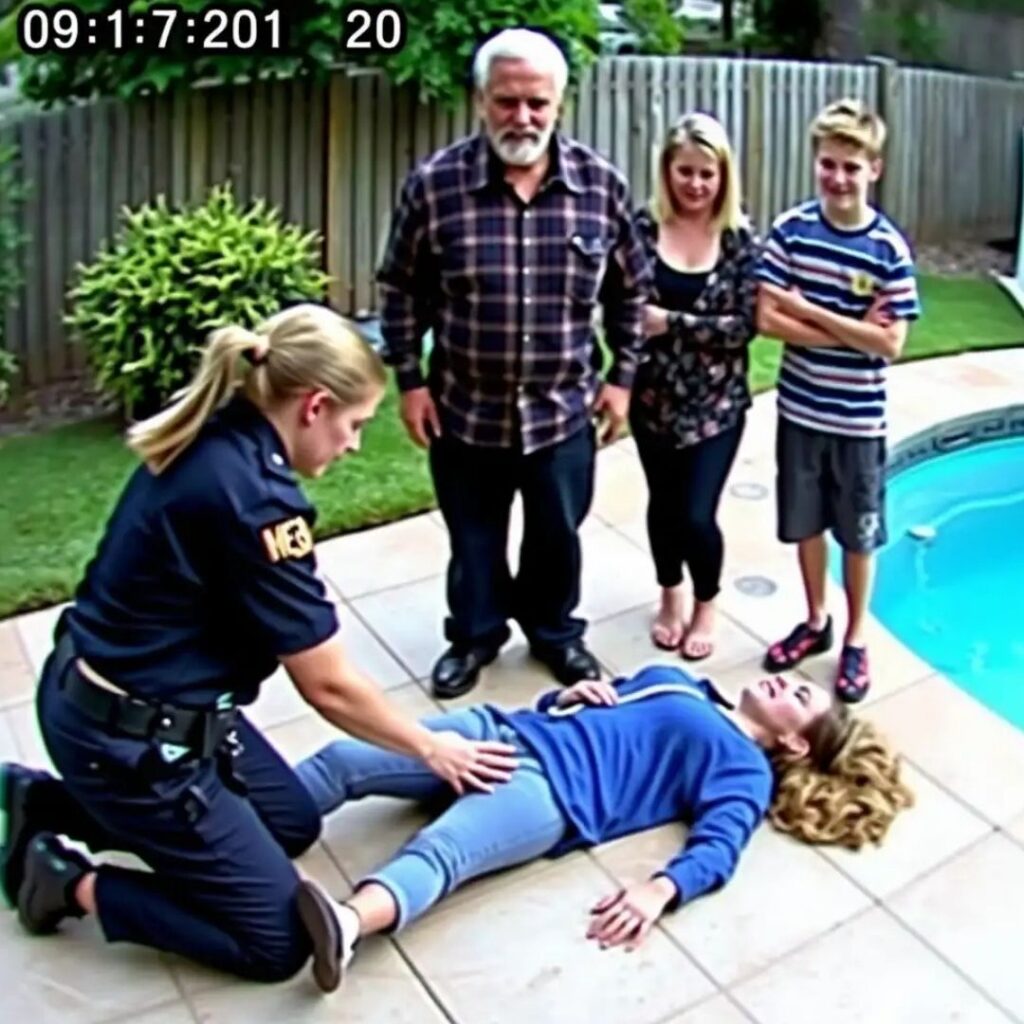
“Walk it off, stop being a baby!” my father barked from across the yard. The world tilted as I stared up at the sky, trying to breathe through the pain clawing up my spine.
My brother, Ryan, stood nearby with a smug grin, the kind he’d worn my whole life whenever he got away with something cruel. Mom appeared beside him, arms crossed, irritation tightening her jaw.
“Seriously, Hannah?” she snapped. “This is your brother’s birthday. Why do you always have to make everything about you?”
Their voices blurred as panic took over. I tried to lift my legs—nothing. I slapped my hands against my thighs—still nothing. A cold terror spread through my chest.
“Mom… Dad… I can’t move my legs,” I gasped. “Please help me.”
But my father rolled his eyes. “You slipped on clean wood, Hannah. You’re fine. Get up.”
Before I could respond, Ryan’s friend snickered. “She’s always so dramatic.”
I wanted to scream at them—beg them to look at me, really look—but the words caught in my throat. The pain was too much. My vision blurred around the edges.
Then a stranger’s voice cut through everything.
“Everyone move. I’m a paramedic—let me through.”
A woman knelt beside me, her badge reading EMT L. MORRIS. Her hands were steady and warm as she checked my pulse.
“Hannah, can you feel this?” she asked, pressing on my shin.
“No,” I whispered. “I can’t feel anything.”
Her expression changed—subtle but unmistakably serious.
She lifted her radio. “Dispatch, this is Unit 14 at a private residence. I have a suspected spinal injury. Requesting immediate police backup.”
Mom sputtered, “Police? That’s unnecessary—she’s exaggerating!”
But the paramedic ignored her. She leaned closer to me.
“Hannah, did you slip naturally, or do you think something caused it?”
My breath trembled. “The deck was oily. Someone… someone did something.”
Before I could finish, EMT Morris ran a gloved hand across the wood. She rubbed her fingers together, her face tightening.
“This isn’t water,” she said loudly enough for everyone to hear. “This is deck oil.”
All eyes turned to Ryan—who suddenly looked pale.
“It was just a joke,” he muttered. “I didn’t think she’d—”
Sirens wailed in the distance. The paramedic’s voice hardened.
“She can’t move her legs. This is serious spinal trauma. And this”—she gestured to the oily boards—“is evidence.”
My heart thudded painfully. Evidence. Trauma. Police.
Everything my family had ignored… someone else finally saw.
As the sirens grew louder and the backyard fell silent, a terrifying new truth settled into my bones:
My life had just changed forever—and my family’s silence had crossed into criminal territory.
The ambulance doors slammed shut, sealing me inside with two paramedics and more fear than I had ever felt in my life. I stared at the ceiling as they strapped me to the backboard, my body trembling uncontrollably.
“Stay with us, Hannah,” one paramedic said gently. “We’re taking you to St. Anne Trauma Center. You’re in good hands.”
But I didn’t feel safe—not yet. Not while the memory of my father’s dismissive glare and my mother’s accusations still echoed in my ears.
At the hospital, a whirlwind of doctors, nurses, and machines surrounded me. They slid me into an MRI machine, injected medication, and hooked me up to monitors. Everything felt distant, like it was happening to someone else.
Hours passed before a neurosurgeon finally entered my room.
“I’m Dr. Patel,” she said, her voice calm but grave. “Hannah, your MRI shows an incomplete spinal cord injury at T11. You have a fracture and bone fragments compressing the cord. We need to operate immediately.”
My heart froze.
“Will I walk again?”
She hesitated—just long enough to tell me the truth before she spoke it.
“We don’t know yet. But the sooner we decompress the spine, the better the chance for recovery.”
The surgery took nearly five hours.
When I woke, my lower body still felt like it wasn’t mine.
Over the next two days, Detective Carly Briggs visited my room twice. She questioned me gently but thoroughly.
“Hannah, multiple witnesses say your brother admitted to putting oil on the deck. Your parents also refused to call 911 despite your inability to move your legs. We’re treating this as a criminal case.”
The words hit me like another fall.
Ryan was arrested the next morning for reckless endangerment resulting in severe injury.
My parents were charged with negligence and obstruction for delaying medical care.
No one came to visit me—not a call, not even a text.
It hurt… but it also told me everything I needed to know about where I stood in my family.
Rehabilitation was brutal.
Every day, my therapists pushed me—slowly, painfully—toward reclaiming parts of my life.
Some days I felt flickers of sensation in my thighs. Other days brought nothing but frustration and tears.
But the rehab team encouraged me relentlessly.
“You’re stronger than you think,” they’d say.
And maybe, for the first time, I began to believe them.
Three months after the accident, the criminal case moved forward. Ryan took a plea deal—three years in prison. My parents received probation and mandatory counseling.
My civil attorney filed claims for damages, and eventually, their homeowner’s insurance paid out the maximum. They later sold their home to cover additional settlement costs.
I wish I could say I felt vindicated.
But mostly, I felt tired—so unbelievably tired.
Healing from a spinal injury was one battle. Healing from a lifetime of being dismissed and ignored was another.
But in the aftermath, something unexpected happened:
I found people who believed me. Nurses, therapists, other patients—they became my chosen family.
They helped me stand—literally and emotionally—when my own blood family wouldn’t.
And slowly, I began to rebuild.
One year later, I could stand between parallel bars and take a few assisted steps. Not gracefully, not easily—but proudly.
Those first steps meant more to me than any milestone before them.
Not because I was close to walking normally again, but because they represented something far deeper:
I wasn’t broken. I was becoming someone new.
I moved into an accessible apartment, returned to work part-time as a school counselor, and started attending a support group for spinal cord injury survivors. The people there understood me in ways my family never had.
One evening after group, a woman named Cheryl—paralyzed from the waist down for fifteen years—said something that stuck with me:
“Losing the life you planned isn’t the end. Sometimes it’s the start of a better one.”
I didn’t believe her at first.
But slowly, I realized she was right.
I began mentoring newly injured patients, helping them navigate the emotional storm I knew too well. Sharing my story didn’t weaken me—it freed me.
A physical therapist, Ethan, joined the rehab center during my second year of recovery. He was patient, funny, and understood boundaries better than anyone I’d met. We went from working on gait exercises to talking during sessions… to talking after sessions… to sharing coffee on weekends.
I didn’t expect romance—not with everything I was still figuring out—but Ethan never made me feel “less.”
He saw me, the whole me: injured but healing, scared but trying, fragile but fiercely alive.
As for my family?
Ryan was still in prison.
He wrote me a long letter apologizing—truly apologizing—for the first time in our lives. It wasn’t enough to erase the past, but it mattered.
My parents moved to a different state. I never heard from them again.
That silence used to feel like a wound.
Now it feels like closure.
My life today looks nothing like the life I expected to have.
I use braces and crutches on good days, my wheelchair on bad ones. I deal with pain, spasms, and limitations I never imagined.
But I also have meaning, connection, and a strength I didn’t know existed in me.
I am no longer the girl begging her parents to believe her.
I am a woman who survived the moment that should have broken her—and built something new from the pieces.
If you’re reading this and you’ve ever had your pain dismissed by the people who were supposed to protect you, please hear this:
Your truth matters.
Your pain is real.
And your healing begins the moment you choose to believe yourself—even if they never believed you.
Thank you for listening to my story.
And now I want to hear yours.
Have you ever had someone ignore your pain? Tell me what helped you stand back up—your story might help someone else.
The trial was over, the medical bills were settled with the insurance payout, and the physical therapist, Ethan, had become a permanent fixture in my life. But the “happily ever after” of a spinal cord injury isn’t a straight line; it’s a jagged climb.
Three years after the day on the deck, I was living in a sun-drenched apartment in a city where no one knew me as “the girl who was paralyzed.” I was Hannah, the counselor. Hannah, the mentor.
Then, the phone rang.
It was my mother. Her voice was thin, stripped of the sharp authority she used to wield like a weapon.
“Hannah,” she whispered. “Ryan is being released next month. He… he has nowhere to go. We lost the house, and your father’s health isn’t good. We thought maybe… since you have that settlement money and a big apartment…”
I sat in my wheelchair, looking at my legs. I could wiggle my toes now—a hard-won victory that had taken a thousand hours of agony.
“Mom,” I said, my voice steady. “When I lay on that deck and told you I couldn’t move, you told me I was ruining a birthday. You didn’t call the ambulance. You didn’t even cover me with a blanket. You watched me break.”
“We didn’t know!” she wailed. “We thought it was just a fall!”
“The EMT knew within ten seconds,” I replied. “You chose not to know. You can’t live with me. You can’t even have my address. Ryan made a choice that day, but you and Dad made a choice every day for twenty years to believe he was a golden boy and I was a nuisance. I’m not a nuisance anymore. I’m a stranger.”
I hung up. It didn’t feel like a victory. it felt like finally putting down a suitcase I had been carrying for a lifetime.
Despite what I told my mother, I did show up at the prison gates the day Ryan was released. Not to take him home, but to close the circle.
He stepped out with a single duffel bag. He looked older, his smugness replaced by a hollow, haunted stare. When he saw me standing there, leaning on my forearm crutches, he stopped. He didn’t smirk. He didn’t even smile. He just wept.
“I dream about the sound,” he said, staring at the ground. “The sound of you hitting the wood. I hear it every night.”
“The sound didn’t paralyze me, Ryan,” I said. “The oil did. Your hand did.”
I handed him an envelope. It wasn’t money. It was a list of names—addiction counselors, job placement services for ex-cons, and a therapist who specialized in family aggression.
“This is the last thing I will ever give you,” I told him. “I’m not doing this because I forgive you. I’m doing this because I refuse to let your shadow follow me for another three years. If you want to be a man, use these. If you don’t, that’s your choice. But you’ll never see me again.”
He reached out to touch my arm, but I stepped back, my balance sure and practiced.
“Goodbye, Ryan.”
A month later, Ethan took me to a quiet beach at sunset. The sand was a nightmare for my gait, but he didn’t carry me. He walked beside me, his hand hovering near my waist, ready but not interfering.
“You’ve been quiet lately,” he said.
“I realized I’ve spent three years recovering from a fall,” I said, stopping to catch my breath. “But I haven’t spent any time just… being.”
I looked out at the water. The doctors said I’d hit my “plateau”—that this was as much movement as I’d ever get back. I walked with a limp, my left leg dragged slightly, and I had no bladder control without a catheter. To the world, I was still “disabled.”
But as the waves hit my feet, I felt the cold.
I felt the salt.
I felt the tiny grains of sand between my toes.
I let go of my crutches. They fell into the soft sand with a muffled thud. For a few seconds, I stood on my own two feet, the wind whipping my hair, the sun warming my face. I was wobbly, my muscles screaming, but I was upright.
“I’m not ruined,” I whispered.
Ethan smiled, his eyes wet. “You never were, Hannah. You were just waiting for the rest of us to catch up to the truth.”
I never did move back to my hometown. I bought a small house with a ramp and wide doorways, but I filled it with things that made me feel fast—bright art, a sleek car with hand controls, and a dog named ‘Flash’ who didn’t care that I couldn’t run.
Sometimes, when the rain hits the roof, I think about that deck. I think about the girl who lay there invisible to her own parents. I wish I could go back and tell her that the paramedic is coming. I wish I could tell her that she’s going to find a love that doesn’t require her to be “perfect.”
But most of all, I’d tell her this: The crack you heard wasn’t just your spine. It was the breaking of the cage they built for you.
Today, I don’t ruing birthdays. I celebrate them. Especially my own. Because every year I’m alive is a year I proved them wrong.
I am Hannah. I am a survivor. And I am finally, beautifully, walking away from the dark.