PART 2
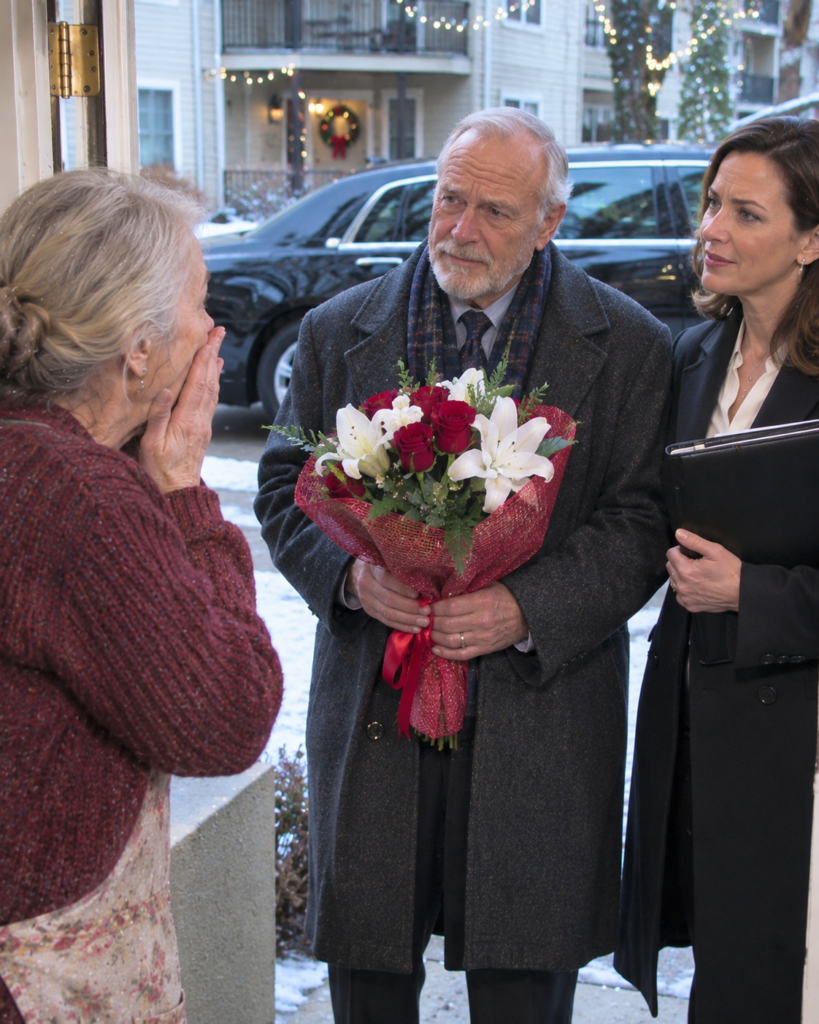
We sat at my small kitchen table. Mr. Wallace held my hand the whole time, like he was afraid I’d disappear.
Lucille opened the folder.
“My father started a little corner grocery store in 1961,” she said. “One store. He worked the register himself for twenty years.”
She slid a paper across the table. A company logo I knew very well. It was on my old apron.
“That one store became thirty-eight stores. Including yours. My father founded the company. I’m the CEO now.”
I looked at Mr. Wallace.
He smiled at me, a little shy.
“I used to be good with numbers,” he said.
Lucille’s eyes filled with tears.
“After my mother died, Dad started losing his memory. Slowly. The doctors told us to keep his routines. So every morning, his driver takes him to your store. He buys a banana, a can of soup, and flowers for my mother’s picture. It’s the only place he remembers how to go.”
“I didn’t know,” I whispered. “I thought he was just a lonely old man.”
“He was,” she said. “And you were kind to him anyway. Without knowing who he was.”
She told me the rest.
When Finnick filed his report about me, it went to the regional office. Then to corporate. Then it landed on her desk with the security footage attached.
“I watched three hours of video,” she said. “I saw you pay for strangers’ groceries. I saw you cover a man’s heart medicine. And then I saw my father, confused, counting his coins wrong, and you telling him, ‘Pay me tomorrow.’”
She wiped her face.
“Do you know he talks about you every night? ‘The nice lady at lane four.’ He doesn’t remember my husband’s name. But he remembers yours.”
Mr. Wallace squeezed my hand.
“You let me pay tomorrow,” he said. “Every day.”
Lucille pulled out three more papers.
The first was a check. $5,600.
“Every penny from your notebook,” she said. “I had the footage counted.”
The second was a letter. Finnick had been removed as manager. “A manager who calls a seventy-year-old employee a charity case doesn’t belong in my father’s company.”
The third was a new policy, signed by Lucille.
The Lane 4 Fund.
Every one of the thirty-eight stores would now have a small fund at every register. If an elderly customer, or a parent with children, came up short, the cashier could cover it. No questions. No paperwork.
“I’d like you to come back,” Lucille said. “Not as a cashier. As the person who trains every cashier in the company on how to treat people.”
I didn’t know what to say.
So I said the only thing I could think of.
“Can I still work lane four on Tuesdays?”
Mr. Wallace laughed. It was the first time I’d ever heard him laugh.
They stayed for Christmas Eve dinner. My small ham was enough for three.
Mr. Wallace gave me the flowers.
“For your husband’s picture,” he said.
I put them next to the photo on my windowsill.
Now, every Tuesday morning at 9 a.m., I’m back at lane 4.
And every Tuesday at 9 a.m., a quiet old man walks in with his driver. One banana. One can of soup. One small bouquet.
He always forgets his wallet.
I always tell him he can pay me tomorrow.
THE END.
──────────────
Lesson: Be kind to the confused old man in your line. You never know whose father he is, or whose world he built.
Would you have covered strangers’ groceries with your own money? Tell us in the replies.