PART 2
Mr. Cyprian was screaming. “Somebody get my gun! Get my gun from the office!”
“NO!” I shouted. “Don’t shoot her! Nobody move!”
I’ve worked with elephants for thirty-five years. I know what an angry elephant looks like. Ears pinned back. Head high. Fast charge.
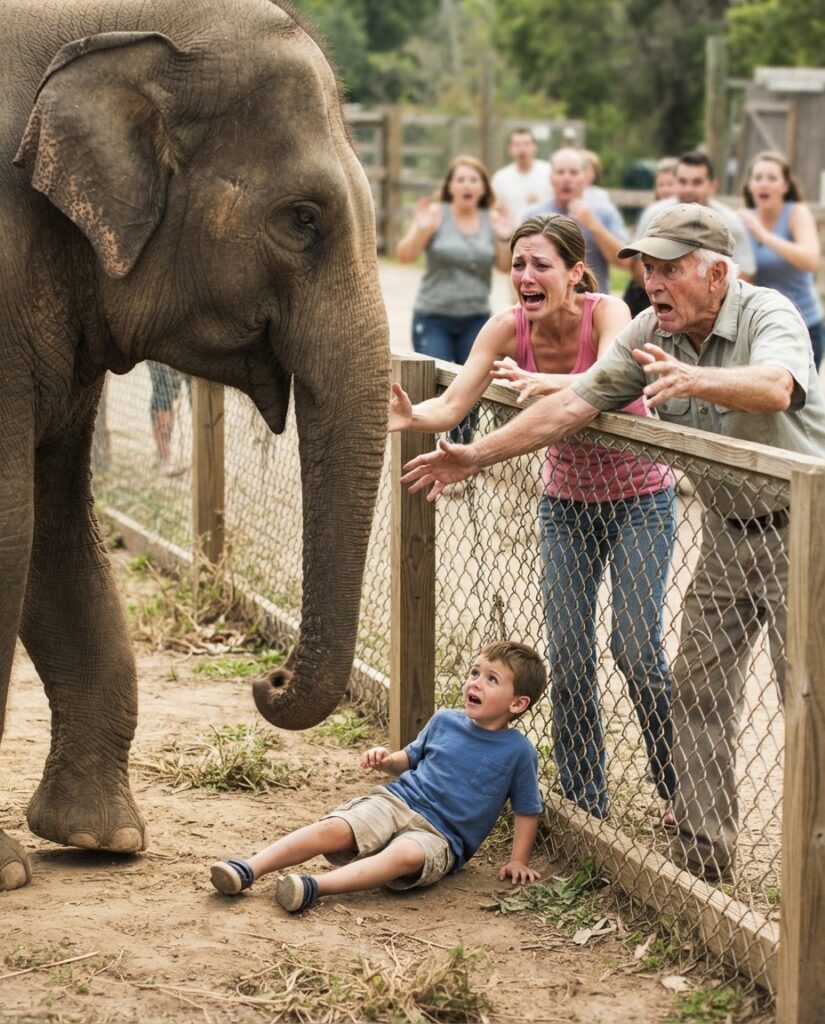
Ophira wasn’t angry.
Her ears were wide open. Her trunk was low. She was walking slowly. Carefully.
The way a mother elephant walks toward a calf that’s fallen down.
She reached the boy. She stood over him.
The crowd went silent. Isadore’s mother was sobbing, gripping the fence.
Ophira lowered her trunk. Very gently, she touched the boy’s head. His back. His legs. Like she was checking him.
Then she did something I’d only seen elephant mothers do in the wild.
She stood right over him. Her huge body formed a shelter. Her front legs were on either side of him. Her belly was above him, blocking the hot afternoon sun.
She was protecting him.
Isadore opened his eyes. He started crying.
Ophira rumbled softly. That low, gentle sound I’d heard every Sunday for two years.
“Ophira,” I called to her. Calm. Steady. “Good girl. Good girl. Bring him to me.”
She turned her head and looked at me.
“Bring him to the gate, girl. Gently.”
I opened the small service gate in the corner of the enclosure. I’d seen the workers use it a hundred times.
Ophira curled her trunk around the little boy’s waist. So gently. Like she was picking up a flower.
She lifted him off the ground and walked slowly to the gate.
And she set him down at my feet.
I scooped him up and handed him over the fence to his mother.
She fell to her knees, holding him, crying, saying “thank you, thank you, thank you” over and over. I didn’t know if she was saying it to me or to the elephant.
The paramedics came. Isadore had a broken arm and some bruises from the fall. That was all.
“That elephant could have killed him with one step,” one of the paramedics said, shaking his head.
“She would never,” I said.
The story was all over the news by that night. A video someone filmed on their phone had millions of views by morning.
And people started asking questions.
Why was a fifty-two-year-old elephant living alone in a dirt lot? Why was she swaying? Why was the fence so low that a child could fall over it?
A week later, inspectors from the state and an animal welfare organization showed up at the roadside zoo.
They found a dozen violations. Unsafe fences. Untreated injuries. Animals without enough food or water.
Mr. Cyprian’s license was revoked. Every animal was taken away.
And Ophira was moved to an elephant sanctuary in Tennessee. Two thousand acres. Grass. Trees. A lake.
And other elephants.
I went with her. I rode in the truck for nine hours, talking to her through the trailer window the whole way.
When they opened the trailer at the sanctuary, Ophira stepped out onto real grass for the first time in decades.
Three old elephants were waiting at the edge of the field.
They rumbled at her.
She rumbled back.
Then she walked over to them, and they wrapped their trunks around each other.
I cried like a baby.
The sanctuary hired me as a part-time volunteer. I drive down from Missouri twice a month.
Last summer, a little boy in a red cap came to visit. His arm had healed. He was holding a watermelon almost as big as he was.
“Hi, Ophira,” Isadore said. “Thank you for saving me.”
She reached her trunk over the fence and touched his cap.
He giggled.
So did I.
THE END.
──────────────
Animals remember kindness. And sometimes, they give it back in ways we never imagined.
Do you believe animals know when someone needs protecting? Tell us in the replies.