PART 2
Mr. Tolliver pressed play.
Mrs. Whitlow appeared on the screen, sitting in her own living room, in her blue cardigan. Her hair was brushed. Her eyes were sharp.
“My name is Agatha Whitlow,” she said clearly. “Today is January 18th. My doctor is sitting next to me. He examined me this morning and will tell you I am of sound mind.”
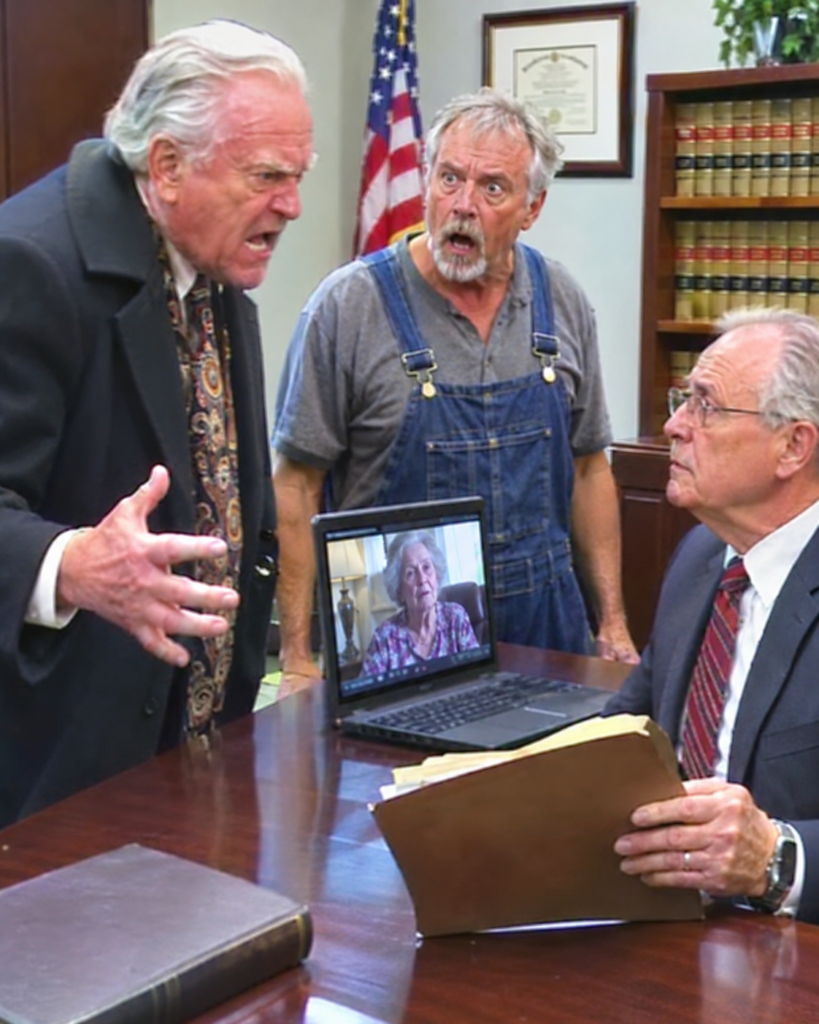
The camera turned briefly. A gray-haired man in a white coat nodded. “She is entirely competent,” he said.
The camera turned back.
“Marshall,” she said, looking straight into the lens. “If you’re watching this, it means you’re angry. I’m sorry for that. But you already know why.”
Marshall had gone very still.
“When your father died, you came to the funeral. You stayed for one hour. You asked me to sign a paper so you could ‘help with the bank.’ Then you took sixty thousand dollars out of our savings and I never saw you again.”
She paused.
“On Christmas Eve, I called you first. Before I called the plumbers. You didn’t answer. I called three times.”
The room was silent.
“A man I’d never met drove across town in the snow for forty-one dollars he didn’t even take. He fixed my furnace. He made me tea. He came back every Sunday after that. Not for money. Because he was kind.”
She smiled a little.
“Isaac, if you’re there, thank you. You fixed more than my pipes.”
The video ended.
Marshall didn’t sue.
He left the lawyer’s office without a word. A few weeks later, Mr. Tolliver told me Marshall’s lawyer had advised him that a court would never overturn the will. Not with a video, a doctor’s statement, and a bank record showing the sixty thousand dollars he’d taken.
I inherited a little blue house, everything in it, and about $90,000 in savings.
I didn’t know what to do with any of it.
So I asked myself what Agatha would want.
I sold the house to a young family with two kids and a dog. They promised to plant tulips in the front yard every spring, the way Agatha always had.
With the money, I started my own plumbing business.
I named it Whitlow Plumbing.
It has one rule, printed on the side of every van:
“No senior goes cold. Emergency calls for anyone over 75 who can’t pay: free.”
It’s been a year and a half. We’ve done 212 free emergency calls. Three of my old coworkers from Stan’s company came to work for me. Then a fourth.
Stan called me last month. Business was slow, he said. Customers had heard about Christmas Eve.
“You got lucky,” he said.
“No,” I said. “I just answered the phone.”
Every Christmas Eve now, I work the night shift myself.
I keep forty-one dollars in an envelope taped inside my toolbox lid.
In Agatha’s handwriting, on the front, it says:
“For the next one.”
THE END.
──────────────
The people who show up when there’s nothing in it for them are the ones who matter most.
Have you ever helped someone who couldn’t pay you back? Tell us in the replies.