## PART 3 — THE MAN WHO TAUGHT MY HUSBAND TO HIDE EVERYTHING
For several seconds, I just stared at Richard.
My phone was still in my hand.
Caleb’s message glowed on the screen.
TESSA, ASK MY FATHER WHAT REALLY HAPPENED TO MORGAN FAMILY HOLDINGS BEFORE YOU TRUST HIM.
Richard looked toward the empty driveway where Caleb’s car had disappeared.
Then he slowly lowered his own phone.
“What does he mean?” I asked.
Richard said nothing.
Diane stepped beside me.
“Richard.”
“I heard her.”
“No,” I said. “You heard Caleb. I’m asking you.”
Elodie shifted against my chest, and I instinctively rocked her.
Richard looked suddenly older.
Not weaker.
Just tired.
“Come inside.”
“I’m not going anywhere until somebody tells me the truth.”
“Tessa, it’s complicated.”
I laughed.
“Today I learned my husband lied about owning our house, hid money from me, moved my inheritance, enrolled my daughter in daycare behind my back, lied about his job, created a company in secret, and left after I found a f/o/rged authorization form.”
I held up my phone.
“So please don’t tell me complicated is the problem.”
Diane touched Richard’s arm.
“Tell her.”
Richard closed his eyes.
“Morgan Family Holdings was mine.”
“I know that.”
“No. You know I created it. You don’t know why.”
He sat on the front step.
I remained standing.
“Twenty-one years ago, I owned three apartment buildings and a small construction company. Morgan Family Holdings was the company that held everything.”
Diane’s face tightened.
“We had more money than Caleb ever understood.”
Richard gave a bitter laugh.
“That was part of the problem.”
He explained that his construction company had expanded too quickly.
Loans.
Properties.
Partners.
And one partner who began moving money between projects without authorization.
“When I discovered it, I tried to save the company quietly.”
Diane looked at him.
“You tried to hide it.”
Richard nodded.
“I was ashamed.”
My stomach tightened.
The pattern felt familiar.
Hide the mistake.
Control the people around you.
Pretend everything is fine.
“What happened?” I asked.
“I borrowed against everything.”
“The apartments?”
“Yes.”
“The house?”
“Yes.”
Diane folded her arms.
“And he didn’t tell me until we were ninety days from losing almost everything.”
Richard looked at the ground.
“I thought I could repair it before she found out.”
Caleb’s words echoed in my mind.
I was fixing it.
I looked at Richard differently.
“You did the same thing.”
His head lifted.
“Yes.”
The answer surprised me.
No excuse.
No argument.
Just yes.
Richard continued.
“The company collapsed. There was an investigation into my partner’s transfers. He had falsified invoices and moved funds through vendor accounts.”
“Was he charged?”
Richard’s mouth tightened.
“Yes. Financial f/r/@/ud.”
Diane added quietly, “But Richard nearly destroyed our marriage before that happened because he refused to admit how bad things were.”
Richard looked toward me.
“And Caleb saw all of it.”
My chest tightened.
“How old was he?”
“Thirteen.”
That explained something.
Not everything.
But something.
Caleb had watched his family’s security collapse around money.
He had watched his father hide problems until they became disasters.
He had learned fear.
Then turned fear into control.
“Why did Caleb reopen Morgan Family Holdings?”
“That I don’t know.”
My phone rang again.
Marissa.
I answered immediately.
“Where are you?”
“Home.”
“Stay there.”
“Tessa—”
“No. You signed my name.”
“I didn’t sign your name.”
I went still.
“What?”
“I witnessed it.”
“That isn’t better.”
“I know.”
Her voice cracked.
“I know.”
“Who signed it?”
Silence.
“Marissa.”
“Caleb.”
I looked toward Richard.
“He signed it?”
“He copied your signature.”
My stomach turned.
“And you watched him?”
“I didn’t know what the form was.”
“Then why did you sign?”
“Because he lied to me too.”
Of course he did.
“What did he tell you?”
“That you had postpartum anxiety about money.”
I almost couldn’t speak.
“He said you wanted to move the inheritance temporarily but were scared you’d regret it, so you asked him to handle the paperwork.”
“He told you I asked him?”
“Yes.”
“And you believed him?”
“At first.”
“At first?”
Marissa started crying.
“I realized something was wrong later.”
“How much later?”
“Two weeks.”
“Two weeks?”
“Tessa, please.”
“No.”
I paced toward the driveway.
“What happened two weeks later?”
“I saw the company account.”
“How?”
“Caleb left his laptop open at Mom’s house. There were transfers.”
“Then why didn’t you tell me?”
She went silent.
That silence sliced deeper than any explanation.
“Why?”
“Because I had already borrowed money from him.”
I shut my eyes.
“How much?”
“Eight thousand.”
Richard heard me.
His face hardened.
“For what?”
Marissa whispered, “My mortgage.”
I felt dizzy.
She had lost hours at work months earlier.
I knew she was struggling.
I had offered help.
She refused.
Apparently she hadn’t refused Caleb.
“He told me if I exposed what he was doing, Diane and Richard would come after him, the company would fail, and you could lose the house.”
“So you protected him.”
“I thought I was protecting you.”
“You protected yourself.”
She sobbed.
“Yes.”
Finally.
A truthful sentence.
I leaned against Richard’s car.
“What’s in the fireproof box?”
Marissa’s breathing changed.
“That’s why I called.”
“What is it?”
“Contracts.”
“What contracts?”
“I don’t know everything.”
“Marissa.”
“He wasn’t running the company alone.”
Richard stood.
“Who was he working with?”
She heard his voice.
“Is Richard there?”
“Yes.”
Her next words came slowly.
“Then he needs to know the name Daniel Cross.”
Richard stopped breathing.
Diane whispered, “Oh my God.”
I looked between them.
“Who is Daniel Cross?”
Richard took the phone from me.
“Marissa, are you sure?”
“Yes.”
“How do you know?”
“I saw the name on three contracts.”
Richard went pale.
Diane grabbed the porch railing.
“Richard?”
He handed my phone back.
His voice sounded hollow.
“Daniel Cross is the son of my former business partner.”
The one convicted of f/r/@/ud.
My skin went cold.
“He approached Caleb?”
“That would be my guess.”
“Why?”
Richard looked sick.
“Because twenty years ago his father blamed me for everything.”
Diane shook her head.
“Richard testified against him.”
“So Daniel wanted revenge?”
“I don’t know.”
But he did know.
I saw it.
“You think that’s what this is.”
Richard nodded slowly.
“Maybe.”
I turned back to the phone.
“Marissa, send me every document you have.”
“I will.”
“And after that?”
She hesitated.
“Yes?”
“Don’t call me for a while.”
“Tessa—”
“I love you. But I can’t process what you did and everything else at the same time.”
She cried quietly.
“I understand.”
I ended the call.
Richard was already dialing someone.
“Who?”
“My attorney.”
“You said Caleb needs his own.”
“He does.”
“What about me?”
Richard looked toward Diane.
“She already called one.”
Diane handed me a card.
“Family law and financial litigation.”
The reality of those words hit differently.
This wasn’t merely betrayal anymore.
This had consequences.
Possible civil claims.
Possible f/r/@/ud.
Possibly more.
I looked at Elodie.
“I don’t want her life to become a war.”
Diane’s expression softened.
“Then don’t make decisions from anger.”
Richard nodded.
“But don’t make them from fear either.”
My phone buzzed again.
A location pin.
From Caleb.
I stared at it.
An industrial park forty minutes away.
Below it:
COME ALONE IF YOU WANT THE TRUTH ABOUT DANIEL CROSS.
Richard read it over my shoulder.
“No.”
“He has the box.”
“Exactly.”
“I’m going.”
“Tessa, absolutely not.”
I looked at him.
“You don’t get to decide for me.”
He stopped.
“I’m sorry.”
“I mean it.”
“I know.”
I thought for several seconds.
“I’m not going alone.”
Richard exhaled.
“Good.”
“But you’re not going with me.”
His expression changed.
“Why?”
“Because if Caleb is telling the truth, you’re part of whatever he’s hiding.”
Diane nodded immediately.
“I’ll go.”
Richard protested.
“Tessa.”
Diane looked at him.
“She’s right.”
We transferred Elodie’s carrier into Diane’s car.
I was halfway into the passenger seat when another message arrived.
Not from Caleb.
Unknown number.
One photograph.
Caleb was standing inside a warehouse.
Beside him was a man I didn’t recognize.
Under the photograph, a message appeared.
YOUR HUSBAND ISN’T RUNNING FROM YOU.
HE’S RUNNING FROM US.
I felt every hair on my arms rise.
Then another message appeared.
BRING THE AUTHORIZATION FORM.
NO P/O/LICE.
Diane read it.
Her face changed.
“Tessa.”
“I know.”
“This isn’t about money anymore.”
I stared at the picture.
Caleb looked terrified.
And for the first time that day, I wondered whether my husband had disappeared because he was hiding another lie—
or because someone else had finally stopped letting him.
## PART 4 — THE CONTRACT IN THE FIREPROOF BOX
We did not go to the warehouse.
Not immediately.
That was Diane’s decision.
And for once, I was grateful somebody else was thinking more clearly than I was.
“We don’t respond to unknown numbers,” she said. “We don’t hand over documents. And we definitely don’t walk into an industrial building because somebody ordered us to.”
“What if Caleb’s in danger?”
Her eyes met mine.
“Then we handle that intelligently.”
She called Richard.
He was angry we had left without him.
Then he heard about the photograph.
His anger disappeared.
“Call the p/o/lice.”
I looked at Diane.
She nodded.
Within twenty minutes, we were speaking to two officers in a grocery store parking lot.
I showed them the messages.
The photograph.
The location.
The authorization form.
They asked whether Caleb had ever been physically threatening.
“No.”
Whether Daniel Cross had contacted me before.
“No.”
Whether I knew if Caleb had a we/@/pon.
“No.”
The officers told us not to approach the warehouse.
One stayed with us while another unit went ahead.
Waiting was unbearable.
I sat in Diane’s car holding Elodie.
She woke and stared up at me with enormous dark eyes.
Six weeks old.
She knew nothing about contracts.
Nothing about companies.
Nothing about secrets.
She only knew whether she was warm, hungry, held, safe.
That realization hurt.
I had spent six weeks believing I was failing because I couldn’t keep the house perfect.
Because laundry piled up.
Because dinner wasn’t always cooked.
Because sometimes I cried when she cried.
But Elodie had never needed perfection.
She needed care.
Maybe I did too.
Forty-three minutes later, one of the officers returned.
“No one is there.”
My stomach dropped.
“What?”
“The warehouse is empty.”
“What about Caleb?”
“No sign.”
They had found tire marks, discarded boxes, an old folding table.
Nothing else.
The photograph could have been taken earlier.
I called Caleb.
Straight to voicemail.
Again.
Nothing.
Then Diane’s phone rang.
Richard.
She answered on speaker.
“I found something.”
“What?” I asked.
“I went back through the Morgan Family Holdings records.”
His voice was tense.
“The company wasn’t reopened by Caleb.”
I sat upright.
“Who reopened it?”
“Daniel Cross.”
Diane frowned.
“How?”
“He filed reinstatement documents using an old corporate authorization.”
“Could he legally do that?”
“No.”
“So it was f/r/@/ud?”
“Likely.”
Richard continued.
“But here’s the problem. Three months later, Caleb signed a manager agreement.”
I shut my eyes.
“So Caleb knew.”
“Yes.”
“Why?”
“I don’t know.”
My phone rang.
This time, Caleb.
I answered instantly.
“Where are you?”
Silence.
Then:
“Are you with Dad?”
“No.”
“Who are you with?”
“Diane.”
He exhaled.
“Good.”
“Caleb, tell me where you are.”
“I can’t.”
“You absolutely can.”
“Tessa, listen to me. Daniel has access to everything.”
“What does that mean?”
“Our bank records. The company. The house information.”
“How?”
“I gave it to him.”
My grip tightened.
“Why?”
“Because I thought he was helping me.”
“With what?”
“My job.”
The story came out in pieces.
Seven months earlier, Caleb’s employer had eliminated his department.
He had been humiliated.
Terrified.
And instead of telling me, he pretended to keep working.
Every morning he closed himself in the home office.
He applied for jobs.
Took consulting work.
Then Daniel contacted him.
Daniel claimed he knew Richard.
Claimed the Morgan family owed his father money from the old collapse.
Claimed he wanted to settle old history.
“He offered me a business.”
“What business?”
“Property analytics. Renovation contracts. Flipping distressed homes.”
“Using Morgan Family Holdings.”
“Yes.”
“Why would you agree?”
“Because he showed me numbers.”
I almost laughed.
“Numbers?”
“I was desperate.”
There it was.
The word that explained everything.
Not excused.
Explained.
Caleb continued.
“The first deal made money. So did the second.”
“And then?”
“Then he asked for more capital.”
“My inheritance.”
Silence.
“Yes.”
My eyes filled.
“You stole it.”
“I know.”
“You f/o/rged my signature.”
“I know.”
“And you let me panic about grocery bills while you did it.”
“I know.”
“No. Stop saying you know.”
Elodie startled at my voice.
I lowered it.
“You didn’t know. Because if you had understood what this did to me, you wouldn’t have done it.”
Caleb cried quietly.
It was the first time I had ever heard him cry like that.
Not dramatic.
Not loud.
Broken.
“I thought I could replace it before you noticed.”
“You sound exactly like your father.”
“I know.”
Richard would have hated hearing that.
I almost smiled at the irony.
“Where are you?”
“Driving.”
“Where?”
“Away from Daniel.”
“What happened at the warehouse?”
He hesitated.
“I met him there.”
“Why?”
“To get the box back.”
“The fireproof box?”
“Yes.”
“So he has it?”
“No.”
“Who does?”
“I do.”
Relief hit me.
“Then bring it to the p/o/lice.”
“I can’t.”
“Why?”
“Because there’s a contract in it that makes me look guilty.”
“You are guilty of some things.”
“I know.”
“Stop saying that.”
“Sorry.”
Diane glanced at me.
Even she almost smiled.
“What’s in the contract?”
Caleb inhaled.
“A purchase agreement.”
“For what?”
“The house.”
I froze.
“Our house?”
“Yes.”
“Who’s buying it?”
“Daniel.”
My stomach turned.
“He’s buying our house?”
“He thinks he is.”
“What does that mean?”
“I signed a conditional sale agreement.”
“You signed away the house?”
“I was trying to stop foreclosure if Dad enforced his loan.”
“But your father only decided to enforce it three weeks ago.”
“That’s not the foreclosure I mean.”
I felt cold.
“What foreclosure?”
Caleb whispered:
“There’s another loan.”
Diane closed her eyes.
“Oh, Caleb.”
“How much?”
“One hundred eighty thousand.”
I nearly dropped the phone.
“You borrowed a hundred eighty thousand dollars against the house?”
“Daniel arranged it through a private lender.”
“Why?”
“To keep the company alive.”
“You put everything at risk.”
“I know.”
This time, I let him say it.
Because there was nothing else.
“Daniel funded the company,” Caleb continued. “But every time things went wrong, he offered another loan. Another contract. Another way out.”
“He trapped you.”
“Yes.”
“You still signed.”
“Yes.”
No excuse.
That mattered.
Not enough.
But it mattered.
“Why is he after the authorization form?”
“Because it proves your inheritance transfer wasn’t authorized.”
“And?”
“And if that transfer is invalid, part of the capitalization agreement falls apart.”
“Meaning?”
“The company debts may not attach to your money.”
Diane leaned closer.
“What about the house?”
Caleb heard her.
“That’s worse.”
“Why?”
“Daniel used Morgan Family Holdings to guarantee the private loan.”
Richard’s old company.
Daniel had resurrected it.
Used Caleb’s panic.
Used my inheritance.
Used the house.
And wrapped all of it together.
“This was planned,” Diane whispered.
“Yes,” Caleb said.
“For how long?”
“I don’t know.”
Then he said something that chilled me.
“But I found emails between Daniel and his father.”
“His father?”
I looked at Diane.
“I thought his father went to prison.”
“He did,” she said.
Caleb continued.
“He’s been out for five years.”
Richard’s former partner was free.
And his son had quietly entered our lives.
“Why didn’t you tell anyone?”
“Because the emails also showed Dad knew Daniel was back.”
Diane stiffened.
“What?”
“Yes.”
“When?”
“Last year.”
“Richard never told me.”
“Because Daniel contacted him first.”
Everything shifted again.
“What did Daniel want from Richard?”
“Money.”
“How much?”
“Two hundred thousand.”
“For what?”
“To drop a civil claim against him.”
Diane stared through the windshield.
“A claim over what?”
“The old company collapse.”
“But Daniel’s father was convicted.”
“Apparently there were assets Richard never disclosed.”
Diane went silent.
I knew that silence.
Another secret.
“Diane?”
“I don’t know anything about hidden assets.”
But her voice wasn’t convincing.
Before I could press her, Caleb spoke.
“Tessa, I need you to promise me something.”
“No more promises.”
“Fair.”
“Tell me what you need.”
“If something happens to me—”
“No.”
“Tessa.”
“No. Don’t start talking like that.”
“There’s a flash drive in the box.”
“What’s on it?”
“Copies of everything.”
“The contracts?”
“Yes. Emails. Bank transfers. Daniel’s messages. My messages too.”
“Your messages?”
“I didn’t delete anything.”
That surprised me.
“Why?”
“Because three weeks ago I realized he was setting me up.”
“Setting you up for what?”
“To take all the blame.”
Diane whispered, “Of course.”
“What made you realize?”
“Daniel asked me to sign a statement saying I acted alone.”
“Did you?”
“No.”
“Finally.”
A tiny broken laugh came through the phone.
“I deserved that.”
Then another sound.
A horn.
Brakes.
Caleb swore.
“Where are you?”
“Tessa, I have to go.”
“Caleb!”
“If I don’t call you in thirty minutes, give the authorization form to the p/o/lice.”
“Where are you?”
The line went dead.
I stared at the phone.
Diane immediately started the car.
“We’re going home.”
“Why?”
“Because if Richard knew Daniel was back last year, I want to know why.”
We drove fast.
Not recklessly.
But fast enough that every red light felt personal.
When we arrived, Richard was in the kitchen.
He took one look at our faces.
“What happened?”
Diane shut the door.
“Daniel contacted you last year.”
Richard went still.
So it was true.
“Tessa—”
“No.”
I placed Elodie’s carrier on the table.
“No more partial truths.”
Richard looked toward his granddaughter.
Then at me.
“Daniel demanded money.”
“For what?”
“He claimed his father had documents proving I hid assets during the old investigation.”
“Did you?”
Richard didn’t answer quickly enough.
Diane whispered, “Richard.”
“Yes.”
One word.
Another crack.
“What assets?” I asked.
“A property.”
“What property?”
“The warehouse.”
I stared at him.
“The warehouse Caleb was photographed in?”
“Yes.”
The room seemed to tilt.
“You own it?”
“I did.”
“Did?”
“I transferred it.”
“To whom?”
Richard swallowed.
“Morgan Family Holdings.”
Diane backed away from him.
“When?”
“Twenty years ago.”
“So Daniel’s claim—”
“Was partly true.”
My heart pounded.
“You hid property?”
Richard closed his eyes.
“I kept it out of the settlement because I was afraid we’d lose everything.”
Diane’s face crumpled.
“You lied to me.”
“I was trying to leave something for Caleb.”
“Don’t.”
Her voice broke.
“Don’t use him to excuse it.”
Richard looked destroyed.
And suddenly I understood something terrible.
Caleb’s behavior wasn’t appearing from nowhere.
He had inherited a blueprint.
Fear.
Secrecy.
Control.
Protect the family by lying to the family.
Hide the truth until you can fix it.
Richard had taught him without ever meaning to.
Then the front door opened.
We all turned.
Caleb stepped inside.
His shirt was wrinkled.
His face pale.
The fireproof box was under his arm.
I ran toward him, then stopped myself.
He looked at me.
“I’m okay.”
“What happened?”
“Daniel followed me.”
“Where is he now?”
“I lost him.”
Richard stepped forward.
“Give me the box.”
Caleb laughed bitterly.
“No.”
“Son.”
“That’s the problem, Dad.”
He looked at me.
“All of this started because every Morgan man thinks he gets to decide what everybody else is allowed to know.”
He placed the box on the table.
Then slid it toward me.
“Tessa decides.”
I looked at him.
For the first time since this began, he wasn’t telling me what to do.
He was handing me the choice.
I opened the box.
Contracts.
Statements.
Copies of messages.
And one black flash drive.
Then I noticed an envelope beneath them.
It was labeled:
FOR ELODIE.
I looked at Caleb.
“What is this?”
His face changed.
“I didn’t put that there.”
Richard went white.
Diane whispered, “Neither did I.”
I opened it.
Inside was an old photograph.
Richard.
A younger Diane.
Thirteen-year-old Caleb.
And another boy standing beside them.
I stared.
“Who is he?”
Richard sat down hard.
Caleb looked confused.
Diane covered her mouth.
I turned the photograph over.
A handwritten message was on the back.
RICHARD MORGAN HAD TWO SONS.
ASK HIM WHAT HAPPENED TO THE FIRST.
## PART 5 — THE SON NO ONE SPOKE ABOUT
“No.”
Richard’s voice barely existed.
Diane sat beside him.
Caleb stared at the photograph.
“Dad?”
Richard looked unable to breathe.
“Who is he?”
Caleb held the picture closer.
The boy appeared maybe sixteen.
Dark hair.
Tall.
One arm around Richard’s shoulder.
The resemblance was impossible to miss.
“Dad.”
Diane whispered:
“His name was Nathan.”
Caleb looked at her.
“Who is Nathan?”
She began crying.
“Your brother.”
The word landed like thunder.
Caleb stumbled backward.
“My what?”
Richard covered his face.
I stood frozen.
“You had another son?”
Richard nodded.
Caleb’s voice rose.
“I had a brother?”
“Yes.”
“And nobody told me?”
“You were young.”
“I was thirteen in this picture!”
“You knew him.”
Caleb went completely still.
“What?”
Diane looked horrified.
“Richard, no.”
But Richard continued.
“You knew him when you were little.”
“No, I didn’t.”
“You did.”
“I would remember having a brother!”
“You remembered him as Nate.”
Caleb’s face drained.
“Nate?”
Something changed in his eyes.
Recognition.
Not complete.
Fragments.
A bicycle.
A bedroom.
A teenager carrying him on his shoulders.
I could see it happening.
“Nate was my cousin.”
“That’s what we told you later.”
Caleb sat down.
“No.”
Diane sobbed.
“I’m sorry.”
“What happened to him?”
Richard stared at the table.
“He left.”
“Why?”
“He and I fought.”
“About what?”
“The company.”
Of course.
Everything returned to the company.
“Nathan discovered what my partner was doing before I did. He warned me.”
“And you didn’t believe him.”
Richard shook his head.
“No.”
His voice cracked.
“I accused him of stealing.”
Caleb looked sick.
“Did he?”
“No.”
“What happened?”
“He left.”
“How old was he?”
“Seventeen.”
Diane wiped her eyes.
“He went to stay with my sister.”
“Then what?”
“He refused to come home.”
Richard whispered, “And I was too proud to go after him.”
My chest hurt.
“Where is he now?”
Nobody answered.
Caleb stared at his parents.
“Where is he?”
Diane finally said:
“We don’t know.”
“What do you mean you don’t know?”
“He stopped contacting us.”
“How long ago?”
“Eighteen years.”
Caleb laughed once.
A hollow sound.
“So I had a brother, and you erased him.”
Richard looked at him.
“We thought it would hurt you less.”
Caleb stood.
“No.”
His voice shook.
“You thought it would hurt you less.”
Richard flinched.
Caleb walked toward the window.
For several moments, he said nothing.
Then:
“Daniel knows about him.”
We all looked at him.
“What?”
“The contracts.”
He grabbed the stack from the fireproof box and flipped through pages.
“Daniel kept referring to ‘the beneficiary.’ I assumed he meant himself.”
Richard stood.
“Let me see.”
Caleb pushed him away.
“No. I’m done handing everything to you.”
He searched until he found a clause.
“There.”
I read it.
A portion of any recovered assets from Morgan Family Holdings would be assigned to an unnamed third-party beneficiary.
“Who?”
Caleb shook his head.
“I don’t know.”
I looked at the photograph again.
“Could it be Nathan?”
Richard went pale.
Diane whispered, “Daniel might know where he is.”
Suddenly, the unknown message made sense.
Someone had placed the envelope in the box.
Someone wanted us asking questions.
Maybe Daniel.
Maybe his father.
Maybe Nathan himself.
My phone rang.
Unknown number.
Everyone froze.
I answered.
“Hello?”
A man’s voice.
“You opened the envelope.”
Not a question.
“Who is this?”
“Someone who has been waiting a long time for Richard Morgan to tell the truth.”
Richard held out his hand.
I ignored him.
“Are you Daniel Cross?”
The man laughed softly.
“No.”
Caleb stepped closer.
“Who is it?”
The voice continued.
“Ask Richard why Nathan left.”
“He already told us.”
“No. He told you the version that makes him ashamed.”
My stomach tightened.
“What’s the other version?”
“The one that makes him liable.”
Richard whispered, “Give me the phone.”
I stepped away.
The caller said:
“Nathan didn’t leave because Richard accused him.”
“Then why?”
“Because Nathan discovered the original f/r/@/ud involved more than one person.”
I looked at Richard.
His face changed.
“Who else?”
The caller paused.
“Richard.”
Diane stood.
“No.”
Richard closed his eyes.
The voice continued.
“Daniel’s father didn’t act alone.”
The room became silent.
I stared at Richard.
“You committed f/r/@/ud?”
Richard’s mouth opened.
No words.
Caleb looked like he had been struck.
“Dad?”
“I didn’t steal.”
The caller heard him.
“Still choosing vocabulary carefully, Richard?”
“Who is this?”
“You know.”
Richard went completely still.
Then his face changed in a way I had never seen.
Not fear.
Recognition.
“Nathan?”
Caleb stopped breathing.
The line went silent.
Then the caller said:
“Hello, Dad.”
Diane collapsed into a chair.
Caleb gripped the counter.
I nearly dropped the phone.
Richard whispered:
“Oh my God.”
Nathan laughed bitterly.
“No. He hasn’t been involved in this family for a long time.”
Richard’s eyes filled.
“Nathan, where are you?”
“Close enough.”
“Please.”
“No.”
Richard flinched.
“You don’t get to say please after eighteen years.”
Caleb stepped forward.
“Nate?”
Silence.
Then the voice softened.
“Cal?”
Caleb began crying immediately.
The sound broke something in all of us.
“I thought you were my cousin.”
“I know.”
“I thought—”
“I know.”
“Why didn’t you contact me?”
Nathan’s voice broke.
“I tried.”
Caleb looked at his mother.
Diane’s face emptied.
“What does that mean?”
“I sent letters.”
Richard stared at her.
“Nathan—”
“Not to you.”
The room froze.
“I sent them to Caleb.”
Caleb turned toward Diane.
“Mom?”
Her mouth trembled.
“No.”
Nathan continued.
“Every birthday until you turned eighteen.”
Caleb stepped backward.
Diane stood.
“I never saw them.”
“Then Richard did.”
All eyes shifted.
Richard shook his head.
“I swear I didn’t.”
Nobody spoke.
Nathan’s voice sharpened.
“Someone did.”
Caleb looked around as if the walls themselves had betrayed him.
“Where were they sent?”
Nathan named an address.
Diane frowned.
“That was my mother’s house.”
Her sister’s.
The aunt Nathan had stayed with.
Diane whispered:
“My mother must have intercepted them.”
“Why?”
Nathan laughed sadly.
“Because she believed I destroyed the family.”
Diane began crying again.
“This family.”
She covered her face.
“This family has buried every problem under another lie.”
No one argued.
Nathan continued.
“I didn’t call to reunite.”
Caleb closed his eyes.
“What do you want?”
“The same thing I wanted eighteen years ago.”
“What?”
“The truth on paper.”
Richard sat down.
Nathan explained.
As a teenager, he discovered Richard had knowingly approved false invoices to keep the company solvent.
Richard didn’t take money personally.
But he signed documents he knew were false.
When investigators arrived, Daniel’s father took the brunt of the case.
Richard testified.
Nathan believed his father had protected himself by letting his partner absorb more blame.
Richard looked destroyed.
“That’s not what happened.”
“Then prove it.”
“I tried to correct the record.”
“When?”
“Years later.”
“Quietly.”
Richard nodded.
“Yes.”
“Because public truth might have cost you.”
“Yes.”
I listened.
This was bigger than heroes and villains.
Everyone had a piece of guilt.
Different sizes.
Different consequences.
But guilt nonetheless.
“What does this have to do with Caleb?” I asked.
Nathan was silent.
Then:
“Daniel approached me first.”
Richard’s eyes widened.
“What?”
“He found me three years ago.”
“Why?”
“He wanted help rebuilding the case against you.”
“Did you help him?”
“At first.”
Caleb stared at the phone.
“You helped Daniel?”
“Yes.”
“Then you’re part of this?”
Nathan exhaled.
“I thought Daniel wanted records.”
“What did he actually want?”
“Everything.”
The house.
Company assets.
Money.
Revenge.
Nathan realized too late that Daniel wasn’t interested in accountability.
He wanted leverage.
So Nathan started feeding him incomplete information.
Trying to slow him.
Then Daniel found Caleb.
“My little brother was the perfect target,” Nathan said.
Caleb flinched.
“Afraid of failure. Obsessed with protecting the family. Desperate to prove he wasn’t Dad.”
Caleb laughed bitterly.
“And I became exactly like him.”
Nathan didn’t answer.
Caleb looked at me.
“No.”
His voice changed.
“I became worse.”
I said nothing.
Nathan continued.
“When Daniel used Tessa’s money, I knew this had gone too far.”
“So you put the envelope in the box?”
“Yes.”
“How?”
“Daniel had the box for two days last month.”
Caleb stared at it.
“You were working with him?”
“Watching him.”
“Why didn’t you come to me?”
“Would you have listened?”
Caleb said nothing.
He wouldn’t have.
I knew it.
He knew it.
Nathan said:
“I want to meet.”
Richard stood.
“Where?”
“Not you.”
His voice hardened.
“I want Tessa.”
I stared at the phone.
“Me?”
“Yes.”
“Why?”
“Because everybody else in this family has spent twenty years protecting themselves.”
His voice softened.
“You’re the only person here who has nothing to gain by rewriting the past.”
Caleb shook his head.
“No.”
I looked at him.
He stopped himself.
That mattered.
Nathan gave me an address.
A public park.
Tomorrow.
Noon.
Then he said one final thing.
“Tessa?”
“Yes?”
“Bring Elodie.”
Caleb’s face hardened.
“Absolutely not.”
Nathan laughed softly.
“I don’t want to hurt your daughter.”
“Then why?”
“Because I have waited eighteen years to meet my niece.”
The call ended.
Nobody spoke.
Then Caleb turned toward Richard.
“If Nathan is telling the truth—”
“He is.”
Richard’s answer surprised everyone.
Caleb stared.
“You knowingly signed false invoices?”
“Yes.”
“Then Daniel’s father—”
“Was guilty too.”
“But you were involved.”
“Yes.”
Caleb laughed in disbelief.
“All those years, you lectured me about integrity.”
Richard’s eyes filled.
“Because I knew what happened when I lost mine.”
“No.”
Caleb shook his head.
“You lectured me because you wanted to believe regret made you different.”
Richard’s face crumpled.
Caleb’s next words were quieter.
“And I controlled Tessa because I wanted to believe fear made me responsible.”
He looked at me.
“It didn’t.”
“No.”
“It made me cruel.”
I held his gaze.
“Yes.”
He looked down.
For once, I didn’t soften the answer.
That night, I slept at Diane’s house.
Caleb stayed with Richard.
We agreed he would not contact me unless it concerned Elodie or the legal situation.
At 2:17 a.m., I woke to feed my daughter.
The house was dark.
Elodie stared at me while she drank.
Her fingers wrapped around mine.
I thought about the four-minute timer.
About Nathan’s letters.
About Richard’s invoices.
About Caleb’s secrets.
Generations of people confusing silence with protection.
I whispered to my daughter:
“It stops with us.”
At 11:45 the next morning, Diane drove me to the park.
She stayed in the car.
I carried Elodie toward a bench beneath an oak tree.
A man stood when he saw me.
Late thirties.
Dark hair.
Caleb’s eyes.
Richard’s jaw.
He stared at Elodie first.
Then me.
“Tessa?”
“Nathan?”
He nodded.
For several seconds, neither of us moved.
Then he looked at his niece.
His eyes filled.
“May I?”
I hesitated.
Then I placed Elodie carefully in his arms.
Nathan held her as if she were something sacred.
“She looks like Caleb.”
“Unfortunately.”
He laughed.
A real laugh.
It surprised both of us.
Then Nathan looked down at her.
“You don’t know me.”
Elodie yawned.
Nathan smiled through tears.
“That’s probably healthier.”
We sat.
He reached into his coat.
“I brought you something.”
A flash drive.
“Another one?”
“This one is mine.”
“What’s on it?”
“The part Daniel doesn’t know I have.”
I looked at him.
“What part?”
“Proof your husband may be guilty of lying to you.”
My chest tightened.
Nathan continued:
“But not of the lawsuit Daniel is trying to pin on him.”
He handed me the drive.
“And proof Daniel Cross never intended to let Caleb repay the debt.”
## PART 6 — THE TRAP INSIDE THE LOAN
Nathan had documented everything.
Emails.
Recorded calls where legally permitted.
Corporate filings.
Messages Daniel sent him before approaching Caleb.
The plan was disturbingly simple.
Daniel knew Caleb had lost his job.
He knew Caleb was ashamed.
He knew Richard had hidden the warehouse.
And he knew exactly which emotional pressure points to use.
Help Caleb feel successful.
Let him win twice.
Then increase the stakes.
The first two property deals were real.
Profitable.
The third was designed to fail.
Contractors Daniel controlled inflated expenses.
A buyer suddenly withdrew.
Permits were delayed because an associated company filed objections.
Every loss pushed Caleb toward another loan.
Every loan gave Daniel more control.
“He wanted the house?” I asked.
Nathan shook his head.
“The house was leverage.”
“Then what did he want?”
“The warehouse.”
“Why?”
“It’s worth nearly four million dollars now.”
I stared.
Richard’s forgotten industrial property had become extremely valuable.
Redevelopment had transformed the surrounding area.
Daniel wanted the title cleaned and transferred through Morgan Family Holdings.
Caleb was just the bridge.
“Why use my inheritance?”
“To create a fresh capital trail through the company.”
Nathan looked ashamed.
“I should have stopped him earlier.”
“Why didn’t you?”
“Because I wanted Richard exposed.”
I appreciated the answer because it wasn’t noble.
He didn’t pretend.
“I spent years believing Dad got away with everything.”
“Did he?”
“In some ways.”
Nathan looked toward Elodie sleeping beside me.
“But then I watched Daniel turn accountability into revenge.”
He sighed.
“I realized I had become comfortable with collateral damage.”
“Caleb.”
“You.”
“Elodie.”
“Yes.”
I looked at him.
“So what now?”
“Now everybody tells the truth.”
That afternoon, we met with attorneys.
Separate attorneys.
Mine.
Caleb’s.
Richard’s.
Nathan’s.
Nobody was allowed to hide behind family loyalty.
It was the healthiest meeting the Morgans had probably ever had.
The facts were ugly.
Caleb had f/o/rged my signature.
That mattered.
He had moved my inheritance without authorization.
That mattered.
He had concealed debt.
That mattered.
Daniel’s manipulation did not erase Caleb’s choices.
My attorney made that clear.
I was grateful.
At the same time, Nathan’s records showed Daniel had engineered losses, misrepresented loan terms, and used deceptive corporate filings.
There was enough for a serious investigation.
Caleb voluntarily handed over the fireproof box and his laptop.
He provided passwords.
Statements.
Messages.
Everything.
At one point, his attorney told him not to answer a question.
Caleb looked at me.
Then answered anyway.
“I lied to my wife.”
His attorney closed his eyes.
Caleb continued.
“I f/o/rged her signature. Nobody made me do that.”
Daniel had pressured him.
Manipulated him.
But Caleb refused to pretend pressure erased responsibility.
That was the first thing he did that made me believe he might actually change.
Not because he apologized.
He had apologized before.
Because he accepted consequences without trying to negotiate them away.
The next week was chaos.
Investigators interviewed us.
Financial accounts were frozen.
The private lender began reviewing Daniel’s disclosures.
Richard provided old records from the original company investigation.
Nathan gave a formal statement.
Diane found something else.
The letters.
Nathan’s letters to Caleb.
They were still in a storage trunk from her mother’s house.
Unopened.
Eighteen birthdays.
Eighteen letters.
Caleb held the first one with trembling hands.
He was sixteen again.
Nathan had written:
Happy birthday, Cal. I know they told you I left because I didn’t love the family. That isn’t true.
Caleb couldn’t finish.
Nathan sat beside him.
Neither man spoke.
Eventually, Caleb handed him the letter.
“You read it.”
Nathan shook his head.
“I already know what it says.”
“I don’t.”
So Nathan read the letters aloud.
One by one.
They didn’t fix eighteen years.
But they created something new.
A beginning.
Meanwhile, Caleb moved into a small furnished apartment.
He could have stayed with Richard.
He refused.
“I need to stop being rescued.”
For the first time, I agreed with him completely.
He sold his expensive watch.
His gaming computer.
Two collectible guitars.
He liquidated legitimate investments.
Then transferred $26,000 back into an account controlled only by me.
It wasn’t the full amount he had taken.
He signed a repayment agreement for the remainder.
No excuses.
No expectation that repayment would earn forgiveness.
Then he did something I didn’t expect.
He cancelled the daycare reservation.
Not because he assumed I would stay home.
Because he had no right to make that decision.
“We decide childcare together if we’re ever in a place where we make decisions together again.”
If.
He had finally learned that word.
I began therapy.
Not because I thought anything was wrong with me.
Because months of exhaustion and control had changed how I saw myself.
I jumped whenever a timer beeped.
I rushed through showers even at Diane’s house.
The first time I stayed under warm water for fifteen minutes, I cried.
Not dramatically.
Quietly.
Because I realized how small my world had become.
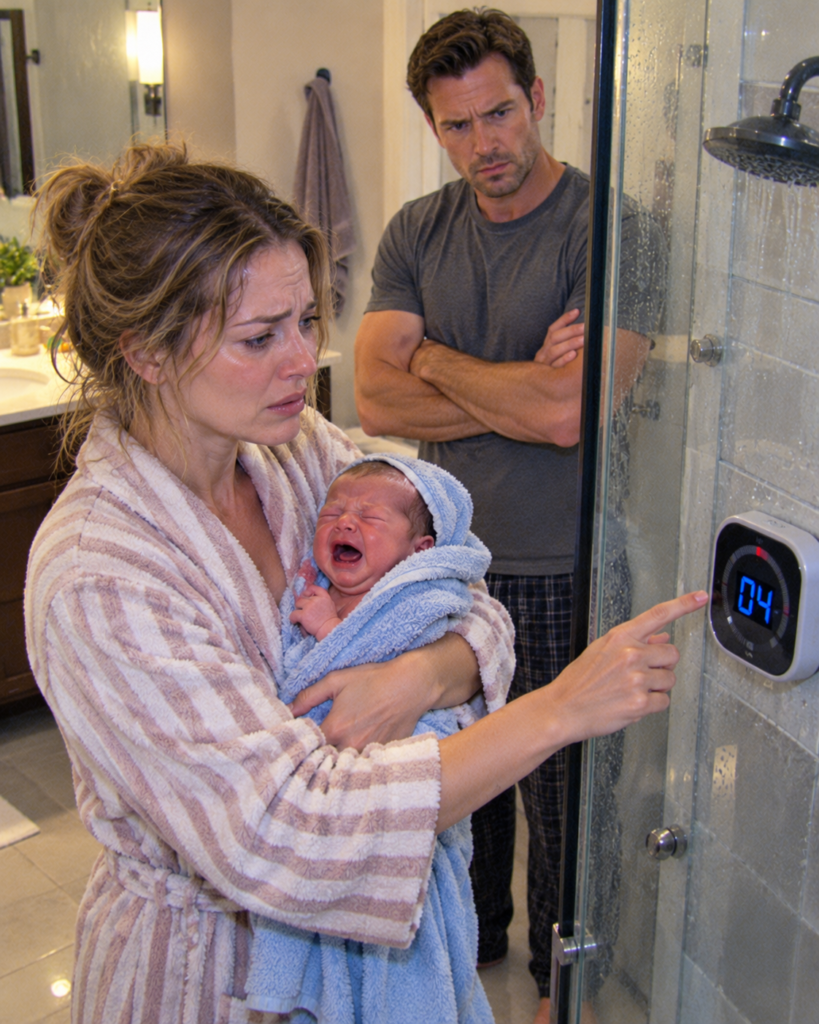
Four minutes.
That was what Caleb believed I deserved.
Four minutes to wash.
Four minutes to breathe.
Four minutes before his needs returned to the center.
I stopped timing myself.
Two weeks later, Daniel Cross was formally questioned by investigators.
Then something unexpected happened.
He disappeared.
His attorney claimed he was traveling.
Nathan didn’t believe it.
Neither did I.
Daniel stopped answering calls.
His office emptied overnight.
Several accounts were drained.
Richard looked terrified.
“He’s running.”
Nathan shook his head.
“No.”
“What do you mean?”
“Daniel doesn’t run.”
“How would you know?”
“Because I spent three years around him.”
Nathan looked at me.
“He’s preparing leverage.”
“What leverage?”
We found out forty-eight hours later.
A package arrived at Diane’s house.
No return address.
Inside was a tablet.
One video file.
I almost didn’t open it.
My attorney told me not to touch anything else.
But the file played automatically when the tablet powered on.
Daniel appeared on screen.
Calm.
Well dressed.
Smiling.
“If you’re watching this, Nathan has probably convinced you that I’m the villain.”
I hated how relaxed he sounded.
“He’ll show you documents. Richard will confess just enough to look repentant. Caleb will cry. Everybody will discover the healing power of honesty.”
His smile vanished.
“But there is one problem.”
The screen changed.
Security footage.
A parking garage.
Caleb meeting Daniel.
The timestamp was six months earlier.
Caleb accepted an envelope.
Then Daniel’s voice continued.
“Your husband was not trapped from the beginning.”
Another clip.
Caleb signing paperwork.
Another.
Caleb laughing with Daniel at a restaurant.
My stomach tightened.
Then a final clip.
Caleb saying:
“If this works, Dad loses control of the warehouse, and I finally stop living under him.”
I felt sick.
Caleb had wanted something too.
Not merely survival.
Freedom.
Status.
Maybe revenge.
Daniel reappeared.
“Ask Caleb what he promised me in return for the warehouse.”
The video ended.
I called Caleb.
“Come to Diane’s.”
He arrived twenty minutes later.
I played the footage.
He watched silently.
When it ended, I asked:
“What did you promise him?”
Caleb looked at Nathan.
Then Richard.
Then me.
“Twenty percent.”
“Of the warehouse?”
“Yes.”
Richard exploded.
“You had no right!”
Caleb turned toward him.
“You hid it for twenty years!”
“And that gives you permission?”
“No.”
Caleb’s voice rose.
“But stop pretending I woke up one morning wanting to destroy you.”
Richard fell silent.
Caleb looked at me.
“At first, Daniel told me the warehouse should have belonged partly to Nathan and partly to me.”
“Did you believe him?”
“Yes.”
“Did you want it?”
“Yes.”
The honesty hurt.
“Why?”
“Because I was angry.”
“At Richard?”
“At everything.”
He paced.
“I spent my whole life feeling like Dad measured me.”
Richard looked shocked.
“You never said that.”
“No, because Morgan men apparently only talk after somebody finds a flash drive.”
Even Nathan laughed.
It broke the tension for half a second.
Then Caleb continued.
“When I lost my job, I thought Dad would see me as a failure.”
Richard whispered:
“I wouldn’t have.”
Caleb looked at him.
“You timed my childhood the same way I timed Tessa.”
Richard froze.
“What?”
“Homework. Soccer. Chores. Everything.”
Caleb’s voice cracked.
“If I wasn’t efficient enough, you made me redo it.”
Richard stared at the floor.
Caleb continued.
“I hated you for it.”
Then he looked at me.
“And somehow I became you.”
Richard sat down.
For a long time, nobody spoke.
Then Nathan said quietly:
“That’s the part none of us wanted to admit.”
“What?” I asked.
“Daniel didn’t invent our weaknesses.”
He looked around the room.
“He exploited them.”
That distinction mattered.
Daniel was responsible for his own scheme.
But he didn’t create Richard’s secrecy.
He didn’t create Caleb’s control.
He didn’t create Nathan’s hunger for revenge.
He just found existing cracks and pushed.
My phone buzzed.
A message.
Unknown number.
A photograph.
Elodie.
Sleeping in her bassinet.
My heart stopped.
The background was Diane’s guest room.
Taken recently.
Very recently.
Everyone stood.
Diane ran upstairs.
The bassinet was empty.
I screamed her name.
“Elodie!”
The room dissolved into motion.
Then another message appeared.
DON’T PANIC.
YOUR BABY IS SAFE.
I could barely see.
Richard called the p/o/lice.
Caleb looked like he might collapse.
Nathan grabbed my phone.
Another message.
COME TO THE WAREHOUSE.
ONE HOUR.
BRING RICHARD.
I couldn’t breathe.
Then we heard a sound.
A tiny cry.
From downstairs.
We froze.
Diane ran toward the basement door.
It opened.
Marissa stepped out.
Holding Elodie.
My knees nearly gave out.
I grabbed my daughter.
“What are you doing?!”
Marissa looked terrified.
“I’m sorry!”
“Why was she downstairs?”
“I took her when the package arrived.”
“What?”
“I saw a man outside.”
Nathan ran to the window.
Marissa explained she had come to apologize in person.
She saw someone photographing the house.
She panicked, picked up Elodie, and hid in the finished basement.
My anger collided with relief.
“You should have called!”
“My phone was upstairs.”
I held Elodie against my chest.
Her warmth brought me back to earth.
Then Nathan looked at the photograph.
“This wasn’t taken today.”
“What?”
He zoomed in.
“The blanket.”
Diane stared.
“That was last week.”
Daniel had taken or obtained a photo earlier.
The message was psychological leverage.
Nothing more.
But it worked.
My hands shook.
Caleb looked at the screen.
“He wants Dad at the warehouse.”
Richard nodded.
“I’m going.”
“No,” I said.
Everyone looked at me.
“I’m done letting Daniel decide where everybody stands.”
“What do you mean?”
I looked at Nathan.
“Does he know we found the second flash drive?”
“No.”
“Good.”
Then I looked at Caleb.
“Does he know you turned over your records?”
“Probably not everything.”
“Even better.”
My attorney had told me something important.
Evidence was strongest when preserved.
Plans were safest when coordinated.
So for once, instead of keeping a family secret, we told professionals everything.
And that decision changed the entire game.
## PART 7 — THE NIGHT EVERY MORGAN STOPPED LYING
The warehouse meeting happened.
But not the way Daniel expected.
Richard arrived alone.
At least, that was what it looked like.
He entered through the front door carrying a folder.
Daniel stood near the old loading bay.
He looked almost disappointed.
“You came.”
Richard held up the folder.
“You threatened my granddaughter.”
“I sent a photograph.”
“You used a baby to frighten her mother.”
Daniel shrugged.
“Fear creates clarity.”
Richard laughed sadly.
“No. Fear creates people like me.”
Daniel’s expression changed.
Richard continued.
“I spent half my life believing fear justified secrecy.”
He set the folder on a table.
“It doesn’t.”
Daniel stared at it.
“The authorization form?”
“A copy.”
“Where’s the original?”
“With the authorities.”
For the first time, Daniel lost his composure.
“You went to the p/o/lice?”
“Yes.”
“You idiot.”
“Probably.”
Daniel paced.
“Do you know what happens if everything comes out?”
“Yes.”
“You could face charges related to the old company.”
“Yes.”
“Civil liability.”
“Yes.”
“Loss of the warehouse.”
“Yes.”
Daniel stared.
Richard smiled.
“You see the problem?”
Daniel said nothing.
“You built this entire scheme around the assumption that I would keep protecting myself.”
Richard stepped closer.
“I stopped.”
Daniel’s face hardened.
Then Nathan walked in.
Daniel turned.
“You.”
Nathan nodded.
“Me.”
“You gave them the records.”
“Yes.”
“You think you’re better than me?”
“No.”
That answer surprised Daniel.
Nathan continued.
“I helped you longer than I should have.”
Richard looked at his son.
Nathan did not look away.
“I wanted him punished.”
Richard swallowed.
Nathan added:
“I stopped caring who else got hurt.”
He looked toward the hidden recording equipment investigators had authorized.
“I’m telling the truth about that too.”
Daniel laughed.
“This is pathetic.”
Then Caleb entered.
Daniel’s smile returned.
“There he is.”
Caleb stopped several feet away.
“My favorite disaster.”
Caleb didn’t react.
Daniel continued.
“You think confessing makes you noble?”
“No.”
“Good.”
“It makes me accountable.”
Daniel rolled his eyes.
“Everybody learned therapy words.”
Caleb almost smiled.
Then Daniel said:
“You wanted that warehouse.”
“Yes.”
“You wanted your father humiliated.”
“Yes.”
“You wanted Tessa’s money.”
“No.”
Daniel’s smile sharpened.
“You used it.”
“Yes.”
“You f/o/rged her signature.”
“Yes.”
“Then stop pretending you were my victim.”
Caleb nodded.
“I was both.”
Daniel’s face changed.
Caleb continued.
“You manipulated me.”
“Yes.”
“I made my own choices.”
“Yes.”
“I hurt my wife.”
“Yes.”
“I lied to my family.”
“Yes.”
“And none of that gives you ownership of me.”
Daniel stared at him.
For the first time, his control was slipping.
Because every weapon he had was made of secrets.
And they were no longer secret.
Then I entered.
Daniel looked genuinely shocked.
“Tessa.”
I hated hearing my name in his voice.
“You shouldn’t be here.”
“That’s funny.”
“What?”
“Caleb used to say similar things.”
He glanced at Caleb.
Caleb looked down.
I continued.
“Men deciding where I should stand has become exhausting.”
Daniel smiled.
“You think you understand what’s happening?”
“I understand enough.”
“You’re married to a liar.”
“I know.”
Caleb flinched.
“You married into a family built on deception.”
“I know.”
“You lost money.”
“I know.”
“Then why are you defending them?”
“I’m not.”
Daniel paused.
“I’m defending the truth.”
His expression hardened.
I placed copies of the corporate statements on the table.
“You engineered losses.”
“No.”
“You controlled vendors.”
“Prove it.”
“Nathan did.”
His eyes flicked toward Nathan.
I continued.
“You used false disclosures to obtain financing.”
“Allegedly.”
“You tried to shift liability to Caleb.”
“His signature is on everything.”
“Yes.”
I looked at my husband.
“He’ll answer for what he signed.”
Caleb nodded.
Then I looked back at Daniel.
“And so will you.”
Daniel laughed.
“You’re all adorable.”
Then he reached into his coat.
Every person in the room tensed.
He pulled out a small recorder.
Not a we/@/pon.
He placed it on the table.
“You want truth?”
He pressed play.
A younger Richard’s voice filled the warehouse.
Old audio.
Richard speaking to Daniel’s father.
“If investigators find the warehouse transfer, we both lose everything.”
Richard closed his eyes.
Daniel smiled.
“There.”
Nathan looked at his father.
Richard didn’t deny it.
Daniel continued.
“My father went to prison while Richard rebuilt his reputation.”
“Your father committed f/r/@/ud,” Nathan said.
“So did Richard.”
Richard nodded.
“Yes.”
Daniel blinked.
He had expected denial.
Richard continued.
“I signed false invoices.”
Daniel stared.
“I concealed the warehouse.”
Richard stepped forward.
“And tomorrow morning, I am filing a full amended disclosure with my attorney.”
Daniel’s face emptied.
“You’ll lose it.”
“Maybe.”
“You could lose millions.”
“Yes.”
“You could destroy your family.”
Richard looked at Caleb.
“No.”
He looked at Nathan.
“Lying already did that.”
Daniel’s strategy collapsed in real time.
He had built leverage around shame.
Richard surrendered the shame.
Caleb surrendered the shame.
Nathan surrendered the shame.
There was nothing left to threaten them with.
Then Daniel looked at me.
“You still have something to lose.”
My chest tightened.
“Elodie?”
“No.”
He smiled.
“Your husband.”
I almost laughed.
“You think that’s leverage?”
Caleb actually laughed.
Daniel looked annoyed.
I continued.
“I haven’t decided whether my marriage survives.”
Caleb’s smile disappeared.
But he nodded.
Because that was true.
Daniel stared at him.
“You’re letting her decide?”
Caleb looked at me.
“It’s her life.”
There it was.
The change I had needed to see.
Not grand gestures.
Not punishment.
Agency.
Daniel looked disgusted.
“You’re weak.”
Caleb shook his head.
“No.”
He glanced at Richard.
“Controlling people because you’re scared is weak.”
Richard absorbed that quietly.
Then Daniel’s phone rang.
He looked at the screen.
Ignored it.
It rang again.
Nathan smiled.
“You should answer.”
Daniel stared at him.
“Why?”
“Because your lender knows.”
Daniel went pale.
The private lender had received the evidence.
So had the contractors Daniel controlled.
One had already agreed to cooperate.
Daniel turned toward the exit.
Two investigators entered.
He stopped.
The next hour was procedural.
Questions.
Documents.
Phones surrendered.
Statements.
Daniel was not dragged away in some dramatic scene.
Real consequences were slower.
Less cinematic.
More terrifying.
His attorney arrived.
He stopped speaking.
And eventually, he left under legal supervision while the investigation continued.
Outside the warehouse, dawn was beginning.
The sky was gray-blue.
I stood beside Caleb.
Neither of us spoke.
Then he said:
“I’m sorry.”
I closed my eyes.
“I know.”
“No.”
He looked at me.
“I don’t mean as a way to fix us.”
That mattered.
“I’m sorry because what I did was wrong even if you never forgive me.”
I looked at him.
He continued.
“The timer.”
His voice broke.
“I keep thinking about the timer.”
“So do I.”
“I treated your basic needs like an inconvenience.”
“Yes.”
“I treated caring for our daughter like your job.”
“Yes.”
“I made money decisions for you.”
“Yes.”
“I stole your choice.”
“Yes.”
He cried.
I didn’t comfort him.
Not because I hated him.
Because his pain was his to carry.
Then he asked:
“Can I see Elodie later?”
“You can.”
His face crumpled with relief.
“Thank you.”
“Supervised.”
He nodded.
“Whatever you need.”
Three months passed.
The investigation continued.
Daniel’s companies collapsed under scrutiny.
Several civil claims were filed.
His private lending structure unraveled.
Caleb entered a formal repayment agreement regarding my inheritance.
He also accepted legal responsibility for the f/o/rged authorization.
Because he cooperated early and because the broader scheme was documented, his attorney negotiated an outcome focused heavily on restitution, financial penalties, and court supervision rather than incarceration.
I did not celebrate.
Consequences were not revenge.
They were consequences.
Richard voluntarily disclosed the warehouse history.
It cost him.
A lot.
Legal fees.
Taxes.
Civil settlement negotiations.
But something strange happened.
Once the title issues were corrected, the warehouse still had substantial value.
Enough that, after settlements, Richard retained part of it.
He could have kept the money.
Instead, he created a trust.
Not secretly.
Not alone.
The paperwork was reviewed by everyone.
Half of Richard’s remaining warehouse interest went to Nathan.
The other half went into a trust for Caleb and Elodie, with independent management.
Caleb objected.
“I don’t deserve it.”
Richard answered:
“It isn’t about deserving.”
Nathan added:
“And you don’t control it.”
That made me smile.
Caleb laughed.
“Good.”
Nathan moved back to the city.
Not into Richard’s house.
Not into some magical restored family.
He rented his own apartment.
He had dinner with Caleb once a week.
Sometimes those dinners went well.
Sometimes one of them left angry.
But they kept returning.
Diane began speaking to Richard again.
Carefully.
No romantic reunion.
No miracle.
Just honesty.
One evening, Richard told her:
“I spent decades wanting to be forgiven before I had earned trust.”
Diane replied:
“Then stop chasing forgiveness.”
“What should I chase?”
“Consistency.”
I wrote that down later.
Because it applied to Caleb too.
Four months after the warehouse meeting, I moved into my own apartment.
Not Diane’s.
Not my sister’s.
Mine.
Two bedrooms.
A sunny kitchen.
A bathroom with terrible tile and unlimited shower time.
The first night, I taped something beside the shower.
Caleb’s old timer.
Not running.
Not counting.
Just hanging there.
Then beneath it, I taped a note.
YOU DECIDE WHEN YOU’RE DONE.
I laughed every time I saw it.
Eventually, I threw the timer away.
## PART 8 — THE FOUR MINUTES THAT CHANGED EVERYTHING
A year after Elodie was born, I stood in my kitchen decorating a cake.
It leaned slightly to the left.
The frosting was uneven.
There were crumbs everywhere.
I didn’t care.
Elodie sat in her high chair banging a wooden spoon.
She had inherited Caleb’s dark eyes and my refusal to sit still.
The doorbell rang.
Caleb stood outside holding balloons.
“Too many?” he asked.
“Definitely.”
“I panicked.”
“I can tell.”
He smiled.
A year ago, panic made him control everything.
Now apparently it made him buy twelve balloons.
Progress.
“Come in.”
He entered.
Things between us were strange.
Not bad.
Not simple.
For eleven months, Caleb had attended therapy.
Individual.
Parenting sessions.
Financial counseling.
He had a new job at a mid-sized software company.
Not executive.
Not glamorous.
Stable.
He deposited part of every paycheck into the repayment account.
Every month.
Never late.
He never mentioned it unless I asked.
Most importantly, he showed up for Elodie.
Night feedings when she stayed with him.
Doctor appointments.
Laundry.
Diapers.
Tantrums.
Baths.
The invisible work he once called “your routine.”
We had shared custody informally while our legal separation remained in place.
Yes.
Separation.
Not divorce.
Not yet.
I had filed paperwork six months earlier.
Then paused it.
Not because Richard asked.
Not because Diane asked.
Not because Caleb begged.
He never begged.
I paused because I didn’t know what I wanted.
And for the first time in years, nobody pressured me to decide faster.
Nathan arrived next.
He had become Elodie’s favorite uncle largely because he was willing to crawl around the floor pretending to be a horse.
“Where’s Dad?” Caleb asked.
“Late.”
“Of course.”
Nathan grinned.
“He’s discovering punctuality doesn’t repair childhood trauma.”
Caleb threw a napkin at him.
Their relationship had become like that.
Painful history mixed with stupid jokes.
Then Richard arrived.
Exactly four minutes late.
Nathan looked at the clock.
“Oh, perfect.”
Richard frowned.
“What?”
Caleb started laughing.
I did too.
Richard realized why.
“Oh, come on.”
Nathan pointed at him.
“Four minutes. Family tradition.”
Even Diane laughed when she walked in behind him.
Richard muttered:
“I deserve this.”
“Yes,” all of us said together.
The room erupted.
I looked around the table.
A year earlier, these people could barely exist in the same room without secrets.
Now nothing was perfect.
Richard still had legal obligations from the old company case.
Nathan still had days when he couldn’t forgive him.
Diane still refused to let Richard romanticize their past.
Marissa was rebuilding trust with me slowly.
Caleb and I were still separated.
But nobody pretended anymore.
That was the difference.
The doorbell rang again.
Marissa stood outside.
She held a small gift.
“I can leave it and go.”
I looked at her.
We had spoken twice in three months.
Briefly.
Carefully.
She had repaid part of the money she borrowed from Caleb.
She had also provided a sworn statement about the f/o/rged authorization.
That statement had mattered.
“You can stay.”
Her eyes filled.
“Really?”
“For cake.”
She smiled.
“I’ll take cake.”
After everyone sang badly, Elodie shoved one hand directly into the frosting.
Nathan cheered.
Caleb took approximately fifty photographs.
Richard tried to clean the table before the party was over.
Diane slapped his hand away.
“Leave it.”
“But there’s frosting on the floor.”
“Tessa?”
They all looked at me.
I smiled.
“Leave it.”
Richard slowly sat down.
Growth.
Later, everyone left except Caleb.
Elodie fell asleep against his chest.
He sat on my couch, barely moving.
“She’s heavy now.”
“You complained she was loud when she weighed eight pounds.”
His expression tightened.
“I know.”
I regretted the sharpness immediately.
Not because it was untrue.
Because I no longer wanted every conversation to be punishment.
“I’m sorry.”
“No.”
He shook his head.
“You’re allowed to remember.”
I sat across from him.
“That’s the problem.”
“What?”
“Sometimes I remember the worst version of you even when you’re doing something good.”
His eyes lowered.
“I understand.”
“I don’t know how to stop.”
“You don’t have to.”
I looked at him.
He continued.
“I spent months thinking the goal was making you forget.”
He brushed Elodie’s hair away from her forehead.
“Now I think that would be unfair.”
“What’s the goal then?”
“Becoming someone the memory doesn’t control.”
That sentence stayed with me.
He carried Elodie to her crib.
When he returned, he picked up his coat.
“Goodnight.”
“Caleb.”
He stopped.
“Do you want coffee?”
He stared at me.
“Now?”
“Yes.”
A cautious smile appeared.
“I’d love coffee.”
We sat at the kitchen table.
The same kind of table where our marriage had nearly ended.
For an hour, we talked.
Not about Daniel.
Not about Richard.
Not about money.
About books.
TV.
Elodie’s obsession with bananas.
The neighbor’s ridiculous lawn decorations.
Ordinary things.
I had forgotten how much I missed ordinary.
When he left, he didn’t try to kiss me.
He didn’t ask where we stood.
He simply said:
“Thanks for coffee.”
Three weeks later, I asked him to dinner.
Two months after that, we attended couples therapy.
Not reconciliation therapy.
Decision therapy.
Our counselor made that distinction clear.
The goal wasn’t keeping us married.
The goal was determining whether a healthy marriage between us could exist.
Caleb spoke first.
“I controlled her.”
No minimizing.
“I used money as power.”
No excuse.
“I treated childcare like it belonged to her.”
No excuse.
“I invaded her basic autonomy.”
No excuse.
Then the therapist asked me what I needed.
I said:
“Choice.”
One word.
It contained everything.
Choice about money.
Work.
Motherhood.
My body.
My time.
My shower.
My marriage.
Caleb nodded.
“Okay.”
The counselor looked at him.
“Not okay as permission. Okay as understanding.”
Caleb corrected himself.
“I understand.”
That became our work.
Not romance.
Not grand gestures.
Structure.
Separate accounts plus one joint household account.
Equal visibility.
No hidden debt.
No unilateral childcare decisions.
No controlling each other’s personal spending.
No comments about food, showers, clothing, rest, or time that implied ownership.
If either of us felt scared about money, we said:
“I’m scared about money.”
Not:
“You’re wasting money.”
It sounds simple.
It wasn’t.
Changing language meant changing thought.
Changing thought meant admitting fear.
And the Morgan men had spent generations being terrible at that.
Six months later, something happened I never expected.
Richard sold the warehouse.
Completely.
The final net proceeds after legal settlements and taxes were far less than four million dollars.
Still substantial.
He gathered everyone at Diane’s house.
“I made a decision.”
Nathan groaned.
“Dangerous opening.”
Richard smiled.
“It isn’t unilateral.”
He handed us documents.
A foundation.
THE MORGAN FAMILY RESOURCE FUND.
I frowned.
“What is this?”
Richard looked embarrassed.
“Your mother helped.”
Diane corrected him.
“I supervised.”
The fund would provide emergency grants for new parents facing housing or utility instability.
Short-term childcare support.
Counseling.
Financial education.
No application question asked how long someone showered.
I stared at Richard.
“Why this?”
He looked at me.
“Because money should make a family safer.”
His voice cracked.
“Not smaller.”
Caleb looked away.
Nathan rubbed his eyes.
Diane pretended not to cry.
I asked:
“Whose idea was the parent support?”
Richard pointed at Caleb.
I looked at him.
Caleb shrugged.
“I thought somebody should get help before they become us.”
That was when I finally cried.
Not because everything was fixed.
Because something ugly had been transformed without being erased.
A year and eight months after Elodie’s birth, the investigation into Daniel Cross concluded.
He entered a negotiated resolution involving restitution, financial penalties, and restrictions related to several businesses after evidence established deceptive lending practices, false filings, and financial f/r/@/ud connected to multiple projects.
He was not a monster from a novel.
That would have been easier.
He was a man who turned old resentment into justification.
Nathan attended the final hearing.
When he returned, Richard asked:
“Do you feel better?”
Nathan thought about it.
“No.”
Richard nodded.
“Me neither.”
Then Nathan added:
“But I feel finished.”
Sometimes that is better.
Two years after the four-minute timer, Caleb and I stood in the bathroom of my apartment.
He was replacing a loose towel rack.
I leaned against the door.
“You know you installed that crooked.”
“It is not crooked.”
“It’s extremely crooked.”
He stepped back.
It was crooked.
“Okay.”
I laughed.
“Move.”
“I can fix it.”
“You said that once before.”
He froze.
The sentence had slipped out.
Old memory.
Old wound.
I almost apologized.
Then he surprised me.
“You’re right.”
He handed me the screwdriver.
“I used to think fixing things meant controlling the outcome.”
“And now?”
“Now I ask whether help is wanted.”
I smiled.
“Help is wanted.”
He fixed the rack.
Straight this time.
Then his eyes landed on a small object inside the cabinet.
The timer.
I hadn’t thrown it away after all.
Apparently, I had shoved it into a box during the move.
Caleb picked it up.
His face changed.
“I thought this was gone.”
“So did I.”
He held it for a long moment.
Then handed it to me.
“What should we do with it?”
I turned it over.
Four buttons.
Cheap plastic.
Such a tiny object to hold so much history.
I pressed START.
4:00.
The numbers began counting backward.
Caleb went pale.
“Tessa?”
I walked to the bathtub.
Filled the sink.
Dropped the timer into the water.
It died instantly.
Caleb stared.
“You know electronics and water—”
“I know.”
“You could have just thrown it away.”
“That wasn’t satisfying.”
He laughed.
I did too.
Then he became serious.
“Tessa.”
“Yes?”
“I love you.”
He had said it before.
Many times.
This time, he didn’t attach anything to it.
No question.
No expectation.
Just a statement.
I looked at him.
“I love you too.”
His eyes filled.
“But.”
He laughed through tears.
“There’s a but.”
“There’s always a but.”
I stepped closer.
“I love who you are becoming.”
He nodded slowly.
“I’ll take that.”
“And I don’t want our old marriage back.”
His expression tightened.
“I don’t either.”
“I want something new.”
He stared at me.
“Are you saying—”
“I’m saying we can try.”
His breath caught.
“No promises?”
“No.”
“No deadline?”
“No.”
“No pressure?”
“Caleb.”
“Sorry.”
I smiled.
“Come here.”
I kissed him.
Not because everything was forgiven.
Not because pain vanished.
Because trust, after nearly two years of consistency, had begun to return.
Slowly.
Honestly.
On my terms too.
We did not move back together immediately.
That would have made Richard furious because apparently he had become the family’s loudest advocate for emotional boundaries.
Nathan found this endlessly funny.
“You created a monster,” he told me.
“A healthy monster.”
“Still annoying.”
Six months later, Caleb moved into my apartment.
Not his house.
Mine.
His original house was sold after the financial claims were resolved.
The remaining equity mostly went toward restitution and debt.
He didn’t complain.
“I spent years thinking owning that house meant security.”
He looked around my smaller apartment.
“This feels safer.”
A year later, we bought a new house.
Together.
Both names on the deed.
Both names on the mortgage.
Every account visible.
Every document discussed.
During closing, the attorney asked:
“Any questions?”
Caleb looked at me.
“You?”
“No.”
“You sure?”
“Yes.”
Only then did he sign.
That tiny pause meant more to me than the house.
Three years after Elodie’s birth, we had another baby.
A boy.
We named him Nathan Richard Morgan.
Nathan cried when we told him.
Richard cried harder.
“Why is my name second?”
Nathan asked.
“Because you complain more.”
“That’s fair.”
After our son was born, Caleb took six weeks off work.
The first night home, the baby woke at 2:13 a.m.
Caleb got up.
“You sleep.”
“I’m awake.”
“You were awake for nine months.”
“That isn’t how pregnancy works.”
“It feels persuasive.”
I laughed.
He carried our son downstairs.
An hour later, I woke again.
The baby was asleep.
Caleb was folding laundry badly.
“What are you doing?”
“Being useful.”
“That shirt is inside out.”
“It’s folded.”
I smiled.
Then I went to shower.
Hot water filled the bathroom.
I washed my hair.
Conditioned it.
Stood beneath the water.
No knocking.
No timer.
No voice asking if I was almost done.
After twelve minutes, I turned the water off.
When I entered the bedroom, Caleb looked up.
“You okay?”
“Yes.”
“Baby’s asleep.”
“Thank you.”
He smiled.
“Anytime.”
I looked at the clock.
Twelve minutes.
Three times the limit he once gave me.
I almost told him.
Then I realized something.
I didn’t need to count anymore.
That was the real ending.
Not Daniel’s consequences.
Not Richard’s confession.
Not Nathan coming home.
Not even Caleb and me finding our way back to each other.
The real ending was quieter.
I could take a shower without hurrying.
Spend money without fearing interrogation.
Ask for help without being called inefficient.
Rest without earning it first.
And my daughter would grow up never believing love required shrinking herself.
Years later, Elodie would hear the story in a softened form.
Not the f/o/rged signatures.
Not the investigations.
Not the financial f/r/@/ud.
Just the lesson.
“Your dad once made a very bad rule.”
She was seven.
“What rule?”
“He thought he could decide how long someone else was allowed to shower.”
Her eyes widened.
“That’s weird.”
Caleb, listening from the kitchen, called:
“Extremely weird.”
Elodie yelled back:
“Why did you do that?”
Caleb walked in carrying pancakes.
“Because I was scared about things I didn’t know how to talk about.”
“So you became bossy?”
“Yes.”
She considered this.
Then:
“Mom fixed you?”
I laughed so hard I almost spilled my coffee.
Caleb sat beside her.
“No.”
He looked at me.
“Mom protected herself.”
Then he tapped his chest.
“I had to fix me.”
I felt tears sting my eyes.
Elodie nodded as if this made perfect sense.
“Good.”
Then she drowned her pancake in syrup.
Caleb opened his mouth.
I gave him a look.
He immediately closed it.
Elodie saw.
“Were you going to tell me that’s too much syrup?”
Caleb cleared his throat.
“No.”
“Yes, you were.”
Nathan walked in behind us.
“I heard controlling behavior.”
“Get out.”
Richard followed carrying fruit.
“What happened?”
“Caleb almost started a syrup dictatorship.”
Richard nodded gravely.
“Runs in the family.”
Everyone laughed.
Even Caleb.
Especially Caleb.
And as I looked around the kitchen—the imperfect pancakes, the sticky table, my daughter laughing, my son throwing blueberries onto the floor, two brothers arguing over coffee, Richard being corrected by Diane from the hallway—I understood something I wish I had known sooner.
Families are not saved by pretending nothing happened.
They are saved, when saving is possible, by refusing to repeat what happened.
By telling the truth sooner.
By respecting boundaries.
By making repair measurable.
By accepting that forgiveness is a gift, not a debt.
By understanding that love is not ownership.
And by never confusing control with care.
Caleb reached for my hand.
Not pulling.
Not assuming.
Just offering.
I placed mine in his.
Across the table, Richard noticed.
So did Nathan.
Neither said anything.
For once, the Morgan men knew when silence was appropriate.
And that, perhaps, was the most unbelievable transformation of all.
I squeezed Caleb’s hand.
He smiled.
The kitchen was loud.
The baby fussed.
Elodie demanded more syrup.
Nathan accused Richard of stealing his coffee.
Diane shouted from the hallway that nobody was leaving until they cleaned the kitchen.
And somewhere beneath all that beautiful noise was the life I once believed I had to earn four minutes at a time.
Now there were no timers.
No secret accounts.
No hidden contracts.
No one standing outside the bathroom deciding when my time belonged to them again.
Only a family still learning.
Still repairing.
Still choosing honesty.
One ordinary day at a time.
**the end.**