Clara remained near the door.
Mother noticed.
“Not over there,” she said gently. “Come here.”
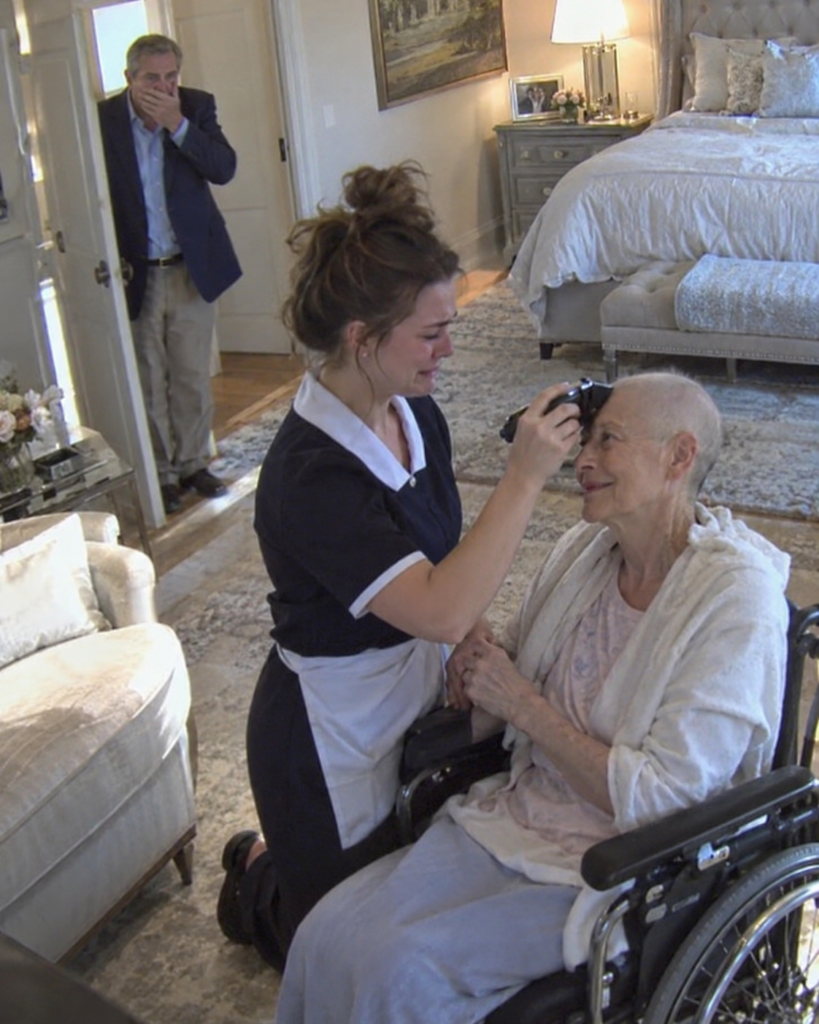
Clara hesitated before walking back and taking the chair beside her wheelchair.
I had never seen a housekeeper sit in my office before.
The fact that I noticed that bothered me.
Mother drew a slow breath.
“Your father knew Clara’s mother.”
I frowned.
“That’s the secret?”
“No.”
Clara closed her eyes.
Mother continued.
“He knew her long before he met me.”
Something in the room changed.
It wasn’t dramatic. No thunder. No raised voices. Just a quiet rearranging of facts I had believed permanent.
My father, Thomas Hale, had been dead for twelve years. In my memory, he existed in polished fragments: dark suits, Sunday newspapers, a hand on my shoulder after my first failed business pitch, the smell of cedar and coffee in his study.
He had been demanding.
Private.
Disciplined.
I had spent half my life trying to become the kind of man he would have respected.
“What does that have to do with Clara?” I asked.
Mother looked at her.
Clara gave the smallest shake of her head.
Mother ignored it.
“Clara’s mother was named Miriam Reed.”
The name meant nothing to me.
“At university,” Mother continued, “your father and Miriam were together for almost three years. They were very young. They separated before graduation.”
I felt impatient.
“Mother.”
“Bennett, listen.”
So I did.
“After they separated, Miriam discovered she was pregnant.”
The room became utterly still.
I turned toward Clara.
She was crying silently now.
Not openly.
Just tears moving down her cheeks while she stared straight ahead.
My mind rejected the thought before Mother said it.
Then she said it anyway.
“Clara is your father’s daughter.”
For a moment I heard nothing.
Not the clock.
Not the air conditioner.
Not my own breathing.
I looked at Clara as though seeing her for the first time.
Twenty-eight, perhaps twenty-nine. Dark hair usually tied at the back of her neck. Gray-green eyes.
My father had gray-green eyes.
I had never noticed.
“No,” I said.
It came out quietly.
Mother’s expression softened.
“I’m afraid so.”
I stood again.
“That’s impossible.”
“It isn’t.”
“She works here.”
“I know.”
“She applied through an agency.”
“I know that too.”
I looked at Clara.
“You knew?”
She finally met my eyes.
“Yes.”
One word.
That was all it took to make everything inside me turn hard.
“You knew when you came into this house?”
“Yes.”
“You knew who I was?”
“Yes.”
“And you said nothing.”
“I didn’t know how.”
A humorless laugh escaped me.
“You found a way to get employed in my home, but you couldn’t find a way to speak?”
“Bennett.”
Mother’s warning voice.
I looked at her.
“You knew too?”
“Not at first.”
“How long?”
Her pause was brief.
“Seven months.”
Seven months.
Clara had been working in the mansion for a little over eight.
I stared at my mother.
“So almost the entire time.”
“Yes.”
“And you both decided I didn’t need to know.”
“That isn’t what happened.”
“It appears remarkably similar.”
Mother leaned back in her wheelchair.
The movement cost her more strength than she wanted me to see.
Clara noticed immediately.
She reached for the glass of water on the side table.
Mother took it.
That small, practiced exchange made my anger worse.
They had a language together.
A routine.
A relationship.
All of it had developed while I was arranging specialists and signing invoices.
“Why did you come here?” I asked Clara.
She looked at the glass in Mother’s hands.
Then at me.
“Not for money.”
“I didn’t ask what you didn’t come for.”
“I know.”
“Then answer me.”
She folded her hands in her lap.
“My mother died three years ago.”
The anger in me slowed.
Only slightly.
“She never told me who my father was while she was alive,” Clara continued. “She said he had another life and that some doors were kinder left closed.”
“And after she died?”
“I found letters.”
“What letters?”
“From him.”
My father.
The words landed differently now.
I sat again because my legs suddenly felt unreliable.
Clara swallowed.
“They were in a wooden box behind some old blankets in her closet. There were twelve of them. Some from before I was born. Some from afterward.”
I looked at Mother.
“Did you know about those?”
“No.”
Clara continued.
“My mother had kept them all.”
“What did they say?”
“That he knew about me. That he wanted to help. That he cared.”
“Did he?”
“Did he what?”
“Help.”
Clara understood what I meant.
“Sometimes. When my mother would let him.”
Money again.
Of course.
I almost laughed.
Even my father had apparently known only one language.
But Clara shook her head as if she had followed my thought.
“It wasn’t only money.”
I said nothing.
“He asked to see me.”
My eyes lifted.
“She refused for a long time.”
“Why?”
“Because by then he had married your mother.”
I glanced toward Eleanor.
Mother’s face was unreadable.
“She thought he should leave your family alone,” Clara said. “She believed she’d made her choice when she didn’t tell him immediately. She didn’t want to return years later and disrupt everything.”
“Did you ever meet him?”
Clara nodded.
“Twice.”
That hurt more than I expected.
My own father had met her while I was alive.
While I was under the same roof.
“When?”
“The first time I was twelve.”
I calculated quickly.
I would have been nineteen.
At university.
“The second?”
“Sixteen.”
I remembered that year.
Father had told us he was traveling to Boston for a charity conference.
Clara must have seen something change in my face.
“He was only there for an afternoon,” she said.
“Where?”
“A public garden.”
I stared at her.
“What did you do?”
“Walked.”
“That’s it?”
“We had coffee. He asked about school. I told him I hated mathematics. He said that proved I couldn’t possibly be related to him.”
Despite myself, I knew exactly how my father would have delivered the line.
Dryly.
With one corner of his mouth slightly raised.
A memory stirred: my father teaching me algebra at the kitchen table, refusing to let me use a calculator.
I hated that Clara possessed a version of him I had never known.
And I hated myself for hating it.
“Why didn’t he tell me?”
Clara looked toward Mother.
Mother answered.
“He intended to.”
“When?”
“I don’t know.”
“That’s convenient.”
“Bennett.”
“No. You said I should listen. I’m listening. Apparently everyone in this room knows things about my father except me.”
Mother’s eyes flashed.
“You think I enjoyed carrying this?”
“I don’t know what you enjoyed, Mother. Until yesterday I didn’t even know Clara knew what tea you drink when you’re sick.”
That silenced all three of us.
The cruelty of the remark arrived only after I heard it aloud.
Clara looked down.
Mother studied me with tired disappointment.
I stood.
“I need some air.”
“Bennett.”
“Not now.”
I left before either of them could stop me.
For nearly an hour, I walked the grounds behind the house.
The property covered twenty-three acres, most of which I rarely saw.
My father had bought the estate when I was fourteen. I remembered him standing near the old stone wall with his hands in his coat pockets.
One day, this will all be yours.
At fourteen, I had thought he meant the house.
At forty-one, I realized he had meant something larger.
Expectation.
Responsibility.
The exhausting inheritance of becoming him.
Now I wondered what else he had left behind.
When I returned inside, Clara was arranging flowers in the front hall.
Not because anyone had asked her.
Because one of the lilies had wilted.
She removed it carefully from the vase.
I stopped several feet away.
“Do you still have the letters?”
Her hands froze.
“Yes.”
“I want to see them.”
She looked at me.
“I don’t think that’s a good idea.”
“They were written by my father.”
“To my mother.”
“He was also my father.”
“Yes.”
The calmness of her answer irritated me.
“Then you understand why I have a right to know.”
“No,” she said softly. “I understand why you want to know.”
There was a difference.
I didn’t like it.
“What are you protecting?”
“My mother.”
“She’s dead.”
The instant I said it, I regretted it.
Clara flinched.
Not dramatically.
Just enough.
“I know,” she replied.
“I shouldn’t have said that.”
“No.”
“I’m sorry.”
She adjusted one of the flowers.
It was the first apology I had made to an employee in years.
Maybe ever.
“I’ll show you some of them,” she said.
“Some?”
“The ones about you.”
My chest tightened.
“There are letters about me?”
“Yes.”
“When?”
“Mostly when you were young.”
I had no answer.
Clara lifted the vase and walked away.
That evening, Mother refused dinner.
Her nurse informed me that nausea had returned.
I stood outside her room longer than necessary before entering.
She was awake, reading an old mystery novel.
“You’re angry,” she said without looking up.
“Yes.”
“Good. Anger is more energetic than sulking.”
“I don’t sulk.”
“You have been professionally sulking since adolescence.”
I sat beside the bed.
Mother placed the book down.
For a while, neither of us spoke.
Then I asked, “Why didn’t you tell me?”
She looked toward the window.
“Because I was afraid.”
I almost smiled.
My mother rarely admitted fear.
“Of what?”
“You.”
“That makes no sense.”
“It makes perfect sense.”
She turned back.
“You worshipped your father.”
“I respected him.”
“You worshipped him.”
Her voice was gentle now.
“He wasn’t perfect, Bennett.”
“I know that.”
“No. You know intellectually that no person is perfect. That isn’t the same as allowing your father to have been flawed.”
I leaned back.
Mother continued.
“He told me about Miriam before we married.”
That surprised me.
“He told you?”
“Yes. He said they had been serious, that it ended badly, and that he regretted how young and stubborn they both were. He did not know about Clara then.”
“When did you find out?”
“Many years later.”
“How?”
“He told me.”
“So you knew while Father was alive.”
Mother closed her eyes.
“Yes.”
The answer struck harder than Clara’s revelation.
“How many years?”
“Six.”
I stood.
She looked tired.
Too tired for the conversation.
But twelve years of silence stood between us.
I could not leave it alone.
“You had six years.”
“Yes.”
“And after he died, twelve more.”
“Yes.”
“Eighteen years, Mother.”
Her voice weakened.
“I know.”
“Why?”
“Because every year I waited made the next year harder.”
That answer was so painfully ordinary that it disarmed me.
No conspiracy.
No calculated deception.
Just fear accumulating.
She looked toward the chair near the window.
“Your father wanted to tell you. I asked him to wait.”
I stared at her.
“Why?”
“You were twenty-three. You had just joined the company. Your grandfather had died. You were trying desperately to prove yourself. Your father thought honesty was more important than timing.”
“And you disagreed.”
“Yes.”
“Then he died.”
“Six years later.”
“And during those six years?”
“We kept waiting for the perfect moment.”
Her eyes filled.
“There is no perfect moment, Bennett. That is one of the stupidest lessons life teaches us.”
I sat again.
“Did Clara know you knew?”
“Not when she came.”
“How did you recognize her?”
“I didn’t.”
For the first time that day, Mother smiled faintly.
“She was cleaning my sitting room. I asked where she grew up. She said Connecticut. I asked about her parents. She mentioned Miriam Reed.”
“That was enough?”
“No.”
Mother reached toward her nightstand and opened the top drawer.
Inside was an old silver necklace.
A small oval pendant.
“She was wearing this.”
I took it.
Inside were initials.
T.H.
“Miriam gave your father this pendant when they were students. He returned it when they separated.”
“Clara wears it?”
“Her mother gave it to her before she died.”
I closed the pendant.
“What happened when you asked?”
“She lied.”
That almost made me laugh.
“Finally, something about her I understand.”
Mother smiled.
“She said she bought it at an antique shop.”
“And you believed her?”
“I raised you. I am familiar with terrible lies.”
I handed the pendant back.
“Eventually she told me.”
“Everything?”
“Enough.”
“And you asked her to stay.”
“Yes.”
“Why?”
Mother’s answer came instantly.
“Because I had already lost eighteen years.”
That night I barely slept.
The mansion felt different.
Every corridor seemed full of people who had once passed through it carrying secrets.
The next morning, I found an envelope beneath my office door.
My name was written across the front.
Inside were three photocopied letters.
Not the originals.
Clara was still protecting her mother.
I respected that more than I wanted to.
The first was dated thirty years earlier.
Thomas,
I received the check. I am returning it.
Please understand that I am not punishing you. I simply cannot build Clara’s life around a man who belongs to another family.
She asks about her father sometimes. For now I tell her you live far away.
Perhaps someday things will be simpler.
—Miriam
The second came four years later.
Miriam,
Bennett turned ten this week.
He insisted on building his own model airplane and refused help until he glued one wing upside down.
You once accused me of believing competence was a personality. Perhaps you were right.
I think often about Clara.
You say she reads constantly. Bennett does too.
I wonder whether they would like each other.
I know you believe distance is kindness.
I am beginning to wonder whether distance is only distance.
—Thomas
I read that letter twice.
Then the third.
It had been written shortly before Clara’s first meeting with him.
Miriam,
Thank you.
I will not ask for more than the afternoon.
I have told Eleanor.
She knows everything.
There is one more person who deserves the truth.
Bennett.
I have not told him yet.
But I will.
He should know he has a sister.
My hands stopped moving.
I read the final sentence again.
A sister.
Not an inconvenience.
Not a mistake.
Not an obligation.
A sister.
There was a knock.
Clara stood in the doorway.
“I thought you might have questions.”
I looked at her.
For once, I had none.
Instead I asked, “Do you remember him?”
“My father?”
The words sounded natural when she said them.
That hurt too.
“Yes.”
“Some things.”
“Like what?”
She leaned against the doorframe.
“He hated cinnamon.”
I stared.
“He claimed it ruined coffee.”
“He was wrong.”
“I know.”
“He tapped his fingers when impatient.”
“Yes.”
“He never laughed loudly.”
“No. But when something really amused him, he looked down first.”
I looked away.
She knew him.
Not well.
But truly.
I folded the letters.
“Why become a housekeeper?”
Clara seemed prepared for the question.
“Because I needed work.”
“That simple?”
“Mostly.”
“And the rest?”
She took a breath.
“When I found out who you were, I searched your name.”
“Of course.”
“There were interviews. Articles. Photographs of this house.”
I nodded.
“I knew Mrs. Hale still lived here.”
“You wanted to meet her.”
“Yes.”
“And me?”
Clara took longer to answer.
“I wasn’t sure.”
That should have offended me.
Instead, I understood.
“What did you expect?”
“Someone like our father.”
I almost corrected her.
Our father.
The phrase remained between us.
“And?”
She looked around my office.
“I found someone trying very hard to be.”
I should have been angry.
But I wasn’t.
“What does that mean?”
“You really want to know?”
“Yes.”
“You schedule everything.”
“I’m busy.”
“You solve problems before people finish explaining them.”
“That is generally efficient.”
“You think paying for something means you’ve participated in it.”
That one landed.
“And,” she added, “you stand at doors when you don’t know what to say.”
I frowned.
“I do not.”
“You stood outside your mother’s room for eleven minutes last night.”
I stared.
Clara smiled faintly.
“I was changing the flowers.”
“Do you observe everyone this closely?”
“No.”
The answer was quiet.
“Only the people I was trying to understand.”
I looked down at the letters.
“Are you leaving?”
She seemed surprised.
“Do you want me to?”
I thought about the question.
Yesterday I would have said that staffing decisions belonged to me.
Today it sounded ridiculous.
“No.”
She nodded.
“Then not yet.”
Not yet.
I didn’t like those words.
But I let them remain.
Over the next week, something changed in the house.
Not dramatically.
Mother was still sick.
Doctors still came.
Medication still lined the bathroom cabinet.
But I began arriving home before dinner.
At first Mother found this suspicious.
“Did the stock market close?”
“No.”
“Has capitalism ended?”
“No.”
“Then why are you home at six?”
“I live here.”
“You have technically lived here for years.”
Clara hid a smile behind a teacup.
I ignored her.
I started sitting with Mother while she ate.
Some nights she ate only three bites.
Some nights she talked for an hour.
I learned that she hated the television in her bedroom.
I learned that she missed driving.
I learned that she had been secretly ordering mystery novels because she disliked the books I had selected for her.
“You bought me a biography of Winston Churchill.”
“It was highly reviewed.”
“I have cancer, Bennett. I don’t need six hundred pages of someone else’s problems.”
Clara laughed so hard she spilled tea.
Mother looked delighted.
For the first time in months, perhaps years, I stopped thinking about what came next.
Then one Sunday afternoon, Mother asked us both to join her in the library.
Clara and I arrived together.
Mother sat near the fireplace with a wooden box on her lap.
I recognized it immediately.
It had belonged to my father.
He kept important documents inside.
Mother ran her fingers across the lid.
“I should have opened this with you years ago.”
My chest tightened.
“With me?”
She nodded.
“Your father left instructions.”
Clara went very still.
“What instructions?” I asked.
Mother looked from Clara to me.
“When he died, I found this inside his desk.”
She lifted a sealed envelope from the box.
My name was written across it in my father’s unmistakable handwriting.
BENNETT.
Underneath, in smaller letters:
When you are ready to know the whole family.
I stared at it.
Mother’s voice trembled.
“I told myself you weren’t ready.”
She placed the envelope in my hand.
“Then I told myself you were grieving.”
Her eyes filled.
“Then I told myself too much time had passed.”
I looked at the sealed edge.
It had never been opened.
For twelve years, my father’s final explanation had been sitting in the same house where I slept.
Waiting.
Mother reached for my hand.
“I was wrong.”
I looked at Clara.
She shook her head.
“I didn’t know about this.”
Neither had I.
And suddenly the question was no longer why Clara had entered our lives.
The question was what my father had wanted me to know before any of us had the courage to tell the truth.
-END OF PART 2, –PRESS NEX PART IN BOTTOM OF PAGE TO READ NEXT PART
Clara read the words over my shoulder.
Eleanor asked me to come.
Neither of us spoke.
The storage unit suddenly felt too small.
Dust floated through the narrow beam of afternoon light coming through the raised door. Somewhere outside, a truck reversed with a steady electronic beep.
I turned the photograph over again.
There was no mistake.
My mother’s name.
Miriam’s handwriting.
My father holding me as an infant.
And Miriam standing beside him.
Clara sat on one of the boxes.
“She knew your mother when you were born.”
“Apparently.”
“But Mrs. Hale told us she didn’t know about me until years later.”
“She said she didn’t know about you.”
I looked at the photograph.
“She never said she didn’t know Miriam.”
Clara looked up.
“That is a very lawyerly distinction.”
“I’m aware.”
“Are you angry?”
I thought about it.
“No.”
That surprised me.
A month earlier, another hidden fact would have felt like an attack.
Now I mostly felt tired of guessing.
“I want the whole story,” I said.
Clara nodded.
“So do I.”
We drove home together.
Mother was in the sunroom.
She had grown weaker that week.
Not suddenly.
Her illness moved in increments.
A little less appetite.
A little more sleep.
A few more steps requiring help.
Ruth, her nurse, had warned me that decline could look ordinary from the outside.
That was perhaps the hardest part.
You expected life-changing moments to announce themselves.
Most did not.
Mother was wrapped in a blue blanket, listening to music.
She smiled when she saw us.
“You came together.”
Clara glanced at me.
“That sounds ominous.”
Mother lowered the volume.
“What have you found?”
I placed the photograph on the table.
Her smile disappeared.
For a long moment she said nothing.
Then she touched Miriam’s image with one finger.
“I wondered where this had gone.”
“Tell us.”
Mother closed her eyes.
When she opened them again, something about her had changed.
Not physically.
She looked relieved.
As if another locked room inside her had finally opened.
“I met Miriam before your father and I married.”
I sat.
Clara took the chair beside me.
Mother continued.
“Thomas introduced us.”
That was not what I expected.
“Why?”
“Because he believed in being honest.”
I almost laughed.
Mother noticed.
“Yes,” she said. “I appreciate the irony.”
Clara leaned forward.
“Did you know my mother had been in a relationship with him?”
“Yes.”
“Did you know she was pregnant?”
“No.”
Mother shook her head.
“Neither did Thomas.”
She looked at me.
“Miriam and I met once before the wedding. She was kind to me. Kinder than she had any obligation to be.”
“Why would she come?”
“Because Thomas asked.”
“That seems strange.”
“It was.”
Mother smiled faintly.
“Your father could be very determined once he decided something represented integrity.”
I knew that.
“He wanted no ghosts in our marriage,” she continued. “He thought if Miriam and I met, I would understand that his past was truly past.”
“Was it?”
“Yes.”
She answered without hesitation.
“In the romantic sense, yes.”
Clara looked at the photograph.
“Then why was my mother at the hospital when Bennett was born?”
Mother’s smile turned sad.
“Because by then she and I had become friends.”
Neither Clara nor I responded.
Mother gave a small laugh.
“I know. It sounds unlikely.”
“Yes,” I said.
“It was unlikely.”
She adjusted the blanket.
“After our first meeting, Miriam sent me a wedding card. I wrote back. Then she sent another letter. We corresponded occasionally.”
“Father knew?”
“Yes.”
“And later?”
“Later, when I was pregnant with you, she had moved back to Connecticut. She came through New York for work. I invited her to lunch.”
Mother looked at Clara.
“She knew your father in a way I did not. Not better. Differently. When I was terrified about becoming a mother, she told me stories about him when he was young.”
“Did she already have Clara?”
“No.”
The timeline settled.
Clara had not yet been born.
Mother touched the photograph again.
“You arrived early, Bennett.”
“So I’ve been told.”
“I had been expecting another three weeks. Miriam happened to be in the city.”
“She came to the hospital?”
“Yes.”
“Why?”
“Because I asked her.”
Mother smiled.
“Your father was trying to appear calm and failing badly. My own mother was traveling. Miriam came because I didn’t want to be alone before Thomas returned from speaking with the doctor.”
Clara looked down.
“My mother never told me any of this.”
“I doubt she knew how.”
That sentence felt familiar.
Mother continued.
“Afterward, life moved on. Miriam and I exchanged fewer letters. Then we stopped.”
“And then she discovered she was pregnant?”
“No. She already knew by then.”
Clara’s head lifted.
Mother’s expression sharpened.
“She simply had not told Thomas.”
“Why?”
“I can only tell you what she later told me.”
Clara nodded.
“She said she was frightened.”
Mother’s voice became gentler.
“She and Thomas had been separated for months. She saw him building another life. She told herself that informing him would pull everyone backward.”
“That sounds like my mother,” Clara said.
“I suspect it does.”
Mother gave her a sad smile.
“Years passed. When Thomas eventually learned the truth, he was furious.”
I had difficulty imagining my father furious.
He had been controlled even in anger.
“Did he blame you?” I asked.
“For what?”
“Being friends with her.”
“No. I didn’t know.”
Mother looked at Clara.
“When I learned about you, you were already six.”
Clara absorbed that quietly.
“What did you think?”
Mother did not rush the answer.
“I was jealous.”
The word surprised us both.
She smiled without humor.
“There. At my age, one should be allowed to admit unattractive things.”
Clara’s voice was soft.
“Of me?”
“Not you.”
Mother shook her head.
“Of what you represented.”
“My father’s other life.”
“Yes.”
She looked toward the garden.
“I had spent years believing I understood the shape of my marriage. Then suddenly there was a child. A good child, by all accounts. A child Thomas cared about.”
She swallowed.
“And I was ashamed of myself because my first reaction was fear.”
I reached for her hand.
She let me take it.
“I worried he would love you less,” she said to me.
“Why?”
“Because parents are not always rational.”
“I was an adult.”
“To me, you were still mine.”
Clara watched us.
Mother turned toward her.
“And that fear cost you.”
Clara’s eyes filled.
Mother continued before she could respond.
“I never told Thomas not to see you. But I did ask him to move slowly. I told him Bennett should be protected from the disruption until we understood what Miriam wanted.”
“You weren’t protecting me,” I said.
“No.”
Mother squeezed my hand.
“I was protecting myself and using you as the reason.”
The honesty hurt.
But unlike the earlier revelations, it did not feel like betrayal.
It felt like truth.
Messy.
Late.
Necessary.
Clara asked, “Did my mother know you felt that way?”
“Yes.”
“Was she angry?”
“At first.”
Mother smiled.
“She told me I was being selfish.”
“I can hear her saying that.”
“So can I.”
“What happened?”
“We talked.”
“You and my mother?”
“Several times.”
Mother looked at the photograph.
“Miriam had fears of her own. She worried Thomas would want to bring you into a wealthy family and that your whole life would change.”
Clara gave a faint smile.
“She hated rich people.”
“I am aware.”
Despite everything, Mother laughed.
“Your father once sent her a very expensive Christmas gift for you. She returned it with a note saying, ‘She is seven. Buy her crayons.’”
Clara laughed through her tears.
“That was definitely my mother.”
I smiled.
“What did Father do?”
“Bought crayons.”
“Expensive crayons?”
“Extremely.”
We all laughed then.
It lasted only a few seconds.
But it loosened something in the room.
Mother settled back.
“Over time, Miriam and I understood that we were both doing the same thing.”
“What?” Clara asked.
“Deciding for our children what truths they could handle.”
Her gaze moved between us.
“We called it protection.”
She sighed.
“Mostly it was fear.”
For the next hour, Mother told us everything she remembered.
The letters.
The occasional calls.
My father’s first meeting with Clara.
The arguments over when I should be told.
The Christmas they had finally chosen.
My father’s sudden heart attack weeks before it.
After he died, Mother had planned to tell me in the spring.
Then after the anniversary.
Then after I became chief executive.
Then after I married.
I never married.
So the years simply continued.
“What made you finally tell Clara you knew?” I asked.
Mother smiled toward her.
“She was terrible at cleaning my desk.”
Clara looked offended.
“I was perfectly adequate.”
“You dusted around the photograph of Thomas every day but never moved it.”
Clara’s face changed.
Mother continued.
“You looked at it every time.”
“I didn’t realize.”
“I did.”
“And then?”
“One morning I asked whether she thought he had been handsome.”
Clara laughed.
“I nearly dropped the vase.”
“That was when I knew.”
Mother’s face softened.
“She had his eyes.”
I looked at Clara.
Gray-green.
I could see it now.
Not because she resembled Father exactly.
Because I finally knew what to look for.
Mother grew tired.
Ruth came in and ended the conversation.
For once, none of us argued.
As Clara and I walked into the hall, she stopped.
“Are you all right?”
“Yes.”
“You don’t look all right.”
“I’m thinking.”
“That is your favorite excuse.”
I leaned against the wall.
“I spent years believing my family was simple.”
Clara nodded.
“Mine too.”
“Father. Mother. Me.”
“And mine was Mother and me.”
“And now?”
She looked toward Mother’s door.
“Now I think families are probably never as simple as the people inside them imagine.”
I smiled.
“That sounds annoyingly wise.”
“I’ve had a difficult month.”
“So have I.”
She looked at me.
“Coffee tomorrow?”
“Yes.”
“Outside the house?”
I sighed.
“Yes.”
We went.
It became a habit.
Every Tuesday at eight in the morning, Clara and I met at a small café downtown.
The first time, I arrived in a suit.
She stared.
“What?”
“You look like you’re acquiring the café.”
“I have a meeting afterward.”
“Of course.”
Over time, the meetings became less awkward.
I learned about Clara’s life.
Not the family mystery.
Her life.
She loved watercolor painting but rarely showed anyone.
She had once lived in Vermont for six months.
She hated olives.
She could repair old furniture.
She read the final page of novels first, a habit I considered morally indefensible.
She learned things about me too.
That I cooked when anxious.
That I had wanted to study architecture before joining my father’s company.
That I still kept the first watch Father had given me, even though it had not worked in years.
“You could have it repaired,” she said.
“I know.”
“Then why don’t you?”
I considered that.
“I suppose I like it the way it is.”
“Broken?”
“Connected to a particular time.”
She understood.
Mother’s health declined slowly.
The doctors had been clear.
There would be no miraculous reversal.
And yet her final months did not feel like a continuous tragedy.
That was something I had not expected.
There were difficult days.
There were also ordinary ones.
Mother watched terrible television and complained loudly.
Clara brought paints and convinced her to make a watercolor of the garden.
Mother’s painting looked nothing like a garden.
“It is abstract,” she insisted.
“It looks like vegetables falling down stairs,” I said.
Clara nearly dropped her brush laughing.
Mother threw a tissue at me.
We had dinner in the library.
We went through old photographs.
Mother recorded stories on my phone because Clara said neither of us would remember everything.
At first Mother resisted.
“I refuse to become an oral-history project.”
Two days later she asked whether the microphone was on.
She told us about her first job.
Her wedding.
The worst meal Father ever cooked.
The time I ran away from home at nine and hid behind the garage for forty minutes.
“I was protesting injustice,” I said.
“You were angry because I made you clean your room.”
“History is written by the survivors.”
Clara laughed.
Sometimes Mother talked about fear.
Sometimes she talked about nothing important at all.
Those recordings became more valuable to me than every possession in the house.
One evening near the end of autumn, she asked us to bring her outside.
The garden had begun turning gold.
We wrapped her in blankets and sat beneath the old elm tree.
Mother looked small between us.
But peaceful.
“I have one final request,” she said.
I immediately became tense.
Mother noticed.
“Nothing dramatic.”
“That is exactly what someone says before something dramatic.”
Clara smiled.
Mother looked at me.
“Stop living here.”
I blinked.
“In the garden?”
“In this house.”
“What?”
“You hate it.”
“I do not hate it.”
“You have hated it since your father died.”
“That’s not true.”
Clara became very interested in the leaves.
Mother continued.
“You kept every room the same because changing anything felt disloyal.”
I looked toward the mansion.
She was right.
“And you,” Mother said to Clara.
Clara looked up.
“Yes?”
“Stop treating belonging as something temporary.”
Clara frowned.
“What does that mean?”
“You keep one foot near the door.”
“That’s practical.”
“It’s lonely.”
Clara’s smile disappeared.
Mother took both our hands.
“I do not care who lives in this house.”
Her voice was weaker now.
“I care that after I am gone, neither of you turns this family into another secret.”
I swallowed.
“We won’t.”
Mother looked at Clara.
Clara nodded.
“We won’t.”
That winter, Eleanor Hale died quietly in her room.
Not alone.
Clara sat on one side.
I sat on the other.
There was no dramatic final speech.
No sudden revelation.
Mother had already said what mattered during the months before.
Near dawn, she opened her eyes briefly.
She looked at Clara.
Then at me.
“You two finally look related.”
Clara laughed softly through her tears.
“What does that mean?”
“You both worry too much.”
Mother smiled.
Then she closed her eyes.
Those were the last words she spoke.
For a long time afterward, grief made the house feel enormous.
I had believed money could protect us from chaos.
In some ways it could.
It paid for excellent care.
It bought comfort.
It gave Mother choices many people did not have.
I was grateful for all of that.
But money could not sit beside her bed and remember the story she had told twice already.
It could not make Clara laugh.
It could not forgive eighteen years of fear.
It could not tell me when to stay in the room instead of returning to work.
Those things required time.
And attention.
And sometimes courage.
Months after the funeral, I sold the mansion.
Everyone was astonished.
The business press speculated about financial reasons.
There were none.
I simply no longer needed twenty-three acres to prove I had succeeded.
I kept Father’s study desk.
Mother’s blue blanket.
The recordings.
And one box of photographs.
Including the picture of Father, Miriam, and Clara.
Clara kept the photograph from the hospital.
We made copies for each other.
I moved into a smaller house near the city.
Clara moved into an apartment three streets away.
Not because I asked.
She made that very clear.
“I already signed the lease.”
“I said nothing.”
“You were thinking loudly.”
She eventually returned to arts work.
Not through a building I bought.
Not through a foundation with our family name.
She joined a nonprofit that operated neighborhood art programs.
A year later, when they needed additional funding, she did something that surprised both of us.
She asked me for help.
Not a blank check.
Advice.
Connections.
A reasonable donation.
I gave all three.
“You’re improving,” she told me.
“At what?”
“Helping without taking over.”
“I have always been excellent at helping.”
She looked at me.
I sighed.
“Fine.”
We created one program in Mother’s memory.
Clara chose the name.
The Eleanor Room.
It provided free art classes for adults caring for seriously ill relatives.
No speeches.
No giant portrait of Mother.
Just tables, brushes, coffee, and a quiet place to spend two hours being something besides a caregiver.
Mother would have complained about the attention.
Then secretly loved it.
Two years after Clara entered my house as a maid, we stood together at the opening of a second community center.
She had paint on her sleeve.
I was holding three folding chairs because someone had mistaken me for useful labor.
Clara looked delighted.
“This is good for you.”
“My company employs sixteen thousand people.”
“And today you have successfully moved furniture.”
“I contain multitudes.”
She laughed.
A woman approached and thanked Clara for the program.
Then she turned to me.
“Are you her husband?”
Clara nearly choked.
“No,” we said together.
The woman looked embarrassed.
“Brother,” Clara explained.
My brother.
My sister.
The words had stopped sounding unusual.
Later that evening, after everyone left, Clara and I sat on the front steps.
The building was modest.
Brick walls.
Large windows.
A mural created by local artists.
Nothing like Hale Group headquarters.
Nothing like the mansion.
And yet I felt more proud of that little building than almost anything carrying my surname.
Clara handed me a paper cup of coffee.
“No cinnamon,” she said.
“Good.”
“You’re becoming Father.”
“I thought the point was for me to stop doing that.”
“Only the bad parts.”
I smiled.
For a moment we sat quietly.
Then Clara asked, “Do you ever wish we’d known earlier?”
“Yes.”
She looked at me.
The answer had come too quickly.
I corrected myself.
“Yes,” I repeated. “But not because I think we would have instantly become close.”
She nodded.
“We probably wouldn’t have.”
“I was insufferable at twenty-three.”
“You remain difficult.”
“I’ve improved.”
“Marginally.”
I smiled.
“What about you?”
“Do I wish we’d known?”
“Yes.”
She looked down at her coffee.
“Sometimes.”
Her voice became softer.
“I wish I’d had more time with your mother.”
“Our mother?”
Clara looked at me.
I had never called Eleanor that to her before.
Technically, Eleanor was not Clara’s mother.
But biology had become a less useful map of our family.
Clara smiled.
“Your mother.”
I nodded.
Fair enough.
“She loved you,” I said.
“I know.”
That was enough.
We sat until the streetlights came on.
Before leaving, Clara reached into her bag.
“I have something for you.”
She handed me a small box.
Inside was my father’s old watch.
The broken one.
I stared at it.
“You stole this.”
“I borrowed it.”
“It was in my desk.”
“You gave me a key.”
“That was clearly an error.”
“Look at it.”
I did.
The second hand moved.
Tick.
Tick.
Tick.
“You had it repaired.”
“Yes.”
I touched the glass.
For years I had kept that watch frozen at 4:17 because that was how I remembered Father’s life after he died.
Stopped.
Permanent.
Untouchable.
Now it moved again.
“I told you I liked it broken.”
“I know.”
“Then why fix it?”
Clara looked toward the lit windows of the community center.
“Because remembering someone isn’t the same as freezing everything where they left it.”
I looked at her.
She shrugged.
“Also, watches are supposed to tell time.”
I laughed.
That night I wore it home.
Years have passed since then.
Hale Group still exists.
I still work too much.
Clara still tells me when I am being impossible.
We still meet for coffee on Tuesdays.
Sometimes we speak about Father.
Sometimes Mother.
Often neither.
That may be the clearest sign that we became a family.
We no longer need the past to justify our relationship.
On the anniversary of Mother’s death, we visit the garden where her ashes were scattered.
There is a bench beneath the elm tree now.
Nothing elaborate.
A small brass plaque carries one sentence chosen from one of her recorded conversations.
It reads:
TIME IS THE ONLY GIFT YOU MUST BE PRESENT TO GIVE.
The first time I saw it, I accused Clara of choosing something sentimental.
“She said it.”
“She also said the neighbor’s dog looked judgmental. We could have used that.”
“We considered it.”
I laughed.
Then we sat.
The mansion belonged to another family by then.
The company had changed.
People had come and gone.
The world had continued without asking permission.
I used to think permanence was something wealth could purchase.
A house.
A company.
A name engraved in stone.
I know better now.
The most important things in my life survived because they changed.
My memory of my father changed.
My understanding of my mother changed.
My definition of family changed.
Even my understanding of Clara changed.
She had entered my house wearing a housekeeping uniform and carrying a secret.
For months I thought she was simply an employee who had become too involved with my mother.
Then I thought she was the sister who had been hidden from me.
Eventually, I learned she was neither of those things alone.
She was Clara.
My sister.
A woman with her own life, her own grief, her own ambitions, and her own choices.
And perhaps that was the lesson I had missed for most of my life.
Loving people did not mean arranging their world for them.
It meant knowing them well enough to stand beside them while they arranged it themselves.
Mother had tried to teach me that.
Father, in his unfinished way, had tried too.
Clara finally succeeded.
One Tuesday morning, many years after that first revelation, I arrived at our café late.
Clara was already seated.
She looked at her watch.
“You’re seven minutes late.”
“I had a meeting.”
“Of course.”
I sat down.
She pushed a cup toward me.
“Ordered for you.”
“Thank you.”
She studied me.
“What?”
“You look happy.”
I frowned.
“I am often happy.”
“No. You are often satisfied. Sometimes pleased. Occasionally smug.”
“I reject this classification system.”
She laughed.
I looked through the window.
People hurried along the sidewalk.
Someone walked a dog.
A delivery truck blocked half the street.
Nothing remarkable was happening.
And yet she was right.
I was happy.
Not because I had solved every problem.
Not because I had recovered the years we lost.
Not because grief had disappeared.
I was happy because nothing needed fixing in that moment.
My sister was across the table.
My father’s watch was ticking on my wrist.
My mother’s voice still lived in recordings I sometimes played when I missed her.
And for once, I was not thinking about what money could buy next.
I was simply there.
Clara lifted her cup.
“To being late.”
“That seems irresponsible.”
“To showing up anyway.”
I considered it.
Then raised mine.
“To showing up.”
And after everything our family had hidden, postponed, misunderstood, and nearly missed, that became the promise we finally learned how to keep.
– END OF PART 4 – LET SAY YES AND LIKE, SHARE THIS POST IN FACEBOOK SO THAT WE HAVE THE MOTIVATION TO SHARE MORE STORIES