He did.
The lock did not move.
A small white sign had been attached to the front window.
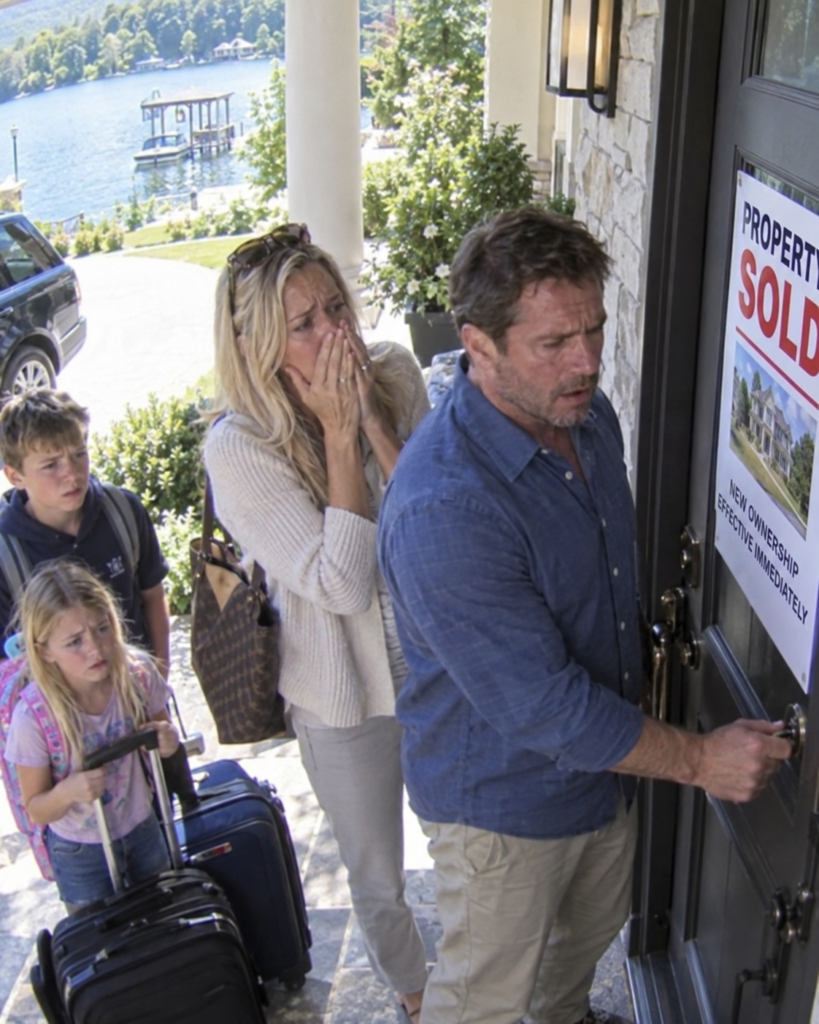
Patrick noticed it only then.
PRIVATE PROPERTY.
Underneath, in smaller letters:
Please do not disturb the residents.
Megan removed her sunglasses.
“Why is that there?”
Patrick looked toward the driveway.
The SUV was parked where he had always parked it, beneath the old maple tree.
Their luggage filled the back.
One of the children was asleep inside, his cheek pressed to the window.
Patrick pulled out his phone and called me.
I watched his name appear on the screen.
For several seconds, I simply stared at it.
I was sitting at the kitchen counter in the small apartment I had rented in town.
Through the window, I could see a sliver of the lake between two buildings.
It wasn’t the same view, but it was peaceful.
My boxes were still stacked against the wall, and I hadn’t yet decided where to put George’s fishing photographs.
The phone rang again.
I answered.
“Mom, the lock has been changed.”
His voice was tense, but not angry yet.
“I know.”
“What do you mean, you know?”
“I sold the house.”
There was silence.
Not the stunned silence I had imagined while signing the papers.
This was different.
It was the silence of a person waiting for someone to laugh and admit the whole thing was a mistake.
“You sold the lake house?”
“Yes.”
“To who?”
“The new owners moved in this morning.”
Megan’s voice rose in the background.
“Put me on speaker.”
Patrick didn’t.
“Mom, what are you talking about?
We’re here.”
“I understand.”
“You knew we were coming back today.”
“Yes.”
“You didn’t tell us?”
“You didn’t ask.”
His breath caught.
For a moment, I wondered whether he remembered the message he had sent me from the ship.
The excursion desk had declined my card, and he had asked me to fix it as if I had made some clerical error.
I had answered him plainly.
Use your own card.
He had not spoken to me since.
“What do you mean, the new owners moved in?” he asked.
“I mean the sale closed yesterday.”
“Yesterday?”
“Yes.”
“Mom, you can’t do that.”
“I already did.”
Megan finally came close enough for me to hear her.
“Patrick, give me the phone.”
He hesitated.
Then her voice came through, sharp and controlled.
“You had no right to sell that house without telling us.”
“I was the owner.”
“That doesn’t mean you could make a decision like this without considering the family.”
“I considered the family for years.”
“That house was supposed to stay with Patrick.”
“No.
It was supposed to remain mine until I decided otherwise.”
“You knew we were planning our future there.”
I looked at the boxes around me.
The words landed differently now that I was no longer standing in the lake house, surrounded by their expectations.
“You were planning a future in a home you didn’t own,” I said.
“We assumed you understood that.”
“I understood that you had started choosing paint colors for my kitchen.”
Megan went quiet.
Patrick said, “What are you talking about?”
“I found your remodeling folder.”
“That was private.”
“In my house?”
“It was just an estimate,” Megan said quickly.
“We were thinking ahead.”
“You were thinking ahead to a life that depended on me disappearing.”
“That’s not fair.”
“No,” I said softly.
“It isn’t.”
Behind them, one of the children began asking where they were going to sleep.
I heard Patrick’s daughter say that she wanted the blue room.
Her voice carried the ordinary impatience of a tired child who had no idea that the adults’ assumptions had collapsed.
I closed my eyes.
“I don’t want the children standing outside this conversation,” I said.
“Take them somewhere safe and comfortable.
Then call me tonight.”
“Mom—”
“I’m not discussing this while everyone is upset.”
“You can’t just sell our home and hang up.”
“It was never your home.”
I ended the call.
My hands were trembling.
Not because I regretted the sale.
Because saying those words out loud made the truth impossible to soften.
It had never been their home.
I spent the afternoon unpacking one box at a time.
George’s winter coats went into the hall closet.
My china, which had sat untouched in the lake house dining room for years, went onto the small shelves above the sink.
I put his fishing photographs beside the window, where the late-afternoon light touched the frames.
The apartment was modest.
There was no wide porch, no stone fireplace, and no lake stretching beyond the back lawn.
But every object in it belonged there because I had chosen it.
That evening, Patrick called again.
This time, he was alone.
“Are you somewhere private?”
I asked.
“Yes.”
“Are the children all right?”
“They’re with Megan’s parents.
We got a hotel.”
“I’m sorry you had to make unexpected arrangements.”
He gave a humorless laugh.
“You’re sorry?”
“I’m sorry the children were inconvenienced.
I’m not sorry for selling the house.”
He was quiet.
Then he said, “I don’t understand how you could do this.”
“I think you do.”
“I never thought you would actually sell it.”
“That was the problem.”
“You told me it was the family home.”
“You called it that.”
“You never corrected me.”
“Every time I tried to discuss the house, you told me we would figure it out later.”
“Because I assumed there would be a later.”
“There is a later.
It just doesn’t include the lake house.”
His breathing grew heavier.
“Did you plan this because of the cruise?”
“The cruise made me stop pretending.”
“You’re punishing us because Megan didn’t want you there.”
“No.
I’m responding to a pattern that existed long before the cruise.”
“Mom, she didn’t mean it the way you think.”
“I saw the caption.”
“She was trying to make her parents feel included.”
“And I was not family?”
“She made a stupid post.”
“She sent me a message saying the children shouldn’t be affected by my feelings.
She didn’t ask whether my feelings had been affected by being excluded.
She only objected when her expenses were no longer covered.”
He had no answer.
For the first time since the sale, I felt something other than anger.
I felt tired.
“Patrick,” I said, “I love you.
That has never been the question.”
“Then why does it feel like you’re cutting us off?”
“Because you confused love with access.”
He didn’t speak.
I continued before I lost my nerve.
“I helped you because your father and I wanted you to have a good start.
But help became a system.
You stopped asking whether I could afford something and started assuming I would pay it.
You stopped thanking me because the payments became invisible.”
“I did thank you.”
“Sometimes.
But gratitude isn’t just saying thank you after someone rescues you.
It’s making sure you don’t need rescuing every month.”
His voice softened.
“I didn’t know you felt this way.”
“I told you.”
“When?”
“In small ways.
I said I was worried about money.
I said I wanted to travel.
I said the house needed repairs.
You told me not to worry because it was all going to be yours someday.”
He was silent again.
That sentence had been spoken years earlier in the kitchen, while he was looking over a contractor’s estimate for the boathouse.
I had remembered it because of the confidence in his voice.
Not someday, perhaps.
Just eventually.
“When did you decide to sell?” he asked.
“Two weeks before the cruise.”
“So you were planning this while you were paying for everything?”
“I was still trying to believe we could repair things.”
“Why didn’t you tell me?”
“Because I knew you would ask me to wait.”
“Maybe I would have changed.”
“I wanted to see change before making another sacrifice.”
He exhaled slowly.
“Who bought it?”
“A couple named Claire and Daniel Hart.”
“Do they know what they bought?”
“They know they bought a house.”
“Do they know about us?”
“I told them you had grown up there.”
“That’s not what I mean.”
“I know.”
Another silence settled between us.
This one was less defensive.
More honest.
Finally, Patrick said, “Megan wants to talk to you.”
“I’ll speak with her tomorrow.”
“She thinks you owe us an explanation.”
“I have given you one.”
“She says you humiliated her.”
“I didn’t tell anyone about the payments.”
“You didn’t have to.
She knows people will ask why we’re not living there.”
“That isn’t my responsibility.”
“No,” he said quietly.
“I suppose it isn’t.”
I heard something in his voice then that I hadn’t expected.
Not anger.
Loss.
And despite everything, I understood it.
He had lived in that house as a child.
His father had taught him to swim from the dock.
His first dog was buried beneath the willow tree.
George’s workshop still smelled faintly of cedar and motor oil.
Selling the house had not only taken away a property.
It had closed a chapter Patrick believed belonged to him.
But grief did not turn an assumption into a right.
“I’m not trying to erase your memories,” I said.
“It feels like you erased our future.”
“I gave you the chance to build your own.”
“That’s easy for you to say.”
“No, it isn’t.
I know what it feels like to start over.”
After we ended the call, I sat in the quiet apartment until the sky turned dark.
The following morning, I drove to the lake house.
I had no practical reason to go.
The buyers had received the keys.
The realtor had already delivered the final paperwork.
All of my belongings were gone.
Still, I wanted to see the place once more.
Claire opened the door before I reached the porch.
She was in her early forties, with short brown hair and a paint-stained sweatshirt.
Behind her, Daniel was carrying a box of books toward the living room.
“Come in,” she said warmly.
“I’m glad you came.”
“I wasn’t sure if I should.”
“You’re always welcome to visit, as long as you call first.”
I smiled.
“That seems fair.”
She stepped aside.
The house looked both familiar and strange.
The furniture was gone, and the rooms echoed slightly.
Yet there were signs of new life everywhere.
A stack of dishes sat on the counter.
A vase of yellow flowers stood where I had kept a bowl of fruit.
“We found something while cleaning,” Claire said.
My stomach tightened.
“What?”
She exchanged a glance with Daniel.
“We weren’t sure whether to give it to you.
It looked personal.”
She walked toward the hallway and opened a small drawer beneath the built-in shelves.
From inside, she removed a narrow wooden box.
I recognized it immediately.
George had made it during the first winter we owned the house.
The lid was carved with a simple compass rose.
I had kept old receipts, spare keys, and small keepsakes in it.
“I thought I packed this,” I said.
“You may have missed it.
It was behind the drawer.”
She handed it to me.
The box felt heavier than it should have.
I opened the lid.
Inside were three things.
A brass key to the old boathouse.
A photograph of George and me standing beside the lake, both of us younger and sunburned.
And a sealed envelope.
My name was written across the front in George’s handwriting.
For Eleanor, when the house is no longer hers.
I couldn’t breathe.
I had seen George’s handwriting thousands of times.
On grocery lists.
Birthday cards.
Notes left beside the coffee maker.
But I had never seen this envelope.
Claire’s expression changed.
“Do you want us to leave you alone?”
I nodded.
They moved into the kitchen, giving me privacy without making a show of it.
I sat on the empty floor near the window.
For several moments, I only held the envelope.
George had been gone for six years.
Six years of sorting paperwork, closing accounts, answering sympathy cards, and learning how to sleep on one side of the bed.
Six years in which I had believed there were no more words waiting for me.
The envelope had no date.
My fingers shook as I opened it.
Inside was a single folded sheet of paper.
I read the first line.
My darling Ellie,
Then I stopped.
Outside, the lake moved quietly beneath the afternoon wind.
I looked toward the kitchen, where Claire and Daniel were speaking in low voices.
I looked at the empty living room, the bare walls, and the doorway that Patrick had once run through with muddy shoes.
Then I lowered my eyes to the letter.
The second line made my heart begin to race.
If Patrick is asking you to give him this house, there is something you need to know about the promise I made to him.
-END OF PART 2, –PRESS NEX PART IN BOTTOM OF PAGE TO READ NEXT PART
PART 3
I read the second line again.
If Patrick is asking you to give him this house, there is something you need to know about the promise I made to him.
The words blurred.
I pressed the heel of my hand against my eyes, then looked down at the page again.
The ink had faded slightly, but George’s handwriting remained unmistakable—slanted, careful, with the long tail he always gave the letter y.
I forced myself to continue.
He came to me three months before I got sick.
You were visiting your sister, and he stayed late after helping me repair the dock.
We sat in the workshop with the door open, listening to the water.
He asked me whether the house would be his one day.
I stopped reading.
In the kitchen, a cabinet closed softly.
Claire and Daniel were trying to make themselves invisible, though I knew they were probably wondering whether they had accidentally stepped into something far more private than an old forgotten letter.
I lowered my gaze.
I told him that you and I had built this place together, and that it would remain yours for as long as you wanted it.
He said he understood.
Then he asked me to promise that, when the time came, I would leave it to him.
My heart tightened.
I had spent years believing Patrick’s certainty had come from casual conversations—things said over dinner, assumptions made in passing.
I had never imagined he had asked George directly.
I made the promise.
The sentence sat alone on the page.
Below it, George had drawn a line through something and continued underneath.
I made it because I was afraid.
Not afraid of Patrick.
Afraid of what would happen to him if I didn’t reassure him.
He was struggling then.
His business had failed, he and Megan were fighting about money, and he believed losing the house would mean losing the only stable thing in his life.
I thought a promise would calm him.
I looked toward the empty living room.
The afternoon light stretched across the floorboards, pale and golden.
This was where George had once sat with a newspaper folded beside him, pretending not to listen while Patrick complained about his first mortgage.
I kept reading.
But a promise made to ease someone’s fear can become a burden placed on someone else.
I knew that the next morning.
I intended to tell you.
Then the doctor called about the tests, and everything in our lives became appointments, prescriptions, and things neither of us was ready to say aloud.
My throat burned.
George had been sick for only four months before he died.
I remembered every day of it.
The hospital corridors.
The plastic cup of ice chips.
His hand searching for mine in the dark.
I remembered Patrick visiting, sometimes.
I remembered him standing at the foot of the bed, asking questions about the house.
At the time, I had thought he was trying to distract his father.
Patrick asked me again two weeks before I went into the hospital.
He said he needed to know whether he could plan his future.
I told him the house was yours, and that no one could make plans for it without you.
He became angry.
He said I had promised.
I closed my eyes.
A memory came back to me.
Patrick standing beside George’s hospital bed, his face flushed, his voice low but sharp.
“You told me.”
George had looked exhausted.
“I told you what I hoped would happen.”
“That’s not what you said.”
I had been in the hallway then, carrying two coffees.
When I entered, both of them stopped talking.
I had assumed the silence was because they had been discussing George’s illness.
Perhaps it had been about the house.
I told him I was sorry.
I told him a promise could not take away your right to choose.
He said I was changing the rules because I was dying.
I wanted to explain everything to you, but I was ashamed.
I had given him hope I had no right to give.
A tear dropped onto the paper.
I wiped it away before it could spread the ink.
Ellie, if he ever uses my promise to make you feel guilty, remember this: I made it.
You did not.
And I release you from it.
For a long moment, I could not move.
The room seemed to tilt gently around me.
George had released me from a promise I had never known existed.
But the letter continued.
There is one more thing.
Before I became ill, I put money aside for Patrick.
It is not the house.
It is not enough to support his family forever.
It was meant to help him recover from the business failure and build something of his own.
I told him about the account, but I made one condition: he had to meet with a financial counselor and create a plan.
He refused.
He said he didn’t need advice, only time.
I read the paragraph twice.
Then a third time.
I had never heard of an account.
George had handled most of our investments.
After his death, the attorney had explained the paperwork, and I had spent months signing documents I barely understood.
There had been life insurance, retirement funds, and the sale of his workshop equipment.
But no account for Patrick.
The money remains in the family trust.
If Patrick has become dependent on you, I suspect he never took the steps required to receive it.
That is not your failure.
It is his unfinished choice.
At the bottom of the page, George had written one final sentence.
Do not give him the house to prove that you love him.
If he loves you, he will not ask you to.
I folded the letter carefully.
My hands were cold.
“Eleanor?”
Claire stood in the doorway.
She had removed her paint-stained sweatshirt and was holding two mugs.
“I’m sorry,” she said.
“I didn’t mean to interrupt.”
“You’re not.”
She set one mug on the floor beside me.
“Coffee?”
“Thank you.”
She sat a few feet away, leaving enough distance for privacy.
“You don’t have to tell me what it says.”
“I know.”
“But I might need to tell someone.”
She nodded.
I looked down at the wooden box in my lap.
“Did you see anything else in the drawer?”
“No.
Just the box.”
I ran my fingers along the carved compass rose.
“Would you mind if we looked?”
“Of course.”
Claire helped me lift the drawer out.
Daniel joined us, carrying a flashlight.
Behind the drawer was a shallow space in the wall, partly covered by old dust and a strip of loose molding.
I leaned closer.
“There,” I said.
A corner of blue paper showed beneath the molding.
Daniel carefully eased it free.
It was not paper.
It was a thin blue folder, folded nearly in half and tucked into the space as though someone had hidden it in a hurry.
My name was written on the front.
Not in George’s handwriting.
In Patrick’s.
My stomach turned.
Claire looked at me.
“Do you want to open it here?”
I should have said no.
I should have taken it home, called the attorney, and let a professional explain whatever was inside.
Instead, I opened the folder.
The first page was a copy of a trust agreement.
I recognized the name of the law firm.
It was the same firm George had used for our estate planning.
The document was dated six months before his death.
At the top, in bold type, were the words:
The George Henderson Family Support Trust
Beneath that was a list of beneficiaries.
Patrick Henderson.
Megan Henderson.
And, in a separate provision, the grandchildren.
The trust contained a significant amount of money—not enough to buy the lake house, but enough to pay off Patrick’s remaining debts, cover educational costs, and give him the opportunity to rebuild his business without depending on me.
I turned the page.
There were conditions.
Patrick could access the funds only after attending three financial planning sessions and signing an acknowledgment that the money was intended to support his family, not replace earned income.
The final page had two signatures.
George’s.
And Patrick’s.
The signature date was three weeks before George entered the hospital.
I stared at it.
“He signed this,” I whispered.
Claire leaned forward but did not touch the folder.
“Your son?”
“Yes.”
A second document was clipped behind the trust agreement.
It was a letter from the attorney.
Mr.
Henderson,
As discussed, the trust has been established according to your father’s instructions.
Your first meeting with our financial counselor is scheduled for Tuesday, October 14.
Please bring current statements for all personal and business accounts.
Your father has emphasized that the trust is intended to create long-term stability, not provide indefinite monthly support.
At the bottom, someone had written in blue ink:
Patrick called to cancel.
Says he’ll reschedule.
There was no record of another appointment.
My fingers began to tremble.
For six years, I had paid Patrick’s bills because I believed George had left me with no alternative.
I had thought my husband’s final wish was for me to protect our son from every consequence.
But George had already created a path for Patrick.
A path Patrick had chosen not to take.
The last item in the folder was a handwritten note.
This time, I knew the handwriting immediately.
Patrick’s.
Dad, I’m not signing anything that makes me look irresponsible.
If the house is mine, I don’t need the trust.
Mom will understand.
She always does.
The sentence seemed to drain the warmth from the room.
Claire quietly moved closer.
“Eleanor…”
I couldn’t answer.
I read the note again.
Not because I doubted the words.
Because I wanted them to mean something else.
Maybe Patrick had written it in anger.
Maybe he had later apologized.
Maybe George had somehow misunderstood.
But the date at the top was clear.
Six years ago.
Two months before George died.
I remembered that winter.
Patrick had begun asking for help with his car payment.
Then the children’s tuition.
Then the business credit line he claimed was temporary.
I had paid everything.
Not once had he mentioned the trust.
A sharp, bitter laugh escaped me.
“He knew,” I said.
Claire’s expression was gentle.
“Knew what?”
“That my husband had left him money.
He knew there was a way to become independent, and he chose not to tell me.”
Daniel leaned against the wall, his face troubled.
“Maybe he was embarrassed.”
“Maybe.”
“And signing something doesn’t mean he understood what he was doing.”
I looked at the note.
“He understood enough to say he preferred the house.”
No one spoke.
The lake outside the window had turned silver.
Somewhere down by the shore, a bird called once, then went quiet.
I gathered the papers into the folder.
“I need to take this to the attorney.”
“Do you want me to come with you?”
Claire asked.
The question startled me.
We had known each other less than a day, yet she was offering the kind of quiet companionship I had once expected from family.
“I may take you up on that,” I said.
She smiled faintly.
“You can call me.”
I stood, but my knees felt weak.
Before I left, I walked through the house one final time.
The living room belonged to Claire and Daniel now.
Their books were already filling the shelves.
The kitchen smelled like fresh paint and coffee.
In the hallway, a framed photograph of the lake had replaced the portrait of George and me.
I paused near the doorway.
“I’m glad you bought it,” I said.
Claire looked surprised.
“Why?”
“Because you see it as a home.
Not an inheritance.”
She absorbed that quietly.
Then she said, “We’re going to take care of it.”
I believed her.
When I reached my apartment, Patrick had called four times.
I didn’t answer immediately.
I placed the blue folder on the kitchen table, set George’s letter beside it, and made myself a cup of tea.
Then I called him back.
He answered on the first ring.
“Mom.”
His voice sounded strained.
“Where are you?”
“At the hotel.”
“Is Megan with you?”
“She’s taking the kids to the indoor pool.”
“Good.”
A pause followed.
“I found a letter from your father,” I said.
Patrick went silent.
“What letter?”
“One he wrote before he died.”
“I don’t know what you mean.”
“It mentions a promise.”
His breathing changed.
“Mom, whatever Dad told you—”
“Did he promise you the lake house?”
The silence that followed answered me.
When Patrick finally spoke, his voice was barely audible.
“He said it would be mine.”
“He wrote that he told you the house was mine to keep.”
“He was sick.”
“He said he regretted making the promise.”
Patrick exhaled shakily.
“I didn’t know he wrote anything.”
“He also left a trust.”
Another silence.
This one was longer.
“You knew about it,” I said.
“I knew Dad wanted to set something up.”
“You signed the agreement.”
“I didn’t take the money.”
“You never told me.”
“I was going to.”
“When?”
“I don’t know.”
“You let me pay your bills for six years.”
“I didn’t ask you to pay all of them.”
“No.
You only asked for the next one.”
His voice grew defensive.
“I was trying to keep things together.”
“So was I.”
“I thought the house was going to be mine.”
“It wasn’t.”
“Dad promised me.”
“And then he withdrew the promise.”
“He had no right to do that.”
“He had every right.
It was my house.”
Patrick said nothing.
I opened the folder and looked at his signature.
“Why did you hide this from me?”
“Because I was ashamed.”
The answer was so immediate that it unsettled me.
“Of what?”
“Of needing help.
Of not being able to make the business work.
Of Megan’s parents constantly asking what our plan was.
Of Dad looking at me like I was a child.”
“You were his son.”
“I was thirty-eight years old.”
“And you thought owning my house would make you feel successful?”
“I thought it would mean I hadn’t failed completely.”
His voice cracked on the last word.
For the first time, I heard the fear beneath the entitlement.
It did not excuse what he had done.
But it explained some of it.
“I’m sorry you felt that way,” I said.
“But you made me carry the cost of protecting your pride.”
“I know.”
“Do you?”
“Yes.”
Another pause.
Then Patrick asked, “Can the trust still be used?”
“I don’t know.”
“You’re going to take it from me now?”
“I am going to ask the attorney what the documents allow.”
“Mom—”
“I’m not trying to punish you.
But I will not hide this from you, pay for your life, or give you something that was never mine to promise.”
“I don’t want the trust if it means you think I’m a failure.”
“Patrick, accepting help responsibly is not failure.
Refusing every path to independence while expecting someone else to fund you is.”
He inhaled slowly.
“What happens now?”
“I don’t know.”
It was the first honest answer I could give him.
Neither of us spoke for a while.
Then, quietly, he said, “I’m sorry.”
The words were small.
They did not erase the cruise, the messages, the declined cards, or the years of being treated as a resource instead of a mother.
But they were the first apology he had offered without adding an explanation afterward.
I closed my eyes.
“I hear you.”
“Can I come see you?”
“Not tonight.”
“I understand.”
“Tomorrow, after I speak with the attorney.”
“Will you tell me what he says?”
“Yes.”
When the call ended, I remained at the table.
George’s letter lay beside the trust agreement.
Two documents written by two men who had loved me in different ways—one trying to protect me from a promise, the other trying to protect himself from the consequences of breaking it.
I reached for the final page of the folder.
There was one line I had missed.
At the very bottom, beneath the attorney’s signature, someone had added a handwritten notation.
Trust amended by George Henderson on November 3.
See sealed addendum.
I turned the page over.
A narrow white envelope was attached to the back of the folder.
It was sealed.
And across the front, in George’s handwriting, were six words:
Only open this after selling the house.
-END OF PART 3–PRESS NEX PART IN BOTTOM OF PAGE TO READ NEXT PART
PART 4 (THE END)
I stared at the sealed envelope until the words began to blur.
Only open this after selling the house.
For years, I had imagined that there could be no more surprises left in a life shared with George.
We had divided furniture, bank accounts, photographs, and memories.
I had learned which silence belonged to grief and which belonged to peace.
But he had left one more decision in my hands.
I did not open the envelope that night.
Instead, I placed it beside the lamp and called the attorney’s office first thing the next morning.
The receptionist recognized my name.
Within an hour, I was sitting across from Mr.
Lawson, the same attorney who had helped George prepare his will.
He had aged since the last time I saw him.
His hair was almost entirely white now, and he wore the same narrow glasses perched low on his nose.
When I placed the blue folder on his desk, he looked at it for several seconds.
“I wondered whether you would find this,” he said.
“You knew about it?”
“I knew there was an addendum.
I did not know where George had stored it.”
“You knew Patrick had signed the trust agreement.”
“Yes.”
“And you knew he never completed the requirements.”
Mr.
Lawson folded his hands.
“George told me Patrick canceled the first counseling appointment.
I sent two follow-up letters.
Your son did not respond.”
“Why didn’t you tell me?”
“Because the trust was confidential, and because George specifically instructed me not to discuss it with you unless Patrick activated it or you asked about it.”
I looked down at the envelope.
“And the addendum?”
“That was also confidential.”
“Until I sold the house.”
“Yes.”
“Why?”
Mr.
Lawson’s expression softened.
“George anticipated that the property might become a source of conflict.
He wanted you to have the complete information before making any decision about Patrick’s future.”
I let out a quiet breath.
“He knew.”
“He knew his son well.”
There was no judgment in the statement.
That made it harder to hear.
“May I open it now?”
Mr.
Lawson nodded.
I broke the seal.
Inside was a single page, along with a smaller document bearing the firm’s stamp.
The letter began in George’s familiar hand.
Ellie,
If you are reading this, then you have made a decision about the lake house without allowing guilt to make it for you.
I hope that means you are still listening to your own heart.
I pressed my fingers to my lips.
The enclosed amendment changes the trust in one important way.
Patrick cannot access the funds simply by completing three counseling sessions.
He must first acknowledge, in writing, that the house was never promised to him and that the money is not an inheritance replacing your ownership.
I read that sentence twice.
George had understood exactly what had happened.
I am not asking you to make him apologize.
An apology demanded is only another performance.
I am asking that he accept responsibility before receiving help.
If he cannot do that, the trust will remain intact for the grandchildren’s education and for your care.
The smaller document was the amendment itself.
It stated that the trust funds would be divided into two portions.
One would remain available to Patrick and Megan only after the required counseling, a written financial plan, and a signed acknowledgment of the ownership issue.
The other would be protected for the grandchildren’s education and medical needs.
If Patrick declined the conditions, the funds would not disappear.
They would remain reserved for the children and for me.
I lowered the page.
“He protected the grandchildren.”
“And you,” Mr.
Lawson said.
“From what?”
“From being pressured into becoming the sole source of support.”
I looked at the signature at the bottom.
George had signed the amendment four days before he entered the hospital for the final time.
“He knew he was running out of time.”
“I believe he did.”
I read the letter again.
At the bottom, he had added one final paragraph.
Do not mistake compassion for surrender, Ellie.
You can love your son and still require him to stand on his own feet.
If he stumbles, offer him a hand.
Do not carry him forever.
I closed my eyes.
For six years, I had believed carrying Patrick was what love required.
Perhaps George had known that I would confuse the two.
“What happens if Patrick refuses?”
I asked.
“Then the trust remains protected.
He cannot access the funds personally, but the children’s expenses can still be paid directly from their portion.”
“And if he agrees?”
“He receives the funds gradually, after the counseling sessions and according to the approved plan.
Not as a lump sum.”
I nodded.
“That is probably wise.”
“Your son will need to decide.”
“Will you speak to him?”
“Of course.”
I gathered the documents, but before I stood, I asked, “Did George ever say why he believed Patrick might choose the house over the trust?”
Mr.
Lawson gave a faint, sad smile.
“Your husband said Patrick wanted proof that he was trusted.”
“By owning the house?”
“By being given something no one could take away.”
I looked out the window.
Cars moved along the street below, each one carrying people toward ordinary appointments and ordinary problems.
“Patrick thought ownership would prove he had not failed.”
“Perhaps.”
“And George thought responsibility might teach him that.”
“Yes.”
I left the office with the envelope tucked inside my purse.
Patrick was waiting in the lobby of my apartment building when I returned.
He stood beside the mailboxes with both hands in his coat pockets.
He looked tired.
Not dramatically changed, not suddenly transformed.
Just tired in the way a person looks when the story they have told themselves no longer holds together.
“I didn’t know whether you would let me come up,” he said.
“I wasn’t sure either.”
He nodded.
We rode the elevator in silence.
Inside my apartment, I put the kettle on.
Patrick sat at the small table, glancing around at the shelves and the photographs I had arranged.
His eyes rested on a picture of George teaching him to fish.
“I remember that day,” he said.
“You caught nothing.”
“I caught a branch.”
“You insisted it was a very large fish.”
He smiled briefly.
Then the smile disappeared.
“I’m sorry about the house.”
The kettle began to whistle.
I turned it off.
“I know.”
“I mean it.”
“I believe you.”
He looked down at his hands.
“I was angry because I thought Dad gave me his word.
Then I was angry because you sold it without telling me.
But mostly…” He paused.
“Mostly, I was embarrassed.”
“I know.”
“I kept thinking that if I had the house, everyone would see that I had built something.
That I had something permanent.”
“You had a family.”
“That didn’t feel like enough.”
The honesty in his voice hurt more than defensiveness would have.
“Patrick, your worth was never measured by the lake house.”
“I know that now.”
“Do you?”
“I’m trying to.”
I brought two cups of tea to the table.
He wrapped both hands around his.
“Did you meet with the attorney?”
“Yes.”
“And the trust?”
“It still exists.”
His shoulders lowered slightly, though he did not look relieved.
“There are conditions.”
“I expected that.”
“You need to attend financial counseling.
Create a realistic plan.
And sign an acknowledgment that the house was never yours and that Dad’s promise did not give you a claim to it.”
He stared at the tea.
“That sounds like a confession.”
“It is an acknowledgment.”
“Everyone will know I failed.”
“Patrick, the people who love you already know you struggled.
The difference is that they have been waiting for you to stop pretending you didn’t.”
He flinched, but he did not argue.
“What happens if I don’t sign?”
“The funds remain protected.
The children’s portion can be used for their education and medical needs.
Your portion stays inaccessible.”
“And you?”
“I have my own money.”
He looked up sharply.
“Are you sure?”
“Yes.
The sale gave me enough to live comfortably, and I have retirement savings.
I’m not asking you to support me.”
“I didn’t think you were.”
“You thought the house would.”
He lowered his eyes again.
“Yes.”
The admission settled between us.
Not like a wound.
Like a stone finally placed where it belonged.
“I want to sign,” he said.
I studied his face.
“Because you need the money?”
“Because I need to stop hiding.”
That answer mattered.
Not enough to erase six years, but enough to begin something different.
“I’ll arrange a meeting with Mr.
Lawson.”
He nodded.
Then he said, “Megan is angry.”
“I expected that.”
“She says you’ve changed.”
“I have.”
“She says the children are losing their home.”
“They’re losing a house they never owned.
They still have parents, grandparents, school, friends, and a place to sleep.”
“We’re staying with her parents for another week.”
“That may be good for everyone.
It gives you time to make a plan instead of rushing back into the same one.”
He looked toward the window.
“Are you going to sell everything?”
“No.”
“What do you mean?”
“I’m going to live.”
That made him smile faintly.
“I suppose that’s fair.”
“I’m thinking of taking a trip.”
“Where?”
“Somewhere George and I always talked about going.”
“Europe?”
“Maybe.
Or the Pacific Northwest.
I haven’t decided.”
“You should go.”
“I intend to.”
A few days later, Patrick attended the first counseling session.
He arrived at the attorney’s office early and brought every financial statement the counselor had requested.
The process was not easy.
He had to look directly at debts he had avoided, subscriptions he no longer remembered authorizing, and the pattern of relying on short-term solutions whenever a larger problem frightened him.
Megan joined the second session.
She was defensive at first.
She said the family had been under pressure.
She said the lake house had always been discussed as part of their future.
She said I had made a sudden decision that affected everyone.
The counselor listened without interrupting.
Then she asked Megan a simple question.
“What part of your future depended on something you did not own?”
Megan had no answer.
By the third session, she had one.
“Too much,” she said.
It was not an apology, but it was the beginning of accountability.
The children adjusted more easily than the adults.
They stayed with Megan’s parents while Patrick and Megan searched for a rental house near the school.
Their routines remained intact.
They still went to soccer practice, still argued over whose turn it was to choose the movie, still asked whether Grandma would visit on Sundays.
I did visit.
Not every Sunday.
That was another boundary I had to learn.
Love did not require me to be available every hour.
It required me to be sincere when I was there.
Three months after the sale, Patrick signed the acknowledgment.
Mr.
Lawson sent me a copy.
The document stated plainly that the lake house had belonged to me, that no promise made by George could transfer ownership, and that Patrick accepted responsibility for his financial choices.
At the bottom, Patrick had added a handwritten sentence.
I thought being given the house would prove I was worthy of it.
I understand now that becoming responsible for my own life is the proof I was looking for.
I kept that copy in the drawer beside George’s letter.
Patrick’s business did not suddenly flourish.
There was no miraculous turnaround.
He sold the luxury SUV, reduced expenses, and took a part-time consulting contract while rebuilding his work.
Megan returned to full-time employment after the children settled into school.
Their lives became less polished.
They also became more honest.
The trust paid for the grandchildren’s educational expenses directly, while Patrick and Megan managed the rest of their household according to the plan they had created.
Some months were still difficult.
But when Patrick needed help, he called early and asked clearly.
Sometimes I said yes.
Sometimes I said no.
Both answers became possible without destroying our relationship.
A year after the sale, Claire and Daniel invited me to the lake house for dinner.
They had restored the old dock and planted a row of lavender along the path.
The kitchen had been remodeled, but they had kept the original windows overlooking the water.
When I arrived, Claire handed me a glass of lemonade.
“We saved one thing for you,” she said.
She led me to the living room.
Above the fireplace hung a framed photograph of George and me standing beside the lake.
I stared at it.
“You don’t have to display that,” I said.
“We wanted to,” Daniel replied.
“This house had a history before us.
We didn’t want to erase it.”
My eyes filled.
“Thank you.”
We ate outside as evening settled over the water.
Claire told me about the garden.
Daniel described his plans for a small workshop.
They spoke about the house as something they were building, not something they were waiting to inherit.
When I left, Claire hugged me.
“You can come anytime,” she said.
“I’ll call first.”
“Please do.”
I drove home beneath a sky streaked with pink and gold.
My apartment no longer felt temporary.
I had painted the bedroom a soft green, placed George’s fishing photographs along the hallway, and filled the balcony with herbs.
The space was smaller than the lake house, but it held only what I had chosen to carry forward.
That winter, I booked a trip to Scotland.
George had wanted to see the coast there.
I went alone, though I carried his photograph in my suitcase.
I stood beside cliffs beneath a wide gray sky and thought about all the promises people make because they are afraid.
Some promises are kept.
Some are released.
And some must be replaced with something better: truth, responsibility, and the freedom to choose a life that belongs to you.
On the first night of the new year, Patrick called.
“Happy New Year, Mom.”
“Happy New Year.”
“We’re having dinner at home.
The kids wanted to call you.”
I heard their voices in the background, bright and overlapping.
After they spoke to me, Patrick came back on the line.
“I wanted to tell you something.”
“All right.”
“I don’t think of the lake house as ours anymore.”
I smiled despite myself.
“What do you think of it as?”
“A place where we were lucky to grow up.”
“That sounds right.”
“And I think I finally understand why you sold it.”
I waited.
“Because you wanted your life to belong to you while you were still living it.”
My throat tightened.
“Yes.”
“I’m glad you did.”
Those were the words I had once thought I would never hear.
Not because I needed permission.
Because I needed to know he had found his way past the loss and into understanding.
“Thank you,” I said.
After we hung up, I opened the drawer and took out George’s letter.
The final line remained as clear as the day I first read it.
Do not give him the house to prove that you love him.
If he loves you, he will not ask you to.
Patrick had asked.
Then, slowly, painfully, he had learned to stop.
And I had learned that keeping something for myself did not make me selfish.
Sometimes, it was the most honest way to teach the people I loved that they were capable of standing on their own.
The lake house was no longer mine.
It was not Patrick’s, either.
It belonged to people who had chosen it, worked for it, and understood that a home was built by care—not entitlement.
And my life, at last, belonged entirely to me.
– END OF PART 4 - LET SAY YES AND LIKE, SHARE THIS POST IN FACEBOOK SO THAT WE HAVE THE MOTIVATION TO SHARE MORE STORIES