I looked through the gate.
Mark had not left. He stood with his hands gripping the iron bars, watching us with an expression that shifted between anger, confusion, and calculation.
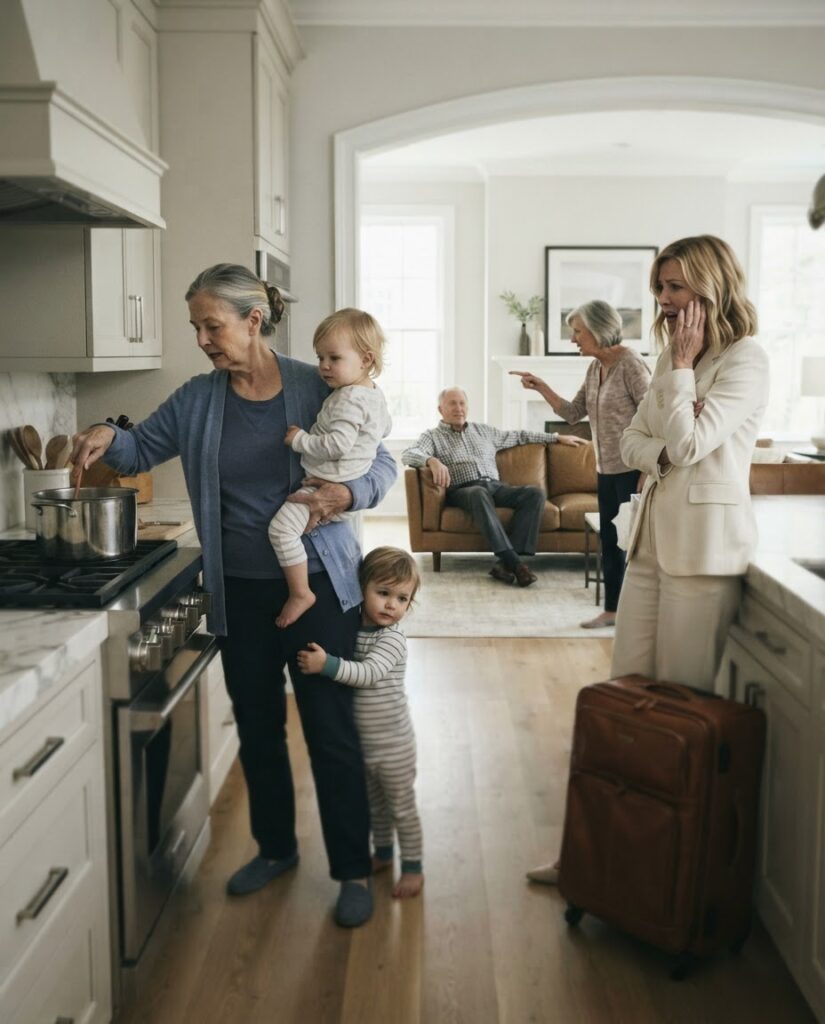
His mother had appeared behind him in the street. Eleanor wore a cream cardigan over her house clothes, one foot shoved into a slipper and the other bare. She called my name, but the distance and the closing gates softened her voice into something almost harmless.
Almost.
I turned away.
The front door opened before we reached it. Mrs. Alvarez, the caretaker, stood beneath the porch light. She was in her late sixties, with silver hair pinned neatly at the back of her head and the calm, observant eyes of someone who noticed everything.
“Mrs. Bennett,” she said.
“Not tonight, Teresa.”
Her gaze moved to my mother’s bruised face, then to the children.
She opened the door wider.
“Come inside.”
The house smelled faintly of lemon polish and lavender. It had always seemed too large when I visited alone, its rooms quiet and carefully preserved. That evening, the silence felt like shelter.
Mrs. Alvarez locked the door behind us.
“Should I call someone?” she asked.
I looked at Rose.
My mother lowered her eyes.
“I don’t want police,” she said quickly.
“Mom.”
“No police, Claire.”
Her voice carried a fear I had never heard before.
Not stubbornness.
Fear.
I set Noah down in the entrance hall, though he kept one hand wrapped around my fingers. Lily refused to leave my arms.
Mrs. Alvarez crouched in front of them.
“I have warm milk,” she said. “And I believe there are cinnamon biscuits in the pantry.”
Noah looked up cautiously.
“Round ones?”
“The roundest.”
He glanced at me for permission.
I nodded.
Mrs. Alvarez took both children toward the kitchen, moving slowly enough that Noah could follow without feeling hurried. Lily watched them go, then pointed after her brother.
“Biscuit.”
Even in that moment, I almost laughed.
“Go with Noah, sweetheart.”
She let Mrs. Alvarez take her, but only after I promised I would remain where she could see me.
When the children were settled at the kitchen island, I led Rose into the small sitting room at the back of the house. It was less formal than the main drawing room, with deep chairs, warm lamps, and French doors facing the garden.
Rose sat on the edge of the sofa.
I knelt in front of her.
“Show me your arm.”
“It looks worse than it is.”
“Show me.”
She hesitated, then slowly rolled back her sleeve.
The bruises were darker under the lamplight. One circled her wrist in an uneven band. Another spread across the soft skin below her elbow.
They did not look like marks from a fall.
I had spent years negotiating contracts, reading people across conference tables, and noticing the moment someone withheld the most important part of the truth. Yet looking at my own mother, I felt suddenly helpless.
“Did Mark grab you?”
“No.”
“Did Eleanor?”
Rose looked toward the open doorway, where the children’s quiet voices drifted from the kitchen.
“Keep your voice down.”
My stomach tightened.
“Then tell me.”
She folded her hands in her lap.
“I should have called you.”
“Yes.”
“I thought I could manage.”
“You could barely stand.”
“I have managed pain for years.”
“This isn’t only about your arthritis.”
She said nothing.
Outside, someone pressed the gate intercom.
Once.
Then again.
A moment later, the house phone rang.
Mrs. Alvarez appeared in the doorway. “Your husband is asking to come inside.”
“He’s not coming in.”
“He says he only wants to speak with you.”
“He can call.”
Rose’s shoulders tensed.
I noticed.
“Mom, are you afraid of Mark?”
Her answer came too quickly.
“No.”
The phone stopped ringing.
Then my mobile began to vibrate.
MARK.
I declined the call.
It rang again.
Then a message appeared.
Please don’t do this in front of the children.
I stared at the words until anger rose through me, sharp and clean.
He had watched my mother struggle over a stove while caring for our twins. He had laughed about his laundry. Now he wanted to talk about what should or should not happen in front of the children.
Another message arrived.
Mom is upset. You embarrassed her.
I turned the phone facedown.
Rose reached for my hand.
“Claire, shutting off the house—”
“It’s my house.”
“I know.”
“And I didn’t shut it off permanently. The emergency systems are still working. The refrigerator and heat will stay on. They just won’t have television, unnecessary lighting, or access to the accounts I pay for.”
“That isn’t what I mean.”
“What do you mean?”
She looked at me with tired sadness.
“Don’t become cruel because they were careless.”
The words stung because they sounded like her.
Even now, bruised and exhausted, she was asking me not to lose myself.
“I’m not trying to be cruel.”
“I know.”
“I’m trying to understand how my husband became someone who could sit in the next room while you—”
My voice broke.
I looked away.
Rose touched my cheek.
For as long as I could remember, her hands had carried the scent of soil, soap, and hand cream. They had buttoned my school uniforms, mended torn dresses, harvested vegetables before sunrise, and counted coins at the kitchen table after my father died.
Now those hands were swollen and marked.
“I didn’t tell you because you worked so hard to build your life,” she said. “I didn’t want to be the reason it fell apart.”
“You are not the reason.”
“Families can survive selfishness, Claire. Sometimes they cannot survive suspicion.”
I turned back to her.
“What am I supposed to be suspicious of?”
She inhaled slowly.
Before she could answer, Lily cried out from the kitchen.
We both rose.
The sound was not fear, only frustration. Noah had taken the larger biscuit.
By the time we reached them, Mrs. Alvarez had solved the dispute by breaking another biscuit into two equal pieces and placing both halves on a plate.
“Emergency resolved,” she said.
Lily reached for Rose.
My mother lifted her automatically, then winced.
I took Lily from her.
“No more carrying them tonight.”
Rose started to protest.
“No.”
The firmness in my voice surprised both of us.
Mrs. Alvarez studied me for a moment.
“There are clean rooms upstairs,” she said. “I will prepare the one beside the nursery.”
“Thank you.”
“And perhaps a doctor.”
Rose shook her head.
I ignored her. “Is Dr. Patel still nearby?”
“He moved his evening clinic to Oak Avenue, but I have his number.”
“Call him.”
“Claire—”
“I am not negotiating this.”
Rose looked as if she wanted to argue. Then the fight left her face.
“All right.”
That surrender frightened me more than resistance would have.
Dr. Patel arrived forty minutes later.
He was a quiet man in his fifties who had treated my mother several times when she visited me. He examined her wrist, arm, cheek, and shoulders while I waited outside with the twins.
Mark continued calling.
After the sixth attempt, I silenced the phone.
Noah sat beside me on the upstairs landing, rolling a wooden toy car back and forth over the carpet.
“Daddy angry?” he asked.
I looked down at him.
Children rarely understood words as well as adults believed, but they understood tone, silence, and the shape of fear in a room.
“Daddy is upset,” I said carefully.
“Grandma Ellie loud.”
“Yes.”
“She made Grandma Rose cry.”
The toy car stopped.
I crouched beside him.
“When?”
He pointed vaguely toward the stairs, as though the answer belonged somewhere behind us.
“Kitchen.”
“What happened?”
“Grandma Ellie said bad dinner. Daddy said Grandma Rose was lying.”
“Lying about what?”
Noah pushed the car again.
“Paper.”
My breath caught.
“What paper?”
He shrugged.
At two years old, he had only fragments. Pictures without sequence. Sounds without context.
“Did Daddy have the paper?”
“Blue paper.”
“Where is it?”
He lifted the car and pressed it against his chest.
“Daddy took it.”
The door to the guest room opened.
Dr. Patel stepped into the hallway and closed it behind him.
“How is she?” I asked.
“She is exhausted, dehydrated, and her arthritis is badly inflamed. I don’t see evidence of a fracture, but I would like imaging done on the wrist tomorrow.”
“And the bruises?”
His expression became guarded.
“They are consistent with firm gripping.”
The words settled heavily between us.
“Could they have happened from a fall?”
“It would be unusual for a fall to leave that pattern.”
I glanced at the closed door.
“She says no one hurt her.”
“She may not be ready to explain.”
“Did she tell you anything?”
“Nothing specific.”
He lowered his voice.
“I asked whether she felt safe. She said she did now.”
Now.
The single word felt like a door opening onto a dark room.
Dr. Patel gave me instructions for medication, hydration, and rest. Before leaving, he asked me to call if Rose became dizzy, confused, or unusually weak.
When I returned to the guest room, she was sitting against the pillows in a borrowed nightgown. Her hair, usually pinned neatly, hung in loose gray strands around her face.
For the first time in years, she looked old.
Not elderly.
Worn down.
I sat beside her.
“Noah mentioned a blue paper.”
Rose closed her eyes.
I waited.
“Mom.”
“It was nothing.”
“He said Mark accused you of lying.”
“He misunderstood.”
“He is two, not deaf.”
Her eyes opened.
There it was again.
Fear.
“Please let tonight be quiet,” she said. “The children need you calm.”
“And tomorrow?”
“Tomorrow, I will explain what I can.”
“What you can?”
She looked toward the window.
The garden beyond the glass had disappeared into darkness. Only our reflections remained: mother and daughter, sitting close while something unspoken stood between us.
“I need to be certain first.”
“Certain of what?”
Rose did not answer.
A car door slammed outside.
Then another.
Mrs. Alvarez called from downstairs.
“Mrs. Bennett?”
I went to the landing.
She stood below holding the house phone.
“There is a woman at the gate. She says her name is Anna Reed.”
I did not recognize it.
“What does she want?”
“She says she needs to speak with your mother.”
Behind me, Rose made a soft sound.
I turned.
All the color had drained from her face.
“You know her.”
Rose gripped the edge of the blanket.
“Don’t let her in.”
“Who is she?”
“Claire, please.”
The gate intercom buzzed again.
Mrs. Alvarez waited at the foot of the stairs.
I walked back into the room and lowered my voice.
“If this woman has something to do with your bruises, I need to know.”
“She didn’t hurt me.”
“Then who is she?”
Rose swallowed.
“She worked for Mark.”
“Doing what?”
“I don’t know.”
That was not true.
I could see it in the way her eyes moved away from mine.
I picked up my phone and opened the security application. The camera at the front gate showed a woman standing beneath the streetlamp.
She appeared to be in her early thirties, wearing a dark coat and carrying a large envelope against her chest. Her hair was damp from the evening mist. She kept glancing over her shoulder toward the house across the road.
Toward Mark.
As I watched, his front door opened.
Anna stepped closer to the intercom.
“I’m sorry to come here,” she said through the speaker. “Mrs. Hale told me Claire would be home.”
Mrs. Hale.
My mother’s maiden name.
“Why do you need to speak to her?” I asked.
The woman looked directly at the camera.
“Because I think her son-in-law knows I found the original.”
Rose appeared beside me, one hand braced against the wall.
“Send her away.”
“What original?” I asked.
Anna’s expression tightened.
“The deed transfer.”
Silence filled the hallway.
I looked at my mother.
“What deed?”
Rose began to shake her head.
Across the street, Mark walked toward the gate.
Not running.
Not shouting.
Walking with the deliberate calm of someone trying not to reveal panic.
Anna saw him.
She pressed the envelope through the narrow delivery slot built into the stone column beside the gate. It fell into the secure parcel box inside the property.
Then she turned and hurried toward a gray car parked down the block.
Mark called after her.
“Anna!”
She did not stop.
He reached the gate and pressed the intercom.
“Claire, do not open that envelope.”
His voice was no longer angry.
It was afraid.
I looked at Rose.
“What is inside it?”
She sank into the nearest chair.
“I don’t know.”
“That woman said you told her I was home.”
“I spoke to her once.”
“When?”
“Last week.”
I stared at her.
“You were staying in my house with my husband and his mother, caring for my children while you could barely walk, and you were secretly speaking to a woman who worked for Mark?”
“I was trying to protect you.”
“From what?”
The twins had followed us into the hallway. Noah stood holding Lily’s hand.
I stopped.
Whatever the truth was, they did not need to hear it while half asleep.
I asked Mrs. Alvarez to take them upstairs to the nursery.
Lily protested until I promised I would come read to them soon. Noah watched Rose as he walked away, his face solemn and uncertain.
When they were gone, I turned back to my mother.
“No more half-truths.”
Rose pressed her palms together.
“You remember the farm.”
Of course I remembered.
It had been in my mother’s family for generations. Twenty-eight acres of dark soil, apple trees, and weathered fences outside a small town four hours north.
After my father died, the farm became both our survival and our burden.
Rose worked it until her arthritis made the labor impossible. When I received an offer to attend university, she sold the land. She told me she had received enough to pay my tuition and clear the remaining debts.
I had believed her.
“You sold it to pay for school,” I said.
“That is what I told you.”
A cold unease moved through me.
“What actually happened?”
“I transferred it.”
“To whom?”
“Your father’s cousin. He promised to pay in installments.”
“Why would you do that?”
“Because he said the land should stay in the family. At the time, I thought that mattered.”
She gave a small, bitter smile.
“He made the first payment. Then he claimed there were problems with the boundary records. After that, he disappeared.”
“How did you pay my tuition?”
“I borrowed against the house. I sold equipment. I took work at the cannery during the winter.”
I felt as though the floor had shifted beneath me.
“You told me the farm covered everything.”
“You were nineteen. You had already offered to give up your place.”
“You should have told me.”
“You would not have gone.”
She was right.
That did not make the secret hurt less.
“What does this have to do with Mark?”
“Your father’s cousin died two years ago. His estate went into review. A solicitor contacted me because the original transfer had never been properly registered.”
“So the farm still belongs to you?”
“Possibly.”
“Possibly?”
“There are two versions of the transfer.”
I stared at her.
“One shows the land going to him. The other shows me selling it years later to a holding company.”
“What company?”
Rose’s eyes filled with tears.
“I didn’t know until last month.”
I already knew the answer before she spoke.
“One connected to Mark.”
The room became very still.
I could hear the hum of the heating system, the faint clink of dishes in the kitchen, and Mark’s voice outside the gate, calling my name.
“How?”
“I don’t know.”
“You must know something.”
“Only pieces.”
She wiped her cheek carefully, avoiding the bruise.
“A letter arrived at my house six weeks ago. It asked me to confirm a signature on a property record. The signature looked like mine, but I had never seen the document.”
“Why didn’t you call me?”
“Because Mark called first.”
My hands went cold.
“What did he say?”
“He said it was a clerical matter involving an old investment. He asked me not to worry you while you were preparing for New York.”
“And you believed him?”
“I wanted to.”
The honesty of that answer hurt more than an excuse.
“He has been my son-in-law for seven years,” she continued. “He is the father of my grandchildren. I did not want to assume the worst.”
“What happened after he called?”
“I contacted the number on the letter. Anna answered. She worked in records for a legal services company Mark had hired.”
“The same company managing the transfer?”
“Yes.”
Rose looked down at her hands.
“She told me the file had been flagged because the dates did not match. Then she stopped returning my calls.”
“And last week?”
“She called again. She said she had been dismissed. She believed documents had been altered.”
“By Mark?”
“She did not say.”
“But Mark knew you were looking into it.”
“Yes.”
The bruise on Rose’s wrist seemed darker than before.
“Tell me exactly how you got hurt.”
She looked toward the gate.
“Mark came into the kitchen yesterday morning. He asked whether I had spoken to Anna. I told him no.”
“You lied.”
“I panicked.”
“What did he do?”
“He took my phone.”
“Did he grab you?”
“He reached for it. I tried to hold on.”
My chest tightened.
“He grabbed your wrist.”
“He was trying to take the phone.”
“That does not make it acceptable.”
“No.”
“And your cheek?”
Rose touched the bruise.
“I lost my balance.”
“Because he pushed you?”
“No. He pulled the phone, and I stumbled against the cabinet.”
I closed my eyes.
Mark had not struck her.
Some part of me registered the distinction.
Another part understood that the difference did not absolve him.
He had frightened an ill woman. He had taken her phone. He had concealed information. Then he had left her to care for two toddlers and prepare dinner while bruises spread across her skin.
“Why did you stay?”
“The children.”
“They were not your responsibility.”
“They were alone with Eleanor most of the day.”
The way she said it made me look up.
“What does that mean?”
“Eleanor is not cruel to them.”
“That is not what I asked.”
Rose hesitated.
“She forgets things.”
I thought of Eleanor stretched across the sofa, issuing orders with complete confidence.
“What things?”
“The kettle. The front door. Whether she has given Lily her medicine.”
“Lily is not on medicine.”
“She had a fever two days ago.”
My pulse quickened.
“No one told me.”
“It passed.”
“That isn’t the point.”
“I know.”
I paced to the window.
Across the street, the house was mostly dark. Mark remained outside the gate, now speaking on his phone. Eleanor stood on the front steps, hugging her cardigan around herself.
My marriage had not collapsed in a single evening.
That was the most painful part.
It had been weakening quietly, perhaps for years, while I explained away every crack.
Mark had left his finance job after Noah and Lily were born, telling me he wanted to build a consultancy from home. I had admired him for choosing flexibility.
The consultancy never seemed to acquire clients.
He began handling more of our household documents because I traveled often. I thought it was partnership.
He spent freely, but never beyond what I could cover. I thought it was carelessness.
He resented questions about money. I thought it was pride.
Perhaps none of those things alone proved anything.
Together, they formed a shape I could no longer ignore.
“I need the envelope,” I said.
Rose rose unsteadily.
“Claire, we should speak to a solicitor before opening it.”
“It was delivered to my property.”
“That does not mean—”
“Mark is outside telling me not to open it.”
I went downstairs.
The parcel box could only be accessed from inside the gate. Mrs. Alvarez accompanied me through the side corridor and unlocked the panel.
The envelope lay inside.
It was thick, cream-colored, and sealed with clear tape. My name had been written on the front in blue ink.
CLAIRE BENNETT—PERSONAL.
Beneath my name, in smaller letters, Anna had written:
Your mother was right to be concerned.
Back inside, I placed the envelope on the dining room table.
Rose stood opposite me.
The chandelier above us cast a circle of warm light over the polished wood. For years, the room had been unused except for occasional business dinners. Now it felt like a place where a verdict might be delivered.
My phone rang again.
This time I answered.
“What?” I said.
Mark’s breath came sharply through the speaker.
“Do not open anything Anna gave you.”
“Why?”
“She stole confidential documents.”
“Documents involving my mother’s land?”
Silence.
That silence answered more than words.
“Mark.”
“It isn’t what you think.”
“I don’t know what to think. You have not told me anything.”
“Because there is nothing to tell.”
“Then why are you standing outside a house you did not know I owned, begging me not to read a file you claim means nothing?”
His voice dropped.
“Claire, let me come in.”
“No.”
“We should discuss this face-to-face.”
“You had plenty of time to discuss it while my mother was in your kitchen.”
“I did not hurt Rose.”
“You grabbed her hard enough to bruise her.”
“She took something that belonged to me.”
“A phone?”
“A document.”
I looked at Rose.
She stared back, confused.
“What document?”
Mark exhaled.
“Ask her.”
My mother’s face changed.
Not guilt.
Recognition.
She reached beneath the collar of her nightgown and touched the thin silver chain she always wore.
At the end of it was a small brass key.
I had seen it thousands of times.
I had never asked what it opened.
“Mom?”
Rose closed her fingers around the key.
“I thought he didn’t know.”
“Know what?”
Mark’s voice came through the phone.
“Claire, your mother has been lying to you for years.”
I ended the call.
For several seconds, Rose and I stood in silence.
Then she lifted the chain over her head.
“The day I transferred the farm,” she said, “your father’s cousin gave me a metal cash box. He said it contained copies of the records and old family papers.”
“Where is it?”
“In the storage room beneath Mark’s house.”
The house I had just left.
“Why would you put it there?”
“I didn’t. I kept it in my own attic for years. Last spring, Mark offered to help clear some boxes after my roof leaked. He brought several things back with him.”
“And you never asked for them?”
“I did. He said they were safe.”
I looked at the key.
“What is in the box?”
“I don’t know everything. I never opened the sealed folder inside.”
“Why not?”
“Because it was addressed to you.”
A chill moved down my arms.
“To me?”
Rose nodded.
“In your father’s handwriting.”
I could not speak.
My father had died when I was sixteen.
I remembered him as a patient man with broad shoulders, a quiet laugh, and a habit of singing badly while repairing fences. After his death, grief entered our home like winter and stayed for years.
“What did the folder say?”
“Only your name. And a date.”
“What date?”
“Your thirtieth birthday.”
I had turned thirty four years ago.
“Why didn’t you give it to me?”
“I intended to. Then I could not find the key.”
She held it up.
“I found it last month in an old sewing tin. That was when I remembered the box.”
“So you came to my house to look for it.”
“I came to help with the twins.”
“But also for the box.”
“Yes.”
“And Mark caught you.”
Her eyes filled again.
“He found me in the storage room yesterday. I had moved several boxes. He became angry when he saw the key.”
“What did he say?”
“That some things should stay buried.”
The phrase seemed to darken the room.
I looked at the sealed envelope on the table.
“Open Anna’s package,” Rose whispered.
I tore through the tape.
Inside were copies of property records, emails, bank transfers, and handwritten notes. Most of the language was technical, but certain details stood out immediately.
The farmland had been assigned to North Vale Holdings.
North Vale Holdings had been created eighteen months earlier.
Its listed director was not Mark.
It was Eleanor.
I turned the page.
The company had taken out a substantial loan using the disputed land as security.
The money had then moved through several accounts before arriving in one I recognized.
A joint investment account bearing my name.
I stared at the account number.
“I have never seen this account.”
Rose came around the table.
“Are you certain?”
“Yes.”
But beneath my certainty, another feeling emerged.
Doubt.
As chief financial officer of a growing logistics company, I reviewed complex financial systems every day. I monitored budgets across three countries. I noticed discrepancies that other people missed.
Yet my own name had been attached to an account I knew nothing about.
How had Mark managed it?
Then I reached the signature page.
My name appeared at the bottom.
The signature looked almost perfect.
Almost.
The first letter of my surname curved too sharply. The final stroke stopped short.
A copied signature.
Not written.
Traced.
Rose pressed a hand to her mouth.
“There is more,” she said.
At the bottom of the stack was a printed email from Mark to Anna.
The subject line read: REVISED AUTHORIZATION.
The message itself was brief.
Use the version signed by C.B. Do not contact Rose Hale again. My wife is aware of the arrangement.
I read it twice.
Then a third time.
My wife is aware.
The lie was so simple it felt intimate.
Mark had not merely hidden something from me. He had used my name as the shield behind which he hid it.
My phone vibrated.
A message from Anna appeared.
I’m sorry I couldn’t stay. I think Mark has been watching my apartment. The documents in the envelope are copies. The original authorization is missing.
I replied immediately.
Where is the original?
Three dots appeared.
Then vanished.
A minute passed.
Another message came.
Ask Rose about Daniel Bennett.
I looked at my mother.
“Who is Daniel Bennett?”
The change in her was immediate.
She stepped backward.
The chair behind her scraped across the floor.
“Where did you hear that name?”
“Anna just sent it.”
Rose gripped the edge of the table.
“Mom.”
Her lips parted, but no sound came.
I knew Bennett was Mark’s surname.
It was mine too, by marriage.
But I had never heard of a Daniel Bennett.
“Is he related to Mark?”
“I don’t know.”
“You do know.”
“No.” Her voice trembled. “I knew a Daniel Bennett. A long time ago.”
“How long?”
“Before you were born.”
The room seemed to narrow around us.
“What does he have to do with the farm?”
Rose looked toward the windows, though the curtains were drawn.
“Your father knew him.”
“From where?”
“The county planning office.”
I waited.
“He was the surveyor who prepared the original boundary map,” she said.
“And?”
“And he disappeared three weeks before your father died.”
My skin prickled.
“Disappeared?”
“He left town. No explanation. No forwarding address.”
“That happens.”
“Yes.”
But she said it as though it did not.
“Why did Anna tell me to ask you about him?”
“I don’t know.”
“Why are you frightened?”
Rose sank into the chair.
“Because Daniel came to the farm once, late at night. Your father sent me upstairs, but I heard them arguing.”
“About the land?”
“I think so.”
“What did they say?”
“Your father kept asking who had changed the map. Daniel said it was already done and there was no way to correct it without exposing everyone involved.”
“Exposing them for what?”
“I never found out.”
She pressed her fingers to her temples.
“The next morning, your father placed the sealed folder in the metal box. He told me that someday you might need to know what really belonged to you.”
A memory rose unexpectedly.
My father standing beside the north fence at dusk, pointing beyond the apple trees.
One day, Claire, people will tell you a line is fixed because it is drawn on paper. Remember that paper is drawn by people.
At sixteen, I had assumed he was talking about courage.
Now I was no longer sure.
“What happened to Daniel?” I asked.
“I told you. He left.”
“Do you believe that?”
Rose looked at me.
“No.”
The doorbell rang.
Not the gate intercom.
The doorbell inside the property.
Mrs. Alvarez entered the dining room quickly.
“There is someone at the front door.”
“How did they get through the gate?”
“I don’t know.”
Mark could not have entered without authorization. The gate logs would have alerted me.
I checked the camera feed.
A man stood beneath the porch light.
He was elderly, perhaps seventy, with a narrow face, a gray cap, and a wooden cane. He held no package. He did not look toward the camera.
He simply waited.
Rose came to stand beside me.
The moment she saw him, the brass key slipped from her fingers and struck the floor.
“No,” she whispered.
“You know him?”
She took another step toward the screen.
Thirty years seemed to fall away from her expression, leaving behind the frightened young widow she had once been.
The man lifted his face toward the camera.
Across his left eyebrow ran a thin white scar.
Rose’s hand closed around my arm.
“That’s Daniel Bennett.”
The doorbell rang again.
Then my phone received a message from an unknown number.
Do not call Mark. Do not call the police yet. Your father did not die because of an accident.
END OF PART 2 – LIKE, SHARE AND COMMENT “THE ENTIRE STORY” IF YOU WANT TO READ THE FULL STORY.