Daniel’s Christmas lights disappeared in my rearview mirror as I drove Ethan away from the house. For the first several minutes, neither of us spoke.
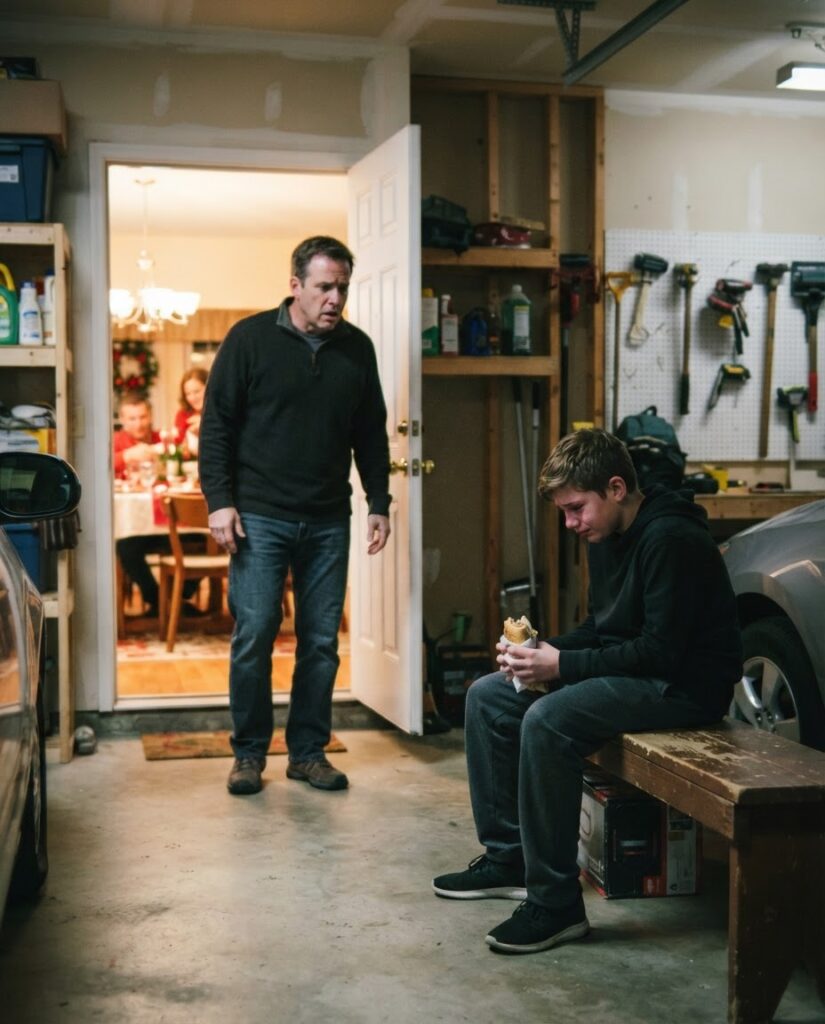
Ethan sat turned toward the passenger window, his coat still zipped to his chin. The heat was running, but he kept rubbing his hands together as if he could still feel the cold from that folding chair in the garage.
I wanted to tell him that Victoria was wrong, that my mother was wrong, that every adult who had chosen silence had been wrong.
Image
But thirteen-year-olds know when adults are trying to repair something with words that should have been repaired with actions.
So I just asked, “Are you hungry?”
He shrugged.
“That sandwich wasn’t exactly Christmas dinner.”
That got the smallest smile out of him.
My restaurant in Manhattan was technically closed for the night. The last catering orders had gone out before I left for Daniel’s house, but I still had my keys, and there was enough food in the walk-in to make something decent.
“Want to go back to the restaurant?” I asked.
Ethan looked at me. “Just us?”
“Just us.”
He nodded.
By the time we reached Manhattan, the streets around the restaurant had quieted down. I unlocked the side entrance, turned on only the kitchen lights, and tossed my keys onto the stainless-steel counter.
Ethan took off his jacket.
Then he lifted the sleeve toward his nose.
“Do I really smell that bad?”
That question hurt more than anything Victoria had said to me.
I walked over and smelled his sleeve.
“You smell like garlic, butter, and a little smoke.”
His face fell.
“Which means,” I added, “you smell like the place where you spent three hours helping your dad when you didn’t have to.”
He looked down at the floor.
I pulled out a clean white plate and started putting together dinner from what we had left: sliced beef, roasted potatoes, vegetables, and one of the chocolate desserts Ethan had helped box earlier.
When I set the plate in front of him, he stared at it for a moment.
“You don’t have to make a big deal about it,” he said.
“I’m not. I’m feeding my kid. That’s supposed to be normal.”
He finally picked up his fork.
We ate at a small table near the front window instead of in the kitchen. Halfway through dinner, Ethan said something I wasn’t expecting.
“Grandma came into the garage.”
I stopped chewing.
“When?”
“Before you got there.”
I already knew my mother had admitted she knew where he was. What I hadn’t known was that she had actually gone out to him.
“What did she say?”
Ethan moved a potato around his plate.
“She said Aunt Victoria was stressed because there were a lot of people there. She told me not to make tonight harder for Uncle Daniel.”
For a second, I couldn’t speak.
My mother hadn’t merely noticed Ethan was missing.
She had seen him sitting alone in the garage, understood exactly why he was there, and asked the thirteen-year-old to absorb the humiliation so the adults wouldn’t have to deal with an uncomfortable argument.
“Did she tell you to stay there?”
Ethan shook his head. “Not exactly. She just said dinner would be over soon.”
That was somehow worse.
I leaned back and looked at my son.
“You should never have been put in that position.”
He gave a tiny nod.
Then he asked, “If you hadn’t gotten there early, would anybody have come for me?”
I couldn’t lie to him.
“I don’t know.”
He looked back at his food.
My phone started vibrating on the table.
Daniel.
I let it ring.
A minute later, he called again.
Then again.
On the fourth call, Ethan looked at the screen and said, “You can answer.”
I stepped toward the kitchen but stayed where Ethan could still see me.
“What?”
Daniel exhaled hard. The noise behind him was gone. No talking. No music. No clinking dishes.
“Everybody left.”
“Okay.”
“Mark, the whole thing blew up after you drove away.”
“It should have blown up before I arrived.”
He was quiet.
Then he said, “Claire found the sandwich.”
Claire was Daniel’s sixteen-year-old daughter.
Apparently, after we left, she had gone into the garage looking for her phone charger. She saw Ethan’s half-eaten sandwich still sitting on the folding chair.
She carried it into the dining room and placed it beside Victoria’s prime rib.
Then she asked, “Is this seriously what you gave Ethan?”
No one could pretend not to understand after that.
Daniel told me several people started asking questions at once.
That was when something else came out.
Victoria had told some of the guests that Ethan wasn’t feeling well and wanted to eat somewhere quiet.
I gripped the edge of the counter.
“She told people that?”
“Yes.”
That changed the shape of what had happened.
It didn’t excuse my mother. She had known the truth.
It didn’t excuse Daniel, who had accepted Ethan’s absence without checking on him.
But several people I had blamed for knowingly ignoring Ethan hadn’t known what Victoria had actually done. They had been given a convenient explanation and hadn’t bothered to question it.
Still bad.
But different.
“What did Victoria say when Claire brought in the sandwich?”
Daniel hesitated.
“At first she said she was protecting the dinner from becoming uncomfortable. Then Dad asked her what was uncomfortable about Ethan sitting at a table.”
I almost laughed at the absurdity of it.
“And?”
“She said the smell was strong.”
“He had changed his shirt.”
“I know.”
“And she put him in a garage.”
“I know.”
Daniel’s voice sounded smaller now.
He told me Victoria had eventually said she had spent days making the house and dining room perfect and didn’t want the restaurant smell around the table.
There it was.
Not a misunderstanding.
Not a child choosing to be alone.
Not concern about his comfort.
A thirteen-year-old had interfered with the picture she wanted to present, so she removed him from it.
Daniel said, “I should’ve checked on him.”
“Yes.”
“I should’ve stopped you from leaving.”
“No. You should’ve stopped her from sending him out there in the first place.”
He didn’t argue.
Then he asked, “Can I talk to Ethan?”
I looked toward the table. Ethan was eating dessert now, but I could tell from the way he held himself that he was listening.
“Do you want to talk to Uncle Daniel?” I asked.
Ethan shook his head.
I told Daniel no.
He accepted it.
That night, Ethan and I stayed at the restaurant longer than necessary. We washed two plates, straightened a few boxes, and packed the remaining desserts into the refrigerator. Nothing dramatic happened. We just worked beside each other until the knot in his shoulders slowly loosened.
Before we left, he put his jacket back on.
Then he smelled the sleeve again.
This time he said, “It actually does smell like garlic.”
“Occupational hazard.”
He smiled.
The next morning, Christmas Day, my mother showed up at my apartment shortly after nine.
I almost didn’t let her in.
Ethan was awake, though, and when I told him Grandma was outside, he said, “It’s okay.”
I made one thing clear before opening the door.
“You don’t owe her forgiveness because she came here.”
He nodded.
My mother entered without gifts, food, or the usual Christmas bags she carried everywhere. I appreciated that. She wasn’t trying to buy her way around the conversation.
She sat across from Ethan at the kitchen table.
For once, she didn’t begin with an explanation.
She said, “I saw you in that garage, and I should have brought you inside.”
Ethan stared at her.
“Why didn’t you?”
My mother swallowed.
“Because I was afraid Victoria would start a fight, and I wanted everyone to have a peaceful Christmas Eve.”
“But I wasn’t having one.”
My mother closed her eyes for half a second.
“No. You weren’t. And I decided your feelings were easier to sacrifice than everyone else’s comfort.”
That was the first apology I’d heard since the whole thing happened that actually named the wrongdoing.
Ethan didn’t say it was okay.
He shouldn’t have had to.
Instead, he asked the same question he had asked me.
“If Dad hadn’t come early, when were you going to get me?”
My mother started to answer, then stopped.
“I don’t know,” she said quietly.
Ethan nodded.
“That’s what Dad said.”
My mother’s face changed.
Not because Ethan had insulted her. He hadn’t.
Because there was nothing to defend herself with anymore.
She apologized again and left about twenty minutes later.
After she was gone, Ethan told me, “I think she meant it.”
“I think so too.”
“I’m still mad.”
“You can be.”
That afternoon, Victoria finally contacted me.
Her message was long.
She wrote that she regretted how the evening had ended, that she never intended to hurt Ethan, that everyone had been under stress, and that I had embarrassed her in front of thirty-five people by making a private hosting decision into a public accusation.
There was a lot about intentions.
There was a lot about my reaction.
There was almost nothing about Ethan.
I sent one reply.
“If you want to repair this, apologize directly to Ethan for sending him into the garage because you didn’t want him at your table. Don’t explain the smell. Don’t explain the party. Don’t explain me. Tell him what you did.”
She didn’t respond.
For two days, nothing moved.
The family group chat became a parade of careful messages about leftover food, travel plans, and whether anyone had accidentally taken home my father’s scarf. Nobody mentioned Christmas Eve.
That silence bothered me almost as much as the argument had.
Then Daniel came to the restaurant on the morning of December 27.
He looked exhausted.
“Victoria says she’ll apologize,” he told me.
“Good.”
“She wants Ethan to come over so they can talk.”
“No.”
Daniel frowned. “Mark, she’s trying.”
“Then she can try without making the thirteen-year-old return to the house where she humiliated him.”
“I’m just saying maybe if Ethan hears her out—”
I put my hand up.
“Daniel, don’t do this. Don’t make him responsible for giving an adult the right conditions to apologize.”
He went silent.
That was Daniel’s mistake, and to his credit, he recognized it immediately.
“You’re right,” he said. “I’m sorry.”
He didn’t ask again.
Instead, he sat at one of the empty tables and told me what had happened after our phone call.
He and Victoria had argued until nearly two in the morning.
Not because he suddenly became a hero. Daniel admitted that, at first, he had still been focused on how spectacularly the evening had fallen apart.
Then Claire had asked him a question.
“If Uncle Mark hadn’t come early, were you actually going to let Ethan sit there all night?”
Daniel couldn’t answer her.
That was the moment, he said, when he stopped thinking about the ruined dinner and started thinking about the kid twenty feet away from him whom he had failed to notice.
He told Victoria there would be no more big family dinners at their house until Ethan received a real apology and I believed he would be treated respectfully there.
Victoria accused him of choosing me over his wife.
Daniel told her he was choosing not to humiliate a child to protect an adult’s pride.
Then he said something I hadn’t expected.
“I’m not asking you to forgive me either. I saw he wasn’t at the table. I knew he had arrived with Mom and Dad. And I didn’t get up and look for him.”
“Why not?”
“Because I assumed somebody else knew what was going on.”
That sentence stayed with me.
Most failures in families don’t happen because thirty-five people secretly agree to hurt someone.
They happen because each person decides somebody else will handle the uncomfortable part.
Daniel asked if he could write Ethan a note instead of calling him.
I asked Ethan later.
He said yes.
Daniel’s note wasn’t dramatic. He didn’t blame Victoria. He didn’t ask Ethan to come back. He wrote that he had failed to notice his nephew was missing from his own Christmas table and that being the host meant he had been responsible for every kid in that house, not just the dinner.
Ethan folded the note and put it in his desk.
Then came the part that scared me most.
That evening, I asked Ethan whether he wanted to go to my parents’ house for New Year’s Day.
He immediately said no.
Then he added, “I don’t really want to go to family dinners anymore.”
That was the damage I couldn’t fix with anger.
Victoria hadn’t just ruined one meal for him.
She had taken a place that was supposed to mean belonging and taught him that the adults at the table might decide he was the easiest person to remove.
I sat beside him.
“Then we won’t go.”
He looked surprised.
“Grandma will be upset.”
“Grandma’s feelings aren’t your assignment.”
“What about Uncle Daniel?”
“His aren’t either.”
For the first time since Christmas Eve, Ethan looked relieved instead of guilty.
The next morning, I called my mother and told her we weren’t coming for New Year’s.
She didn’t argue.
Instead, she asked, “Would Ethan be comfortable if we came to you?”
I asked him.
He thought about it and said yes, but only if Victoria wasn’t there.
So that’s what happened.
On New Year’s Day, I opened the restaurant for family even though we were closed to customers. No decorations beyond a few lights still hanging from Christmas. No formal seating chart. No champagne display.
My parents came. Daniel came with Claire and her younger brother. A few relatives who had spoken to Ethan privately came too.
Victoria did not.
That was not revenge.
It was a consequence.
She had been offered a simple way to begin repairing what she’d done: acknowledge it directly to the child she had humiliated.
She still wasn’t willing to do that without explaining why everybody else had made her do it.
So Ethan didn’t have to share a table with her.
Before everyone arrived, I started setting plates.
Ethan walked over, took one from the stack, and placed it at the seat beside mine.
“This one’s mine,” he said.
“Looks like it.”
During the meal, nobody gave a speech. Nobody forced Ethan to discuss Christmas Eve. My mother asked him about a game he’d been playing. Claire complained about school. Daniel helped carry dishes back to the kitchen.
It was almost ordinary.
That was exactly what Ethan needed.
Near the end of dinner, my mother stood to clear the table and reached automatically for Ethan’s plate.
He still had food on it.
She stopped herself.
“Sorry,” she said. “You finished?”
Ethan looked at the plate, then at her.
“Not yet.”
She left it in front of him.
It was a tiny moment, but I noticed it.
So did Ethan.
A week later, Victoria finally sent him a message.
This time, there was no mention of smells, hosting pressure, my behavior, or the ruined Christmas dinner.
She told him she had been wrong to decide that the way his jacket smelled mattered more than whether he felt welcome. She said she should never have sent him into the garage and that she understood if he didn’t want to see her.
Ethan read it twice.
Then he handed me the phone.
“Do I have to answer?”
“No.”
He thought for a moment.
Then he typed, “I read it.”
Nothing more.
That was enough.
Daniel eventually started inviting us over again, but only after asking Ethan directly whether he was comfortable. Sometimes Ethan said yes. Sometimes he didn’t. Nobody argued with his answer.
Things between Daniel and Victoria were strained for a while. I stayed out of that. Their marriage wasn’t mine to manage, and I wasn’t interested in turning one ugly Christmas Eve into permission to control the rest of their lives.
What mattered to me was simpler.
The next Christmas Eve, we didn’t go to Daniel’s house.
We closed my restaurant early and had dinner there instead.
My parents came. Daniel and the kids came. A couple of my employees who had nowhere else to go joined us.
Ethan helped in the kitchen again, by choice.
When he finally sat down, his shirt smelled faintly of roasted garlic and butter.
Nobody moved away from him.
Nobody opened a garage door.
Nobody suggested he change.
I watched him carry his own plate out of the kitchen and choose his seat at the table.
The year before, a plate had been something other people decided he wasn’t worthy to receive with everyone else.
This time, it was simply his.
And no one at that table needed to be reminded why.