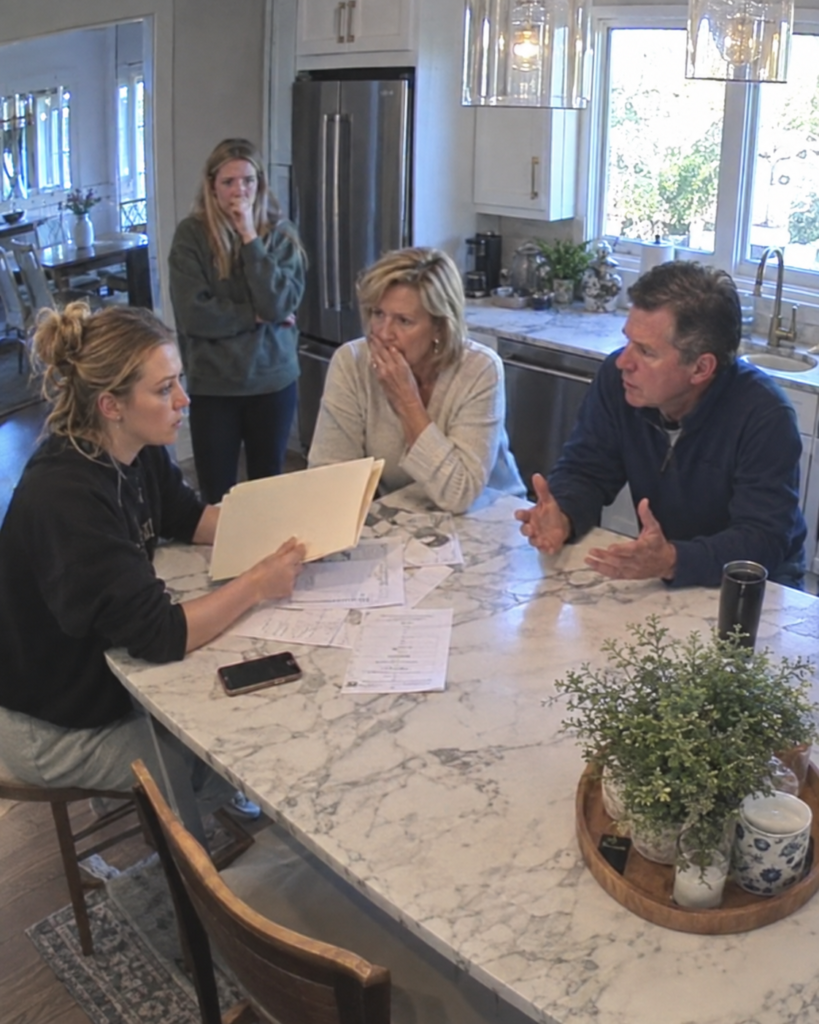
Downstairs, I heard paper. The slow, careful crinkle of documents being shuffled, folded. My mom’s voice pitched low. Mark’s voice lower. I couldn’t hear words.
I didn’t have to.
I put the envelope back in the box. I closed the lid. I went down and poured myself a glass of water. I said nothing about the light being on in the kitchen at 10:30 at night when my mother was supposed to be in bed.
Looking back, that envelope was the first time someone had ever handed me a weapon. I just didn’t recognize it yet.
I didn’t open the letter that night. I should have.
My dad died when I was 10. His name was Gregory Everett. He drove a silver Ford Ranger, and one morning in November of 2018, he didn’t come back from a delivery run up Route 30.
There was fog. There was a semi. There was a trooper at our front door with his hat in his hands.
My mother cried for exactly one week.
Then she started house hunting for a new kitchen.
She remarried in 2020. Mark Hollis. Contractor. Big truck, big laugh. A daughter from his first marriage named Skyler, two years younger than me, who moved into the bedroom across the hall.
I learned three things fast.
One, my mother punished tears. If I cried, she called it drama. She’d sigh. She’d go to the front porch with her wine.
Two, my mother punished joy. If I laughed too loud, she called it showing off. She’d narrow her eyes. She’d say, “Quinn. Inside voice.”
Three, the only safe setting was flat.
So I went flat. I went quiet.
By 12, I’d stopped spending my feelings around her. I saved them for Grandma Margaret’s porch and Grandpa Harold’s tomato vines and the pages of books where other people were allowed to feel things out loud.
My mother thought quiet meant obedient.
It didn’t.
Quiet meant I was watching. Quiet meant I was remembering.
In my house, emotions were currency. I’d stopped spending mine by 12. My mother called it quiet. I called it not giving her a weapon.
Eight years later, she would slide a manila folder across a kitchen table and find out how much I had been paying attention.
But I’m getting ahead of myself.
Dinner at the Hollis house ran on a schedule. At 6:30, Mark came in through the garage, boots off in the laundry room, the smell of joint compound and truck cab on him. He’d drop his keys on the counter. Ford F-350. Loud keys.
He’d say, “Another one bailed,” or, “Kitchen in Konosogga had mold behind the drywall,” or, “Permit guy’s a crook.”
My mother would pour his wine before he asked.
Skyler would talk. She always talked.
That night, a Sunday in March, she’d gotten her Bucknell admission email. Early decision. $65,000 a year before books.
Mark raised his glass.
“That’s my girl.”
My mother touched Skyler’s wrist. “We’ll figure out the rest. Don’t you worry.”
Skyler glanced at me. I was cutting my chicken. I didn’t look up.
“I got the Penn State email yesterday,” I said evenly. “Main campus.”
A silence.
My mother said, “That’s nice, sweetheart.”
Mark grunted. He took a swallow of wine.
“College is a scam. Real money’s in the trades, but whatever.”
He didn’t look at me.
My mother smiled, her charity-committee smile.
“Quinn, we’ll talk about your future closer to your birthday.”
That phrase again.
Closer to your birthday.
She’d said it three times in February, twice already in March. It didn’t sound like a celebration. It sounded like an appointment.
Mark topped off his glass. He added, casual as weather, “Family money stays with family, Quinn. Not in some lawyer’s vault.”
My mother cut him a look. A fast one. The kind that says shut up, too soon.
I kept cutting my chicken.
I was paying attention.
My grandma Margaret died when I was 14. Breast cancer. She fought it twice. The second time, it fought back harder.
She held my hand the afternoon she passed.
“You are a good, good girl,” she said. “Don’t let anyone tell you otherwise.”
I didn’t cry in the hospital. I cried in the parking lot, in the passenger seat of Grandpa’s Buick. And he didn’t shush me or sigh.
He just said, “Let it out, Peanut. Let it out.”
Grandpa Harold held on for two more years. He got quieter, not sadder. Quieter, like a house at dusk.
The summer I was 16, I moved into his spare room for July and August. I read to him from the chair by the window. I watered the tomatoes. I cooked the eggs the way he liked them—hard yolks, butter, salt.
He died in September, on a Tuesday. Seventy-eight years old. Heart.
At the funeral, my mother wore navy and cried at the right volumes. Mark stood in the back and checked his phone.
The will was read two weeks later.
There was a trust, my name on it, a number that made Mark’s jaw go loose: about $680,000. Blue-chip shares, some cash, the proceeds from a small lot Grandpa had sold in Bucks County.
The terms were simple. The assets belonged to me. I couldn’t touch the principal until my 18th birthday. On that day, full beneficial ownership transferred.
The trustee’s name on the paperwork was David Caldwell.
Grandpa’s written note inside the folder said six words:
“Your choice, your life. Love, Grandpa.”
My mother read those six words with a look on her face I’d never forget.
Not sad.
Not proud.
Calculating.
Grandpa left me a door. My mother had already hired a locksmith.
Six months before my 18th birthday, a man in a gray suit started showing up at our house. Wednesdays, 4:30. Same car, a charcoal Lexus with an ugly plate frame that said Briggs and Associates, Lancaster.
He stayed an hour and 15 minutes. He left with a leather binder under his arm.
My mother said he was an insurance guy, then a financial planner, then, one week, a friend of Mark’s.
The story changed.
His binder didn’t.
One afternoon in January, I came home early from the library. My shift got cut. Snowstorm coming. I pushed through the mudroom door and heard papers on the kitchen table.
I stopped.
My mother said, “Once she signs, the rest is just paperwork.”
Mark said, “And if she hesitates?”
My mother laughed. Short. Dry.
“Quinn? She’ll sign. She always does.”
I stood in the mudroom with my boots on and my pulse in my ears.
Then I opened the door loud.
“Mom, I’m home early.”
I heard papers sweep.
When I came into the kitchen, the table was clear. My mother was smiling.
“Snow day, huh? Want some cocoa?”
“Sure.”
On the counter, under her purse, the corner of a folder stuck out. Cream-colored, embossed letterhead.
Briggs and Associates. Family Wealth Planning.
Skyler walked in behind me.
“Is that about Quinn’s money?”
My mother’s smile didn’t move.
Mark said, “Sky, go upstairs.”
Skyler went upstairs.
My mother handed me cocoa.
“Quinny, you’re such a good girl.”
I took the mug.
“Thanks, Mom.”
I went up to my room.
That was the moment I stopped being the daughter who didn’t know.
I just didn’t tell anyone I’d crossed over.
I opened the envelope that Friday.
I walked to Willow Creek Park with it tucked inside my hoodie pocket. The swings were empty. The sky was the color of wet pavement. I sat on a bench that was too cold, and I slit the seal with my thumbnail.
The letter was one page. Grandpa’s handwriting.
“Peanut, if you’re reading this, something has gone wrong with your mother. I’ve suspected it for a long time. I never wanted to poison you against her, but I couldn’t leave without giving you a door to open.
“David Caldwell has been my attorney for 30 years. He knows everything. He’s waiting for your call. You have the right to protect yourself. You have the right to choose. I believe you will choose well.
“Love, Grandpa.”
Below it, in careful block letters, was a phone number. Area code 717.
I stared at it for a while. My hands were cold. My eyes were not wet.
I took out my phone.
I dialed.
A woman answered.
“Caldwell Estate Law. This is Paula.”
“Hi, my name is Quinn Everett. My grandfather was Harold Everett. He told me to call Mr. Caldwell.”
She was quiet for half a second.
“Hold on, sweetie.”
A click, then a warm baritone.
“Quinn, this is David Caldwell. I’ve been expecting your call.”
I couldn’t speak for a beat.
He said, “Your grandfather and I spoke about this possibility many times. I’m glad you reached out. Can you come to Lancaster next week? Tell your mother it’s a college-aid meeting.”
“Yes.”
“Good. And Quinn, don’t change a thing at home. Not your face, not your schedule, not a word.”
For the first time in a long time, someone believed I could handle the truth.
Caldwell’s office was on the second floor of a brick building on Prince Street. A green banker’s lamp on his desk, a shelf of Pennsylvania statute books, a plant he clearly didn’t water enough.
He stood up when I walked in. Sixty-five, maybe. White hair, kind eyes, a suit that had been tailored three administrations ago.
“Sit, please. Tea?”
“Water.”
He walked me through it slowly. He used small words. He wrote terms down on a legal pad so I could see them.
Trust. Beneficial interest. Fiduciary duty. Spendthrift. Irrevocable.
“At midnight on your 18th birthday, Quinn, the assets your grandfather left you are legally yours. You have options. You can keep the current trust. You can dissolve it. Or you can move everything into a new structure you design today.”
“What do you recommend?”
“A new irrevocable trust. Professional corporate trustee. I work with Midland Trust Services. You’re the sole beneficiary. Distributions covered for education, housing, medical. Your mother, Mark Hollis, and Skyler Hollis are excluded as beneficiaries and trustees permanently.”
“Irrevocable means what?”
“Once you sign, not even you can undo it. That’s the point. It protects you from outside pressure, including your own in a weak moment.”
I thought about that. I thought about my mother’s hand on my wrist, her smile, her closer to your birthday.
“Okay.”
He nodded. He looked down at his pad, then up.
“Quinn, before we go further, there’s something I need to tell you about your mother’s attorney.”
The plant in the corner was dying. The banker’s lamp hummed. Outside, a UPS truck braked at the curb.
“Tell me.”
Caldwell folded his hands.
“Your mother has been working with a man named Lance Briggs. Briggs is a local estate attorney. He’s been reprimanded twice by the state bar. He specializes in what my profession politely calls aggressive family planning.”
“Meaning?”
“Meaning he’ll draft documents most of us would walk away from.”
He opened a folder on his desk. He slid it halfway toward me.
I could see the top page upside down.
Everett Family Financial Unification Agreement.
My full legal name in the subheader.
Quinn Marie Everett.
“A paralegal at Briggs’s firm left for a different practice two weeks ago. She sent us drafts she was concerned about. She wasn’t the only one concerned.”
“What does it do?”
“It would make you a co-trustee with your mother. It would grant her durable financial power of attorney, and it would assign a significant portion of your beneficial interest to a holding company, something called Hollis Everett Holdings LLC.”
He let me read.
The signature line was dated February 28th, two months before my birthday, while I was still 17.
I looked up.
“I’d still be a minor.”
“Correct. Your mother’s signature as your guardian would have been required alongside yours. That’s their plan. Have you sign under maternal authority before the trust releases, while you still need her signature to breathe, in the legal sense.”
I put the folder down carefully.
My hands were steady.
My hands surprised me.
“Four months?”
“I’m sorry, Quinn. Four months that we know of.”
Four months of me serving her coffee while she was building a cage.
“Let’s build mine.”
I drove home from Lancaster at the speed limit with my hands at ten and two.
I walked in at 5:30. My mother was at the stove, stirring something that smelled like her Sunday chicken pot pie. My favorite since I was six.
She turned. She smiled.
“How did the college meeting go?”
“Fine. Good, actually.”
“Oh, that’s wonderful. Come sit.”
I sat at the kitchen island. She set a plate in front of me without asking. Two scoops of pot pie, a sprig of parsley, her church-supper presentation.
“Quinny, I was thinking about your birthday.”
I kept my face clean.
“Oh, yeah?”
“For your 18th, we should do something just family. A special breakfast, just us. Pancakes, your favorite.”
“That sounds nice, Mom.”
“And maybe we’ll talk about some grown-up things. You’re a woman now.”
Mark’s voice drifted in from the living room over the TV.
“Yeah. Grown-up stuff.”
Skyler came into the kitchen. She took a plate.
“What grown-up stuff?”
My mother said brightly, “Nothing, honey. Just family planning.”
Skyler rolled her eyes. “Sounds boring.”
“It will be.”
I took a bite of pot pie.
It tasted the way it always tasted. Butter, pepper, thyme. My childhood on a fork.
“Pancakes sound great, Mom.”
I even smiled.
Caldwell had told me, “Don’t change a thing. Not your face, not your schedule, not a word.”
I didn’t.
I was the quiet daughter she thought I was.
I just happened to also be the daughter with a lawyer.
We met twice more before my birthday. Always a cover story: a college tour, a financial-aid appointment, a library research trip.
Caldwell was patient. He had a way of talking about money that made it feel like plumbing, not magic, not morality. Just pipes and valves.
We named the new trust together.
“Most people name trusts after themselves,” he said. “What do you want to call it?”
“The Margaret Trust.”
He wrote it down.
He didn’t ask why.
We built the thing piece by piece.
Corporate trustee: Midland Trust Services, a Harrisburg-based firm with a clean 40-year record.
Beneficiary: Quinn Marie Everett and her direct biological descendants, if any, in perpetuity.
Excluded forever from beneficiary or trustee status: Caroline Everett Hollis, Mark Hollis, Skyler Hollis, and any entity in which any of the three held equity.
Distributions authorized for tuition, reasonable housing, medical, emergency living expenses. Discretionary distributions subject to trustee review.
Spendthrift clause. No creditors could attach. No one could pressure me into a lump-sum withdrawal on anyone else’s behalf.
Irrevocable.
No amendment.
No termination.
No reversal.
Caldwell said, “You understand that this protects you from them. It also protects you from you. In a weak moment, five years from now, if your mother cries the right cries, you can’t undo this. That’s on purpose.”
“I know.”
“Good. Many 18-year-olds don’t.”
I signed the draft in pencil twice to practice.
Then we set the live execution for 12:00 and one second on April 15th, 2026, my birthday.
Notary ready.
Trustee ready.
Caldwell set a phone call for 9:00 a.m. sharp the morning after, on speaker if I chose.
“It’s your moment, Quinn. Use it how you need to.”
Aunt Beth called me the week after that meeting, out of the blue.
Or maybe not.
“Quinny, Pittsburgh speaking. You got a minute?”
I stepped into the backyard. The air smelled like early grass.
“I heard from David Caldwell that you’ve been asking questions.”
“He told you?”
“He told me you called. He didn’t tell me what about. I can guess.”
Beth was my dad’s little sister. ICU nurse. Forty-eight. She and my dad had been close.
She and my mother had not.
“Quinn, I should have told you this years ago. I’m sorry. Your father tried to change his will before he died. Six months before the accident, he wanted a trust set up for you with my name as co-trustee.”
I sat down on the porch step.
“What happened?”
“Your mother happened. She cried for a week. She said it would kill her trust in him. She said it was a betrayal. He caved. He left everything to her. Life insurance, the house, everything.”
“Four hundred and fifty thousand?”
“You knew?”
“I found the paperwork last month.”
A long quiet.
Then she said, “Honey, you are not the first one she worked on. You’re just the one with a grandfather who planned ahead.”
I didn’t cry.
I wanted to.
I didn’t.
“If you need somewhere to go after your birthday, I have a room. I have a mean cat named Walter. I have coffee. You’re welcome as long as you want.”
“Aunt Beth, what day is it there?”
“Thursday, Peanut. Same as you.”
“I might take you up on the room.”
The Sunday before my birthday, my mother made pot roast. Her something-big-is-coming meal.
Mark lit candles. Skyler put her phone face down.
Over dinner, I floated a question. Casual, curious. The voice of a daughter looking for guidance.
“Mom, what’s the difference between a trust and a family account, anyway?”
She lit up like a porch lamp.
“Oh, honey, trusts are complicated. They can fail if they’re not managed by family who really cares.”
Mark nodded.
“Lawyers drain them. Saw it happen to Gus Trainer’s mom.”
My mother said, “You’d be shocked. Fees, delays. They nickel-and-dime you.”
“Huh. That’s scary.”
“It’s why family accounts work better. Shared goals. No strangers. Just pooled.”
Mark said, “Family money stays with family hands, not some corporate trustee up in Harrisburg.”
It was the word corporate that gave him away.
I’d never used that word in front of him.
Neither had she.
But Briggs would have.
“Huh.”
Skyler said from her plate, without looking up, “Mom says the money was supposed to be all of ours anyway.”
Dead silence.
My mother’s fork froze half an inch above her plate.
Mark said too loud, “Sky, honey, eat.”
My mother recovered.
“Sky just means family is a team, sweetheart. That’s all.”
“Oh, of course, Mom. This roast is amazing.”
I reached for the potatoes. I passed the gravy. I kept my face the face of the quiet daughter who didn’t know anything.
Inside my head, I was taking notes.
Skyler had known at least the shape of it. Maybe the edges. My mother had told her enough to get her to behave on a certain morning in April.
Four days now.
I was counting.
Two days before my birthday, my mother announced an early celebration dinner at Willow Creek Country Club.
I hadn’t agreed to it.
Fifteen people. The pastor and his wife. Mark’s business partner, Ron. Two neighbors. My mother’s women’s-circle co-chair, Donna.
Skyler in a pink dress. Mark in a navy blazer that strained across his shoulders.
The club’s private room had green wallpaper and a chandelier the size of a small car. The waiters wore white gloves that made me sad for their wrists.
My mother stood up during dessert. She tapped her wine glass with a butter knife.
“I’d like to propose a toast to my brave girl, who’s going to make such smart decisions tomorrow.”
Fifteen people lifted 15 glasses.
I lifted mine.
I smiled.
“Thank you, Mom.”
Mark caught my eye from across the table. He tipped his wine toward me.
He mouthed, “Big day.”
I smiled back.
Three tables over, at a table for one, a man in a navy blazer was eating a Caesar salad. Mid-50s, thinning hair, a ring with a stone too big for his finger, a leather briefcase leaning against his chair.
He looked up.
He looked at Mark.
He gave a small professional nod.
Mark nodded back.
I didn’t know the man’s face yet.
But I knew the briefcase.
I knew the posture of a man who charged by the hour and expected his invoice paid in cash.
Lance Briggs was already at my birthday dinner.
One day early.
Waiting.
Pastor Lowry raised his glass and said something kind about my late grandfather. I smiled and thanked him.
Grandpa had said, “Your choice, your life.”
I raised my glass to the whole room.
I drank the wine.
April 15th, 2026.
11:47 p.m.
My bedroom door was locked.
My laptop was open. Three sharpened pencils sat on my desk that I hadn’t needed. I was wearing pajamas. Gray top, plaid pants, slippers.
I wanted my signature to come from the version of me who slept in this house every night.
At 11:52, Caldwell joined the Zoom. White hair, blue tie, green banker’s lamp behind him.
At 11:54, a woman from Midland Trust Services joined. Her name was Priya Desai.
“Happy almost birthday, Miss Everett.”
At 11:56, the online notary joined. Commissioned in Pennsylvania. Camera on. ID check completed.
11:59.
Caldwell said, “Ready, Quinn?”
“Yes.”
11:59:40.
11:59:55.
The cursor blinked in the signature field.
12:00.
In one second, I typed my legal name.
Quinn Marie Everett.
Slow.
Each letter on purpose.
The notary confirmed.
Priya confirmed.
Caldwell’s eyes tracked the screen.
At 12:02, the system requested confirmation of the asset-transfer authorization.
I clicked approve.
Two-factor code approved.
At 12:03, Priya said, “Initiating wire.”
At 12:04, she said, “Confirmed. Funds received. $681,412.90. The Margaret Trust is funded. Fully executed. Irrevocable.”
Caldwell looked into the camera.
“Happy birthday, Miss Everett. The world is yours now.”
I realized I’d been holding my breath for almost a minute.
I let it out.
“Thank you.”
“Sleep if you can. Expect me at nine tomorrow.”
The three of them dropped off.
The Zoom window went quiet.
Downstairs, in the dark house, a refrigerator hummed.
I closed my laptop.
I sat.
My hands tingled.
For the first time in six months, I was tired.
I lay down.
And I slept.
Let me pause here for a second. If somebody in your family has ever asked you to sign something you didn’t fully understand, drop the word rooted in the comments. I want to know how many of us there are. I read every comment later tonight, I promise.
Because what comes next isn’t the ending.
Not even close.
I still had to go downstairs the next morning. I still had to sit across from the woman who’d spent four months drafting papers about me, and she still thought she was going to win.
Back to the story.
7:30 a.m., April 16th.
I was awake before my alarm.
I showered for six minutes. I dried my hair halfway. I put on a cashmere cardigan the color of early butter. Jeans. My grandmother’s gold stud earrings. No makeup.
I stood in front of my bedroom mirror.
I said out loud, “Quiet daughter.”
I looked like her.
I went downstairs at 7:45.
The kitchen smelled like pancakes.
My mother was at the stove in her robe. Pink quilted. Her blonde hair pinned back the way she wore it for brunch.
She turned.
She beamed.
“There’s my birthday girl. Happy 18th, sweetheart.”
She wrapped me in a hug. It lasted three seconds longer than her hugs usually lasted.
She smelled like her Estée Lauder and bacon grease.
Mark was at the table in a polo.
Skyler was in her pajamas with her phone propped against the orange-juice pitcher.
A manila folder sat on the table to the right of my mother’s place setting.
Not hidden.
Not even slightly.
Three pancakes in a tower on my plate.
Candles, the thin birthday kind, unlit.
My mother said, “Sit. Sit. Mark, light her candles.”
Mark pulled a lighter from his pocket.
He lit three candles.
My mother said, “Make a wish, Quinny.”
I leaned over the plate.
I thought, I wish for my grandfather to know.
I blew the candles out.
My mother clapped.
Skyler said, “Yay, Quinn.”
Mark said, “Eighteen years old. Christ.”
“Smells great, Mom.”
I took my fork. I cut into the top pancake.
The folder caught the morning light. The edge of it lined up perfectly with my mother’s coffee mug.
I’d rehearsed this morning in my head 50 times, maybe.
None of them prepared me for how normal it felt.
She let me eat two bites of pancake.
Then she folded her hands on the table.
She used her warm voice. The women’s-circle voice.
“Honey, now that you’re 18, there’s something we need to talk about.”
“That money from Grandpa.”
I set my fork down.
“Okay.”
She slid the folder across the table.
It moved three inches.
It came to rest against my plate.
“It’s nothing big. Just some family paperwork Mark’s attorney drew up to help us all be smart for the family.”
Mark said, “Nothing crazy. Just structure.”
Skyler watched. She had not picked up her phone.
“May I look?”
“Of course, sweetheart. Take your time.”
I opened the folder.
The cover page said:
Everett Family Financial Unification Agreement.
Quinn Marie Everett, Principal.
Beneath it, smaller:
Caroline Everett Hollis, Successor Co-Trustee.
Mark J. Hollis, Attorney-in-Fact.
My full legal name in three places.
A signature line with my name printed below it.
Another line for my mother’s signature as parent or guardian, which she’d only need if I were still a minor.
I flipped past the cover.
Page two: durable financial power of attorney granted to Caroline Everett Hollis.
Page five: assignment of partial beneficial interest to Hollis Everett Holdings LLC.
Page seven: co-trusteeship designation.
Page nine: acknowledgement of family financial priorities, including tuition assistance for Skyler Anne Hollis.
My blood ran cold.
I was looking at proof.
I kept my face even.
I turned to the footer on page one.
Generated December 14th, 2025.
Four months ago.
My mother said, still smiling, “It’s simpler than it looks. Just a few signatures and we can get on with your birthday.”
“I’d like to read it first.”
I read every page.
Not skimming.
Reading.
I turned each sheet with both hands. I followed every paragraph with my index finger. I mouthed the harder words.
At the two-minute mark, my mother’s cheerful smile began to crack at the corners.
At the four-minute mark, she tapped her coffee mug twice. Quick.
At five minutes, Mark said, “Quinn, sweetheart, you don’t need to read every line.”
“I like to understand what I’m signing.”
“It’s just structure. My guy’s on standby to notarize this morning.”
“Mark, you just said my guy.”
“What?”
“A minute ago, you said Mark’s attorney. Now it’s my guy.”
A silence.
Skyler’s phone still sat face down.
She hadn’t touched it.
I turned to page five. I tapped the paragraph.
“Mom, this line says, ‘Partial beneficial interest is assigned to Hollis Everett Holdings LLC.’ What is Hollis Everett Holdings?”
My mother blinked.
“Oh, a family entity for tax purposes. It’s not really a thing.”
“When was it formed?”
“I don’t remember exactly.”
Mark cut in.
“Quinn, stop. It’s just paperwork. Sign the stickied pages. Eat your pancakes.”
I looked at him.
Calm.
Steady.
“Mark, how long have you known Lance Briggs?”
The name landed.
Mark’s jaw did something slight.
But I saw it.
My mother said too quickly, “Sweetheart, we haven’t even told you the attorney’s name yet.”
“I know. That’s what I’m noticing.”
Skyler looked up.
Finally.
Wide-eyed.
Mark said, “Quinn—”
“One more second. I want to check the footer on the last page.”
I turned to page 11.
Generated December 14th, 2025.
Briggs and Associates.
Document V4.3.
Four months.
Four versions.
I closed the folder carefully.
“Mom, this document was generated four months ago.”
“Honey, lawyers keep old templates.”
“Templates don’t put a person’s middle name in them.”
I flipped back to page one. I pointed at my middle name.
Quinn Marie Everett.
“This is mine. This is only mine. Four months ago.”
My mother’s mouth opened.
Then closed.
Then opened again.
“We’ve been planning for your future for months. That’s all. That’s just good parenting, sweetheart.”
Mark said, “Quinn, sign the pages.”
His voice was not warm anymore.
“Mark, your lawyer’s name is on the letterhead. Briggs and Associates, Lancaster. I passed your lawyer at the country club on Monday night. Navy blazer. Caesar salad.”
Skyler breathed in fast.
Not out.
Mark said, “Quinn, don’t get cute.”
“I’m not being cute. I’m reading.”
My mother tried again, softer. The wounded voice.
“Quinny, honey, this is for your protection. You don’t understand how taxes work. You don’t understand what happens when someone your age inherits a lot of money. There are sharks out there.”
“Mom, I didn’t say no. I said I want to understand.”
“There’s nothing to understand. It’s just—it’s family. Sign.”
“Before I sign anything, I’d like to have our family attorney on the line, just to explain it to me.”
I said the word our gently.
That was the word that broke her face.
Her smile locked.
Her eyes flicked.
Fast panic.
“We don’t need Caldwell for this. My guy can walk you through it just fine.”
I waited.
I let the silence work.
“Mom.”
I looked at her.
“I never told you who our family attorney was.”
The kitchen went quiet the way kitchens do when the refrigerator kicks off and nobody’s spoken in a minute.
I watched my mother’s mouth.
She opened it.
Closed it.
Opened it again.
“Quinny, Grandpa mentioned him years ago. I must have remembered.”
“Grandpa died 18 months ago. I’ve never said his name in this house.”
Mark said, “Quinn, stop.”
Skyler said quietly from her chair, “Wait. Who’s Caldwell?”
Mark snapped, “Skyler. Not now.”
Skyler shrank back.
My mother tried to grip the table edge. Her knuckles were white.
“I asked around when Grandpa died about his estate. That’s all. It’s nothing sinister.”
“Mom, when did you ask around?”
She didn’t answer.
“Was it around the time you and Mark started meeting with Lance Briggs?”
“Quinn, please.”
Mark said, “You little—”
He caught himself.
His face was red. A vein pulsed at his temple.
“You think you’re slick? You think you know what’s best?”
“I don’t think I’m slick, Mark. I think I’ve been quiet for a long time, and people mistook that for a different thing.”
Skyler’s voice was very small.
“Mom, what is happening?”
“Nothing is happening, honey. Quinn is being difficult.”
“I’m being careful.”
My phone, lying face up beside my plate, vibrated.
The three of them looked at it.
The screen lit up.
David Caldwell, Esquire.
9:03 a.m.
My mother’s face lost the last of its color.
I picked up the phone.
I looked at her.
I looked at Mark.
I looked at Skyler.
“Do you mind if I put him on speaker?”
Mark half stood.
“Don’t answer that.”
“I think I will.”
My mother said, “Quinn. Quinny, wait.”
Mark said louder, “Quinn, sit down.”
I was already sitting down.
So I said, “I am sitting down, Mark.”
I looked at him the way I’d looked at ice on the driveway every January of my life.
Carefully.
Without sentiment.
“He’s our family attorney. He represented Grandpa for 30 years. He’s called to wish me a happy birthday. I think he has a right to be heard in this house.”
My mother said, “This is a private family matter, Quinn.”
“You invited a whole country club to hear your toast two nights ago, Mom.”
She had no answer for that.
I hit the green button.
I hit the speaker icon.
I set the phone on the table, face up between the folder and the maple syrup.
“Mr. Caldwell, you’re on speaker. I’m at the kitchen table with my mother, Mark Hollis, and my sister, Skyler.”
His voice filled the kitchen.
Calm.
Low.
The voice of a man who had done this exact thing in many kitchens before and knew exactly how to do it in mine.
“Good morning, Quinn. Happy birthday. I hope I’m not interrupting breakfast.”
“You’re not. We were just starting a conversation about money.”
“I see. Good timing, then.”
Skyler was staring at the phone.
Mark was staring at my mother.
My mother was staring at the manila folder as if it had bitten her.
Caldwell said, “I wanted to formally confirm something with you, Quinn, for the record.”
He paused.
I could hear a page turn in his office.
“Are you ready?”
“Yes.”
Caldwell said clearly and without hurry, “I’m calling to confirm that the asset transfer we discussed completed successfully at 12:04 a.m. last night. The Margaret Trust is fully funded. The trustee is Midland Trust Services. The transaction is legally irrevocable.”
The sound that happened in the kitchen wasn’t a sound.
It was the opposite of sound.
My mother’s fork dropped onto her plate.
A small, clean clink.
Mark’s hands, which had been flat on the table, curled into fists.
Skyler said, “What?”
Caldwell went on warmly, as if he hadn’t just set a house on fire.
“Total funded amount: $681,412.90. Trustee fees quoted at 0.6% annually. Your first distribution request for fall tuition at Penn State is preapproved. Everything is in order.”
Mark said, “What trust?”
His voice came out strangled.
“The Margaret Trust, Mr. Hollis. Named, I believe, for Quinn’s late grandmother. Established last night.”
My mother said, “Quinn. You didn’t.”
“Mom, I did.”
Skyler said, “What does that mean?”
Caldwell said, “It means, Skyler, that the funds your grandparents left to Quinn are now held by a corporate trustee. They can only be used for Quinn’s benefit. They cannot be accessed by anyone else. Ever.”
Mark stood all the way up.
“This is—this is—”
Caldwell said pleasantly, “Mr. Hollis, please don’t finish that sentence. You’ll want to be careful about what’s said on an open line.”
Mark didn’t sit down.
He also didn’t keep talking.
I watched my mother’s face go through four expressions in three seconds.
Disbelief.
Calculation.
Fear.
And finally, slowly, the expression I’d been waiting 18 years to see on her.
The expression that said:
I have lost.
Caldwell said, as if he were reading the weather, “Incidentally, Quinn, I wanted to flag something else while we’re all together.”
“Go ahead.”
“About ten weeks ago, my office received a forwarded copy of a draft document package originating from Briggs and Associates in Lancaster. A former paralegal there raised concerns about the content and forwarded it to two colleagues. Standard whistleblower channel.”
My mother said, “That’s—that’s protected material.”
Caldwell said gently, “Ma’am, work product prepared for a third-party minor beneficiary is not privileged in the way you seem to be thinking, and the forwarding isn’t the issue. The content is.”
Mark said, “You can’t.”
“I can, Mr. Hollis. I’ve been doing this a long time.”
He let that sit.
I watched my mother’s hands shake.
Just her hands.
Her face was frozen.
Caldwell went on.
“The document is titled Everett Family Financial Unification Agreement. It’s addressed to my client Quinn, with a signature line dated February 28th of this year. That date was two months before Quinn’s 18th birthday, while she was still legally a minor in Pennsylvania.”
He paused.
“Quinn, can you describe what you’re holding?”
“A manila folder. Inside, a document called Everett Family Financial Unification Agreement. Twelve pages. Generated December 14th, 2025. Letterhead: Briggs and Associates. Version 4.3.”
“Yes. That is the document.”
Skyler whispered, “Oh my God.”
Mark said, “This is a setup.”
Caldwell said, “No, Mr. Hollis. A setup requires deception by the party being accused. Ms. Everett has simply read what was placed in front of her, with witnesses.”
My mother said, very small, “Quinn, honey, please.”
“Mom, let him finish.”
Caldwell said, “I’d like to be clear about a few things for Quinn’s protection and for the record of this conversation.”
He numbered them out loud.
“One. The document in front of Quinn is not enforceable. After midnight last night, the assets it attempts to direct are no longer legally available to Quinn to assign. They belong to the Margaret Trust.
“Two. The document was intended to be executed while Quinn was still a minor. The signature line was dated February 28th. Execution would have required Caroline Everett Hollis’s signature as guardian. That is a structural indicator of intent to use parental authority to direct a minor’s future inheritance.
“Three. In Pennsylvania, a guardian owes a fiduciary duty to a minor child. Attempting to divert a minor’s inheritance into an entity in which the guardian has personal financial interest, such as Hollis Everett Holdings LLC, formed November of 2025, Mark Hollis sole member, is a fiduciary breach.”
My mother said, “Stop. Please stop.”
Caldwell said, “Four. I have, as of yesterday, filed a formal complaint with the Pennsylvania Disciplinary Board regarding Lance Briggs’s role in preparing this document, along with three previous drafts. Mr. Briggs has two prior reprimands.”
Mark said, “You filed on Briggs?”
“I filed on Monday. Mr. Briggs was notified yesterday at 4:00 p.m. I expect he’s not answering calls today.”
The manila folder on the table looked different now.
Smaller.
Sadder.
Dead paper.
“Mom, look at me.”
Her eyes came up slow, red.
“Did you know what he was drafting?”
“Quinn—”
“Yes or no?”
“I… yes. I knew.”
Skyler made a sound I’d never heard her make.
Mark slammed his palm flat on the table.
The salt shaker jumped.
Skyler jumped.
“You did all this behind our backs?”
I looked at him.
“Mark.”
I said it the way you’d say it to a dog in a kitchen.
“I did it in front of a licensed attorney at 12:01 a.m. on my 18th birthday under full legal capacity. You did yours behind my back for four months while I was still 17.”
His face was purple. A vein at his temple stood up.
“We raised you.”
“Mark, you moved in when I was 12. What you raised was Skyler’s brand, not me.”
My mother flinched.
Skyler made a small noise.
Mark said, “You ungrateful—”
Caldwell, from the speaker, cut in.
Calm.
Blade calm.
“Mr. Hollis, I’d advise you to take a breath. This conversation is being documented on my end for my client’s protection.”
Mark stopped.
He sat back down hard.
He stared at the wall.
“Mr. Caldwell, thank you.”
“You’re welcome, Quinn.”
“One more thing. Could I read something out loud for the record?”
“Please.”
I opened the folder. I found page nine.
I read:
“Acknowledgement of family financial priorities, including tuition assistance for Skyler Anne Hollis at Bucknell University.”
I looked up at Skyler.
At my mother.
At Mark.
“So the whole thing was to pay for Skyler’s school?”
Nobody said no.
Nobody said yes, either.
I closed the folder.
“I’ll be keeping this. My attorney has asked for a copy.”
My mother said, “Quinn.”
“Mom, not right now. I don’t have anything cruel to say, but I don’t have anything kind either.”
My mother’s tears started on cue, on volume.
Real tears.
I’d give her that.
Her body could produce them.
But the script underneath them was one I’d heard a hundred times before, at a hundred dinner tables.
“After everything I’ve sacrificed for you, Quinn, this is how you repay me.”
I waited for the wave to pass.
“Mom, I’ve been thinking about the word sacrifice for a long time. I’d like to come back to it with you when we’re both calmer, with professionals in the room. A mediator. A counselor. Someone neutral.”
“I don’t need a stranger to tell me how to be your mother.”
“I think we do. I think we’ve needed one for a long time.”
She cried harder.
Mark put his hand on her shoulder.
For show.
He didn’t look at her.
Caldwell, still on speaker, said, “Quinn, Elizabeth Everett is parked at the end of your driveway. She called me ten minutes ago. You are welcome to leave whenever you’re ready.”
I stood up.
I picked up the folder.
I picked up my phone.
“Thank you for breakfast, Mom.”
I walked to the coat rack.
I put on my jacket.
I stepped into my sneakers.
I walked down the hallway past the wedding photos on the wall.
At the front door, I paused.
I turned.
Skyler was watching me.
Just her.
My mother had her face in her hands.
Mark was staring at his coffee.
“Sky, you’re 16. You didn’t do this. Don’t carry it. Text me in a year.”
Skyler nodded once.
I opened the door.
The April sun was pale and honest.
I walked down the driveway.
Aunt Beth’s Honda Civic was waiting with the engine running.
Pause with me again. If you just unclenched your jaw, tap that like button. It helps more than you know.
I thought walking out that door was the ending.
It wasn’t.
It was maybe chapter 10 of 15.
I didn’t know yet how small towns decide who the villain is. How fast. How quietly.
And the phone calls that were about to hit my voicemail from people I hadn’t spoken to in years.
My mother wasn’t done.
Mark wasn’t done.
Willow Creek had opinions, too.
Stay with me.
The next part surprised even me.
Aunt Beth lived in a second-floor apartment on Maple Street in Squirrel Hill. She had a fiddle-leaf fig that was taller than me. A gray cat named Walter who judged everyone. A sectional couch with a quilt thrown over it. A coffee table with a water ring.
I instantly loved it.
“Shoes off. Tea now.”
“Beth.”
“Shoes, tea, shower, sleep. In that order. Adult talk in 12 hours.”
I did what she said.
I showered for 20 minutes. I came out in sweats.
My phone was face down on the counter.
I turned it over.
47 missed calls.
62 texts.
My mother.
My mother.
My mother.
Pastor Lowry.
Donna from women’s circle.
My aunt on my mother’s side.
Linda, who I hadn’t spoken to in two years.
A neighbor named Phil.
I scrolled.
“Quinny. Please call me.”
“Quinn. Your mother is devastated.”
“This is Pastor Lowry. I’d like to speak with you when you’re ready.”
“You are breaking your mother’s heart.”
“Call me back right now, young lady.”
Beth appeared in the doorway with a mug of Earl Grey. She looked over my shoulder at the screen.
“Block them.”
“All of them?”
“All of them. Caldwell will tell you which ones to unblock later. Tonight, your job is to sleep.”
“She’ll say I abandoned her.”
“She’ll say what she’ll say. The truth has to get its shoes on. The truth is slow, Peanut. Let it walk.”
I blocked 12 numbers.
I put my phone on airplane mode.
I drank the tea.
Walter jumped up onto the couch. He looked at me. He sighed. He curled up on the quilt like he’d decided.
I slept for ten hours.
I hadn’t slept like that since I was nine.
Willow Creek was a town of 9,000 people, three churches, and two opinions on everything.
My mother went to First Methodist the Sunday after. She wore navy. She cried during the announcements. She stood up during prayer concerns and said her daughter had left home unexpectedly in a moment of confusion.
Pastor Lowry’s wife, Mary, sat three rows back.
Mary had been at the country-club toast on Monday night.
Mary had heard Mark mouth, “Big day.”
Mary had heard my mother say, “Such smart decisions tomorrow.”
Mary did not cry during Caroline’s prayer concern.
Mary did not come over afterward for a hug.
Mary went home and called Donna from women’s circle.
Three days later, Pastor Lowry pulled my mother aside after service. He used a kind voice.
“Maybe the circle needs you to take a step back. To focus on your family. To do some reflection.”
My mother said, “After everything I’ve given this church—”
“I know, Caroline. I know.”
At Skyler’s school, kids on the swim team had already seen a screenshot.
Not of the documents.
Of something simpler.
An article one of them shared in group chat.
Headline: “30 Times Parents’ Favoritism of One Child Came Back to Bite Them.”
Somebody added a crying-laughing emoji.
Somebody else added a photo of Skyler’s mom at the last bake sale.
Skyler was not the villain at school.
But her mother was.
The swim-team captain, a junior named Izzy, sat with Skyler at lunch on Wednesday.
“That was messed up.”
“What?”
“They tried. You okay?”
“I didn’t know.”
“Yeah. I believe you.”
That was, in Willow Creek, a verdict.
I didn’t tweet anything.
I didn’t post.
I didn’t have to.
Mark’s business was held together with prayer and invoicing tricks. It had been for 18 months.
The morning after the breakfast, First Keystone Bank called on a past-due equipment lien.
Mark had been paying the minimum. He’d been planning to catch up with the “new family capital.”
His own phrase, spoken to his business partner Ron over beers in January.
First Keystone was not interested in family capital.
First Keystone wanted $6,400 by Friday.
Friday came.
The $6,400 did not.
They called liens on the F-350 and two of his concrete mixers.
On Monday, the tow truck came to the shop off Route 272.
Mark watched his truck go up the ramp.
He did not cry.
He also did not come home.
My mother had co-signed the second mortgage on the house. Her name was on the paper.
Her name was on the hook.
On Tuesday, she called a divorce attorney.
Not Briggs.
Briggs was, by that point, no longer taking calls.
A different one. Someone named Cartwright.
She filed for legal separation of their finances on Thursday.
Skyler’s Bucknell deposit was non-refundable.
$2,000 gone.
She emailed the admissions office crying. They were kind. They issued a waiver and a gentle form letter about deferring a year.
Skyler enrolled at Penn State Harrisburg instead.
In-state tuition.
Eighty-six percent cheaper.
On a Saturday in May, Mark moved out of the Willow Creek house. He rented a room above a garage in Africa.
My mother kept the house.
Technically, the second mortgage kept most of it on paper.
None of this was my doing.
I’d simply declined to be the life raft.
They’d spent six months trying to pull my money into “family money.”
Now they couldn’t even agree on whose debts were whose.
Caldwell’s complaint against Lance Briggs went to the Pennsylvania Disciplinary Board in late April.
The board is slow.
Usually.
This one moved.
Briggs’s paralegal, the one who’d forwarded the drafts, gave a sworn statement.
Two other former clients came forward. A widow whose late husband’s assets had been restructured suspiciously, and a retired schoolteacher whose grandchildren’s educational trust had disappeared into a family LLC controlled by her son-in-law.
Pattern.
The board called it a disciplinary word.
Eight weeks after Caldwell’s filing, the board issued a ruling.
Lance Briggs was suspended from the practice of law in the Commonwealth of Pennsylvania for three years.
Upon reinstatement, he’d be subject to supervisory probation for an additional two.
He couldn’t touch a trust document.
He couldn’t advise on an estate.
He couldn’t even technically draft a simple will.
The local paper ran a small item on page three.
Two paragraphs.
His photo.
His firm’s address.
It was the kind of item that does not make the front page but is read quietly by every attorney within 50 miles and by every past client he’d ever had.
Caldwell forwarded the article to me by email.
The email had no subject line and no body.
Just the link.
I wrote back, “Thank you.”
He replied three minutes later.
Three words.
“Justice isn’t loud.”
I saved the email.
I still have it.
I saved it because it said something I wanted to remember.
You don’t have to yell to win.
You don’t have to tear anyone down.
You file the paperwork.
You let the system do what it was built to do.
You let the truth walk slowly toward daylight.
And you let the people who hurt you watch their own ceilings come down brick by brick without your help.
Skyler texted me on a Tuesday in late May.
I was in Squirrel Hill, at the kitchen table, writing my application essay for the Schreyer Honors College.
Her text said:
“I didn’t know she wanted all of it. I thought it was just some for my tuition. I didn’t ask her to. I swear.”
I read it three times.
I did not write back immediately.
Beth walked past, saw my face.
“Skyler?”
I nodded.
“Take your time. Or don’t. Either’s fine.”
I took three days.
On Friday evening, I wrote back.
“Sky, I know. She told you what she needed you to believe. The planning was hers, not yours. You’re 16. You were in the kitchen, not behind the papers.”
Three dots.
Dots for a long time.
She wrote, “I’m sorry.”
I wrote, “I know.”
Then I wrote, “I’m not angry with you. I’m not available to be around Mom for a while, but I’m not cutting you off.”
She wrote, “Okay.”
I wrote, “Coffee in a year when you’re 18 and on your own. I mean it. I’ll drive.”
She wrote, “Okay, Quinny.”
She hadn’t called me Quinny in three years.
Not since Grandpa died.
I set the phone down on the table.
I looked out at the fiddle-leaf fig.
Beth came into the room. She sat across from me. She had a mug in each hand.
She pushed one toward me.
“How’s the kid?”
“Scared. Lonely. She’ll be okay.”
“You’re not responsible for her being okay.”
“I know. But I can hold a door open.”
Beth tapped her mug against mine.
Earl Grey against Earl Grey.
“Your dad would have liked that. Holding a door open.”
“Yeah. I think he would.”
August came.
I got my Penn State packet. Roommate assignment. Floor plan. Meal-plan brochure. A bulleted list of what to bring.
Beth and I packed her Civic on a Saturday morning. The trunk first, then the back seat. A quilt. A bag of books. A desk lamp that had belonged to Grandpa. The cedar box in a padded case.
The letter from Grandpa was in the glove compartment, folded, softened now from being held.
Beth drove 200 miles.
We listened to Linda Ronstadt.
We stopped at a roadside place for grilled cheese.
State College was warm and green.
The dorm smelled like new paint and popcorn.
My roommate was named Maya.
Dominican American from Philadelphia.
Loud laugh.
Sunflower bedsheets.
Maya hugged me within a minute of meeting me.
“You’re going to love this floor. Our RA brings donuts.”
“I’m Quinn. I’m from Lancaster County.”
“I’m Maya. I don’t talk to my mom either. Solidarity.”
I laughed out loud.
Actually loud.
Beth caught my eye from across the room and smiled.
We unpacked.
We made my bed.
We hung Grandpa’s lamp on the desk.
Beth took me to dinner at an Italian place.
She paid.
“The Margaret Trust is paying technically, but I want the receipt.”
“Beth.”
“Quinn, you did not cost me anything. You gave me back someone who looks like my brother around the eyes. I’m the one who owes.”
I cried a little.
Then I ate my pasta.
When she dropped me back at the dorm, she put her hand on my cheek.
“He’d be proud of you.”
He said he would be standing in my kitchen four years ago.
She drove away.
I did not look back toward the house on Maple Street.
I looked forward.
September was a blur.
I took an intro to philosophy class and an intro to constitutional law class and a math class I would quietly drop in week four.
Maya and I figured out a grocery rhythm. A laundry rhythm. Which dining hall had the better salad bar.
I joined a pre-law club.
I sat at a long table with eight other freshmen who all talked too fast about contracts and wanted to be Supreme Court clerks.
I didn’t talk too fast.
I listened.
Three of them became actual friends.
My mother didn’t call for the first two months.
The first text came on October 12th.
“Are you safe”
No punctuation.
No question mark.
I read it twice.
I didn’t answer.
The second came two weeks later.
“I miss you.”
I didn’t answer that one either.
Beth called me every Sunday.
We talked about Walter the cat. About Beth’s rotation schedule. About what I was reading. About what my classes were teaching me that my family had not.
One Sunday in November, Beth said, “How’s your heart, Peanut?”
“It’s quiet.”
“Good quiet or bad quiet?”
I thought about it.
“Good quiet. The kind I didn’t know existed.”
“That’s peace, honey.”
“Peace.”
I sat with that word for a while.
I’d spent my whole childhood being quiet because emotions were expensive, because noise was dangerous, because laughing too hard was an invoice my mother would eventually collect on.
In my dorm room, with Maya humming in the shower and snow beginning to hit the window, I understood for the first time that quiet could also just mean quiet.
No threat.
No penalty.
Just the sound of a life I was finally allowed to have.
April 15th, 2027.
Paterno Library, fourth floor, window seat.
The desk I liked best by the radiator, with a view of the quad under a light dusting of late snow.
I had an organic chemistry exam in the morning.
I had closed my book.
I had closed my notes.
At 11:58 p.m., I opened my laptop.
I logged into Midland Trust Services.
Quarterly statement: April 1st to April 15th.
The Margaret Trust value: $729,448 and change.
Up 7.2% year-over-year.
Distributions issued: tuition, housing, fall books, a small grant for winter clothing.
Next disbursement scheduled: fall tuition, August.
I scrolled down to the footer of the statement.
My grandparents’ names were there in small italics.
Harold and Margaret Everett, Originators of Corpus.
I put my fingertips on the screen briefly, over their names.
At 12:01 a.m., exactly one year from the moment I had signed my name in a locked bedroom in Willow Creek, I closed my laptop.
I sat in the window light for a minute.
Outside, snow was falling so slowly it looked stopped.
I thought about Grandpa and his six words.
“Your choice, your life.”
I thought about my mother.
I hoped, actually, that she was okay.
Not in a gushy way.
The way you hope a stranger on the news is okay.
I thought about Skyler and the text she had sent me that morning.
A photo of her first dorm room at Penn State Harrisburg, taken two weeks after her own 18th birthday.
She’d written:
“Coffee in May?”
I had written back:
“Yes. I’ll drive.”
I gathered my things.
I walked to the elevator.
I rode down alone.
Outside, in the cold, clear April night, I tilted my face up to the snow.
I breathed out.
I went home.
If you made it this far, thank you. I know that wasn’t easy to listen to. I know some of you heard yourselves in it.
Drop one word in the comments. Just one.
What would you have done at 12:01 a.m.?
Signed.
Waited.
Walked.
I read every comment. I answer the ones I can.
If you want to hear the next story about the aunt who waited ten years to tell me what actually happened the night my father changed his will, it’s linked in the description right below this video.
You’re not dramatic.
You’re paying attention.