At 12:30 a.m., he escaped into a storm and appeared at my apartment door wearing a numbered plastic bracelet.
They thought he had escaped with nothing.
They did not know where he had hidden the folder.
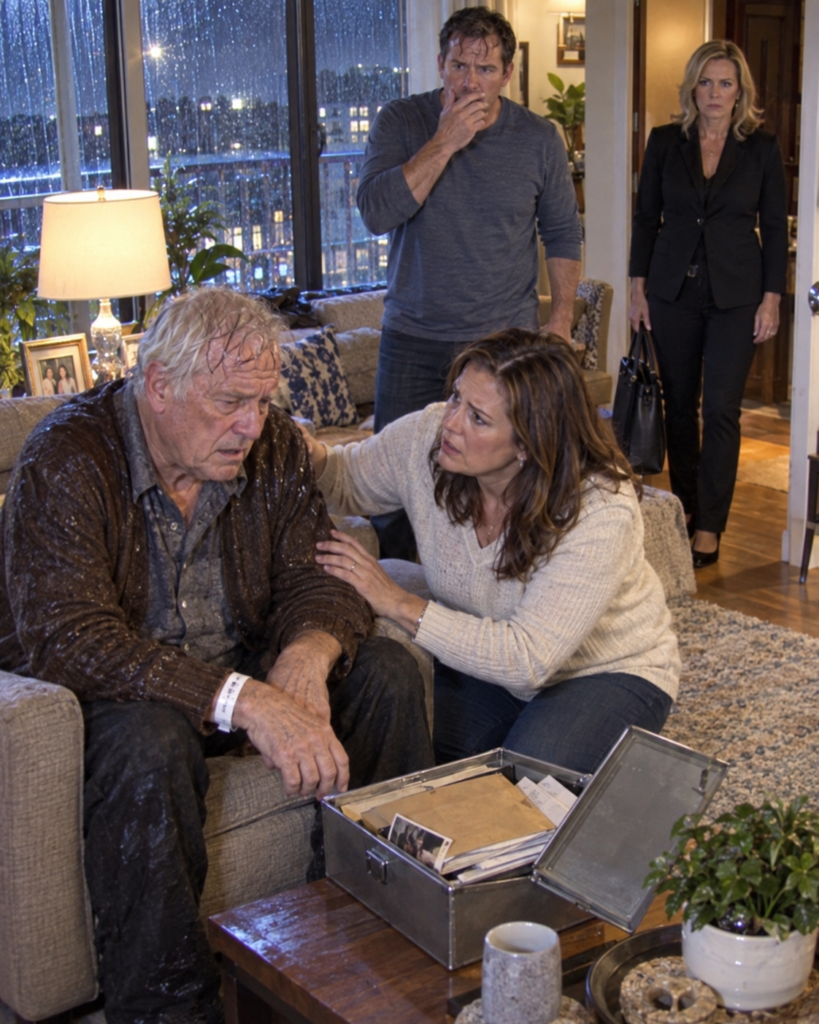
Three weak taps woke me over the sound of rain hammering my windows. When I opened the door, Grandpa nearly collapsed into my arms.
His coat was soaked. His lips were pale. Water streamed from his white hair and pooled around his shoes.
He looked past me into the apartment and whispered, “Sorry for coming so late.”
I pulled him inside and kept asking where my parents were.
He would not answer.
Then I noticed his wrist.
The silver watch he had worn every day since before I was born was gone. In its place was a thick plastic band with a QR code and a string of numbers.
No hospital name.
No emergency contact.
Just a number, locked around his skin.
When I touched it, he flinched.
Under his sleeve were fresh needle marks and bruises in different shades of purple and yellow.
“Did you go to the hospital?” I asked.
“No hospital.”
“Then who did this?”
He stared at the blanket I had wrapped around him.
“Your father signed papers,” he said. “Your mother said it was only until I stopped being difficult.”
The room went cold.
I called Dad. Voicemail.
I called Mom. Her phone was off.
When I returned to the guest room, Grandpa was sitting unnaturally straight, as though even now he was afraid someone might accuse him of taking up too much space.
He asked me what day it was. Then he checked the clock twice.
Finally, he caught my hand.
“Do not tell them I made it here yet.”
I sat beside him. “Tell me what happened.”
The story came in fragments.
For months, my parents had pressured him to sell the house where he had lived for forty-six years. Dad wanted control of his accounts. Mom wanted him somewhere “supervised.”
Grandpa refused.
He still watered the roses my grandmother had planted. He still spoke to her while he did it.
He was slower than he used to be. Sometimes he misplaced his glasses or repeated a story.
But he was not incapable.
Three days earlier, Dad told him they were going to a memory appointment.
Instead, they drove him to a locked private residence with beige walls, lavender air freshener, and employees who smiled without meeting his eyes.
A staff member removed his watch “for safekeeping.”
Another brought paper cups filled with pills he did not recognize.
Whenever Grandpa asked to leave, they changed the story.
They said he had wandered.
They said he had frightened my mother.
They said he was confused.
Then they told him he was lucky his children had found room for him at all.
“Did you sign anything?” I asked.
His face tightened with shame.
“One page. They said it would let me leave with family. The letters would not stay still.”
I scanned the bracelet.
It opened a resident intake page for Hearthside Transitional Memory Residence. There was no hospital system, no medical portal, and no listed physician.
At the bottom of the page, one polished sentence made my stomach turn:
Secured, structured support for residents experiencing behavioral resistance.
His refusal to surrender his home had been turned into a diagnosis.
I took screenshots.
Then I asked what had been in the paper cups.
Grandpa rubbed his bare wrist and whispered, “After that, time would go missing.”
At three in the morning, he began shivering again. I wanted to take him to the emergency room, but he gripped my sleeve with surprising strength.
“No more places with bracelets.”
So I stayed beside him. I warmed soup he could not eat and listened as he explained how he had escaped.
The storm had rattled the building. A young night employee left a side door latched but not locked.
“I think she felt sorry for me,” he said.
“How far did you walk?”
He gave a tired shrug. “Far enough.”
By morning, my fear had hardened into something colder.
I called the attorney who had handled my grandmother’s estate. Years earlier, she had warned me, “If anyone starts using the word capacity around your grandfather, call me before you call your relatives.”
She arrived before nine with a legal pad open.
She asked Grandpa his name, address, the year, my birthday, and who owned the house.
He answered everything except the exact date. He missed it by one day.
Then she examined the bracelet, the bruises, and my screenshots.
Her expression changed.
By noon, she had contacted Adult Protective Services, the state licensing office, and a doctor willing to examine him privately.
“Do not answer your parents,” she told me. “Write down every word he remembers. None of this sounds legal.”
My parents began calling at 1:17 p.m.
They did not ask whether Grandpa was safe.
They did not ask whether he was hurt.
Every message asked the same question:
“Is he with you?”
I stayed silent.
After sleeping almost eleven hours, Grandpa woke clearer. He drank tea, looked at the rain streaking the window, and told me about a folder.
The day before they took him, Dad had brought papers to the house and called them “backup paperwork.”
Grandpa refused to sign.
Then he hid the folder.
Mom discovered what he had done. They argued. The next morning, they drove him away.
“Where is it now?” I asked.
He slowly turned toward my coat closet.
On the highest shelf, behind two old board games and a broken lamp, I found a tin box.
Inside were bank statements, property records, printed emails about listing Grandpa’s house, and a drafted power-of-attorney update.
His silver watch was wrapped in a dish towel.
The bank statements showed repeated transfers from Grandpa’s savings into an account controlled by my father.
Large transfers.
On one sticky note, underlined twice in Grandpa’s shaking handwriting, were six words:
If anything happens, do not trust them.
A week later, my parents arrived together.
Mom had been crying. Dad looked like he had not slept.
Behind me, Grandpa sat upright in my armchair, wearing my cardigan and holding his cane across his knees.
His silver watch was back on his wrist.
The moment Dad saw it, his face drained of color.
Then he begged.
He called the facility a misunderstanding. He said they had been under pressure. He insisted they had made a terrible choice, but not the choice I thought.
Mom kept whispering, “Please let us explain before anyone else gets involved.”
Each time she said anyone else, her voice cracked.
Grandpa did not shout.
He asked me to bring him the tin box.
I placed it in his lap.
He opened it, removed the bank statements, and laid my father’s signature on the coffee table.
Mom stopped crying.
Dad stopped breathing.
Grandpa looked at his son and said, “Before I decide whether I still have a son, tell her what you did the day after you took my watch.”
Dad glanced toward the door.
Then the attorney stepped out of my kitchen, placed a sealed report beside the statements, and said, “Choose your next sentence very carefully.”
Type WATCH and I’ll continue.
Dad stared at the sealed report as if it had appeared from inside the wall.
Mom reached for his arm. He pulled away.
“We were protecting him,” she said.
The attorney did not sit down. “From whom?”
Grandpa tapped one finger against his cane. “Tell her about the bank.”
Dad’s mouth opened, but the attorney slid a photograph across the table first. It showed him inside a branch office the morning after Grandpa was admitted to Hearthside. Beside him stood a notary and a facility administrator.
The timestamp was 10:42 a.m.
Grandpa had been sedated at 10:15.
“That document gave you control of the house,” I said.
“It was temporary,” Dad snapped. “And he agreed.”
From the hallway, a woman’s voice answered, “No, he didn’t.”
The young night employee from Hearthside stepped into the room holding her phone.
Dad went white when she pressed play.
Type WATCH and I’ll post Part 3.