Part 1
The last ordinary thing I remember before my life split in half was the smell of scorched frosting from Sophie’s birthday cake. She had leaned too close while blowing out nine candles, and one flame licked the edge of the blue icing until I smothered it with a spoon.
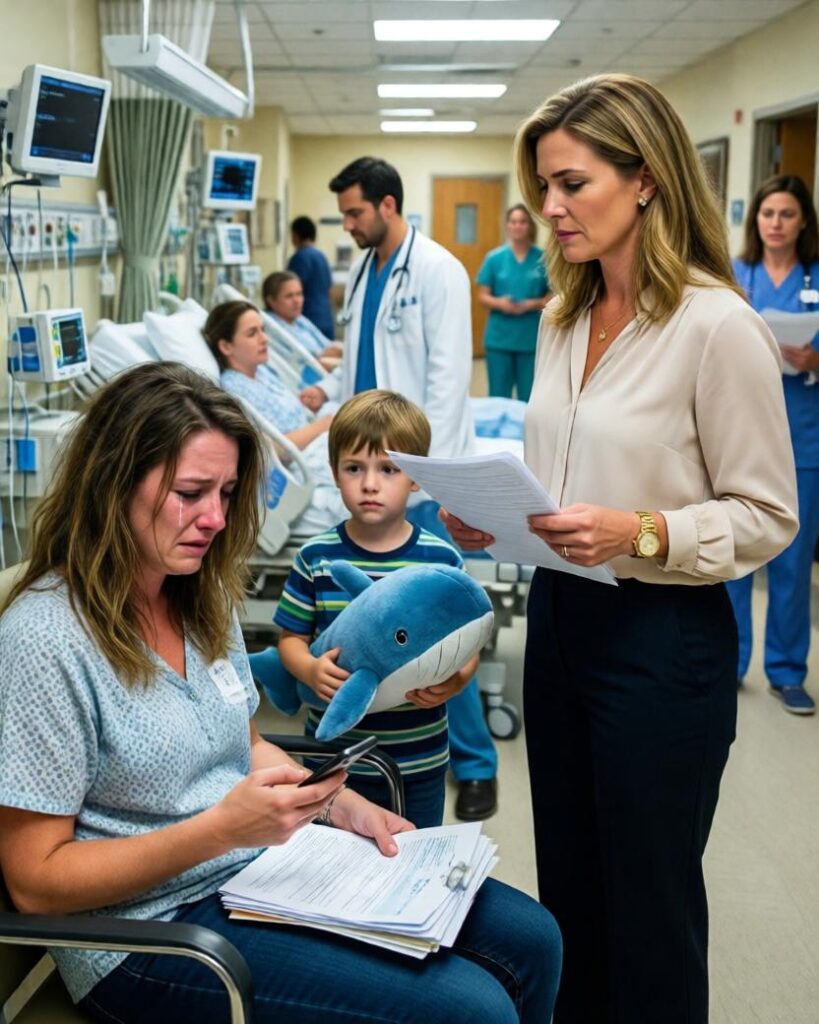
Sophie laughed so hard milk came out of her nose. Her younger brother Owen nearly fell off his chair. Our apartment was small enough that his elbow hit the refrigerator when he threw his hands up, but that night it felt warm and complete. Sophie wanted to study whales someday. Owen wanted to build robots that could clean oceans. I wanted rent paid on time and both my children home for dinner. My ambitions had become practical after their father, Ryan, left three years earlier.
Two days later, at 10:17 on a Tuesday morning, a police officer called while I was processing insurance claims at work. A pickup truck had run a light and struck the school transport van carrying both my children. Owen had bruised ribs and a cut above his eyebrow. Sophie had taken the impact on her side. By the time I reached Fairview Children’s Hospital, nobody would let me see her. A silver-haired nurse caught me by the shoulders and said, “They’re working on your daughter.” Those five words became the doorway into another life. Nine hours later, pediatric trauma surgeon Dr. Adrian Cole finally came out and told me Sophie was alive, but she had severe swelling around her brain, internal injuries, and no guarantee she would wake up normally—or at all.
Owen sat beside me holding Sophie’s stuffed blue whale, Finn, which a paramedic had found under a seat. My son had always been quiet, but people mistook quiet for innocence. Owen noticed everything. He knew when I paid the electric bill late. He knew which relatives only called when they wanted information. He knew I cried in the shower because that was the only room where I thought he could not hear me. When I called my older brother Daniel, he dropped his construction job and came straight to the hospital. When I called my sister Vanessa, she returned my message nearly an hour later and said, “Don’t worry, Rachel. I’ll handle everything.” I should have understood what those words meant. Vanessa never helped without eventually claiming ownership of whatever she touched.
By midnight, the ICU waiting room had filled with relatives, coffee cups, coats, whispered prayers, and quiet judgments. My mother, Margaret, arrived in a wheelchair because a stroke the year before had weakened her left side. She had been living with Vanessa ever since, something Vanessa mentioned whenever anyone praised her generosity. Vanessa herself arrived looking like she had stepped out of a magazine—cream blouse, perfect hair, gold watch, gardenia perfume. She hugged me where everyone could see and whispered, “My poor sister.” Daniel hugged me without saying anything at all. The difference between them felt small then. It would not stay small.
For three days, I barely slept. Sophie’s room glowed even at night from monitors and hallway lights. I learned the sound of every machine attached to her. I could tell when a pump needed attention before a nurse entered. I spoke to Sophie about beaches, whales, school gossip, anything that might give her a road home. Vanessa kept bringing expensive coffee and unsolicited advice. She questioned the doctors about “quality of life.” She asked what permanent disability might look like. When Dr. Cole explained that surgery might become necessary if the pressure inside Sophie’s skull kept rising, Vanessa frowned and said, “Sometimes keeping someone alive isn’t the same as saving them.” I turned toward her so sharply my chair scraped the floor. “She is nine,” I said. Vanessa replied, “Exactly. You need to think realistically.”
That evening my body finally betrayed me. Owen was coloring in the corner. Daniel had gone downstairs. Mom was in the chapel. I laid my head beside Sophie’s arm and told myself I would close my eyes for one minute. I woke without moving when I heard Vanessa speaking behind me. “Look at Rachel’s life,” she whispered to our aunt. “The overdue notices. That apartment. The cheap food. The divorce. She’s barely managing healthy children. If Sophie survives needing full-time care, what happens then?” Someone murmured that I had always done my best. Vanessa sighed. “Best intentions don’t create stability.” My heartbeat slowed instead of speeding up. Something inside me understood that if I moved, she would stop talking.
Then Vanessa stepped closer to Sophie’s bed and whispered the sentence I would remember for the rest of my life. “Maybe it’s better if she doesn’t survive. Rachel has always been a curse on everyone around her.” Nobody defended me. Someone shifted uncomfortably. Another relative stared at the floor. Vanessa continued as though she were discussing property taxes. She had contacted a family attorney named Charles Whitman. She had photographed overdue notices from my purse. She believed an old emergency guardianship form signed during my divorce might help her seek custody of Owen if I could be portrayed as unstable. Then she mentioned money. “Ryan left more than she knows,” she said. “If I become guardian, someone responsible can administer it.”
Ryan? Money? My ex-husband had barely stayed current on child support.
I heard my purse zipper open. Vanessa removed papers and quietly photographed them. “Judges like patterns,” she whispered.
Across the room, Owen had stopped coloring. His eyes were fixed on her. His old phone—the one I let him use for games—rested in his lap. His thumb moved once across the screen.
Minutes later, Dr. Cole entered and told me Sophie’s brain pressure had risen dangerously. “I recommend surgery tonight,” he said. Vanessa immediately stepped forward. “Rachel hasn’t slept. You should explain everything to me.” I sat upright and answered before he could. “No. Explain it to me.”
Vanessa argued that I was emotional, broke, exhausted, incapable of understanding the risks. I looked at Sophie’s chipped turquoise nail polish and said, “Do the surgery.”
“That decision could change Owen’s entire future,” Vanessa snapped.
That was when my son stood.
His coloring book slid from his knees and hit the floor. He walked to the foot of Sophie’s bed holding his cracked phone in both hands.
“Aunt Vanessa,” he asked quietly, “should I tell everyone what you did while Mom was asleep?”
Vanessa’s face went white.
And for the first time since the accident, I realized my daughter might not be the only person in that room fighting for her life.
### Part 2
Vanessa recovered quickly. She always had. “Sweetheart, you’re frightened,” she told Owen. “You misunderstood an adult conversation.” Owen looked at her with the flat expression he used when teachers assumed he had not been paying attention. “No, I didn’t.” Then he turned toward me. I wanted to protect him from whatever came next, but I also knew that interrupting him would teach the worst possible lesson—that adults could demand silence whenever children witnessed something ugly. So I nodded.
“You opened Mom’s purse,” Owen said. “You took pictures of her bills. Then you called Mr. Whitman near the soda machine and said you had proof Mom was unstable.” My aunt covered her mouth. Vanessa laughed, but the sound came out thin. Owen lifted the phone. “I recorded it because Mom saves things when people say something didn’t happen.”
He pressed play.
Vanessa’s voice filled the room. “Charles, she has no idea. I photographed the shutoff notice and bank statements. If the girl survives with serious problems, Rachel can’t manage the care. If she doesn’t, custody of Owen becomes easier.” My skin went cold. Then came the sentence that changed the entire shape of my past. “Ryan died more than a month ago. His lawyer has been trying to reach Rachel, but two notices came through my address. The insurance and settlement money are for the children. If I control guardianship, I control administration.”
I forgot to breathe.
Ryan was dead.
My former husband—the man I had spent years teaching myself not to wait for—had been dead for weeks, and my sister knew.
Owen played another recording. Vanessa was trying to persuade him that he could live with her, have a bigger bedroom, attend a private school, swim in her pool. Owen’s recorded voice asked, “What about Mom?” Vanessa answered, “She would understand eventually.” Then he asked about Sophie. Vanessa paused and said, “Sometimes God makes difficult decisions for us.” The recording ended with Owen asking, “If you love us, why did you say Sophie might be better dead?”
.
Nobody spoke afterward.
My mother finally broke the silence. “Vanessa,” she said. Her speech had been slower since the stroke, but anger made every syllable clear. “What have you done?”
Vanessa stopped pretending. “What someone had to do. Rachel lives paycheck to paycheck. Ryan finally created something useful for these children, and she would waste it.” I stood beside Sophie’s bed. “You hid their father’s death.” Vanessa replied, “He abandoned them.” “You intercepted legal notices.” “I protected the family.” “You built a custody case while my daughter was in a coma.” Her eyes hardened. “Someone had to think without emotion.”
I looked at Sophie lying beneath white gauze and tubing. “A poor mother isn’t a disaster,” I said. “A woman calculating inheritance beside a child’s hospital bed is.”
Then I asked security to remove my sister.
Vanessa exploded. She accused Owen of lying, me of manipulating everyone, Daniel of encouraging me. The louder she became, the clearer everything looked. She had spent years presenting herself as the competent one while turning my struggles into evidence that I deserved less. When two security officers escorted her toward the elevator, she shouted, “You’ll need me before this is over!”
“No,” I said. “I needed witnesses.”
Minutes later I signed Sophie’s surgical consent forms. Daniel read every page beside me. When they wheeled her away, Owen clutched Finn against his chest and asked, “Mom, did I do something bad?” I knelt and held his face. “You told the truth.” His eyes filled. “What happens now?” I looked at the closed operating-room doors. “Now we find out how much truth she was hiding.”
Sophie survived the surgery. Dr. Cole warned us that the next forty-eight hours remained dangerous, but the pressure inside her skull had improved. Relief lasted perhaps five minutes before I started making calls. I restricted Vanessa from receiving medical information. I gave the hospital a password. I contacted the police about the intercepted mail and Owen’s recordings. Then I called Ryan’s estate attorney.
His name was Nathan Pierce, and he arrived the next morning carrying three unopened envelopes. One was addressed to me. Two were for the children. He explained that Ryan had died six weeks earlier in a private aircraft accident while traveling for work. He had recently updated a life insurance policy and established a trust for Sophie and Owen. I was the trustee. Vanessa’s name appeared only on an outdated emergency guardianship document from our separation years earlier. “It does not override his will,” Nathan said. “And she had no authority to withhold these notices.”
He showed me a certified delivery receipt.
V. Mercer.
Vanessa’s married signature.
Then he handed me Ryan’s letter.
I opened it alone in the chapel. Ryan did not ask me to forgive him. He admitted he had left me carrying responsibilities that should have been shared. He wrote that my strength had never been permission for him to disappear. He said he had placed the children’s money under my control because “you were always the parent who stayed.” For Sophie he wrote, “Tell her the ocean will be lucky to have her.” For Owen: “Tell him quiet people can still be brave.”
.
I cried harder over that letter than I had cried over our divorce.
Before I could return upstairs, Daniel called from my apartment.
Someone had entered using a key.
My bedroom had been searched. The folder containing old custody records, tax returns, birth certificates, and Ryan’s temporary emergency authorization was missing.
Then the police reviewed my neighbor’s doorbell camera.
At 6:12 p.m., while Sophie was in surgery and Vanessa knew I would not leave the hospital, a woman in sunglasses unlocked my apartment door.
The detective froze the video.
Even beneath the scarf, I recognized my sister.
She had not started planning at the hospital.
She had simply believed the hospital was where she could finally finish.
### Part 3
Once I understood Vanessa had been planning before Sophie’s accident, I stopped thinking of her behavior as desperation. Desperation reacts. Vanessa had prepared. She had intercepted Ryan’s mail, investigated old custody documents, asked my landlord about emergency access, photographed my finances, and spoken to an attorney before I knew there was a battle. The hospital had only given her a crisis large enough to hide inside.
Detective Lena Brooks began examining Vanessa’s finances after my mother admitted Vanessa controlled most of her banking. What started as questions about mail and guardianship widened quickly. Mom had signed what she believed was limited authority to help pay bills after her stroke. The actual document gave Vanessa far broader control. Over eighteen months, money had moved from Mom’s savings into accounts connected to Vanessa’s consulting business. Some transfers were labeled “care expenses,” though Mom had paid for her own medical equipment. Others funded renovations that never happened. By the third day of the investigation, detectives had traced nearly ninety thousand dollars.
Mom sat beside me in a hospital consultation room staring at the bank statements. “She told me I was expensive,” she whispered. I took her hand. “Needing help did not give her permission to steal from you.” Mom began crying. For years Vanessa had made care feel like a debt everyone owed her. Suddenly we could see the system behind it: she created dependence, then charged people for the privilege.
Vanessa kept making herself easier to investigate. She texted me that courts would see how “emotional” I was. She emailed that she intended to petition for custody. She called Daniel and accused me of weaponizing Owen. When a new attorney arrived at the hospital carrying the old emergency authorization stolen from my apartment, Vanessa made the mistake of speaking before the lawyer could stop her. “I had a key,” she said when I asked how she obtained the papers. “I was protecting evidence before Rachel destroyed it.”
The attorney’s expression changed instantly.
I held up my phone. “Say that again.”
Vanessa saw the recording screen and stepped back.
“You always do this,” she hissed. “You turn failure into sympathy.”
“What failure?”
“Your whole life. The apartment. The coupons. The divorce. Everybody treats you like some brave struggling mother because you never managed to become anything.”
There it was at last—not concern, not responsibility, not love. Comparison.
“You never needed me to improve,” I said. “You needed me beneath you.”
Her face tightened.
She turned toward security and shouted, “Seth—Ryan—whatever saint she’s turned him into—knew she couldn’t handle those children!”
“Nathan has his will,” I replied. “Ryan chose me.”
“He chose you because he felt guilty!”
“Yes. Sometimes guilt tells the truth.”
Her attorney closed the folder. “Vanessa, we’re leaving.”
My sister stared at her, stunned. That was the first time I saw Vanessa understand that confidence could no longer substitute for evidence.
Hours later, Sophie began waking.
At first it was only movement in her fingers. Then tears slipped from beneath her closed eyelids when I spoke. Dr. Cole reduced the support helping her breathe, and by late afternoon she opened her eyes. They wandered across the room before finding me.
“Hi, Ocean Girl,” I whispered.
Her lips moved.
“Mom.”
One word destroyed every wall I had built around myself.
Owen came running to the bedside and stopped himself before touching any tubes. Sophie found him with her eyes. “I heard you,” she rasped.
Owen started crying. “I just told them what happened.”
“You stood up,” she whispered.
So did I.
While Sophie started the slow work of recovery, Detective Brooks discovered Vanessa had used similar tactics with two older real estate clients—people moving after deaths, illnesses, or major life changes. Both had previously complained about unexplained fees, but neither case had gone far because the clients felt confused and embarrassed. Vanessa had built her reputation around helping people during vulnerable transitions. Vulnerability had given her access.
She was eventually charged with financial exploitation involving Mom, fraud connected to those accounts, unlawful entry into my apartment, and interference related to Ryan’s estate documents. Her firm suspended her, then terminated her. Her husband moved out. Some relatives still tried to excuse her. “She was under enormous pressure,” one aunt told me.
“She said my daughter might be better dead because it improved her custody case,” I answered.
That ended most conversations.
Sophie spent weeks relearning things nobody should have to think about—balance, stairs, throwing a ball, walking without staring at her feet. She hated therapy. She hated needing help even more. One afternoon she cried in my car after struggling through an exercise.
“What if I never run normally again?”
I wanted to promise her everything.
Instead I said, “Then we learn what normal means now.”
She glared at me because truth is not always comforting.
Then she took my hand.
Owen needed help too. He checked locks repeatedly and kept his phone charged at all times. His counselor explained that he had learned to associate attention with safety. So I bought him a cheap instant camera and told him we were going to document better things.
Our kitchen wall slowly filled with photographs.
Sophie taking ten steps without support.
Mom holding the key to her new senior apartment after moving out of Vanessa’s house.
Daniel asleep on our couch with a screwdriver in his hand.
Owen burning toast.
Me laughing before I realized he had taken the picture.
“What’s this evidence of?” I asked.
He shrugged.
“That we’re still here.”
Months later, the children’s trust was formally placed under my supervision with court oversight. Using approved funds, I bought a modest one-story house where Sophie could move around safely. Three bedrooms. A small yard. No luxury. No spare keys floating through somebody else’s purse.
On our first night there, rain tapped against the windows while boxes surrounded us.
For the first time since the accident, I did not listen for approaching disaster.
Then my phone lit up with a court notification.
Vanessa had agreed to enter a plea.
### Part 4
The courtroom was quieter than television had taught me to expect. Nobody screamed. Nobody pounded tables. Consequences came through case numbers, financial records, signed statements, and a judge reading carefully from a file. Vanessa sat at the defense table wearing a plain black suit. Her hair was perfect, but perfection looked different once nobody trusted it.
Mom sat on my left. Daniel sat on my right. I left Sophie and Owen home with a neighbor because they had already survived enough of the battle. Sophie protested. Owen said nothing, which meant he wanted to come even more. I told them, “Surviving something does not mean you have to watch every consequence.”
Vanessa accepted responsibility for reduced charges involving financial exploitation, fraud, unlawful entry, and interference with family and estate matters. She faced restitution, strict supervision, professional penalties, and civil claims from other victims. Her real estate license was gone. The money she had taken from Mom would have to be repaid. The prosecutor explained that cooperation had prevented a harsher outcome.
I did not care whether strangers believed the punishment was severe enough.
I cared that the record was permanent.
When the judge invited statements, Mom stood with Daniel supporting her weaker arm. “I believed needing help meant giving away control,” she said. “My daughter taught me the difference. Help should leave someone with more dignity, not less. Vanessa, I still love you because I am your mother. But love is not permission. You took my money and my confidence. I am taking back what I can.”
Vanessa lowered her head.
Then it was my turn.
I carried a page to the front but barely looked at it.
“My daughter was unconscious when my sister decided her possible death might make taking my children easier,” I said. “My son was eight when he realized adults were discussing who would control him. My mother was recovering from a stroke when assistance became financial access. My former husband died before his children knew, because notices about his death were treated like leverage.”
Vanessa shifted in her chair.
I kept my eyes on the judge.
“I am not here asking anyone to hate her. Hate requires time, and I have better uses for mine. I have school lunches, physical therapy, trust reports, homework, bills, and a nine-year-old who still plans to study whales.”
A few people smiled faintly.
“What I want preserved is something simpler. Poverty is not neglect. Exhaustion is not incompetence. Living in a small apartment is not evidence that someone loves their children less. And being family does not grant unlimited access to another person’s life.”
I paused.
“My sister believed quiet people were easy to erase. She was wrong because my quiet son listened. Then he spoke.”
When court ended, Vanessa approached me in the aisle.
For one second she did not look like the woman from the ICU. She looked like my older sister from twenty years earlier—the girl who braided my hair before school and split candy with me when Mom could not afford snacks.
“Rachel,” she said.
I stopped.
Her eyes filled.
“I’m sorry.”
I believed she regretted losing everything.
I did not know whether she regretted what she had done.
Either way, it was no longer my responsibility to decide.
“I hope someday you understand why those words aren’t enough,” I said.
She swallowed. “Could we ever—”
“No.”
The word came easily.
Not angrily.
Cleanly.
“You wanted my daughter’s death to make your plan easier. You tried to take my children while I was sleeping beside her hospital bed. I can move forward without spending my life punishing you, but I will never give you access to us again.”
She stared at me.
I walked away.
That spring, Sophie returned to school full-time. Her hair grew unevenly over the surgical scar, and a faint limp appeared when she was exhausted. At her first soccer practice, the coach suggested she help arrange cones instead of playing. Sophie listened politely, then stepped onto the grass anyway. When the ball rolled toward her, she missed the first kick badly enough to send it sideways.
Her face burned red.
Owen tensed beside me.
“Wait,” I whispered.
Sophie chased the ball.
Her second kick was better.
Her third went straight.
The applause that followed was small, but Sophie looked toward me as if the whole stadium had risen.
A few weeks later, Owen’s class held a presentation called “My Hero.” Children talked about athletes, firefighters, grandparents, and comic-book characters. Owen walked to the front wearing a shirt one size too big.
“My heroes are my mom and my sister,” he began.
Sophie grabbed my hand.
“My mom reads papers before she signs them,” Owen continued. “She keeps receipts. She says loud people aren’t automatically right. My sister had to learn things again that everybody else thinks are easy. She got mad and cried, but she kept doing them.”
Then he stopped and looked directly at me.
“And heroes tell the truth when everyone is scared of what happens after. Your voice can shake. It still counts.”
His teacher wiped her eyes.
That night, Sophie asked me something I had been expecting for months.
“Did Aunt Vanessa love us?”
We were sitting on her bed beneath the blue glow of a whale-shaped night-light. Owen lingered in the doorway pretending to search for a charger.
“I think she loved being needed,” I said. “And I think she loved control. Sometimes people let those things grow so large that they start calling them love.”
Sophie rubbed Finn’s repaired fin between her fingers. “Do we forgive her?”
“You can decide what forgiveness means when you are older,” I said. “But forgiveness never means giving someone another chance to hurt you.”
Owen leaned against the doorway.
“So she’s not coming back?”
“No.”
He nodded, satisfied.
Later I sat alone on our porch. The yard smelled like damp soil. Somewhere down the street, a dog barked. Through the window I could hear the refrigerator humming and Sophie laughing because Owen had apparently said something ridiculous after lights-out.
I thought about Vanessa whispering beside that hospital bed, certain I was too tired and too poor to fight back. I thought about relatives staring at the floor. Ryan’s letter. Mom’s trembling hands. Daniel arriving with tools instead of promises. Sophie opening her eyes.
Most of all, I thought about an eight-year-old boy standing beneath fluorescent ICU lights with a cracked phone in his hands.
Vanessa had spent years making me believe survival meant enduring whatever people did and continuing quietly.
She was wrong about that too.
Survival was not silence.
Sometimes survival was paperwork.
Sometimes it was evidence.
Sometimes it was changing the locks.
And sometimes it was a child asking one simple question in a room full of adults who had forgotten how to be brave:
“Should I tell everyone what you did?”
He did.
And none of us ever belonged to Vanessa again.
THE END!