“Save it. Maybe someday you can buy your own house. Nothing comes for free.”
They said it in the living room of the house whose mortgage, utilities, insurance, and property taxes I had quietly been paying for almost two years.
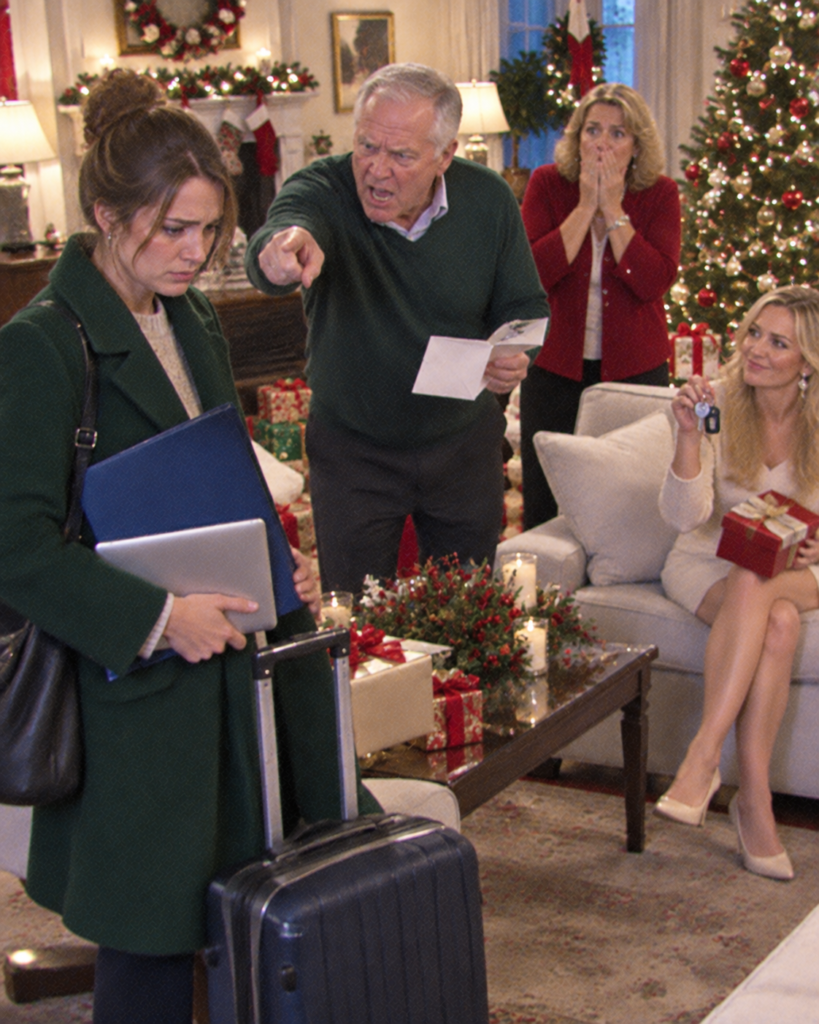
And they had no idea what I was about to stop paying.
Megan sat beside the Christmas tree shaking a tiny gift box until a silver key fell into her palm.
Mom actually squealed.
“Three bedrooms,” she said. “Fenced yard. Fifteen minutes from your office.”
Megan covered her mouth. “You bought me a house?”
Dad grinned. “Closed last week. Consider it your real start in life.”
I stared at the key while calculating numbers automatically, because numbers were what I did whenever emotion threatened to overwhelm me.
$1,620 mortgage.
$340 property taxes and insurance.
Electricity. Gas. Water. Internet.
Groceries whenever Mom’s card was declined.
For twenty-two months, those numbers had come out of my checking account.
Dad’s hours had been cut. Mom’s insurance costs had jumped. They told relatives I was “living at home to save money.”
The truth was the opposite.
I was working two jobs and attending accounting classes at night because without my income, their house didn’t work on paper.
Then Dad reached under the tree again.
“For Emily.”
My envelope was thin.
Inside was one fifty-dollar bill.
Dad leaned back, pleased with himself. “You’re twenty-seven now. Megan needed help getting started. You’re older. Time to stand on your own two feet.”
Mom nodded like he had delivered wisdom instead of an insult.
“Save up and buy your own house,” Dad added. “Nothing comes for free.”
Megan looked uncomfortable for approximately three seconds.
Then she jingled her new keys.
“Can you believe I have a breakfast island?”
I didn’t cry.
I folded the fifty-dollar bill and put it back inside the envelope.
“You’re right,” I said.
Dad smiled, apparently believing I had accepted the lesson.
“Glad you understand.”
I walked to my bedroom.
Ten minutes later, I returned with my suitcase, laptop bag, coat, and the blue accordion folder I kept locked in my desk.
Mom’s smile disappeared.
“Where are you going?”
“To stand on my own two feet.”
Dad gave an irritated laugh. “Emily, don’t be dramatic.”
“I’m not.”
Megan stared at my suitcase. “You’re leaving on Christmas?”
“I’m leaving tonight.”
Mom followed me toward the door. “Over a present?”
That stopped me.
I turned around.
“No. Over what the present explained.”
Dad’s face hardened. “We don’t owe you a house.”
“I never said you did.”
“Then what exactly is this performance?”
I looked around the room—the tree lights, the new television, the thermostat set to seventy-two, the chandelier burning over the dining table.
Everything running.
Everything paid.
“For almost two years,” I said, “I thought helping this family meant something.”
Dad pointed toward the door. “If you’re going to hold money over our heads, maybe leaving is best.”
That was the moment he overplayed his hand.
I nodded once.
“Okay.”
Mom blinked. “Okay?”
I opened my laptop on the entryway table.
Dad scoffed. “What are you doing now?”
“Taking my name off the things I won’t be using anymore.”
His expression changed slightly.
I logged into the household account I had created when Dad’s hours were reduced. Mortgage transfer. Electric. Gas. Water. Internet. Home insurance escrow contribution. The emergency credit card used for groceries and repairs.
One by one, I canceled my automatic payments.
Mom moved closer.
“Emily… what automatic payments?”
I looked at her.
The room became very quiet.
Dad answered before I could.
“She means her rent. Stop making this into something.”
I closed the laptop.
“Then you won’t notice I’m gone.”
I picked up my suitcase and walked out.
I stayed that night with my friend Rachel. By morning I had found a furnished studio apartment available immediately. It was small enough that I could touch the kitchen counter from my sofa.
It was also mine.
For the first time in years, I paid one person’s expenses instead of three adults’ expenses.
Christmas Day passed with four calls from Mom.
I ignored them.
December 26 brought nine.
December 27 brought fourteen.
Then the mortgage transfer failed.
My phone lit up while I was unpacking dishes.
DAD.
DAD.
MOM.
DAD.
MEGAN.
MOM.
A voicemail appeared.
“Emily, call me immediately. There’s some problem with the mortgage account.”
Another arrived three minutes later.
“Why did you cancel the electric payment?”
Then another.
“Your mother says the insurance draft didn’t clear. Fix this.”
I sat on the floor of my studio and opened the blue accordion folder.
Inside were twenty-two months of bank statements, payment confirmations, repair invoices, tax receipts, and screenshots showing exactly whose paycheck had kept their household functioning.
There was also one document they had never seen.
Three months earlier, while organizing Dad’s financial paperwork, I had discovered how they really paid for Megan’s “free” house.
They hadn’t simply used their savings.
They had borrowed against the house I had been keeping afloat.
And the first payment on that new debt was due in eleven days.
By New Year’s Eve, my missed-call counter had passed 100.
By the second week of January, it was 502.
Then Dad left a voicemail that made me stop cold.
“We’re having a family meeting tonight. Megan is here. Your mother is here. You need to come explain what you’ve done.”
So I went.
Not to apologize.
I walked into the living room carrying the same blue folder.
Dad was standing beside the dining table with a bank representative on speakerphone.
He looked furious until I placed one document in front of him.
Then he read the first page.
His face drained of color.
The bank representative said, “Mr. Carter, I need to make sure you understand what happens if that payment isn’t made.”
Dad slowly looked up at me.
And for the first time, nobody in that room was looking at Megan’s new house keys.
They were looking at my folder.
Type BILLS and I’ll continue.
Dad grabbed the document again. “This can’t be right.”
The bank representative’s voice came through the speaker. “The home-equity loan is secured by your current residence. The next payment remains your responsibility regardless of who previously covered household expenses.”
Mom turned toward him. “Home-equity loan?”
Megan stopped spinning her new house key around her finger.
Dad muted the phone. “Emily was paying part of the bills. That doesn’t mean she gets to destroy this family.”
I opened the folder and slid twenty-two bank statements across the table.
“Part?”
Mom picked up the first page. Then the second. Her hands began shaking.
Mortgage. Insurance. Utilities. Taxes. Repairs.
Every payment ended with the same account number.
Mine.
Then Megan noticed another sheet beneath them—the closing statement from her house.
Her smile vanished.
“Dad,” she whispered, “why is your house listed as collateral?”
He reached for the paper.
I put my hand over it first.
Because that wasn’t the worst page in the folder.
Type BILLS and I’ll post Part 3.
Chapter 3 — They Gave My Sister a House—Then My Folder Exposed Who Paid Everything
Dad’s expression shifted.
That was the first moment I realized she truly hadn’t known.
She had accepted the house without asking many questions, but she genuinely believed our parents had purchased it from savings.
Mom apparently believed the same thing.
Dad had managed that part alone.
He rubbed his forehead.
“It’s called using equity intelligently.”
“How much?” Mom asked.
He didn’t answer.
I did.
“One hundred forty thousand dollars.”
Mom gripped the back of a chair.
Megan went completely still.
Dad glared at me.
“You had no right to dig through my private finances.”
“You asked me to organize your tax documents in October.
The loan statement was in the folder you handed me.”
His face reddened.
The truth was painfully simple.
My parents had not purchased Megan’s house outright.
They had used their savings for part of the purchase and taken a home-equity loan against their own residence to cover the rest.
That might have been manageable if they had enough monthly income.
They didn’t.
Their budget only worked because someone else had been covering the mortgage, utilities, taxes, insurance, groceries, and repairs on their current house.
Me.
Dad had apparently assumed that arrangement would continue indefinitely.
Megan stared at him.
“You used this house to buy mine?”
“To help you,” he snapped.
“You told me it was paid for.”
“It is paid for.
Your property doesn’t have the loan.
Ours does.”
Mom closed her eyes.
“How much is the payment?”
I answered again.
“Just over $1,300 a month.”
That was in addition to the original mortgage.
Mom sat down hard.
For the first time, Dad seemed less angry than cornered.
He unmuted the phone.
“What happens if the payment is late?” he asked.
The bank representative explained that there was a grace period, late fees, and eventually more serious consequences if the loan remained unpaid.
Nothing catastrophic would happen overnight, but the debt was secured by their home.
There would be no magical exception because the money had been used to buy a Christmas present.
Dad thanked him abruptly and ended the call.
Then he turned toward me.
“So what do you want?”
I blinked.
“What?”
“You came here with a folder.
You clearly planned this whole performance.
What do you want from us?”
That question told me he still did not understand.
“I didn’t plan anything,” I said.
“You called me 502 times.”
Mom lowered her eyes.
Dad continued as if I hadn’t spoken.
“Do you want us to apologize for Megan’s house? Fine.
We’re sorry your feelings were hurt.”
Megan winced.
I stared at him.
“My feelings aren’t your financial problem.”
“Then why are you here?”
“Because your voicemail said I needed to come explain what I’d done.
I came to explain it.”
I closed the folder halfway.
“I moved out.
I canceled payments coming from my bank account.
That’s what I did.”
Dad laughed without humor.
“And you expect us to suddenly cover everything?”
“Yes.”
The single word landed harder than anything else I could have said.
Mom whispered my name.
“Emily, we can’t handle all of it immediately.”
I looked at her, and my anger softened slightly.
Mom had participated in the favoritism.
She had hugged Megan while I sat holding fifty dollars.
She had never once asked how I was managing two jobs and school.
But looking at her now, I could see she had also allowed Dad to manage the finances because she trusted him.
That trust had cost her.
“I’m not asking you to handle it immediately for me,” I said.
“I’m telling you I’m not handling it anymore.”
Dad struck the table with his palm.
“Family helps family.”
Megan flinched.
I reached into my coat pocket and placed the Christmas envelope on the table.
The fifty-dollar bill was still inside.
“You were right about something,” I said.
“Nothing comes for free.”
His eyes dropped to the envelope.
For once, he had no answer.
Megan broke the silence.
“Can my house be sold?”
Dad whipped around.
“No.”
She looked at him steadily.
“If you borrowed against your house to buy mine, maybe we should sell mine and pay the loan back.”
“Megan, stop.”
“I’m serious.”
“It was a gift.”
“A gift you apparently can’t afford.”
That was the first time in my life I heard my sister directly challenge our father.
His expression hardened.
“You don’t understand finances.”
She glanced at me.
“Apparently neither did I.”
I expected some satisfaction from seeing the golden child finally recognize what had happened.
Instead I felt tired.
Megan had benefited from our parents’ favoritism, but Dad had also encouraged her to believe resources appeared because he loved her more, not because somebody else absorbed the cost.
She looked at me.
“Did you know they were buying it?”
“No.”
“Did you know about the loan?”
“I found the paperwork three months ago.
I knew money had been borrowed.
I didn’t know until Christmas that it was being used for your house.”
Her face changed.
“So you knew they were taking on another payment while you were already paying everything here.”
“Yes.”
“Why didn’t you say anything?”
Because I had spent years avoiding the accusation Dad had thrown at me anyway: dramatic, selfish, ungrateful.
Because every time I questioned family finances, he reminded me that it was his house.
Because I kept thinking adulthood meant enduring discomfort without making anyone else uncomfortable.
“I thought it wasn’t my decision,” I said.
“The loan is in their names.
The house is theirs.
I figured adults were allowed to make their own financial choices.”
Dad seized on that.
“Exactly.”
I looked at him.
“And I’m allowed to make mine.”
Silence again.
This one felt different.
Not humiliating.
Final.
Over the next week, things moved quickly.
Dad tried several strategies.
First came anger.
He sent messages telling me I was abandoning my family.
Then came guilt.
Mom called crying because she didn’t know which bills were due when.
I emailed her a clean schedule with account names, due dates, and customer-service numbers.
I did not send money.
Then came bargaining.
Dad offered to let me return home without “rent” for six months if I restarted the mortgage transfer.
I reminded him that I had never been paying rent.
I had been paying the mortgage itself.
He stopped using that argument.
Meanwhile, Megan made a decision nobody expected.
She contacted a real-estate agent.
The market had moved enough that selling immediately would involve costs and likely a modest loss, but she refused to pretend the situation was sustainable.
Dad fought her viciously over it.
“You’ll never own another place this nice,” he told her.
“Then I’ll rent,” she said.
“You’re throwing away what we gave you.”
“No,” she replied.
“I’m refusing to let you lose your house to protect mine.”
Mom sided with her.
That changed everything.
For years, Dad had controlled family decisions because nobody challenged his certainty.
Once two people did, he suddenly sounded less like an authority and more like a frightened man defending a terrible calculation.
Megan’s house went on the market three weeks later.
It sold after six weeks.
After closing costs and a small loss, most of the home-equity balance could be repaid.
My parents still had several thousand dollars left to cover, but the $1,300 monthly obligation disappeared.
They were not rescued entirely.
They had to confront the original household budget too.
Dad picked up additional shifts.
Mom reduced several expenses.
They canceled subscriptions, downgraded the cable package, sold Dad’s second car, and refinanced one smaller debt.
Most importantly, they began paying their own mortgage again.
It was difficult.
It was also possible.
The world did not collapse when my checking account stopped supporting it.
My own life changed more quietly.
My studio apartment had thin walls, an unreliable dishwasher, and exactly one narrow closet.
I loved it.
The first month after leaving, I opened my banking app on payday and stared at the balance.
For years, money had arrived and vanished almost immediately into somebody else’s obligations.
Now I paid my rent, utilities, tuition, groceries, and transportation and still had money left.
I created an emergency fund.
Then a separate savings account.
I labeled it DOWN PAYMENT.
Not because my father had told me to save for a house.
Because for the first time, saving for one was actually possible.
Megan and I started speaking differently too.
Our relationship had always been shaped by comparison.
She was the easy child.
I was the responsible one.
She received help.
I handled consequences.
Once the house was gone, she admitted something I had never expected.
“I thought you didn’t need anything,” she told me over coffee one afternoon.
I frowned.
“Why?”
“Because Mom and Dad always said you were good with money.
Independent.
They said helping you would almost be insulting because you liked doing things yourself.”
I laughed softly.
“That’s convenient.”
“I know.”
She looked embarrassed.
“I should have questioned it.”
“Yes,” I said.
I didn’t tell her it was fine.
It hadn’t been.
But I also didn’t need her to spend the rest of her life apologizing.
What I needed was a relationship where the truth could exist without being softened for someone else’s comfort.
Months later, Mom asked me to come for dinner.
I almost declined, but she said Dad wanted to speak to me.
When I arrived, the house looked different.
The giant television was gone.
So were several expensive decorations Mom used to buy whenever she felt stressed.
The thermostat was set lower than I remembered.
Dad was already seated at the dining table.
The blue folder was beside him.
I hadn’t noticed it missing after the January meeting.
Apparently Mom had kept it.
Dad tapped the cover once.
“I went through all of this.”
I waited.
He looked older than he had at Christmas.
Not defeated.
Just less certain.
“I didn’t realize how much you were covering,” he said.
I could have reminded him that he had chosen not to realize.
Instead, I let him continue.
“I told myself you were contributing because you lived here.
Then when things got tight, I started assuming the payments would keep happening.”
Mom sat quietly beside him.
Dad looked down.
“When we decided to help Megan, I thought I was giving one daughter something she couldn’t get herself.
I told myself you didn’t need the same help.”
“And the fifty dollars?” I asked.
His face tightened.
“That was cruel.”
It was the first clean apology I had received from him.
No explanation attached.
No statement about my sensitivity.
No reminder that parents make mistakes.
Just the truth.
“Yes,” I said.
“It was.”
He nodded.
“I’m sorry.”
I accepted the apology.
I did not restart the payments.
Those were two separate things.
By autumn, I had finished my accounting degree and accepted a better-paying position with a regional firm.
My savings account grew steadily.
One afternoon, almost ten months after that Christmas, I sat across from a mortgage adviser discussing what I could realistically afford.
Nothing extravagant.
A small two-bedroom townhouse on the edge of Columbus, if I waited another year and kept saving.
I walked out of the appointment holding a folder of estimates.
Folders had become strangely important in my life.
That evening, Megan texted me a picture of her new apartment.
She had bought a secondhand dining table and was absurdly proud of assembling it herself.
Mom called to tell me she and Dad had finally built a three-month emergency fund.
Nobody asked me for money.
That mattered more than any dramatic revenge could have.
At home, I opened the drawer where I kept important documents.
The Christmas envelope was still there.
I had never spent the fifty dollars.
For months, I thought I kept it because I was angry.
Eventually I understood it differently.
It was a receipt from the night my family accidentally gave me something more valuable than a house key.
They showed me the difference between being dependable and being used.
Between helping someone and financing choices I was never allowed to question.
Between love and unlimited access to my labor.
I placed the envelope beside my growing down-payment statements and closed the drawer.
My father had told me nothing came for free.
He had meant it as a lesson for me.
In the end, all four of us had to learn it.